ISSN Online: 2151-4771 ISSN Print: 2151-4755
DOI: 10.4236/ce.2019.103038 Mar. 6, 2019 524 Creative Education
Big Data—Building Software: Some Thoughts
on the Future of Building Sciences
Winifred Elysse Newman
Department of Architecture, Clemson University, Clemson, SC, USA
Abstract
Building and sustaining our communities is the most significant challenge of our day. This means seeing and understanding the interrelatedness of econ-omies, technologies, physical and natural systems. One way of achieving this objective is visualizing our options using big-data decision spaces where unique systems are represented by dynamic flows of data create patterns, re-lationships and context. As seminal computer scientist Jim Gray articulated in 2003, “big data describes on the one hand extremely large data sets that through analysis generate patterns and associations; on the other hand, it can be understood to encompass all potential data generated by any dynamic process, in short life on Earth as we know it”. This kind of ecological “data li-teracy” let us see beyond a mechanistic view of the phenomenal world in which the imagined universe is a machine composed of elementary building blocks, to a system view where the dominant model of the material world is a network of systems with interrelated and interdependent patterns of beha-vior. Adopting the systems’ approach the challenge in designing resilient buildings is: 1) educating architects and engineers capable of using multiple and varied data to create multipart decision spaces, 2) assessing the impact visualizing data will have on all aspects of the building design, construction and fabrication process and 3) making increasingly large data-sets available to the AEC professionals and researchers to asses building performance and its impact on our design, delivery and maintenance of the built environment available.
Keywords
Big-Data, Systems, Architecture, Engineering, Building Design
1. Introduction
In January of 2007 pioneering computer scientist Jim Gray gave one of his last How to cite this paper: Newman, W. E.
(2019). Big Data—Building Software: Some Thoughts on the Future of Building Sci- ences. Creative Education, 10, 524-534. https://doi.org/10.4236/ce.2019.103038
Received: February 11, 2019 Accepted: March 3, 2019 Published: March 6, 2019
Copyright © 2019 by author(s) and Scientific Research Publishing Inc. This work is licensed under the Creative Commons Attribution-NonCommercial International License (CC BY-NC 4.0).
http://creativecommons.org/licenses/by-nc/4.0/
DOI: 10.4236/ce.2019.103038 525 Creative Education talks to the Computer Science and Telecommunications Board where he out-lined a vision of a “fourth paradigm” in scientific research. The fourth paradigm according to Gray is a methodological approach to discovery based on da-ta-intensive science beyond experimental and theoretical research and computer simulations of natural phenomena. This isn’t new per se as increasingly complex and larger amounts of data can arguably be considered part of the drive to empi-ricism in the 19th and the early 20th century science. What is new and as yet un-clear—how the new paradigm will change fundamental modes of knowing and acting in the sciences and technology in the 21st century? The transition from material or phenomena-based research to systems research is relatively new in relation to the amount of data, so called big-data, available through the Inter-net-of-Things, supercomputing, and the like. This paper looks at the fourth pa-radigm and its relationship to e-science, potential modes of knowing and their bearing on architecture, engineering and construction, and the AEC of building sciences. We discuss the nature of transition from mechanical to systems science, the definitions of e-science and computational thinking and the potential impact this will have on the way to manage big data in the building sciences.
2. System Science
One of the fundamental conditions of the present is a growing interconnected-ness and interdependence of data. Big-data describes on the one hand extremely large data sets that through analysis generate patterns and associations; on the other it can be understood to encompass all potential data generated by any dy-namic process, in short life on Earth, as we know it (Hey, 2009). This means a shift in scientific methodology where the dynamic flow of data creating patterns, relationships and context is the lens through which we study a given phenome-non, not an initial hypothesis based on inductive or deductive reason. The data is the starting point, not the substantiation of a theory. This kind of ecological literacy let us see beyond the mechanistic view in science where the universe was a machine composed of elementary building blocks. Let’s take a moment to compare the systems approach in the sciences to the mechanistic view.
DOI: 10.4236/ce.2019.103038 526 Creative Education linearity inherent in this analysis, science had to change and in Kuhnian terms, a paradigm shift is visible by the mid-20th century (Bush, 1945). To fill the lacunae of theories capable of addressing some of the problems posed by modern tech-nology and instrumentation, science moved away from the teleology of the me-chanistic model to an analytical science of systems where generating simulations and models to observe interactions between complex behaviors, predict out-comes, and generate alternatives is the norm.
Systems theory formally emerged with the publication of Ludwig Bertalanffy’s
General System Theory (1928) but arguably noted earlier in Leibniz and the
monadology, Nicholas of Cusa’s coincidence of opposites, and Hegel’s dialectical view of history. The history isn’t as important here as the terms of the new para-digm. Mechanistic analytical procedure means entities under examination can be assembled and re-assembled from their parts and the part to whole relation will bear the condition of summativity where equations describing the behavior of the total are of the same form. As Bertalanffy notes, these conditions cannot be met in systems consisting of parts in interaction where the prototype of their description is a set of simultaneous nonlinear differential equations in the gener-al case (EIA). Systems, in contrast, are “organized complexity” (Von Bertalanffy,
1968). The problem for systems theory is to address relations between parts and
wholes “in interaction”; meaning they are nonlinear or inherently dynamic, oc-cur in time (metabolic processes, growth a decay), are open or closed (develop-mental processes), and rely on the calculus. Graph-, compartment-, set- and net-theory are subsets of systems theory requiring specialized mathematics to describe structural, topological or quantitative relations. Cybernetics is techni-cally a subset of systems theory dealing with the control of mechanisms in tech-nology and nature and founded on the concepts of information and feedback
(Von Bertalanffy, 1968).
3.
e-
Science and the Fourth Paradigm
In this next section we turn to the relation between e-science and big data gen-erated when computing meets systems theory. Jim Grey argues the fourth para-digm follows on the experimental, theoretical and more recent computational science. It is the overwhelming amount of observational and computationally generated data requiring new ways to manage how we analyze, visualize and store data, including data generated in the process of analyzing other data. This is relatively new and emerges along with ubiquitous computing available from the 1970s onward making models of increasing robustness and complexity possible in systems theory. Once established there is intensifying reliance on processed data: data captured by instruments and processed by software, stored in computers and managed by statistics, or metadata or both. The new paradigm shift parallels the development of e-science where “IT meets scientists” (Hey,
2009). The exemplar case is cybernetics. Three fundamental contributions
DOI: 10.4236/ce.2019.103038 527 Creative Education
Theory (1947). Wiener’s Cybernetics and the others lead to developments of
computer technology, information theory, and self-regulating machines. Wiener in particular carried the cybernetic, feedback and information concepts far beyond the fields of technology and generalized it in the biological (EIA). Con-current to the emergence of systems theory and cybernetics engineer and inven-tor Vannevar Bush remarked,
“There is a growing mountain of research. But there is increased evidence that we are being bogged down today as specialization extends. The investigator is staggered by the findings and conclusions of thousands of other workers—con-
clusions which hecannot find timeto grasp, much less to remember, as they
appear. Yet specialization becomes increasingly necessary for progress, and the
effort to bridge between disciplines is correspondingly superficial” (Italics by Author) (Bush, 1945).
Bush tried to imagine the next computation machine to manage the data needed to feed the systems analysis—reminding his reader that “such machines will have enormous appetites. One of them will take instructions and data from a whole roomful of girls armed with simple keyboard punches and will deliver sheets of computed results every few minutes. There will always be plenty of things to compute in the detailed affairs of millions of people doing complicated things”. References to the human and very female “computers” of his time aside, Bush could only imagine the later generations of machines doing computations
faster—meaning improvements were improvements of degree, not type. The
truth is more startling: in the research world today data itself is the phenomena, not a phenomenal subject: the constant stream of dynamic information captured by instruments or generated by simulations, processed and stored in the comput-er’s memory bank is what we study.
3.1. Computational Science versus Data-Intensive Science
Computational science and data-intensive science are dissimilar enough to war-rant a quick explanation. Computational science focuses on how a system works—for example, computational neuroscience simulates how the brain works where general neuroscience collects data about how the brain performs, compu-tational ecology simulates ecological systems, while eco-informatics collects and analyzes information gathered during experimentation. One of the effects of the computational paradigm is “computational thinking” or applying computer processes to problems at hand like, “reformulating a seemingly difficult problem into one we know how to solve, perhaps by reduction, embedding, transforma-tion, or simulation”. Computational thinking involves solving problems, de-signing systems, and understanding human behavior, by drawing on the con-cepts fundamental to computer science. Computational thinking includes a range of mental tools that reflect then breadth of the field of computer science
(Wing, 2006).
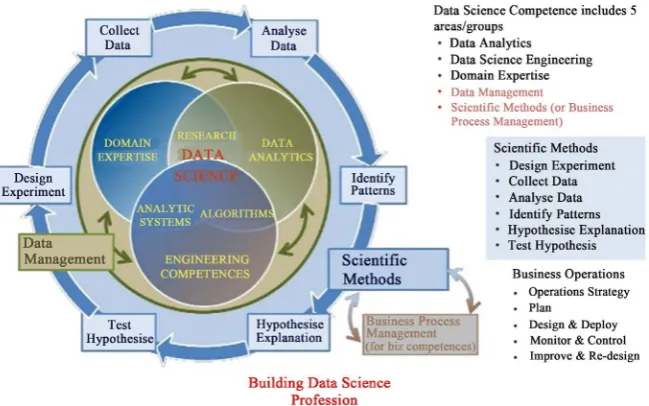
DOI: 10.4236/ce.2019.103038 528 Creative Education and emerging as a second path to computational science becomes clear when we imagine how scientists share data these days, not dissimilar from the way we in the AEC share building information (Figure 1). For instance, using building in-formation model or BIM-models work as long as everyone has the same data, meaning the components for buildings are standardized and represented in an algorithmic way. In many sciences like astronomy and ecology, the software costs needed to process data exceed capital investments in instrumentation. High-powered computing (HPC) infrastructure is an equal to or larger invest-ment than the instruinvest-mentation (telescopes, colliders, high-resolution microsco-py). By 1996 more than 70% of America’s top 500 companies were using AI
(Goodman, 1996). This is rapidly becoming the case in the AEC professions as
software and visualization tool costs make up significant percentage of overhead costs for AE firms. Among all AE and EA firms accurate project cost forecasting (52.3%) and collaboration communication (47.4%) were the top ranked project management challenges. Better decision-spaces using data-intensive computing enabled by artificial intelligence (AI) are poised to change the way we build.
3.2. Collecting, Curating, Analyzing and Archiving Data
[image:5.595.213.538.415.618.2]Data must be given definition, shape or form—in effect more than files, but a database with a schema (e.g. ductwork) making the data self-describing enough
DOI: 10.4236/ce.2019.103038 529 Creative Education a mechanical engineer can access the files sent from the architect’s office. Or for researchers the data can be indexed, aggregated, and searched (Hey, 2009). In the building sciences one advantage over the other sciences is our affinity for vi-sualization: we already work with a set of visual conventions for abstracted re-presentations of phenomenal conditions. Remember, the AEC professions rarely work on the physical object, but determine everything through simulacra: mod-els and graphic representations. The three activities, collecting, curating and analyzing data are worth closer inspection to understand how this is part of a paradigm shift in the AEC industries and why we should think about the parallel shift from mechanical to systems theory as the emerging decision space in de-sign.
3.3. Collection and Data Validation
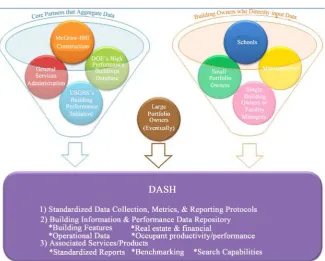
Data collection happens at every scale in our industry, but we typically are not using it. In the sciences, people collect data either from instruments or sensors, or from running simulations (Hey, 2009). In the building industry and especially in the area of improving building practices for resiliency and disaster mitigation, we collect data for safety and security, accessibility, cost effectiveness, water use and indoor environmental air quality. In the wake of the 2011 announcement by the U.S. Energy Information Administration (EIA) they were suspending work on the Commercial Building Energy Consumption Survey, the National Institute of Building Sciences established the High-Performance Building Data Collection Initiative to collect and curate data for multi-dimension data. ASHRE estab-lished DASH, the Database for Analyzing Sustainable and High-Performance Buildings in 2004 also co-managed by the Green Building Alliance to facilitate consistent collection for measured data (Figure 2). Their sources include exist-ing buildexist-ing information databases, organizations, companies and researchers. Stakeholders included the real property industry, researchers and analysts in the academic-military-industrial complex, and consultants, services and products – in short, anyone involved in designing, manufacturing, fabricating, installing or evaluating buildings or building products (Read, 2018).
DOI: 10.4236/ce.2019.103038 530 Creative Education
Figure 2. The database for analyzing sustainable and high-performance buildings started in 2004.The diagram is from comments prepared by Doug Read, ASHRAE for the Green Building Alliance and the American Society of Heating, Refrigerating & Air-conditioning Engineers for the representative hearing of July 18, 2011. Courtesy of the national build-ing data collection initiative. https://www.nibs.org/?page=hpbdata
in London School of Law looked at the case of the NestTM an array of IoT prod-ucts monitoring cars, washing machines, lights, locks and communication de-vices. They focused on the contractual documents relevant to the Nest ecosystem including notices, declarations, reports and licenses. They concluded it is legally difficult to separate the “thing” from a mixture of hardware, software, data and service (La Diega & Walden, 2016). The implications of these issues are far from determined, but they suggest serious reconsideration in the building industry of how we contract for services over the course of a building’s use. One potential outcome is a continued maintenance and upgrade contract opposed to a onetime fee for services.
3.4. Curation
DOI: 10.4236/ce.2019.103038 531 Creative Education for longevity and integration across contexts, types and professional offices. Without this schema and metadata, interpretation is implicit and depends on the programs used to analyze it. For example, in the building industry DASH identi-fied the following focus for data intake: building characteristics, including site and operational data such as energy, water, thermal comfort, indoor air quality, lighting, and acoustics. This potentially represents petabytes (PB) of informa-tion. One petabyte is 1024 terabytes or a million gigabytes of informainforma-tion. The San Diego Supercomputer Center (SDSC) at the University of California, San Diego supplies computational power to the scientific community. SDSC estab-lished its Data Central site holding 27PB of data in more than 100 specific data-bases (e.g., for bioinformatics and water resources). In 2009, it set aside 400 te-rabytes (TB) of disk space for both public and private databases and data collec-tions that serve a wide range of scientific institucollec-tions, including laboratories, li-braries, and museum (Hey, 2009). Today the number is 36 petabytes or 36 thou-sand trillion bytes of information.
3.5. Analysis
DOI: 10.4236/ce.2019.103038 532 Creative Education successful management of a digital data collection, lie in having their creativity and intellectual contributions fully recognized. Today in the AEC disciplines, we see increasing numbers of students interested in data—how to visualize, catalog, create and maintain datasets related to building performance at all levels. Edu-cating and crediting this generation for their contributions to the data will be critical for fostering a skilled and knowledgeable workforce in the AEC discip-lines.
4. What Does This Mean for the Building Sciences?
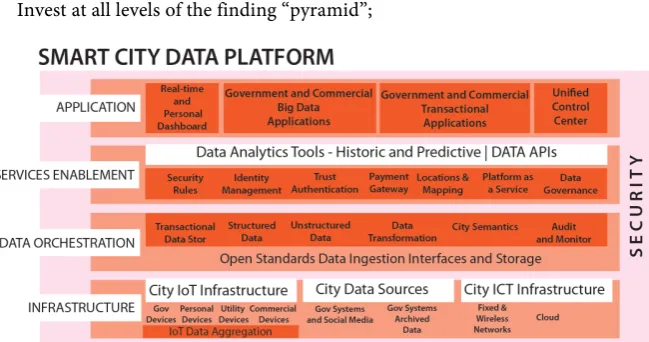
We looked earlier at the impact of systems theory on the methodological ap-proach to science and the shift to a focus on dynamic processes and morpholog-ical change. The data intensive decision spaces made possible through computa-tion validate and corroborate a systemic approach across science and engineer-ing, including architecture, engineering and their allied disciplines. Buildings were isolated objects in the mechanistic view—in the new paradigm, buildings are data. The IoT makes this not only inevitable but also necessary. Data gener-ated through sensors will increasingly control and determine building design, delivery and performance. The Smart City Platform requirements listed in
Fig-ure 3 outline a systemic approach to big building. The need for data
infrastruc-ture, sources, and analytics will coincide with legal, economic, and regulatory applications affecting every aspect of the city. Buildings linked to the IoT will provide real-time data about energy use, air quality, maintenance and so forth—in effect, cities will be agglomerations of built areas interconnected, monitored and managed in a dynamic parts-to-whole relationship where it will be difficult to determine the boundaries between infrastructure, bricks and mortar, and data.
Returning to the issues raised by a fourth paradigm in science, Jim Gray out-lined a specific set of needs critical in the future to the computation sciences for governments, industry and research:
[image:9.595.212.537.508.679.2] Fund both development and support of software tools; Invest at all levels of the finding “pyramid”;
DOI: 10.4236/ce.2019.103038 533 Creative Education Fund development of “generic” Laboratory Information Management
Sys-tems (LIMS);
Fund research into scientific data management, data analysis, data visualiza-tion, new algorithms and tools. Three key areas for action relate to the future of scholarly communication and libraries;
Establish digital libraries supporting the other sciences (and I would add en-gineering and architecture) like the NLM does for medicine;
Fund development of new authoring tools and publication models;
Explore development of digital data libraries containing scientific data (not just the metadata) and support integration with published literature.
If his laundry list sounds foreign, consider the increased scientization of our disciplines:
Demands for research-based methodologies including benchmarking, pro-tocols for acquiring, analyzing, and reporting data;
Publications moving to a solely online presence;
Developers demanding the building industry provide data-driven business outcomes for better cost-estimation and post-occupancy analysis;
Professional firms investing time and money in research and publication; Standardization of Building Information Modeling and integrated building
delivery;
Increase in number of performance-based software since 2000.
Given the dominant model of the material world is increasingly a network of systems with interrelated and interdependent patterns of behavior, the challenge for creating resilient buildings, smart cities and good ecological management plans is the education of architects and engineers capable of using multiple and varied date to create complex decision spaces. This means big building won’t mean a tall structure, but a dataset describing the conditions of a built environ-ment. The use of artificial intelligence (AI) to manage and predict environmen-tal conditions, safety and security, energy performance and use and land man-agement will mean buildings and their context merge into a complex of interre-lated systems. It is yet to be determined how this will effect change in the legal definitions of objects and environments or the limits of contracts in the service sector. Challenges for future study include addressing the legal definitions of property where objects and data coincide, determinations of how, when and where data are public or private, when data are proprietary and what maybe the consequences of a breach in cybersecurity across such large systems. Some of the legal considerations were briefly discussed, but there is much work to do.
DOI: 10.4236/ce.2019.103038 534 Creative Education pass. The virtual site-model and the real site intersect in a real-time decision space updated daily. The sea-change suggested by these new processes are part of what this article aimed to suggest. The significance of bringing this discussion forward now while we are still somewhat indeterminate about future use of big data in the building sciences is precisely to outline what needs to be addressed.
5. Recommendations
Our next steps are to make sure we educate the present generation of designers, demand our professional organizations to address the impact of these changes on our contractual procedures, promote, share and disseminate findings, devel-op protocols for the “pyramid” of collecting, curating and analyzing data, and participate in the ethical, aesthetic and social impacts of these changes to the built world.
Acknowledgements
Thanks to Clemson University and the Mickel Endowment for the funding sup-port to complete this article.
Conflicts of Interest
The author declares no conflicts of interest regarding the publication of this pa-per.
References
Bush, V. (1945). As We May Think. The Atlantic Monthly, 101-108. EIA (2018). Open Data. https://www.eia.gov/opendata/
Goodman, W. C. (1996). The Software and Engineering Industries: Threatened by Tech-nological Change? MonthlyLaborReview, 176, 37-45.
Hey, A. J. G. (2009). TheFourthParadigm:Data-IntensiveScientificDiscovery.
La Diega, G. N., & Walden, I. (2016). Contracting for the “Internet of Things”: Looking into the Nest. Queen Mary School of Law Legal Studies Research, Paper No. 219/2016.
https://ssrn.com/abstract=2725913
Read, D. (2018). Testimony on Data Needs to Achieve High-performance Buildings.
https://c.ymcdn.com/sites/www.nibs.org/resource/resmgr/HPBDATA/Read_Summary. pdf
Von Bertalanffy, L. (1968). GeneralSystemTheory:Foundations, Development, Applica-tions. New York: G. Braziller.
Wing, J. M. (2006). Computational Thinking. Communications of the ACM, 49, 33-35.