AN IN-VITRO STUDY TO COMPARE THE DIMENSIONAL STABILITY AND SURFACE HARDNESS OF
ELASTOMERIC BITE REGISTRATION MATERIALS AT VARIOUS TIME INTERVALS
*,1
Arjun N. Mithra,
2Pranav V. Mody,
1
Senior lecturer, Department of Prosthodontics, V. S. Dental College and Hospital, Bengaluru, Karnataka, India
2
Professor and Head, Department of Prosthodontics
3
Private Practitioner, St. Fathima Dental Clinic and Implant Center, Deharadun, Uttarkhand, India
4
Senior lecturer, Department of Prosthodontics, V.Y.W.S. Dental College, Amravati, Maharashtra,
ARTICLE INFO ABSTRACT
Introduction:
of the polymer science introduced elastomeric interocclusal recording materials in the field of dentistry. But their properties are not completely understood.
Aim: To evaluate and compare the dimensional stability and surface hardness of two commercially available Vinyl Polysiloxane and Polyether elastomeric bite registration materials at various time intervals.
Materials and Methods:
of 30 specimens were made, 10 each from three elastomeric bite registration materials. A travelling microscope was used to measure dimensional change and Shore
surface hardness. The measurements were collected at t
mean values were taken for statistical analysis. Statistical analysis was performed by one ANOVA test and post hoc analysis by Bonferroni to compare the percentage of change over a period of time.
Result
materials. Vinyl Polysiloxane showed significant dimensional change up to 48 hours. Polyether showed less dimensional change in the first 24 hours but later showe
bite registration materials attained their maximum surface hardness in 48 hours. Vinyl Polysiloxane bite registration materials recorded the highest surface hardness.
Copyright©2017, Arjun N. Mithra et al. This is an open use, distribution, and reproduction in any medium, provided
INTRODUCTION
Any dental restorative procedures require the transfer of tooth and jaw relationships to an articulator and interocclusal records are used to articulate mandibular cast to maxillary cast. (Berman, 1960; Shanahan, 1960) This enables us to study the status of the dentition and to construct dental restorations. (Cohn, 1963) Historically various materials have been used to make interocclusal records such as Waxes, Dental plaster, Zinc Oxide Eugenol impression paste etc. Wax
combined with other materials were most commonly used for these purposes. However, since most waxes have not been specifically developed for these objectives, they are subject to distortion and do not store well at room temperatures after removal from the mouth. In addition, most techniques do not
*Corresponding author: Arjun N. Mithra,
Senior lecturer, Department of Prosthodontics, V. S. Dental College and Hospital, Bengaluru, Karnataka, India.
ISSN: 0975-833X
Article History:
Received 05th June, 2017
Received in revised form 11th July, 2017
Accepted 15th August, 2017
Published online 30th September, 2017
Citation: Arjun N. Mithra, Pranav V. Mody, Mohamed Imran Zainvi and Bhushan G. Wankhade stability and surface hardness of elastomeric bite registration materials at various time intervals 57686.
Available
Key words:
Interocclusal record, Dimensional stability, Surface hardness, Time,
Vinyl Polysiloxane, Polyether.
RESEARCH ARTICLE
VITRO STUDY TO COMPARE THE DIMENSIONAL STABILITY AND SURFACE HARDNESS OF
ELASTOMERIC BITE REGISTRATION MATERIALS AT VARIOUS TIME INTERVALS
Pranav V. Mody,
3Mohamed Imran Zainvi and
4Bhushan
Senior lecturer, Department of Prosthodontics, V. S. Dental College and Hospital, Bengaluru, Karnataka, India
Professor and Head, Department of Prosthodontics, K.V.G. Dental College and Hospital, Sullia, Karnataka, India
Private Practitioner, St. Fathima Dental Clinic and Implant Center, Deharadun, Uttarkhand, India
Senior lecturer, Department of Prosthodontics, V.Y.W.S. Dental College, Amravati, Maharashtra,
ABSTRACT
Introduction: Interocclusal records are essential to relate dental casts to an articulator. The advance of the polymer science introduced elastomeric interocclusal recording materials in the field of dentistry. But their properties are not completely understood.
To evaluate and compare the dimensional stability and surface hardness of two commercially available Vinyl Polysiloxane and Polyether elastomeric bite registration materials at various time intervals.
Materials and Methods: The materials tested were ImprintTM bite, Futar® D and Ramitec
of 30 specimens were made, 10 each from three elastomeric bite registration materials. A travelling microscope was used to measure dimensional change and Shore
surface hardness. The measurements were collected at the time intervals of 1, 24, 48 and 72 hours and mean values were taken for statistical analysis. Statistical analysis was performed by one ANOVA test and post hoc analysis by Bonferroni to compare the percentage of change over a period of time.
Results: Result showed that significant percentage of dimensional change was noted in all the three materials. Vinyl Polysiloxane showed significant dimensional change up to 48 hours. Polyether showed less dimensional change in the first 24 hours but later showe
bite registration materials attained their maximum surface hardness in 48 hours. Vinyl Polysiloxane bite registration materials recorded the highest surface hardness.
open access article distributed under the Creative Commons Attribution provided the original work is properly cited.
Any dental restorative procedures require the transfer of tooth articulator and interocclusal records are used to articulate mandibular cast to maxillary cast. This enables us to study the status of the dentition and to construct dental restorations. Historically various materials have been used to make interocclusal records such as Waxes, Dental plaster, Zinc Oxide Eugenol impression paste etc. Wax alone or waxes combined with other materials were most commonly used for these purposes. However, since most waxes have not been specifically developed for these objectives, they are subject to distortion and do not store well at room temperatures after
emoval from the mouth. In addition, most techniques do not
Senior lecturer, Department of Prosthodontics, V. S. Dental College and
establish sufficient control of the accuracy and detail of the record. (Cohn, 1963; Lucia,
1969)The materials available to us are either thermoplastic or
chemically set. The thermoplastic materials are predominantly waxes and chemically set materials are Zinc Oxide Eugenol and the recently developed and popular elastomerics. The thermoplastics should have some “body” in order to be manipulated. The chemically set materials require some time to undergo their chemical reaction before the
1969) Considerable controversy exists regarding the accuracy, usefulness and manipulative skills required in obtaining accurate interocclusal records. (
et al., 1973; Lundeen, 1974)They
maintain extreme accuracy even under varying conditions during storage and handling. Even though a
to be dimensionally stable and accurate, it may still undergo
dimensional change which can only be evaluated
microscopically. (Millstein et al
specific jaw relation registration materials that have been
International Journal of Current Research
Vol. 9, Issue, 09, pp.57681-57686, September, 2017
Arjun N. Mithra, Pranav V. Mody, Mohamed Imran Zainvi and Bhushan G. Wankhade, 2017. “An In-vitro
stability and surface hardness of elastomeric bite registration materials at various time intervals”, International Journal of Current Research
Available online at http://www.journalcra.com
z
VITRO STUDY TO COMPARE THE DIMENSIONAL STABILITY AND SURFACE HARDNESS OF
ELASTOMERIC BITE REGISTRATION MATERIALS AT VARIOUS TIME INTERVALS
Bhushan G. Wankhade
Senior lecturer, Department of Prosthodontics, V. S. Dental College and Hospital, Bengaluru, Karnataka, India
, K.V.G. Dental College and Hospital, Sullia, Karnataka, India
Private Practitioner, St. Fathima Dental Clinic and Implant Center, Deharadun, Uttarkhand, India
Senior lecturer, Department of Prosthodontics, V.Y.W.S. Dental College, Amravati, Maharashtra, India
records are essential to relate dental casts to an articulator. The advance of the polymer science introduced elastomeric interocclusal recording materials in the field of
To evaluate and compare the dimensional stability and surface hardness of two commercially available Vinyl Polysiloxane and Polyether elastomeric bite registration materials at various time
bite, Futar® D and RamitecTM. A total of 30 specimens were made, 10 each from three elastomeric bite registration materials. A travelling microscope was used to measure dimensional change and Shore-A durometer was used to measure he time intervals of 1, 24, 48 and 72 hours and mean values were taken for statistical analysis. Statistical analysis was performed by one-way ANOVA test and post hoc analysis by Bonferroni to compare the percentage of change over a period
Result showed that significant percentage of dimensional change was noted in all the three materials. Vinyl Polysiloxane showed significant dimensional change up to 48 hours. Polyether showed less dimensional change in the first 24 hours but later showed significant expansion. All the bite registration materials attained their maximum surface hardness in 48 hours. Vinyl Polysiloxane
ribution License, which permits unrestricted
sufficient control of the accuracy and detail of the , 1964; Skurnik, 1969; Skurnik, The materials available to us are either thermoplastic or chemically set. The thermoplastic materials are predominantly ly set materials are Zinc Oxide Eugenol and the recently developed and popular elastomerics. The thermoplastics should have some “body” in order to be manipulated. The chemically set materials require some time to undergo their chemical reaction before they set. (Skurnik, Considerable controversy exists regarding the accuracy, manipulative skills required in obtaining (Millstein et al., 1971; Millstein They should have the ability to maintain extreme accuracy even under varying conditions during storage and handling. Even though a record may appear to be dimensionally stable and accurate, it may still undergo
dimensional change which can only be evaluated
et al., 1975; Skurnik, 1977)Four
specific jaw relation registration materials that have been using
INTERNATIONAL JOURNAL OF CURRENT RESEARCH
vitro study to compare the dimensional
57681-recent years are Zinc Oxide Eugenol paste, Eugenol free Zinc Oxide paste, Silicone elastomer, and Polyether elastomer. While these recording materials are basically similar to impression materials, they have been modified to give them different handling characteristics. (Balthazar-Hart et al., 1981) Polyether has been suggested as being more dimensionally stable when compared with its predecessors and Vinyl Polysiloxane have recently claimed even superior accuracy and
stability over Polyether. (Lacy et al., 1981) Considering the
introduction of these materials and current usage in dental practice, it is absolutely necessary to study the material properties before using them clinically.
MATERIALS AND METHODS
In this study, a stainless steel die was prepared according to the ANSI/ADA specifications no 19 [Fig.1]. (Revised American dental association specification no. 19 for non-aqueous, elastomeric dental impression materials, 1977) Vinyl Polysiloxane bite registration paste (Group 1 & Group 2) and Polyether bite registration paste (Group 3) [Table: 1] were manipulated according to manufacturer’s instructions [Table: 2]. Specimens were prepared at room temperature. Metal ring was placed over the mold and material was manipulated and placed in the mold. Then the die was covered with a 4 x 4 inch square glass plate. Hand pressure was applied over the glass plate for 5 seconds until the metal ring was seen; this was followed by application of a 500 g weight to further remove excess material. Then the stainless steel die with bite registration material, glass slab and weight were submerged in a water bath with temperature of 36 ± 10C to simulate ambient temperature. Complete assembly remained in water bath till the material was set plus an additional 3 min to ensure complete set of the material. Once the material was set, the metal ring was removed from the stainless steel die and all the excess material was removed by using a Bard parker blade no: 15. The sample was stored at room temperature in a water proof container. The prepared specimen was in the form of a disk measuring 3mm in thickness and 30mm in diameter. 30 samples comprising of 10 samples from 3 different materials were obtained [Fig. 2, Fig. 3 and Fig. 4] [Table: 3].
Testing the samples
To measure dimensional stability
Measurements from each sample were taken between the parallel lines A and C by means of travelling microscope (Mitutoyo, Japan) [Fig. 5] with magnification of 10 X. The microscope had least count of 0.01 mm. The distance between two parallel lines A and C was measured at four fixed points. The mean of two readings was taken for statistical analysis. Measurements were made for all the samples of each group at an interval of 1, 24, 48 and 72 hours.
The change in dimension was calculated using the following formula:
Dimensional change % = (X’ – Y’) / X’ x100
Where
X’ = standard measurement (mm) of X and Z line in the die
Y’ = observed measurement (mm) of A and C line in the
sample
To measure the surface hardness
The same specimens were used to evaluate the surface hardness using Shore - A Durometer (RSK Co., Taiwan) [Fig. 6]. For testing, the depth indicator was set to zero. A light force was applied with the index finger to the indenter for 3 seconds and the unit was lowered on the sample until the presser was in full contact. The hardness value was displayed on the Durometer. Four readings were taken on four different sites of the specimen and mean value was taken for statistical analysis. Surface hardness was measured for all the samples of each group at an interval of 1, 24, 48 and 72 hours. Mean value was taken for statistical analysis. For each dimension one way ANOVA analysis was used to assess the significance of the difference among the 3 groups. Subsequent pair-wise comparisons were performed by using post hoc analysis by Bonferroni test.
RESULTS
Percentage of Dimensional change
Comparison of change between various groups for dimensional stability at different time intervals by Post hoc analysis by Bonferroni test [Table: 4] [graph 1] showed significant difference between the time period of 1 hour (hr) – 24 hours (hrs) between group 1 & group 2 and highly significant difference between the group 1 & group 3 and group 2 & group 3. Between the time period 1 hr – 48 hrs, no significant difference was seen between group 1 & group 2 but highly significant difference was seen between group 1 & group 3 and group 2 & group 3. Between the time period 1 hr – 72 hrs, no significant difference between group 1 & group 2, highly significant difference between group 1 & group 3 and group 2 & group 3. Between the time period 24 hrs – 48 hrs, no significant difference between group 1 & group 2, highly significant difference between group 1 & group 3 and group 2 & group 3. Between the time period 24 hrs – 72 hrs, no significant difference between group 1 & group 2, highly significant difference between group 1 & group 3 and group 2 & group 3. Between the time period 48 hrs – 72 hrs, no significant difference between group 1 & group 2, highly significant difference between group 1 & group 3 and group 2 & group 3.
Change in Surface hardness:
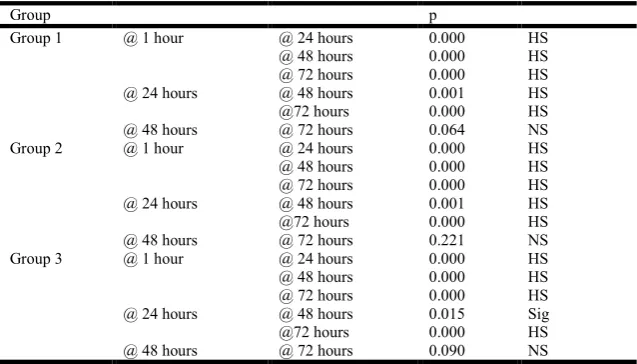
Multiple comparisons within the groups for surface hardness at various time intervals [Table: 5] [Graph: 3] showed high significant difference in group 1 material between 1 hr and 24 hrs, 48 hrs & 72 hrs and also high significant difference between 24 hrs & 48 hrs and 24 hrs & 72 hrs. No significant difference between 48 hrs & 72 hrs. In group 2 high significant differences between 1 hr and 2 4hrs, 48 hrs & 72 hrs and also high significant difference between 24 hrs & 48 hrs and 24 hrs & 72 hrs. No significant difference between 48 hrs & 72 hrs. In group 3 high significant differences between 1 hr and 24 hrs, 48 hrs & 72 hrs and 24 hrs & 72 hrs, significant difference between 24 hrs & 48 hrs and no significant difference between 48 hrs & 72 hrs.
DISCUSSION
During oral rehabilitation of the patient, articulation of the casts is necessary to simulate the patient’s maxillo-mandibular relation which enables the dentist and the technician to study
the dentition in static as well as in function and to fabricate the
restoration. (Cohn, 1963)When the teeth do not offer vertical
and horizontal stability between the arches, an interocclusal record is mandatory to relate the casts. Precise articulation of the patient’s casts is a prerequisite for proper diagnosis and
subsequent accurate treatment. (Lucia, 1964) Many authors have explained the use and manipulation skills of several interocclusal recording materials like Hi-Fi Wax, (Skurnik, 1969) Tenax wax, Alu wax, Zinc Oxide Eugenol paste with Jones frame, Dental plaster, (Skurnik, 1969) Acrylic resin
Table 1. List of materials used in the study
S.No. Material Trade name Manufacturer Batch no.
1 Vinyl Polysiloxane bite registration material (Group 1) ImprintTM bite 3M Deutschland GmbH, Germany LOT 507557 2015 - 02
2 Vinyl Polysiloxane bite registration material (Group 2) Futar® D Kettenbach GmbH & Co, Germany LOT 112211 2014 - 07
3 Polyether bite registration material (Group 3) RamitecTM 3M Deutschland GmbH, Germany LOT 506034 2015 - 02
Table 2. Manufacturer’s recommendation for Bite registration materials (≤ - lesser than or equal to, ≥ - greater than or equal to)
Material Trade name Mixing system Storage temperature Mixing time Working time Setting time
ImprintTM bite
(Group 1)
Auto mix Base/catalyst paste - cartridge
15-250C 20 sec 1 min from start of
mixing Futar® D
(Group 2)
Auto mix Base/catalyst paste - cartridge
18-250C ≤ 30 sec at 230C ≥ 1 min 30 sec at
350C
RamitecTM
(Group 3)
Manual mixing
Base/catalyst paste - Tube
18-250C 30 sec 2 min from start of
mixing
5 min from start of mixing
Table 3. Study samples
Material Vinyl Polysiloxane bite registration material Vinyl Polysiloxane bite registration material Polyether bite registration material
Trade name ImprintTM bite (Group 1) Futar® D (Group 2) RamitecTM (Group 3)
[image:3.595.142.461.323.505.2]No. of specimen 10 10 10
Table 4. Comparison of change between various groups for dimensional stability over period of time by post hoc analysis by Bonferroni test (Sig – significant, HS – highly significant and NS – not significant)
p
1hr – 24 hrs Group 1 Group 2
Group 3
0.041 0.000
Sig HS
Group 2 Group 3 0.001 HS
1 hr – 48 hrs Group 1 Group 2
Group 3
0.072 0.000
NS HS
Group 2 Group 3 0.000 HS
1 hr – 72 hrs Group 1 Group 2
Group 3
0.084 0.000
NS HS
Group 2 Group 3 0.000 HS
24 hrs – 48 hrs Group 1 Group 2
Group 3
1.000 0.000
NS HS
Group 2 Group 3 0.000 HS
24 hrs – 72 hrs Group 1 Group 2
Group 3
1.000 0.000
NS HS
Group 2 Group 3 0.000 HS
48 hrs – 72 hrs Group 1 Group 2
Group 3
1.000 0.000
NS HS
[image:3.595.141.460.544.726.2]Group 2 Group 3 0.000 HS
Table 5. Multiple comparisons within the groups for surface hardness at various time intervals (Sig – significant, HS – highly significant and NS – not significant)
Group p
Group 1 @ 1 hour @ 24 hours
@ 48 hours @ 72 hours
0.000 0.000 0.000
HS HS HS
@ 24 hours @ 48 hours
@72 hours
0.001 0.000
HS HS
@ 48 hours @ 72 hours 0.064 NS
Group 2 @ 1 hour @ 24 hours
@ 48 hours @ 72 hours
0.000 0.000 0.000
HS HS HS
@ 24 hours @ 48 hours
@72 hours
0.001 0.000
HS HS
@ 48 hours @ 72 hours 0.221 NS
Group 3 @ 1 hour @ 24 hours
@ 48 hours @ 72 hours
0.000 0.000 0.000
HS HS HS
@ 24 hours @ 48 hours
@72 hours
0.015 0.000
Sig HS
@ 48 hours @ 72 hours 0.090 NS
wafers, modelling compound (Skurnik, 1977) elastomeric bite registration materials (Balthazar
[image:4.595.326.545.50.326.2]1981). Waxes have been used as interoccluasl recording material since a very long time.
[image:4.595.39.290.110.265.2]Figure 1. Stainless steel metal die
[image:4.595.350.521.360.593.2]Figure 2. ImprintTM Bite (group 1) 10 specimens
[image:4.595.40.288.471.609.2]Figure 3. Futar® D (group 2) 10 specimens
Figure 4. RamitecTM (group 3) 10 specimens
57684 Arjun N. Mithra et al. An in-vitro study to compare the dimensional stability and surface hardness of elastomeric bite registration materials
(Skurnik, 1977) and Polyether
(Balthazar-Hart et al.,
Waxes have been used as interoccluasl recording
Stainless steel metal die
Bite (group 1) 10 specimens
D (group 2) 10 specimens
(group 3) 10 specimens
Figure 5. Travelling microscope (Mitutoyo, Japan)
Figure 6. Shore - A Durometer (RSK Co., Taiwan)
Graph 1.Percent deviation of mean of percentage dimension change of the 3 group of material at 1, 24, 48 and 72 hours
vitro study to compare the dimensional stability and surface hardness of elastomeric bite registration materials at various time intervals
Travelling microscope (Mitutoyo, Japan)
A Durometer (RSK Co., Taiwan)
deviation of mean of percentage dimension change of the 3 group of material at 1, 24, 48 and 72 hours
[image:4.595.311.559.623.768.2] [image:4.595.42.285.641.779.2]Graph 2. Mean and Standard Deviation for dimension change of the 3 group of material at 1, 24, 48 and 72 hours
Graph 3. Percent deviation of mean surface hardness of the 3 group of material at 1, 24, 48 and 72 hours
Graph 4.Mean and standard deviation for surface hardness of the 3 group of material at 1, 24, 48 and 72 hours
However they have many limitations. Being
they are easily subjected to dimensional change at varying room temperature. (Skurnik, 1969; Millstein
improved dimensional stability, waxes should be reinforced with a metal screen or cloth matrix and zinc oxide eugenol
paste. (Cohn, 1963)In various studies, exact reproduction of
the original wax recording was never achieved even under
highly controlled conditions. (Millstein et al
et al., 1973) Zinc oxide eugenol registration paste is simple to use, offers no resistance to closure and storage is not a problem but it must have sufficient body. Plaster is the most exacting material but its use is more complicated than the use of wax or zinc oxide eugenol paste. (Skurnik, 1969)
controversy exists regarding the accuracy, usefulness and manipulative skills required in obtaining accurate inter
records. (Millstein et al., 1971) Variations in the interocclusal records may occur in the vertical, antero-posterior, or medio lateral position. So it should have qualities to maintain extreme
57685 International Journal of Current Research,
Mean and Standard Deviation for dimension change of the 3 group of material at 1, 24, 48 and 72 hours
Percent deviation of mean surface hardness of the 3 group of material at 1, 24, 48 and 72 hours
Mean and standard deviation for surface hardness of the 3 group of material at 1, 24, 48 and 72 hours
However they have many limitations. Being thermoplastic, they are easily subjected to dimensional change at varying (Skurnik, 1969; Millstein et al., 1971) For improved dimensional stability, waxes should be reinforced with a metal screen or cloth matrix and zinc oxide eugenol In various studies, exact reproduction of the original wax recording was never achieved even under et al., 1971; Millstein Zinc oxide eugenol registration paste is simple to rs no resistance to closure and storage is not a problem but it must have sufficient body. Plaster is the most exacting material but its use is more complicated than the use of wax or (Skurnik, 1969) Considerable s regarding the accuracy, usefulness and manipulative skills required in obtaining accurate inter-occlusal Variations in the interocclusal posterior, or medio-it should have qualmedio-ities to maintain extreme
accuracy even under varying conditions of storage and handling. Although the record may appear to be accurate to the naked eye, it may undergo dimensional change which can only be evaluated microscopically.
Vinyl Polysiloxane elastomeric bite registration materials have been introduced in the market. Basically these materials are similar to Impression materials; they have been modified to give them different handling characteristics.
al., 1981) Elastomeric bite registration materials, introduced in the last decades, show superior properties than the conventional
materials in handling characteristics, surface detail
reproduction, dimensional stability and hardness. al., 1984)
Occlusal record inaccuracies can be caused by many factors but the basic nature of the recording material and its properties affects the most. Other factors are the storage temperature, polymerization shrinkage, chemical reaction, stress and mechanical manipulation occurs duri
(Mullick et al., 1981)The evaluation period of 1 hr, 24 hrs, 48
hrs and 72 hrs very critical, this time intervals were based on the time required to carry the inter
laboratories or delay in the articulation o
laboratory. The study revealed that significant greatest shrinkage rate of all the materials appeared within the first 24 hrs after the manufacturer’s sp
Group 1 and group 2 (Vinyl Polysiloxane) showed gre shrinkage in the first 24 hrs. Significant shrinkage was seen up to 48 hrs. After 48 hrs, no significant dimensional change was seen corresponding to the study conducted by Michalakis (2004) In general, the excellent dimensional stability of V Polysiloxane was attributed to the fact that it set by addition reaction. Hence there were no by
as stated by Millstein et al. (1994)
initial shrinkage up to first 24 hrs followed by significant expansion of the material up to 72 hrs and showed least linear change compared to group 1 and group 2 (Vinyl Polysiloxane) up to 24 hrs. Polyether sets by polymerizatio
shrinkage is seen due to polymerization shrinkage. However, polyether is hydrophilic, resulting in absorption of water and expansion of the material. This leads to subsequent expansion after initial shrinkage. This expansion occurs afte
Lassila and McCabe have confirmed the same shr expansion patterns. (Lassila and McCabe, 1985)
suggests that Polyether interocclusal records must be used within 24 hrs for realibility.
groups of Vinyl Polysiloxane bite registration material (group 1 and group 2) show same hardness [Graph: 4]. Polyether (group 3) showed lesser values as compared to Vinyl Polysiloxane bite registration material. The significant increase in the surface hardness was noticed in all the 3 materials up to first 48 hrs as
mentioned by the Hatzi et al,(2012)
in the hardness of the material was seen. Hardness of the bite registration material at setting time is critical, as it can ensure distortion free inter-occlusal recordings. Hard, highly filled inter-occlusal recording materials are expected to exhibit less vertical discrepancies due to reduced setting shrinkage and high resistance to deformation ensuring more accurate fit on stone models.
Conclusion
Within the limitation of this study, it can be concluded that
Vinyl Polysiloxane bite registration paste is more
International Journal of Current Research, Vol. 9, Issue, 09, pp.57681-57686, September
accuracy even under varying conditions of storage and handling. Although the record may appear to be accurate to the naked eye, it may undergo dimensional change which can only
(Millstein et al., 1975)Recently
elastomeric bite registration materials have been introduced in the market. Basically these materials are similar to Impression materials; they have been modified to
give them different handling characteristics. (Balthazar-Hart et
ite registration materials, introduced in the last decades, show superior properties than the conventional
materials in handling characteristics, surface detail
reproduction, dimensional stability and hardness. (Fattore et
uracies can be caused by many factors but the basic nature of the recording material and its properties affects the most. Other factors are the storage temperature, polymerization shrinkage, chemical reaction, stress and mechanical manipulation occurs during the procedures. The evaluation period of 1 hr, 24 hrs, 48 hrs and 72 hrs very critical, this time intervals were based on the time required to carry the inter-occlusal records to distant laboratories or delay in the articulation of the casts in the laboratory. The study revealed that significant greatest shrinkage rate of all the materials appeared within the first 24 hrs after the manufacturer’s specified setting time [Graph: 2]. Group 1 and group 2 (Vinyl Polysiloxane) showed greatest shrinkage in the first 24 hrs. Significant shrinkage was seen up to 48 hrs. After 48 hrs, no significant dimensional change was seen corresponding to the study conducted by Michalakis et al. In general, the excellent dimensional stability of Vinyl Polysiloxane was attributed to the fact that it set by addition reaction. Hence there were no by-products and loss of volatiles
(1994)Group 3 (Polyether) showed
initial shrinkage up to first 24 hrs followed by significant expansion of the material up to 72 hrs and showed least linear change compared to group 1 and group 2 (Vinyl Polysiloxane) up to 24 hrs. Polyether sets by polymerization; hence an initial shrinkage is seen due to polymerization shrinkage. However, polyether is hydrophilic, resulting in absorption of water and expansion of the material. This leads to subsequent expansion after initial shrinkage. This expansion occurs after 24 hrs. Lassila and McCabe have confirmed the same shrinkage and
(Lassila and McCabe, 1985) Muller
suggests that Polyether interocclusal records must be used
within 24 hrs for realibility. (Muller et al., 1991) Both the
l Polysiloxane bite registration material (group 1 and group 2) show same hardness [Graph: 4]. Polyether (group 3) showed lesser values as compared to Vinyl Polysiloxane bite The significant increase in the surface ed in all the 3 materials up to first 48 hrs as
(2012)later no significant change
in the hardness of the material was seen. Hardness of the bite registration material at setting time is critical, as it can ensure occlusal recordings. Hard, highly filled occlusal recording materials are expected to exhibit less vertical discrepancies due to reduced setting shrinkage and high resistance to deformation ensuring more accurate fit on stone
Within the limitation of this study, it can be concluded that
Vinyl Polysiloxane bite registration paste is more
dimensionally stable over a period of time and recorded higher surface hardness compared to Polyether bite registration paste
1. All three elastomeric bite registration materials showed greatest dimensional change in the first 24 hrs of storage.
2. Vinyl Polysiloxane bite registration paste showed continuous shrinkage although the shrinkage was not clinically significant after 24 hrs.
3. Polyether bite registration paste showed least shrinkage in the first 24 hrs but exhibited expansion after 24 hrs leading to significant amount of dimensional change. This expansion is contributed to hydrophilicity due to which absorption of water takes place.
4. Vinyl Polysiloxane bite registration paste recorded greater surface hardness than Polyether.
5. Vinyl Polysiloxane bite registration paste and Polyether bite registration paste attained maximum surface hardness in the first 24 hrs.
REFERENCES
Balthazar-Hart Y, Sandrik JL, Malone WFP, Mazur B, Hart T. 1981. Accuracy and dimensional stability of four interocclusal recording materials. J Prosthet Dent., 45:586-91.
Berman MH. 1960. Accurate interocclusal records. J Prosthet Dent., 10:620-30.
Cohn LA. 1963. Two techniques for interocclusal records. J
Prosthet Dent., 13:438-43.
Fattore LD, Malone WF, Sandrik JL, Mazur B, Hart T. 1984. Clinical evaluation of the accuracy of interocclusal recording materials. J Prosthet Dent., 51:152-57.
Hatzi P, Tzakis M, Eliades G. 2012. Setting characteristics of
vinyl-polysiloxane interocclusal recording materials.
Dental Materials, 28:783-91
Lacy AM, Fukuni H, Bellman T, Jendresen MD. 1981. Time- dependent accuracy of elastomer impression materials Part II. J Prosthet Dent., 45 :329-33.
Lassila V, McCabe JF. 1985. Properties of interocclusal registration materials. J Prosthet Dent., 53:100-04.
Lucia VO. 1964. A technique for recording centric relation. J Prosth Dent., 14:492-05.
Lundeen HC. 1974. Centric relation records: the effect of muscle action. J Prosthet Dent., 31:244-53.
Michalakis KX, Pissiotis A, Anastasiadou V, Kapari D. 2004. An experimental study on particular physical properties of several interocclusal recording media. Part II: Linear
dimensional change and accompanying weight change. J
Prosthodont, 13:150-59.
Millstein PL, Clark RE, Kronman JH. 1973. Determination of
the accuracy of wax interocclusal registration Part II. J
Prosthet Dent., 29:40-45.
Millstein PL, Clark RE, Myerson RL. 1975. Differential accuracy of silicone body interocclusal records and
associated weight loss due to volatiles. J Prosthet Dent.,
33:649-54.
Millstein PL, Hsu CC. 1994. Differential accuracy of elastomeric recording materials associated weight change. J Prosthet Dent., 71:400-03.
Millstein PL, Kronman JH, Clark RE. 1971. Determination of
the accuracy of wax interocclusal registration. J Prosthet
Dent., 25:189-96.
Muller J, Gotz G, Bruckner G, Kraft E. 1991. An experimental study of vertical deviations induced by different
interocclusal recording materials. J Prosthet Dent.,
65:43-50.
Mullick SC, Stackhouse JA, Vincent GR. 1981. A study of interocclusal record materials. J Prosthet Dent., 46:304-07. Revised American dental association specification no. 19 for
non-aqueous, elastomeric dental impression materials. JADA (April) 1977; 94:733-41.
Shanahan TEJ. 1960. Interocclusal records. J Prosthet Dent.,
10:842-8.
Skurnik H. 1969. Accurate interocclusal records. J Prosthet
Dent., 21:154-65.
Skurnik H. 1969. Functional interach relationship recorded in wax. J Prosthet Dent., 21:283-99.
Skurnik H. 1977. Resin registration for interocclusal records. J Prosthet Dent., 37:164-72.
57686 Arjun N. Mithra et al. An in-vitro study to compare the dimensional stability and surface hardness of elastomeric bite registration materials at various time intervals