NAVIGATING THE LEARNER RELATED CULTURAL DYNAMICS IN ENGLISH LANGUAGE TEACHING
AND LEARNING IN SECONDARY SCHOOLS IN KENYA
*
Benter Oseno. Gudu, Peter L. Barasa
Moi University, P.O. Box 3900
ARTICLE INFO ABSTRACT
Kenya is a multicultural country with between 42 to 63 linguistic and
languages and cultural heritage. Consequently, secondary schools attract learners from varied cultural backgrounds which pose challenges in teaching English language lessons.
profound influence of cultural background in learning of second language, little research is available in Kenya on how the diverse linguistic and ethnic groups affect the teaching and learning of English language. The study focused on the lea
and learning of English language in Kenyan secondary schools. It adopted relativist
philosophical paradigm and used qualitative case study method. It was carried out in Uasin Gishu County, Kenya. Purposive sampling was carried out based on cultural backgrounds. Data was generated using in depth interviews of twelve form three teachers of English, forty eight learners participated in focused group discussions, analysis of teachers’ pr
observations were also done. The data was transcribed, coded and analyzed basing on emerging themes. The key findings were: Uasin Gishu County has two learner types active and passive, passive learners prefer teacher centered metho
teaching methods. The study recommends that Ministry of Education could make the English language curricula culturally relevant for learners thus culturally and communicatively competent learners. The findings are useful to teachers of English language and English language educators.
Copyright©2016, Benter Oseno. Gudu et al. This is an open access article distributed under the Creative Commons Att unrestricted use, distribution, and reproduction in any medium, provided the original work is properly cited.
INTRODUCTION
There is a general concern among language teacher educators and parents regarding the low communicative competence in English language by secondary school graduates (Abidin 2011; Gudu, 2015). There is a consensus among English teacher educators that there is low oral communicative competence among secondary school and college graduates (Hemerka, 2009; Peneiro, 2002). These observations ha brought into sharp focus the teaching and learning of English language in secondary schools in Kenya (Barasa, 2 Researches indicate that factors for instance students’ self confidence, involvement in interaction, group size, familiarity with the language and topic under discussion,
activities, time allocation, planning for instruction, resourc materials and cultural background could result in the problem of low communicative competence (Fang, 2010; Gudu, Barasa and Omulando, 2014).
*Corresponding author: Benter Oseno. Gudu,
Moi University, P.O. Box 3900 - 30100, Eldoret –
ISSN: 0975-833X
Article History:
Received 18th March, 2016
Received in revised form 23rd April, 2016
Accepted 20th May, 2016
Published online 30th June,2016
Key words: Learner, Cultural Dynamics, English Language, Teaching, Learning, Culture.
Citation: Benter Oseno. Gudu, Peter L. Barasa and Charles O. Ong’ondo teaching and learning in secondary schools in Kenya”,
REVIEW ARTICLE
NAVIGATING THE LEARNER RELATED CULTURAL DYNAMICS IN ENGLISH LANGUAGE TEACHING
AND LEARNING IN SECONDARY SCHOOLS IN KENYA
Oseno. Gudu, Peter L. Barasa and Charles O. Ong’ondo
Moi University, P.O. Box 3900 - 30100, Eldoret - Kenya
ABSTRACT
Kenya is a multicultural country with between 42 to 63 linguistic and
languages and cultural heritage. Consequently, secondary schools attract learners from varied cultural backgrounds which pose challenges in teaching English language lessons.
profound influence of cultural background in learning of second language, little research is available in Kenya on how the diverse linguistic and ethnic groups affect the teaching and learning of English language. The study focused on the learner-related cultural dynamics and how they affect teaching and learning of English language in Kenyan secondary schools. It adopted relativist
philosophical paradigm and used qualitative case study method. It was carried out in Uasin Gishu County, Kenya. Purposive sampling was carried out based on cultural backgrounds. Data was generated using in depth interviews of twelve form three teachers of English, forty eight learners participated in focused group discussions, analysis of teachers’ pr
observations were also done. The data was transcribed, coded and analyzed basing on emerging themes. The key findings were: Uasin Gishu County has two learner types active and passive, passive learners prefer teacher centered methods and individual work, active learners prefer learner centered teaching methods. The study recommends that Ministry of Education could make the English language curricula culturally relevant for learners thus culturally and communicatively competent
ers. The findings are useful to teachers of English language and English language educators.
is an open access article distributed under the Creative Commons Att use, distribution, and reproduction in any medium, provided the original work is properly cited.
There is a general concern among language teacher educators and parents regarding the low communicative competence in English language by secondary school graduates (Abidin et al., 2011; Gudu, 2015). There is a consensus among English t there is low oral communicative competence among secondary school and college graduates (Hemerka, 2009; Peneiro, 2002). These observations have brought into sharp focus the teaching and learning of English language in secondary schools in Kenya (Barasa, 2005). Researches indicate that factors for instance students’ self-confidence, involvement in interaction, group size, familiarity with the language and topic under discussion, co-curricular activities, time allocation, planning for instruction, resource materials and cultural background could result in the problem of low communicative competence (Fang, 2010; Gudu, Barasa
– Kenya.
This paper discusses the influence of cultural backgrounds of learners as a major factor influencing how they learn English language (Wong, 2004). A keen look at the curriculum that English language teachers are exposed to at the universities and the English language curriculum for secondary schools, reveal the lack of cultural content thereby denying teachers and students critical contribution of culture to the learning of English language (Kenya Institute of Education, 2002). Culture has long been identified as a stumbling block in learning of ESL in different contexts (Wong, 2004; Abidin
Kenya is a multicultural country where secondary school students come from diverse cultures and ethnic languages. This could affect the way they learn English
face challenges in enhancing learners’ learning outcomes due to cultural differences among students and teachers. This is why one of the goals of education and the Kenyan Constitution emphasizes the need for learners to know more and res cultural heritage of various ethnic communities (KIE, 2002; Constitution of Kenya, 2010; UNESCO, 2009).
International Journal of Current Research
Vol. 8, Issue, 06, pp.33019-33028, June, 2016
INTERNATIONAL
Benter Oseno. Gudu, Peter L. Barasa and Charles O. Ong’ondo, 2016. “Navigating the learner related cultural dynamics in english language
”, International Journal of Current Research, 8, (06), 33019-33028.
NAVIGATING THE LEARNER RELATED CULTURAL DYNAMICS IN ENGLISH LANGUAGE TEACHING
AND LEARNING IN SECONDARY SCHOOLS IN KENYA
Charles O. Ong’ondo
Kenya is a multicultural country with between 42 to 63 linguistic and ethnic groups with distinct languages and cultural heritage. Consequently, secondary schools attract learners from varied cultural backgrounds which pose challenges in teaching English language lessons. Despite the profound influence of cultural background in learning of second language, little research is available in Kenya on how the diverse linguistic and ethnic groups affect the teaching and learning of English related cultural dynamics and how they affect teaching and learning of English language in Kenyan secondary schools. It adopted relativist-interpretivist philosophical paradigm and used qualitative case study method. It was carried out in Uasin Gishu County, Kenya. Purposive sampling was carried out based on cultural backgrounds. Data was generated using in depth interviews of twelve form three teachers of English, forty eight learners participated in focused group discussions, analysis of teachers’ professional documents and observations were also done. The data was transcribed, coded and analyzed basing on emerging themes. The key findings were: Uasin Gishu County has two learner types active and passive, passive ds and individual work, active learners prefer learner centered teaching methods. The study recommends that Ministry of Education could make the English language curricula culturally relevant for learners thus culturally and communicatively competent
ers. The findings are useful to teachers of English language and English language educators.
is an open access article distributed under the Creative Commons Attribution License, which permits
paper discusses the influence of cultural backgrounds of learners as a major factor influencing how they learn English A keen look at the curriculum that English language teachers are exposed to at the universities language curriculum for secondary schools, reveal the lack of cultural content thereby denying teachers and students critical contribution of culture to the learning of English language (Kenya Institute of Education, 2002). Culture as a stumbling block in learning of ESL in different contexts (Wong, 2004; Abidin et al, 2011). Kenya is a multicultural country where secondary school students come from diverse cultures and ethnic languages. This could affect the way they learn English language. Teachers face challenges in enhancing learners’ learning outcomes due to cultural differences among students and teachers. This is why one of the goals of education and the Kenyan Constitution emphasizes the need for learners to know more and respect cultural heritage of various ethnic communities (KIE, 2002; Constitution of Kenya, 2010; UNESCO, 2009).
INTERNATIONAL JOURNAL OF CURRENT RESEARCH
Empirical research has shown that learners’ cultural background influence how they learn English language (Borg, 2006; Rowsell & Blaney, 2007; Derderian-Aghajarian and Cong, 2012; Arslan and Arslan, 2012; Methitham, 2014). According to Wong (2004 p154), students’ learning styles are pre-determined by their culture. This is an important aspect of learners’ cognition which enhances their language learning outcome. Teachers who ignore this fact get constantly frustrated by the differences in the learning styles that students bring into the English language lessons which play an important role in creating opportunities in the learning process (Abidin et al., 2011). However, there is little research on the role of culture in teaching and learning of English language in secondary schools in Kenya and how teachers navigate this important fact in their lessons. Secondary schools provide students with chances of moving away from their linguistic communities /cultural backgrounds meeting other learners and teachers from other linguistic communities and cultural backgrounds (Kenya Institute of Education, 2002) hence provides an opportunity to address the influence of culture in learning of English language. Although Kenyan native languages share similarities with English language in terms of sound system, grammar and syntax, there are differences which pose great challenges to learners from different linguistic communities and cultural backgrounds (Abidin et al, 2011). Learners use their mother-tongue to think and reconstruct their thinking in order to adjust to new languages patterns, vocabulary and grammar (Derderian–Aghanian and Cong, 2012).
Classroom behavior by students from diverse cultural backgrounds could be interpreted differently by a teacher and these may hamper learning the process or bring a change in teaching method. According Pratt-Johnson (2006), in Korea, learners’ smiling during lessons is considered culturally inappropriate since it is associated with shallowness and thoughtlessness and as such learners may be difficult to motivate in an active learning situation. Similarly, a study done in Japan found that students do not freely participate in classroom discussion due to the cultural value which considers a good student to be “quiet, passive, obedient and performs well in tests” (Hammond, 2007). The two cases require that a teacher should be culturally responsive in recognizing learners’ cultures and adopt an appropriate teaching method which can improve learning outcome in an English language lesson.
Researchers have found that factors for example parental knowledge, education and socio-economic status affect learners’ learning outcomes in foreign language lessons (Pineiro, 2002; Derderian-Aghajarian and Cong, 2012). Learners from upper and middle class households come from a culture that already encourages the use of other languages, speak English language at home, purchase books written in English, and have contact with television set and Newspapers written in English language which enhances fluency in the language (Ongo’ndo, 2010). A study done in Spain by Pineiro, (2002) confirmed that children from upper and middle class not only have high communicative competence, but also score better grades because they are exposed to English language early in life. On the other hand, learners from poor background lack frequent contact with English language in their environment, use Sheng, Kiswahili and other native
languages at home all of which intensify their language learning difficulty (Schmitt, 2000; Barasa 2005; Gudu, 2015). Culture stereotyping can also hinder learners from being helped by their teachers. For instance there is a general belief that Luo students are good in English yet this may not be true for all Luo students. Similarly, a study done by Derderian – Aghajarian and Cong (2012) found that Chinese students encounter bias in English language because of the general belief that they are high achievers as compared with majority groups like aborigines of Canada, African and Hispanic students in the United States. Cultural stereotyping is dangerous because it may promote invisibility disguise social realities, socio-cultural, socioeconomic and sociopolitical problems faced by learners in and out of school (Ibid).
Thus, language teachers should carefully integrate culture in their classes so as to raise the awareness of students about the differences between cultures, help them to be culturally competent and convey communication in the society of the target language. This helps in increasing culturally rich instruction in English language classrooms among teachers, researchers and also provides a framework on how teachers can integrate culture in their English language classrooms (Luk, 2012). Foreign language researchers have also observed that when learners lack knowledge of cross-cultural communicative competence in foreign language classrooms, they become unable to integrate and socialize in the society. Turkish students attending English preparatory schools have a problem of making connections between language, cultural connotations and literal meanings of the language they learn (Arslan and Arslan, 2012).
This problem results from lack of cultural knowledge which prevents learners from comprehending the messages they get from people, movies, songs, videos and books. There is need for learners studying away from their community to make adjustments emotionally, socially, culturally, and academically in order to maximize language learning (Derderian-Aghajarian and Cong, 2012 p. 172). Chinh (2013) did a study in Vietnam on cultural diversity in English language teaching and found out that students who had undertaken a course in cultural diversity in EFL classrooms developed positive attitude towards learning other languages and cultures
for effective learning of English language. However, the little research on this topic in the Kenyan context could negatively influence the way in which learners learn English language. Therefore the objective of the study was to investigate how teachers navigate the learner related cultural dynamics in English language pedagogy.
METHODOLOGY
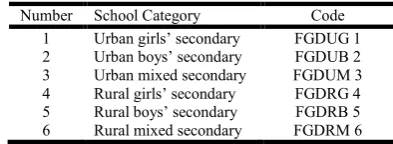
[image:3.595.61.258.410.482.2]The Study was carried in Uasin Gishu County, Kenya which has manifested the problem of lack of intercultural competence (Manyasi, 2012). The study adopted relativist-interpretivist philosophical paradigm (Creswell, 2009) with a qualitative multiple case study method. Purposive sampling was used to select six schools basing on school category. A total of sixty participants comprising 48 students and 12 teachers of English language were also purposively selected. The twelve teachers were linguistically diverse. The teachers were given code one to twelve for instance Interviewee 1/OB 1 up to Interviewee 12/OB12. Interviewee 1 /OB1 Luo (f), Interviewee2 /OB2 Luo (m), Interviewee 3/OB3 Sabaot (m), Interviewee 4/OB 4 Kamba (m), Interviewee 5/OB 5 Kisii (m), Interviewee 6/OB 6 Nandi (F), Interviewee 7/OB7 Sabaot (m), Interviewee 8/OB 8 Kamba (f), Interviewee 9/OB 9 Nandi (f), Interviewee 10/OB10 Keiyo(f), Interviewee 11/OB11 Luhya (f), Interviewee 12/OB12 Tugen (f), The codes used in students’ focused group discussions according to school categories whether girls, boys or mixed in both urban and rural contexts is presented in Table 1.
Table 1.Codes used to Indicate Sources of Data from Students’ Focused Group Discussions
Number School Category Code
1 Urban girls’ secondary FGDUG 1
2 Urban boys’ secondary FGDUB 2
3 Urban mixed secondary FGDUM 3
4 Rural girls’ secondary FGDRG 4
5 Rural boys’ secondary FGDRB 5
6 Rural mixed secondary FGDRM 6
Data related students and teachers’ ethnicity, e.g. mother-tongue, language spoken at home, religion, family economic status, social standing, method of teaching, availability of class study materials were generated through in-depth interviews with teachers of English language, focused group discussions with students, twelve English lessons were observed (two from each of the six schools) and teachers’ professional documents were analyzed. Based on learners’ classroom behavior, they were classified as either passive or active learners. Dynamics related to content, misconceptions about English language and class control were determined. Ethical considerations including permission to carry out the research was sought from relevant authorities (Jwan and Ong’ondo, 2011). Trustworthiness in research was observed by using four step criteria; internal validity, transferability, dependability and generalizability (Morrow 2005; Cohen et al, 2007; Creswell, 2009; Morse et al, 2002).
The data was coded, transcribed and analyzed qualitatively using emerging themes.
Findings of the Study
Results given in this section integrates findings from teacher interviews, students’ focused group discussions, observations and document analysis.
Cultural Dynamics Related to the Learner Characteristics
Passive Learners
Learners in the study area were from varied ethnic and linguistic communities including Kalenjin group (Keiyo, Marakwet, Nandi, Tugen and Kipsigis), Luhya, Kisii, Maasai, Kikuyu, Kamba and Luo. In addition, some learners were of Indian and Sudanese origin. From another perspective, Learners were of Christians, Muslims and Hindu religious faith. Based on cultural backgrounds, some learners were resistant to punishment by teachers for any wrong doing. The data suggests that generally Uasin Gishu County has both passive and active students who learn in distinct but different ways.Passive learners acquire knowledge without active effort towards the curriculum provided and are receivers of knowledge as provided by their teachers. It was observed that girls from Muslim community, Maasai and Kalenjinlinguistic groups were generally passive in English language classrooms. The school context, whether urban or rural did not increase learners’ participation in English language. The results of these observations are presented below.
Most of us Kalenjin girls are just quiet when people are talking, we are just there passive…when at home. In class we do not easily carry up our hands to answer a question. I have been thinking it is because of mother-tongue problem for instance calling a book a “puk”. Personally when at home with my parents I do not talk unless they ask me something. We have very little to share (Interviewee 6).
Thus in a typical classroom situation, one Kalenjin female teacher thought the students were quiet because they have low proficiency in English. She was not aware that this could be a cultural phenomenon but when she reflected on her experience and practice during the interview she realized that their quietness is due to culture. Similar observations were also made by Interviewee 7 who is a male Kalenjin concerning Maasai girls, but he too was not aware that quietness in class was cultural rather than out of fear to say wrong answers in class.
Another teacher from the same linguistic community seems to support the passiveness of girls from his community. He said:
The Nandi girls are very quiet just as required by culture. They really do not answer questions in class. But when you give continuous assessment test they score very high marks just like girls from other cultures like Kikuyu, Luo and Luhya in the same class.
The observation above seems to represent the correct view of the learners from theKalenjin society. This teacher was aware culture could contribute to shyness in class. In the student focused group discussions FGDRG4, FGDRB5 and FGDRM6 emphasized the effect of this cultural value on their learning of English language. One of the groups said:
The circumcised men should be respected by using respectful language. We need to observe our behavior when talking to them and teachers as well because it is part of respect we give to the teachers (FGDRG 4).
A teacher observed that the passiveness results from the fact that some communities do not provide equal chances to boys and girls to air their views in a discussion. However, he pinpoints that Kalenjin girls who have embraced urban culture are not like their rural counterparts because they participate in class discussion. He thus said:
When a Kalenjin girl child grows up in rural set up where she is not provided with opportunities to come out forcefully, they become passive unlike their counterparts whogrow up in town who are outgoing. For passive girls I literally hold hands of passive girls in my class, ask them what they think, use discussions and class presentations to involve them. During discussions, I choose on anybody to present. I use strategies for instance pair work which allows me to encourage the passive learners to participate (Interviewee 2).
According to the findings, even boys from Kalenjin
communities are passive learners. Interviewee 3 who teaches in a boys’ school said:
We have students from different tribes associated with different cultures… I have realized that Kalenjin boys are passive. They do not come out to tell the class what they know but when you call them by name, they give you the correct answer (Interviewee 3).
In total, although Kalenjin boys and girls are passive learners in English language lessons, the boys are active outside the class. Interviewee 5 said:
Both Nandi boys and girls are passive in class. However, Nandi boys are active outside class. They want to know much especially after class. The girls do not say much in class and do not go to their English teacher for consultation like the boys.
In total, both Kalenjin boys and girls are passive learners and this could influence the way they learn and methods of teaching adopted by teachers.
Active Learners
Active learners engage with the curriculum provided for meaningful learning through listening, speaking, reading, writing, discussion and problem solving which promote acquisition of higher order skills like analysis, synthesis and evaluation. In this study, learners from Luhya, Kisii, Kikuyu, Kamba, Luo, Somali boys, Sudanese, Maasai boys and Indians were found to be active learners. According to teachers this category of learners has characteristics like they talk a lot, require preciseness from the teacher, embrace learner centered methods of teaching and learning, hardworking and are determined, goal oriented, high motivation and some were regarded as indisciplined.
First, they are willing to learn, ask questions, motivated and welcome any teaching methodology and strategies that the teacher decides to employ. One of the teachers when elaborating on this fact said:
Students from Luhya, Kisii, Kamba, Kikuyu and Luos cultural backgrounds are willing to speak to the teacher. They are happy to try out new teaching methodologies and strategies. They even smile back at the teacher when corrected (Interviewee 9).
This motivates the teacher even to try new methods and strategies and optimum learning then takes place because both the teacher and the learners are motivated.
Second, participation of both boys and girls is equal. Some learners are also go getters and will not stop at anything until they achieve their goal. A comment by the teacher on one of the linguistic communities could help to elaborate this observation:
Learners from Luo linguistic community, both boys and girls, are active. If there is a question they have not understood, they insist and persist until they understand. They are good in spoken English. They find it easy to speak English; although they have problems in written English just like the rest of the students from other cultures (Interviewee 5).
Even though the teacher seems to be happy with the Luo learners, this could be culture stereotyping which could be detrimental and lead to poor performance in English language because most teachers will assume that all of them are good in spoken English.
Indian learners also actively participate in class. Interviewee 5 said:
Indian learners are friendly, ready to learn and the most disciplined. They like discussions and class presentations. They have realized that there is competition and they are not the best so they really work hard (Interviewee 5).
Interviewee 5 observed that Indian learners are motivated to learn, embrace learner centered methodology and are the most disciplined; which could be a cultural value in their community.
Cultural Dynamics Related to Instructional Materials, Teaching Methods and Strategies
Teachers reported that they face challenges in teaching passive learners. These learners seem not to embrace teaching and learning resources (pictures, manila papers and realia), communicative language teaching methods (discussion, task based) and strategies (oral drills). First, Interviewee 10 observed:
Culture affects how I choose the teaching and learning resources (Interviewee 10).
Here we see clearly the mismatch of culture and certain teaching materials used to illustrate certain aspects of English language. This could affect learning of the language.
Culturally enforced submissiveness of girls to boys in certain communities could also affect teaching methods or learning strategies. Teachers reported that passive girls are also submissive to boys from their cultures during group discussions (Interviewee 1, 5, 8, 11 and 12). For example Interviewee 8 voiced her concern about the submissive nature of the Kalenjin, Maasai girlsand Muslim religious girls:
Cultures are similar and different there are cultures which socialize girls as inferior to boys. For example among the
Kalenjin communities and Muslim religious cultures, the girls are expected to be submissive to boys. And this we have noticed during discussion groups especially when they are from the same culture and religion.
Teaching strategy for instance oral drills is not appealing to Kalenjin learners because of their cultural background. A teacher thus said:
There are some male students in my class who when corrected on pronunciation of a vocabulary, are reluctant to repeat the correct pronunciation of the word. They imagine as a female teacher I have no right to correct them. I avoid engaging such learners who will affect my mood and hold the class captive (Interviewee 9).
Interviewee 10 had similar observations:
According to the Kalenjin culture, the boys believe they are men. They are beyond childish kind of acts. I do not use manila papers showing them how to pronounce words, stress patterns and intonation. When I feel that pronunciation affects how they read, sometimes I can correct them here and there. But when I correct a student twice, sometimes they might refuse to answer because they will think that I am demeaning them. I use lecture method to some extent but sometimes I use group work to force them talk but they are not free (Interviewee 10).
It was established that Passive learners do no embrace communicative teaching methods as observed by many teachers. Interviewee 11 said:
I do not know whether it is learners’ cultures or their personality. They do not like coming to the front and presenting. They do not participate in discussion even when you put them in groups they prefer to remain quiet. In a group of ten, nine will say they did not do the work but one will say I tried. It means they like individual work. They prefer individual assignments even if you group them. I tend to think they prefer being passive and do individual work. The learners only discuss when the teacher is in class but when given work to discuss on their own, they do not discuss (Interviewee 11).
Interviewee 12 concurred with above observations and said:
They do not like group work or oral questions so they just keep they quite.
At the end of the day you are forced to answer the questions. In my class I have 45 students but when I use whole class discussion, the discussion is dominated by two or three students. It’s a culture I do not know. Students from Kalenjin
community are passive and withdrawn.
According to the above observations, these learners rarely carry up their hands to answer a question in class but this does not mean that they do not know the answer. Sometimes they may not know the answer. This cultural value could pose challenges to teachers who would want to use interactive and communicative teaching approach as a strategy to teach English language. However, a teacher explained the reason why learners may not raise up their hands:
We the Kalenjin we are brought up not to be boastful. You do not have to show the whole world that you know (Interviewee 3).
Cultural Dynamics Related to Classroom Management
Culture may make classroom management a challenge. In focused group discussions with learners it became clear that there is conflict between learners’ cultures with the type of punishments administered in schools. Learners were reluctant to undertake certain punishments such as mopping classrooms because of cultural beliefs. For example a Maasai male learner said:
In the Maasai community after initiation boys are warriers. When a prefect beats me, I am supposed to protect myself but the school rules say if I fight a prefect I will be suspended. This annoys me because am not able to practice my culture. Female teachers use abusive language like ‘stupid’ when they are angry and may even slap you. This is not right because females are inferior in the community. They are supposed to respect me. The Maasai boys should be given manual work to do outside because when a teacher slaps me, it does not matter whether male or female because my culture demands that l protect myself. As for the Maasai you are given some work outside not beating me because if she slaps me, it is an insult because as a warrier am not supposed to be slapped (FGDUB2).
The conflict between punishment and learners’ cultural beliefs was also reported among boys from the Kalenjin communities which can bring confrontation between teachers and students and make teaching and learning of English as well as other subjects difficult. One of the focused group discussions reported that:
However, learners from Luo linguistic community reported that they preferred corporal as opposed to manual punishment. They said, “For the Luo it is better caning than giving punishment like weeding flowers and washing dining hall because they will make you dirty. I would rather be caned but remain clean (FGDUB2).”
On the other hand learners from the Luhya community said they did not mind manual or corporal punishment.
This narrative brings out two pertinent issue of classroom management. First, some of the observations by learners may be cultural but could be misconstrued by teachers as rudeness. Second, some of the observations could come from sheer rudeness of the students. When a learner makes a mistake, the teacher should really establish the real cause of behaviour before punishing.
Second, Interviewee 6 agreed that Somali male learners are active. However, she seems to suggest that they are indisciplined when the teacher wants to punish them. She said:
The Somali boys I have in my class are active. They do not agree to be punished. They think teachers are on the wrong and they are right. Those who misbehave we have no choice but to expel. I do not know whether it is culture or religion (Interviewee 6).
A similar case of indiscipline among the male Somali linguistic learners was reported by Interviewee 2, 5, 6, 7 and 8. This is what one of them had to say:
Male learners from Somali community are not as disciplined as the Indians. They are very disturbing and tough. They are the ones who disturb most, talk most and have assault cases. They use physical might instead of engaging their minds. Some have been suspended and others expelled. Sometimes they can fight a teacher, throw a hand at you and answer questions as they want. They are unpleasant. We are trying to understand them…What I do is to engage them and insist that they do what I want and not what they want. Sometimes they misbehave but I assume and ignore them. They sometimes need to be recognized. When I ignore them, they cool down and do what others are doing. They like talking in Somali and group together. They talk in mother tongue but when you try to find out who has spoken, they will not tell you the person. Their culture is patriarchal in away. Their religion also affects them and they think Christians are not doing the right thing. And they think you are against them or their religion. They are tough. They have misconception that teachers are against them (Interviewee 5).
Cultural Dynamics Related to Learners’ Perceptions of ELT Content
English language sound system was problematic to several learners in the schools visited. Mother-tongue dominance was indicated in all school categories as an important factor affecting learning of English language. Teachers reported that
many learners were shy to speak in class because of mother-tongue dominance.
Learners also agreed that mother- tongue dominance influence how they pronounce words. One of the teachers said:
We do not pronounce the words the way they are pronounced in Standard English because of mother-tongue influence. For example sounds like [l, r] are mixed depending on the cultural community of the teacher or student (Kikuyu). Pronunciation of sounds like [n, d] the teacher might add [n] where it is not supposed to be (Meru). When pronouncing [b] the teacher might add [m] or eliminate what should be there (Kamba). Other people have problems pronouncing [p, b] (Kalenjin). In Kamba culture the challenge is on [n, d, k, m, b, x, s]. Those are the most difficult sounds unless you are conscious about them; they will influence your pronunciation (Interviewee 8).
This is an indication that mother-tongue is indeed a problem in teaching and learning of English language even from the teacher’s point of view. The students also had the same sentiments. They said:
We might not be able to pronounce a word well because of our first language which is our mother-tongue (FGDRB 5).
Another student concurred that mother-tongue is indeed a problem because it is the language they use all the time when they are at home thus lack opportunity to practice speaking English language. This is what one of the student groups said:
In our cultures we can say that mother-tongue affect us as students. Our grandparents teach us in mother tongue. We only speak English and Kiswahili in school. This makes us not to speak good English (FGDRG 4).
Due to low proficiency in English language, learners code switch to Kiswahili during English language lessons. This was reported by focused group as follows:
The teachers should allow us to talk in Kiswahili and English language especially when we do not know the new vocabulary in English. There are some words which we do not know how to pronounce because of our mother - tongue so this makes us not to like teacher telling us to pronounce certain English words (FGDRB5).
According to the students, some teachers are not good role models for their learners. This is because after teaching vocabulary, they ask learners to say the meaning of the word in their mother-tongues as it was observed by one of the students:
Our teacher after teaching vocabulary, he asks us to say the vocabulary in our mother tongues and their meanings. This makes learning fun (FGDUG1).
The teacher uses groups but they are based on ability so that those who are fluent can help the less fluent ones can improve (FGDRG4).
I observed that the students laugh at their fellow students who have mother-tongue dominance in English lessons. This poses instructional challenge to the teacher because the learners with low proficiency in spoken English might not embrace communicative strategies to enhance their use of English language.
Cultural Dynamics Related to the Learners’ Perceptions of English Language
It was reported that students have misconceptions about English language. Some of them think that it is feminine and an easy subject. Some of the teachers believed that these two factors partially contribute to low learning and performance in English language. Four teachers were overt about this fact (Interviewee 4, 9, 10 and interviewee11):
In this school the entry behavior is 350 marks and above out of 500 so the students come mainly from the middle class. They have some knowledge about English Language so I do not start from scratch. During private studies they revise for mathematics and sciences and believe English is easy so they do not revise and end up failing. I told them that they needed to invest in English language as much as they do with other subjects. When I came to this school, students believed that poetry was hard especially in English paper two. But now they do well in poetry because of changed attitude. The trend has changed so that learners perform well in English. I have recorded good grades and I am very happy (Interviewee 4).
Another teacher concurred with the above sentiments and said:
My learners do not bother themselves so much studying English language because it is difficult. They feel they can pass other subjects and therefore do not have to struggle with a difficult subject like English (Interviewee 10).
Another misconception reported by teachers was that English Language is feminine. This was clearly stated by Interviewee 9 who said:
My students believe that English language is a girl subject. Also this misconception is reinforced when students see that English department has many female teachers. They believe that boys’ subjects are Mathematics, Physics, Chemistry and Biology. And also it is based on the assumption of how important a subject is to their later occupation (Interviewee 9).
Interviewee 11 also was concerned and agreed with other teachers and said:
When it comes to English language and it is mainly taught by female teachers, the boys see the language as feminine. This misconception therefore affects the boy child negatively while encourages girls to put more effort in studying English language.
English language is neither easy nor feminine. It is a subject like others and should be treated with the seriousness it deserves since it is an important language used across the curricula. Teachers should encourage boys that English is a career subject like any other for both boys and girls.
DISCUSSION
Cultural Dynamics Related to Personality Passive learners
In the present study it was observed that learners come from highly patriarchal societies such as the Kalenjin tribe which includes, Nandi, Tugen, Kipsigis, Keiyo, Marakwet, Sabaot and Maasai communities have unique characteristics which included rote learning, quietness in classroom and only talk when called by name, low participation in class discussions, lack fluency in English language, embrace individual work, observe protocol and were overly respectful of their teachers. In general, these characteristics are derived from deep cultural values which encourage a top down communication approach. This presumably has led to the learners’ passiveness and consequently a reduction in their communicative competence.
The challenge that the teachers face with passive learners is their lack of participation in classroom activities which forces the teacher to do everything and discourages them from adopting communicative teaching methods which is recommended for improving fluency and communicative competence (Aydogan and Akbarov, 2014). A similar conclusion was arrived at by Dogancay- Aktuna (2005) and Ho
et al., (2004) who found that the teachers could not implement communicative language teaching approaches when dealing with passive learners who are unable to participate in classroom activities. Similarly, a study done in Canada by Rowsell et al. (2007) attributed the shyness of English second Language (ESL) learners to their culture, gender or personality. A teacher at Walker public school said:
Well just the example that I gave, I guess, with the female in my class who is very shy and knowing that giving her that space is important because in her culture women aren’t always necessarily given those opportunities to speak up or expected to speak up and participate as often (Rowsell et al, 2007:152).
It is important for teachers to know the learner types present in their classrooms. Teachers should employ culturally relevant pedagogy which requires that they understand their learners’ culture related issues and linguistic backgrounds so that they design instruction that better meet their needs. This is done by building on their cultural knowledge, prior experiences and frames of references, learning styles and achievement thus learning becomes more relevant (http://ejlts.ucdavis.edu retrieved on 3rd March 2013).
Similar recommendation was made by Luo (2014) for Chinese students who are mainly passive learners. In addition, they could be made to speak by giving them leadership roles in the group discussions, debates, drama among others. The teacher could employ different strategies to take care of them.
Active Learners
In this study the active learners comprised of Kikuyu, Luo, Kisii, Luhya, Kamba, Somali boys, Maasai boys, Sudanese and Indians. These learners participated in the learning process by actively deconstructing knowledge, embrace communicative methods of teaching including teacher-centered methods. A similar observation was made by Methitham (2014) who reported that learners with British cultural backgrounds are active thus Communicative Language Teaching (CLT) approaches are used effectively to teach them English Language. This is in line with the qualitative research where one deconstructs knowledge using the prior experiences to give new knowledge. This finding seems to disagree with the research done by Ho et al., (2004) who found that African learners are passive. Based on the findings of the current study, it can be asserted here that Kenyan learners have mixed learning styles and characteristics of both collectivist and individualist cultures and are made up of passive and active characteristics. Although, they do not positively associate with what is new because their cultures hold them back, there are those learners from a number of linguistic communities who associate themselves with what is new in the society. Teachers could plan to use the learner centered approaches to help spark and maintain their motivation throughout English lesson.
Misconceptions about English language
English language is “easy” or “difficult”. In this study it was found that male students did not like learning English because of misconception that it is easy, or difficult and feminine. These misconceptions lead to negative attitude towards English language learning. According to Zheng (2009) teachers should discuss with learners their beliefs about English language in order to correct the misconceptions. This could help the students to have positive attitude towards the subject and how they learn.In order to alleviate the misconceptions above, schools could encourage learners to participate in activities: drama, debates, and interclass competition in English language among others. English language teachers could also strive to ensure that the language experiences of their learners are positive by telling their learners their expectation, be caring, committed, respect their learners, motivate their students, provide calm and safe classroom environment (Borg, 2003).
English Language is “Feminine”. Student associated English language with the female gender because language departments in schools have many female teachers and in some of the departments all teachers of English are female. This observation is consistent with that of Norton and Pavlenko (2004) in Japan where many young women than men consider English to be intrinsically linked to being feminine and are motivated to learn it as a language of empowerment. Teachers of English language and language educators should encourage
male students to see English language as any other professional subject and not as oneonly meant for women
Teacher – Learner Expectation
Mismatch between teacher expectations and learner expectations in English language could lead to learners disinterest in the subject. In the study, the strategy of error correction, testing, using oral drills and resources for instance realia, charts and pictures conflicted with students cultural backgrounds. This concurs with research done by Schulz (1996) as cited in Borg (2003) which explored teachers and student attitudes towards the role of grammar and corrective feedback resulting in mismatch between teachers’ and students’ views about error correction. Teachers should find out what the learner expectations are and compare them with their own so that they match hence enhance academic outcome.Mwamba (2005) found out that learners kept passive in class due to low proficiency in English language. Teachers employed strategies for instance reading aloud events and looking for word meaning in the dictionary. This helped learners in vocabulary development according to Schmitt, (2000). Teachers’ reasons for adopting reading aloud was due to lack of enough textbooks and also because learners did not read when given assignments. Teachers were not also aware that reading aloud helps in vocabulary development. Discussions were not embraced by the learners and this was also because of their nature of being passive thus embraced individual work.
Conclusion
management difficult or did not provide learners with adequate opportunities to practice with English language in context leading to poor performance.
Recommendations
Based on the findings the following recommendations are made
Teachers should navigate the cultural labyrinth of their learners and change their tact to help learners despite their diverse cultural backgrounds to improve their academic learning outcomes.
Change in policy by K. I. C. D designing a cultural syllabus and review the 2002 English language syllabus to make it culturally relevant for learners.
The recommended resource materials could also include cultural aspects that inculcate intercultural competence in learners.
The subject panels at the Kenya Institute for Curriculum Development could also be culturally representative.
REFERENCES
Abidin, M. J. Z., Rezaee, A. A., Abdullah, H. N. and Singh, K. K.B. 2011. Learning Styles and Overall Academic Achievement in A Specific Educational System.
International Journal of Humanities and Social Science, 1(10): 143 – 152.
Arslan, F. K. and Arslan, A. 2012. Culture in Language Teaching. Contemporary Online Language Education Journal (COLEJ), 2 (2): 29-44.
Aydogan, H. and Akbarov, A. A. 2014. The Role of Gender, Age, Academic Achievement, LLS and Learning Styles at Tertiary Level in EFL Classes in Turkey. Journal of Second and Multiple Language Acquisition- JSMULA, 2 ( 2): 11-24.
Barasa, P. L. 2005. English Language Teaching in Kenya Policy, Training and Practice. Eldoret: Moi University Press.
Barjesteh, H. and Vaseghi, R. 2012. Acculturation Model for L2 Acquisition: Review and Evaluation. Advances in Asian Social Sciences (AASS), 2(4). World Science Publisher, United States.
Borg, S. 2003. Teacher Cognition in Language Teaching: A Review of Research on What Language Teachers’ Think, Know, Believe and Do. ELT Journal, 36:. 81-109.
Borg, S. 2006. Teacher Cognition and Language Education
Research and Practice. London: Continuum.
Chinh, N. 2013. Cultural Diversity in English Language Teaching: Learners Voices. English Language Teaching; 6 ( 4).
Cohen, L. Manion, L. and Marrison, K. 2000. Research
Methods in Education. London: Routledge Falmer.
Creswell, J. W. 2009. Research Design: Qualitative, Quantitative and Mixed Methods Approaches. New Delhi: SAGE Publications, Inc.
Derderian-Aghajarian, A. and Cong, W.C. 2012. How Culture Affects on English Language Leraners (ELL’S) Outcomes, with Chinese and Middle Eastern Immigrant Students.
International Journal of Business and Social Science, 3(5).
Dogancay- Aktuna, S. 2005. Intercultural Communication in English Language Teacher Education. ELT Journal, 59/2. El- Hassan. 2011. The Portrayal of Local and the International
Cultures in Sudanese English Language Syllabus (SPINE).
Global Journal of Human Social Science, 11 (7).
Eun, B. and Lim, H.S. 2009. A Sociocultural View of Language Learning: Importance of Meaning Based Instructions. TESL CANADA Journal/ Revenue Tel Du Canada, 27 (1).
Fang F. 2010. A discussion on developing students’ communicative competence in English Language in China.
Journal of language teaching and research 1 (2) :111-116. Gudu, B. O. 2015. Teaching Speaking Skills in English Language Using Classroom Activities in Secondary School Level in Eldoret Municipality, Kenya. Journal of Education and Practice, 6 (35).
Gudu, B. O., Barasa, P. L. and Omulando, C. 2014. Teaching Speaking Skills: Challenges of Using Integrated Approach in Secondary Schools in Kenya. Journal of Education and Practice, 5 (31).
Hammond, C. 2007. Culturally Responsive Teaching in the Japanese Classroom: A Comparative Analysis of Cultural Teaching and Learning Styles in Japan and United States:
Journal of the Faculty of Economics, K.G.V., 17.
Hermeka V. 2009. Low Speaking performance in learners of English. Bachelor Thesis. Masaryk University Brno Faculty of Education
Ho, E., Holmes, P. and Cooper, J. 2004. Review and evaluation of International Literature on Managing Cultural Diversity in the Classroom. The University of Waikato. Jwan, J. O. and Ong’ondo, C. O. 2011. Qualitative Research:
An Introduction to Principles and Techniques. Eldoret: Moi University Press.
Kenya Institute of Education. 2002. Secondary School Education Syllabus Volume One Subjects: English, Kiswahili, Physical Education, Arabic, French and German. Nairobi: Kenya Institute of Education.
Luk, J. 2012. Teachers’ Ambivolence in Integrating Culture with EFL Teaching in Hong Kong. Language, Culture and Curriculum, 25(3): 249-264.
Luo, J. 2014. A Study of Mother Tongue Interference in Pronunciation of College English Learning in China.
Theory and Practice in Language Studies, 4 (8): 1702- 1706.
Manyasi, B. 2012. English Language Teachers’ Cognition of the Teaching of Reading for Nationhood. A study of Secondary School Teachers in Uasin Gishu County in Kenya. Eldoret: Moi University Press Unpublished Doctor of Philosophy Thesis.
Methitham, P. 2014. Survey The landscape of ELT in Thailand: Offering New Possibility for Change. WEI International Academic Conference Proceedings.
Morrow, S. L. 2005. Quality and Trustworthiness in Qualitative Research in Counseling Psychology. Journal of Counseling Psychology, 52 (2): 250 -260.
Morse, J. M., Barrett, M., Mayan, M., Olsen, K. & Spiers, J. 2002. Verification Strategies for Establishing Reliability and Validity in Qualitative Research. International Journal of Qualitative Methods, 1 (2).
Kenyan Secondary Schools: A Case of Kisii District. Eldoret: Moi University Press.
Norton, B. & Pavlenko A. (Eds) 2004. Gender and English
Language Learners. Alexandria, Va: TESOL.
Ong’ondo, C. O. 2010. Pedagogical Practice and Support of English Language Student Teachers: during the
Practicum. Saarbruke: Lambart Academic Publishing.
Pineiro, M.E. (2002). Oral communicative competence in English language at the completion of compulsory education. Level of achievement and conception of Galician community students’. Cause No. 25. Revista de Filogia y su diductica, p533-561
Pratt-Johnson, Y. 2006. Communicating Cross- Culturally: What Teachers should Know. The Internet TESL Journal, Xii (2).Printer.
Republic of Kenya. 2010. The Proposed Constitution of
Kenya. Nairobi: Government
Rowsell, J. S. and Blaney, J. 2007. Losing Strangeness: Using Culture to Mediate ESL Teaching. Language Culture and Curriculum, 20 (2).
Schmitt, N. 2000. Vocabulary in Language Teaching. USA: Cambridge University Press.
Schulz, R. A. 1996. Focus on Form in the Foreign Language Classroom: Students’ and Teachers’ Views on Error Correction and the Role of Grammar. Foreign Language Annals, 29 (3): 343 – 64.
Shenton, A. K. 2004. Strategies ensuring Trustworthiness in Qualitative Research Projects. Education for Information,
22: 63-75.
Wong, K. K. J. 2004. Are the Learning Styles of Asian International Students Culturally or Contextually Based?
International Educational Journal, 4(4): 154-166.
Zheng, H. 2009. A Review of Research on EFL- Pre-service Teachers’ Beliefs and Practices. Journal of Cambridge Studies, 4 (1): 73-81.