371
De-Mixing Sentiment from Code-Mixed Text
Yash Kumar Lal∗† Vaibhav Kumar∗‡ Mrinal Dhar∗◦
Manish Shrivastava Philipp Koehn†
†Johns Hopkins University,‡Carnegie Mellon University,◦Bloomberg LP,
International Institute of Information Technology
{yash, phi}@jhu.edu,
[email protected], [email protected], [email protected]
Abstract
Code-mixing is the phenomenon of mixing the vocabulary and syntax of multiple languages in the same sentence. It is an increasingly common occurrence in today’s multilingual society and poses a big challenge when en-countered in different downstream tasks. In this paper, we present a hybrid architecture for the task of Sentiment Analysis of English-Hindi code-mixed data. Our method consists of three components, each seeking to allevi-ate different issues. We first generate sub-word level representations for the sentences using a CNN architecture. The generated representations are used as inputs to a Dual Encoder Network which consists of two dif-ferent BiLSTMs - the Collective and Spe-cific Encoder. The Collective Encoder cap-tures the overall sentiment of the sentence, while the Specific Encoder utilizes an atten-tion mechanism in order to focus on individ-ual sentiment-bearing sub-words. This, com-bined with a Feature Network consisting of or-thographic features and specially trained word embeddings, achieves stateoftheart results -83.54% accuracy and 0.827 F1 score - on a benchmark dataset.
1 Introduction
Sentiment Analysis (SA) is crucial in tasks like user modeling, curating online trends, running po-litical campaigns and opinion mining. The major-ity of this information comes from social media websites such as Facebook and Twitter. A large number of Indian users on such websites can speak both English and Hindi with bilingual proficiency. Consequently, English-Hindi code-mixed content has become ubiquitous on the Internet, creating the need to process this form of natural language.
Code-mixing is defined as ”the embedding of linguistic units such as phrases, words and
mor-∗
Equal Contribution
phemes of one language into an utterance of an-other language” (Myers-Scotton, 1993). Typi-cally, a code-mixed sentence retains the underly-ing grammar and script of one of the languages it is comprised of.
Due to the lack of a formal grammar for a code-mixed hybrid language, traditional approaches don’t work well on such data. The spelling vari-ations of the same words according to different writers and scripts increase the issues faced by tra-ditional SA systems. To alleviate this issue, we introduce the first component of our model - it uses CNNs to generate subword representations to provide increased robustness to informal pecu-liarities of code-mixed data. These representations are learned over the code-mixed corpus.
Now, let’s consider the expression: x but y, where x and y are phrases holding opposite sen-timents. However, the overall expression has a positive sentiment. Standard LSTMs work well in classifying the individual phrases but fail to effec-tively combine individual emotions in such com-pound sentences (Socher et al.,2013). To address this issue, we introduce a second component into our model which we call the Dual Encoder Net-work. This network consists of two parallel BiL-STMs, which we call the Collective and Specific Encoder. The Collective Encoder takes note of the overall sentiment of the sentence and hence, works well on phrases individually. On the other hand, the Specific Encoder utilizes an attention mechanism which focuses on individual sentiment bearing units. This helps in choosing the correct sentiment when presented with a mixture of senti-ments, as in the expression above.
training examples as compared to established ap-proaches.
We perform extensive experiments to evaluate the effectiveness of this system in comparison to previously proposed approaches and find that our method outperforms all of them for English-Hindi code-mixed sentiment analysis, reporting an accu-racy of 83.54% and F1 score of 0.827. An ablation of the model also shows the effectiveness of the in-dividual components.
2 Related Work
Mohammad et al.(2013) employ surface-form and
semantic features to detect sentiments in tweets and text messages using SVMs. Keeping in mind a lack of computational resources,Giatsoglou et al.
(2017) came up with a hybrid framework to ex-ploit lexicons (polarized and emotional words) as well as different word embedding approaches in a polarity classification model. Ensembling sim-ple word embedding based models with surface-form classifiers has also yielded slight improve-ments (Araque et al.,2017).
Extending standard NLP tasks to code-mixed data has presented peculiar challenges. Meth-ods for POS tagging of code-mixed data obtained from online social media such as Facebook and Twitter has been attempted (Vyas et al., 2014) . Shallow parsing of code-mixed data curated from social media has also been tried (Sharma et al.,
2016). Work has also been done to support word level identification of languages in code-mixed text (Chittaranjan et al.,2014).
Sharma et al.(2015) tried an approach based on
lexicon lookup for text normalization and senti-ment analysis of code-mixed data. Pravalika et al.
(2017) used a lexicon lookup approach to per-form domain specific sentiment analysis. Other attempts include using sub-word level composi-tions with LSTMs to capture sentiment at mor-pheme level (Joshi et al., 2016), or using con-trastive learning with Siamese networks to map code-mixed and standard language text to a com-mon sentiment space (Choudhary et al.,2018).
3 Model Architecture
An overview of this architecture can be found in Figure3. Our approach is built on three compo-nents. The first generates sub-word level repre-sentations for words using Convolutional Neural Networks (CNNs). This produces units that are
more atomic than words, which serve as inputs for a sequential model.
In Section 3.2, we describe our second com-ponent, a dual encoder network made of two Bi-directional Long Short Term Memory (BiLSTM) Networks that: (1) captures the overall sentiment information of a sentence, and (2) selects the more important sentiment-bearing parts of the sentence in a differential manner.
Finally, we introduce a Feature Network, in Section3.3, built on surface features and a mono-lingual vector representation of the sentence. It augments our base neural network to boost classi-fication accuracy for the task.
3.1 Generating Subword Representations
Word embeddings are now commonplace but are generally trained for one language. They are not ideal for code-mixed data given the transcription of one script into another, and spelling variations in social media data. As a single character does not inherently provide any semantic information that can be used for our purpose, we dismiss character-level feature representations as a possible choice of embeddings.
Keeping in mind the fact that code-mixed data has innumerable inconsistencies, we use charac-ters to generate subword embeddings (Joshi et al.,
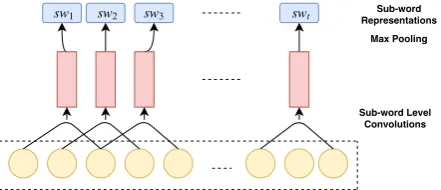
2016). This increases the robustness of the model, which is important for noisy social media data. Intermediate sub-word feature representations are learned by filters during the convolution operation.
sw1 sw2 swt RepresentationsSub-word
Max Pooling
Sub-word Level Convolutions
[image:2.595.308.529.526.621.2]sw3
Figure 1: CNNs for Generating Sub-Word Representa-tions
mapfsw.
fsw[i] =g((S[:, i:i+m−1]∗F) +b) (1)
Here, S[:, i : i+m−1] is a matrix of (i)th to
(i+m−1)th character embeddings andg is the ReLU activation function. Thereafter, a final max-pooling operation overpfeature maps generates a representation for individual subwords:
swi =max(fsw[p∗(i:i+p−1)]) (2)
A graphical representation of the architecture can be seen in Figure1
3.2 Dual Encoder
We utilize a combination of two different encoders in our model.
3.2.1 Collective Encoder
The collective encoder, built over a BiLSTM, aims to learn a representation for the overall sentiment of the sentence. A graphical representation of this encoder is in Figure 2(A). It takes as input the subword representation of the sentence. The last hidden state of the BiLSTM i.e. ht, encapsulates the overall summary of the sentence’s sentiment, which is denoted bycmrc.
3.2.2 Specific Encoder
The specific encoder is similar to the collective en-coder, in that it takes as input a subword repre-sentation of the sentence and is built over LSTMs, with one caveat - an affixed attention mechanism. This allows for selection of subwords which con-tribute the most towards the sentiment of the input text. It can be seen in Figure2(B).
Identifying which subwords play a significant role in deciding the sentiment is crucial. The spe-cific encoder generates a context vector cmrs to this end. We first concatenate the forward and backward states to obtain a combined annotation
(k1, k2, . . . , kt). Taking inspiration from (Yang
et al.,2016), we quantify the significance of a sub-word by measuring the similarity of an additional hidden representationuiof each sub-word against a sub-word level context vectorX. Then, a nor-malized significance weightαiis obtained.
ui=tanh(Wiki+bi) (3)
αi =
exp(uTi X)
P
exp(uTiX) (4)
The context vectorXcan be looked at as a high-level representation of the question ”is it a signif-icant sentiment-bearing unit” evaluated across the sub-words. It is initialized randomly and learned jointly during training. Finally, we calculate a vec-torcmrsas a weighted sum of the sub-word anno-tations.
cmrs=Xαiki (5)
Using such a mechanism helps our model to adap-tively select the more important sub-words from the less important ones.
3.2.3 Fusion of the Encoders
We concatenate the outputs obtained from both these encoders and use it as inputs to further fully connected layers. Information obtained from both the encoders is utilized to come up with a unified representation of sentiment present in a sentence,
cmrsent= [cmrc;cmrs] (6)
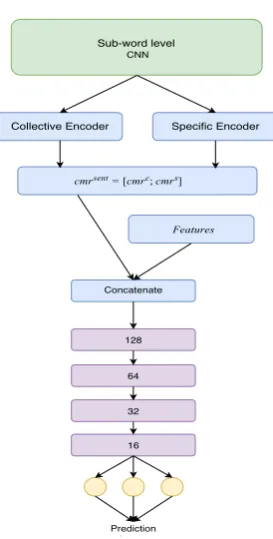
where cmrsent represents the unified representa-tion of the sentiment. A representarepresenta-tion of the same can be found in Figure3.
3.3 Feature Network
We also use linguistic features to augment the neu-ral network framework of our model.
• Capital words: Number of words that have only capital letters
• Extended words: Number of words with mul-tiple contiguous repeating characters.
• Aggregate positive and negative sentiments: Using SentiWordNet (Esuli and Sebastiani,
2006) for every word bar articles and con-junctions, and combining the sentiment po-larity values into net positive aggregate and net negative aggregate features.
• Repeated exclamations and other punctua-tion: Number of sets of two or more contigu-ous punctuation.
• Exclamation at end of sentence: Boolean value.
• Monolingual Sentence Vectors: Bojanowski
et al. (2017)’s method is used to train word
sw1 sw2 sw3 swt
←
ht
cmrc=ht
←
h1
←
h2
←
h3
Sub-word Representations BiLSTM Layer
sw1 sw2 sw3 swt
cmrs= t ∑ i= 1
αiki
←
k1
Sub-word Representations BiLSTM Layer Representation of the Specific Sentiment of the Sentence
α1 α2 α3 αt Attention Weights
(A) Collective Encoder Models the overall sentiment of the sentence
(B) Specific Encoder Models the specific sentiments of the sentence
→
ht
→
h1
→
h2
→
h3
Representation of the Collective Sentiment of the Sentence
←
k2
←
k3
←
kt
→ k1
→ k2
→ k3
[image:4.595.82.524.67.220.2]→ kt
Figure 2: Parts of the Dual Encoder Network
Method Accuracy F1-score
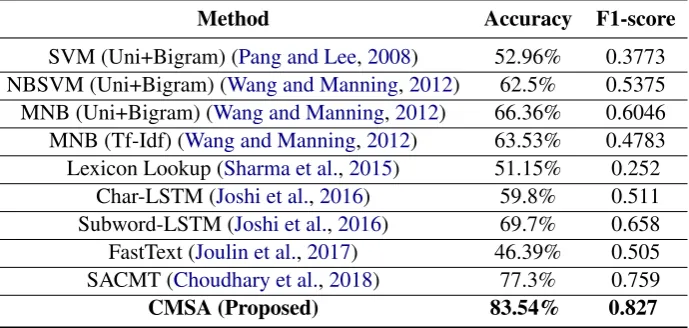
SVM (Uni+Bigram) (Pang and Lee,2008) 52.96% 0.3773 NBSVM (Uni+Bigram) (Wang and Manning,2012) 62.5% 0.5375 MNB (Uni+Bigram) (Wang and Manning,2012) 66.36% 0.6046 MNB (Tf-Idf) (Wang and Manning,2012) 63.53% 0.4783 Lexicon Lookup (Sharma et al.,2015) 51.15% 0.252
Char-LSTM (Joshi et al.,2016) 59.8% 0.511 Subword-LSTM (Joshi et al.,2016) 69.7% 0.658 FastText (Joulin et al.,2017) 46.39% 0.505 SACMT (Choudhary et al.,2018) 77.3% 0.759
CMSA (Proposed) 83.54% 0.827
Table 1: Comparing against previous approaches
3.4 CMSA
The entire model is shown in Figure3. Sub-word representations are fed into both the specific and the collective encoder. The outputs of the encoders are concatenated with each other, and further with the result of the Feature Network. Subsequently, these are passed through multiple fully connected layers to make the prediction. This architecture allows us to capture sentiment on the morphemic, syntactic and semantic levels simultaneously and learn which parts of a sentence provide the most value to its sentiment.
This system enables us to combine the best of neural networks involving attention mechanisms with surface and semantic features that are tradi-tionally used for sentiment analysis.
4 Experiments And Results
4.1 Dataset
We use the dataset released by (Joshi et al.,2016). It is made up of 3879 code-mixed English-Hindi
sentences which were collected from public Face-book pages popular in India.
4.2 Baselines
We compare our approach with the following:
• SVM (Pang and Lee, 2008): Uses SVMs
with ngrams as features.
• NBSVM(Wang and Manning, 2012): Uses
Naive Bayes and SVM with ngrams as fea-tures.
• MNB (Wang and Manning, 2012): Uses
Multinomial Naive Bayes with various fea-tures.
• Lexicon Lookup(Sharma et al.,2015): The
code-mixed sentences are first transliterated from Roman to Devanagari. Thereafter, sen-timent analysis is done using a lexicon based approach.
• Char-LSTM and Sub-word-LSTM (Joshi
[image:4.595.128.473.257.421.2]Text TextText
16 32 64 128 Concatenate
Specific Encoder Collective Encoder
Sub-word level CNN
[image:5.595.112.249.73.343.2]Prediction Features cmrsent= [cmrc;cmrs]
Figure 3: Complete Architecture of CMSA.
embeddings are passed to LSTM for classifi-cation.
• FastText(Joulin et al.,2017): Word
Embed-dings utilized for classification. It has the ability to handle OoV words as well.
• SACMT(Choudhary et al.,2018): Siamese
networks are used to map code-mixed and standard sentences to a common sentiment space.
5 Results and Analysis
From Table1, it is clear that that CMSA outper-forms the state-of-the-art techniques by 6.24% in accuracy and 0.068 in F1-score. We observe that sentence vectors (FastText) alone are not suitable for this task. A possible reason for this is the pres-ence of two different languages.
There is a significant difference in accuracy be-tween Subword-LSTM and Char-LSTM, as seen in Table1, which confirms our assumption about subword-level representations being better for this task as compared to character-level embeddings. Amongst the baselines, SACMT performed the best. However, mapping two sentences into a com-mon space does not seem to be enough for senti-ment classification. With a combination of
differ-ent compondiffer-ents, our proposed method is able to overcome the shortcomings of each of these base-lines and achieve significant gains.
5.1 Effect of different Encoders
Method Accuracy F1-score
Specific Encoder 80.2% 0.801
Collective Encoder 77.3% 0.795
[image:5.595.322.507.360.405.2]Specific + Collective (CMSA) 83.54% 0.827
Table 2: Different encoding mechanisms with Feature Network
We experiment with different encoders used in the dual encoder network. From Table2, we can see that CMSA>Collective Encoder >Specific Encoder, for both accuracy and F1 score. A com-bination of the two encoders provides a better sen-timent classification model which validates our initial hypothesis of using two separate encoders.
5.2 Effect of Different Model Components
System Accuracy F1-score
Dual Encoder 75.74% 0.705
Feature Network only 57.9% 0.381
CMSA 83.54% 0.827
Table 3: Effect of different model components
From Table3, we see the performance trend as follows: CMSA>Dual Encoder>Feature Net-work. Although the feature network alone does not result in better overall performance, it is still comparable to Char-LSTM (Table 2). However, the combination of feature network with dual en-coder helps in boosting the overall performance.
5.3 Effect of Training Examples
[image:5.595.312.518.576.740.2]We experimented with varying numbers of training examples used for learning the model pa-rameters. Different models were trained on 500, 1000, 1500 and 2000 examples. We observed that the performance of CMSA was greater than Subword-LSTM and SACMT at each point. This can be seen in Figure4. One of the reasons for the same is the feature network in CMSA which helps in better performance even with lesser number of training examples.
6 Conclusion
We propose a hybrid approach that combines re-current neural networks utilizing attention mech-anisms, with surface features, yielding a unified representation that can be trained to classify sen-timents. We conduct extensive experiments on a real world code-mixed social media dataset, and demonstrate that our system is able to achieve an accuracy of 83.54% and an F1-score of 0.827, outperforming state-of-the-art approaches for this task. In the future, we’d like to look at varying the attention mechanism in the model, and evaluating how it performs with a larger training set.
References
Oscar Araque, Ignacio Corcuera-Platas, J. Fernando Snchez-Rada, and Carlos A. Iglesias. 2017. Enhanc-ing deep learnEnhanc-ing sentiment analysis with ensemble techniques in social applications. Expert Systems with Applications, 77:236 – 246.
Piotr Bojanowski, Edouard Grave, Armand Joulin, and Tomas Mikolov. 2017. Enriching word vectors with subword information. Transactions of the Associa-tion for ComputaAssocia-tional Linguistics, 5:135–146.
Gokul Chittaranjan, Yogarshi Vyas, Kalika Bali, and Monojit Choudhury. 2014. Word-level language identification using crf: Code-switching shared task report of msr india system.
Nurendra Choudhary, Rajat Singh, Ishita Bindlish, and Manish Shrivastava. 2018. Sentiment analysis of code-mixed languages leveraging resource rich lan-guages.
Andrea Esuli and Fabrizio Sebastiani. 2006. Sen-tiwordnet: A publicly available lexical resource for opinion mining. In In Proceedings of the 5th Conference on Language Resources and Evaluation (LREC06, pages 417–422.
Maria Giatsoglou, Manolis G. Vozalis, Konstantinos Diamantaras, Athena Vakali, George Sarigiannidis,
and Konstantinos Ch. Chatzisavvas. 2017. Senti-ment analysis leveraging emotions and word embed-dings. Expert Systems with Applications, 69:214 – 224.
Aditya Joshi, Ameya Prabhu, Manish Shrivastava, and Vasudeva Varma. 2016. Towards sub-word level compositions for sentiment analysis of hindi-english code mixed text. In Proceedings of the 26th Inter-national Conference on Computational Linguistics (COLING).
Armand Joulin, Edouard Grave, Piotr Bojanowski, and Tomas Mikolov. 2017. Bag of tricks for efficient text classification. InProceedings of the 15th Con-ference of the European Chapter of the Association for Computational Linguistics: Volume 2, Short Pa-pers, pages 427–431.
Saif M. Mohammad, Svetlana Kiritchenko, and Xiao-dan Zhu. 2013. Nrc-canada: Building the state-of-the-art in sentiment analysis of tweets. CoRR, abs/1308.6242.
Carol Myers-Scotton. 1993. Common and uncommon ground: Social and structural factors in codeswitch-ing.Language in society, 22(4):475–503.
Bo Pang and Lillian Lee. 2008. Opinion mining and sentiment analysis. Found. Trends Inf. Retr., 2(1-2):1–135.
A. Pravalika, V. Oza, N. P. Meghana, and S. S. Ka-math. 2017. Domain-specific sentiment analysis ap-proaches for code-mixed social network data. In 2017 8th International Conference on Computing, Communication and Networking Technologies (IC-CCNT), pages 1–6.
A. Sharma, S. Gupta, R. Motlani, P. Bansal, M. Srivas-tava, R. Mamidi, and D. M. Sharma. 2016. Shallow Parsing Pipeline for Hindi-English Code-Mixed So-cial Media Text.
Shashank Sharma, PYKL Srinivas, and Rakesh Chan-dra Balabantaray. 2015. Text normalization of code mix and sentiment analysis. 2015 International Conference on Advances in Computing, Commu-nications and Informatics (ICACCI), pages 1468– 1473.
Richard Socher, Alex Perelygin, Jean Wu, Jason Chuang, Christopher D Manning, Andrew Ng, and Christopher Potts. 2013. Recursive deep models for semantic compositionality over a sentiment tree-bank. In Proceedings of the 2013 conference on empirical methods in natural language processing, pages 1631–1642.
Sida Wang and Christopher D. Manning. 2012. Base-lines and bigrams: Simple, good sentiment and topic classification. In Proceedings of the 50th Annual Meeting of the Association for Computational Lin-guistics: Short Papers - Volume 2, ACL ’12.