Proceedings of the 57th Annual Meeting of the Association for Computational Linguistics, pages 424–434 424
Disentangled Representation Learning for
Non-Parallel Text Style Transfer
Vineet John, Lili Mou, Hareesh Bahuleyan, Olga Vechtomova
University of Waterloo
{vineet.john,hpallika,ovechtom}@uwaterloo.ca [email protected]
Abstract
This paper tackles the problem of disentan-gling the latent representations of style and content in language models. We propose a simple yet effective approach, which incorpo-rates auxiliary multi-task and adversarial ob-jectives, for style prediction and bag-of-words prediction, respectively. We show, both qual-itatively and quantqual-itatively, that the style and content are indeed disentangled in the latent space. This disentangled latent representation learning can be applied to style transfer on non-parallel corpora. We achieve high perfor-mance in terms of transfer accuracy, content preservation, and language fluency, in compar-ison to various previous approaches.1
1 Introduction
The neural network has been a successful learning machine during the past decade due to its highly expressive modeling capability, which is a conse-quence of multiple layers of non-linear transfor-mations of input features. Such transfortransfor-mations, however, make intermediate features “latent,” in the sense that they do not have explicit meaning and are not interpretable. Therefore, neural net-works are usually treated as black-box machinery. Disentangling the latent space of neural net-works has become an increasingly important re-search topic. In the image domain, for example,
Chen et al.(2016) use adversarial and information maximization objectives to produce interpretable latent representations that can be tweaked to ad-just writing style for handwritten digits, as well as lighting and orientation for face models. However, this problem is less explored in natural language processing.
1Our code and all model output are
avail-able at https://sites.google.com/view/ disentangle4transfer.
In this paper, we address the problem of dis-entangling the latent space of neural networks for text generation. Our model is built on an autoen-coder that encodes a sentence to the latent space (vector representation) by learning to reconstruct the sentence itself. We would like the latent space to be disentangled with respect to different fea-tures, namely,styleandcontentin our task.
To accomplish this, we propose a simple yet ef-fective approach that combines multi-task and ad-versarial objectives. We artificially divide the la-tent representation into two parts: the style space and content space, where we consider the senti-ment of a sentence as its style. We design a sys-tematic set of auxiliary losses, enforcing the sepa-ration of style and content latent spaces. In partic-ular, the multi-task loss operates on a latent space to ensure that the space does contain the infor-mation we wish to encode. The adversarial loss, on the contrary, minimizes the predictability of in-formation that should not be contained in a given latent space. In early work, researchers typically work with the style space (Shen et al., 2017;Fu et al.,2018), but simply ignore the content space, as it is hard to formalize what “content” actually refers to. Cycle consistency of back-translation defines content implicitly (Xu et al., 2018), but requires reinforcement learning over the discrete sentence space, which could be extremely difficult to train.
In our paper, we propose to approximate the content information by bag-of-words (BoW) fea-tures, where we focus on style-neutral, non-stopwords. Along with traditional style-oriented auxiliary losses, our BoW multi-task loss and BoW adversarial loss enable better disentangle-ment of the style and content spaces.
the same content but a different style. We follow the setting where the model is trained on a non-parallel but style-labeled corpus (Hu et al.,2017;
Shen et al.,2017); thus, we call itnon-parallel text style transfer. With our disentangled latent space, we simply use the autoencoder to encode the con-tent vector of a sentence, but ignore its encoded style vector. We then infer from the training data an empirical embedding of the style that we would like to transfer to. The encoded content vector and the empirically-inferred style vector are concate-nated and fed to the decoder. This grafting tech-nique enables us to obtain a new sentence similar in content to the input sentence, but with a differ-ent style.
We conducted experiments on two benchmark datasets. Both qualitative and quantitative results show that the style and content spaces are indeed disentangled well. In the style-transfer evaluation, we achieve high performance in style-transfer ac-curacy, content preservation, as well as language fluency, compared with previous results. Ablation tests also show that all our auxiliary losses can be combined well, each playing its own role in disen-tangling the latent space.
2 Related Work
Disentangling neural networks’ latent space has been explored in computer vision in recent years, and researchers have successfully disentangled the features (such as rotation and color) of im-ages (Chen et al., 2016;Higgins et al.,2017). In these approaches, the disentanglement is purely unsupervised, as no style labels are needed. Un-fortunately, we have not observed disentangled features by applying these approaches in text rep-resentations, and thus we require style labels in our approach.
Style-transfer has also been explored in com-puter vision. For example, Gatys et al. (2016) show that the artistic style of an image can be cap-tured well by certain statistics.
In NLP, the definition of “style” itself is vague, and as a convenient starting point, researchers of-ten treat sentiment as a salient style attribute. Hu et al. (2017) propose to control the sentiment by using discriminators to reconstruct sentiment and content from generated sentences. However, there is no evidence that the latent space would be disen-tangled by simply reconstructing a sentence.Shen et al.(2017) use a pair of adversarial
discrimina-tors to align the recurrent hidden decoder states of original and style-transferred sentences, for a given style. Fu et al. (2018) propose two ap-proaches: training style-specific embeddings and training separate style-specific decoders. Their style embeddings are similar to an earlier study by study byFicler and Goldberg(2017). Their multi-decoder approach is used byNogueira dos Santos et al.(2018), and is extended to private-shared net-works for styled generation (Zhang et al., 2018).
Zhao et al. (2018) also extend the multi-decoder approach and use a Wasserstein-distance penalty to align content representations of sentences with different styles. Tsvetkov et al. (2018) use a machine-translation preprocessing step to strip au-thor style from documents, and then use a multi-decoder model to convert the result into a sentence with a specific style.
Recently, cycle consistency of back-translation is applied to ensure content preservation (Xu et al.,
2018;Logeswaran et al.,2018). These methods re-quire reinforcement learning and are usually diffi-cult to train.
Li et al. (2018) propose a hybrid retrieval and generation method that transfers the style by re-trieving and incrementally editing a sentence sim-ilar to the source sentence.
Rao and Tetreault (2018) treat the formality of writing as a style, and create a parallel corpus for style transfer with sequence-to-sequence models. This is beyond the scope of our paper, as we focus on non-parallel text style transfer.
Style transfer generation is also related to non-parallel machine translation, where researchers apply similar techniques of adversarial alignment, back translation, etc. (Lample et al.,2018a,b; Con-neau et al.,2018).
Our paper differs from previous work in that we accomplish style transfer with a disentangled la-tent space, for which we propose a systematic set of auxiliary losses.
3 Approach
GRU RNN
GRU RNN the
product
is great
}
the product is great
(a) Training Phase
GRU RNN
GRU RNN the
book is good
the book is boring
[image:3.595.82.283.62.206.2](b) Inference Phase
Figure 1: Overview of our approach.
3.1 Autoencoder
An autoencoder encodes an input to a latent vector space, from which it reconstructs the input itself.
Let x = (x1, x2,· · ·xn) be an input sequence
withnwords. Our encoder uses a recurrent neural network (RNN) with gated recurrent units (GRUs,
Cho et al., 2014); it reads x word-by-word, and performs a linear transformation of the final hid-den state to obtain a hidhid-den vector representation
h.
Then, a decoder RNN generates a sentence word-by-word, which ideally should be x itself. Suppose at a time steptthe decoder RNN predicts the wordxt with probabilityp(xt|h, x1· · ·xt−1),
the autoencoder is trained with a sequence-aggregated cross-entropy loss, given by
JAE(θE,θD) =− n
X
t=1
logp(xt|h, x1· · ·xt−1)
(1) where θE and θD are the parameters of the
en-coder and deen-coder, respectively. For brevity, we only present the loss for a single data point (i.e., a sentence) throughout the paper. Total loss sums over all data points, and is implemented with mini-batches. Both the encoder and decoder are deter-ministic functions in the this model (Rumelhart et al., 1986), and thus, we call it a deterministic autoencoder(DAE).
Variational Autoencoder. Alternatively, we may use a variational autoencoder (VAE,Kingma and Welling,2013), which imposes a probabilistic distribution on the latent vector. The decoder re-constructs data based on the sampled latent vector from its posterior, and the Kullback–Leibler (KL,
1951) divergence is penalized for regularization.
Formally, the VAE loss is
JAE(θE,θD) =−EqE(h|x)[logp(x|h)]
+λklKL(qE(h|x)kp(h)) (2)
where λkl is the hyperparameter balancing the
reconstruction loss and the KL term. p(h)
is the prior, typically the standard normal
N(0,I). qE(h|x) is the posterior in the form N(µ,diagσ2), where µandσ are predicted by the encoder.
Compared with DAE, the reconstruction of VAE is based on the samples of the posterior, which populates encoded representations into a neighbourhood close to its prior and thus smooths the latent space. Bowman et al.(2016) show that VAE enables more fluent sentence generation from a latent space than DAE.
The autoencoding loss serves as our primary training objective for sentence generation. For dis-entangled representation learning, we hope thath
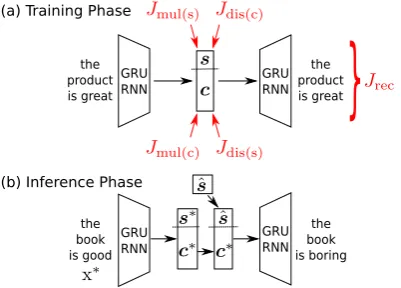
can be separated into two spacessand c, repre-senting style and content, respectively, i.e., h = [s;c], where [·;·] denotes concatenation. This is accomplished by a systematic design of auxiliary losses described below, and shown in Figure1a.
3.2 Style-Oriented Losses
We first design auxiliary losses that ensure the style information is contained in the style spaces. This involves (1) a multi-task loss that ensuressis discriminative for the style, and (2) an adversarial loss that ensurescis not.
Multi-Task Loss for Style.In the dataset, each sentence is labeled with its style, particularly, bi-nary sentiment of positive or negative, following most previous work (Hu et al., 2017;Shen et al.,
2017;Fu et al.,2018;Zhao et al.,2018).
We build a two-way softmax classifier (equiva-lent to logistic regression) on the style spacesto predict the style label, given by
ys = softmax(Wmul(s)s+bmul(s)) (3)
where θmul(s) = [Wmul(s);bmul(s)] are the
param-eters of the style classifier in the setting of multi-task learning, andysis the output of softmax layer. The classifier is trained with cross-entropy loss against the ground-truth distributionts(·)by
Jmul(s)(θE;θmul(s)) =−
X
l∈labels
In fact, we train the style classifier at the same time as the autoencoding loss. Thus, this could be viewed asmulti-tasklearning, incentivizing the entire model to not only decode the sentence, but also predict its sentiment from the style vectors. We denote it by “mul(s).” The idea of multi-task training is not new and has been used in previous work for sentence representation learning (Jernite et al.,2017) and sentiment analysis (Balikas et al.,
2017), among others.
Adversarial Loss for Style. The multi-task loss only ensures that the style space contains style information. However, the content space might also contain style information, which is undesir-able for disentanglement.
We thus apply an adversarial loss to discour-age the content space containing style information. We first train a separate classifier, called an adver-sary, that deliberately discriminates the style label based on the content vectorc. Then, the encoder is trained to encode a content space from which its adversary cannot predict the style.
Concretely, the adversarial discriminator and its training objective have a similar form as Eqns. (3) and (4), but with different input and parameters, given by
ys = softmax(Wdis(s)c+bdis(s)) (5)
Jdis(s)(θdis(s)) =−
X
l∈labelstc(l) logys(l) (6)
whereθdis(s) = [Wdis(s);bdis(s)]are the parameters
of the adversary.
It should be emphasized that, when we train the adversary, the gradient is not propagated back to the autoencoder, i.e., the vectorcis treated as shal-low features. Therefore, we viewJdis(s)as a
func-tion ofθdis(s)only, whereasJmul(s)is a function of
bothθE andθmul(s).
Having trained an adversary, we would like the autoencoder to be tuned in such anad hocfashion thatc is not discriminative for style. In existing literature, there could be different approaches, for example, maximizing the adversary’s loss (Shen et al., 2017; Zhao et al., 2018) or penalizing the entropy of the adversary’s prediction (Fu et al.,
2018). In our work, we adopt the latter, as it can be easily extended to multi-category classifi-cation, used in Subsection3.3. Formally, the style-oriented adversarial objective is to maximize
Jadv(s)(θE) =H(ys|c;θdis(s)) (7)
where ys is the predicted distribution over the
style labels and H(p) = −P
i∈labelspilogpi is
the entropy of the adversary. Here,Jadv(s)is
max-imized with respect to the encoderθE and we fix θdis(s). The objective attains maximum value when ysis uniform.
While adversarial loss has been explored in pre-vious style-transfer studies (Shen et al., 2017;Fu et al., 2018), it has not been combined with the multi-task loss. As shown in our experiments, a simple combination of these two losses is promis-ingly effective, achieving better style transfer per-formance than a variety of previous methods.
3.3 Content-Oriented Losses
The above style-oriented losses only regularize style information, but they do not impose any con-straint on how the content information should be encoded.
In practice, the style space is usually smaller than content space. But it is unrealistic to expect that the content would not flow into the style space simply because of its limited capacity. Therefore, we need to design content-oriented losses to reg-ularize the content information. In most previous work, however, the treatment of content is miss-ing (Hu et al.,2017;Fu et al.,2018).
Inspired by the above combination of multi-task and adversarial losses, we apply the same idea to the content space. However, it is usually hard to define what “content” actually refers to.
To this end, we propose to approximate the con-tent information by bag-of-words (BoW) features. The BoW feature of a sentence is a vector, each element indicating the probability of a word’s oc-currence. For a sentencexwithNwords, the word w∗’s BoW probability istc(w∗) =
PN
i=1I{wi=w∗}
N ,
whereI{·}is an indicator function. Here, we only
consider content words, excluding stopwords and sentiment words (Hu and Liu, 2004),2 since we focus on “content” information. It should be men-tioned that the removal of stopwords and senti-ment words is not essential, but results in better performance. We analyze the effect of using dif-ferent vocabularies in AppendixB.
Multi-Task Loss for Content. Similar to the style-oriented loss, the multi-task loss for content, denoted as “mul(c),” ensures that the content space
2The list of sentiment words is available at
ccontains content information, i.e., BoW features. We introduce a softmax classifier over the BoW vocabulary
yc= softmax(Wmul(c)c+bmul(c)) (8)
whereθmul(c)=[Wmul(c);bmul(c)]are the classifier’s
parameters;ycis the predicted BoW distribution.
The training objective is a cross-entropy loss against the ground-truth distributiontc(·):
Jmul(c)(θE;θmul(c)) =−
X
w∈vocab
tc(w) logyc(w)
(9) where the optimization is performed with both en-coder parametersθE and the multi-task classifier θmul(c). Notice that, although the target
distribu-tion is not one-hot for BoW, the cross-entropy loss in Eqn. (9) has the same form as (4).
It is also interesting that, at first glance, the multi-task loss for content appears to be redun-dant to the autoencoding loss, when in fact, it is not. The autoencoding loss only requires that the model could reconstruct the sentence based on the combined content and style spaces, but does not ensure their separation. The multi-task loss fo-cuses on content words and is applied to the con-tent space only.
Adversarial Loss for Content. To ensure that the style space does not contain content informa-tion, we design our final auxiliary loss, the BoW adversarial loss for content, denoted as “adv(c).”
We build a content adversary, a softmax classi-fier on the style space predicting BoW features
yc= softmax(Wdis(c)>s+bdis(c)) (10)
Jdis(c)(θdis(c)) =−
X
w∈vocab
tc(w) logyc(w) (11)
whereθdis(c) = [Wdis(c);bdis(c)]are the classifier’s
parameters for BoW prediction.
The adversarial loss for the model is to maxi-mize the entropy of the discriminator
Jadv(c)(θE) =H(yc|s;θdis(c)) (12)
Again, Jdis(c) is trained with respect to the
dis-criminator’s parameters θdis(c), whereas Jadv(c) is
trained with respect toθE, similar to the
adversar-ial loss for style.
Our BoW-based, content-oriented losses are novel in the style-transfer literature. While they do not directly work with “style,” they regularize the content information, so that the style and con-tent can be better disentangled.
1 foreachmini-batchdo
2 minimizeJdis(s)(θdis(s))w.r.t.θdis(s); 3 minimizeJdis(c)(θdis(c))w.r.t. θdis(c); 4 minimizeJovrw.r.t.θE,θD,θmul(s),θmul(c); 5 end
Algorithm 1:Training process.
3.4 Training Process
The overall lossJovrfor our model comprises
sev-eral terms: the autoencoder’s reconstruction ob-jective, the multi-task and adversarial objectives, for style and content, respectively, given by
Jovr=JAE(θE,θD) (13)
+λmul(s)Jmul(s)(θE,θmul(s))−λadv(s)Jadv(s)(θE)
+λmul(c)Jmul(c)(θE,θmul(c))−λadv(c)Jadv(c)(θE)
whereλs are the hyperparameters that balance the autoencoding loss and these auxiliary losses.
To put it all together, the model training in-volves an alternation of optimizing the adversaries byJdis(s) andJdis(c), and the model itself byJovr,
shown in Algorithm1.
3.5 Generating Style-Transferred Sentences
A direct application of our disentangled latent space is style-transfer sentence generation, i.e., we can synthesize a sentence with generally the same meaning but a different style in the inference stage. Letx∗ be an input sentence withs∗ andc∗ be-ing the encoded style and content vectors, respec-tively. If we would like to transfer its content to a different style, we compute an empirical estimate of the target style’s vectorsˆof the training set, us-ing
ˆ
s=
P
i∈target stylesi
# target style samples (14)
The inferred target stylesˆis concatenated with the encoded contentc∗ for decoding style-transferred sentences, as shown in Figure1b.
4 Experiments
4.1 Datasets
We conducted experiments on two datasets, Yelp and Amazon reviews. Both comprise sentences la-beled by binary sentiment (positive or negative). They are used to train latent space disentangle-ment as well as to evaluate sentidisentangle-ment transfer.
2017; Zhao et al., 2018).3 It contains 444101, 63483, and 126670 labeled reviews for train, vali-dation, and test, respectively. We set the maximum length of a sentence to 15 words and the vocabu-lary size to∼9200, followingShen et al.(2017).
Amazon Product Reviews. We further eval-uate our model with an Amazon review dataset, following some other previous papers (Fu et al.,
2018).4 It contains 555142, 2000, and 2000
la-beled reviews for train, validation, and test, re-spectively. The maximum length of a sentence is set to 20 words and the vocabulary size is∼58k, as inFu et al.(2018).
4.2 Experimental Settings
Our RNN has a hidden state of 256 dimensions, linearly transformed to a style space of 8 dimen-sions and a content space of 128 dimendimen-sions. They were chosen empirically, and we found them ro-bust to model performance. For the decoder, we fed the latent vectorh= [s,c]to the hidden state at each step.
We used the Adam optimizer (Kingma and Ba,
2014) for the autoencoder and the RMSProp op-timizer (Tieleman and Hinton, 2012) for the dis-criminators, following stability tricks in adversar-ial training (Arjovsky et al.,2017). Each optimizer has an initial learning rate of10−3. Our model is trained for 20 epochs, by which time it has con-verged. The word embedding layer was initial-ized by word2vec (Mikolov et al., 2013) trained on respective training sets. Both the autoencoder and the discriminators are trained once per mini-batch with λmul(s)= 10, λmul(c)= 3, λadv(s)= 1,
andλadv(c) = 0.03. These hyperparameters were
tuned by a log-scale grid search within two orders of magnitude around the default value1; we chose the values yielding the best validation results.
For the VAE model, the KL penalty is weighted by λkl(s) andλkl(c) for style and content,
respec-tively. We set both to 0.03, tuned by the same method of log-scale grid search. During training, we also used thesigmoidKL annealing schedule, followingBahuleyan et al.(2018).
4.3 Exp. I: Disentangling Latent Space
First, we analyze how the style (sentiment) and content of the latent space are disentangled. We
3
The Yelp dataset is available athttps://github. com/shentianxiao/language-style-transfer
4The Amazon dataset is available at https://
github.com/fuzhenxin/text_style_transfer
Latent Space Yelp Amazon
[image:6.595.323.516.62.127.2]DAE VAE DAE VAE None (majority guess) 0.60 0.51 Content space (c) 0.66 0.70 0.67 0.69 Style space (s) 0.97 0.97 0.82 0.81 Complete space ([s;c]) 0.97 0.97 0.82 0.81
Table 1: Classification accuracy on latent spaces.
Style Space Content Space
(b) VAE (a) DAE
Figure 2: t-SNE plots of the disentangled style and con-tent spaces on Yelp (with all auxiliary losses).
train separate logistic regression sentiment clas-sifiers on different latent spaces, and report their classification accuracy in Table1.
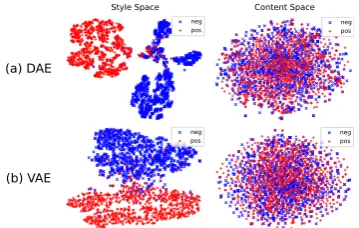
We see the 128-dimensional content vectorcis not particularly discriminative for style. Its accu-racy is slightly better than majority guess. How-ever, the 8-dimensional style vectors, despite its low dimensionality, achieves substantially higher style classification accuracy. When combining content and style vectors, we observe no further improvement. These results verify the effective-ness of our disentangling approach, as the style space contains style information, whereas the con-tent space does not.
We show t-SNE plots (van der Maaten and Hin-ton, 2008) for both DAE and VAE in Figure 2. As seen, sentences with different styles are no-ticeably separated in a clean manner in the style space (LHS), but are indistinguishable in the con-tent space (RHS). It is also evident that the lacon-tent space learned by VAE is considerably smoother and more continuous than the one learned by DAE.
4.4 Exp. II: Non-Parallel Text Style Transfer
In this experiment, we apply the disentangled la-tent space to sentiment-transfer text generation.
[image:6.595.326.506.159.273.2]well.
Style-Transfer Accuracy(STA): We follow most previous work (Hu et al.,2017;Shen et al.,2017;
Fu et al.,2018) and train a separate convolutional neural network (CNN) to predict the sentiment of a sentence (Kim,2014), which is then used to ap-proximate the style transfer accuracy. In other words, we report the CNN classifier’s accuracy on the style-transferred sentences, considering the target style to be the ground-truth. While the style classifier itself may not be perfect, it achieves a reasonable sentiment accuracy on the validation sets (97% for Yelp; 82% for Amazon). Thus, it provides a quantitative way of evaluating the strength of style transfer.
Cosine Similarity (CS): We followed Fu et al.
(2018) and computed the cosine measure be-tween source and generated sentence embeddings, which are the concatenation of min, max, and
mean of word embeddings (sentiment words re-moved). This provides a rough estimation of con-tent preservation.
Word Overlap(WO): We find that cosine simi-larity, although correlated to human judgment, is not a sensitive measure. Instead, we propose a simple and effective measure that counts the un-igram word overlap rate of the original sentencex
and the style-transferred sentencey, computed by
count(x∩y)
count(x∪y). Here, we exclude both stopwords and
sentiment words.
Perplexity (PPL): We use a trigram Kneser– Ney (KN,Kneser and Ney,1995) language model as a quantitative and automated metric to evaluate the fluency of a sentence. It estimates the empiri-cal distribution of trigrams in a corpus, and com-putes the perplexity of a test sentence. We trained the language model on the respective datasets, and report PPL on the generated sentences. A smaller PPL indicates more fluent sentences.
Geometric Mean (GM): We use the geometric mean of STA, WO, and 1/PPL—reflecting trans-fer strength, content preservation, and fluency, respectively—to obtain an aggregated score con-sidering all aspects. Notice that a smaller PPL is desired; thus, we use 1/PPL when computing GM. Also, cosine similarity (CS) is not included, because it is insensitive yet repetitive with word overlap (WO). Here, we adopt the geometric mean so that the scale of each metric does not influence the judgment.
Manual Evaluation: Despite the above
auto-matic metrics, we also conduct human evaluations to further confirm the performance of our model. This was done on the Yelp dataset only, due to the amount of manual effort involved. We asked 6 human annotators to rate each sentence on a 1–5 Likert scale (Stent et al., 2005) in terms of transfer strength (TS), content preservation (CP), and language quality (LQ). This evaluation was conducted in a strictly blind fashion: samples ob-tained from all evaluated models were randomly shuffled, so that the annotator was unaware of which model generated a particular sentence. The inter-rater agreement—as measured by Krippen-dorff’s alpha (Klaus, 2004) for our Likert scale ratings—is 0.74, 0.68, and 0.72 for these three as-pects, respectively. According to Klaus (2004), this is an acceptable inter-rater agreement. We also computed the geometric mean (GM) to ob-tain an aggregated score.
Overall performance. We compare our ap-proach with previous state-of-the-art work in Ta-ble 2. For competing methods, we quote re-sults from existing papers whenever possible. In some studies, the authors have released their style-transferred sentences, and we tested them with our metrics. A caveat is that this may involve a different data split, providing a rough (but unbi-ased) comparison. For others, we re-evaluated the model using publicly available code. We sought comparison with Hu et al. (2017), but unfortu-nately could not find publicly available code. In-stead we sought performance comparisons of their model in subsequent work, and found that, accord-ing to the human evaluation inShen et al.(2017),
Hu et al.(2017) is comparable but slightly worse than Shen et al. (2017). The latter is compared with our model in terms of both automatic metrics and human evaluation.
We see in Table2a clear trade-off between style transfer and content preservation, as they are con-tradictory goals. Especially, a few models have a transfer accuracy lower than 50%. They are shown in gray, and not the focus of the comparison, be-cause the system cannot achieve the goal of style transfer most of the time.
Our method achieves high style-transfer accu-racy (STA) in both experiments. On the Yelp dataset, it outperforms previous methods by more than 7%, whereas on Amazon, VAE is 1% lower thanTsvetkov et al.(2018), ranking second.
preserva-Model Yelp Dataset Amazon Dataset
STA↑ CS↑ WO↑ PPL↓ GM↑ STA↑ CS↑ WO↑ PPL↓ GM↑ Style-Embedding (Fu et al.,2018) 0.18 0.96 0.67 124 0.10 0.40† 0.93† 0.36 32 0.17 Cross-Alignment (Shen et al.,2017) 0.78† 0.89 0.21 93 0.12 0.61 0.89 0.02 202 0.04 Multi-Decoder (Zhao et al.,2018) 0.82† 0.88 0.27 85 0.14 0.55 0.93 0.17 75 0.11 Del-Ret-Gen (Li et al.,2018)‡ 0.86 0.94 0.52 70 0.19 0.43 0.98 0.80 65 0.17 BackTranslate (Tsvetkov et al.,2018) 0.85 0.83 0.08 206 0.07 0.83 0.82 0.02 115 0.05 Cycle-RL (Xu et al.,2018)‡ 0.80 0.92 0.43 470 0.09 0.72 0.91 0.22 332 0.08
Ours (DAE) 0.88 0.92 0.55 52 0.21 0.72 0.92 0.35 73 0.15
[image:8.595.93.506.62.171.2]Ours (VAE) 0.93 0.90 0.47 32 0.24 0.82 0.90 0.20 63 0.14
Table 2: Performance of text style transfer. STA:Style transfer accuracy. CS: Cosine similarity. WO:Word overlap rate.PPL:Perplexity. GM:Geometric mean. The larger↑(or lower↓), the better.†Quoted from previous papers (with the same data split). ‡Involving custom data splits, providing a rough (but unbiased) comparison. Others are based on our replication, and we use published code whenever possible. We achieve 0.809 and 0.835 transfer accuracy on the Yelp dataset, close to the results inShen et al.(2017) andZhao et al.(2018), respectively, showing that our replication is fair. Gray numbers show that a method fails to transfer style most of the time.
Model TS CP LQ GM
Fu et al.(2018) 1.67 3.84 3.66 2.86
Shen et al.(2017) 3.63 3.07 3.08 3.25 Zhao et al.(2018) 3.55 3.09 3.77 3.46
[image:8.595.317.515.271.338.2]Ours (DAE) 3.67 3.64 4.19 3.83 Ours (VAE) 4.32 3.73 4.48 4.16
Table 3: Manual evaluation on the Yelp dataset.
tion as well. Among all the methods that can achieve more than 50% transfer accuracy, DAE has the highest word overlap (WO) on Yelp; VAE is also high, although slightly lower thanLi et al.
(2018). On Amazon, the phenomenon is similar. DAE is the best; VAE is 2% lower in WO (al-though 10% better in transfer accuracy), compared withXu et al.(2018).
For language fluency, VAE yields the best PPL in both datasets. It is also noted that, the cycle reinforcement learning (Cycle-RL) approach does not generate fluent sentences (Xu et al., 2018). They have unusually high PPL scores, but after reading the samples provided by the authors (via personal email correspondence) we are assured that the sentences obtained by Cycle-RL are less fluent.
When we consider all the above aspects, our approach (either DAE or VAE) has the highest geometric meaning (GM), showing that we have achieved good balance on transfer strength, con-tent preservation, as well as language fluency.
Table 3 presents the results of human evalua-tion on selected methods.5Again, we see that the style embedding model (Fu et al.,2018) is ineffec-tive as it has a very low transfer strength, and that our method outperforms other baselines in all
as-5Selection was based on the time of availability.
Objectives STA CS WO PPL GM JAE 0.11 0.94 0.47 40 0.11 JAE,Jmul(s) 0.77 0.91 0.33 41 0.18 JAE,Jadv(s) 0.78 0.89 0.23 35 0.17 JAE,Jmul(s),Jadv(s) 0.91 0.87 0.17 23 0.19 JAE,Jmul(s),Jadv(s),
[image:8.595.102.262.271.336.2]0.93 0.90 0.47 32 0.24 Jmul(c),Jadv(c)
Table 4: Ablation tests on Yelp. In all variants, we fol-low the same protocol of style transfer by substituting an empirical estimate of the target style vector.
pects. The results are consistent with Table2. This also implies that the automatic metrics we used are reasonable, and could be extrapolated to different models; it also shows consistent evidence of the effectiveness of our approach.
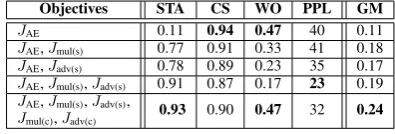
Ablation Test. We conducted ablation tests on the Yelp dataset, and show results in Table4. WithJAEonly, we cannot achieve reasonable style
transfer accuracy by substituting an empirically estimated style vector of the target style. This is because the style and content spaces would not be disentangled spontaneously with the autoencoding loss alone. With eitherJmul(s)orJadv(s), the model
achieves reasonable transfer accuracy and cosine similarity. Combining them together improves the transfer accuracy to 90%, outperforming previous methods by a margin of5%(Table2). This shows that the multi-task loss and the adversarial loss work in different ways. Our insight of combining the two auxiliary losses is a simple yet effective way of disentangling latent space.
On the other hand, Jmul(s) andJadv(s) only
features, which regularize the content information in the same way as style. By incorporating all these auxiliary losses, we achieve high transfer ac-curacy, high content preservation, as well as high language fluency.
5 Conclusion and Future Work
In this paper, we propose an effective approach for disentangling style and content latent spaces. We systematically combine multi-task and adver-sarial objectives to separate content and style from each other, where we also propose to approximate content information with bag-of-words features of style-neutral, non-stopword vocabulary.
Both qualitative and quantitative experiments show that the latent space is indeed separated into style and content parts. The disentangled space can be directly applied to text style-transfer tasks. Our method achieves high style-transfer strength, high content-preservation scores, as well as high language fluency, compared with previous work.
Our approach can be naturally extended to non-categorical styles, because our style feature is en-coded from the input sentence. Non-categorical styles cannot be easily handled by fixed style embeddings or style-specific decoders (Fu et al.,
2018). Bao et al.(2019) have successfully shown that the syntax and semantics of a sentence can be disentangled from each other.
Acknowledgments
We thank all reviewers for insightful comments. This work was supported in part by the NSERC grant RGPIN-261439-2013 and an Amazon Re-search Award. We would also like to acknowl-edge NVIDIA Corporation for the donated Titan Xp GPU.
References
Martin Arjovsky, Soumith Chintala, and Leon Bottou. 2017. Wasserstein generative adversarial networks. InICML, pages 214–223.
Hareesh Bahuleyan, Lili Mou, Olga Vechtomova, and Pascal Poupart. 2018. Variational attention for sequence-to-sequence models. In COLING, pages 1672–1682.
Georgios Balikas, Simon Moura, and Massih-Reza Amini. 2017. Multitask learning for fine-grained twitter sentiment analysis. InSIGIR, pages 1005– 1008.
Yu Bao, Hao Zhou, Shujian Huang, Lei Li, Lili Mou, Olga Vechtomova, XIN-YU DAI, and Jiajun CHEN. 2019. Generating sentences from disentangled syn-tactic and semantic spaces. InACL.
Samuel R. Bowman, Luke Vilnis, Oriol Vinyals, An-drew M. Dai, Rafal Jozefowicz, and Samy Ben-gio. 2016. Generating sentences from a continuous space. InCoNLL, pages 10–21.
Xi Chen, Yan Duan, Rein Houthooft, John Schulman, Ilya Sutskever, and Pieter Abbeel. 2016. Infogan: Interpretable representation learning by information maximizing generative adversarial nets. In NIPS, pages 2172–2180.
Kyunghyun Cho, Bart van Merrienboer, Caglar Gul-cehre, Dzmitry Bahdanau, Fethi Bougares, Holger Schwenk, and Yoshua Bengio. 2014. Learning phrase representations using RNN encoder-decoder for statistical machine translation. InEMNLP, pages 1724–1734.
Alexis Conneau, Guillaume Lample, Marc’Aurelio Ranzato, Ludovic Denoyer, and Herv´e J´egou. 2018. Word translation without parallel data. InICLR.
Jessica Ficler and Yoav Goldberg. 2017. Controlling linguistic style aspects in neural language genera-tion. InProc. Workshop on Stylistic Variation, pages 94–104.
Zhenxin Fu, Xiaoye Tan, Nanyun Peng, Dongyan Zhao, and Rui Yan. 2018.Style transfer in text: Ex-ploration and evaluation. InAAAI, pages 663–670.
Leon A. Gatys, Alexander S. Ecker, and Matthias Bethge. 2016. Image style transfer using convolu-tional neural networks. InCVPR, pages 2414–2423.
Irina Higgins, Loic Matthey, Arka Pal, Christopher Burgess, Xavier Glorot, Matthew Botvinick, Shakir Mohamed, and Alexander Lerchner. 2017. Beta-VAE: Learning basic visual concepts with a con-strained variational framework. InICLR.
Minqing Hu and Bing Liu. 2004. Mining and summa-rizing customer reviews. InKDD, pages 168–177.
Zhiting Hu, Zichao Yang, Xiaodan Liang, Ruslan Salakhutdinov, and Eric P. Xing. 2017.Toward con-trolled generation of text. In ICML, pages 1587– 1596.
Yacine Jernite, Samuel R. Bowman, and David Son-tag. 2017. Discourse-based objectives for fast un-supervised sentence representation learning. arXiv, abs/1705.00557.
Yoon Kim. 2014. Convolutional neural networks for sentence classification. In EMNLP, pages 1746– 1751.
Diederik P. Kingma and Max Welling. 2013. Auto-encoding variational Bayes. arXiv preprint arXiv:1312.6114.
Krippendorff Klaus. 2004. Content Analysis: An Intro-duction to Its Methodology. Sage Publications.
Reinhard Kneser and Hermann Ney. 1995. Improved backing-off for m-gram language modeling. In ICASSP, pages 181–184.
Solomon Kullback and Richard A Leibler. 1951. On information and sufficiency. The Annals of Mathe-matical Statistics, 22(1):79–86.
Guillaume Lample, Alexis Conneau, Ludovic De-noyer, and Marc’Aurelio Ranzato. 2018a. Unsu-pervised machine translation using monolingual cor-pora only. InICLR.
Guillaume Lample, Myle Ott, Alexis Conneau, Lu-dovic Denoyer, and Marc’Aurelio Ranzato. 2018b. Phrase-based & neural unsupervised machine trans-lation. InEMNLP, pages 5039–5049.
Juncen Li, Robin Jia, He He, and Percy Liang. 2018. Delete, retrieve, generate: A simple approach to sen-timent and style transfer. In NAACL-HLT, pages 1865–1874.
Lajanugen Logeswaran, Honglak Lee, and Samy Ben-gio. 2018. Content preserving text generation with attribute controls. InNIPS, pages 5108–5118.
Laurens van der Maaten and Geoffrey Hinton. 2008. Visualizing data using t-SNE.JMLR, 9:2579–2605.
Tomas Mikolov, Ilya Sutskever, Kai Chen, Gregory S. Corrado, and Jeffrey Dean. 2013. Distributed repre-sentations of words and phrases and their composi-tionality. InNIPS, pages 3111–3119.
Sudha Rao and Joel R. Tetreault. 2018. Dear sir or madam, may I introduce the GYAFC dataset: Cor-pus, benchmarks and metrics for formality style transfer. InNAACL-HLT, pages 129–140.
D. E. Rumelhart, G. E. Hinton, and R. J. Williams. 1986. Learning internal representations by error propagation. In Parallel Distributed Processing: Explorations in the Microstructure of Cognition, volume 1, pages 318–362.
Cicero Nogueira dos Santos, Igor Melnyk, and Inkit Padhi. 2018. Fighting offensive language on social media with unsupervised text style transfer. InACL (Short Papers), pages 189–194.
Tianxiao Shen, Tao Lei, Regina Barzilay, and Tommi S. Jaakkola. 2017. Style transfer from non-parallel text by cross-alignment. InNIPS, pages 6833–6844.
Amanda Stent, Matthew Marge, and Mohit Singhai. 2005.Evaluating evaluation methods for generation in the presence of variation. InCICLing, pages 341– 351.
Tijmen Tieleman and Geoffrey Hinton. 2012. Lecture 6.5-rmsprop: Divide the gradient by a running av-erage of its recent magnitude. COURSERA: Neural Networks for Machine Learning.
Yulia Tsvetkov, Alan W. Black, Ruslan Salakhutdi-nov, and Shrimai Prabhumoye. 2018. Style transfer through back-translation. InACL, pages 866–876.
Jingjing Xu, Xu Sun, Qi Zeng, Xiaodong Zhang, Xu-ancheng Ren, Houfeng Wang, and Wenjie Li. 2018. Unpaired sentiment-to-sentiment translation: A cy-cled reinforcement learning approach. In ACL, pages 979–988.
Ye Zhang, Nan Ding, and Radu Soricut. 2018. SHAPED: Shared-private encoder-decoder for text style adaptation. InNAACL-HLT, pages 1528–1538.
Junbo Jake Zhao, Yoon Kim, Kelly Zhang, Alexan-der M. Rush, and Yann LeCun. 2018. Adversarially regularized autoencoders. In ICML, pages 5897– 5906.
A Qualitative Examples
Table 5 provides several examples of our style-transfer model. Results show that we can success-fully transfer the sentiment while preserving the content of a sentence.
B Effect of the BoW Vocabulary
Original (Positive) DAE Transferred (Negative) VAE Transferred (Negative)
the food is excellent and the service is exceptional
the food was a bit bad but the staff was exceptional
the food was bland and i am not thrilled with this
the waitresses are friendly and helpful
the guys are rude and helpful the waitresses are rude and are lazy
the restaurant itself is romantic and quiet
the restaurant itself is awkward and quite crowded
the restaurant itself was dirty
great deal horrible deal no deal
both times i have eaten the lunch buffet and it was out-standing
their burgers were decent but the eggs were not the consis-tency
both times i have eaten here the food was mediocre at best
Original (Negative) DAE Transferred (Positive) VAE Transferred (Positive)
the desserts were very bland the desserts were very good the desserts were very good it was a bed of lettuce and
spinach with some italian meats and cheeses
it was a beautiful setting and just had a large variety of ger-man flavors
it was a huge assortment of fla-vors and italian food
the people behind the counter were not friendly whatsoever
the best selection behind the register and service presenta-tion
the people behind the counter is friendly caring
the interior is old and generally falling apart
the decor is old and now per-fectly
the interior is old and noble
[image:11.595.76.525.120.454.2]they are clueless they are stoked they are genuinely profession-als
Table 5: Examples of style transferred sentence generation.
BoW Vocabulary STA CS WO PPL GM
Full corpus vocabulary 0.822 0.896 0.344 30 0.21
Vocabulary without sentiment words 0.872 0.901 0.359 30 0.22
Vocabulary without stopwords 0.836 0.894 0.429 33 0.22
Vocabulary without stopwords and sentiment words 0.934 0.904 0.473 32 0.24
[image:11.595.86.510.610.679.2]