4146
TIGS: An Inference Algorithm for Text Infilling with Gradient Search
Dayiheng Liu†, Jie Fu‡, Pengfei Liu§, Jiancheng Lv†∗ †College of Computer Science, Sichuan University
‡Mila, IVADO, Polytechnique Montreal
§School of Computer Science, Fudan University
[email protected] [email protected]
Abstract
Text infilling is defined as a task for filling in the missing part of a sentence or para-graph, which is suitable for many real-world natural language generation scenarios. How-ever, given a well-trained sequential genera-tive model, generating missing symbols condi-tioned on the context is challenging for exist-ing greedy approximate inference algorithms. In this paper, we propose an iterative inference algorithm based on gradient search, which is the first inference algorithm that can be broadly applied to any neural sequence gener-ative models for text infilling tasks. We com-pare the proposed method with strong base-lines on three text infilling tasks with various mask ratios and different mask strategies. The results show that our proposed method is ef-fective and efficient for fill-in-the-blank tasks, consistently outperforming all baselines.1
1 Introduction
Text infilling aims at filling in the missing part of a sentence or paragraph by making use of the past and future information around the miss-ing part, which can be used in many real-world natural language generation scenarios, for exam-ple, fill-in-the-blank image captioning (Sun et al.,
2017), lexically constrained sentence generation
(Liu et al., 2018b), missing value reconstruc-tion (e.g. for damaged or historical documents) (Berglund et al.,2015), acrostic poetry generation (Liu et al.,2018a), and text representation learning (Devlin et al.,2018).
Text infilling is an under-explored
challeng-ing task in the field of text generation.
Re-cently, sequence generative models like
sequence-to-sequence (seq2seq) models (Sutskever et al.,
∗
Correspondence to Jiancheng Lv.
1Our code and data are available at
https://github.com/dayihengliu/ Text-Infilling-Gradient-Search
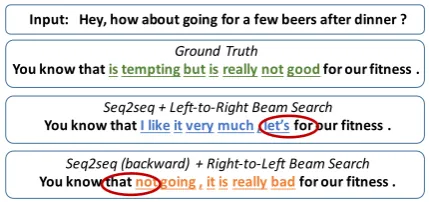
Input: Hey, how about going for a few beers after dinner ?
Ground Truth
You know that is tempting but is really not goodfor our fitness .
Seq2seq + Left-to-Right Beam Search
You know that I like it very much , let’sfor our fitness .
Seq2seq (backward) + Right-to-Left Beam Search
[image:1.595.307.522.221.322.2]You know thatnot going , it is really badfor our fitness .
Figure 1: Our key observation on text infilling for Di-alogue task. The inability of unidirectional BS to con-sider both the future and past contexts leads models to fill the blank with words that clash abruptly with the context around the blanks (see red circles).
2014;Bahdanau et al.,2014;Gehring et al.,2017;
Vaswani et al.,2017) are widely used in text gen-eration tasks, including neural machine translation (Wu et al.,2016;Vaswani et al.,2017), image cap-tioning (Anderson et al., 2017), abstractive sum-marization (See et al., 2017), and dialogue gen-eration (Mei et al., 2017). Unfortunately, given
a well-trained2 neural seq2seq model or
uncon-ditional neural language model (Mikolov et al.,
2010), it is a daunting task to directly apply it to text infilling task. As shown in Figure1, we ob-serve that the infilled words should be conditioned on past and future information around the miss-ing part, which is contrary to the popular learnmiss-ing paradigm, namely, each output symbol is condi-tioned on all previous outputs during inference by
using unidirectional Beam Search (BS) (Och and
Ney,2004).
To solve the issues above, one family of meth-ods for text infilling is “trained to fill in blanks” (Berglund et al., 2015; Fedus et al., 2018; Zhu et al.,2019), which requires large amounts of data in fill-in-the-blank format to train a new model that takes the output template as a conditional
in-2Here “well-trained” means that ones focus on popular
put. Such methods are only used for uncondi-tional text infilling tasks, whereas many text in-filling tasks are conditional, e.g., conversation re-ply with templates. Another kind of promising ap-proach (Berglund et al.,2015;Wang et al.,2016;
Sun et al., 2017) is an inference algorithm that can be directly applied to other generative models. These inference algorithms are applied to
Bidi-rectional RNNs (BiRNNs) (Schuster and Paliwal,
1997; Baldi et al., 1999) which can model both forward and backward dependencies. The latest
work is Bidirectional Beam Search (BiBS) (Sun
et al.,2017) which proposes an approximate infer-ence algorithm in BiRNN for image caption infill-ing. However, this method is based on some un-realistic assumptions, such as that given a token, its future sequence of words is independent of its past sequence of words. We experimentally find that these assumptions often generate non-smooth or unreal complete sentences. Moreover, these in-ference algorithms can be only used to decoders with bidirectional structures, whereas almost all sequence generative models use a unidirectional decoder. As a result, it is highly expected to de-velop an inference algorithm that could be applied to the unidirectional decoder.
In this paper, we study the general inference al-gorithm for text infilling to answer the question:
• Given a well-trained neural sequence gener-ative model, is there any inference algorithm that can effectively fill in the blanks in the output sequence?
To investigate such a possibility, we propose a dramatically different inference approach called Text Infilling with Gradient Search (TIGS), in which we search for infilled words based on gradi-ent information to fill in the blanks. To the best of
our knowledge, this could be the first inference
algorithmthat does not require any modification
or training of the model and can be broadly used in any sequence generative model to solve the fill-in-the-blank tasks as verified in our experiments.
To be specific, we treat the blanks to be filled as parameterized vectors during inference. More concretely, we first randomly or heuristi-cally project each blank to a valid token and ini-tialize its parameterized vector with the word em-bedding of the valid token. The goal is seeking the words to be infilled by minimizing the negative log-likelihood (NLL) of the complete sequence.
Then the algorithm alternately performs optimiza-tion step (O-step) and projection step (P-step)
un-til convergence. In O-step, we fix all other
pa-rameters of the model and only optimize the blank
parameterized vectors by gradients. In P-step,
heuristics like local search and projected gradient are used to project the blank parameterized vectors to valid tokens (i.e., discretization).
The contribution and novelty of this work could be summarized as below:
• We propose an iterative inference algorithm based on gradient search, which could be the first inference algorithm that can be broadly applied to any neural sequence generative models for text infilling tasks.
• Extensive experimental comparisons show the effectiveness and efficiency of the pro-posed method on three different text infill-ing tasks, compared with five state-of-the-art methods.
2 Related Works
There are some effective solutions to the text in-filling task: a) training a model specifically for text infilling tasks (Berglund et al., 2015; Fedus et al., 2018;Zhu et al., 2019); b) using standard sequence generative model with modified infer-ence algorithm (Berglund et al.,2015;Wang et al.,
2016;Sun et al.,2017).
As one typical work of the first category, NADE (Berglund et al.,2015) is proposed to train a spe-cific BiRNNs for filling in blanks, which concate-nates an auxiliary vector to input vectors for dicating a missing input during training and
in-ference. Fedus et al. (2018) propose MaskGAN
seq2seq models for both conditional and uncondi-tional text infilling tasks.
As with the second category, some inference al-gorithms based on BiRNNs have been proposed for fill-in-the-blank tasks thanks to their ability to model both forward and backward
dependen-cies. For example, Berglund et al. (2015)
pro-pose Generative Stochastic Networks (GSN) to
reconstruct the blanks of sequential data. The
idea is to first randomly initialize the symbols in
the blanks and then resample an output yt from
PBiRN N(yt | {yd}d6=t, x)one at a time until
con-vergence. More recently,Sun et al.(2017) propose the Bidirectional Beam Search (BiBS) inference algorithm of BiRNNs for fill-in-the-blank image captioning task. However, this method is based on some strong assumptions, which may be vio-lated in practice. As shown in our experiments, we provide empirical analysis on cases where this approach fails. Moreover, GSN and BiBS can be only applied to decoders with bidirectional struc-tures, while almost all sequence generative models use a unidirectional decoder. In contrast, our pro-posed inference method decouples from these as-sumptions and can be applied to the unidirectional decoder.
3 Preliminary
Since our method utilizes gradient information, it could smoothly cooperate with other architectures, such as models proposed in (Vaswani et al.,2017;
Gehring et al.,2017). Considering the popularity of RNNs, and the related work is based on RNN model, we use RNN-based models as a showcase in this paper.
3.1 RNN-based Seq2Seq Model
We firstly introduce the notations and briefly de-scribe the standard RNN-based seq2seq model. Letx = {x1,x2, ...,xn}denotes one-hot vector representations of the conditional input sequence,
y ={y1, y2, ..., ym}denotes scalar indices of the
corresponding target sequence, andV denotes the
vocabulary. n andm represent the length of the
input sequence and the output sequence, respec-tively.
The seq2seq model is composed of an encoder and a decoder. For the encoder part, eachxtwill
be firstly mapped into its corresponding word em-bedding xembt . Then {xembt } are input to a bi-directional or unibi-directional long short-term
mem-ory (LSTM) (Hochreiter and Schmidhuber,1997)
RNN to get a sequence of hidden states{henct }. For the decoder, at time t, similarly yt is first
mapped toyemb
t . Then a context vectorctis
calcu-lated with attention mechanism (Bahdanau et al.,
2014; Luong et al., 2015) ct = Pni=1atihenci ,
which contains useful latent information of the
in-put sequence. Here, at is an attention
distribu-tion vector to decide which part to focus on. The context vectorctand the embeddingytembare fed
as input to a unidirectional RNN language model (LM), which will output a probability distribution of the next wordP(yt+1|y1:t,x), wherey1:trefers
to{y1, ..., yt}.
During training, the negative log-likelihood (NLL) of the target sequence is minimized us-ing standard maximum-likelihood (MLE) trainus-ing with stochastic gradient descent (SGD), where the NLL is calculated as follows:
−logP(y|x) =− m
X
t=1
logP(yt|y1:t−1,x). (1)
During inference, the decoder needs to find the most likely output sequencey∗by giving the input
x:
y∗ = arg max
y
P(y|x). (2)
Since the number of possible sequences grows as|V|m(|V|is the size of vocabulary), exact
infer-ence is NP-hard and approximate inferinfer-ence algo-rithms like left-to-right greedy decoding or beam
search (BS) (Och and Ney, 2004) are commonly
used.
3.2 Problem Definition
In this paper, instead of setting some restrictions such as limiting the number of blanks or restricting
the position of the blanks in previous work (Sun
et al.,2017), we consider a more general case of text infilling task where the number and location of blanks are arbitrary.
Let B be a placeholder for a blank, B be the
set that records all the blanks’ position index,
and yB be a target sequence where portions of
text body are missing as indicated by B. For
in-stance, if a target sequence has two blanks at the
position i and j, then B = {i, j} and yB =
{y1, .., yi−1, B, yi+1, ..., yj−1, B, yj+1, ..., ym}.
Given an input sequence x and a target
se-quence yB containing blanks indicated byB, we
aim at filling in the blanks ofyB. This procedure
I like cake , It’s sweet I like , It’s sweet
𝒚𝔹:
FNN + Softmax Output
I like the , It’s sweet
Decoder
Word embeddings
ℒ%&&(𝑥, 𝑦∗)
(a) Initialize𝑦-and get NLL loss
Word embedding space
Parameterized vector Update by
Gradient 𝛻
/01234ℒ(𝑥, 𝑦
∗)
(b) O-step
Parameterized
vector (one-hot)Cake Project
(c) P-step
A fill-in-the-blank sample Inference result
Initialize𝑦-with left-to-right greedy
[image:4.595.160.435.63.243.2]NLL Loss
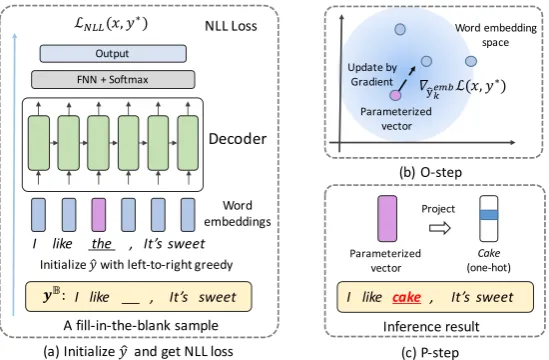
Figure 2: Overall framework.
and provide meaningful details under the condi-tionx.
4 Methodology
In this section, we present our inference method in detail. The overall framework is shown in
Fig-ure2. Given a well-trained seq2seq model and a
pair of text infilling data (x,yB), the method aims
at finding an infilled word set yˆ = {ˆy1, ...,yˆ|B|}
to minimize the NLL of the complete sentencey∗
via:
ˆ
y= arg min
ˆ yj∈V
LN LL(x,y∗), (3)
wherey∗denotes the complete sentence after fill-ing the blanks ofyBwithyˆ,|B|denotes the
num-ber of blanks. Since the numnum-ber of possible in-filled word set is|V||B|, na¨ıvely searching in this
space is NP-hard.
Our key idea is to utilize the gradient infor-mation to narrow the range of search during in-ference. This idea is similar to the “white-box”
adversarial attacks (Goodfellow et al., 2014b;
Szegedy et al.,2013;He and Glass,2018). How-ever, the adversarial attack aims to slightly modify the inputs in order to mislead the model to make wrong predictions, while our goal is to search for the reasonable words that should be filled into the blanks.
Unlike the continuous input space (e.g., im-ages) in other tasks, applying gradient search di-rectly to the input would make it invalid (i.e., no longer a one-hot vector) for text infilling tasks. More specifically, we firstly treat the blanks to be filled as parameterized word embedding vectors
ˆ
yemb = {yˆemb1 , ...,yˆemb|
B| }. Then, we fix the
pa-rameters of the well-trained model and only opti-mize these parameterized vectors in the continu-ous space, where the gradient information can be used to minimize the NLL lossLN LL(x,y∗).
Fi-nally, the yˆemb is discretized into valid words yˆ
by measuring the distance between the yˆemb and
the word embeddings in Wemb. Here Wemb
de-notes the word embedding matrix in the decoder of the well-trained seq2seq model, and each
col-umn of Wemb represents the word embedding of
one word in the vocabulary.
As every word in the setyˆis dependent on each other, the simultaneous discretization of all
pa-rameterized word embeddings in yˆemb into valid
words at the same time usually make the complete
sentencey∗ non-smooth. As a concrete example,
when infilling the two blanks in “Amy likes
eat-ing , so she goes to snack bars very often.”,
the yˆemb may be close to the word embeddings
of{“ice”, “cream”}and{“fried”, “chips”}. How-ever, if one discretizes the two blanks simultane-ously, one might get answers like{“ice”, “chips”} or{“fried”, “cream”}. Therefore, we adopt an it-erative algorithm which is similar to Gibbs sam-pling. At each inference step, we focus on one single infilled wordyjˆ forj-th blank and update it while keeping other words in the infilled word set
ˆ
yfixed. For the unknown blank length tasks (each
blank may contain an arbitrary unknown number of tokens), we can apply the TIGS as a black box inference algorithm over a range of blank lengths and then rank these solutions.
At the beginning, we initialize the infilled word
heuris-tically (from a left-to-right beam search). Then
we perform optimization step (O-step) and
pro-jection step (P-step) alternately to update each in-filled word in the inin-filled word setyˆuntil
conver-gence or reach the maximum number of roundsT.
InO-step, we aim to optimize theyˆjembin con-tinuous space using gradient information with re-spect to LN LL(x,y∗). Firstly, we get the
com-plete sentencey∗ by fillingyˆin the blanks ofyB
and obtain theLN LL(x,y∗)ofy∗after puttingx
into the encoder and y∗ into the decoder of the
well-trained seq2seq model. Then we treat the vector yˆembj as parameterized vector, and fix all other parameters of the seq2seq model and only optimize the parameterized vectoryˆembj with gra-dient information to minimizeLN LL(x,y∗).
However, directly optimizing LN LL(x,y∗)
may lead to the final yˆembj not like a feasible
word embedding inWemb, and its nearest
neigh-bor word embedding inWembcould be far away
from it. So we add anL2 penalty to make theyˆjemb get close toWemb:
L(x,y∗) =LN LL(x,y∗)+λ·X j
yˆ
emb j
2, (4)
where λ is a hyperparameter. We also tried to
add an additional regularization term that directly narrow the distance betweenyˆjemband its nearest
word embedding inWemb, which is used inCheng
et al.(2018) for seq2seq adversarial attacks, but no obvious improvement was found.
Given the loss L(x,y∗), yˆembj is updated with ∇yˆemb
j L(x,y
∗)by one-step gradient descent:
ˆ
yjemb= ˆyjemb−α· ∇yˆemb
j LN LL(x,y
∗). (5)
Instead of updating yˆjemb by na¨ıvely SGD al-gorithm, we experimentally find that Nesterov (Sutskever et al.,2013) optimizer performed bet-ter than other optimizers to update yˆembj . As
discussed in Dong et al. (2017b), this
momen-tum based optimizer can stabilize update direc-tions and escape from poor local maxima during the iterations for adversarial attack.
In P-step, we aim to project the yˆjemb into a
valid infilled wordyjˆ. A na¨ıve way is to find the
word whose word embedding in Wemb is
near-est toyˆjembbased on the distance metric function
dist(·)3. However, due to its high dimensionality,
3Through experiments we find that using Euclidean
dis-tance as metric functiondist(·)perform slightly better than Cosine distance for our method.
the obtaining word embedding may be far from satisfactory. Instead, similar to the idea of beam
search, we first obtain a setS containingK
can-didate words whose word embedding is K-nearest toyˆjemb:
S= nearest-K yk∈V
dist( ˆyjemb,yembk ), (6)
and then we select one word with lowest NLL
from theseK words inS asyjˆ . Our experiments
suggest that just setting the size ofKto 1% of the vocabulary size works well.
The whole algorithm is further summarized in
1. Since our method is designed for the unidirec-tional decoder, the time complexity is expected to be slightly higher than that of the inference algo-rithm designed for the bidirectional decoder. In
brief, our approach requiresmKT|B|RNN steps,
while the GSN (Berglund et al., 2015) requires
mT|B| BiRNN steps, and the BiBS (Sun et al.,
2017) requires 2mKT RNN steps. Fortunately,
our inference algorithm can be easily optimized with GPUs.
Algorithm 1TIGS algorithm
Input:a trained seq2seq model, a pair of text infilling data (x,yB), output lengthm.
Output:a complete output sentencey∗.
Initialize the infilled word setyˆand initializey∗by infill-ingyBwithy.ˆ
Initializeyˆembby looking up the word embedding matrix
Wemb.
fort= 1,2, . . . , Tdo forj= 1,2, . . . ,|B|do
O-step: Updateyˆemb
j with gradient∇yˆemb j L(x,y
∗
)
P-step:
SetS= nearest-K yk∈V
dist( ˆyembj ,ykemb)
Setyjˆ = arg min ˆ yj∈S
LN LL(x,y∗)
end for
Updatey∗withyjˆ
ifconvergencethen break
end if end for returny∗
5 Experiments
5.1 Datasets
In the experiments, we evaluate the proposed method on three text infilling tasks with three widely used publicly available corpora.
The first task isconversation reply with a
tem-plate(denoted as Dialog) which is conducted on
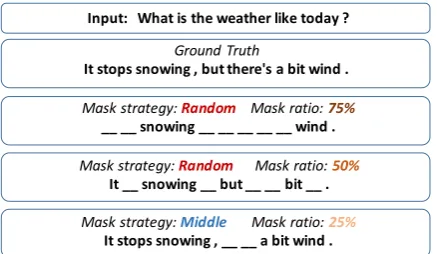
Input: What is the weather like today ?
Ground Truth
It stops snowing , but there's a bit wind .
Mask strategy: Random Mask ratio: 75% __ __ snowing __ __ __ __ __ wind .
Mask strategy: Random Mask ratio: 50% It __ snowing __ but __ __ bit __ .
Mask strategy: Middle Mask ratio: 25%
[image:6.595.73.292.62.189.2]It stops snowing , __ __ a bit wind .
Figure 3: Some testing samples of conversation reply with templates task with different mask strategies and ratios.
its single-turn data, which contains 82,792 conver-sation pairs. The query sentence is taken as en-coder input x, and the reply sentence is taken as
y.
The second task is Chinese acrostic poetry
generation (denoted as Poetry). Here we use a
publicly available Chinese poetry dataset4 which
contains 232,670 Chinese four-line poems. For each poem, the first two lines are used as encoder inputx, and the last two lines arey.
The third task isinfilling product reviews (de-noted as APRC). The Amazon Product Reviews
Corpus (APRC) (Dong et al., 2017a), which is
built upon Amazon product data (McAuley et al.,
2015) and contains 347,061 reviews, is used in this task. Unlike the first two tasks, this task is an un-conditional text infilling task (without un-conditional
input x). We use each product review in Dong
et al.(2017a) asy.
For each task, we take 5,000 samples in the test set to construct the data with blanks (yB) for
test-ing, we create a variety of test samples by
mask-ing out text y with varying missing ratios and
two mask strategies. More specifically, the first
mask strategy is calledmiddlewhich is followed
as the setting inSun et al.(2017), namely,
remov-ing r = 25%, 50%, or 75% of the words from
the middle ofy for each data. The second mask
strategy is calledrandom, namely, randomly
re-movingr = 25%, 50%, or75% of the words in
y for each data. To sum up, we have three test
tasks, and each task has six types of test sets (two mask strategies and three mask ratios). Each test set contains 5,000 test samples. We show some data examples in Figure3.
4https://github.com/chinese-poetry/ chinese-poetry
5.2 Baselines
We compare our approach TIGS with several
strong baseline approaches:
Seq2Seq-f: it runs beam search (BS) with beam
width K on a well-trained seq2seq model
(for-ward) to fill the blanks from left to right.
Seq2Seq-b: it runs BS with beam widthKon a
well-trained seq2seq model (backward) to fill the blanks from right to left.
Seq2Seq-f+b: it fills the blanks by both
Seq2Seq-f and Seq2Seq-b, and then selects the output with a maximum of the probabilities as-signed by the seq2seq models. This method is used inWang et al.(2016).
BiRNN-GSN: it runs GSN (Berglund et al.,
2015) on a well-trained seq2seq model with
BiRNN as the decoder to fill the blanks.
BiRNN-BiBS: it runs bidirectional beam search
(BiBS) (Sun et al.,2017) on a well-trained seq2seq model with BiRNN as the decoder to fill the blanks. The method has achieve the state-of-the-art results on fill-in-the-blank image captioning task inSun et al.(2017).
Except for BiRNN-GSN and BiRNN-BiBS, all the above baselines and our method perform in-ference on the same well-trained seq2seq model. BiRNN-GSN and BiRNN-BiBS perform infer-ence on a well-trained seq2seq model in which the decoder is BiRNN. These models are trained on the complete sentence dataset with standard
maximum-likelihood. Moreover, the sentences
with blanks are only used in the inference stage. For fari comparison, BiRNN-BiBS, BiRNN-GSN, and the proposed method use the same initializa-tion strategy (left-to-right greedy). The maximum number of iterationsT is set to 50 to ensure that all the algorithms can achieve their best performance.
In addition to the above inference based proaches, we also compare two model-based
ap-proaches: Mask-Seq2Seq and Mask-Self-attn
(Fedus et al.,2018;Zhu et al.,2019). These base-lines take the output template as an additional in-put and are trained on the data in fill-in-the-blank format. We use LSTM RNNs for Mask-Seq2Seq, and use the self-attention model (Vaswani et al.,
Datasets Metrics Methods r=25% r=50% r=75% Random Middle Random Middle Random Middle
Dialog NLL
Seq2Seq-f 3.573 3.453 3.653 3.316 3.328 2.975 Seq2Seq-b 3.657 3.558 3.911 3.542 3.713 3.421 Seq2Seq-f+b 3.397 3.321 3.491 3.213 3.233 2.932 BiRNN-BiBS 3.248 3.279 3.268 3.294 3.245 3.217 BiRNN-GSN 3.239 3.270 3.219 3.199 3.086 2.938 Mask-Seq2Seq 3.406 3.368 3.434 3.347 3.279 3.177 Mask-Self-attn 3.567 3.524 3.694 3.466 3.509 3.205 TIGS (ours) 3.143 3.164 3.050 3.030 2.920 2.764
BLEU
Template 0.780 0.823 0.621 0.700 0.552 0.601 Seq2Seq-f 0.834 0.861 0.670 0.737 0.584 0.640 Seq2Seq-b 0.837 0.862 0.675 0.739 0.584 0.627 Seq2Seq-f+b 0.860 0.881 0.692 0.751 0.594 0.643 BiRNN-BiBS 0.828 0.852 0.661 0.725 0.575 0.626 BiRNN-GSN 0.894 0.892 0.726 0.752 0.600 0.643 Mask-Seq2Seq 0.867 0.887 0.719 0.769 0.614 0.662
Mask-Self-attn 0.858 0.864 0.719 0.743 0.623 0.643 TIGS (ours) 0.895 0.894 0.724 0.754 0.596 0.644
Poetry NLL
Seq2Seq-f 4.107 4.022 3.901 3.642 3.430 3.294 Seq2Seq-b 4.180 4.124 4.051 3.837 3.638 3.511 Seq2Seq-f+b 4.021 3.994 3.825 3.630 3.390 3.275 BiRNN-BiBS 3.939 3.966 3.735 3.701 3.476 3.430 BiRNN-GSN 3.953 3.976 3.739 3.652 3.405 3.296 Mask-Seq2Seq 4.103 4.071 3.996 3.886 3.738 3.637 Mask-Self-attn 4.052 4.028 3.911 3.810 3.666 3.548 TIGS (ours) 3.860 3.912 3.601 3.567 3.268 3.181
BLEU
Template 0.727 0.815 0.581 0.687 0.508 0.559 Seq2Seq-f 0.779 0.842 0.629 0.704 0.536 0.576 Seq2Seq-b 0.774 0.835 0.623 0.702 0.534 0.576 Seq2Seq-f+b 0.789 0.844 0.635 0.705 0.538 0.577 BiRNN-BiBS 0.776 0.836 0.625 0.702 0.533 0.575 BiRNN-GSN 0.802 0.848 0.648 0.707 0.541 0.579
Mask-Seq2Seq 0.785 0.843 0.635 0.705 0.537 0.577 Mask-Self-attn 0.790 0.845 0.640 0.706 0.539 0.579
TIGS (ours) 0.805 0.850 0.650 0.707 0.542 0.579
APRC NLL
Seq2Seq-f 3.554 3.129 3.687 2.650 3.068 2.122 Seq2Seq-b 3.694 3.215 4.039 2.826 3.494 2.349 Seq2Seq-f+b 3.354 3.002 3.515 2.553 2.962 2.045 BiRNN-BiBS 2.999 3.001 2.943 2.759 2.733 2.456 BiRNN-GSN 2.969 2.967 2.907 2.515 2.628 2.012 Mask-Seq2Seq 3.080 2.983 2.951 2.567 2.472 2.088 Mask-Self-attn 3.002 2.946 2.847 2.551 2.448 2.085 TIGS (ours) 2.831 2.857 2.722 2.394 2.451 1.913
BLEU
Template 0.503 0.692 0.127 0.432 0.009 0.182 Seq2Seq-f 0.781 0.897 0.623 0.881 0.682 0.879 Seq2Seq-b 0.779 0.896 0.616 0.872 0.683 0.864 Seq2Seq-f+b 0.812 0.905 0.658 0.887 0.703 0.884
[image:7.595.136.461.62.532.2]BiRNN-BiBS 0.867 0.896 0.715 0.869 0.740 0.856 BiRNN-GSN 0.879 0.904 0.751 0.884 0.736 0.882 Mask-Seq2Seq 0.860 0.900 0.750 0.856 0.754 0.835 Mask-Self-attn 0.878 0.914 0.778 0.882 0.778 0.870 TIGS (ours) 0.883 0.911 0.774 0.889 0.769 0.878
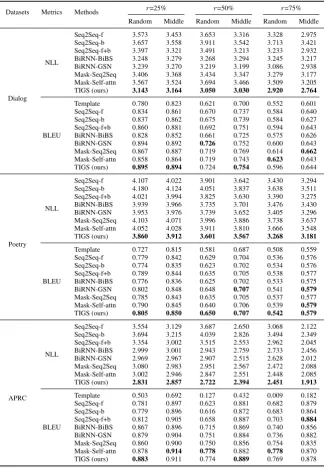
Table 1: BLEU and NLL results.
5.3 Metrics
FollowingSun et al.(2017), we compare methods
on standard sentence-level metric BLEU scores (4-gram) (Papineni et al., 2002) which considers the correspondence between the ground truth and the complete sentences. However, such a metric also has some deficiencies in text infilling tasks. For example, given two complete sentences with only one word different, the sentence level statis-tics of them may be quite similar, whereas a hu-man can clearly tell which one is most natural. Moreover, given a template, there may be several reasonable ways to fill in the blanks. For example,
given a template, “i this book, highly
recom-mend it”, it is reasonable to fill the word “love” or “like” in the blank. However, since there is only one ground truth, the BLEU scores of these two complete sentences are quite different. We find that this issue is more severe for the unconditional text filling task which has fewer restrictions, lead-ing to more ways of filllead-ing in the blanks.
Besides BLEU scores, we conduct a model-based evaluation. We train a conditional LM for each task (unconditional LM for APRC task) and use its NLL to evaluate the quality of the complete sentencey∗given the inputx.
5.4 Results
The BLEU (the higher the better) and NLL (the
lower the better) results are shown in Table 1.
Generally, we find that bidirectional methods (BiRNN-BiBS, BiRNN-GSN, and Seq2Seq-f+b) outperform unidirectional ones (Seq2Seq-f and Seq2Seq-b) in most cases. The model-based meth-ods (Mask-Seq2Seq and Mask-Self-attn) perform well on unconditional text infilling task (APRC), but slightly poorly on conditional text infilling tasks (Dialog and Poetry). In line with the evalua-tion results inZhu et al.(2019), the Mask-Self-attn performs consistently better than Mask-Seq2Seq. It has also achieved the highest BLEU score in some cases of unconditional text infilling tasks. However, in most cases of conditional text infilling tasks, the proposed method performs better than Mask-Self-attn.
Since the goal of the proposed method TIGS is to find the complete sentence with minimal NLL by utilizing gradient information. As expected, it achieves the lowest NLL in all cases of all tasks. Also, the BLEU scores of TIGS is highest in most cases of conditional text infilling tasks, while BiRNN-GSN and BiRNN-BiBS provide compara-ble performance. Although TIGS is used in RNN-based seq2seq model, it still achieves very com-petitive BLEU results on unconditional text infill-ing task compare with Mask-Self-attn.
Methods Dialog Poetry APRC
BiRNN-BiBS 1.524 1.478 1.558
BiRNN-GSN 2.979 2.675 2.261
Mask-Self-attn 2.270 2.727 3.042
TIGS 3.226 3.120 3.137
Table 2: Human evaluation resutls
5.5 Human Evaluation
We also conduct the human evaluation to further compare TIGS, BiRNN-BiBS, BiRNN-GSN, and Mask-Self-attn. Following the setting inZhu et al.
(2019), we collect generations of each of the four methods on 50 randomly-selected test instances. Then we launch a crowd-sourcing online study, asking 10 evaluators to rank the generations. The
Template really __ this __ __ __ believable plot .
Ground Truth really enjoyed this futuristic book . believable plot . Seq2seq-f really enjoyed this book . the believable plot . Seq2seq-b really with this development and a believable plot . Mask-Seq2Seq really enjoyed this fast paced and believable plot Mask-Self-attn really enjoyed this book . very believable plot .
BiRNN-BiBS really enjoyed this story and a believable plot . BiRNN-GSN really enjoyed this book and a believable plot . TIGS really enjoyed this book . very believable plot .
Input (Query) can you study with the radio on ? Template __ , __ listen __ __ music . Ground Truth no , I listen to background music .
Seq2seq-f i'd , I'm listen to the music . Seq2seq-b music , can listen to the music . Mask-Seq2Seq yes , they listen to the music . Mask-Self-attn yes , it'salot of music .
BiRNN-BiBS I , to listen to the music . BiRNN-GSN yes , I'll listen to the music .
TIGS yes , I listen to classical music .
Template so __ better __ the __ one . __ __ . __ now i __ <num> more __ __ __ __ submit .
Ground Truth so much better than the last one . really good . and now i need <num> more words before i can submit . Seq2seq-f so far better than the first one . ca n't . wait now i
have <num> more books to read . submit . Seq2seq-b so getting better for the next one . it down . . now i
write <num> more words so i can submit . Mask-Seq2Seq so much better than the first one . loved it . and now
i have <num> more words to submit this submit . Mask-Self-attn so much better than the first one . loved it . now
now i need <num> more words to describe and submit .
BiRNN-BiBS so much better than the first one . loved it . and now i have <num> more to read . i submit .
BiRNN-GSN so much better than the first one . i cried . so now i have <num> more words to go to submit . TIGS so much better than the first one . highly
recommend . but now i need <num> more words to go to submit .
Template love __ book and __ __ club series
Ground Truth love this book and the camel club series Seq2seq-f love love book and ca n't club series Seq2seq-b love next book and 's murder club series Mask-Seq2Seq love this book and the murder club series Mask-Self-attn love this book and the book club series
BiRNN-BiBS love this book and the book club series BiRNN-GSN love this book and all the club series
[image:8.595.315.520.73.465.2]TIGS love this book and the motorcycle club series
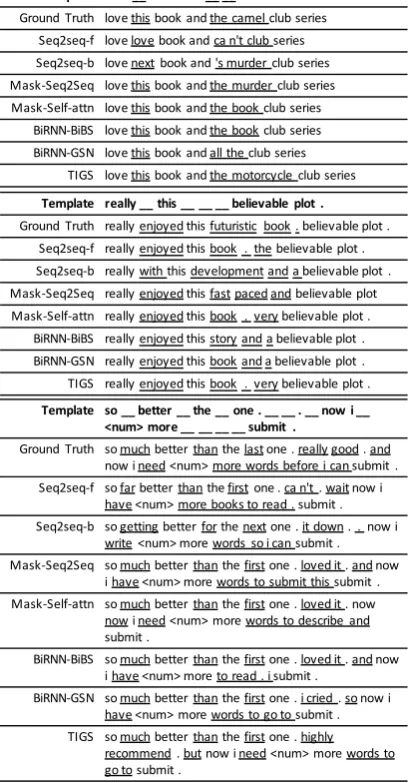
Figure 4: Example outputs of different methods on APRC task.
method with the best generation receives a score of 4, and the other three methods receive scores of 3, 2, and 1 according to the rank, respectively. The results are shown in Table2. We can see that TIGS consistently outperforms all baselines.
5.6 Samples and Analysis
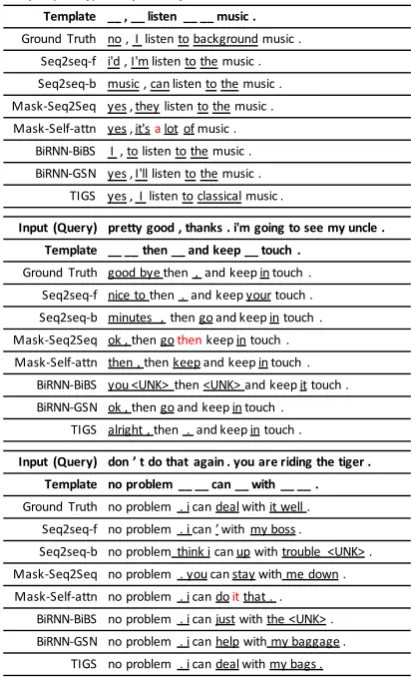
Figure 4 and 5 show some qualitative examples
Input (Query) pretty good , thanks . i'm going to see my uncle . Template __ __ then __ and keep __ touch .
Ground Truth good bye then , and keep in touch . Seq2seq-f nice to then . and keep your touch . Seq2seq-b minutes , then go and keep in touch . Mask-Seq2Seq ok , then gothenkeep in touch . Mask-Self-attn then , then keep and keep in touch .
BiRNN-BiBS you <UNK> then <UNK> and keep it touch . BiRNN-GSN ok , then go and keep in touch .
TIGS alright , then . and keep in touch .
Input (Query) don ’ t do that again . you are riding the tiger . Template no problem __ __ can __ with __ __ . Ground Truth no problem . i can deal with it well .
Seq2seq-f no problem . i can ’ with my boss .
Seq2seq-b no problem think i can up with trouble <UNK> . Mask-Seq2Seq no problem . you can stay with me down . Mask-Self-attn no problem . i can doitthat . .
BiRNN-BiBS no problem . i can just with the <UNK> . BiRNN-GSN no problem . i can help with my baggage .
TIGS no problem . i can deal with my bags . Template really __ this __ __ __ believable plot .
Ground Truth really enjoyed this futuristic book . believable plot . Seq2seq-f really enjoyed this book . the believable plot . Seq2seq-b really with this development and a believable plot . Mask-Seq2Seq really enjoyed this fast paced and believable plot Mask-Self-attn really enjoyed this book . very believable plot .
BiRNN-BiBS really enjoyed this story and a believable plot . BiRNN-GSN really enjoyed this book and a believable plot . TIGS really enjoyed this book . very believable plot .
Input (Query) can you study with the radio on ? Template __ , __ listen __ __ music . Ground Truth no , I listen to background music .
Seq2seq-f i'd , I'm listen to the music . Seq2seq-b music , can listen to the music . Mask-Seq2Seq yes , they listen to the music . Mask-Self-attn yes , it'salot of music .
BiRNN-BiBS I , to listen to the music . BiRNN-GSN yes , I'll listen to the music .
[image:9.595.76.282.74.413.2]TIGS yes , I listen to classical music .
Figure 5: Example outputs of different methods on Daily task.
the blank.
BiRNN-BiBS makes assumption that
P(yt|y1:t−1,yt+1:m,x) = P−−→URNN(yt|y1:t−1,x) ·
P←−−
URNN(yt|yt+1:m,x). This assumption may
cause some sentences generated by
BiRNN-BiBS are non-smooth or unreal. For example,
in the top instance, the BiRNN-BiBS gener-ates a non-smooth sentence “i, to listen to the
music”. At the third time-step, because both
P−−→
URNN(y3 =“to”|y4:m =“listen to the music”,x)
and P←−−
URNN(y3 =“to”|y1:2 =“i,”,x) are relatively
large, resulting in this blank being filled with an inappropriate word “to” by BiRNN-BiBS. However, P(y3 =“to”|y1:2 =“i,”, y4:m =“listen
to the music”,x)should be lower. In addition, we find that BiRNN-BiBS tends to use the unknown token “<unk>” to fill the blanks compared to other methods. The reason we analyze may be that
sometimes both P−−→
URNN(yt=“<unk>”|y1:t−1,x)
and P←−−
URNN(yt=“<unk>”|yt+1:m,x) would be
relatively large.
As for Mask-Seq2Seq and Mask-Self-attn,
al-though they directly take the template yB as an
additional input and are trained with data in
fill-in-the-blank format. We experimentally found
that the generalization ability of these models is still limited, especially for conditional text
infill-ing tasks. In the Dialog task,21%and16%of the
samples generated by Self-attn and Mask-Seq2Seq with beam search could not even recon-struct the template (see Figure5).5
Because the BiRNN-GSN fills the blank from the probabilityPBiRNN(yt|y1:t−1,yt+1:m,x), and
the proposed method filling the blank directly with the gradient ∇yˆemb
t L(x,y
∗). Both of them have
the ability to reason about the past and future si-multaneously without any unrealistic assumptions. We can see that the complete sentences generated by them are better than all other algorithms. How-ever, BiRNN-GSN uses the bidirectional structure as the decoder, which makes it challenging to ap-ply to most sequence generative models, but the proposed method is gradient-based, which can be broadly used in any sequence generative models.
6 Conclusions
In this paper, we propose a general inference algo-rithm for text infilling. To the best of our knowl-edge, the method is the first inference algorithm that does not require any modification or training of the model and can be broadly used in any se-quence generative model to solve the fill-in-the-blank tasks. We compare the proposed method and several strong baselines on three text infilling tasks with various mask ratios and different mask strate-gies. The results show that the proposed method is an effective and efficient approach for fill-in-the-blank tasks, consistently outperforming all base-lines.
Acknowledgment
This work is supported by the National Key R&D Program of China under contract No. 2017YFB1002201, the National Natural Science Fund for Distinguished Young Scholar (Grant No. 61625204), and partially supported by the State Key Program of National Science Foundation of China (Grant Nos. 61836006 and 61432014).
5For BLEU and NLL evaluation, we force them to
References
Peter Anderson, Basura Fernando, Mark Johnson, and Stephen Gould. 2017. Guided open vocabulary im-age captioning with constrained beam search. In
EMNLP.
Dzmitry Bahdanau, Kyunghyun Cho, and Yoshua Ben-gio. 2014. Neural machine translation by jointly learning to align and translate. arXiv preprint arXiv:1409.0473.
Pierre Baldi, Søren Brunak, Paolo Frasconi, Giovanni Soda, and Gianluca Pollastri. 1999. Exploiting the past and the future in protein secondary structure prediction. Bioinformatics.
Mathias Berglund, Tapani Raiko, Mikko Honkala, Leo K¨arkk¨ainen, Akos Vetek, and Juha T Karhunen. 2015. Bidirectional recurrent neural networks as generative models. InNIPS.
Minhao Cheng, Jinfeng Yi, Huan Zhang, Pin-Yu Chen, and Cho-Jui Hsieh. 2018. Seq2sick: Evaluat-ing the robustness of sequence-to-sequence mod-els with adversarial examples. arXiv preprint arXiv:1803.01128.
Jacob Devlin, Ming-Wei Chang, Kenton Lee, and Kristina Toutanova. 2018. Bert: Pre-training of deep bidirectional transformers for language understand-ing. arXiv preprint arXiv:1810.04805.
Li Dong, Shaohan Huang, Furu Wei, Mirella Lapata, Ming Zhou, and Ke Xu. 2017a. Learning to generate product reviews from attributes. InACL.
Yinpeng Dong, Fangzhou Liao, Tianyu Pang, Hang Su, Xiaolin Hu, Jianguo Li, and Jun Zhu. 2017b. Boosting adversarial attacks with momentum. arXiv preprint arXiv:1710.06081.
William Fedus, Ian Goodfellow, and Andrew M Dai. 2018. Maskgan: Better text generation via filling in the . arXiv preprint arXiv:1801.07736.
Jonas Gehring, Michael Auli, David Grangier, De-nis Yarats, and Yann N Dauphin. 2017. Convolu-tional sequence to sequence learning. arXiv preprint arXiv:1705.03122.
Ian J. Goodfellow, Jean Pouget-Abadie, Mehdi Mirza, Bing Xu, David Warde-Farley, Sherjil Ozair, Aaron C. Courville, and Yoshua Bengio. 2014a. Generative adversarial nets. InNIPS.
Ian J Goodfellow, Jonathon Shlens, and Christian Szegedy. 2014b. Explaining and harnessing adver-sarial examples. arXiv preprint arXiv:1412.6572.
Tianxing He and James Glass. 2018. Detecting egregious responses in neural sequence-to-sequence models. arXiv preprint arXiv:1809.04113.
Sepp Hochreiter and J¨urgen Schmidhuber. 1997. Long short-term memory.Neural computation.
Yanran Li, Hui Su, Xiaoyu Shen, Wenjie Li, Ziqiang Cao, and Shuzi Niu. 2017. Dailydialog: A manually labelled multi-turn dialogue dataset. InICLR.
Dayiheng Liu, Quan Guo, Wubo Li, and Jiancheng Lv. 2018a. A multi-modal chinese poetry generation model. InIJCNN.
Dayiheng Liu, Jiancheng Lv, Feng He, and Yifan Pu. 2018b. Bfgan: Backward and forward generative adversarial networks for lexically constrained sen-tence generation. arXiv preprint arXiv:1806.08097.
Minh-Thang Luong, Hieu Pham, and Christopher D Manning. 2015. Effective approaches to attention-based neural machine translation. arXiv preprint arXiv:1508.04025.
Julian McAuley, Rahul Pandey, and Jure Leskovec. 2015. Inferring networks of substitutable and com-plementary products. InSIGKDD.
Hongyuan Mei, Mohit Bansal, and Matthew R Walter. 2017. Coherent dialogue with attention-based lan-guage models. InAAAI.
Tom´aˇs Mikolov, Martin Karafi´at, Luk´aˇs Burget, Jan ˇ
Cernock`y, and Sanjeev Khudanpur. 2010. Recur-rent neural network based language model. In
IN-TERSPEECH.
Franz Josef Och and Hermann Ney. 2004. The align-ment template approach to statistical machine trans-lation.Computational linguistics.
Kishore Papineni, Salim Roukos, Todd Ward, and Wei-Jing Zhu. 2002. Bleu: a method for automatic eval-uation of machine translation. InACL.
Mike Schuster and Kuldip K Paliwal. 1997. Bidirec-tional recurrent neural networks. IEEE Transactions on Signal Processing.
Abigail See, Peter J Liu, and Christopher D Manning. 2017. Get to the point: Summarization with pointer-generator networks. InACL.
Qing Sun, Stefan Lee, and Dhruv Batra. 2017. Bidirec-tional beam search: Forward-backward inference in neural sequence models for fill-in-the-blank image captioning. InCVPR.
Ilya Sutskever, James Martens, George E. Dahl, and Geoffrey E. Hinton. 2013. On the importance of initialization and momentum in deep learning. In
ICML.
Ilya Sutskever, Oriol Vinyals, and Quoc V Le. 2014. Sequence to sequence learning with neural net-works. InNIPS.
Ashish Vaswani, Noam Shazeer, Niki Parmar, Jakob Uszkoreit, Llion Jones, Aidan N Gomez, Łukasz Kaiser, and Illia Polosukhin. 2017. Attention is all you need. InNIPS.
Cheng Wang, Haojin Yang, Christian Bartz, and Christoph Meinel. 2016. Image captioning with deep bidirectional lstms. InACM Multimedia.
Yonghui Wu, Mike Schuster, Zhifeng Chen, Quoc V Le, Mohammad Norouzi, Wolfgang Macherey, Maxim Krikun, Yuan Cao, Qin Gao, Klaus Macherey, et al. 2016. Google’s neural ma-chine translation system: Bridging the gap between human and machine translation. arXiv preprint arXiv:1609.08144.
Lantao Yu, Weinan Zhang, Jun Wang, and Yong Yu. 2017. Seqgan: Sequence generative adversarial nets with policy gradient. InAAAI.