5308
Span-Level Model for Relation Extraction
Kalpit Dixit Amazon AWS AI, USA
Yaser Al-Onaizan Amazon AWS AI, USA
Abstract
Relation Extraction is the task of identifying entity mention spans in raw text and then iden-tifying relations between pairs of the entity mentions. Recent approaches for this span-level task have been token-span-level models which have inherent limitations. They cannot eas-ily define and implement span-level features, cannot model overlapping entity mentions and have cascading errors due to the use of sequen-tial decoding. To address these concerns, we present a model which directly models all pos-sible spans and performs joint entity mention detection and relation extraction. We report a new state-of-the-art performance of 62.83F1
(prev best was 60.49) on the ACE2005 dataset.
1 Introduction
Many NLP tasks follow the pattern of taking raw text as input and then: detecting relevant spans and classifying the relations between those spans. Examples of this include Relation Extraction (Li and Ji,2014), Coreference Resolution (Ng,2010) and Semantic Role Labeling (Gildea and Juraf-sky, 2002). This class of NLP problems are in-herently span-level tasks. This paper focuses on Relation Extraction (RE), which is the task of en-tity mention detection and classifying the relations between each pair of those mentions. We report a new state-of-the-art performance of 62.83 F1
(prev best was 60.49) on the ACE2005 dataset. Here is a simple example of Relation Extrac-tion for the sentence, ”Washington, D.C. is the capital of the USA”. Step 1, Entity Mention De-tection will detect the spans ”Washington, D.C.” and ”USA” as LOCATIONS. Step 2, Relation Extraction will classify all directed pairs of de-tected entity mentions. It will classify the directed pair (”Washington, D.C.”, ”USA”) as having the relation IS CAPITAL OF. But the directed pair (”USA”, ”Washington, D.C.”) will be classified
as having no relation (NONE). In more complex cases, each entity could participate in multiple dif-ferent relations.
Since (Li and Ji, 2014), work on RE has re-volved around end-to-end systems: single models which first perform entity mention detection and then relation extraction. These recent works ( Bek-oulis et al.,2018;Katiyar and Cardie,2017;Miwa and Bansal, 2016;Li and Ji,2014) have used se-quential token-level methods for both the steps. Token-level models are primarily constrained by the fact that each token has a single fixed repre-sentation while each token is a part of many dif-ferent spans. To model and extract spans, these token-level models have to resort to approximate span-level features which are increasingly indirect and expensive: Tree-LSTMs (Miwa and Bansal,
2016), CRFs (Bekoulis et al.,2018), Beam Search (Li and Ji, 2014) and Pointer Networks (Katiyar and Cardie, 2017). Their usage of the BILOU (Ratinov and Roth, 2009; Florian et al., 2006) token-tagging scheme makes modelling overlap-ping entities impossible. In general, these token-level models are sequential in nature and hence have cascading errors.
cascad-ing errors. Such models have recently found suc-cess in similar NLP tasks like Coreference Resolu-tion (Lee et al.,2017) and Semantic Role Labeling (Ouchi et al.,2018). In this paper, we present such a span-level model for Relation Extraction.
We propose a simple bi-LSTM based model which generates span representations for each pos-sible span. The span representations are used to perform entity mention detection on all spans in parallel. The same span representations are then used to perform relation extraction on all pairs of detected entity mentions. We evaluated the per-formance of our model on the ACE2005 dataset (Doddington et al., 2004) and report a new start-of-the-artF1score of 62.83 for Relation Extrac-tion.
2 Related Work
Given text input, Relation Extraction involves two steps: span detection and classification of the rela-tion between pairs of detected spans. In the RE literature, these are more commonly called En-tity Mention Detection and Relation Extraction re-spectively. An earlier line of research has focused on only the second step, assuming that the argu-ments of the relations are given by some other sys-tem/oracle (Bunescu and Mooney, 2005; Socher et al.,2012;dos Santos et al.,2015).
The more interesting problem is joint Entity Mention Detection and Relation Extraction. More interesting because it simultaneously addresses both steps, enriches embeddings from losses re-lated to both sub-tasks and only requires using a single model during test. Past approaches include Integer Linear Programming (Yang and Cardie,
2013) and Probabilistic Graphical Models (Singh et al.,2013). Li and Ji(2014) modeled this joint task as a Structured Prediction problem and since then most work on RE has revolved around end-to-end systems which do the joint task (Miwa and Bansal,2016;Katiyar and Cardie,2017;Bekoulis et al.,2018).
A common theme in current end-to-end mod-els is the use of toklevel modmod-els. For the en-tity mention detection step, recent works (Miwa and Bansal,2016;Katiyar and Cardie,2017; Bek-oulis et al., 2018) have used the BILOU ( Rati-nov and Roth, 2009; Florian et al., 2006) token-tagging scheme. For the relation extraction step there have been a variety of methods tried like Tree-LSTMs (Miwa and Bansal,2016), sequence
labeling (Katiyar and Cardie, 2017) and multi-head selection (Bekoulis et al., 2018). Li and Ji
(2014) used semi-Markov chains and the Viterbi algorithm, which is also a sequential token-level approach. This token-level modeling approach has several limitations as highlighted in Section1.
Recent work using span-level end-to-end mod-els have seen success in NLP tasks following the same pattern as RE (Coreference Resolution (Lee et al., 2017) and Semantic Role Labeling (Ouchi et al.,2018)). In this paper, we adapt (Lee et al.,
2017) to create a span-level end-to-end model for RE.
3 Model
Our model consists of three steps which we ex-plain in detail in the next subsections:
1. Span Representation Generation
Use task-agnostic raw token embeddings to create task-specific token embeddings for each token. The task-specific token embed-dings are used to generate span embedembed-dings for each possible span.
2. Entity Mention Detection (EMD)
The span embeddings are used to obtain a vector of entity type scores for each span. Each span is assigned the entity type corre-sponding to its highest entity type score. The spans that are assigned an entity type other thanNONEare selected for Step 3.
3. Relation Extraction (RE)
For each ordered span-pair(i, j), we obtain a representation by concatenating the respec-tive span embeddings. This representation is defined in an order-sensitive way in Section
3.3i.e. the span-pair representation of spans
(i, j)is different from that of spans(j, i). For each ordered span-pair, its representation is used to obtain a vector of relation type scores. Each ordered span-pair is assigned the rela-tion type of its highest relarela-tion type score.
3.1 Step 1: Span Representation Generation
The architecture we use to generate span represen-tations closely follows (Lee et al.,2017).
Raw Token Embeddings We usextto represent the raw token embeddings of tokentwith1≤t≤
T.xtis a concatenation of the following:
1. Fixed Contextual Word Embeddings
2. Fixed Word Embeddings
3. Trained from scratch Character Embeddings
We use fixed ELMo (Peters et al., 2018) for Contextual Word Embeddings, fixed Senna ( Col-lobert et al.,2011) for Word Embeddings and train Character Embeddings from scratch. The Con-textual Word Embeddings for each sentence were computed separately.
In terms of number of free parameters; Con-textual Word Embeddings use the most (100’s of millions), followed by Word Embeddings (10’s of millions) and finally Character Embeddings use by far the least (10’s of thousands). The decision to train only the Character Embeddings was based on overfitting concerns given our relatively small dataset.
Bi-LSTM Layers The pretrained Contextual Embeddings we use in xt above are obtained by unsupervised task-agnostic training. To ob-tain task-specific contextualization we use stacked bidirectional LSTMs (Hochreiter and Schmidhu-ber,1997) on the raw token embeddingsxtto ob-tainx∗t,
x∗t = [−→ht,←h−t]
where−h→tand
←−
ht are the hidden states of the last layer of the forward and backward LSTMs respec-tively. x∗t is the concatenation of−→htand
←− ht. The bi-LSTMs were run separately on each sentence as that gave better performance.
Span Representation Syntactic heads obtained from general syntactic parsers are used in many NLP systems. Here we don’t use general syntactic parsers but instead use attention (Bahdanau et al.,
2015) to create a task-specific span-head feature. This feature vector is computed for each span:
αt=MLPα(x∗t)
βi,t=
exp(αt)
END(i)
P
k=START(i)
exp(αk)
ˆ xi=
END(i)
X
k=START(i) βi,txt
where MLPα is a Multi Layer Perceptron (aka
Feed Forward Network). ˆxiis a weighted sum of fixed word vectors for the tokens in spani. We did experiment with using the weighted sum of the bi-LSTM output (x∗t) or of the ELMo (Peters et al.,
2018) fixed contextual word embeddings but got better results with using fixed word embeddings.
For each spani, its span representationgi was defined as:
gi= [x∗START(i),x∗END(i),ˆxi, φ(i)]
whereφ(i) encodes the size of spaniin number of tokens. Each component ofgiis a span-specific feature that would be difficult to define and use in token-level models.
3.2 Step 2: Entity Mention Detection (EMD)
In this step, we predict the entity type for each span. This prediction is done identically and par-allelly for each span. For each span we compute a vector of entity type scores. The number of entity type scores computed is the number of entity types (including the NONEentity type). For each span, the softmax function is applied to its entity type scores to get a distribution over the entity types. For spani,
scoreneri =MLPner(gi)
pneri =sof tmax(scoreneri ) (1)
The output size of MLPner and hence the size of pneri is equal to the number of NER classes.
The predicted entity type for each spaniis the entity type corresponding to span i’s highest en-tity type score i.e. max (scoreneri ). Only spans whose predicted entity type is not NONE are se-lected for Step 3. Unlike token-level models, over-lapping spans can be selected here as each span’s selection decision is independent of other spans.
3.3 Step 3: Relation Extraction (RE)
In this paper, we only consider ordered binary relations, the most common setting of RE i.e. only relations between exactly two arguments and where the two pairs (spani, spanj) and (span j, spani) are considered different. We consider ev-ery ordered pair of selected spans (from Step 2) such that both spans are from the same sentence. For each such pair (spani, spanj), we first com-pute an ordered pair embeddingr(i,j):
where gi andgj are the span embeddings of the 1st and 2nd arguments respectively (from Step 1).
gi◦gjrefers to their element-wise product. We use the ordered pair embeddingri,jto com-pute a vector of relation type scores. The number of relation type scores is the number of relation types (including theNONErelation type). For each ordered pair of spans, the softmax function is ap-plied to its relation type scores to get a distribution over the relation types. For pair (spani, spanj),
scorerei,j =MLPre(ri,j)
prei,j =sof tmax(scorerei,j) (2)
The output size of MLPre and hence the size of prei,j is equal to the number of RE classes.
3.4 Loss
Two learning signals are provided to train the model: entity type information per span and rela-tion type informarela-tion per ordered (selected) span pair. Both are provided via CrossEntropy Loss on Equations 1 and2 respectively. We use yˆner
i
to represent the correct entity type for spaniand
ˆ
yi,jre to represent the correct relation type for the ordered pair of spans, (spani, span j). S repre-sents the set of all spans andS0 represents the set of all selected spans (Section3.2). Then the final training loss is,
loss=X
i∈S
pneri (ˆyneri ) +X
i∈S0
X
j∈S0,j6=i
prei,j(ˆyrei,j)
where the first term is a sum over all spans of the entity mention detection loss (eqn1) and the sec-ond term is a sum over all ordered pairs of selected spans of the relation extraction loss (eqn2).
4 Experiments
Dataset We use the ACE2005 dataset ( Dodding-ton et al., 2004). It has 351 documents for train, 80 for validation and 80 for test. There are seven span-level entity types and six ordered span rela-tion types.
Character Embeddings The learned character embeddings are of size 8. 1-dimensional convo-lutions of window size 3,4,5 are applied per-token with 50 filters of each window size. This is fol-lowed by ReLU activation (Nair and Hinton,2010) and max-pooling over each filter.
Model Size Our stacked bi-LSTMs (Section3.1) has 3 layers with 200-dimensional hidden states
and highway connections. All Multi Layer Per-ceptrons (MLP) has two hidden layers with 500 dimensions, each followed by ReLU activation.
Feature Encoding Each span gets a span width feature which is a learned 20-dimensional vector representing the number of tokens in that span.
Span Pruning A high number of spans un-der consiun-deration can lead to memory and speed issues. We only consider spans that are entirely within a sentence and limit spans to a max length ofL = 10. This choice was based on our Train Set, see Section5) for a discussion about it. Per-formance is not affected significantly as very few entity mentions have more than 10 tokens.
Regularization Dropout (Srivastava et al.,2014) is applied with dropout rate 0.2 to all hidden layers of all MLPs and feature encodings, with dropout rate 0.5 to all word and character embeddings and with dropout rate 0.4 to all LSTM layer outputs.
Learning Learning is done with Adam (Kingma and Ba,2015) with default parameters. The learn-ing rate is annealed by 1% every 100 iterations. Minibatch Size is 1. Early Stopping of 20 evalua-tions on the dev set is used.
5 Model Complexity
Section3.1describes our span generation process and Section4describes our algorithmic span prun-ing process. The algorithmic span prunprun-ing process limits our model spans which are entirely within a single sentence and have a max length ofL = 10
tokens. While our model creates representations for spans (instead of just tokens), it achieves the dual goals of being memory efficient and captur-ing most (more than 99.95%) entities and relations in the space of the spans considered.
Entity Mention Detection Relation Extraction
System P R F1 P R F1
(Li and Ji,2014) 85.2 76.9 80.8 68.9 41.9 52.1 (Miwa and Bansal,2016) 82.9 83.9 83.4 57 54.0 55.6 (Katiyar and Cardie,2017) 84.0 81.3 82.6 57.9 54.0 55.9 (Sanh et al.,2018) EMD + RE 86.54 85.49 86.02 68.66 54.05 60.49 (Sanh et al.,2018) multi-task * 85.68 85.69 85.69 68.53 54.48 61.30
[image:5.595.105.496.62.174.2]our model 85.85 86.10 85.98 68.02 58.38 62.83
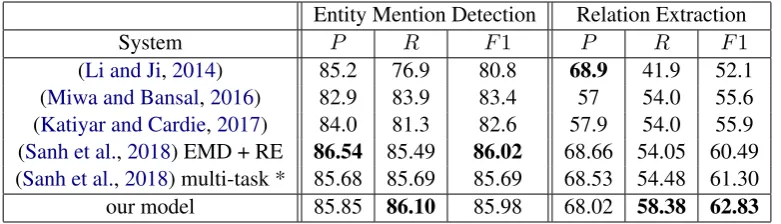
Table 1: EMD and RE results on the ACE2005 Test dataset. Our model reports a new state-of-the-art RE perfor-mance. Sanh et al.(2018) present several results in their multi-task paper. Results marked with (*) are not fair comparisons here because they use additional signals beyond EMD and RE. Included here for completeness.
Permitted Spans # Spans % Entities Covered % Relations Covered
all spans across doc 45,836,252 100.00 100.00
only spans within single sentence 1,894,256 100.00 100.00
+ max lengthL=10 1,079,150 99.99 99.96
+ max lengthL= 5 632,477 99.92 99.60
+ max lengthL= 2 279,515 98.02 94.92
[image:5.595.85.513.230.327.2]+ max lengthL= 1 144,783 89.13 78.87
Table 2: Numbers are for the Train Set (351 docs) of ACE2005, where each Relation is between exactly two Entities. Dev and Test Sets follow the same trends. Each row is a different policy for span generation and our chosen policy is bolded. ”# Spans” is the number of spans considered by the policy. ”% Entities Covered” is the percentage of entities in the dataset that are considered by that policy. ”% Relations Covered” is the same thing for Relations (i.e. a Relation is covered if both entities of the Relation are covered). Note how our chosen policy is more than 40x more memory efficient than a policy which considers all spans in the doc. And yet, our method covers 99.99% and 99.96% of all Entities and Relations respectively in the Train Set of ACE2005.
6 Results
Table 1 shows the results for RE. For the joint task, we compare entity mention detection perfor-mance and relation extraction perforperfor-mance. Our proposed model achieves a new SOTA on RE with aF1of 62.83, more than 2.3F1above the previ-ous SOTA. Our proposed model also beats a multi-task modelSanh et al.(2018) which uses signals from additional tasks by more than 1.5F1points.
For both tasks, our model’s Precision is close to and Recall is significantly higher than previ-ous works. The Recall gains for RE (4.3 absolute points) are much higher than for EMD (0.6 abso-lute points). The gains in EMD Recall highlights the effectiveness of our span representations (Sec-tion3.1). The disproportionate gains in RE Recall cannot be fully explained by the relatively lower gains in EMD Recall. Thus, our large gains in RE Recall (andF1) showcase the effectiveness of our simple modeling of ordered span pairs for relation extraction (Section3.3).
7 Conclusions
We present a neural span-level end-to-end model for joint entity mention detection and relation ex-traction. In contrast with existing token-level models: our model is able to use span-specific fea-tures, allows for overlapping entity mentions and does not use sequential decoding. Our proposed model achieves a new state-of-the-art RE perfor-mance on the ACE2005 dataset. The gains are driven by improvements in Recall for both tasks.
Acknowledgements
We would like to thank He He for her guidance in writing this paper and comments on multiple manuscripts. We would also like to thank the anonymous reviewers of ACL 2019, their com-ments and suggestions have helped us focus more on the important aspects of this paper.
References
jointly learning to align and translate. CoRR, abs/1409.0473.
Giannis Bekoulis, Johannes Deleu, Thomas Demeester, and Chris Develder. 2018. Joint entity recogni-tion and relarecogni-tion extracrecogni-tion as a multi-head selecrecogni-tion problem.Expert Syst. Appl., 114:34–45.
Razvan C. Bunescu and Raymond J. Mooney. 2005. A shortest path dependency kernel for relation ex-traction. InProceedings of the Conference on Hu-man Language Technology and Empirical Methods in Natural Language Processing, HLT ’05, pages 724–731, Stroudsburg, PA, USA. Association for Computational Linguistics.
Ronan Collobert, Jason Weston, L´eon Bottou, Michael Karlen, Koray Kavukcuoglu, and Pavel Kuksa. 2011. Natural language processing (almost) from scratch.J. Mach. Learn. Res., 12:2493–2537.
George R Doddington, Alexis Mitchell, Mark A Przy-bocki, Lance A Ramshaw, Stephanie Strassel, and Ralph M Weischedel. 2004. The automatic content extraction (ace) program-tasks, data, and evaluation. InLREC, volume 2, page 1.
Radu Florian, Hongyan Jing, Nanda Kambhatla, and Imed Zitouni. 2006. Factorizing complex models: A case study in mention detection. In ACL 2006, 21st International Conference on Computational Linguistics and 44th Annual Meeting of the Associ-ation for ComputAssoci-ational Linguistics, Proceedings of the Conference, Sydney, Australia, 17-21 July 2006.
Daniel Gildea and Daniel Jurafsky. 2002. Auto-matic labeling of semantic roles.Comput. Linguist., 28(3):245–288.
Sepp Hochreiter and J¨urgen Schmidhuber. 1997. Long short-term memory. Neural Comput., 9(8):1735– 1780.
Arzoo Katiyar and Claire Cardie. 2017. Going out on a limb: Joint extraction of entity mentions and re-lations without dependency trees. InProceedings of the 55th Annual Meeting of the Association for Com-putational Linguistics (Volume 1: Long Papers), pages 917–928. Association for Computational Lin-guistics.
Diederik P. Kingma and Jimmy Ba. 2015. Adam: A method for stochastic optimization. CoRR, abs/1412.6980.
Kenton Lee, Luheng He, Mike Lewis, and Luke Zettle-moyer. 2017. End-to-end neural coreference reso-lution. InProceedings of the 2017 Conference on Empirical Methods in Natural Language Process-ing, pages 188–197. Association for Computational Linguistics.
Qi Li and Heng Ji. 2014. Incremental joint extrac-tion of entity menextrac-tions and relaextrac-tions. In Proceed-ings of the 52nd Annual Meeting of the Associa-tion for ComputaAssocia-tional Linguistics (Volume 1: Long
Papers), pages 402–412. Association for Computa-tional Linguistics.
Makoto Miwa and Mohit Bansal. 2016.End-to-end re-lation extraction using lstms on sequences and tree structures. InProceedings of the 54th Annual Meet-ing of the Association for Computational LMeet-inguistics (Volume 1: Long Papers), pages 1105–1116. Asso-ciation for Computational Linguistics.
Vinod Nair and Geoffrey E. Hinton. 2010. Rectified linear units improve restricted boltzmann machines. InProceedings of the 27th International Conference on International Conference on Machine Learning, ICML’10, pages 807–814, USA. Omnipress.
Vincent Ng. 2010.Supervised noun phrase coreference research: The first fifteen years. InProceedings of the 48th Annual Meeting of the Association for Com-putational Linguistics, ACL ’10, pages 1396–1411, Stroudsburg, PA, USA. Association for Computa-tional Linguistics.
Hiroki Ouchi, Hiroyuki Shindo, and Yuji Matsumoto. 2018. A span selection model for semantic role la-beling. InProceedings of the 2018 Conference on Empirical Methods in Natural Language Process-ing, pages 1630–1642. Association for Computa-tional Linguistics.
Matthew Peters, Mark Neumann, Mohit Iyyer, Matt Gardner, Christopher Clark, Kenton Lee, and Luke Zettlemoyer. 2018. Deep contextualized word repre-sentations. InProceedings of the 2018 Conference of the North American Chapter of the Association for Computational Linguistics: Human Language Technologies, Volume 1 (Long Papers), pages 2227– 2237. Association for Computational Linguistics.
Lev Ratinov and Dan Roth. 2009. Design challenges and misconceptions in named entity recognition. In
Proceedings of the Thirteenth Conference on Com-putational Natural Language Learning, CoNLL ’09, pages 147–155, Stroudsburg, PA, USA. Association for Computational Linguistics.
V. Sanh, T. Wolf, and S. Ruder. 2018. A hierarchical multi-task approach for learning embeddings from semantic tasks.
Cicero dos Santos, Bing Xiang, and Bowen Zhou. 2015. Classifying relations by ranking with con-volutional neural networks. InProceedings of the 53rd Annual Meeting of the Association for Compu-tational Linguistics and the 7th International Joint Conference on Natural Language Processing (Vol-ume 1: Long Papers), pages 626–634. Association for Computational Linguistics.
Sameer Singh, Sebastian Riedel, Brian Martin, Jiap-ing Zheng, and Andrew McCallum. 2013. Joint in-ference of entities, relations, and corein-ference. In
Richard Socher, Brody Huval, Christopher D. Man-ning, and Andrew Y. Ng. 2012. Semantic compo-sitionality through recursive matrix-vector spaces. In Proceedings of the 2012 Joint Conference on Empirical Methods in Natural Language Process-ing and Computational Natural Language LearnProcess-ing, EMNLP-CoNLL ’12, pages 1201–1211, Strouds-burg, PA, USA. Association for Computational Lin-guistics.
Nitish Srivastava, Geoffrey Hinton, Alex Krizhevsky, Ilya Sutskever, and Ruslan Salakhutdinov. 2014. Dropout: A simple way to prevent neural networks from overfitting. J. Mach. Learn. Res., 15(1):1929– 1958.