J. Range Manage.
55:144-149 March 2002
Day and night grazing by cattle in the Sahel
AUGUSTINE. A. AYANTUNDE, SALVADOR FERNANDEZ-RIVERA, PIERRE. H. HIERNAUX, HERMAN VAN KEULEN, AND HENK M. J. UDO
Authors are former graduate Fellow, Animal Scientist and Range Ecologist, International Livestock Research Institute, ILRI/ICRISAT, B.P. 12404, Niamey, Niger, professor and Associate Professor, Animal Production Systems Group, Wageningen Agricultural University, P. 0. Box 338, 6700 AH Wageningen, The Netherlands. The correspondence author is Henk Udo.
Abstract
The influence of night grazing on feeding behavior, nutrition and performance of cattle was studied. Twenty-four steers weighing 367 kg (SD = 76) grazed either from 0900 to 1900 (day grazers), 2100 to 0700 (night grazers) or 0900 to 1900 and 2400 to 0400 (day-and-night grazers) during 13 weeks. Four esophageally flstulated steers were used in a cross-over design to sample the diet selected during the day and at night. No differences (P >
0.05) were observed in the diet selected in the day or at night. As the season progressed the fiber components of the diet increased (P < 0.01) significantly while nitrogen and in sacco dry matter dis- appearance declined (P < 0.01). Actual grazing time (min day"', SE =16) were 352, 376, and 476 for day, night, and day-and-night grazers, respectively. Day-and-night grazers had a higher intake of organic matter than either day or night grazers. Night grazers had the lowest forage intake and also the slowest rate of con- sumption. Steers that grazed in the night had the lowest water intake: 22.7 liter day"' (SE =1.5) in week 4;19.9 liter day' (SE _ 1.1) in week 8. Average weight changes (g day', SE = 62) were -
435, -548 and -239 for day, night, and day-and-night grazers, respectively. These results show that during the dry season, graz- ing exclusively in the night cannot substitute for day time graz- ing, but that it is rather complementary to the latter. Timing (day or night) of grazing did not affect diet selection but noctur- nal grazing decreased the need for water.
Key Words: cattle, forage intake, night grazing, Sahel
Night grazing is a common herd management practice in the West African Sahel, especially at the end of the dry season (Dicko-Toure 1980, Powell et al. 1996). This practice has also been reported for herded animals in the sub-humid zone of West Africa (Bayer 1986), East Africa (Wigg and Owen 1973, Nicholson 1987) and for free ranging sheep and cattle in the USA and Australia (Vallentine 1990). In addition to the advantage of increased grazing time, King (1983) reported that night grazing helps to reduce heat stress on the animals and may increase for- age intake. It has the benefit of manure deposition on rangelands rather than in the enclosed sites (Wigg and Owen 1973).
However, this is in conflict with the practice of corralling the ani- mals on cropland for depositing manure (Powell et al. 1996).
Previous research (Fernandez-Rivera et al. 1996) on night grazing
Resumen
El objetivo del presente trabajo fue estudiar la influencia del pastoreo nocturno sobre el comportamineto alimenticio, el con- sumo de forraje, la excrecion fecal y los cambios de peso en bovi- nos. Veinticuatro novillos con un peso inicial de 367 kg (desviacion estndar = 76) pastorearon de 0900 a 1900 (pastoreo diurno), 2100 a 0700 (pastoreo nocturno) o de 0900 a 1900 y de 2100 a 0700 (pastoreo dia y noche) durante 13 semanas. Cuatro novillos con fistula esofgica fueron utilizados en un dise0 reversible para muestrear la dieta seleccionada durante el dIa y en la noche. No se observaron diferencias (P > 0.05) en la dieta seleccionada en el dIa o en la noche. A medida que la estacion seca avanzo los componentes de fibra de la dieta aumentaron (P
< 0.01), mientras que el contenido de nitrogen y la desaparicion in sacco de la materia seca disminuyeron (P < 0.01). El tiempo de pastoreo propiamente dicho (i.e. tiempo de consumo) fue 352, 376 y 476 min dia'' (SE = 16) para novillos con pastoreo noc- turno, pastoreo diurno o con pastoreo el dla y la noche, respecti- vamente. Los novillos con pastoreo el dia y la noche tuvieron un mayor consumo de materia orgnica que aquellos que pastoreo-
ran el dIa o la noche. Los novillos con pastoreo nocturno tuvieron los niveles y tasas de consumo de forraje ms bajos. El consumo de agua fue tambiEn ms bajo . en los novillos que pas- torearon durante la noche 22.7 liter dIa' (SE =1.5) en la semana 4 y 19.9 liter dIa'' (SE = 4) en la semana 8). El cambio promedio de peso fue -435, -548 y -239 g dia' (SE = 62) para los novillos con pastoreo nocturno, pastoreo diurno o con pastoreo el dia y la noche, respectivamente. Estos resultados indican que durante la estacion seca el pastoreo exclusivamente durante la noche no puede ser substituto, sino ms bien complemento del pastoreo durante el dia. El momento (dIa o noche) de pastoreo no affecto la selection de la dieta, pero el pastoreo nocturno disminuyo el requerimiento de agua.
by cattle showed that diet selection during the day and at night were not different. However, the steers that grazed during the day consumed more forage and water than those that grazed in the night. Further studies on the influence of night grazing on feeding behavior, nutrition and performance of cattle are needed to improve understanding of the nutrition of grazing cattle and cat- tle's role in nutrient transfer processes in the landscape.
The objective of this study was to determine the effects of night grazing on diet selection, forage and water intake, fecal excretion, feeding behavior and performance of cattle.
Manuscript accepted 7 Jul. 01.
Material and Methods
Study site
The experiment was conducted over 13
weeks at the end of the dry season (February to May) of 1995 at International Crop Research Institute for the Semi-Arid Tropics (ICRISAT-SC) in Sadore (13° 14' N 2° 16' E), Niger.
Treatments, pasture and animals Twenty-four intact steers with a body weight (W) of 367 (SD = 76) kg were ran- domly allotted to 3 treatments: grazing either from 0900 to 1900 (day grazing), 2100 to 0700 (night grazing) or 0900 to 1900 and 2400 to 0400 (day-and-night grazing). After return from the pasture, the steers were kept in individual pens in a barn located 150 m from the paddock. The animals grazed the same pasture in the day and at night, i.e. a fallow of 5.5 ha, domi- nated by annual grasses mainly Ctenium elegans Kunth, Diheteropogon hagerupii Hitchc., Pennisetum pedicellatum Trin.
and forbs mainly Borreria stachydea
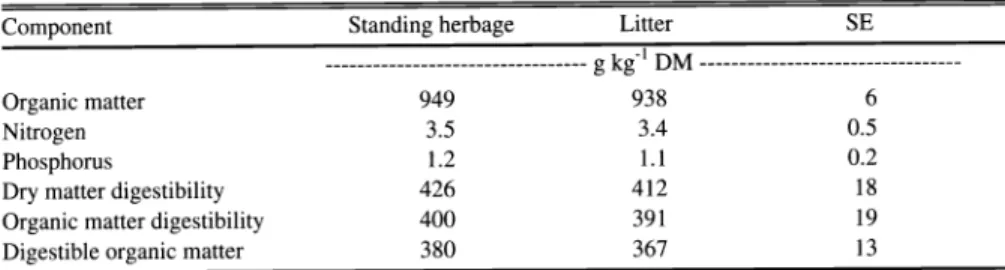
(DC.) Hutch. & Dalz. and Hibiscus sab- darifa Linn. At the beginning of the trial, the standing herbage and litter mass of the pasture were estimated at 828 and 1,070 kg DM ha
1,respectively (Table 1). The herbage mass consisted of standing hay composed of 59% grasses and 41% forbs.
The study included 2 periods of collec- tion of feces and extrusa which started in weeks 4 and 8 of the experiment. Each period included 9 days of fecal collec- tion.The animals were accustomed to car- rying fecal collection bags during the last week before the collection started. In each collection period, fecal bags were emptied and the feces weighed, before and after grazing. Ten percent of the fecal excretion was sampled and frozen for subsequent analysis. Water intake was also measured in weeks 4 and 8 of the trial. All the ani- mals were watered in the morning (0800) before grazing started. Water intake was measured daily during the collection peri- ods, for which all animals had access to
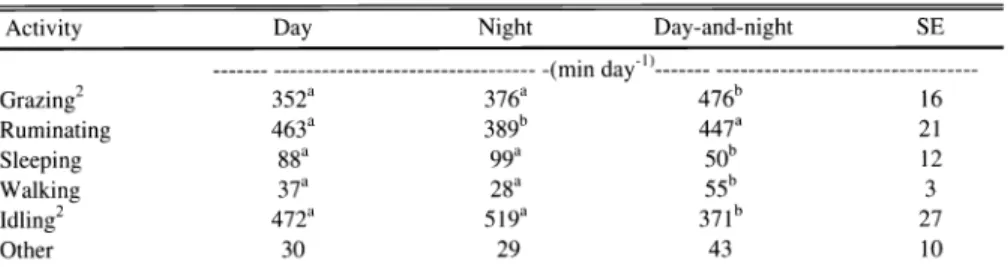
water for 30 min. In week 8 of the experi- ment the grazing activities of all steers were observed. Observation was made every 5 min (24 hour/day) for 3 consecu- tive days by 6 observers. The observation was instantaneous and the recording included one of the following activities:
searching for food, prehending, masticat- ing, ruminating, walking, drinking, sleep- ing, and idling. Grazing time was defined as the time spent prehending, masticating and searching for food. Idling included time spent neither for grazing, ruminating, sleeping, walking, nor drinking. Activities such as drinking, fighting, and socializing were referred to as `other'.
In the 2 collection periods, four esophageally fistulated steers were ran- domly grouped into 2 pairs and were used in a cross-over design for sampling the diet selected during the day and at night.
The 2 pairs either grazed in the day (0900 to 1900) or at night (2100 to 0700).
During the data collection period in weeks 4 and 8, samples of the diet selected by the fistulated steers (extrusa) were collected in the morning (1000) and afternoon (1500) for the day grazing pair, and at night (2200) and at dawn (0300) for the night grazing pair, for 3 consecutive days. At the end of the 3 days collection period, the 2 groups were switched. After switching the grazing schedule, the animals were allowed 3 days for adaptation after which extrusa samples were collected for another 3 days following the same collection
schedule. The extrusa samples were frozen immediately after collection.
Sample processing and laboratory analyses
The daily fecal sub-samples were bulked by time of collection (before or after grazing) and analyzed for dry (DM) and organic matter (OM). The extrusa samples were dried at 55° C for 48 hours and were ground to pass a 1-mm screen.
They were analyzed for DM, OM, nitro- gen (N), ashless neutral detergent fiber (NDF), ashless acid detergent fiber (ADF)
Table 1. Nutritional quality of standing herbage and litter mass at the beginning of the experiment (March 1995).
Component Standing herbage Litter SE
--- g kg
1DM ---
Organic matter 949 938 6
Nitrogen 3.5 3.4
Phosphorus 1.2
1.1Dry matter digestibility 426 412
Organic matter digestibility 400
391Digestible organic matter 380 367
and ashless lignin (Van Soest et al. 1991).
Hemicellulose and cellulose were calculat- ed as the differences NDF-ADF and ADF- lignin, respectively. Samples ground to pass a 2-mm screen were incubated in duplicate for 48 hours in 3 ruminally fistu- lated steers to determine in sacco DM (DMD) and OM (OMD) disappearance, treating the residues from the nylon bags in a HC1-pepsin solution for 24 hours.
Samples collected from vegetation mass measurement, representing the available feed, were subdivided by functional group (grasses or forbs) and dominant species within a group for standing herbage and litter separately. These were analyzed for DM, OM, N, phosphorus (P), DMD, and OMD.
Animal measurements
Animals were weighed every two weeks for 3 consecutive days. Average daily gain (ADG) was estimated by regression of individual body weight (W) data over time. Individual animal feed intake was determined from individual data on fecal output and group (day or night schedule) means of OMD.
Statistical analysis
Data analysis were performed with SAS (Statistical Analysis System Institute 1987) using the General Linear Model (GLM) procedure for the variance and regression analyses. An analysis of vari- ance model including treatments as fixed effects, was used to analyze data on fecal output, forage and water intake, and ani- mal behavior (time spent grazing, ruminat- ing, idling, walking, sleeping, and drink- ing). The model for analysis of water intake included live weight and dry matter intake in addition to the treatments stud- ied. Multiple comparisons of treatment means (Day vs Night grazing and Day vs
Day-and-night grazing) within and between the collection periods (weeks 4
and 8) were performed by contrasts.
Extrusa components of diet selected in the day and at night were analyzed using the Cochran procedure for the t-test. Unless it is specified differently, the level of signifi- cance was declared at P < 0.05.
Results
There were no differences in the quality
of diet (extrusa) selected (Table 2) in the
day or at night for both collection periods
(weeks 4 and 8), the only exception was
observed in week 4 when the NDF (SE =
Table 2. Chemical composition of forage selected (extrusa) by esophageally fistulated steers graz- ing in the day or at night.
Week 4 Week 8
Component Day Night
g kg DM ---
Organic matter 894 883 4
Nitrogen 9.0a 8.1a
NDF 649a 675`'
h6
ADF 507a 521
a6
Lignin 134a 129`'
5Cellulose 373a 393a 6
5 8 8