Unsupervised extractive summarization via coverage maximization
with syntactic and semantic concepts
Natalie Schluter and Anders Søgaard Center for Language Technology
University of Copenhagen
{natschluter,soegaard}@hum.ku.dk
Abstract
Coverage maximization with bigram con-cepts is a state-of-the-art approach to un-supervised extractive summarization. It has been argued that such concepts are ad-equate and, in contrast to more linguistic concepts such as named entities or syn-tactic dependencies, more robust, since they do not rely on automatic process-ing. In this paper, we show that while this seems to be the case for a commonly used newswire dataset, use of syntactic and se-mantic concepts leads to significant im-provements in performance in other do-mains.
1 Introduction
State-of-the-art approaches to extractive summa-rization are based on the notion of coverage max-imization (Berg-Kirkpatrick et al., 2011). The assumption is that a good summary is a selec-tion of sentences from the document that contains as many of the important concepts as possible. The importance of concepts is implemented by as-signing weightswi to each concept iwith binary
variableci, yielding the following coverage
maxi-mization objective, subject to the appropriate con-straints:
N
X
i
wici (1)
In proposing bigrams as concepts for their system, Gillick and Favre (2009) explain that:
[c]oncepts could be words, named enti-ties, syntactic subtrees or semantic re-lations, for example. While deeper se-mantics make more appealing concepts, their extraction and weighting are much more error-prone. Any error in concept
extraction can result in a biased objec-tive function, leading to poor sentence selection. (Gillick and Favre, 2009)
Several authors, e.g., Woodsend and Lapata (2012), and Li et al. (2013), have followed Gillick and Favre (2009) in assuming that bigrams would lead to better practical performance than more syntactic or semantic concepts, even though bi-grams serve as only an approximation of these.
In this paper, we revisit this assumption and evaluate the maximum coverage objective for ex-tractive text summarization with syntactic and se-mantic concepts. Specifically, we replace bigram concepts with new ones based on syntactic depen-dencies, semantic frames, as well as named enti-ties. We show that using such concepts can lead to significant improvements in text summariza-tion performance outside of the newswire domain. We evaluate coverage maximization incorporating syntactic and semantic concepts across three dif-ferent domains: newswire, legal judgments, and Wikipedia articles.
2 Concept coverage maximization for extractive summarization
In extractive summarization, the unsupervised ver-sion of the task is sometimes set up as that of find-ing a subset of sentences in a document, within some relatively small budget, that covers as many of the important concepts in the document as pos-sible. In the maximum coverage objective, con-cepts are considered as independent of each other. Concepts are weighted by the number of times they appear in a document. Moreover, due the NP-hardness of coverage maximization, for an ex-act solution to the concept coverage optimization problem, we resort to fast solvers for integer linear programming, under some appropriate constraints. Bigrams. Gillick and Favre (2009) proposed to use bigrams as concepts, and to weight their con-tribution to the objective function in Equation (1)
by the frequency with which they occur in the doc-ument. Some pre-processing is first carried out to these bigrams: all bigrams consisting uniquely of stop-words are removed from consideration, and each word is stemmed. They also require bigrams to occur with a minimal frequency (cf. Section 3.2).
Named entities. We consider three new types of concepts, all suggested, but subsequently rejected by Gillick and Favre (2009). The first is simply to use named entities, e.g.,Court of Justice of the European Union, as concepts. This reflects the in-tuition that persons, organizations, and locations are particularly important for extractive summa-rization. We use an NER maximum entropy tag-ger1to augment documents with named entities. Syntactic dependencies. The second type of concept is dependency subtrees. In particular, we extract labeled and unlabeled syntactic depen-dencies, e.g., DEPENDENCY(walks,John) or SUB -JECT(walks,John), from sentences and represent
them by such syntactic concepts. We use the Stan-ford parser2 to augment documents with syntac-tic dependencies. As was done for bigrams, each word in the dependency is stemmed. Syntactic dependency-based concepts are intuitively a closer approximation than bigrams to concepts in gen-eral.
Semantic frames. The intuition behind our use of frame semantics is that a summary should rep-resent the most central semantic frames (Fillmore, 1982; Fillmore et al., 2003) present in the cor-responding document—indeed, we consider these frames to be actual types of concepts. We ex-tract frame names from sentences for a further type of concepts under consideration. We use SE-MAFOR3 to augment documents with semantic frames.
3 Experiments
3.1 Data
In order to investigate the importance of concept types across different domains, we evaluate our systems across three distinct domains, which we refer to asECHR,TAC08, andWIKIPEDIA.
ECHR consists of judgment-summary pairs
scraped from the European Court of
Hu-1http://www.nltk.org/
2http://nlp.stanford.edu/software/
lex-parser.shtml
3http://www.ark.cs.cmu.edu/SEMAFOR/
man Rights case-law website, HUDOC4. The document-summary pairs were split into training, development and test sets, consisting of 1018, 117, and 138 pairs, respectively. In the training set (pruning sentences of length less than 5), the aver-age document length is 13,184 words or 455 sen-tences. The average summary length is 806 words or 28 sentences. For both documents and sum-maries, the average sentence length is 29 words.
TAC08 consists of 48 queries and 2 newswire
document sets for each query, each set containg 10 documents. Document sets contain 235 in-put sentences on average, and the mean sentence length is 25 words. Summaries consist of 4 sen-tences or 100 words on average.
WIKIPEDIA consists of 992 Wikipedia articles
(all labeled “good article”5) from a comprehen-sive dump of English language Wikipedia arti-cles6. We use the Wikipedia abstracts (the leading paragraphs before the table of contents) as sum-maries. The (document,summary) pairs were split into training, development and test sets, consist-ing of 784, 97, and 111 pairs, respectively. In the training set (pruning sentences of length less than 5), the average document length is around 8918 words or 339 sentences. The average summary length is 335 words or 13 sentences. For both documents and summaries, the average sentence length is around 26 words.
In our main experiments, we use unsupervised summarization techniques, and we only use the training summaries (and not the documents) to de-termine output summary lengths.
3.2 Baseline and systems
Our baseline is the bigram-based extraction sum-marization system of Gillick and Favre (2009), icsisumm7. Their system was originally in-tended for multi-document update summarization, and summaries are extracted from document sen-tences that share more thankcontent words with some query. We follow this approach for the
TAC08 data. For ECHR and WIKIPEDIA, the
task is single document summarization, and the now irrelevant topic-document intersection pre-processing step is eliminated.
4http://hudoc.echr.coe.int/ 5http://en.wikipedia.org/wiki/
Wikipedia:Good_articles
6https://dumps.wikimedia.org/
enwiki/latest/enwiki-latest-pages -articles-multistream.xml.bz2
The original system uses the GNU linear pro-gramming kit8 with a time limit of 100 sec-onds. For all experiments presented in this pa-per, we double this time limit; we experimented with longer time limits on the development set for the ECHR data, without any performance
im-provements. Once the summarizer reaches the time limit, a summary is output based on the cur-rent feasible solution, whether the solution is op-timal or not. Moreover, the current icsisumm (v1) distribution prunes sentences shorter than 10 words. We note that we also tried replacingglpk bygurobi9, for which no time limit was neces-sary, but found poorer results on the development set of theECHRdata.
The original system takes several important in-put parameters.
1. Summary length, for TAC08, is specified
by the TAC 2008 conference guidelines as 100 words. For WIKIPEDIA and ECHR, we
have access to training sets which gave an average summary length of around 335 and 805 words respectively, which we take as the standard output summary length.
2. Concept count cut-offis the minimum fre-quency of concepts from the document (set) that qualifies them for consideration in cov-erage maximization. For bigrams of the orig-inal system on TAC08, there are two types
of document sets: ‘A’ and ‘B’. For ‘A’ type documents, Gillick and Favre (2009) set this threshold to 3 and for ‘B’ type documents, they set this to 4. ForWIKIPEDIAandECHR,
we take the bigram threshold to be 4. In our extension of the system to other concepts, we do not use any threshold.
3. First concept weighting:in multi-document summarization, there is the possibility for repeated sentences. Concepts from first-encountered sentences may be weighted higher: these concept counts from first-encountered sentences are doubled for ‘B’ documents and remain unchanged for ‘A’ documents in the original system onTAC08.
For other concepts, we do not alter frequen-cies in this manner, which is justified by the task change to single-document summariza-tion.
8http://www.gnu.org/software/glpk/ 9http://www.gurobi.com/
4. Query-sentence intersection threshold, is set to 1 for ‘A’ documents and 0 to ‘B’ documents in the original system onTAC08.
This threshold is only for the update summa-rization task and therefore does not concern
ECHRandWIKIPEDIA.
In addition to our baseline, we consider five single-concept systems using (a) named entities, (b) labeled dependencies, (c) unlabeled dependen-cies, (d) semantic frame names, and (e) seman-tic frame dependencies, as well as the five sys-tems combining each of these new concept types with bigrams. For the combination of these new concepts with bigrams, we extend the objective function to maximise in, Equation (1), into two sums—one for bigram concepts and the other for the new concept type—with their relative impor-tance controlled by a parameterα. N1andN2are
the number of bigram and other concept types oc-curring with the permitted threshold frequency in the document, relatively. Given that we are carry-ing out unsupervised summarization, rather than tuneα, we setα = 0.5, so the concepts are con-sidered in their totality (i.e.,N1+N2concepts
to-gether) with no explicit favouring of one over the other that does not naturally fall out of concept fre-quency.
(1−α)XN1
i
wibigrami+α N2
X
j
wjnew conceptj
3.3 Results
We evaluate output summaries using ROUGE-1, ROUGE-2, and ROUGE-SU4 (Lin, 2004), with no stemming and retaining all stopwords. These measures have been shown to correlate best with human judgments in general, but among the au-tomatic measures, ROUGE-1 and ROUGE-2 also correlate best with the Pyramid (Nenkova and Pas-sonneau, 2004; Nenkova et al., 2007) and Re-sponsiveness manual metrics (Louis and Nenkova, 2009). Moreover, ROUGE-1 has been shown to best reflect human-automatic summary compar-isons (Owczarzak et al., 2012).
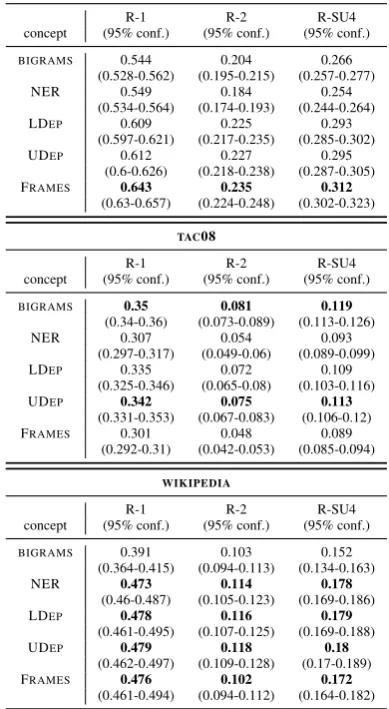
For single concept systems, the results are shown in Table 1, and concept combination sys-tem results are given in Table 2.
We first note that our runs of the current dis-tribution oficsisummyield significantly worse ROUGE-2 results than reported in (Gillick and Favre, 2009) (see Table 1,BIGRAMS): 0.081
On the TAC08 data, we observe no
improve-ments over the baseline BIGRAM system for any
ROUGE metric here. Hence, Gillick and Favre (2009) were right in their assumption that syntac-tic and semansyntac-tic concepts would not lead to perfor-mance improvements, when restricting ourselves to this dataset. However, when we change domain to the legal judgments or Wikipedia articles, using syntactic and semantic concepts leads to signifi-cant gains across all the ROUGE metrics.
For ECHR, replacing bigrams by frame names
(FRAME) results in an increase of +0.1 in
ROUGE-1, +0.031 in ROUGE-2 and +0.046 in ROUGE-SU4. We note that FrameNet 1.5 covers the legal domain quite well, which may explain why these concepts are particularly useful for the
ECHRdataset. However, labeled (LDEP) and
unla-beled (UDEP) dependencies also significantly
out-perform the baseline.
For WIKIPEDIA, replacing bigrams by labeled
or unlabeled syntactic dependencies results in sig-nificant improvements: an increase of +0.088 for ROUGE-1, +0.015 for ROUGE-2, and +0.03 for ROUGE-SU4. Interestingly, the NER sys-tem also yields significantly better performance over the baseline, which may reflect the nature of Wikipedia articles, often being about historical figures, famous places, organizations, etc.
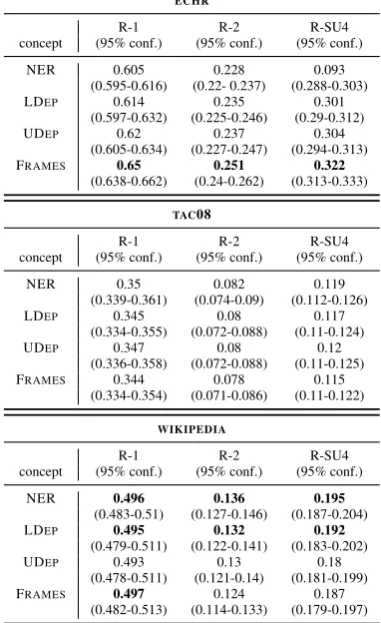
We observe in Table 2, that for concept combi-nation systems as well, ROUGE scores onTAC08
do not indicate any improvement in performance. However, best ROUGE-1 scores are produced for both ECHR and WIKIPEDIA data with
sys-tems that incorporate semantic frame names. For
WIKIPEDIA, best ROUGE-2 and ROUGE-SU4
scores incorporate named-entity information.
4 Related work
Most researchers have used bigrams as concepts in coverage maximization-based approaches to unsu-pervised extractive summarization. Filatova and Hatzivassiloglou (2004), however,use relations be-tween named entities as concepts in extractive summarization. They use slightly different extrac-tion algorithms, but their work is similar in spirit to ours. Nishikawa et al. (2010), also, use opin-ions – tuples of targets, aspects, and polarity – as concepts in opinion summarization. In early work on summarization, Silber and McCoy (2000) used WordNet synsets as concepts. Kitajima and Kobayashi (2011) replace words by syntactic de-pendencies in the Maximal Marginal Relevance
ECHR
R-1 R-2 R-SU4 concept (95% conf.) (95% conf.) (95% conf.)
BIGRAMS 0.544 0.204 0.266
(0.528-0.562) (0.195-0.215) (0.257-0.277) NER 0.549 0.184 0.254
(0.534-0.564) (0.174-0.193) (0.244-0.264) LDEP 0.609 0.225 0.293
(0.597-0.621) (0.217-0.235) (0.285-0.302) UDEP 0.612 0.227 0.295
(0.6-0.626) (0.218-0.238) (0.287-0.305)
FRAMES 0.643 0.235 0.312
(0.63-0.657) (0.224-0.248) (0.302-0.323)
TAC08
R-1 R-2 R-SU4 concept (95% conf.) (95% conf.) (95% conf.)
BIGRAMS 0.35 0.081 0.119
(0.34-0.36) (0.073-0.089) (0.113-0.126) NER 0.307 0.054 0.093
(0.297-0.317) (0.049-0.06) (0.089-0.099) LDEP 0.335 0.072 0.109
(0.325-0.346) (0.065-0.08) (0.103-0.116)
UDEP 0.342 0.075 0.113
(0.331-0.353) (0.067-0.083) (0.106-0.12)
FRAMES 0.301 0.048 0.089
(0.292-0.31) (0.042-0.053) (0.085-0.094)
WIKIPEDIA
R-1 R-2 R-SU4 concept (95% conf.) (95% conf.) (95% conf.)
BIGRAMS 0.391 0.103 0.152
(0.364-0.415) (0.094-0.113) (0.134-0.163)
NER 0.473 0.114 0.178
(0.46-0.487) (0.105-0.123) (0.169-0.186)
LDEP 0.478 0.116 0.179
(0.461-0.495) (0.107-0.125) (0.169-0.188)
UDEP 0.479 0.118 0.18
(0.462-0.497) (0.109-0.128) (0.17-0.189)
FRAMES 0.476 0.102 0.172
[image:4.595.318.513.75.430.2](0.461-0.494) (0.094-0.112) (0.164-0.182)
Table 1: Single concept results on ECHR, TAC08,
andWIKIPEDIA.
Multidocument measure first proposed by Gold-stein et al. (2000) for evaluating the importance of sentences in query-based extractive summa-rization, yielding improvements for their Japanese newswire dataset.
5 Conclusions
This paper challenges the assumption that bigrams make better concepts for unsupervised extractive summarization than syntactic and semantic con-cepts relying on automatic processing. We show that using concepts relying on syntactic dependen-cies or semantic frames instead of bigrams leads to significant performance improvements of cover-age maximization summarization across domains.
References
Taylor Berg-Kirkpatrick, Dan Gillick, and Dan Klein. 2011. Jointly learning to extract and compress. In
ECHR
R-1 R-2 R-SU4 concept (95% conf.) (95% conf.) (95% conf.)
NER 0.605 0.228 0.093 (0.595-0.616) (0.22- 0.237) (0.288-0.303) LDEP 0.614 0.235 0.301
(0.597-0.632) (0.225-0.246) (0.29-0.312) UDEP 0.62 0.237 0.304
(0.605-0.634) (0.227-0.247) (0.294-0.313)
FRAMES 0.65 0.251 0.322
(0.638-0.662) (0.24-0.262) (0.313-0.333)
TAC08
R-1 R-2 R-SU4 concept (95% conf.) (95% conf.) (95% conf.)
NER 0.35 0.082 0.119 (0.339-0.361) (0.074-0.09) (0.112-0.126) LDEP 0.345 0.08 0.117
(0.334-0.355) (0.072-0.088) (0.11-0.124) UDEP 0.347 0.08 0.12
(0.336-0.358) (0.072-0.088) (0.11-0.125)
FRAMES 0.344 0.078 0.115
(0.334-0.354) (0.071-0.086) (0.11-0.122)
WIKIPEDIA
R-1 R-2 R-SU4 concept (95% conf.) (95% conf.) (95% conf.)
NER 0.496 0.136 0.195
(0.483-0.51) (0.127-0.146) (0.187-0.204)
LDEP 0.495 0.132 0.192
(0.479-0.511) (0.122-0.141) (0.183-0.202) UDEP 0.493 0.13 0.18
(0.478-0.511) (0.121-0.14) (0.181-0.199)
FRAMES 0.497 0.124 0.187
(0.482-0.513) (0.114-0.133) (0.179-0.197)
Table 2: Results for systems combining bi-grams with new concepts, on ECHR, TAC08 and WIKIPEDIA.
Elena Filatova and Vasileios Hatzivassiloglou. 2004. Event-based extractive summarization. In ACL Workshop on Text Summarization Branches Out. Charles J. Fillmore, Christopher. R. Johnson, and
Miriam R. L. Petruck. 2003. Background to framenet. International Journal of Lexicography, 16.
Charles J. Fillmore, 1982. Linguistics in the Morn-ing Calm, chapter Frame Semantics, pages 111–137. Hanshin Publishing Co., Seoul, South Korea. Dan Gillick and Benoit Favre. 2009. A scalable global
model for summarization. InProc of ILP, pages 10– 18.
Jade Goldstein, Vibhu Mittal, Jaime Carbonell, and Mark Kantrowitz. 2000. Multi-document sum-marization by sentence extraction. In Proc of the ANLP/NAACL Workshop on Automatic Summariza-tion, pages 40–48.
Risa Kitajima and Ichiro Kobayashi. 2011. A latent topic extracting method based on events in a docu-ment and its application. InProc of ACL-HLT Stu-dent Session, pages 30–35, Portland, OR, USA. Chen Li, Xian Qian, and Yang Liu. 2013. Using
super-vised bigram-based ilp for extractive summarization. InProc of ACL, Sofia, Bulgaria.
Chin-Yew Lin. 2004. Rouge: A package for auto-matic evaluation of summaries. In Proc of WAS, Barcelona, Spain.
Annie Louis and Ani Nenkova. 2009. Automatically evaluation content selection in summarization with-out human models. InProc of EMNLP, pages 306– 314, Singapore.
Ani Nenkova and Rebecca Passonneau. 2004. Evalu-ating content selection in summarization: The pyra-mid method. InProc. of HLT-NAACL.
Ani Nenkova, Rebecca Passonneau, and Kath-leen McKeown. 2007. The pyramid method:incorporating human content selection variation in summarization evaluation. ACM Transactions on Speech and Language Processing, 4.
Hitoshi Nishikawa, Takaaki Hasegawa, Yoshihiro Mat-suo, and Genichiro Kikui. 2010. Opinion summa-rization with integer linear programming formula-tion for sentence extracformula-tion and ordering. In COL-ING.
Karolina Owczarzak, John M. Conroy, Hoa Trang Dang, and Ani Nenkova. 2012. An as-sessment of the accuracy of automatic evaluation in summarization. In Proc of the Workshop on Evaluation Metrics and System Comparison for Automatic Summarization, pages 1–9, Montr´eal, Canada.
[image:5.595.85.276.70.382.2]