www.wjpr.net Vol 3, Issue 3, 2014. 4816
EFFECT OF SOLVENT, TEMPERATURE, pH AND TIME ON
EXTRACTION PROCESS OF ANTI THIAMINE FACTOR PRESENT
IN LEAVES OF Abrus precatorius Linn.
*Prasanta Kumar Mitra
Department of Biochemistry,North Bengal Medical College,Sushrutanagar 734012.
ABSTRACT
Effect of solvent, temperature, pH and time on extraction process of
anti thiamine factor present in Abrusprecatorius Linn.leaveswas
studied. Results showed that extraction of leaves of Abrusprecatorius
Linnwith 50% acetone –water mixture at 400C for one hour at pH 3.0
had maximum anti thiamine activity in in vitro experiments.
Keywords: Extraction process, Anti thiamine activity, Abrus precatorius Linn.
INTRODUCTION
Abrus precatorius Linn. has been used in Hindu medicines from very early times, aswell as in
china and other ancient cultures [1]. The plant was consideredbeneficial for the hair and the
seeds extract isused in the treatment of ulcer and skin affection [2]. Seeds of the plant are
very much attractive, used in ornaments, but are highly poisonous. Seeds are reported to have
anti diabetic property [3], may induce abortion [4], have anti oxidative property [5] as well
as anti– inflammatory analgesic activity [6]. Saganuwan and Gulumbe[7,8]reported
antimicrobial activity of the aqueous extract of Abrus precatorius Linn. Against Salmonella
typhimurium, Escherichia coli, Klebsiellapneumoniae, Streptococcus pyogenes and
Streptococcus pneumoniae. Karamokoet al. also showed antibacterial activities of the
aqueous extract of the plant [9]. Other uses of theplant are observed in cancer [10] and in
malaria[11] .
Phytochemical components of the plant are abricin,abrin, abrisin, abrine, abraline, abrasine,
abrusgenic acid-methylester, abruslectone,abrussic acid, anthocyanins etc. [12,13]. Recently
Volume 3, Issue 3, 4816-4824. Research Article ISSN 2277 – 7105
Article Received on 12 March 2014,
Revised on 05 April 2014, Accepted on 28 April 2014
*Correspondence for
Author
Dr. Prasanta Kumar Mitra
Department of Biochemistry,
North Bengal Medical College,
www.wjpr.net Vol 3, Issue 3, 2014. 4817
we observed anti thiamine activity of the leaves of Abrusprecatorius Linn. inin vitro
experiments. Tempted by this observation we undertook studies for isolation of the bio active
compound present inAbrusprecatorius Linn.responsible for anti thiamine activity. In this
communication we report effect of solvent, temperature, pH and time on extraction process of
anti thiamine compound from the leaves of AbrusprecatoriusLinn.
MATERIALS AND METHODS Collection of plant material
Leaves ofAbrusprecatoriusLinn.were collected from the medicinal plant garden of the
University of North Bengal and identified by the taxonomists of the department of Botany of
the said University. A voucher specimen of the leaf was kept in the department for future
references.
AbrusprecatoriusLinn.
Preparation of leaves for Anti thiamine activity
Leaves of Abrusprecatorius Linn.were shed dried and powdered. 50 grams of this powder
was separately extracted with 500 ml of different solvents at different temperatures, pH and
time on a temperature controlled rotary shocker. The extract was filtered and the solvent was
evaporated to dryness in vacuo with rotary evaporator at 40 – 50 degree centigrade. A
brownish mass was obtained. This mass was kept to check the anti thiamine activity.
In vitro anti thiamine activity
The anti thiamine activity was determined by estimating the residual thiamine present in a
system containingknown amount of thiamine hydrochloride and test material collected from
Abrusprecatorius Linn. leavesby the method of Bhattacharya and Choudhuri[14]. Main steps
were: an intimate mixture of thiamine hydrochloride (100 mg) and test material collected
from Abrusprecatorius Linn. leaves (100 mg) was incubated at 30 degree centigrade for 1
www.wjpr.net Vol 3, Issue 3, 2014. 4818
taken and residual thiamine hydrochloride was estimated by thiochrome method described by
Harris and Wang [15]. In short, to 2ml of the filtrate 0.1ml potassium ferricyanide (2.5g/l)
and 0.25 ml of sodium hydroxide (150g/l) were added. The solution was mixed thoroughly. 2
ml isobutanol was then added to it. The solution was shaked for 1 minute. Fluorescence of the
supernatant was noted by a fluorimeter at 435 nm using excitation at 365 nm. Tubes for
standard thiamine solution (400 µg/l) and for blank were run simultaneously.
Effect of solvents in extraction process
Distilled water as well as 50% (v/v) of chloroform, ethanol, methanol, acetone and petroleum
ether were used separately in extraction process.
Effect of time in extraction process
Extraction processes were done separately for 30, 60, 90 and 120 minutes.
Effect of temperature in extraction process
In separate experiments extraction processes were done at 30, 40, 50 and 60 degree
centigrade.
Effect of pH in extraction process
In separate experiments extraction processes were done at 3.0, 5.0, 7.0, 10.0 and 14.0 pH.
Acidic and alkaline pH was maintained by adding 1(N) hydrochloric acid and 1(N) sodium
hydroxide respectively.
Reagents
All reagents required for the experiment were procured from Merck,USA.
RESULTS
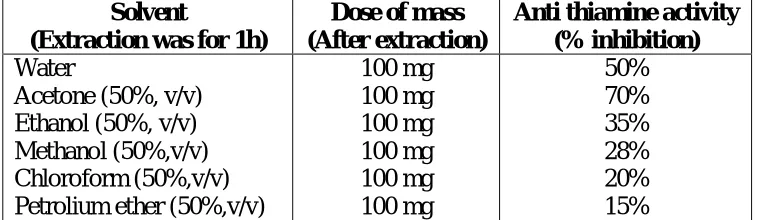
Table – 1 shows effect of solvents on extraction process for isolation of anti thiamine
compound from the leaves of Abrusprecatorius Linn.It was found out that acetone (50%, v/v)
extract of the leaves of Abrusprecatorius Linn. had maximum anti thiamine activity. 70%
inhibition of added thiamine was noted in the in vitro experiment. Anti thiamine activity in
terms of percent inhibition of thiamine for different solvent systems were as follow: water –
50%, ethanol (50%, v/v) – 35%, methanol (50%, v/v) – 28%, chloroform (50%, v/v) – 20%,
www.wjpr.net Vol 3, Issue 3, 2014. 4819
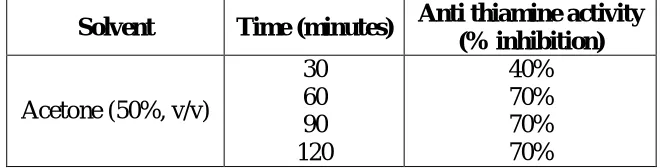
Effect of time on extraction process for isolation of anti thiamine compound from the leaves
of Abrusprecatorius Linn.is shown in Table – 2.Time given for extraction in separate
experiments were 30 minutes, 60 minutes, 90 minutes and 120 minutes. It appears from the
table that antithiamine activity in terms of percent inhibition of exogenous thiamine was
maximum(70%) for 60 minutes extraction time. For 30 minutes, 90 minutes and 120 minutes
of extraction time anti thiamine activity in terms of percent inhibition of thiamine came 40%,
70% and 70% respectively.
Table – 3 shows effect of temperature on extraction process for isolation of anti thiamine
compound from the of leaves of Abrusprecatorius Linn.. Increase in temperature during
extraction elevated anti thiamine activity. When extraction was done at thirty degree
centigrade anti thiamine activity in terms of percent inhibition of added thiamine was 60%
but the same value was 72% when the extraction temperature was raised to forty degree
centigrade. After that even increasing the temperature of extraction process, anti thiamine
activity was not elevated. For fifty and sixty degree centigrade temperature of extraction
process, anti thiamine activity in terms of percent inhibition of thiamine were 68% and 64%
respectively. Results thus showed that maximum anti thiamine activity came when the
temperature of extraction process was forty degree centigrade.
Effect of pH on extraction process for isolation of anti thiamine compound from the leaves of
Abrusprecatorius Linn.is shown in Table – 4. Different pH was maintained in separate
extraction process. It was noted that anti thiamine activity in terms of percent inhibition of
exogenous thiamine was maximum(80%) at pH 3.0. For pH 5.0, 7.0, 10.0 and 14.0 of the
extraction process, anti thiamine activity in terms of percent inhibition of thiamine came
73%, 70%, 60% and 50% respectively.
Table – 1.Anti thiamine activity of extract of Abrusprecatorius Linn. leaves. Effect of solvent on extraction process.
Solvent
(Extraction was for 1h)
Dose of mass (After extraction)
Anti thiamine activity (% inhibition)
Water
Acetone (50%, v/v) Ethanol (50%, v/v) Methanol (50%,v/v) Chloroform (50%,v/v) Petrolium ether (50%,v/v)
100 mg 100 mg 100 mg 100 mg 100 mg 100 mg
[image:4.595.109.489.646.756.2]www.wjpr.net Vol 3, Issue 3, 2014. 4820 Table – 2. .Anti thiamine activity of extract of Abrusprecatorius Linn.leaves.
Effect of time on extraction process.
Solvent Time (minutes) Anti thiamine activity (% inhibition)
Acetone (50%, v/v)
30 60 90 120
40% 70% 70% 70%
Table – 3.Anti thiamine activity of extract of Abrusprecatorius Linn.leaves. Effect of temperature on extraction process.
Solvent Degree centigrade Anti thiamine activity (% inhibition)
Acetone (50%, v/v)
30 40 50 60
60% 72% 68% 64%
Table – 4.Anti thiamine activity of extract of Abrusprecatorius Linn.leaves. Effect of pH on extraction process.
Solvent pH Anti thiamine activity (% inhibition)
Acetone (50%, v/v)
3.0 5.0 7.0 10.0 14.0
80% 73% 70% 60% 50%
Results were mean value of five sets of experiment.
In all experiments of measuring anti thiamine activity 100 mg of extracted mass from the
leaves of Abrusprecatorius Linn. was used. Thiamine added, 100 mg.
DISCUSSION
The concept ofanti thiamine factor was introduced in literature by Green[16,17], Evans et al.
[18] and other workers [19, 20]. De et al. [21] classified anti thiamine compounds broadly
into two categories such as synthetic and natural. Synthetic anti thiamine compounds are
structural analogues or antimetabolites e.g. pyrithiamine type, oxythiamine type, amproleum
type, deoxy and ethyl deoxy thiamine, O – benzoyl thiamine and its derivatives, butyl
www.wjpr.net Vol 3, Issue 3, 2014. 4821
while natural anti thiamine compounds are non – structural analogues and mostly present in
different food – stuffs, plants etc. Natural anti thiamine compounds are further classified into
two groups viz. natural anti thiamine compounds of large molecule e.g. thiaminase I and
thiaminase II mainly isolated from raw fish and natural anti thiamine compounds of small
molecule e.g. caffeic acid, chlorogenic acid, methyl sinapate, 3-5 dimethoxy salicylic acid
etc.
Plants also showed anti thiamine activity. Few such plants are blue berries [22], coffee [23],
Brassicajuncea[14], Bombexmelabericum[24]etc. Recently we observed anti thiamine
activity of the leaves of Abrus precatorius Linn. We undertook isolation studies to get the bio
active compound present in the leaves ofAbrusprecatoriusLinn.Extraction process is a part of
isolation work. Different solvents yield different extracts and extract compositions [25].
Therefore, a suitable extracting solvent should be selected for extraction of the active
compound for its maximum activity [26]. We thus used distilled water, chloroform, ethanol,
methanol, acetone and petrolium ether separately as solvents for the extraction of the active
compound from leaves ofAbrusprecatorius Linn. Results showed that acetone (50%, v/v)
extract had maximum anti thiamine activity in in vitro experiment. This was followed by
water extract. Other solvents used in extraction process like ethanol, methanol, acetone and
petrolium ether had little effect on anti thiamine activity.
Extraction time is important to extract active compound in maximum amount[27,28]. We
allowed extraction time as half an hour, one hour, one and half hours as well as two hours in
separate experiment. It was found out that one hour extraction time produced the extract from
leaves of Abrusprecatorius Linn.which had maximum in vitro anti thiamine activity. Even
after prolonging the time of extraction after one hour anti thiamine activity of the extract was
not increased.
The extraction temperature is another important factor influencing the recovery of the bio
reactive compound from the source [26]. In separate experiments we conducted extraction at
temperatures like thirty, forty, fifty and sixty degree centigrade. Results showed that
extraction of the leaves of Abrusprecatorius Linn. at forty degree centigrade had maximum
anti thiamine activity.
Extraction pH is also important to obtain more bioactive compound from the source as most
www.wjpr.net Vol 3, Issue 3, 2014. 4822
acidic, neutral and alkaline environment by keeping pH 3, 5, 7, 10 and 14 in extraction
process. It was revealed that at pH 3 of extraction process the obtained extract had maximum
anti thiamine activity. This is perhaps due to release of bio active compound from complex
by acid.
CONCLUSION
In conclusion it may be stated that maximum anti thiamine activity of the leaves of Abrus
precatorius Linn. was noted when conditions like 50% (v/v) acetone as solvent system,
one hour time, forty degree centigrade temperature and pH 3.0 were maintained during
extraction process. By maintaining these conditions we are now interested to isolate the bio
active compound present in Abrus precatorius Linn. leaves responsible for in vitro anti
thiamine activity by undertaking several chromatographic experiments. Work is progressing
in this direction.
REFERENCES
1. GurungBejoy. The medicinal plants of Sikkim Himalaya, J B Gurung (Pub), Gangtok,
Sikkkim, 2002, p. 35.
2. Chopra, Col Sir RN and Chopra IC. Indigenous drops of India , U. N. Dhar and sons
Private Limited, Kolkata, 1958, P. 562.
3. Monago CC, Alumanah EO. Antidiabetic effect of Chloroform – Methanol Extract of
Abrusprecatorium Linn.sed in Alloxan Diabetic Rabbits. J. Appl. Sci. Environ.Mgt.,
2005; (9): 85 – 88.
4. Noumi Emmanuel and DjeumenClaudette ). Abortifacient plants of the Buea region, their
participation in the sexuality of adolescent girls.Indian J Traditional Knowledge, 2007;
(6): 502 – 507.
5. Pal Ranju S, Ariharasivakumar G, GirhepunjeKundlik, UpadhyayAshutosh. In – vitro anti
oxidative active activity of phenolic and flavonoid compounds extracted from seeds of
Abrus precatorius, Int.JPharma and Pharmaceutical Sciences,2009: (1): 136 – 140.
6. Arora Rashmi, Gill Singh Naresh, Kaur Sukhuwinder and Jain Ajay Deep.
Phytopharmacological evaluation of ethanolic extract of the seeds of Arbusprecatorius
Linn. J Pharmacol. Toxicol.,2011: (6): 580 – 588.
7. Saganuwan SA, Gulumbe ML. In vitro antimicrobial activities testing of Abrus
precatoriuscold waterleaf extract on Salmonella typhimurium, Escherichia coli and
www.wjpr.net Vol 3, Issue 3, 2014. 4823
8. Saganuwan SA, Gulumbe ML. In vitro antimicrobial activities testing of Abrus
precatoriuscold-waterleaf extract on Streptococcus pyogenesand Streptococcus
pneumoniae.
Proceedings of the 2nd AnnualConference of the Nigeria Soc. Indigenous Knowledge
Dev, Cross River State Univ. Technol.Obubra,9th – 12th Nov. 2005, p. 93-97.
9. KaramokoOuattara, KarimTuo, IdrissaDoumbia, AdamaCoulibaly. Evaluation of the
antibacterial activities of the aqueous extract, alkaloids andflavonoids from
Abrusprecatorius Linn, (Fabaceae).Journal of Chemical and Pharmaceutical
Research,2012;(4):4795-4799.
10. Anbu J, Ravichandiran V, Sumithra M, Sudheer B, Chowdary K, Swaroop Kumar
SLVVSN,Kannadhasan R and Satheesh Kumar R. Anti cancer activity of petroleum ether
extract of Abrusprecatoriusof ehrlichascitis carcinoma in mice. International J of Pharma
and Bio Sciences, 2011; (2): 24 – 31.
11. Saganuwan SA.Antimalarial effects of aqueous stem berk extract of Abrus precatorius
(Jequirity bean) leaf in Swiss albino mice. PhD Thesis UsmanuDanfodiyo University,
Sokoto, Nigeria, 2011.
12. Duke JA, Bogenschutz-Godwin MJ, duCellier J, Duke PAK.Handbook of Medicinal
erbs, 2nd ed. CRC Press, Boca Raton, New York, Washington DC, 2002, P. 114. 13.
Kishor SChaudhari, Ramakant Sharma, Pradeep S. Pawar and Vidyadhish A Kashikaar.
Pharmacological activities of Abrusprecatorius Linn. – A Review International journal of
ayurvedic& herbal medicine, 2012; (2): 336-348.
14. Bhattacharya, J. and Chaudhury, D. K. Antithiamine factor present in Brassica juncea.
BiochemBiophysActa, 1974;(343) :211-20.
15. Harris LJ and WangYL.A new method for estimation of residual thiamine. Biochem J.
1941; (35) :1050-58.
16. Green RG. Studies on Chastekparalysis.Minn. Wildl. Dis. Inv., 1936; (2) :106-13.
17. Green RG.Anti thiamine activity of raw fish. Minn. Wildl. Dis. Inv., 1937;(3) :83-90.
18. Evans CA, Carison WEand Green RG. Prevention of Chastek paralysis by thiamine.
Am. J.Path. 1942; (18) : 79-87.
19. Spitzer EH,Coombus AI,Elvehjem CA and WisnickyW. Thiamine deficiency condition in
chick. Proc. Soc. Exp. Biol. Med., 1941;(88): 376-83.
20. Sealok RR and Goodland RL. Studies on thiaminase in thiamine inactivation.J. Am.
www.wjpr.net Vol 3, Issue 3, 2014. 4824
21. De BK, Bhattacharya J andChaudhuri DK. Anti thiamine compounds in nature. B. C. uha
Commemoration.Volume - 1,1974, p 136-44.
22. HilkerDM.Studies on anti thiamine factor present in blue berries. Int. J. Vit. Res.1968;
(38):387-96.
23. Bonicks R and Georg C.Collq. Int.Chim. Cafes.Verts.,TorrefsisLeursDeriv, Germany, 4th,
1969, p. 209 – 14.
24. Sarkar LinaandChaudhury DK.Studies on anti thiamine factor present in Bombex
melaberries. Int. J. Vit. Nutr. Res.1976; (46): 417-25.
25. Zarnowski R and Suzuki Y. Expedient soxlet extraction of resorcinolic lipids from wheat
grains. Journal of Food composition and Analysis,2004; (17): 649 – 664.
26. Wang L and Weller C L. Recent advances in extraction of nutraceuticals from plants,
rends in Food Science and Technology,2006;(17): 300-312.
27. Cannell R JP.Natural Products Isolation. New Jersey: Human Press Inc; 1998, p 165– 08.
28. Huie CW.A review of modern sample-preparation techniques for theextraction and
nalysis of medicinal plants. Anal.Bioanal. Chem., 2002;(373): 23-30.
29. Sasidharan SY, ChenD,SaravananK,Sundram Mand Yoga Latha. L. Extraction, Isolation and Characterization of Bioactive Compounds from Plants' Extracts. Afr J Tradit