https://doi.org/10.5194/hess-22-6209-2018 © Author(s) 2018. This work is distributed under the Creative Commons Attribution 4.0 License.
An assessment of trends and potential future changes in
groundwater-baseflow drought based on catchment response times
Jost Hellwig and Kerstin Stahl
Faculty of Environment and Natural Resources, University of Freiburg, 79098 Freiburg, Germany Correspondence:Jost Hellwig ([email protected])
Received: 4 May 2018 – Discussion started: 14 May 2018
Revised: 2 October 2018 – Accepted: 31 October 2018 – Published: 3 December 2018
Abstract.Drought is an important natural hazard with large impacts on society. Changes in drought characteristics have been studied for different parts of the hydrological cycle, but insights into changes of groundwater resources are ob-scured due to the lack of long-term observations and large heterogeneity of hydrogeological conditions. Moreover, pre-dicted future changes in precipitation are uncertain and have a lagged effect on streamflow and groundwater. We inves-tigated past changes and potential future changes in catch-ment baseflow as a reflection of groundwater drought for 338 headwater catchments across Germany based on catchments’ characteristic response times. First, baseflow dynamics as a proxy of groundwater storage and outflow on a catchment scale were derived from streamflow records and related to precipitation input. Second, past trends in baseflow minima were calculated and attributed to climate and catchment con-trols. Last, response times and the timing of yearly baseflow minima were combined into estimates of the sensitivity to future precipitation changes. Baseflow response times of the studied headwaters are heterogenous across Germany, rang-ing from a few months to several years, and depend signifi-cantly on hydrogeological conditions. Few significant trends were found in past baseflow minima, and trends are highly dependent on the period of analysis. Based on the assump-tion of a typical regional scenario of increasing winter pre-cipitation and decreasing summer prepre-cipitation, increases in hydrological drought hazard or no changes are projected for most parts of Germany. Catchments with longer response times can buffer interannual precipitation shifts, whereas catchments with fractured rocks are sensitive to summer pre-cipitation decreases. These results urge for a surface water and groundwater management based on local groundwater
response to precipitation and help to assess impacts of cli-mate change on overall water supply.
1 Introduction
Drought is a natural phenomenon occurring in all compart-ments of the hydrological cycle. Accordingly, it is classi-fied into meteorological drought, hydrological drought, agri-cultural drought, socio-economic drought and groundwater drought (Mishra and Singh, 2010). Due to the large number of people affected by drought and the high economic loss related to drought events (EC, 2007), it is important to en-hance the understanding of drought processes considering projected changes in drought hazard, most importantly due to climate change. Empirical analysis of monitored hydro-logical time series remains an important tool with which to validate theory-based or model-derived hypotheses on these changes, since projected future changes are often uncertain. Particularly for the groundwater compartment there is a high diversity in response to climate input (Eltahir and Yeh, 1999; Green et al., 2011), making predictions even more diffi-cult. Most of the empirical studies on long-term trends in drought hazard have focused on meteorological drought (e.g. Sheffield et al., 2012; Spinoni et al., 2017) and on hydrolog-ical drought (e.g. Stahl et al., 2010; Laaha et al., 2017). For groundwater drought, empirical trend analysis is difficult for two reasons: (i) groundwater time series are usually short or influenced by abstractions, and (ii) where long and natural time series are available, they only give point information.
https://www.hydrodaten.admin.ch/de, last access: 28 November 2018; Bavaria: https://www.nid.bayern.de/ grundwasser, last access: 28 November 2018). Studies on groundwater drought have mainly used borehole time series for index generation and statistical analysis (e.g. Bloomfield and Marchant, 2013; Bloomfield et al., 2015; Kumar et al., 2016; Van Loon et al., 2017; Heudorfer and Stahl, 2017; Leelaruban et al., 2017). The groundwater response to drought and its changes over time are typically very site specific, and observations are therefore hardly scalable from point to catchment scale (Kumar et al., 2016). However, larger regional-scale estimates of groundwater resources are relevant for effective groundwater management and adaptation to climate change. Model-based approaches for groundwater drought analysis and estimation (e.g. Peters et al., 2003, 2006; Tallaksen et al., 2009; Li and Rodell, 2015; Apurv et al., 2017) are one common way to get information on the catchment scale. There are also a few studies that analyse spring data (Fiorillo and Guadagno, 2012) or baseflow time series (Brutsaert, 2008, 2010; Fendeková and Fendek, 2012), two flux variables that provide a more integrative measure of the groundwater situation during drought.
To overcome the difficulties related to borehole data, in this study we use a baseflow approach to characterize groundwater drought on a catchment scale. We analyse a large dataset of long baseflow time series in central Europe. In this region groundwater is often used as drinking water, and aquifers act as an important buffer to climatic variabil-ity. Most droughts start with a deficit in precipitation, espe-cially when precipitation falls as rain (Van Loon and Van Lanen, 2012). For the propagation from a meteorological to a groundwater drought different processes are relevant, i.e. attenuation, delay and pooling (e.g. Peters et al., 2003; Tallaksen et al., 2009; Heudorfer and Stahl, 2017). There-fore, the drought signal in groundwater storage not only de-pends on current meteorological conditions, but also the pre-vious months are important. A catchment-specific timescale for this dependence may be called the catchment’s response time. Response times have been analysed by correlations between groundwater depth and time series of precipita-tion accumulated for different periods. Studies have found that the response times for borehole water tables (Bloom-field et al., 2015; Van Loon et al., 2017; Leelaruban et al., 2017) or spring discharge (Fiorillo and Guadagno, 2012) vary strongly. Moreover, some studies suggest time lags for the highest correlations between precipitation and ground-water time series because of delayed groundground-water response (Bloomfield et al., 2015; Fiorillo and Guadagno, 2012). However, when looking at monthly scales, this lag was al-ways found to be quite small and often non-existent (e.g. Haas and Birk, 2017).
There are two approaches to identifying drought periods in a time series. The climatological approach is based on anomalies and often used also in hydrology to track the
prop-agation of relative seasonal water deficits through the hydro-logical cycle (e.g. Barker et al., 2016; Kumar et al., 2016). The traditional hydrological approach is the “threshold level approach”, which defines streamflow droughts as events be-low a certain fixed limit and is therefore focused on actual low water availability (e.g. Yevjevich, 1967; Peters et al., 2006; Tallaksen et al., 2009). In this work we use the term drought according to the threshold level approach; thus we consider drought events as periods of low baseflow in ab-solute terms. If there is a distinct seasonal regime, droughts mostly occur in the dry season.
Recent work on central European low flows, i.e. periods when streamflow mostly consists of baseflow, found that cli-mate change is expected to alter low flows (Marx et al., 2018; Forzieri et al., 2014; Van Vliet et al., 2015; Gosling et al., 2017). However, the sign and magnitude of change in cen-tral Europe are subject to model choice and emission sce-nario (Marx et al., 2018; Forzieri et al., 2014). Those mod-elling studies were focused on large river basins, and the change they predicted reflects strongly that of the precipi-tation change. Marx et al. (2018) found a high correlation between changes in annual precipitation sums and low flows. Stahl et al. (2012) found that hindcasting summer low flow trends with large-scale models suggests a too-homogenous spatial pattern of change compared to trends found in ob-servations. Together with difficulties of models to capture the persistence of drought events in runoff generation found by Tallaksen and Stahl (2014), it can be assumed that some large-scale models do not necessarily resolve the heterogene-ity of catchment storage and release for the hydrological response on a headwater catchment scale. However, recent drought events have demonstrated that especially headwaters are prone to groundwater-related drought impacts like short-ages in water supply (Van Lanen et al., 2016). This coincides with findings that, independent from elevation, groundwater is an important catchment storage (Staudinger et al., 2017). Thus, predicting future changes in groundwater drought on a catchment scale will be a prerequisite for effective drought management.
Depending on the projected climate change, different sce-narios of the future development of natural baseflow can be expected (Fig. 1). If there is an increase (decrease) in pre-cipitation projected for the entire year, flow during the dry season is also expected to increase (decrease). However, if a seasonal shift of precipitation is expected, the future devel-opment of flow during the dry season is not that straightfor-ward. It will depend on the timing of seasonal shift and dry period and on the catchment’s characteristic response time to precipitation. Stölzle et al. (2014) found that for baseflow drought changes in precipitation are especially relevant dur-ing the recharge period, which is dependent on the hydroge-ology of the catchment.
(Ja-Figure 1.Schematic direction of change of natural baseflow in the dry season under different climate change scenarios:(a)all seasons becoming wetter,(b) all seasons becoming drier and(c)seasonal shift of precipitation.
cob et al., 2014), urging for statistical tools to assess the prospective changes in baseflow. Knowledge of the seasonal to multi-annual scale of the baseflow response to climatic variation and extremes is therefore particularly important in central Europe under this seasonally diverging expected cli-mate change.
This study aims to explain differences in drought trends by catchment characteristics to allow for more accurate pre-dictions under climate projection uncertainty on a headwater scale. Firstly, past trends in baseflow drought and catchment-relevant response times are analysed. Secondly, past trends are attributed to climatic and catchment controls. Finally, based on these statistics an estimate for future changes in baseflow drought valid for all common emission scenarios and climate models is realized.
2 Study area and data
[image:3.612.313.546.62.323.2]The dataset used in this study is the same set of head-water catchments (that is, all catchment areas are below 200 km2) that were used in Hellwig et al. (2018) to eval-uate the representativeness of meteorological grid data. It comprises streamflow data of daily resolution available from the responsible environment agencies of the German federal states. The lengths of available time series differ, so there is a trade-off between selected period and the number of records with sufficient data. For this study, we only used catchments with streamflow data of the period 1970 to 2009. Records with data gaps were not considered. Even though the dataset consists of near-natural headwaters with minimal regulations, the hydrographs and their double mass curves
Figure 2.Location of gauges in Germany, catchments’ dominant type of porosity (derived from the German hydrogeological map) and mean annual precipitation sums (calculated from European Cli-mate Assessment and Dataset E-OBS).
were visually screened for signs of anthropogenic influence. In a natural catchment under relatively constant conditions, the precipitation–streamflow relationship should be similar for the entire observation period. Four of the gauges showed sudden changes in the relationship and were subsequently re-moved. The final dataset consisted of 338 unnested and inde-pendent gauges across Germany (Fig. 2).
The selected catchments cover the flat lowland regions in the north of Germany, the low mountain ranges in south-central Germany, and the Alpine foothills and non-glacierized front range in the south. Precipitation varies with highest annual precipitation sums in the Alpine south (> 2000 mm) and lowest sums in the northeast (< 500 mm). Climate in Germany is humid with slightly higher precipita-tion sums in summer than in winter for most regions. Pre-cipitation was analysed in the form of monthly precipita-tion sums taken from the European Climate Assessment and Dataset (Haylock et al., 2008), Version 13.1. According to the procedure described in Hellwig et al. (2018), catchment-specific precipitation was calculated as an area-weighted mean of the intersecting grid cells. Hellwig et al. (2018) found that due to the low spatial resolution of the meteo-rological dataset compared to catchment size there are some biases towards products of higher resolution; however, corre-lations between products were found to be very high.
[image:3.612.48.285.67.258.2](Hydro-geologische Übersichtskarte von Deutschland 1:200.000, Oberer Grundwasserleiter; BGR and SGD, 2016). The catch-ments were classified according to the main type of porosity found in the underlying geology, either “porous” for porous aquifers such as unconsolidated alluvial and glacial fillings or “fractured” for fractured bedrock. Where less than two-thirds of the catchment’s area is covered by one of these types, the class “mixed” was assigned, including catchments which are dominated by other types of porosity like karst. Additional analysis revealed that other reasonable thresholds for classi-fying the catchments do not change the results. According to this classification, 80 headwater catchments (23.7 %) are mainly “porous”, 170 catchments (50.3 %) are mainly “frac-tured” and 88 catchments (26.0 %) have “mixed” porosity (Fig. 2).
The dominant land use was derived from CORINE Land Cover 2006 data (available online from the German Envi-ronment Agency (https://www.umweltbundesamt.de, last ac-cess: 28 November 2018). Each catchment is classified as agricultural (53.6 %), urban (1.2 %) or forested (45.2 %).
To differentiate the catchments regarding topography, the average height above the catchment’s outlet was calculated. This metric describes the potential groundwater waterbody that can contribute to the flow at the gauge and thus charac-terizes the potential storage. Elevation data (1 arcsec digital elevation model over Europe) were obtained from the Euro-pean Environment Agency (2013).
3 Methods
3.1 Characterizing baseflow drought
3.1.1 Baseflow as a measure of groundwater storage at the catchment scale
BaseflowQbis defined as the delayed component of
stream-flow Q, i.e. flow originating from stored sources as op-posed to flow originating from event water (WMO, 2008). In groundwater-dominated catchments, where groundwater is the main water storage,Qbis directly related to
groundwa-ter outflow (see Appendix A for a detailed rationale). There-fore,Qbcan be taken as an integrated measure of
groundwa-ter storageS as it was done in the study of Fendeková and Fendek (2012) and others. It is important to be aware that the unknown functional relationship betweenQbandSstrongly
differs between catchments and might be non-linear, e.g. due to temporal changes in connectivity of groundwater and sur-face water (Elthair and Yeh, 1999; Brunner et al., 2011). Hence, without further knowledge about this functional rela-tionship, the observation ofQballows for conclusions about Ssolely on an ordinal scale.
Despite the clear concept of baseflow, there is no univer-sally valid way to separate Qb from time series of Q.
In-stead, a number of methods exist (e.g. WMO, 2008; Lyne
and Hollick, 1979; Nathan and McMahon, 1990; Eckhardt, 2005; Mei and Anagnostou, 2015) that differ especially in baseflow estimation during high flow, whenQbis relatively
uncertain. For the type of extreme low-flow conditions con-sidered in this study, most methods consistently assume that Qis almost completely comprised ofQb. The World
Mete-orological Organization recommends a baseflow separation method (WMO, 2008) that was applied in this work using the package “lfstat” (Koffler et al., 2016) in the program-ming language R (R Core Team, 2016). The separation pro-cedure consists of five steps: (i) divide the time series into non-overlapping blocks of a certain lengthN, where N is recommended to be 5 days for rainfall regimes which have a fast streamflow response; (ii) select the minimum value for every block; (iii) compare each minimum value with the ad-jacent ones (if the central value isa times smaller than the adjacent values, then it becomes a turning point;ais recom-mended to be 0.9 for rainfall regimes which have fast stream-flow response); (iv) join the turning points by straight lines; and (v) compute the baseflow for every day by linearly inter-polating between the turning points (if the computed value is higher than observed flow, use the observation instead).
3.1.2 Catchment-specific response times to precipitation
To quantify the catchments’ baseflow response times to pre-cipitation (TR), time series of very different characteristics
need to be related to each other. To enhance comparabil-ity over space, time and different parts of the hydrological cycle, it is common to standardize time series. Recent stud-ies on drought have used either parametric (e.g. Fiorillo and Guadagno, 2012; Barker et al., 2016) or non-parametric ap-proaches (e.g. Bloomfield and Marchant, 2013; Kumar et al., 2016) for standardization. Parametric approaches like the Standardized Precipitation Index (SPI), introduced by McKee et al. (1993), rely on the fitting of a theoretical distribution. Since time series of precipitation (P) and Qb
have distinct characteristics, entirely different distributions would have to be selected. To ensure consistency in the way of standardization, in this study a non-parametric approach was applied (Bloomfield and Marchant, 2013; Kumar et al., 2016). All time series (P in accumulation periods from 1 to 36 months,Qb) were standardized according to the
proce-dure of the Standardized Groundwater Index (SGI; Bloom-field and Marchant, 2013).
P(orQb) was transformed by using the inverse normal
cu-mulative distribution function to calculatenequally spaced pi values between 1/(2n) and 1−1/(2n), where n is the
was done separately for all 12 months of the year to account for the regime.
For all 338 catchments, correlation coefficientsRbetween P andQbwere calculated:
R=cov(x, y)
σxσy
=cov(xy), (1)
where x andy are P andQb, respectively, with cov() the
covariance andσ the standard deviation of each time series, which equals one for standardized time series. To derive the catchments’ response times to precipitation, precipitation ac-cumulation periods from 1 to 36 months were tested as well as time lags of these indices to baseflow from 0 to 10 months. For each catchment, the combination of precipitation accu-mulation period and time lag that has the highest correlation coefficient was selected as the optimal accumulation period and the optimal time lag to describe theQbresponse. Longer
optimal accumulation periods indicate higher groundwater attenuation of precipitation input, whereas higher time lags represent a more delayed groundwater response to precipita-tion. To account for seasonal variations in the response times, correlations were calculated separately for all seasons (win-ter: DJF; spring: MAM; summer: JJA; autumn: SON). 3.1.3 Catchment-relevant recharge period
Catchments analysed in this study follow a distinct regime in Qb. Thus, droughts inQbare most likely to occur in a
cer-tain period of the year. To derive the catchment-characteristic drought season, annual minimal 7-dayQb(Qb7) were
calcu-lated. The most frequent month of Qb7 was assigned as the
month of highest baseflow drought hazard (MQb7). Subse-quently, the derived seasonal TRwas used to determine the
months influencingQbinMQb7. For example, ifMQb7 in a catchment was October andTRfor that catchment in autumn
was 6 months, then the catchment-relevant recharge period would be May through October.
3.2 Detection of past baseflow drought trends
Time series of Qb7 for the time period of 1970–2009 were
used to analyse past trends in minimal baseflow. The analy-sis was carried out with the non-parametric Mann–Kendall (MK) test, which is a common tool used to detect mono-tonic increases or decreases in hydrological time series (e.g. used by Douglas et al., 2000; Lins and Slack, 1999; Lorenzo-Lacruz et al., 2012; Rennermalm et al., 2010; Asarian et al., 2016) and is robust to outliers. The test was performed after pre-whitening the time series to account for the influence of serial correlation (see Appendix B for calculation steps). A significance level ofα=0.05 was used.
Trends only give information on the period they are calcu-lated for. Many studies found that trends of a certain period are not part of a trend on another timescale (e.g. Stahl et al., 2010; Hannaford and Buys, 2012; Giuntoli et al., 2013;
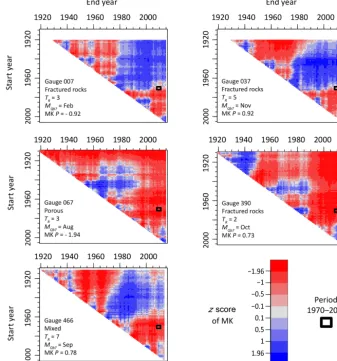
Han-naford et al., 2013). The analysis of trends for multiple peri-ods may help to assess whether observed trends are steady or rather fluctuating. To evaluate the trends found for the period 1970–2009, we additionally calculated trends over multiple periods for the five gauges with longest continuous records. Three of these are in the porosity class “fractured”, and one each in “porous” and “mixed”.
3.3 Attribution of baseflow drought trends
Trends inQb7 were assumed to be driven by both climatic
(climate control) and catchment-specific (catchment control) factors. Thus, the results were related to a set of poten-tial predictors: (i) trends in P for the catchment-specific relevant recharge period, (ii)TRfor the catchment-specific MQb7, (iii) MQb7, (iv) dominant porosity of the catchment, (v) catchment size (A), (vi) dominant land use and (vii) po-tential storage. Statistical significance of the factors was determined using the correlation coefficient R (Eq. 1) for the continuous variables (trends inP,A, potential storage), Spearman’s rank-based correlation coefficient for the dis-crete variable (TR) and an analysis of variance (ANOVA)
combined with the post hoc Tukey test (for details see Ap-pendix C) for the nominally scaled ones (MQb7, dominant porosity, dominant land use).
3.4 Estimate of drought sensitivity to expected future precipitation change
Since past trends derived from empirical trend analysis (e.g. MK) are solely valid for the observation period, they cannot be extrapolated beyond the period of data availability. Fu-ture drought predictions therefore mostly rely on climate jections and process modelling. For Germany climate pro-jections indicate little to no changes of annual precipitation sums but seasonal shifts to lower summer precipitation and higher winter precipitation. However, the magnitude of the shifts differs considerably for different projections (Zebisch et al., 2005; Jacob et al., 2012, 2014; Hübener et al., 2017). A common approach to dealing with such uncertainties is to use a range of possible trajectories to model hydrologi-cal change. Instead of using uncertain quantitative inputs in forward modelling, here we propose a more qualitative in-verse approach. We assume that the general direction of fu-ture development is the most important piece of information for future groundwater management planning and formulate a qualitative test scenario of the consistent direction of differ-ent projections of future precipitation change. Thus, the ap-proach is scenario-neutral regarding emission scenarios and climate models.
Figure 3.Potential directional changes inQb7under a constant sea-sonally diverging precipitation change scenario, depending onTR andMQb7:(a)increase,(b)decrease and(c)no change.
baseflow – there are relevant months with increasing precip-itation but not with decreasing precipprecip-itation; (ii) decreased baseflow – there are relevant months with decreasing precipi-tation but not with increasing precipiprecipi-tation; or (iii) no change – either there are relevant months with both increasing and decreasing precipitation or there are no relevant months with any change.
The test scenario applied in this study is a decrease of pre-cipitation in summer (JJA) and an increase of prepre-cipitation in winter (DJF) with no change in the annual precipitation sum. To derive the future change inQb7for a catchment, we
analyse whether months with increasing or decreasing pre-cipitation belong to the catchment-relevant recharge period. For example, for a catchment with a relevant recharge period from May to October we would estimate an increased base-flow drought hazard, since there are months with decreasing precipitation in the relevant recharge period (June, July and August) but no months with increasing precipitation. This analysis was carried out for all 338 catchments.
4 Results
4.1 Past minimal baseflow trends
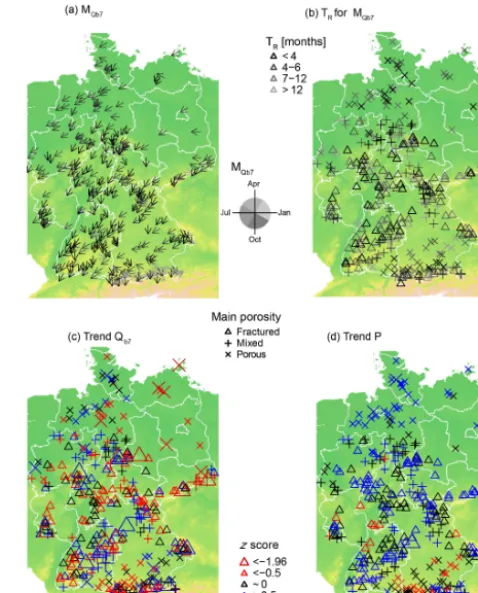
MQb7occurs in most parts of Germany in late summer or au-tumn with some exceptional winter low-flow catchments in the mountainous regions (Fig. 4). Seasonal response times vary across Germany, ranging from short subseasonal re-sponse times (1–3 months) to rere-sponse times of over a year (Fig. 4b). Altogether 22 out of 338 catchments (∼6.5 %) have a time lag in the response, though these are mainly
Figure 4.Patterns ofQb7 across Germany.(a)Low-flow month
MQb7 and (b)seasonal response timeTR. (c)Trend ofQb7 and (d)P in the relevant recharge period for 1970–2009.
short. All five catchments with a time lag above 1 month have response times longer than 12 months. According to the MK test, 40 out of the 338 catchments show a significant trend of Qb7 (Fig. 4c), corresponding to 11.8 %. Assuming
indepen-dence of the baseflow observations, this is slightly more than the expected 5 % in case of no real trends. Hence, for the pe-riod of 1970–2009 there are some changes detectable for all catchments’ porosity classes. ForP there are even fewer sig-nificant trends than would be expected by chance (Fig. 4d). However, the results are skewed towards predominantly pos-itive trends inP during the relevant recharge periods across Germany.
[image:6.612.306.545.67.363.2]Figure 5.z-score values for all possible periods for the five catchments with longest continuous records.
4.2 Trend attribution
None of the factors tested was found to explain past trends of Qb7very well. This lack of statistical relation coincides with
the results that few trends are significant and trend magnitude is highly dependent on the period of analysis. However, there is a small but significant correlation between the trends in P for the catchment-relevant recharge period and trends in Qb7 (Fig. 6). Moreover, the ANOVA indicates a significant
influence ofMQb7on the trends inQb7even though Tukey’s test does not distinguish two groups significantly. The largest differences are between July and November, so the season of low flow might be relevant for trend magnitude in Qb7
as well. The remaining factors (TR, dominant porosity,A,
dominant land use and potential storage) do not show any relation to the trends inQb7(Fig. 6).
4.3 Potential future drought hazard
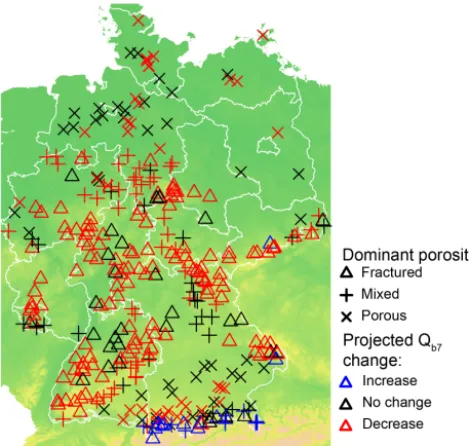
According to the test scenario, Qb7 will decrease or not
change for most of Germany (Fig. 7). The only catchments
with estimated increases ofQb7are located in the
mountain-ous regions of southeast Germany, especially in the Alpine foothills in the catchments with annual low flows in winter. However, in the catchments with annual low flows in winter or spring, impacts might also be more severe for low flows in summer or autumn. Additional tests revealed that, for 22 (27) out of 35 catchments withMQb7 in winter or spring, baseflows of the summer (autumn) season are expected to decrease according to the test scenario.
The changes in drought hazard are significantly related to the catchments’ response times TR (Fig. 8). Moreover,
there is a strong statistical linkage to the dominant poros-ity (Fig. 8b). Catchments dominated by fractured rocks more frequently show estimated decreases in Qb7 than the
other classes. This coincides with a significant relation-ship between TR and the dominant porosity of the
Figure 6.Attribution of trends inQb7to potential influencing factors.(a)Trends in precipitationP during the relevant recharge period,
(b) length of response timeTR,(c)MQb7,(d) dominant porosity in the catchment(e)catchment size A, (f)dominant land use in the catchment and(g)potential storage. Boxes represent the quartiles 0.25 and 0.75, and whiskers last to the most extreme value within a maximum distance of a 1.5-fold interquartile range.
compensate for summer precipitation decreases with winter increases and are therefore more frequently in the category “no change”.
5 Discussion
5.1 The catchment baseflow response to precipitation Catchments’ response times to precipitation were found to be highly diverse across Germany, ranging from 1 month to 3 years. In general, baseflow response times determined
Figure 7.Future changes inQb7according to the test scenario.
may be shorter than 1 month and therefore not detectable on the monthly scale, whereas the attenuation of meteorological variability is clearly attributable to characteristic precipita-tion accumulaprecipita-tion periods.
The large differences of baseflow response times for dif-ferent porosity classes match the theoretical assumptions that baseflow strongly depends on hydrogeological conditions. For the entire streamflow, differences were found to be much smaller (not shown; compare e.g. Haslinger et al., 2014), since other processes like overland flow are also important. The patterns ofTRwhich are related to the catchments’
hy-drogeology support the assumption that baseflow can be used as a proxy of the groundwater situation on a catchment scale. More detailed information on hydrogeology has the potential to further improve the understanding of differences in base-flow response. However, this information is not yet detailed enough for the scale and distribution of headwater catch-ments. For example, two large-scale estimates on hydraulic conductivity available for Germany (GLHYMPS from Glee-son et al., 2014, and HÜK200 from BGR and SGD, 2016) were considered and found to differ up to 6 orders of mag-nitude. Moreover, information on superficial deposits that might be particularly important for streamflow generation could enhance results but is not available in detail yet.
Consistent with the work by Bloomfield et al. (2015), we found that hydrogeology is a highly relevant factor for the explanation of different groundwater baseflow response times. Kumar et al. (2016) did not find a relationship be-tween the hydraulic conductivity and groundwater response time for boreholes. A possible reason for this different find-ing is that for point data even small local influences, which are hard to determine, are quite relevant (e.g. human
influ-Figure 8.Relationships of projected changes,TRand catchment’s dominant porosity.(a)Distribution ofTR for projected changes,
(b)frequency of catchments with a certain dominant porosity for different projected changes and(c)distribution ofTRfor dominant porosities. Boxes represent the quartiles 0.25 and 0.75, and whiskers last to the most extreme value within a maximum distance of a 1.5-fold interquartile range. Red letters indicate results of the post hoc Tukey test to distinguish significantly different groups.
ences), whereas baseflow reflects more the overall situation within the catchment. Small influences may be negligible at this scale, and the underlying influence of hydrogeology may be easier to detect.
[image:9.612.51.286.67.290.2]5.2 Past and potential future changes in low baseflow The trend analysis revealed that the trend in baseflow min-ima is highly dependent on the period it is calculated for. The observation of a trend inQb7 thus is a poor indicator of
fu-ture developments. Despite the relatively narrow seasonality of low-baseflow timing (except for the alpine areas), trends are highly variable across the region – a result of the like-wise variable response times. However, the correlation tests for attribution of the trends revealed that precipitation during the catchment-relevant recharge period is an important factor, which confirms previous model-based findings for part of the region (Stölzle et al., 2014). Thus, this catchment-relevant recharge period should be considered for projections.
The method employed in this study provides a straightfor-ward projection of the probable future directions of changes in baseflow or groundwater drought under climate change. We accounted for the uncertainty in future climate projec-tions by taking only concordant direcprojec-tions of precipitation change in our approach. Contrary to future climate projec-tions, past trends in precipitation for the catchment-relevant recharge period were found to be small and mostly posi-tive. Similarly, Kopp et al. (2018) found for southern Ger-many a high variability of annual groundwater recharge with-out distinct trends. In the past, precipitation trends have not been seasonally diverging, but climate models suggest that changes will become more relevant in the second half of this century (e.g. Jacob et al., 2012). As the magnitude of the trends differs for the climate models, we did not quantify our scenario and thus did not quantify the magnitude of future baseflow either.
Catchments’ characteristic response times were assumed to remain constant. Under a more extreme climate change however, changes in catchments’ responses (e.g. due to non-stationary response times) cannot be excluded. Based on as-sumed precipitation change in the catchments’ respective recharge periods, decreasingQb7(i.e. increased groundwater
drought hazard) were estimated for the majority of the catch-ments. This is because of the timing ofMQb7, which occurs predominantly in summer/autumn. Only those catchments with long response times can compensate for the decreases in summer precipitation, and only in the Alpine foothills, where MQb7is in winter, is a decrease in drought hazard predicted. However, in this region winter precipitation is mainly snow and therefore does not immediately contribute to groundwa-ter recharge. Moreover, air temperature and its changes over time – which are not considered in the test scenario – are es-pecially important for winter low flows. Hence, uncertainty is quite high for these projections. If response times are not assumed constant, further conclusions may be drawn. A de-crease of response times might be caused by dede-creased stor-age, e.g. due to urbanization, or accelerated drying and creased evapotranspiration in spring. Such changes would in-crease the drought hazard for most parts of Germany due to the timing ofMQb7. An increase in response times by the
op-posite processes is possibly less likely but could compensate for the reduced precipitation during summer for the catch-ments that are currently estimated to have increased drought hazard.
6 Conclusions
Climate change is expected to alter the hydrological drought hazard. However, uncertainty of climate projections and even contrasting seasonal changes impede a straightforward as-sessment of the prospective changes in central Europe and elsewhere. Here we presented a statistical approach to es-timating the potential direction of future changes in hydro-logical drought hazard. Past trends were found to be too variable to provide a consistent regional picture of past and expected changes because of their high dependency on the trend calculation period. But they did allow the attribution of trends in baseflow to precipitation changes in catchment-specific recharge periods. Based on that information, a more process-oriented approach was developed, using the catch-ments’ characteristic response times to precipitation and the relevant recharge periods for projections valid for all com-mon emission scenarios and climate models. These projec-tions are efficient alternatives to ensemble projecprojec-tions and target the most important information for management. Es-pecially for regions where directions of climate change are seasonally varying, they can provide valuable insights into the basic changes of the system.
Catchments with short response times were found to have a high probability for a decrease in baseflow minima and hence an increase in the groundwater drought hazard, as sea-sonal changes cannot compensate for each other. However, there is no homogeneous pattern of response times across central Europe, and so predicted changes of groundwater drought hazard also vary regionally. This urges for a re-gionally adapted groundwater management based on the lo-cal catchment response times. As past events like the 2015 central European drought have already caused groundwater-related drought impacts in headwater regions, there is an ur-gent need for adaptation in catchments facing even higher drought hazard in the future.
Appendix A: Mathematical relationship between baseflow and groundwater storage
In groundwater-dominated catchments Qb is an integrated
signal of groundwater conditions in the entire area and mainly depends as a functiongon the hydraulic headH of the groundwater:
Qb=g (H )+r with
dQb
dH >0∀H, (A1)
whereris the additional flow from other stored sources.H is a monotonic functionf of groundwater storageS: H=f (S) with dH
dS >0∀S. (A2)
Combining Eqs. (A1) and (A2) leads to Qb=g (f (S))+r=k (S)+r with
dQb
dS >0∀S. (A3) Because of the monotonic behaviour, functionkis reversible: S=k−1(Qb−r) with
dS d(Qb−r)
>0∀Qb−r. (A4)
Potential sources forrinclude snowmelt, interflow, lake out-flow, sewage discharge or other anthropogenic sources of dis-charge. Anthropogenic influences can be assumed negligi-ble, as catchments in this study were selected as near-natural. Moreover, there are no big lakes or other surface water stor-ages in the catchments. Snowmelt remains an important fac-tor that might blur the true signal of groundwater sfac-torage. This is particularly important for the catchments at higher elevations, e.g. in the Alps, and must be considered for the interpretation of the results. However, in catchments where these factors are of minor relevance compared to groundwa-ter outflow, Eq. (A4) simplifies to
S'k−1(Qb) with
dS d(Qb)
>0∀Qb; (A5)
i.e. higher baseflow indicates higher groundwater storage, and vice versa. However, without further knowledge about k−1, the observation of Qballows for conclusions about S
solely on an ordinal scale.
Appendix B: The Mann–Kendall trend test with pre-whitening
To calculate trends, the non-parametric Mann–Kendall (MK) test was applied. However, the results are affected by serial correlation which increases the type I error (i.e. rejecting the no-trend hypothesis although there is no trend). To test for se-rial correlation in the data, we fitted an autocorrelation AR(1) model to each Qb7 time series. The calculated
autocorrela-tion is significant on a level ofα=0.05 if absolute autocor-relation is higher than 1.96/√n(Douglas et al., 2000), where
nis the length of the time series (in this casen=40). One hundred thirty (130) out of 338 time series showed signifi-cant serial correlation, thus requiring a pre-processing before using MK. Kulkarni and Von Storch (1995) recommended pre-whitening time series to allow for the MK. Since the sam-ple size is relatively small here and trend magnitude not too large, pre-whitening is not expected to reduce the MK test power much in this case, but rather to reduce the type I error (Bayazit and Önöz, 2007). Pre-whitening was done accord-ing to other studies (Kulkarni and Von Storch, 1995; Douglas et al., 2000) as in Eq. (A6):
Yt=Xt−r1Xt−1, (B1)
whereYt is the pre-whitened time series at time stept,Xt
is the original time series at time stept andr1 is the serial
correlation determined with the AR(1) model. Pre-whitening reduced the serial correlation in all time series to close to zero.
The MK test compares the number of concordant pairs in the data with the number of discordant pairs. This gives the Kendall scoreSK(Kendall, 1948):
SK= X
j >isign(Yj−Yi)sign(Zj−Zi), (B2)
where sign() is a function that returns the algebraic sign. For the Mann–Kendall trend test that was applied here,Zis time. Therefore, the second part of Eq. (A7) always equals+1, and it simplifies to
SK= X
j >i
sign(Yj−Yi). (B3)
In the case of no real trend,SK has a mean value of zero; in
the case of no ties in the data, it has a standard deviationσS
of (Kendall, 1948)
σS= r
n (n−1) (2n+5)
18 . (B4)
Thus,SK can be transformed into the standard normal
dis-tributedzscore by dividing by the standard deviation ofSK:
z=
SK−1 σS
if SK>0
0 if SK=0 SK+1
σS
if SK<0
. (B5)
zwas assumed to be significant if it was not within the inter-val±1.96, i.e. a significance level ofα=0.05.
Appendix C: ANOVA and Tukey’s test
this work. The ANOVA comparesSe, the sum of squares
ex-plained by the categorical variable’s levels, with the sum of squares of the residuals (Sr). The mean sums (MSe,MSr) are
tested for significance using theF test:
F =MSe
MSr
=Se/dfe
Sr/dfr
, (C1)
wheredfdenotes the degrees of freedom (dfe: number of
lev-els minus 1;dfr: amount of data minusdfeminus 1). The test
statisticF follows theF distribution and was assumed to be significant forp< 0.05.
The ANOVA gives information about the general signifi-cance of the categorical variable. An equally important piece of information is which of the categorical variable’s levels differ significantly regarding the target variable. This infor-mation was obtained using the post hoc Tukey test. For this analysis a pairwisettest between all levels is carried out:
t= x1−x2
r s2
1
n1 −
s2 2
n2
, (C2)
wherexi andsi2are the mean and the variance for the two
levels, respectively, and ni is the amount of data per level.
Author contributions. JH and KS designed the study. JH performed all analyses and prepared the manuscript. Both authors revised the manuscript and approved the final version.
Competing interests. The authors declare that they have no conflict of interest.
Acknowledgements. We acknowledge the data providers at the federal states’ agencies for the streamflow data, the E-OBS dataset from the EU-FP6 project ENSEMBLES (https://ensembles-eu.metoffice.com, last access: 28 Novem-ber 2018) and the data providers in the ECA&D project (https://www.ecad.eu, last access: 28 November 2018). The authors were funded by the DFG (Jost Hellwig: project TrenDHy DFG STA632/4-1; Kerstin Stahl: Heisenberg programme STA632/3-1). Benedikt Heudorfer provided helpful comments on the manuscript. We are grateful for the comments of John Bloomfield and Spencer Sawaske, which helped to improve the quality of the manuscript. The article processing charge was funded by the Ger-man Research Foundation (DFG) and the University of Freiburg in the funding programme Open Access Publishing.
Edited by: Stacey Archfield
Reviewed by: John Bloomfield and Spencer Sawaske
References
Apurv, T., Sivapalan, M., and Cai, X: Understanding the Role of Climate Characteristics in Drought Propagation, Water Resour. Res., 53, 9304–9329, https://doi.org/10.1002/2017WR021445, 2017.
Asarian, J. E. and Walker, J. D.: Long term trends in stream-flow and precipitation in northwest California and southwest Oregon, 1953–2012, J. Am. Water. Resour. As., 52, 241–261, https://doi.org/10.1111/1752-1688.12381, 2016.
Barker, L. J., Hannaford, J., Chiverton, A., and Svensson, C.: From meteorological to hydrological drought using standard-ised indicators, Hydrol. Earth Syst. Sci., 20, 2483–2505, https://doi.org/10.5194/hess-20-2483-2016, 2016.
Bayazit, M. and Önöz, B.: To prewhiten or not to prewhiten in trend analysis? Hydrolog. Sci. J., 52, 611–624, https://doi.org/10.1623/hysj.52.4.611, 2007.
BGR and SGD: Bundesanstalt für Geowissenschaften und Rohstoffe and Staatliche Geologische Dienste: Hydrogeologis-che Übersichtskarte von Deutschland 1:200.000, Oberer Grund-wasserleiter (HÜK200 OGWL), Digitaler Datenbestand, Version 3.0. – Hannover, 2016.
Bloomfield, J. P. and Marchant, B. P.: Analysis of ground-water drought building on the standardised precipitation in-dex approach, Hydrol. Earth Syst. Sci., 17, 4769–4787, https://doi.org/10.5194/hess-17-4769-2013, 2013.
Bloomfield, J. P., Marchant, B. P., Bricker, S. H., and Morgan, R. B.: Regional analysis of groundwater droughts using hydro-graph classification, Hydrol. Earth Syst. Sci., 19, 4327–4344, https://doi.org/10.5194/hess-19-4327-2015, 2015.
Bundesanstalt für Geowissenschaften und Rohstoffe: HÜK200 – Hydrogeologische Übersichtskarte von Deutschland 1:200 000, available at: https://www.bgr.bund.de/DE/Themen/Wasser/ Projekte/laufend/Beratung/Huek200/huek200_projektbeschr. html, last access: 28 November 2018.
Brunner, P., Cook, P. G., and Simmons, C. T.: Disconnected Surface Water and Groundwater: From Theory to Practice, Ground Water, 49, 460–467, https://doi.org/10.1111/j.1745-6584.2010.00752.x, 2011.
Brutsaert, W.: Long-term groundwater storage trends estimated from streamflow records: Climatic perspective, Water Resour. Res., 44, W02409, https://doi.org/10.1029/2007wr006518, 2008. Brutsaert, W.: Annual drought flow and groundwater storage trends in the eastern half of the United States during the past two-third century, Theor. Appl. Climatol., 100, 93–103, https://doi.org/10.1007/s00704-009-0180-3, 2010.
Douglas, E. M., Vogel, R. M., and Kroll, C. N.: Trends in floods and low flows in the United States: impact of spatial corre-lation, J. Hydrol., 240, 90–105, https://doi.org/10.1016/s0022-1694(00)00336-x, 2000.
EC: Communication from the Commission to the European Parlia-ment and the Council addressing the challenge of water scarcity and droughts in the European Union, Commission of the Euro-pean Communities, COM(2007), 414 final, Brussels, 2007. ECA and D: European Climate Assessment & Dataset, available at:
https://www.ecad.eu/, last access: 28 November 2018.
Eckhardt, K.: How to construct recursive digital filters for baseflow separation, Hydrol. Process., 19, 507–515, https://doi.org/10.1002/hyp.5675, 2005.
Eltahir, E. A. B. and Yeh, P.: On the asymmetric response of aquifer water level to floods and droughts in Illinois, Water Resour. Res., 35, 1199–1217, https://doi.org/10.1029/1998wr900071, 1999. European Environment Agency: Digital Elevation Model over
Europe (EU-DEM), available at: https://www.eea.europa.eu/ data-and-maps/data/eu-dem (last access: 28 November 2018), 2013.
Fendeková, M. and Fendek, M.: Groundwater drought in the Ni-tra river basin-identification and classification, J. Hydrol. Hy-dromech., 60, 185–193, 2012.
Fiorillo, F. and Guadagno, F. M.: Long karst spring discharge time series and droughts occurrence in Southern Italy, Environ. Earth Sci., 65, 2273–2283, 2012.
Forzieri, G., Feyen, L., Rojas, R., Flörke, M., Wimmer, F., and Bianchi, A.: Ensemble projections of future streamflow droughts in Europe, Hydrol. Earth Syst. Sci., 18, 85–108, https://doi.org/10.5194/hess-18-85-2014, 2014.
Giuntoli, I., Renard, B., Vidal, J. P., and Bard, A.: Low flows in France and their relationship to large-scale climate indices, J. Hydrol., 482, 105–118, https://doi.org/10.1016/j.jhydrol.2012.12.038, 2013.
Gleeson, T., Moosdorf, N. Hartmann, J., and van Beek L. P. H.: A glimpse beneath earth’s surface: Global HYdrogeology MaPS (GLHYMPS) of permeability and porosity, Geophys. Res. Lett., 41, 3891–3898, https://doi.org/10.1002/2014GL059856, 2014. Gosling, S. N., Zaherpour, J., Mount, N. J., Hattermann, F. F.,
catchment-scale hydrological models under global warming scenarios of 1 degrees C, 2 degrees C and 3 degrees C, Clim. Change, 141, 577–595, https://doi.org/10.1007/s10584-016-1773-3, 2017. Green, T. R., Taniguchi, M., Kooi, H., Gurdak, J. J., Allen,
D. M., Hiscock, K. M., Treidel, H., and Aureli, A.: Beneath the surface of global change: Impacts of cli-mate change on groundwater, J. Hydrol., 405, 532–560, https://doi.org/10.1016/j.jhydrol.2011.05.002, 2011.
Haas, J. C. and Birk, S.: Characterizing the spatiotemporal variabil-ity of groundwater levels of alluvial aquifers in different settings using drought indices, Hydrol. Earth Syst. Sci., 21, 2421–2448, https://doi.org/10.5194/hess-21-2421-2017, 2017.
Hannaford, J. and Buys, G.: Trends in seasonal river flow regimes in the UK, J. Hydrol., 475, 158–174, https://doi.org/10.1016/j.jhydrol.2012.09.044, 2012.
Hannaford, J., Buys, G., Stahl, K., and Tallaksen, L. M.: The in-fluence of decadal-scale variability on trends in long European streamflow records, Hydrol. Earth Syst. Sci., 17, 2717–2733, https://doi.org/10.5194/hess-17-2717-2013, 2013.
Haslinger, K., Koffler, D., Schoner, W., and Laaha, G.: Exploring the link between meteorological drought and streamflow: Effects of climate- catchment interaction, Water Resour. Res., 50, 2468– 2487, https://doi.org/10.1002/2013wr015051, 2014.
Haylock, M. R., Hofstra, N., Tank, A., Klok, E. J., Jones, P. D., and New, M.: A European daily high-resolution gridded data set of surface temperature and precipitation for 1950–2006, J. Geophys. Res.-Atmos., 113, D20119, https://doi.org/10.1029/2008jd010201, 2008.
Hellwig, J., Stahl, K., Ziese, M., and Becker, A.: The impact of the resolution of meteorological data sets on catchment-scale pre-cipitation and drought studies, Int. J. Climatol., 38, 3069–3081, https://doi.org/10.1002/joc.5483, 2018.
Heudorfer, B. and Stahl, K: Comparison of different threshold level methods for drought propagation analysis in Germany, Hydrol. Res., 48, 1311–1326, https://doi.org/10.2166/nh.2016.258, 2017. Hübener, H., Bülow, K., Fooken, C., Früh, B, Hoffmann, P, Höpp, S., Keuler, K., Menz, C., Mohr, V., Radtke K., Ramthun, H., Spekat, A., Steger, C., Toussaint, F., Warrach-Sagi, K., and Woldt, M. ReKliEs-De, Ergebnisbericht, HLNUG, Hessisches Landesamt für Naturschutz, Umwelt und Geologie, 2017. Jacob, D., Bülow, K., Kotova, L., Moseley, C., Petersen, J.,
and Rechid, D.: Regionale Klimaprojektionen für Europa und Deutschland: Ensemble Simulationen für die Klimafolgen-forschung, MPI für Meteorologie, Climate Service Center, 2012. Jacob, D., Petersen, J., Eggert, B., Alias, A., Christensen, O. B., Bouwer, L. M., Braun, A., Colette, A., Déqué, M., Georgievski, G., Georgopoulou, E., Gobiet, A., Menut, L., Nikulin, G., Haensler, A., Hempelmann, N., Jones, C., Keuler, K., Ko-vats, S., Kröner, N., Kotlarski, S., Kriegsmann, A., Martin, E., Van Meijgaard, E., Moseley, C., Pfeifer, S., Preuschmann, S., Radermacher, C., Radtke, K., Rechid, D., Rounsevell, M., Samuelsson, P., Somot, S., Soussana, J.-F., Teichmann, C., Valentini, R., Vautard, R., Weber, B., and Yiou, P.: EURO-CORDEX: new high-resolution climate change projections for European impact research, Reg. Environ. Change, 14, 563–578, https://doi.org/10.1007/s10113-013-0499-2, 2014.
Kendall, M. G.: Rank correlation methods, London: Griffin, 160 pp., 1948.
Koffler, D., Gauster, T., and Laaha, G.: lfstat: Calculation of Low Flow Statistics for Daily Stream Flow Data. R package version 0.9.4. available at: https://CRAN.R-project.org/package=lfstat (last access: 28 November 2018), 2016.
Kulkarni, A. and von Storch, H.: Monte Carlo experiments on the effect of serial correlation on the Mann-Kendall test of trend, Me-teorol. Z., 4, 82–85, 1995.
Kopp, B., Baumeister, C., Gudera, T., Hergesell, J., Morhard, A., and Neumann, J.: Entwicklung von Bodenwasserhaushalt und Grundwasserneubildung in Baden-Württemberg, Bayern, Rheinland-Pfalz und Hessen von 1951 bis 2015, Hydrol. Wasser-bewirts., 62, 62–76, https://doi.org/10.5675/HyWa_2018,2_1, 2018.
Kumar, R., Musuuza, J. L., Van Loon, A. F., Teuling, A. J., Barthel, R., Ten Broek, J., Mai, J., Samaniego, L., and Attinger, S.: Multiscale evaluation of the Standardized Precipitation Index as a groundwater drought indicator, Hydrol. Earth Syst. Sci., 20, 1117–1131, https://doi.org/10.5194/hess-20-1117-2016, 2016. Laaha, G., Gauster, T., Tallaksen, L. M., Vidal, J.-P., Stahl, K.,
Prud-homme, C., Heudorfer, B., Vlnas, R., Ionita, M., Van Lanen, H. A. J., Adler, M.-J., Caillouet, L., Delus, C., Fendekova, M., Gailliez, S., Hannaford, J., Kingston, D., Van Loon, A. F., Me-diero, L., Osuch, M., Romanowicz, R., Sauquet, E., Stagge, J. H., and Wong, W. K.: The European 2015 drought from a hy-drological perspective, Hydrol. Earth Syst. Sci., 21, 3001–3024, https://doi.org/10.5194/hess-21-3001-2017, 2017.
Leelaruban, N., Padmanabhan, G., and Oduor, P.: Examining the Relationship between Drought Indices and Groundwater Levels, Water, 9, 82, https://doi.org/10.3390/w9020082, 2017.
Li, B. and Rodell, M.: Evaluation of a model-based groundwater drought indicator in the conterminous US, J. Hydrol., 526, 78– 88, https://doi.org/10.1016/j.jhydrol.2014.09.027 2015. Lins, H. F. and Slack, J. R.: Streamflow trends in the
United States, Geophys. Res. Lett., 26, 227–230, https://doi.org/10.1029/1998gl900291, 1999.
Lorenzo-Lacruz, J., Vicente-Serrano, S. M., López-Moreno, J. I., Morán-Tejeda, E., and Zabalza, J.: Recent trends in Iberian streamflows (1945–2005), J. Hydrol., 414, 463–475, https://doi.org/10.1016/j.jhydrol.2011.11.023, 2012.
Lyne, V. and Hollick, M.: Stochastic time-variable rainfall-runoff modelling, Paper presented at the Institute of Engineers Australia National Conference, Perth, Australia, 1979.
Marx, A., Kumar, R., Thober, S., Rakovec, O., Wanders, N., Zink, M., Wood, E. F., Pan, M., Sheffield, J., and Samaniego, L.: Cli-mate change alters low flows in Europe under global warming of 1.5, 2, and 3◦C, Hydrol. Earth Syst. Sci., 22, 1017–1032, https://doi.org/10.5194/hess-22-1017-2018, 2018.
McKee, T. B., Doesken, N., J., and Kleist, J.: The relationship of drought frequency and duration to time scales. Eighth Confer-ence on Applied Climatology, Anaheim CA, 6, 1993.
Mei, Y. and Anagnostou, E. N.: A hydrograph separation method based on information from rainfall and runoff records, J. Hydrol., 523, 636–649, https://doi.org/10.1016/j.jhydrol.2015.01.083, 2015.
Nathan, R. J. and McMahon, T. A.: Evaluation of automated tech-niques for base flow and recession analyses, Water Resour. Res., 26, 1465–1473, 1990.
Peters, E., Torfs, P., van Lanen, H. A. J., and Bier, G.: Propa-gation of drought through groundwater – a new approach us-ing linear reservoir theory, Hydrol. Process., 17, 3023–3040, https://doi.org/10.1002/hyp.1274, 2003.
Peters, E., Bier, G., van Lanen, H. A. J., and Torfs, P.: Propagation and spatial distribution of drought in a groundwater catchment, J. Hydrol., 321, 257–275, https://doi.org/10.1016/j.jhydrol.2005.08.004, 2006.
R Core Team: R: A language and environment for statistical com-puting. R Foundation for Statistical Computing, Vienna, Austria, available at: https://www.R-project.org/ (last access: 28 Novem-ber 2018), 2016.
Rennermalm, A. K., Wood, E. F., and Troy, T. J.: Observed changes in pan-arctic cold-season minimum monthly river discharge, Clim. Dynam., 35, 923–939, https://doi.org/10.1007/s00382-009-0730-5, 2010.
Sheffield, J., Wood, E. F., and Roderick, M. L.: Little change in global drought over the past 60 years, Nature, 491, 435–438, 2012.
Spinoni, J., Naumann, G., and Vogt, J. V.: Pan-European sea-sonal trends and recent changes of drought frequency and severity, Global Planet. Change, 148, 113–130, https://doi.org/10.1016/j.gloplacha.2016.11.013, 2017.
Stahl, K., Hisdal, H., Hannaford, J., Tallaksen, L. M., van Lanen, H. A. J., Sauquet, E., Demuth, S., Fendekova, M., and Jódar, J.: Streamflow trends in Europe: evidence from a dataset of near-natural catchments, Hydrol. Earth Syst. Sci., 14, 2367–2382, https://doi.org/10.5194/hess-14-2367-2010, 2010.
Stahl, K., Tallaksen, L. M., Hannaford, J., and van Lanen, H. A. J.: Filling the white space on maps of European runoff trends: esti-mates from a multi-model ensemble, Hydrol. Earth Syst. Sci., 16, 2035–2047, https://doi.org/10.5194/hess-16-2035-2012, 2012. Staudinger, M., Stoelzle, M., Seeger, S., Seibert, J., Weiler,
M., and Stahl, K.: Catchment water storage varia-tion with elevation, Hydrol. Process., 31, 2000–2015, https://doi.org/10.1002/hyp.11158, 2017.
Stoelzle, M., Stahl, K., Morhard, A., and Weiler, M.: Stream-flow sensitivity to drought scenarios in catchments with different geology, Geophys. Res. Lett., 41, 6174–6183, https://doi.org/10.1002/2014gl061344, 2014.
Tallaksen, L. M. and Stahl, K.: Spatial and temporal pat-terns of large-scale droughts in Europe: Model disper-sion and performance, Geophys. Res. Lett., 41, 429–434, https://doi.org/10.1002/2013gl058573, 2014.
Tallaksen, L. M., Hisdal, H., and Van Lanen, H. A. J.: Space-time modelling of catchment scale drought characteristics, J. Hydrol., 375, 363–372, https://doi.org/10.1016/j.jhydrol.2009.06.032, 2009.
Van Lanen, H. A. J., Laaha, G., Kingston, D. G., Gauster, T., Ionita, M., Vidal, J. P., Vlnas, R., Tallaksen, L. M., Stahl, K., Hannaford, J., Delus, C., Fendekova, M., Mediero, L., Prudhomme, C., Rets, E., Romanowicz, R., Gailliez, S., Wong, W. K., Adler, M.-J., Blauhut, V., Caillouet, L., Chel-cea, S., Frolova, N., Gudmundsson, L., Hanel, M., Haslinger, K., Kireeva, M., Osuch, M., Sauquet, E., Stagge, J. H., and Van Loon, A. F.: Hydrology needed to manage droughts: the 2015 European case, Hydrol. Process., 30, 3097–3104, https://doi.org/10.1002/hyp.10838, 2016.
Van Loon, A. F. and Van Lanen, H. A. J.: A process-based typol-ogy of hydrological drought, Hydrol. Earth Syst. Sci., 16, 1915– 1946, https://doi.org/10.5194/hess-16-1915-2012, 2012. Van Loon, A. F., Kumar, R., and Mishra, V.: Testing the use of
stan-dardised indices and GRACE satellite data to estimate the Euro-pean 2015 groundwater drought in near-real time, Hydrol. Earth Syst. Sci., 21, 1947–1971, https://doi.org/10.5194/hess-21-1947-2017, 2017.
Van Vliet, M. T. H., Donnelly, C., Stromback, L., Capell, R., and Ludwig, F.: European scale climate information services for water use sectors, J. Hydrol., 528, 503–513, https://doi.org/10.1016/j.jhydrol.2015.06.060, 2015.
WMO: World Meteorological Organization: Manual on Low-flow Estimation and Prediction, Operational Hydrology Report No. 50, WMO-NO. 1029, 2008.
Yevjevich, V. M.: An objective approach to definitions and inves-tigations of continental hydrologic droughts, Hydrology Papers, 23, 1967.