Acta Cryst.(2001). E57, o1111±o1112 DOI: 10.1107/S160053680101786X Graham Smithet al. C15H18O4
o1111
organic papers
Acta Crystallographica Section E Structure Reports
Online ISSN 1600-5368
Alloevodionol methyl ether
Graham Smith,* Ertong Wang, John P. Bartley and Raymond C. Bott
Centre for Instrumental and Developmental Chemistry, Queensland University of Tech-nology, GPO Box 2434, Brisbane 4001, Australia
Correspondence e-mail: [email protected]
Key indicators Single-crystal X-ray study T= 293 K
Mean(C±C) = 0.006 AÊ Rfactor = 0.063 wRfactor = 0.224
Data-to-parameter ratio = 14.4
For details of how these key indicators were automatically derived from the article, see http://journals.iucr.org/e.
#2001 International Union of Crystallography Printed in Great Britain ± all rights reserved
The crystal structure determination of one of the substituted
-chromene components isolated in the hexane extraction of the fruit of the indigenous Australian treeMelicope ellyrana, the methyl ether of the known compound alloevodionol, is reported. In this compound, 1-(5,7-dimethoxy-2,2-dimethyl-2H-1-benzopyran-8-yl)ethanone, C15H18O4, the methoxy
groups are approximately coplanar with the aromatic ring, while the acetyl group is normal to the ring.
Comment
The hexane-extracted components of the fruit of the indig-enous Australian tree Melicope ellyrana (Hartley, 1981) resulted in the isolation of a number of ¯avonoids, and the crystal structures of two of these, viz. pachypodol (40 ,5-di-hydroxy-3,30,7-trimethoxy¯avone; Smith, Wang et al., 2001) and 40,5-dihydroxy-3,30 ,8-trimethoxy-7-(3-methylbut-2-enyl-oxy)¯avone (Smith, Bartleyet al., 2001), have been reported. In addition to these, several substituted -chromenes have been isolated, including the title compound, 1-(5,7-dimethoxy-2,2-dimethyl-2H-1-benzopyran-8-yl)ethanone, (I) (alloevo-dionol methyl ether: CA Registry No. 31367-55-2). This compound was ®rst isolated fromEvodia elleryana (Jones & Wright, 1946) and fromMedicosma cunninghamii, its trivial name being given, along with the parent alloevodionol, by Sutherland (1949). It was also isolated fromMelicope simplex
(Briggs & Locker, 1950), while more recently a total of 18 variants of 2,2-dimethyl-substituted -chromenes, including (I), were identi®ed in the leaves ofM. ptelefolia(Kamperdick
et al., 1997). Interest in the chromenes, such as (I) and its variants, has also resulted in a number of patent applications for synthetic procedures,e.g.Nakayamaet al.(1979).
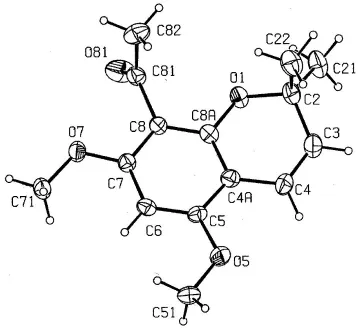
The crystal structure of (I) (Fig. 1) shows the 2,2-dimethyl-2H-1-benzopyran moiety with the methoxy substituents at C5 and C7 being close to coplanarity with the aromatic ring [torsion angles C6ÐC5ÐO5ÐC51 ÿ1.8 (6) and C6ÐC7Ð
O7ÐC71 ÿ6.2 (6)]. In contrast, the acetyl group is almost perpendicular to the ring [torsion angle C7ÐC8ÐC81ÐC82 94.2 (5)]. As might be expected for this type of compound, there are no signi®cant intermolecular associations involved in the packing in the unit cell.
Experimental
The hexane extract of the fresh fruit of Melicope ellyrana, after concentration (Smith, Wanget al., 2001) gave a precipitate of crystals of the title compound suitable for single-crystal structural analysis. Crystal data
C15H18O4
Mr= 262.29
Monoclinic,P21/c
a= 7.2233 (19) AÊ
b= 10.354 (3) AÊ
c= 18.825 (2) AÊ
= 91.334 (19) V= 1407.5 (6) AÊ3
Z= 4
Dx= 1.238 Mg mÿ3
MoKradiation Cell parameters from 25
re¯ections
= 12±18
= 0.09 mmÿ1
T= 293 (2) K Plate, colourless 0.400.350.15 mm
Data collection
Rigaku AFC-7R
diffractometer
!±2scans
2698 measured re¯ections 2486 independent re¯ections 1106 re¯ections withI> 2(I)
Rint= 0.050
max= 25.0
h= 0!8
k= 0!12
l=ÿ22!22 3 standard re¯ections
every 150 re¯ections intensity decay: 2.2%
Re®nement
Re®nement onF2
R[F2> 2(F2)] = 0.063
wR(F2) = 0.224
S= 1.39 2486 re¯ections 173 parameters
H-atom parameters constrained
w= 1/[2(F
o2) + (0.1P)2]
whereP= (Fo2+ 2Fc2)/3
(/)max< 0.001 max= 0.32 e AÊÿ3 min=ÿ0.31 e AÊÿ3
H atoms were included at calculated positions and were constrained in the re®nement.
Data collection: MSC/AFC Diffractometer Control Software (Molecular Structure Corporation, 1999a); cell re®nement: MSC/ AFC Diffractometer Control Software; data reduction:TEXSAN for Windows(Molecular Structure Corporation, 1999b); program(s) used to solve structure:SHELXS97 (Sheldrick, 1997); program(s) used to re®ne structure:SHELXL97 (Sheldrick, 1997); molecular graphics: PLATON for Windows (Spek, 1999); software used to prepare material for publication:TEXSAN for Windows.
The authors acknowledge ®nancial support from The Centre for Instrumental and Developmental Chemistry
(Queensland University of Technology) and the Australian Research Council. Dr Peter Healy is thanked for collection of the X-ray diffraction data.
References
Briggs, L. H. & Locker, R. H. (1950).J. Chem. Soc.pp. 2376±2379. Hartley, T. G. (1981).Gardens Bull.(Singapore),34, 91±131.
Jones, T. G. H. & Wright, W. W. (1946).Queensland Univ. Pap. Chem.1, 27. Molecular Structure Corporation (1999a).MSC/AFC Diffractometer Control Software. MSC, 9009 New Trails Drive, The Woodlands, TX 77381, USA. Molecular Structure Corporation (1999b).TEXSAN for Windows. Version
1.06. MSC, 9009 New Trails Drive, The Woodlands, TX 77381, USA. Kamperdick, C., Van, N. H., Van Sung, T. & Guenter, A. (1997).
Phytochemistry,45, 1049±1056.
Nakayama, M., Hayashi, S., Tsukayama, M., Sakamoto, T. & Masumura, M. (1979). Jn Kokai Tokkyo Koho, JP 54135772 19791022 Showa.
Sheldrick, G. M. (1997). SHELXL97 and SHELXS97. University of GoÈttingen, Germany.
Smith, G., Bartley, J. P., Wang, E. & Bott, R. C. (2001).Acta Cryst.C57, 1336± 1337.
Smith, G., Wang, E., Bartley, J. P. & Bott, R. C. (2001).Acta Cryst.E57, o973± o975.
Spek, A. L. (1999). PLATON for Windows. September 1999 Version. University of Utrecht, The Netherlands.
Sutherland, M. D. (1949).Queensland Univ. Pap. Chem.1, 35.
Figure 1
supporting information
sup-1
Acta Cryst. (2001). E57, o1111–o1112supporting information
Acta Cryst. (2001). E57, o1111–o1112 [doi:10.1107/S160053680101786X]
Alloevodionol methyl ether
Graham Smith, Ertong Wang, John P. Bartley and Raymond C. Bott
S1. Comment
The hexane-extracted components of the fruit of the indiginous Australian tree Melicope ellyrana (Hartley, 1981) resulted
in the isolation of a number of flavonoids, and the crystal structures of two of these, i.e. pachypodol
[4′,5-di-hydroxy-3,3′,7-trimethoxyflavone; Smith, Wang et al., 2001] and
4′,5-dihydroxy-3,3′,8-trimethoxy-7-(3-methylbut-2-enyloxy)flavone (Smith, Bartley et al., 2001), have been reported. In addition to these, several substituted α-chromenes
have been isolated, including the title compound, 1-(5,7-dimethoxy-2,2-dimethyl-2H-1-benzopyran-8-yl)ethanone, (I)
(alloevodionol methyl ether: CA Registry No. 31367–55-2). This compound was first isolated from Evodia elleryana
(Jones & Wright, 1946) and from Medicosma cunninghamii, its trivial name being given, along with the parent
alloevodionol by Sutherland (1949). It was also isolated from Melicope simplex (Briggs & Locker, 1950), while more
recently, a total of 18 variants of 2,2-dimethyl-substituted α-chromenes, including (I), were identified in the leaves of M.
ptelefolia Kamperdick et al. (1997). Interest in the chromenes, such as (I) and its variants, has also resulted in a number
of patent applications for synthetic procedures, e.g. Nakayama et al. (1979).
The crystal structure of (I) (Fig. 1) shows the 2,2-dimethyl-2H-1-benzopyran moiety with the methoxy substituents at
C5 and C7 being close to coplanarity with the aromatic ring [torsion angles C6—C5—O5—C51 - 1.8 (6)° and C6—C7—
O7—C71 - 6.2 (6)°]. In contrast, the acetyl group is almost perpendicular to the ring [torsion angle C7—C8—C81—C82
94.2 (5)°]. As might be expected for this type of compound, there are no significant intermolecular associations involved
in the packing in the unit cell.
S2. Experimental
The hexane extract of the fresh fruit of Melicope ellyrana, after concentration (Smith, Wang et al., 2001) gave a
precipitate of crystals of the title compound suitable for single-crystal structural analysis.
S3. Refinement
Figure 1
The molecular configuration and atom-naming scheme for the title compound. Atoms are shown as the 30% probability
ellipsoids (Spek, 1999).
1-(5,7-dimethoxy-2,2-dimethyl-2H-1-benzopyran-8-yl)-ethanone
Crystal data
C15H18O4
Mr = 262.29 Monoclinic, P21/c
a = 7.2233 (19) Å
b = 10.354 (3) Å
c = 18.825 (2) Å
β = 91.334 (19)°
V = 1407.5 (6) Å3
Z = 4
F(000) = 560
Dx = 1.238 Mg m−3
Melting point: 380 K
Mo Kα radiation, λ = 0.71069 Å Cell parameters from 25 reflections
θ = 12–18°
µ = 0.09 mm−1
T = 293 K Plate, colourless 0.40 × 0.35 × 0.15 mm
Data collection
Rigaku AFC-7R diffractometer
Radiation source: Rigaku rotating anode Graphite monochromator
ω–2θ scans
2698 measured reflections
2486 independent reflections 1106 reflections with I > 2σ(I)
Rint = 0.050
θmax = 25.0°, θmin = 2.8°
h = 0→8
supporting information
sup-3
Acta Cryst. (2001). E57, o1111–o1112l = −22→22
3 standard reflections every 150 reflections
intensity decay: 2.2%
Refinement
Refinement on F2
Least-squares matrix: full
R[F2 > 2σ(F2)] = 0.063
wR(F2) = 0.224
S = 1.39 2486 reflections 173 parameters 0 restraints
Primary atom site location: structure-invariant direct methods
Secondary atom site location: difference Fourier map
Hydrogen site location: inferred from neighbouring sites
H-atom parameters not refined
w = 1/[σ2(F
o2) + (0.1P)2]
where P = (Fo2 + 2Fc2)/3
(Δ/σ)max < 0.001
Δρmax = 0.32 e Å−3
Δρmin = −0.31 e Å−3
Special details
Geometry. All e.s.d.'s (except the e.s.d. in the dihedral angle between two l.s. planes) are estimated using the full covariance matrix. The cell e.s.d.'s are taken into account individually in the estimation of e.s.d.'s in distances, angles and torsion angles; correlations between e.s.d.'s in cell parameters are only used when they are defined by crystal symmetry. An approximate (isotropic) treatment of cell e.s.d.'s is used for estimating e.s.d.'s involving l.s. planes.
Refinement. Refinement of F2 against ALL reflections. The weighted R-factor wR and goodness of fit S are based on F2,
conventional R-factors R are based on F, with F set to zero for negative F2. The threshold expression of F2 > σ(F2) is used
only for calculating R-factors(gt) etc. and is not relevant to the choice of reflections for refinement. R-factors based on F2
are statistically about twice as large as those based on F, and R- factors based on ALL data will be even larger.
Fractional atomic coordinates and isotropic or equivalent isotropic displacement parameters (Å2)
x y z Uiso*/Ueq
H51 0.9797 0.0345 0.3777 0.108* H52 0.8623 −0.0666 0.4175 0.108* H53 0.9036 0.0667 0.4520 0.108* H71 0.6254 0.1940 0.6881 0.088* H72 0.6579 0.0979 0.6264 0.088* H73 0.7617 0.2290 0.6286 0.088* H82 0.2434 0.5319 0.5803 0.108* H83 0.3451 0.5154 0.5092 0.108* H84 0.1332 0.5399 0.5087 0.108* H211 −0.0779 0.2713 0.2644 0.114* H212 −0.0687 0.4209 0.2631 0.114* H213 −0.1214 0.3496 0.3323 0.114* H221 0.2703 0.5050 0.3544 0.111* H222 0.1636 0.5282 0.2830 0.111* H223 0.3576 0.4639 0.2833 0.111*
Atomic displacement parameters (Å2)
U11 U22 U33 U12 U13 U23
O1 0.0519 (18) 0.081 (2) 0.0582 (19) −0.0017 (16) 0.0017 (13) 0.0119 (15) O5 0.075 (2) 0.094 (3) 0.067 (2) 0.0218 (19) 0.0099 (17) −0.0093 (18) O7 0.0664 (19) 0.104 (3) 0.0509 (19) 0.0198 (18) −0.0007 (14) −0.0036 (17) O81 0.087 (3) 0.108 (3) 0.144 (4) 0.020 (2) 0.063 (2) 0.041 (3) C2 0.068 (3) 0.080 (4) 0.056 (3) −0.004 (3) 0.000 (2) 0.017 (2) C3 0.082 (3) 0.108 (4) 0.055 (3) 0.001 (3) −0.003 (3) 0.001 (3) C4A 0.057 (3) 0.060 (3) 0.061 (3) 0.004 (2) 0.011 (2) 0.005 (2) C4 0.086 (3) 0.095 (4) 0.052 (3) 0.012 (3) 0.007 (2) −0.007 (3) C5 0.054 (3) 0.051 (3) 0.062 (3) 0.005 (2) 0.014 (2) −0.002 (2) C6 0.049 (2) 0.058 (3) 0.067 (3) 0.008 (2) 0.003 (2) 0.007 (2) C7 0.052 (2) 0.064 (3) 0.052 (3) 0.000 (2) 0.006 (2) 0.004 (2) C8A 0.046 (2) 0.059 (3) 0.061 (3) −0.003 (2) 0.004 (2) 0.010 (2) C8 0.046 (2) 0.059 (3) 0.053 (3) 0.002 (2) 0.0070 (19) 0.0067 (19) C21 0.081 (4) 0.132 (5) 0.071 (3) −0.004 (4) −0.017 (3) 0.019 (3) C22 0.103 (4) 0.088 (4) 0.087 (4) −0.020 (3) −0.003 (3) 0.028 (3) C51 0.071 (3) 0.107 (5) 0.092 (4) 0.033 (3) 0.012 (3) −0.009 (3) C71 0.066 (3) 0.093 (4) 0.056 (3) 0.010 (3) −0.008 (2) 0.004 (3) C81 0.051 (3) 0.078 (4) 0.062 (3) 0.011 (2) 0.006 (2) 0.009 (2) C82 0.067 (3) 0.089 (4) 0.115 (4) 0.003 (3) 0.015 (3) −0.025 (3)
Geometric parameters (Å, º)
supporting information
sup-5
Acta Cryst. (2001). E57, o1111–o1112C2—C22 1.501 (7) C22—H222 0.95 C2—C3 1.507 (7) C22—H223 0.95 C2—C21 1.519 (7) C51—H51 0.94 C3—C4 1.314 (7) C51—H52 0.96 C3—H3 0.95 C51—H53 0.95 C4A—C8A 1.399 (6) C71—H71 0.95 C4A—C5 1.400 (6) C71—H72 0.95 C4A—C4 1.454 (6) C71—H73 0.95 C4—H4 0.95 C81—C82 1.504 (7) C5—C6 1.372 (6) C82—H82 0.95 C6—C7 1.396 (6) C82—H83 0.94 C6—H6 0.95 C82—H84 0.95
C8A—O1—C2 117.2 (3) C2—C21—H211 110 C5—O5—C51 117.8 (4) C2—C21—H212 110 C7—O7—C71 118.8 (3) H211—C21—H212 110 O1—C2—C22 107.8 (4) C2—C21—H213 109 O1—C2—C3 109.9 (4) H211—C21—H213 109 C22—C2—C3 112.1 (4) H212—C21—H213 109 O1—C2—C21 103.6 (4) C2—C22—H221 109 C22—C2—C21 110.8 (5) C2—C22—H222 110 C3—C2—C21 112.2 (5) H221—C22—H222 109 C4—C3—C2 121.4 (4) C2—C22—H223 110 C4—C3—H3 119 H221—C22—H223 109 C2—C3—H3 119 H222—C22—H223 110 C8A—C4A—C5 117.2 (4) O5—C51—H51 110 C8A—C4A—C4 117.5 (4) O5—C51—H52 109 C5—C4A—C4 125.3 (4) H51—C51—H52 110 C3—C4—C4A 120.5 (4) O5—C51—H53 109 C3—C4—H4 120 H51—C51—H53 110 C4A—C4—H4 120 H52—C51—H53 109 O5—C5—C6 123.7 (4) O7—C71—H71 109 O5—C5—C4A 114.3 (4) O7—C71—H72 110 C6—C5—C4A 121.9 (4) H71—C71—H72 109 C5—C6—C7 118.8 (4) O7—C71—H73 110 C5—C6—H6 121 H71—C71—H73 110 C7—C6—H6 121 H72—C71—H73 110 O7—C7—C8 114.5 (4) O81—C81—C8 121.3 (5) O7—C7—C6 123.9 (4) O81—C81—C82 123.4 (5) C8—C7—C6 121.6 (4) C8—C81—C82 115.2 (4) C8—C8A—O1 116.6 (4) C81—C82—H82 109 C8—C8A—C4A 122.7 (4) C81—C82—H83 109 O1—C8A—C4A 120.6 (4) H82—C82—H83 110 C8A—C8—C7 117.7 (4) C81—C82—H84 109 C8A—C8—C81 121.9 (4) H82—C82—H84 110 C7—C8—C81 120.1 (4) H83—C82—H84 110