Arunkumar et al. World Journal of Pharmaceutical Research
REMOVAL OF LEAD (II) ION FROM AQUEOUS SOLUTION USING
VITEX NEGUNDO STEM
A. Arunkumar, T. Chandrasekaran and K. Riaz Ahamed
PG and Research Department of Chemistry, Jamal Mohamed College (Autonomous), Tiruchirappalli-620 020, Tamil Nadu, India.
ABSTRACT
The potential of chemically carbonized vitex negundo stem (VNC) for the effective removal of Pb(II) ions from aqueous solution has been investigated in batch experiments. The activated carbon prepared from VNC modified with activating agent H2SO4. Lead adsorption
significantly depends on the initial concentration of Pb(II), pH, adsorbent dosage, particle size and effect of temperature. FTIR were used to characterize the functional group and XRD has a highly porous structure with sharp edges. The powder XRD data active sites present in VNC-1. That the main structures of activated carbons are amorphous as expected. The optimum conditions for adsorption studies are calculated and it concludes that the activated carbon exhibits a good adsorption potential for lead ions. The results indicate that the carbon prepared from VNC-1 activated could be used to effectively adsorb lead (II) ions from aqueous solutions.
KEYWORDS: Adsorption, Lead (II) ions, Batch studies, FTIR, XRD.
INTRODUCTION
Lead in the natural environment arises from both natural and anthropogenic sources, and is detrimental to human health and all living things.[1] All lead compounds are considered cumulative poisons. Recently, increasing inters thus been focused on removing Pb(II) ions from drinking water due to its supreme toxicity to our health.[2] Drinking water contaminated with Pb(II) ions for long term, even if in a very low concentration, could lead to a wide spectrum of health problems, such as nausea, convulsions, coma, renal failure, cancer and subtle effects on metabolism and intelligence[3,4] The maximum allowable lead concentration
Volume 5, Issue 3, 1206-1217. Research Article ISSN 2277– 7105
*Correspondence for
Author
Dr. K. Riaz Ahamed,
Assistant Professor,
PG and Research
Department of Chemistry,
Jamal Mohamed College
(Autonomous),
Tiruchirappalli-620 020,
Tamil Nadu, India. Article Received on 01 Jan 2016,
in drinking water has been set at 15 ppb by the US Environmental Protection Agency. A number of methods have been examined for the removal of lead from water, such as: precipitation, coagulation, adsorption, ultra filtration, reverse osmosis, and membrane separation.[5-7] Among them adsorption is recognized as an effective and economic method for heavy metals removal[8,9]
The presence of these heavy metals in streams and surface waters has been responsible for several health problems with animals, plants and human beings. Lead is a pollutant that is present in drinking water and in air. It is derived from lead emissions from automobiles because it is used as an anti knocking agent in the form of lead tetraethyl in gasoline. In water, lead is released in effluent from lead treatment and recovery industries, especially from lead battery manufacturing units.[10] Lead play a wide an applications in the manufacturing of cable sheathing, lining for chemical baths and storage vessels batteries, circuit boards, lining for chemical baths and storage vessels, chemical transmission pipes, electrical components and radiation shielding.[11] Lead continues to use extensively in rolled and extruded products in the construction industry. The use of lead sheeting in the building industry has increased in recent years.[12] Lead also has a variety of other uses, including the manufacture of water repellents, dyes, varnishes and resins, pigments, automotive parts, explosives, paper coatings, crystal vessels, ammunition, ceramic glazes, jewellery, toys, ceramics glass industries, rubber, plastics and in analytical applications.[13] Adsorption is a purely a surface phenomenon and mass transfer process by which its transfer ions from the liquid phase to the surface of a solid and becomes bound by physical and chemical interactions.[14] Various functional groups like alcohol, aldehydes, ketones, carboxylic, ether, phenolic make these adsorbents effective towards metal binding and make the material as attractive for removing of heavy metals.[15]
In the present work, the vitex negundo stem was used as an adsorbent for the removal of Pb(II) ions from aqueous solutions. Our adsorption studies included the effects of pH, contact time, effect of temperature on the adsorption efficiency were studied. The chemical activation consists of more advantages compared to physical activation. H2SO4 helps to develop the
MATERIALS AND METHODS Reagents and Materials
Pb(NO3)2, hydrochloric acid (HCl) and sodium hydroxide (NaOH) with the highest purity
available were purchased from Merck. Double-distilled water was used in all experiments. Stock solution (1000 mg L−1) of Pb(II) was prepared by dissolving Pb(NO3)2 in
double-distilled water. The solutions of different initial concentrations were prepared by diluting the stock solution inappropriate proportions.
Preparation of adsorbents
The plant chosen for the preparation of activated carbon is vitex negundo stem. Chemically activated carbon can be prepared by dipping the plant material into H2SO4 (50%). The plant
materials were kept for 24 hours, at the end of the 24 hours the soaked materials were removed and dried in oven at 110⁰C for 4 hours. The dried samples are made to activate in a muffle furnace at 600⁰C for 3 hours in the absence of air. The activated samples were cooled and washed with distilled water until the pH of washed water become pH 7. The activated samples are then crushed; sieved sample was stored in air tight plastic container. Named as VNC-1used for further characteristics work.
Characterization of adsorbents
The order to characterize the surface structure of activated charcoal HR-SEM in F E I Quanta FEG 200 ZEISS analysis was carried out. The surface morphology involved in metal adsorption, XRD was performed on X’Pert-Pro, PANalytical diffractometer operated at 30 kV/30 mA, to determine the material using CuKa1 radiation with wavelength of 1.54 A˚ in the wide angle region from 100 to 800 on2θ scale. VNC-1 and lead (II) loaded/VNC-1. The functional group were analyzed using FT-IR spectra of the samples were recorded in the range of 400–4000 cm-1 shimadzu spectrometer.
Batch adsorption studies
HCl. All experiments were carried out by adding 50 mL of metal solution and adsorbent in an Erlenmeyer flask and made for constant stirring for 210 min. At the end of the each experiment, the solution was filtered and the filtrate was titrated with EDTA solution. during the adsorption, a rapid equilibrium established between adsorbed metal ions on the active cites of adsorbent (qe) and unabsorbed metal ion in the solution. The amount of adsorption at equilibrium (qe) (mg/g) and the percentage adsorption (%) were computed as follow
Adsorption capacity (qe) (mg/g) = (C0 − Ce) V
X % Percentage Adsorptiom (%)= (C0 − Ce) x100
C0
Where C0 and Ce represented the initial and equilibrium concentrations (mg/L),
V is the volume of solution and X the weight of adsorbent (g).
RESULTS AND DISCUSSION Characterization of adsorbent SEM
The surface texture and morphology of VNC-1 and lead (II) loaded VNC-1 was determined using scanning electron micro-graph. The availability of pores and internal surface, which is a requisite for a potential adsorbent, is clearly displayed in the SEM and EDAX picture of the prepared carbon before adsorption and after adsorption of lead(II) loaded VNC-1. The coverage of the surface and the pores by the adsorbed Pb(II) ions is already discussed in before characteristics work done.[17]
Spectral studies
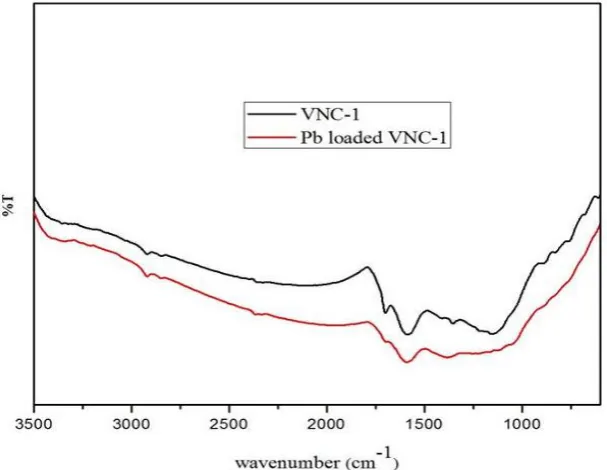
The adsorbents loaded with Pb(II) shows a similar FTIR spectrum as that obtained with an unloaded adsorbent, except that the bands had shifted to higher or lower values as shown in figure. The shifting of band due to the Pb(II) adsorption. Thus, the FTIR analysis revealed that the functional group like –OH, C-H bending, and C=O, COO-, O-H groups were mainly responsible for the adsorption.
Fig-1.FTIR spectrum of VNC-1 and Pb(II) loaded VNC-1
X-Ray Diffraction (XRD)
[image:5.595.147.451.192.427.2]Fig-2. XRD pattern of VNC-1 and Pb(II) loaded VNC-1
Effect of initial Pb(II) concentration
The adsorption process on effect of initial concentration (100-500ppm) on the percent removal of Pb(II) is shown in fig.3. The results reveals as the increase in concentration of metal ion found to be a decrement in percent adsorption of Pb(II). The number of lead ions available at lower concentration of the solution is found to less as compared to the available sites on the adsorbent. However, at higher concentrations, the metal ions are greater than the available adsorption sites are saturated and thus, the percentage removal of lead ions depends on the initial concentration. The maximum percentage removal (80.00%) of Pb(II) was achieved at 100 mg/L of lead solution.[18,19]
Effect of adsorbent dosage
The adsorbent dose is another important parameter that influences the adsorption of metal ions onto the VNC-1. The experiments were carried out under the conditions by varying the adsorbent dosage from 100mg to 500mg. It will be seen that the removal efficiency towards Pb(II) ions increased as the adsorbent dosage increased is presented in Fig-4. The factor is that adsorption sites remain unsaturated during the adsorption reaction. This is due to the dosage of the adsorbent is increased; there is a less proportionate increase in adsorption resulting from the lower adsorptive capacity utilization of the adsorbent. As adsorbent dose increased, there will be a more and more surface area will be available which increases active sites for binding of metal ions and thus exchangeable sites.[20]
Fig-4. Effect on dose of adsorbent on removal of Pb(II) from aqueous solution Conditions: Pb(II)=100mg/L; Size of adsorbent=53μ;pH=6;temperature=33±20C
Effect of particle size on Pb (II) removal
Fig-5. Effect of Size of adsorbent on removal of Pb(II) from aqueous solution Conditions: Pb(II)=100mg/L;adsorbent dose=200mg; pH=6; temperature=33±20C.
Effect of solution pH
The pH of the solution has a significant impact on the uptake of heavy metals, since it determines the surface charge of the adsorbent, the degree of ionization and speciation of the adsorbate. The optimum pH for the removal of Pb(II) from the solution with initial lead concentration of 100mg/L was observed that the percent removal of Pb(II) found to be increased with increasing pH 3-6 further increment of pH 7 cause decline in adsorption displayed in fig-6. This is because at low pH, the active sites get protonated and thus the protonated H+ ion competes with Pb(II) ions for the adsorption reaching the binding sites of the adsorbent caused by the repulsive forces. At high pH, the concentration of H+ decreases hence they do not involve in metal ion on adsorption sites. The surface of the adsorbent with negative charge attracts positive charge of the metal ion easily towards its binding sites. At pH 7, a decrease of adsorption of Pb(II) was observed due to the formation of lead hydroxide[22]. The presence of Hydroxide species lowers the adsorption process onto adsorbent. Hence, the further experiments were conduct at optimal pH 6.[23,24,25]
Conditions: Pb(II)=100mg/L;adsorbentdose=200mg;Size of adsorbent=53μ; temperature=33±20C.
Effect of temperature
The effect of temperature on the removal of metal ions using VNC-1was investigated at different temperatures (35⁰–55⁰C). On increasing temperature, the removal efficiency of metal ion decreased as the solution temperature was increasing from 35⁰to 55⁰C as shown in fig-7. The decrease in percentage may be due to desorption caused by an increase in the available thermal energy. At the high temperature higher mobility of the adsorbate is induced causing desorbed. This result shows the nature of the adsorption processes is mainly due to the decrease in surface activity, suggesting that adsorption between Pb(II) and VNC-1is an exothermic process. The maximum adsorption of metal ions by the VNC-1was obtained at 35⁰C shows that the adsorption of metal ions onto the VNC-1 is highly dependent on the temperature. Has observed a similar result. Therefore, the optimum temperature at 33±20C used for further experiments.[21]
Fig-7. Effect of temperature on removal of Pb(II) from aqueous solution. Conditions: Pb(II)=100mg/L; adsorbent dose=200mg; Size of adsorbent=53μ; pH=6
CONCLUSION
adsorption occur through physically. The results may be very useful for designing an economically cheap treatment process for the removal of Pb(II) containing waste water from chemical industries. Based on the results of this research, VNC-1 can be considered as an effective, available and natural adsorbent for removing Pb(II) from aqueous solutions.
ACKNOWLEDGEMENT
The Author would like to acknowledge and extend his heartfelt gratitude to the persons who helped for this research work and thankful to the Principal and Department of Chemistry, Jamal Mohamed College for providing laboratory facilities to perform the experiments.
REFERENCES
1. Li, Y-H; Wang, S; Wei, J; Zhang, X; Xu, C; Luan, Z. Lead adsorption on carbon nanotubes. Chemical Physics Letters, 2002; 357(3): 263-2666.
2. Zhang, K; Cheung, W; Valix Roles, M; of physical and chemical properties of activated Carbon in the adsorption of lead ions. Chemosphere, 2005; 60(8): 1129-1140.
3. Vuković, GD,; .Marinković, AD; Škapin, SD; Ristić, MĐ;Aleksić, R; Perić-Grujić, AA, et al. Removalof lead from water by amino modified multiwalled carbon nanotubes. J.Chemi.Engineering, 2011; 173(3): 855-865.
4. Deng,X;LüL,Li;Lu,H;ofTheadsorptionpropertiesofPb(II)andCd(II)onfunctionalizedgrap Ene prepared by electrolysis method. J .of hazard.mater, 2010; 183(1): 923- 930.
5. Sun, Y; Yue,Q; Gao, B; Gao,Y; Xu, X; Li, et al.Adsorption and cosorption of Ciprofloxacin and Ni (II) on activated carbon-mechanism study. J. of the Taiwan Institute of Chemi.Engineers, 2014; 45(2): 681-688.
6. Yang, S; Li, J; Shao, D; Hu, J; Wang, X; Adsorption of Ni (II) on oxidized multi-walled Carbon nanotubes: effect of contact time, pH, foreign ions and PAA. J. of hazard. Materi, 2009; 166(1): 109-116.
7. Zhang , S; Zhang, Y; Liu, J; Xu, Q; Xiao, H; Wang, X; Xu, H; Zhou, J; Thiol modified Fe3O4@SiO2as a robust, high effective and recycling magnetic sorbent for mercury
Removal. J.Chemi.Engineering, 2013; 226: 30–38.
8. Cheng, C; Wang, J; Yang, X; Li, A; Philippe, C; Adsorption of Ni (II) and Cd (II) from Water by novel chelating sponge and the effect of alkali earth metal ions on the Adsorption J.of hazard.materi, 2014; 264: 332-341.
10.Qaiser, S; Saleem, A.R; and Ahmed, M; Heavy metal uptake by agro based waste Materials.Environmental Biotechnol, 2007; 10(3): 1-8.
11.Gupta,V. K; and Ali, Removal of lead and chromium from wastewater using bagasse Fly ash-sugar industry waste. J. Colloid Interface Sci., 2004; 271(2): 321.
12.IARC Working Group on the Evaluation of Carcinogenic Risks to Humans. Inorganic And organic lead compounds. IARC Monogr Eval Carcinog Risks Hum, 2006; 87.
13.Manahan, Environmental Chemistry Books, Colei, CA, 1984.
14.Kurniawan, T.A; Babel, S; A research study on Cr(VI) removal from contaminated Wastewater using low-cost adsorbents and commercial activated carbon. I Second Int. Conf. on Energy Technology towards a Clean Environment (RCETE), Phuket, Thailand, 12–14 February, 2003; 2: 1110–1117.
15.Demirbas, A; Heavy metal adsorption onto agro-based waste materials: a review, J. Hazard. Mater., 2008; 157: 220–229.
16.Guo, J; Xu, W.S; Chen, Y.L; Lua, A.C; Adsorption of NH3 onto activated carbon
Prepared from palm shells impregnated with H2SO4, J. Colloid Interface Sci., 2005; 281
(2):285–290.
17.Arunkumar, A; Chandrasekaran, T; Riaz Ahamed, K; ‘Preparation of Activated Carbon from the Stem of the Natural Plant Vitex Negundo and Evaluation of Their Physical and Chemical Properties’. Int. J. Innov. Technol. Explor. Eng, 2014; 4(2): 1-6.
18.Chen, X.C; Wang, Y.P; Lin, Q; Shi, J.Y; Wu, W.X; Chen, Y.X; Biosorptio ofcopper (II) And zinc (II) from aqueous solution by Pseudomonas putida CZ1, ColloidsSurf. B, 2005; 46: 101–107.
19.Lehman, RG; Harter, RD; J.Soil Sci. Soc. Am, 1984; 48: 769.
20.Jayaram, K; Murthy,I.Y.L.N; Lalhruaitluanga, H; Prasad, M.N.V; Biosorption of lead From aqueous solution by seed powder of Strychnos potatorum L,Colloid Surf. B, 2009; 71: 248–254.
21.Aziz, H.M.A; Sorption equilibria of lead (II) on some Palestinian soils – the natural ion Exchangers, Colloids Surf. A, 2005; 264: 1–5.
22.Momˇcilovi´c, M; Purenovi´c, M; Boji´c, A; Zarubica, A and Randelovid, M; Removal Of lead (II) ions from aqueous solutions by adsorption onto pine cone activated carbon, Desalination, 2011; 276: 53–59.
24.Depci, T; et al. Competitive adsorption of lead and zinc from aqueous solution on Activated carbon prepared from Van apple pulp: Study in single- and multi-solute Systems. Chemi. Engineering, 2012; 200: 224–236.