Acta Cryst.(2001). E57, m263±m264 DOI: 101107/S1600536801007814 Jack Chenget al. [Cu2(NCO)2(C2O4)(C6H16N2)2]
m263
metal-organic papers
Acta Crystallographica Section E Structure Reports Online
ISSN 1600-5368
An oxalato-bridged copper(II) complex
Jack Cheng,aFen-Ling Liao,b
Tian-Huey Lu,a* Partha S.
Mukherjee,cTapas K. Majicand
N. Ray Chaudhuric
aDepartment of Physics, National Tsing Hua University, Hsinchu, Taiwan 300,bDepartment of Chemistry, National Tsing Hua University, Hsinchu, Taiwan 300, andcDepartment of Inorganic Chemistry, Indian Association for Cultivation of Science, Jadavpur, Calcutta 700 032, India
Correspondence e-mail: [email protected]
Key indicators
Single-crystal X-ray study
T= 296 K
Mean(C±C) = 0.004 AÊ
Rfactor = 0.039
wRfactor = 0.090
Data-to-parameter ratio = 20.1
For details of how these key indicators were automatically derived from the article, see http://journals.iucr.org/e.
#2001 International Union of Crystallography Printed in Great Britain ± all rights reserved
In the coordination complex
-oxalato-bis[(isocyanato-N)(tetramethylethylenediamine)copper(II)], [Cu2(NCO)2
-(C2O4)(C6H16N2)2], the CuII ions are ®ve-coordinated. One
CuIIion bridges to another centrosymmetry-related CuIIion
through C2O42ÿ, forming a plane with an r.m.s. deviation of
0.059 AÊ. The OÐCuÐO angle is 79.33 (8)and the Cu Cu
separation is 5.14 AÊ.
Comment
Magnetic studies of oxalate-bridged metal complexes are well documented (Julve, Verdagueret al., 1984; Julve, Faus et al., 1984; Kahn, 1985). Presently, this study is mainly concentrated on one-dimensional/two-dimensional systems having alter-nating bridging ligands,i.e.systems with more than one brid-ging ligand (Vicenteet al., 1996). Recently, Ribaset al.(1998) designed a strategy for having NiIIor CuIIas central atom with
the aim of combining oxalate and azide super-exchange pathways in the same compound. To get the desired compound, they replaced the water molecule in [L(H2O)M
-ox-M(H2O)L]2+[M= CuII(Vicenteet al., 1997),L= diamine;
M= NiII(Escueret al., 1994),L= diamine or triamine] with a
bridging azide ligand. Using the same strategy, we tried to synthesize a -oxalato--cyanato-dicopper(II) alternating chain. Surprisingly, due to the lesser bridging tendency of the cyanate ion compared to azide, we did not get the desired one-dimensional alternating chain but instead obtained a dinuclear copper(II) oxalate-bridged complex, (I), with a pendant cyanate ligand in the ®fth position of each copper(II) in atrans
fashion.
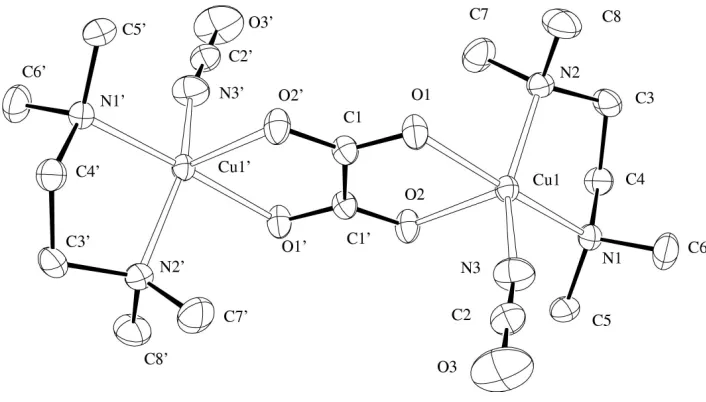
The coordination geometry about each Cu atom is distorted trigonal±bipyrimidal, with N2, N3, O2 and Cu atoms in the equatorial plane of the bipyramid (r.m.s. deviation 0.019 AÊ); N1 and O1 are on the axial sites. The -oxalato chelate is shared by both of the centrosymmetry-related CuII ions.
Several similiar oxalato-briged structures of CuIIcoordination
complexes with aqua instead of isocyanato have been reported (Julve, Verdagueret al., 1984; Julve, Fauset al., 1984; Sletten, 1983).
Experimental
N,N,N0,N0-Tetramethylethane-1,2-diamine (0.3 ml, 2 mmol) was
added slowly to copper nitrate trihydrate (483.2 mg, 2 mmol) dissolved in water (10 ml). To the deep-blue solution, an aqueous solution (10 ml) of potassium cyanate (162.6 mg, 2 mmol) was added drop-by-drop with constant stirring and a blue crystalline compound separated out. An aqueous solution (10 ml) of sodium oxalate (134 mg, 1 mmol) was added slowly with vigorous stirring and a deep-blue solution was obtained. This was ®ltered and the ®ltrate was kept in a desiccator. After a few days, single crystals suitable for X-ray crystal structure analysis were obtained.
Crystal data
[Cu2(NCO)2(C2O4)(C6H16N2)2]
Mr= 531.06 Monoclinic,P21/c
a= 7.4943 (9) AÊ
b= 14.5660 (17) AÊ
c= 10.8812 (13) AÊ
= 105.655 (2)
V= 1143.8 (2) AÊ3
Z= 2
Dx= 1.543 Mg mÿ3 MoKradiation Cell parameters from 25
re¯ections
= 2.4±28.3 = 1.90 mmÿ1
T= 296 (2) K Rectangular plate, blue 0.230.100.10 mm Data collection
CCD area-detector diffractometer
'and!scans
Absorption correction: empirical (Northet al., 1968)
Tmin= 0.646,Tmax= 0.827
7265 measured re¯ections 2734 independent re¯ections
2367 re¯ections withI> 2(I)
Rint= 0.032 max= 28.3
h=ÿ9!9
k=ÿ15!18
l=ÿ14!14
Re®nement Re®nement onF2
R[F2> 2(F2)] = 0.039
wR(F2) = 0.090
S= 1.16 2734 re¯ections 136 parameters
H-atom parameters constrained
w= 1/[2(F
o2) + (0.115P)2 + 0.612P]
whereP= (Fo2+ 2Fc2)/3 (/)max< 0.001
max= 0.37 e AÊÿ3
min=ÿ0.51 e AÊÿ3
Table 1
Selected geometric parameters (AÊ,).
Cu1ÐN3 1.933 (3) Cu1ÐO1 1.9946 (19) Cu1ÐN1 2.030 (2) Cu1ÐN2 2.062 (2) Cu1ÐO2 2.2330 (19)
O1ÐC1i 1.261 (3)
C1ÐO2 1.247 (3) C1ÐO1i 1.261 (3)
C1ÐC1i 1.540 (5)
N3ÐCu1ÐO1 92.33 (11) N3ÐCu1ÐN1 93.99 (11) O1ÐCu1ÐN1 173.19 (9) N3ÐCu1ÐN2 152.15 (12) O1ÐCu1ÐN2 89.69 (9)
N1ÐCu1ÐN2 85.91 (9) N3ÐCu1ÐO2 103.58 (11) O1ÐCu1ÐO2 79.23 (7) N1ÐCu1ÐO2 96.78 (8) N2ÐCu1ÐO2 104.09 (9) Symmetry code: (i)ÿx;ÿy;2ÿz.
Data collection:SMART(Bruker, 1998); cell re®nement:SMART; data reduction:SHELXTL(Bruker, 1998); program(s) used to solve structure: SHELXS97 (Sheldrick, 1997); program(s) used to re®ne structure: SHELXL97 (Sheldrick, 1997); molecular graphics:
SHELXTL; software used to prepare material for publication:
SHELXTL.
The authors thank W. J. Sheen for help with the structure determination and are indebted to the National Science Council, China, for support under grant NSC89-2112-M-007-083.
References
Bruker (1998).SMART(Version 5.0) andSHELXTL(Version 5.1). Bruker AXS Inc., Madison, Wisconsin, USA.
Escuer, A., Vicente, R., Solans, X. & Bardia, M. F. (1994).Inorg. Chem.33, 6007±6011.
Julve, M., Faus, J., Verdaguer, M. & Gleizes, A. (1984).J. Am. Chem. Soc.106, 8306±8308.
Julve, M., Verdaguer, M., Gleizes, A., Philoche-Lavisalles, M. & Kahn, O. (1984).Inorg. Chem.23, 3808±3818.
Kahn, O. (1985).Angew. Chem. Int. Ed. Engl.24, 834±850.
North, A. C. T., Phillips, D. C. & Mathews, F. S. (1968).Acta Cryst.A24, 351± 359.
Ribas, J., Diaz, C., Costa, R., Tercero, J., Solans, X., Bardia, M. F. & Stoeckli-Evans, H. (1998).Inorg. Chem.37, 233±238.
Sheldrick, G. M. (1997). SHELXS97 and SHELXL97. University of GoÈttingen, Germany.
Sletten, J. (1983).Acta Chem. Scand. Ser. A,37, 569±571.
Vicente, R., Escuer, A., Solans, X. & Bardia, M. F. (1996).J. Chem. Soc. Dalton Trans.pp. 1835±1838.
Vicente, R., Escuer, A., Ferretjans, J., Stoeckli-Evans, H., Solans, X. & Bardia, M. F. (1997).J. Chem. Soc. Dalton Trans.pp. 167±171.
Figure 1
supporting information
sup-1
Acta Cryst. (2001). E57, m263–m264
supporting information
Acta Cryst. (2001). E57, m263–m264 [doi:10.1107/S1600536801007814]
An oxalato-bridged copper(II) complex
Jack Cheng, Fen-Ling Liao, Tian-Huey Lu, Partha S. Mukherjee, Tapas K. Maji and N. Ray
Chaudhuri
S1. Comment
Magnetic studies of oxalate-bridged metal complexes are well documented (Julve, Verdaguer et al., 1984; Julve, Faus et
al., 1984; Kahn et al., 1985). Presently, this study is mainly concentrated on one-dimensional/two-dimensional systems having alternating bridging ligands, i.e. systems where more than one bridging ligand (Vicente et al., 1996). Recently,
Ribas et al. (1998) designed a strategy for having NiII and CuII as central atom with the aim of combining oxalate and
azide super-exchange pathways in the same compound. To get the desired compound, they replaced the water molecule in
[L(H2O)M-ox-M(H2O)L]2+ [M = CuII(Vicente et al., 1997), L = diamine; M = NiII (Escuer et al., 1994), L = diamine or
tri-amine] with a bridging azide ligand. Using the same strategy, we tried to synthesize a µ-oxalato-µ-cyanato-dicopper(II)
alternating chain. Surprisingly, due to the lesser bridging tendency of the cyanate ion compared to azide, we did not get
the desired one-dimensional alternating chain but instead obtained a dinuclear copper(II) oxalate-bridged complex with a
pendant cyanate ligand in the fifth position of each copper(II) in a trans fashion. The coordination geometry about each
Cu atom is distorted trigonal–bipyrimidal, with with N2, N3, O2 and Cu atoms in the equatorial plane of the bipyramid
(r.m.s. deviation 0.019 Å); N1 and O1 are on the axial apices. The µ-oxalato chelate is shared by of the two
centrosymmetry-related CuII ions. Several similiar oxalato-briging structures of CuII coordination complex with aqua
instead of isocyanato have been reported (Julve, Verdaguer et al., 1984; Julve, Faus et al., 1984; Sletten, 1983).
S2. Experimental
N,N,N′,N′-Tetramethylethane-1,2-diamine (0.3 ml, 2 mmol) was added slowly to copper nitrate trihydrate (483.2 mg, 2 mmol) dissolved in water (10 ml). To the deep-blue solution, an aqueous solution (10 ml) of potassium cyanate (162.6
mg, 2 mmol) was poured drop-by-drop with constant stirring and a blue crystalline compound separated out. An aqueous
solution (10 ml) of sodium oxalate (134 mg, 1 mmol) was added slowly with vigorous stirring and a deep-blue solution
was obtained. This was filtered and the filtrate was kept in a desiccator. After a few days, single crystals suitable for
Figure 1
ORTEP drawing of the title complex. Atoms labeled with a prime are centrosymmetrically related to those without prime.
The coordination bonds are hollow.
µ-oxalato-bis[(isocyanato-N)(tetramethylethylenediamine)copper(II)]
Crystal data
[Cu2(NCO)2(C2O4)(C6H16N2)2]
Mr = 531.06 Monoclinic, P21/c a = 7.4943 (9) Å
b = 14.5660 (17) Å
c = 10.8812 (13) Å
β = 105.655 (2)°
V = 1143.8 (2) Å3
Z = 2
F(000) = 552
Dx = 1.543 Mg m−3
Mo Kα radiation, λ = 0.71073 Å Cell parameters from 25 reflections
θ = 2.4–28.3°
µ = 1.90 mm−1
T = 296 K
Rectangular plate, blue 0.23 × 0.10 × 0.10 mm
Data collection
CCD area detector diffractometer
Radiation source: fine-focus sealed tube Graphite monochromator
φ and ω scans
Absorption correction: empirical (using intensity measurements)
(North et al., 1968)
Tmin = 0.646, Tmax = 0.827
7265 measured reflections 2734 independent reflections 2367 reflections with I > 2σ(I)
Rint = 0.032
θmax = 28.3°, θmin = 2.4°
h = −9→9
k = −15→18
l = −14→14
Refinement
Refinement on F2 Least-squares matrix: full
R[F2 > 2σ(F2)] = 0.039
wR(F2) = 0.090
S = 1.16 2734 reflections
Primary atom site location: structure-invariant direct methods
Secondary atom site location: difference Fourier map
supporting information
sup-3
Acta Cryst. (2001). E57, m263–m264
w = 1/[σ2(F
o2) + (0.115P)2 + 0.612P] where P = (Fo2 + 2Fc2)/3
(Δ/σ)max < 0.001
Δρmax = 0.37 e Å−3 Δρmin = −0.51 e Å−3
Special details
Geometry. All e.s.d.'s (except the e.s.d. in the dihedral angle between two l.s. planes) are estimated using the full covariance matrix. The cell e.s.d.'s are taken into account individually in the estimation of e.s.d.'s in distances, angles and torsion angles; correlations between e.s.d.'s in cell parameters are only used when they are defined by crystal symmetry. An approximate (isotropic) treatment of cell e.s.d.'s is used for estimating e.s.d.'s involving l.s. planes.
Refinement. Refinement of F2 against ALL reflections. The weighted R-factor wR and goodness of fit S are based on F2, conventional R-factors R are based on F, with F set to zero for negative F2. The threshold expression of F2 > σ(F2) is used only for calculating R-factors(gt) etc. and is not relevant to the choice of reflections for refinement. R-factors based on F2 are statistically about twice as large as those based on F, and R- factors based on ALL data will be even larger.
Fractional atomic coordinates and isotropic or equivalent isotropic displacement parameters (Å2)
x y z Uiso*/Ueq
Cu1 0.01552 (4) 0.05732 (2) 0.76424 (3) 0.03128 (11)
O1 0.1048 (3) −0.04496 (12) 0.88738 (19) 0.0418 (5)
C1 −0.0525 (4) 0.04310 (16) 1.0118 (3) 0.0341 (6)
O2 −0.0791 (3) 0.10586 (12) 0.93093 (18) 0.0432 (5)
N1 −0.0582 (3) 0.17153 (15) 0.6555 (2) 0.0347 (5)
N2 0.2833 (3) 0.10567 (16) 0.8003 (2) 0.0400 (5)
N3 −0.1915 (4) −0.01432 (19) 0.6664 (3) 0.0578 (7)
C2 −0.2965 (4) −0.0685 (2) 0.6242 (3) 0.0446 (7)
O3 −0.4076 (4) −0.1258 (2) 0.5775 (3) 0.0987 (11)
C3 0.2787 (4) 0.1884 (2) 0.7196 (3) 0.0483 (7)
H3A 0.2916 0.1706 0.6365 0.058*
H3B 0.3803 0.2291 0.7593 0.058*
C4 0.0967 (4) 0.23676 (19) 0.7049 (3) 0.0431 (7)
H4A 0.0905 0.2608 0.7868 0.052*
H4B 0.0864 0.2879 0.6463 0.052*
C5 −0.2319 (4) 0.2123 (2) 0.6696 (3) 0.0461 (7)
H5A −0.2195 0.2252 0.7580 0.069*
H5B −0.3321 0.1700 0.6385 0.069*
H5C −0.2570 0.2683 0.6214 0.069*
C6 −0.0820 (5) 0.1523 (3) 0.5184 (3) 0.0565 (8)
H6A 0.0297 0.1257 0.5070 0.085*
H6B −0.1083 0.2085 0.4708 0.085*
H6C −0.1830 0.1102 0.4884 0.085*
C7 0.3592 (5) 0.1307 (3) 0.9364 (3) 0.0649 (10)
H7A 0.2829 0.1772 0.9589 0.097*
H7B 0.4831 0.1536 0.9500 0.097*
H7C 0.3608 0.0774 0.9887 0.097*
C8 0.4017 (5) 0.0342 (3) 0.7662 (4) 0.0641 (10)
H8A 0.3529 0.0177 0.6781 0.096*
H8B 0.4037 −0.0190 0.8187 0.096*
Atomic displacement parameters (Å2)
U11 U22 U33 U12 U13 U23
Cu1 0.03512 (18) 0.02876 (17) 0.03108 (18) −0.00039 (13) 0.01084 (12) 0.00284 (12)
O1 0.0592 (13) 0.0313 (10) 0.0426 (11) 0.0108 (8) 0.0269 (9) 0.0056 (8)
C1 0.0405 (14) 0.0253 (13) 0.0383 (14) 0.0000 (10) 0.0134 (11) 0.0022 (10)
O2 0.0631 (13) 0.0294 (10) 0.0425 (11) 0.0084 (9) 0.0233 (9) 0.0074 (8)
N1 0.0362 (11) 0.0357 (11) 0.0325 (11) −0.0001 (9) 0.0096 (9) 0.0044 (9)
N2 0.0337 (12) 0.0414 (13) 0.0444 (13) 0.0014 (10) 0.0098 (10) 0.0085 (10)
N3 0.0497 (16) 0.0456 (16) 0.072 (2) −0.0114 (13) 0.0065 (14) −0.0049 (14)
C2 0.0430 (16) 0.0385 (16) 0.0496 (17) 0.0046 (13) 0.0078 (13) 0.0008 (13)
O3 0.079 (2) 0.0691 (19) 0.124 (3) −0.0270 (16) −0.0129 (18) −0.0185 (18)
C3 0.0399 (16) 0.0479 (18) 0.0601 (19) −0.0059 (13) 0.0189 (14) 0.0139 (14) C4 0.0456 (16) 0.0304 (14) 0.0537 (17) −0.0019 (12) 0.0143 (13) 0.0083 (12)
C5 0.0376 (15) 0.0477 (17) 0.0507 (17) 0.0088 (13) 0.0078 (13) 0.0084 (14)
C6 0.070 (2) 0.065 (2) 0.0338 (15) 0.0010 (17) 0.0125 (15) 0.0078 (14)
C7 0.058 (2) 0.075 (2) 0.0505 (19) −0.0179 (18) −0.0045 (16) 0.0048 (18)
C8 0.0485 (19) 0.062 (2) 0.089 (3) 0.0177 (16) 0.0297 (19) 0.0132 (19)
Geometric parameters (Å, º)
Cu1—N3 1.933 (3) C3—C4 1.505 (4)
Cu1—O1 1.9946 (19) C3—H3A 0.9700
Cu1—N1 2.030 (2) C3—H3B 0.9700
Cu1—N2 2.062 (2) C4—H4A 0.9700
Cu1—O2 2.2330 (19) C4—H4B 0.9700
O1—C1i 1.261 (3) C5—H5A 0.9600
C1—O2 1.247 (3) C5—H5B 0.9600
C1—O1i 1.261 (3) C5—H5C 0.9600
C1—C1i 1.540 (5) C6—H6A 0.9600
N1—C5 1.476 (4) C6—H6B 0.9600
N1—C6 1.480 (4) C6—H6C 0.9600
N1—C4 1.484 (3) C7—H7A 0.9600
N2—C8 1.479 (4) C7—H7B 0.9600
N2—C7 1.482 (4) C7—H7C 0.9600
N2—C3 1.486 (4) C8—H8A 0.9600
N3—C2 1.122 (4) C8—H8B 0.9600
C2—O3 1.191 (4) C8—H8C 0.9600
N3—Cu1—O1 92.33 (11) C4—C3—H3B 110.0
N3—Cu1—N1 93.99 (11) H3A—C3—H3B 108.4
O1—Cu1—N1 173.19 (9) N1—C4—C3 109.7 (2)
N3—Cu1—N2 152.15 (12) N1—C4—H4A 109.7
O1—Cu1—N2 89.69 (9) C3—C4—H4A 109.7
N1—Cu1—N2 85.91 (9) N1—C4—H4B 109.7
N3—Cu1—O2 103.58 (11) C3—C4—H4B 109.7
O1—Cu1—O2 79.23 (7) H4A—C4—H4B 108.2
supporting information
sup-5
Acta Cryst. (2001). E57, m263–m264
N2—Cu1—O2 104.09 (9) N1—C5—H5B 109.5
C1i—O1—Cu1 116.23 (16) H5A—C5—H5B 109.5
O2—C1—O1i 124.8 (2) N1—C5—H5C 109.5
O2—C1—C1i 118.2 (3) H5A—C5—H5C 109.5
O1i—C1—C1i 117.1 (3) H5B—C5—H5C 109.5
C1—O2—Cu1 108.40 (16) N1—C6—H6A 109.5
C5—N1—C6 108.1 (2) N1—C6—H6B 109.5
C5—N1—C4 109.3 (2) H6A—C6—H6B 109.5
C6—N1—C4 110.9 (2) N1—C6—H6C 109.5
C5—N1—Cu1 112.21 (17) H6A—C6—H6C 109.5
C6—N1—Cu1 111.86 (19) H6B—C6—H6C 109.5
C4—N1—Cu1 104.48 (15) N2—C7—H7A 109.5
C8—N2—C7 109.2 (3) N2—C7—H7B 109.5
C8—N2—C3 110.1 (3) H7A—C7—H7B 109.5
C7—N2—C3 109.4 (3) N2—C7—H7C 109.5
C8—N2—Cu1 109.3 (2) H7A—C7—H7C 109.5
C7—N2—Cu1 111.4 (2) H7B—C7—H7C 109.5
C3—N2—Cu1 107.35 (17) N2—C8—H8A 109.5
C2—N3—Cu1 167.3 (3) N2—C8—H8B 109.5
N3—C2—O3 179.0 (4) H8A—C8—H8B 109.5
N2—C3—C4 108.6 (2) N2—C8—H8C 109.5
N2—C3—H3A 110.0 H8A—C8—H8C 109.5
C4—C3—H3A 110.0 H8B—C8—H8C 109.5
N2—C3—H3B 110.0
N3—Cu1—O1—C1i −95.2 (2) O2—Cu1—N2—C8 138.9 (2)
N2—Cu1—O1—C1i 112.6 (2) N3—Cu1—N2—C7 −155.2 (3)
O2—Cu1—O1—C1i 8.2 (2) O1—Cu1—N2—C7 −60.8 (2)
O1i—C1—O2—Cu1 −173.8 (2) N1—Cu1—N2—C7 114.0 (2)
C1i—C1—O2—Cu1 6.6 (4) O2—Cu1—N2—C7 18.0 (2)
N3—Cu1—O2—C1 81.9 (2) N3—Cu1—N2—C3 85.0 (3)
O1—Cu1—O2—C1 −7.89 (18) O1—Cu1—N2—C3 179.4 (2)
N1—Cu1—O2—C1 177.70 (18) N1—Cu1—N2—C3 −5.8 (2)
N2—Cu1—O2—C1 −94.84 (19) O2—Cu1—N2—C3 −101.76 (19)
N3—Cu1—N1—C5 67.7 (2) O1—Cu1—N3—C2 −6.5 (14)
N2—Cu1—N1—C5 −140.25 (19) N1—Cu1—N3—C2 176.1 (14)
O2—Cu1—N1—C5 −36.53 (19) N2—Cu1—N3—C2 87.3 (14)
N3—Cu1—N1—C6 −54.0 (2) O2—Cu1—N3—C2 −85.9 (14)
N2—Cu1—N1—C6 98.0 (2) C8—N2—C3—C4 151.4 (3)
O2—Cu1—N1—C6 −158.2 (2) C7—N2—C3—C4 −88.5 (3)
N3—Cu1—N1—C4 −174.06 (19) Cu1—N2—C3—C4 32.5 (3)
N2—Cu1—N1—C4 −21.99 (18) C5—N1—C4—C3 166.9 (2)
O2—Cu1—N1—C4 81.74 (18) C6—N1—C4—C3 −74.0 (3)
N3—Cu1—N2—C8 −34.3 (3) Cu1—N1—C4—C3 46.7 (3)
O1—Cu1—N2—C8 60.1 (2) N2—C3—C4—N1 −54.3 (3)
N1—Cu1—N2—C8 −125.1 (2)