RP-HPLC METHOD DEVELOPMENT AND VALIDATION FOR
SIMULTANEOUS ESTIMATION OF SILIBININ AND
URSODEOXYCHOLIC ACID IN BULK AND IN THEIR COMBINED
TABLET DOSAGE FORM
Sayali Salkar*, Dr. (Mrs).Vandana Jain
Department of Quality Assurance, Oriental College of Pharmacy, Sanpada, Navi-Mumbai.
ABSTRACT
A novel, simple, precise, accurate RP-HPLC method was introduced for the simultaneous determination of hepatoprotective polyphenolic drug silibinin with ursodeoxycholic acid. The method was adapted to analyze drugs in their combined dosage form (tablet). The separation was achieved using a Prontosil C18 column (250 x 4.6mm, 5μm) and mobile phase comprised of acetonitrile and 0.02 M sodium dihydrogen phosphate buffer with 1.5ml Triethylamine (pH 6.5) in the ratio of 40:60 (v/v) at the flow rate 1ml/min and the detection was performed at 208nm. The retention time of silybin A, silybin B and ursodeoxycholic acid was found to be 3.847min, 5.643min and 4.453 min, respectively. The linear ranges for silibinin and ursodeoxycholic acid were 100-200µg/ml and 100-600µg/ml, respectively. The recoveries of silibinin and ursodeoxycholic acid in pharmaceutical preparation were all greater than 97% and their relative standard deviations were not more than 2.0%. The developed method was validated in terms of accuracy, precision, linearity, limit of detection, limit of quantitation. This study aimed at developing and validating a simple, accurate and selective RP-HPLC method, and the proposed method can be used for the estimation of these drugs in combined dosage forms.
KEYWORDS: Silibinin, Ursodeoxycholic acid, RP-HPLC, Validation.
INTRODUCTION
Silymarin is a hepatoprotective polyphenolic substance isolated from the milk thistle plant, Silybum marianum, family Asteraceae.[1] Silymarin, a crude extract is a complex
Volume 6, Issue 6, 811-819. Research Article ISSN 2277– 7105
*Corresponding Author
Sayali Salkar
Department of Quality
Assurance, Oriental College
of Pharmacy, Sanpada,
Navi-Mumbai. Article Received on 27 March. 2017,
Revised on 17 April. 2017, Accepted on 07 May. 2017
mixture of several flavonolignans consisting of isomers silibinin, silicristin, and silidianin[2,3] Isomer silibinin (SIL) itself is mixture of two diastereomers, silybin A and silybin B, in approximately equimolar ratio.[4] The mixture exhibits a number of pharmacological effects, particularly in the liver, and there is some clinical evidence for the use of silibinin as a supportive element in alcoholic and child grade 'A' liver cirrhosis.[5] In silymarin extract, silibinin (SIL)represents about 60-70 per cent, followed by silychristin (20%), silydianin (10%), and isosilybin (5%).[3] Because silymarin is mixture of compounds derived from a natural source, batch-to-batch variation in bioactive ingredient composition occurs, which can confound the interpretation of study results.[6]
Ursodeoxycholic acid (UDCA) is an epimer of chenodeoxycholic acid and is a mammalian bile acid found first in the bear.[7] UDCA is a white, odorless, crystalline powder with a bitter taste. It is a water insoluble drug used as a drug for the dissolution of cholesterol gallstones as it reduces the cholesterol saturation of bile,[2,8,9,10,] therefore it is therapeutically applicable bile acid widely used for the dissolution of cholesterol-rich gallstones and in the treatment of chronic liver diseases associated with cholestasis,[3,11] To the best of our research survey till now no such method is available which can simultaneously determine SIL and UDCA with simplicity of methodology, therefore a endeavor was made to generate a new, simple, precise, validated RP-HPLC method for simultaneous estimation of SIL and UDCA in bulk and combined dosage form. The applicability of the method was confirmed for analysis in pharmaceutical product (tablet).
Fig: 2. URSODEOXYCHOLIC ACID (UDCA)
EXPERIMENTAL
Materials and reagents
SIL was obtained from Yarrowchem Pvt Ltd and UDCA was obtained as gift sample from Alkem Pharmaceutical, Sikkim. A commercial preparation (URSOCHEM TABLET) used for analysis was procured from pharma market. Each tablet contains 140mg of SIL and 300mg of UDCA. HPLC grade acetonitrile (Thomas Baker) was used. Other reagents (Sodium dihydrogen phosphate, Triethyl Amine) were of analytical grade purchased from Thomas Baker.
Instrumentation
RP-HPLC was performed using Shimadzu HPLC system consisting of a pump LC-20AD, rheodyne sample injection port with 20 microlitre loop,SPD-20A UV-Detector, Spinchrom software, column used was Prontosil C18(250 x 4.6mm, 5μm), weighing was done on Contech CA-123 balance and pH was adjusted using PCI analytics Digital pH meter 111.
Chromatographic Conditions
A reverse phase column [Prontosil C18 (250 x 4.6mm, 5μm particle size)], equilibrated with mobile phase consisting of acetonitrile: 0.02 M Sodium dihydrogen phosphate buffer (40:60) with 1.5 ml of Triethylamine (TEA) (pH 6.5) was used. Mobile phase flow rate was maintained at 1 mL/min and effluents were monitored at 208 nm. The sample was injected using 20 microlitre fixed loop rheodyne injector and run time was 10 min.
Preparation of 0.02 M Sodium dihydrogen orthophosphate plus 1.5 ml TEA (pH 6.5)
Mobile Phase preparation
Sodium dihydrogen orthophosphate (0.02 M) pH 6.5 (filtered) was prepared. And mixed with Acetonitrile in the ratio 60:40 and was sonicated.
Standard solution preparation
100 mg of SIL and 100 mg of UDCA standard were accurately weighed and transferred into 100 ml volumetric flask respectively. About 70 ml of mobile phase was added, sonicated to dissolve and diluted to 100ml using mobile phase. Final concentration of SIL and UDCA were made to 140µg/ml and 300µg/ml respectively by suitable dilutions.
Sample solution preparation
20 tablets were weighed and powdered. The quantity of powder equivalent to 140 mg of SIL and 300mg of UDCA were transferred into a 500ml volumetric flask. About 350ml mobile was added and solution was sonicated for 30mins with intermittent shaking. The volume was made up using the mobile phase, mixed and filtered through 0.45µ PVDF filter. Final concentration of SIL and UDCA were made to 140µg/ml and 300µg/ml respectively by suitable dilutions.
Validation of HPLC method
The proposed RP-HPLC method was validated as per ICH guidelines for the following parameters.
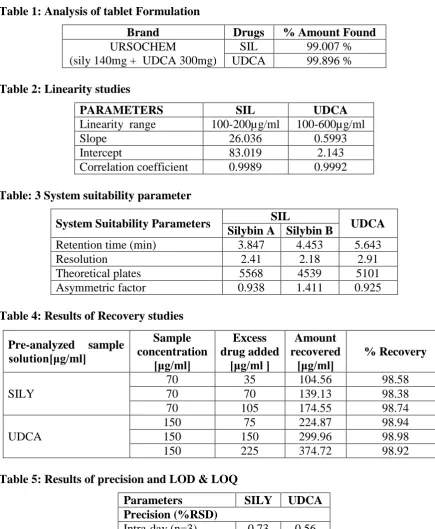
Assay The amount of SIL and UDCA per tablet was determined by formula. Results are
reported in Table 1. % Assay of Drug =
AT x Dilution of standard preparation x P x Avgwt (mg) x 100
As x Dilution of test preparation x 100 x L.C
Where,
AT= Area of peak obtained from the chromatogram of sample preparation
As = Area of peak obtained from the chromatogram of standard preparation
P = % Potency of drug.
Selectivity and Specificity
To assess the selectivity of the developed method solutions of two drugs were injected into the system, two sharp peaks (Silibinin diastereomers - silybin A ,silybin B) of SIL and one peak of UDCA were obtained at retention time of 3.84 min, 5.64 min and 4.45 min respectively in reference to standard solution. Specificity was determined by comparison of the chromatogram of mixed standards and sample solutions. As the retention time of standard drugs and the retention time of the drugs in sample solutions were same, hence the method was specific. The parameters like resolution (Rs) and asymmetric factor were calculated. Good correlation was found between the results of mixed standards and sample solutions. Results are shown in the Table 3.
Linearity
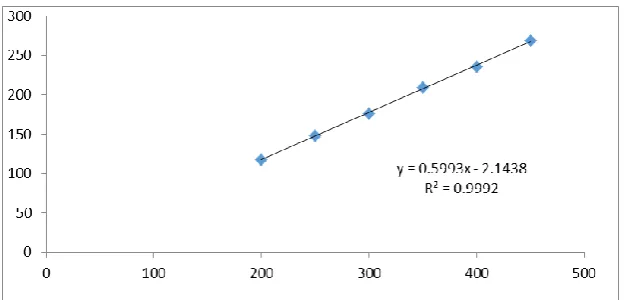
Linearity of silibinin and ursodeoxycholic acid was performed using a standard solution in the range of 100-200 µg/ml and 100-600 µg/ml respectively. Correlation coefficient (R2) should be not less than 0.99. Results are shown in Table 2.
Precision
Precision study was performed to find out intraday and inter day variations. The intra -day and inter-day precision study of SIL and UDCA was carried out by estimating the correspondent response 3 times on the same day and on 3 different days for 3 different concentrations of SIL and UDCA. The results are reported in terms of % relative standard deviation (%RSD) however, all results fall within acceptance limits (RSD < 2), as shown in
Table 5.
Accuracy
The accuracy of the proposed methods was assessed by recovery studies at three different levels i.e. 75%, 100% and 125%. The recovery studies were carried out by adding known amounts of standard SIL and UDCA were added to pre-analyzed samples and they were subjected to proposed HPLC method. The recoveries results of SIL and UDCA in pharmaceutical preparation are shown in the Table 4.
Robustness
Table 1: Analysis of tablet Formulation
Brand Drugs % Amount Found
URSOCHEM
(sily 140mg + UDCA 300mg)
SIL 99.007 % UDCA 99.896 %
Table 2: Linearity studies
PARAMETERS SIL UDCA
Linearity range 100-200µg/ml 100-600µg/ml Slope 26.036 0.5993 Intercept 83.019 2.143 Correlation coefficient 0.9989 0.9992
Table: 3 System suitability parameter
System Suitability Parameters SIL UDCA
Silybin A Silybin B
Retention time (min) 3.847 4.453 5.643 Resolution 2.41 2.18 2.91 Theoretical plates 5568 4539 5101 Asymmetric factor 0.938 1.411 0.925
Table 4: Results of Recovery studies
Table 5: Results of precision and LOD & LOQ
Parameters SILY UDCA
Precision (%RSD)
Intra-day (n=3) 0.73 0.56 Inter-day (n=3) 0.62 0.68 Limit of detection 0.72 7.45 Limit of quantitation 2.19 22.59
Pre-analyzed sample solution[μg/ml] Sample concentration [μg/ml] Excess drug added [μg/ml ] Amount recovered [μg/ml] % Recovery SILY
70 35 104.56 98.58 70 70 139.13 98.38 70 105 174.55 98.74
UDCA
Chromatograms
Figure: 3 Typical chromatogram of standard
Figure: 4 Typical chromatogram of test
Linearity data
Figure 6: Linearity curve of Usodeoxycholic acid (UDCA)
CONCLUSION
The proposed RP- HPLC method was developed for simultaneous estimation of silibinin (SIL) and ursodeoxycholic acid (UDCA) in pharmaceutical dosage form. This method was found to be novel, simple, precise, accurate and had a short chromatographic time. The developed method was validated as per the ICH guidelines and the results obtained were well within the limits. Percent recovery and estimated concentration of active ingredient in pharmaceutical formulations showed that the amount of drug present is consistent with the label claim. Hence the proposed method was found to be satisfactory and can be applied for the analysis of silibinin and ursodeoxycholic acid in pharmaceutical dosage forms.
REFERENCES
1. Mohamed A. Korany, Rim S. Haggag, Marwa A.A. Ragab, Osama A. Elmallah. A validated stability-indicating HPLC method for simultaneous determination of Silymarin and Curcumin in various dosage forms. Arabian journal of chemistry, 2013; 1-15.
2. Bergmann K, Epple-Gutsfeld M, Leiss O. Differences in the effects of chenodeoxycholic acid and ursodeoxycholic acid on biliary lipid secretion and bile acid synthesis in patients with gallstones. Gastroenterology, 1984; 87: 136-143.
3. Nobilis, M, M. Pour, J. Kunes, J.Kopecka, J. Kva tina, Z.Svoboda, K. Slaidkovai and J. Vortel. High-performance liquid chromatographic determination of ursodeoxycholic acid after solid phase extraction of blood serum and detection-oriented derivatization. J. Pharm Biomed Anal, 2001; 24: 937-946.
5. Saller R, Brignoli R, Melzer J, Meier R. "An updated systematic review with meta-analysis for the clinical evidence of silymarin". Forschende Komplementarmedizin, 2008; 15(1): 9–20.
6. Kroll DJ, Shaw HS, Oberlies NH. Milk thistle nomenclature: why it matters in cancer research and pharmacokinetic studies. Integr Cancer Ther., 2007; 6: 110–119.
7. Angulo P .Use of ursodeoxycholic acid in patients with liver disease. Curr Gastroenterol Rep., Feb, 2002; 4(1): 37-44.
8. Bell GD, Dowling RH, Whitney B, Sutor DJ: The value of radiology in predicting gallstone type when selecting patients for medical treatment. Gut, 1975; 16: 359-364. 9. Bouchier IAD: The medical treatment of gallstones. Annu Res Med., 1980; 31: 59-77. 10.Dowling RH: Cholelithiasis: medical treatment. Clin Gastroenterol 1983; 12: 125-178. 11.Von Bergmann, K., M. Epple-Gutsfeld and O. Leiss. Differences in the effects of