any variations of sendmail are used on a wide variety of systems in the Internet that facilitate the exchange of electronic mail. The basic design requirement of sendmail is simply this: no e-mail message should ever be lost. Consequently, the sende-mail algorithm is extremely robust. For example, if the sendmail sending process cannot confirm that a message was delivered, the process repeatedly attempts to deliver the message [1].
In fact, sendmail is so robust that if the delivery mechanism times out when processing a large mailing list, some versions of sendmail return to the beginning of the list and resend the message to everyone. At other times, however, sendmail has locked up when attempting to deliver to noncompliant remote addresses, effectively denying service to the remainder of the mail queue [1]. The complexity and robustness of the send-mail algorithm makes it very difficult to
defend against sendmail-based denial-of-service attacks.
During the first half of 1997, Langley Air Force Base was attacked repeatedly via the Internet with a wide range of automated Simple Mail Transfer Protocol (SMTP) mail bombs. Most e-mail bombs have one primary objective: flood the e-mail server so that it becomes unavailable or is unserviceable. These e-mail attacks may also be used to forge the identity of the attacker, degrade the availability of communications systems, undermine the integrity of organizations, or covertly dis-tribute illicit material.
Langley AFB actively engaged in efforts to stop sendmail-based mail transfer agents (MTAs) from being used as under-ground SMTP servers. E-mail servers were being used to distribute pornography and other inappropriate e-mail, as illustrated in Fig. 1. Initial countermeasures to shunt the dis-tribution of covert e-mail resulted in large volumes of e-mail bombs directed at the MTA, graphically illustrated in Fig. 2, which became known as the Langley Cyber Attack. This article describes the actual Langley Cyber Attack, e-mail bombing techniques, mail-bombing tools, and countermeasures.
The following section provides a brief review of the technol-ogy and an in-depth discussion on e-mail bombing techniques. The Langley Cyber Attack, the countermeasures used, and the early warning system designed to alert against the attack are discussed in the section after that, which also presents a brief analysis of the results. In order to be complete, we then briefly discuss crypto-graphic e-mail bomb countermeasures. An appendix provides an overview of a few automated e-mail bombing programs widely available via the Internet.
Electronic Mail Bombs
There are many e-mail bombing tools and techniques freely available to the public. There are also myriad reasons for cyber-citizens to send e-mail bombs. For example, according to a recent survey [2], 5 percent of the recipients of Internet junk mail retaliate by sending mail bombs
E-Mail Bombs and Countermeasures: Cyber
Attacks on Availability and Brand Integrity
Tim Bass and Alfredo Freyre, SAIC, Center for Information Protection
David Gruber and Glenn Watt, USAF, Langley AFB
M
M
Abstract
The simplicity of SMTP mail can be combined with the robustness of the sendmail MTA program and misused in numerous ways to create extraordinary and power-ful e-mail bombs. These e-mail bombs can be launched in many different attack scenarios which can easily flood and shut down chains of SMTP mail servers. Sendmail-based SMTP mail relays also can be used covertly to distribute messages and files that could be very damaging to the integrity and brands of victims. This article discusses mail-bombing techniques, automated attack tools, and countermea-sures. Also discussed is an actual Internet-based attack that was launched in 1997 on the Langley AFB SMTP e-mail infrastructure. The authors also present an analy-sis of the cyber attack, graphs illustrating the attack volume, and a statistical e-mail bomb early warning system.
■Figure 1.Sample content of covertly distributed e-mail.
Political
Other Covert
material
and executing other denial-of-service attacks.
In this section we review many of the techniques exploited and used for creating powerful e-mail bombs on the Internet. These techniques include chain bombs, error message bombs, covert distribution, and mail exploder exploitation. There are other tech-niques as well. This section cov-ers a large subset of these e-mail bombing techniques.
A Brief Review of E-Mail
Concepts
Transferring e-mail between users on a single machine is a relatively trivial process. However, transporting e-mail between a wide array of TCP/IP hosts and servers globally across the Internet can be quite complex. The protocol used to transport mail across the Internet is SMTP [3], but the actual transport management of global e-mail requires a much more complex electronic infrastructure.
Servers and programs with a primary function of storing and forwarding e-mail across the vast canyons of cyberspace are referred to as MTAs. An MTA is a very specialized pro-gram which delivers and transports e-mail between mail servers. On the other hand, a mail user agent (MUA) may be any one of a vast number of programs users execute to read, compose, reply, and manage e-mail locally. The widely used sendmail program is an MTA [4].
SMTP messages consist of lines of ASCII text of informa-tion in a rigid format followed by the main body of the mes-sage. The rigidly formated section is known as the header. RFC 822 [5] defines the syntax and specification of the SMTP header, created to allow simple parsers to process the general structure of messages without knowledge of the detailed struc-ture of individual header fields.
The sendmail MTA was designed to manage a very complex internetworking environment and is one of the cornerstones of the Internet [4]. One of the myriad technical requirements for sendmail was the necessity to process addresses that are in route address syntax [4, 6]. These addresses follow a syntax cre-ated for directed source message routing:
@MTA1, @MTA2, @MTAn : user@MTAn + 1
In route address syntax, this expression translates to: • The originator sends the message to MTA1
• MTA1sends the message to MTA2 • MTA2sends the message to MTAn
• MTAnsends the message to MTAn+1
• MTAn+1delivers the message to user
The capability of sendmail to process route addressing is but one of numerous uncountable special rules and
expres-sions which a robust universal MTA must manage. The next section discusses how this syntax is exploited to create extraordi-nary e-mail bombs. The reader is kindly referred to Brian Costales and Eric Allman’s excellent book on sendmail [4] for further reading on the send-mail MTA and its capabilities.
Chain Bombs
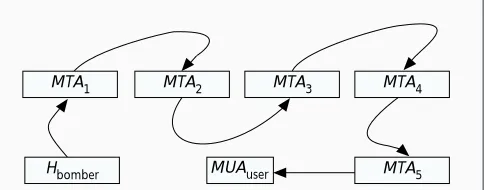
Most sendmail configurations will process e-mail addresses which are in route address syntax, described above. The e-mail bomber exploits the route address functionality to create a very powerful e-mail bomb we refer to as chain bombing. Figure 3 illustrates the chain bomb vulnerability.
In the chain bomb scenario, the e-mail bomber, Hbomber,
executes an automated script with a chain of source routed SMTP messages. The e-mail bombs are delivered and queued on the first MTA in the chain, MTA1. If the attack volume of the e-mail bomb is sufficient to inhibit or deny service to MTA1, the remaining messages in the outbound queue of the bombing host will be directed automatically to MTA2. This process continues for all the MTAs.
If MTA1successfully queues the e-mail from the bombing host, the bomb is delivered to the next route address in the chain, MTA2. The process is repeated through all the MTAs in the chain, either successfully queuing the entire e-mail bomb or queuing a percentage of the volume of the bomb, then moving to flood the next MTA in the chain.
Depending on the configuration of the MTAs, service may be denied due to numerous factors. For example, when the volume of mail in the MTA queue is extremely large, the number of available file descriptors can exceed operating sys-tem parameters or the number of open TCP connections reach system limits. The large volume of e-mail in the MTA queue must be systematically moved out of the queue, both operational and malicious e-mail, and the MTA restarted or the system rebooted. Sorting malicious from important busi-ness e-mail is difficult and very resource-intensive.
Examples from the Langley Cyber Attack reveal that unsus-pecting mail system administrators are often unaware that the MTA has been attacked by a mail bomb and simply reboot the mail server without clearing the malicious messages from the MTA queue. In this case, the sendmail process will reiniti-ate the process again, attempting to deliver the bomb to the next MTA in the route address chain.
Error Message Bombs
[image:2.612.42.284.623.718.2]E-mail bombers also exploit the feedback mechanisms of mail systems by using legitimate error messages generated by MTAs. Figure 4 illustrates how an MTA is exploited by masquerading the source address of the sender so that the system responds with error messages delivered to the MTA of the victim.
In this attack scenario, the bomber inserts the e-mail address of the victim’s e-mail server, MTA2, as the origin of the message, and sends the e-mail bomb to MTA1. MTA1was configured to generate feedback messages to the originator when one of many error conditions are generated.
MTA1generates an error message or, in the case of an e-mail bomb, large volumes of error messages, and forwards them to the victim, MTA2. Depending on the robustness and configuration of MTA2, either MTA2is taken out of service, or the end user’s mailbox, MUAuser, is flooded.
Many well-intended system administrators accidentally
con-■Figure 3.Sendmail route address chain bombing.
MTA1 MTA2 MTA3 MTA4
MTA5 Hbomber MUAuser
■Figure 2.Daily volume of mail bombs (shaded) vs. total e-mail.
Messages
Weeks 0
5000
10 0
figure their systems to be exploited in this manner. One scenario occurs when an MTA has been e-mail-bombed and the system administra-tor configures the mail server to send rejection messages on receipt of unwanted messages. An Internet-based attacker simply inserts the unauthenticated e-mail address of
the victim in the SMTP message and mail-bombs an innocent mail server. The intermediate server innocently responds with error messages, bombing the victim.
Covert Distribution Channels
Guluc and Tsudik [7] discuss potential anonymous abuse of remailers for the purpose of “spreading libelous accusations, hate-filled propaganda, pornography, and other unpleasant content.” The content of the illicit e-mail uncovered at Lang-ley AFB validated this statement and identified a larger sys-temic problem.
The technique of anonymously distributing covert files via a neutral intermediate MTA is illustrated in Fig. 5. The covert
distributor, Hdistributor, uses route address syntax and insecure sendmail configurations to relay illicit material to other MTAs. We have seen this technique used for private individu-als, the general public, and unsuspecting network users.
In addition, the recipient of the illicit mail can easily be fooled to believe that the e-mail originated from an innocent victim’s host machine. This poses a very real and dangerous method for criminals and malicious agents to victimize the Internet community. For example, an MTA for a large bank in Tokyo could be used as a relay by
pornographers. The recipient of the e-mail would more than likely (false-ly) believe that the bank was the orig-inator of the illicit mail. This type of accusation is very difficult to defend against and could be extremely dam-aging to the integrity of the bank’s brand and reputation.
Exploiting Mail Exploders and
List Servers
A mailing list is a community of e-mail addresses that can be reached by sending a single message to one address, known as the list address. E-mail sent to the automated E-mailing list is redistributed to all subscribers to the list [8]. Automated list servers
like Majordomo or ListProcessor provide many opportunities for the e-mail bomber to exploit the SMTP infrastructure (Fig. 6).
This attack scenario can be combined with other bombing tech -niques or executed standalone. In a nutshell, the bomber subscribes the victim, Hvictim, to numerous mailing lists. Currently, most mailing lists do not authenticate the sub-scriber; and the list servers which do use weak authentication mechanisms that may easily be subverted.
Herfert [9] discusses security-enhanced mailing list exploders as a way to provide strong authentication to posters on mailing lists. However, these cryptographic techniques are difficult to implement on a global scale, primarily because of the challenges associated with key management. In addition, the processing overhead of encrypting data for thousands of e-mail messages must be considered. The topic of cryptogra-phy relative to e-mail authentication is briefly summarized in the fourth section.
The Langley Cyber Attack
In January 1997, a commander within Air Combat Command (ACC) received an inflammatory e-mail message, apparently from President Clinton. The commander immediately understood that someone was using SMTP mail to impersonate the President. The chief of the information protection branch was directed to investigate the situation.
The first reaction to the forged e-mail at Langley was to examine the log files of the sendmail-based MTA. However, like most systems administered with limited resources, the level of auditing and logging of the MTA had been configured to the minimum possible setting to save disk space. The inves -tigators increased the sendmail audit configuration to provide the maximum amount of logging information possible.
The investigation into the Langley SMTP infrastructure uncovered a larger systemic problem. SMTP MTAs, accessible from the public Internet, were being used covertly to dis-tribute large volumes of pornography, bigoted hate mail, and other unacceptable and criminal messaging [10]. This discov-ery initiated a concentrated effort to stop all malicious use of the SMTP infrastructure while simultaneously ensuring that all legitimate SMTP mail traffic was delivered. To accomplish this objective, Langley AFB installed a simple rules-based fil-ter, which preprocessed all incoming and queued SMTP mail [10]. These countermeasures were successful in preventing illicit use of the MTAs. The rules-based filter is discussed in more detail later.
The results of this investigation into the Langley Cyber Attack have gained national media attention. The results were discussed exten-sively in the United States Air Force (USAF). In addition, the chairman of the President’s Commission on Critical Infrastructure Protection referenced the Langley Cyber Attack as a critical example of an actual international cyber attack [11] via the Internet. Commercial organizations have since reported millions of dollars in damages resulting from forged SMTP mail originating from the Internet [12].
■Figure 5.Covert distribution channels.
MTA1 MTA2
Hdistributor
MTA3 MTA4
MTAn MTA5
■Figure 4.Error message bombing. MTA2
MUAvictim Hbomber MTA1
Error messages
■Figure 6.Abuse of mail exploders. MTAn
Explodern
Hvictim
Exploder2
Exploder1
Exploder3 Exploder4
Interviews with the system adminis-trators (SAs) of the SMTP MTAs also uncovered very interesting information. The MTA often “locked up,” according to inexperienced SAs, but they never investigated the cause of the service dis-ruptions nor examined log files to deter-mine the cause of the system failures. Routinely, the SAs casually rebooted the platforms and continued performing other duties that were assigned a higher priority.
Examining the log files in real time showed a much larger problem on the enterprise than isolated e-mail spoofing. Large volumes of e-mail originating in
the Internet (Fig. 2) were being delivered to other Internet sites via the SMTP MTAs. Further examination of the e-mail being relayed covertly led to the discovery that incredible vol-umes of pornographic materials was being distributed via the Langley MTA to users at commercial Internet service providers. The largest number of targeted users were America Online subscribers.
Initial Countermeasures
The need to learn the identity of the originator of the [email protected] message was overshadowed by the revela-tion that an MTA at Langley AFB was being used to covertly and illegally distribute pornography and hate mail. Figure 1 illustrates sample content of the illicit mail covertly relayed via the MTA. The concern for the reputation and brand of the enterprise became the primary requirement. If this under-ground distribution channel gained high media viability, undermined public confidence could result in potential dam-age to the organization. The basic requirements of the coun-termeasures were nicknamed the Black Hole Strategy:
•Do not provide any feedback or error messages to the hackers or mail bombers.
•Capture and minimize delivery of ille-gitimate mail using a rules-based filter. •Copy suspect mail for future analysis, delivering legitimate e-mail robustly and quickly.
•Keep and maintain all captured mes-sages as potential forensic evidence. The initial reaction of novice network administrators is to use IP firewalls and routers to block the apparent source addresses of the e-mail bombs. However, experienced network managers familiar with mail-exchange records (MXs) [4] and the robustness of the sendmail MTA understand that the address-blocking technique will not work in the vast majority of cases. In fact, chain bombing and other relaying techniques make most attempts to block specific IP addresses relatively futile; traditional firewalls are simply ineffective. Finally, when legitimate relays are used by bombers and hackers, attempts to block these addresses result in self-styled “denial-of-service attacks”; this is an easily exploitable countermeasure (see box).
Filtering Queued E-Mail
The technical strategy of our countermeasure against mail bombing was simply to queue incoming mail messages, filter the mail based on developed rule sets, and forward the clean mail. The filtering rule sets triggered on information in the header control files of the mail messages. The message con-tent was not used in the filtering process. All filtered mail was processed via one of two paths. Mail was either sent to “jail,” qjail, and not delivered, or copied into qcopy for further analy-sis (Fig. 7). Denying direct feedback to hackers was the cor-nerstone strategy.
During the initial filter prototyping phase, we copied and delivered all mail with the keyword “whitehouse” in the header fields because it was theoretically possible that valid mail could come from “whitehouse.gov.” This was the prototype of a filter refinement queue which would become qcopy. This queue would be used to fine-tune additional rule sets. All captured mail that was taken prisoner was stored in qjail.
Figure 7 illustrates the flow of events for the filtering pro-cess. The SMTP server is started with the -odq switch [4],
instructing sendmail to receive and queue incoming mail, mqueue, only.1The filter program is executed by crond(8).
The program processes the sendmail mqueue by first copying all messages in the queue to another directory. It is in this directory that the files will be processed. Incoming mail con-tinues to arrive in mqueue and the filter program processes the staging queue, qprocess. There are timers and a state machine to avoid moving e-mail which has not been complete-ly received and queued by the MTA.
The filter rule sets first look in the header files (the qf files) for spoofed addresses without the @ character. These files are moved out of the qprocess into qjail and are not delivered. In addition, a subset of sender addresses with @ characters are copied to qcopy and left in the staging queue, qprocess. The remaining messages in qprocess are moved to another queue, qclean, and sendmail delivers the mail by executing with the -q switch, instructing sendmail to process the mail queue; and the -Q switch, specifying which queue to process.2
■Figure 7.Process flow diagram for the SMTP filter.
qclean mqueue
Receive and queue
Deliver mail qprocess
qcopy qjail
1Example: /usr/lib/sendmail -bd -odq.
2Example: /usr/lib/sendmail -q -oQ/usr/spool/qclean.
Sendmail Countermeasures
It is possible to configure the sendmail anti-spamming features defined under the check_ or checkcompat() rule sets as coun-termeasures against many e-mail bombing techniques. For example, these features allow sendmail to be configured; to not perform as a mail gateway, limit the size of messages, and reject certain sites known to send e-mail bombs [4].
The checkcompat() routine requires modification of the sendmail source code, and therefore is quite difficult for the average systems administrator to implement. Beginning with send-mail v. 8.8, limited checking and rejecting can be accomplished with four rule sets: check_mail, check_rcpt, check_relay, and check_compat. For more information on the features, please refer to [4].
During the Langley Cyber Attack, we found the sendmail built-in functions difficult for the average systems administra-tor to configure. The built-in filtering provisions were not flexi-ble enough to meet all of our Black Hole requirements. In fact, inexperienced users of these rule sets inadvertently configured sendmail to serve as a relay for e-mail error bombs because of the error messages generated by the MTA when under attack. Writ-ing a rules-based filter which processed the mail queue was found to be the best defense against e-mail bombs during our engagement.
Rules-Based Filtering
Initial efforts to track down spoofed e-mail were the genesis of the rules-based filter, which began very simple and became much more complex over time. The technical strategy was to filter incoming e-mail messages based on refined rule sets and forward the clean mail. Rule sets triggered on information in the header control files of the mail messages. The message content was not used in the filtering process. All filtered mail was processed via one of two paths.
In the early hours of the filter prototype, we discovered that a majority of e-mail bombs contained invalid originator SMTP addresses without the @ sign. Our first prototype filter jailed all messages with invalid SMTP address formats. How-ever, our cyber-bomb opponents adapted, creating bogus addresses with random @ symbols. Our filters were actively
probed by bombers across the Internet (and across the globe) in order to understand how they were implemented [10]. A small code fragment (see the box on this page), written in PERL, from the first alpha version filter prototype illustrates simple rule-set processing on the header files.
The bombers were adapting to new filter rule sets within 24 to 48 hours. The most common bomb signature was repeated e-mail with the same sender-receiver pairs. With few excep-tions, this fact provided a successful indicator of hostile e-mail. We refined the filtering algorithm based on this observation and provided the programming requirements to the development team. This algorithm became a key element in mitigating numerous types of e-mail bombs during attacks.
It is important to briefly point out that there are occasional exceptions to most filter rules. Trapping all of the exception conditions at the application layer can prove to be a difficult (perhaps impossible) programming challenge. It is impracti-cal, from a resource perspective, to obtain a 100 percent solu-tion. However, the trade-off of jailing a very small percentage of good e-mail vis-a-vis minimizing the risk and exposure to the enterprise was a management decision, not a technical one.
The prototype filter design also provided valuable informa-tion which assisted investigators in discovering the content, type, and origin of the criminal e-mail. Trapping and jailing politically charged mail became a high priority as our team began refining filter rules based on illicit e-mail origin, SMTP mailer, origina-tor, sender-receiver pairs, and so on. Our software development team provided numerous enhancements to the original filter prototype which resulted in reduced countermeasures man-power and improved filter granularity. The speed of the send-mail process receiving and forwarding send-mail in real time made queuing the messages prior to filtering necessary. The addi-tional latency in the mail-filter processing was actually offset by performance improvements in the SMTP infrastructure. However, we did not quantify these observations.
In addition, by queuing the messages the entire SMTP header file and control messages could be used in the filter process. This proved to be extremely valuable in the process of examining mail bombs, understanding the nature of the attacks, and simultaneously insuring all e-mail was correctly delivered with minimal delay.
Mailbomb Early Warning System
As the SMTP filter used against the Langley Cyber Attack matured, SMTP mail denial-of-service (DoS) failures discon-tinued. However, the probability of overwhelming DoS attacks remained. Thousands of rogue e-mail messages continued to bombard Langley AFB servers. This bombardment created a pseudo steady-state condition of background noise. This steady-state bombardment was the basis for the implementa-tion of our e-mail bomb early warning system.
Using a standard mathematical process we were able to identify an ongoing attack and provide a reasonable basis for predicting non-random future attacks. Beginning with the ini-tial version of the SMTP filter, the investigating team auto-matically collected e-mail statistics on the daily volume of e-mail (Td), jailed e-mail (Jd), questionable e-mail, and other
variables of interest.
(1)
By keeping the size of each weekly subgroup, n, constant (seven days), a pattern began to emerge as we graphed and
Ω = = =
= =
∑
∑
J T
d d d n
d d d n
1
1
# author: Tim Bass Jan. 23, 1997
# Sendmail will run with the ‘queue only and
# not deliver’ option, -odq, as a daemon # process (sendmail -bd -odq).
# This script is executed by crond # Currently executed every five minutes
# open the qf files
o p e n ( Q F , ” < $ H e a d e r ” ) | | d i e “ C a n ’ t o p e n files\n”;
# search the qf files for interesting things # currently, only doing minimal filtering on # the sender. It is easy, however, to fil-ter
# on other header fields, as required.
while(<QF>){
# the /^S/ expression looks in the qf file # for the line beginning with S, the sender
if(/^S/){
# then we look in that line for senders # without @ signs
if(!/\@/){
# and we move the suspected header and data # files to the suspected queue, qjail
if(!/<>/){
rename($Header,$JailFile); rename($Data,$JailFile2); }
}
# and we copy these suspected senders with data # files to the copy queue, qcopy (just in case)
elsif(/whitehouse/i){
system(“/bin/cp $Header $CopyFile”); system(“/bin/cp $Data $CopyFile2”);
}
elsif(/whistleblower/i) {
system(“/bin/cp $Header $CopyFile”); system(“/bin/cp $Data $CopyFile2”); }
analyzed the raw data. Clustering one-week averages of jailed e-mail as a percentage of total e-mail volume (Ωin Eq. 1) led to the theory that a statistical process control chart with an upper and lower control limit might serve as an e-mail bomb early warning indicator.
(2)
R = χmax– χmin (3)
Daily e-mail statistics were automatically collected and averaged over weekly periods. –—χdenotes the daily average jailed e-mail percentage based on a one-week clustering inter-val. In addition, the range of the e-mail bomb volume, R, was calculated (Eq. 3) from the computed average minimum and maximum.
The size of each weekly subgroups, n, remained constant (seven days). The total number of weeks analyzed was repre-sented by K. The overall average daily e-mail bomb volume, =χ
, was also tracked (Eq. 4).
(4)
From this simple statistical process, e-mail bomb upper and lower control limits were established. Figure 8 illustrates ten weeks of these statistics as they were collected and ana-lyzed.
The upper and lower control limits (UCL, LCL) were cal-culated by taking a 2 percent standard deviation above and below the average traffic (including attack and legitimate e-mail) volume. The decision to use two standard deviations exceeds the generally accepted 1 percent for normal distribu-tions. However, a control limit that is too narrow results in frequent searches for insignificant e-mail bomb attacks (false alarms), which is an inefficient use of human resources.
Control limits (Fig. 8) that are too wide would permit unde-tected significant e-mail bomb attacks. We simply estimated the initial UCL and LCL from inspection of the graphs. However, as an early warning process matures and each sam-ple outside the prescribed limit is identified and eliminated, the variability from mean to mean should diminish from the initial value. At this point, new upper and lower limits should be calculated. These limits converge to a point where an alarm is sounded at the very start of an attack as the system matures.
A running average exceeding the UCL indicated that a sig-nificant e-mail bomb attack was occurring. If the average fell below the LCL, either the number of bogus e-mail had signifi-cantly dropped or the filters were failing.3At this point,
adjustments were made to the filter rules to eliminate the pro-cess alarm.
The first indication of a control limit breach surprised the team. Instead of a massive counterattack from the mail bombers as had happened in the past, the first Action Trigger (Fig. 8) occurred on the LCL. This caused the team to examine the queues in an attempt to determine what the hackers were up to. Because the Langley AFB MTA had been hardcoded into several automated tools (see the appendix), those tools could no longer bomb victims because the Langley filter removed the illegitimate messages from the Internet. Langley investiga-tors found that the authors of the tools had removed Langley AFB from the list of MTAs preconfigured into the bombing programs. The Black Hole Strategy proved to be an effective and proven countermeasure which we highly recommend.
We stopped experimenting with control charts at that point in time. However, our next step would have been to develop a con-trol chart based on the variance, standard deviation or the range. This is an excellent area for further research and analysis.
Cryptographic Countermeasures
Many of the technical vulnerabilities which make mail bomb-ing a serious threat could be significantly mitigated by enhanc-ing the security infrastructure of the Internet. Published by Linn in 1988, RFC 1040 [13] discussed SMTP message encryp-tion and authenticaencryp-tion procedures. His continuing work in RFC 1115 [14] specified the cryptographic algorithms to sup-port Privacy Enhanced Mail (PEM), including the use of pub-lic-key encryption algorithms.
Presently, the PEM specification is contained in four RFCs which are all a part of the “Privacy Enhancement for Internet Mail” series (RFCs 1421-1424):
• Part 1: Message and Authentication Procedures • Part 2: Certificate-Based Key Management • Part 3: Algorithms, Modes, and Identifiers • Part 4: Key Certification and Related Services
The core security problem with e-mail bombs is the authen-tication of the originator. PEM (and similar cryptographic e-mail services) offer both symmetric and asymmetric authentication, supporting a wide variety of cryptographic algorithms4[15]. Methods for processing mail addressed to
mailing lists are also provided; however, cryptographic authentication remains problematic for e-mail transport [16]. The reader is referred to the many references on the subject [15, 16] for a more detailed technical discussion.
Unfortunately, PEM provides integrity protection only on the body of a message. The header fields of an SMTP mes-sage are not protected because MTAs need to modify many of the header fields during e-mail transport [17]. As pointed out earlier, the entire SMTP infrastructure relies on a complex, heterogeneous internetwork of MTAs and MUAs. Therefore, cryptographic solutions which work robustly with intermediate systems are very difficult to design. Scalability and interoper-ability become complex technical issues which are very expen-sive to design, implement and sustain.
Scalability and interoperability concerns are also major obstacles in the global management of cryptographic keys, known as the emerging public key infrastructure (PKI). Combin-ing a heterogeneous PKI with a robust global MTA infrastruc-ture will provide the developer community with cryptographic tools to address e-mail sender authentication. However, by no χ=
∑
χK
χ = Ω
n
■Figure 8.Early warning system: event trigger.
Percent
Upper control limit
Lower control limit
Action trigger
Weeks 0
40
10 50
60 70 80 90
3Perhaps the “Borg” had adapted to our filters again.
means will a PKI solve the e-mail bomb threat without MTA and MUA integration. Finally, PKI–MTA integration may not significantly mitigate the e-mail bomb problem because PKI was designed to address confidentiality, authentication, integrity, and nonrepudiation, not DoS attacks.
All technologies that present new opportunities also propa-gate new vulnerabilities and risks. Emerging public key cryp-tosystems are traditionally viewed as defensive mechanisms, strengthening the integrity, confidentiality, and authentication of our electronic infrastructure. However, the widespread availability of cryptosystems creates potential offensive threats to the infrastructure which are normally considered after design and deployment. The interested reader is referred to an excellent paper by Young and Yung [17] which discusses cryptovirology and cryptoextortion, emerging topics beyond the scope of this article.
Summary
E-mail bombing and impersonating the sender have become common crimes in cyberspace. The global networking infras-tructure is used as a basis to attack the integrity of unsuspect-ing victims. Disgruntled employees, terrorists, and industrial competitors can use network-based e-mail bombing tech-niques to undermine confidence in organizations of trust. This type of attack on brand integrity has the potential to cause major financial damage to institutions, including financial ser-vices institutions, banks, insurance companies, pharmaceutical companies, publishing companies, law enforcement, govern-ment institutions, ad infinitum.
Our team uncovered and stopped a covert channel for the illegal distribution of pornography, hate mail, and pranks via standard operational SMTP MTAs. We actively engaged to protect the reputation, integrity, and brand of the organiza-tion. Unfortunately, it is extremely difficult for the general public to differentiate between the abuse of legitimate resources by a hacker, terrorist, or criminal and direct mis-use or negligence by an organization or commercial corpora-tion. When the public incorrectly perceives that a large multinational business is distributing illicit material from its e-mail servers, this perception will undermine the integrity, confidence and trust of the business. The results could be devastating.
Tools for launching e-mail based attacks are dangerous, easy to use, and freely available on the Internet. Crypto-graphic mechanisms to authenticate e-mail are emerging. However, the ease with which an attacker might abuse and misuse the e-mail infrastructure of both commercial and federal organizations puts these organizations at significant risk today.
Finally, there exists a perpetual enigma in the Internet community regarding computer and network security. Many professionals are of the opinion that “security through obscu-rity” is the better approach to managing information security risks, where containment of vulnerabilities is preferable to open discourse. On the other hand, there are equally passion-ate opinions for “security without ambiguity”: it pays to have the global community engaged as an open cyber-society, solv-ing security challenges together. It is our hope that this article helps, in some small way, to forward the overall goals and objectives of the Internet community.
Acknowledgments
We are very grateful to the USAF, Air Combat Command, for the interesting and stimulating networking engagements at Langley AFB. In addition, the numerous reviewer comments have significantly improved this article.
References
[1] P. Neumann, “The Computer-Related Risk of the Year: Distributed Control,”
IEEE Proc. Comp. Assurance, June 1990.
[2] J. Berst, “Front-Line Report from the War on Spam,” ZDNet, Aug. 19, 1997. [3] J. Postel, “Simple Mail Transfer Protocol,” Internet RFC 821, Aug. 1982. [4] B. Costales and E. Allman, sendmail, 2nd ed., Sebastopol, CA: O’Reilly &
Associates, 1997.
[5] D. Crocker, “Standard for the Format of ARPA Internet Text Messages,” Inter-net RFC 822, Aug. 1982.
[6] F. Avolio and P. Vixie, Sendmail: Theory and Practice, Newton, MA: Butter-worth-Heinemann, 1995.
[7] C. Gulcu and G. Tsuski, “Mixing Email with Babel,” IEEE Proc. Symp. Net-works and Distr. Sys. Security, 1996.
[8] C. Liu, et al., Managing Internet Information Services, Sebastopol, CA: O’Reilly & Associates, 1994.
[9] M. Herfert, “Security-Enhanced Mailing Lists,” IEEE Network, May/June 1997. [10] T. Bass and Lt. Col. G. Watt, “A Simple Method for Filtering Queued SMTP
Mail,” Proc. IEEE MILCOM ’97, Nov. 1997.
[11] “U.S. Seen as Open to Cyber Attack,” CNN Interactive, Associated Press, Oct. 8, 1997.
[12] “Samsung Stung for Millions by Internet Fraud,” CNN Interactive, News-bytes, Aug. 11, 1997.
[13] J. Linn, “Privacy Enhancement for Internet Electronic Mail: Part I — Message Encryption and Authentication Procedures,” Internet RFC 1040, Jan. 1988. [14] J. Linn, “Privacy Enhancement for Internet Electronic Mail: Part III —
Algo-rithms, Modes, and Identifiers,” Internet RFC 1115, Aug. 1989.
[15] W. Stallings Network and Internetwork Security Principles and Practice, Upper Saddle River, NJ: Prentice Hall, 1995.
[16] Kaufman et al., Network Security: Private Communication in a Public World, Upper Saddle River, NJ: Prentice Hall, 1995.
[17] A. Young and M. Yung, “Cryptovirology: Extortion-Based Security Threats and Countermeasures,” Proc. 1996 IEEE Symp. Security and Privacy, 1996, pp. 129–40.
[18] D. Parker, “Automated Crime and Security,” IEE Euro. Conf. Security and Detection, Apr. 1997.
Additional Reading
[1] B. Schneier, Email Security: How to Keep Your Electronic Messages Private, New York: Wiley, 1995.
[2] E. Sullivan, “Put a Spammer in the Slammer,” PC Week, Dec. 1, 1997. [3] T. Bernstein et al., Internet Security for Business, New York: Wiley, 1996.
Biographies
TIMBASS([email protected]) is a technical director with SAIC, Center for Infor-mation Protection. He graduated from Tulane University in 1987 with a B.S.E. with Departmental Honors in electrical engineering. He played a principal role in building the SprintLink Integrated Network Management Center, the Sprint Man-aged Router Network organization, and the original Base Network Control Cen-ter (NCC) prototype for the USAF. He directs global efforts with SAIC for engagements with very large financial institutions, publishing enterprises, and insurance companies in complex network architectures and global information protection assessments.
ALFREDOFREYRE([email protected]) is a technical director with SAIC, Center for Information Protection. He graduated from Carnegie Mellon University in 1994 with an M.S. in information networking. He also holds a B.S. with Departmental Honors in electrical engineering from Brown University. He specializes in the identification, application, and prevention of computer crime executed using automated hacker tools. He is currently engaged with very large financial institu-tions in the area of vulnerability assessments and security architecture analysis and design. His prior experience before coming to SAIC includes Bell Communi-cations Research and AT&T Bell Laboratories.
Parker [18] defines an automated crime as one “executed entirely by one or more sequentially executed computer pro-grams in a computer” or computer network.
“We must anticipate increasingly sophisticated automated crime, and the packaging of easy-to-use, free-ware computer programs that can be executed by almost anybody for fully automated criminal activities.” [18]
Mail-bombing tools are examples of automated crime. These tools are dangerous, easy to configure, and widely avail-able on the Internet. The potential e-mail bomber simply points a Web browser at a search engine and performs a key-word search for e-mail bombing programs. A search will return pointers to programs such as Voodoo, Unabomber, KaBoom, Up Yours, and Avalanche, described in this appendix. These examples are just a few of the well-known mail-bombing programs that have surfaced on the Internet in the past few years. Each of these tools has one primary objec-tive: flood the mail server so that it becomes unavailable or is unserviceable.
Automated mail-bombing programs vary in features and functionality. One group is more flexible in the construction and configuration of the mail bombs. Other tools allow ran-dom messages and SMTP headers rather than a statically identifiable one. In addition, the bombing programs vary in installation and execution
Many of these bombing tools come with professional-quali-ty graphical user interface (GUI) and very professional docu-mentation. At the other end of the spectrum, there are bombing utilities that are executed via the command line and provide little or no documentation. Most mail-bombing tools attempt to provide full anonymity to the user. The next few subsections describe a few of the well-known and freely avail-able automated bombing tools availavail-able on the Internet.
Unabomber
The Unabomber is a Windows 95 mail-bombing program that was developed by Dead Elvis in 1996. Upon execution, a pic-ture of the Unabomber (the hooded sweatshirt figure with dark glasses) appears before the main program window opens. Unabomber has a GUI (main program window) that allows a user to send multiple copies of the same message to a single recipient. From the main program window, the user may con-struct the contents of the mail message and select the number of copies (bomb size) to send. Unabomber also “features” an online Help menu containing detailed information on pro-gram installation and use.
KaBoom
KaBoom is a Windows 3.x and Windows 95 mail-bombing program developed by The Messiah of The Alliance. Similar to
Unabomber, Kaboom allows the bomber to construct an e-mail message and send multiple copies of a message to recip-ients. Kaboom identifies 62 anonymous servers (i.e., servers that will bounce e-mail anonymously) to assist the bomber to operate covertly. Kaboom also has built-in functionality which can be used to subscribe an SMTP user to 48 different mailing lists.
Up Yours
First released (v. 1.0) in May 1996 as a sample program to illustrate the functionality of Visual Basic (VB) controls, Up Yours is a Windows 95/NT mail-bombing program. The current release (v. 3.0) requires the Microsoft Internet Control Pack and Visual Basic runtime files. Up Yours “features” a random insult generator that can generate 50 million different insults. Similar to KaBoom, Up Yours comes with a mailing list subscription attack and anony-mous SMTP server “features.” In addition, Up Yours sup-ports mailcheck, which assists the bomber in identifying other vulnerable SMTP servers.
Avalanche
Avalanche is a Windows 3.x and Windows 95/NT mail-bomb-ing program that was developed by H-Master. Unlike the other bombers, Avalanche comes with a number of configura-tion files that permit the attacker to customize, create, and select random mail headers and messages. Using a sophistica-ted GUI, the bomber can select the number of mail messages to send or force the program to send messages continuously until explicitly stopped. For anonymity, Avalanche “features” fake mail headers with several built-in anonymous SMTP servers. Avalanche is distributed with over 20 pages of docu-mentation consisting of a detailed user’s guide, a Tips for Bombing tutorial, and an Addon Implementation Guide. The Addon support functionality is a unique feature of Avalanche, which permits the bomber to add new attacks and functionali-ty to the tool without recompiling the source code. Also, simi-lar to KaBoom and Up Yours, Avalanche can be used to subscribe Internet citizens to numerous mailing lists without their knowledge.
Voodoo
Voodoo is a UNIX mail-bombing program that was released in 1996. It is a small easy-to-use command-line program that is supported on both SunOS and Linux. The current release of Voodoo permits the bomber to send 99 consecutive mail bombs to a victim. However, the basic program can be com-bined with shell scripts and other software to create much more damaging and comprehensive e-mail bombs.