The evolution of multi-tenure estates in the British housing
system.
DIXON, Laura Anne.
Available from Sheffield Hallam University Research Archive (SHURA) at:
http://shura.shu.ac.uk/19564/
This document is the author deposited version. You are advised to consult the publisher's version if you wish to cite from it.
Published version
DIXON, Laura Anne. (2000). The evolution of multi-tenure estates in the British housing system. Doctoral, Sheffield Hallam University (United Kingdom)..
Copyright and re-use policy
See http://shura.shu.ac.uk/information.html
REFERENCE
KEY TEXT LOAN
ProQuest Number: 10694445
All rights reserved
INFORMATION TO ALL USERS
The qu ality of this repro d u ctio n is d e p e n d e n t upon the q u ality of the copy subm itted.
In the unlikely e v e n t that the a u th o r did not send a c o m p le te m anuscript and there are missing pages, these will be note d . Also, if m aterial had to be rem oved,
a n o te will in d ica te the deletion.
uest
ProQuest 10694445
Published by ProQuest LLC(2017). C op yrig ht of the Dissertation is held by the Author.
All rights reserved.
This work is protected against unauthorized copying under Title 17, United States C o d e M icroform Edition © ProQuest LLC.
ProQuest LLC.
789 East Eisenhower Parkway P.O. Box 1346
The Evolution of Multi-tenure Estates in
British Housing System
Laura Anne Dixon
A thesis submitted in partial fulfilment of the requirem ents of
Sheffield Hallam University
for the degree of Doctor of Philosophy
September 2000
m o m e n t s
Page
Contents i
List of Tables, Figures & Maps v
Acknowledgments vii
Abstract x
Introduction 1
Part One: Context
Chapter One: Multi-tenure Estates and Social Balance 6
1.1 Introduction 6
1.2 Social Balance: The idea of neighbourhood and the balanced
community 10
1.3 The Scale of Social Balance 20
1.4 Problems associated with Social Balance and the Neighbourhood
Unit Concept 21
1.5 Conclusion 23
Chapter Two: Social Exclusion, Social D ivision and Housing Tenure
2.1 Introduction 25
2.2 Defining Housing Tenure 25
2.3 Social Exclusion and Housing Tenure 27
2.4 Social Division and Housing Tenure 42
2.5 Housing Policy and Tenure Diversification 47
2.6 Residualisation and Housing Tenure 49
2.7 Socio-Tenurial Polarisation 54
Part Two: Research Aims, Design and Methods
Chapter Three: Research Aim s, D esign and Methods 58
3.1 Introduction 58
3.2 Aims and Objectives of the Thesis 61
3.3 Phase One: A Postal Questionnaire Survey of Local Authorities and
Housing Associations in England 63
3.4 Phase Two: Five Local Authority Area Case Studies 71
3.5 Phase Three: Resident Focus Groups 80
3.6 Phase Four: Resident Survey 90
Contents
Page
Part Three: A Stakeholder View o f Multi-tenure Estates
Chapter Four: A National Picture o f Multi-tenure Developm ent 94
4.1 Introduction 94
4.2 The Size of an Organisation and the Development of M ulti-tenure
Estates 96
4.3 Regional Development of M ulti-tenure Estates 101
4.4 Length of Organisational Involvement in the Development of M ulti
tenure Estates 111
4.5 The Scale of Organisational Involvement in the Development of
M ulti-tenure Estates 113
4.6 The Effect of Partnerships on the Development of M ulti-tenure
Estates 115
4.7 The Factors Influencing M ulti-tenure Development 117
4.8 Conclusion 118
Chapter Five: A Local Picture o f Multi-tenure Development:
aims and objectives 1 2 0
5.1 Introduction 120
5.2 The Housing Situation in the Local Authority Case Study Areas 122
5.3The Origins of M ulti-tenure Estates in the Local Authority Case
Study Areas 130
5.4 The Aims of Housing Organisations When Developing M ulti-tenure
Estates 138
5.5 The Partnership Approach to the Development of M ulti-tenure
Estates 144
5.6 Conclusion 149
Chapter Six: A Local Picture o f Multi-tenure Development:
creating communities 1 5 1
6.1 Introduction 151
6.2 Dwelling Size and Type Mix on M ulti-tenure Estates 152
6.3 Tenure Mix on M ulti-tenure Estates 154
6.4 The Use of Allocations and Sales to Achieve Social Balance on M ulti
tenure Estates 157
6.5 Stakeholder Opinions on the Development of M ulti-tenure Estates 159
6.6 The Future Development of M ulti-tenure Estates 162
6.7 A Model of M ulti-tenure Development 163
LsU nieriis
Page
|
c> ~~l
| ^ .
Iti-tenure Estates
3 5 1 3
170 170 171
< \„ / 1 „ 175
183
I Z p y t V a f * A n c l^ ^ Estates
(J n / . 193
Q /irJ u J
/ ? ^ e
PA (A
v C ' 1 9 5196 201 209 217 220 * l & l ( r £ L f c r r } A / ) c 3 C 0 ^ re Estates
223 233
242 246
Appendix Three: Postal Questionnaire Covering cetier 251
Appendix Four: ‘About the Survey’ Information Sheet 252
Appendix Five: Postal Questionnaire Reminder Letter 253
Appendix Six: Response Rates of the National Postal Questionnaire 254
Appendix Seven: Exploratory Interviews Guide 256
Appendix Eight: Local Authority/Housing Association Interview Guide 257
Appendix Nine: Private Developers Interview Guide 261
Appendix Ten: ‘Drop-through-door’ Questionnaire 265
Appendix Eleven: Focus Group Statement Sheet 266
Appendix Twelve: Resident Survey: Multi-tenure Estate 267
Appendix Thirteen: Resident Survey: Single tenure Estates 271
Appendix Fourteen: Resident Survey Covering Letter 275
Appendix Fifteen: Questionnaire Analysis: an explanation 276
Appendix Sixteen: Housing Corporation Regions 277
contents
Bibliography
Page
Bibliography
List o f Tables, Figures and Maps
Figure 1.1 The Five Waves of Planned Residential Communities in the UK Figure 2.1 Inter-relationships of Lawless & Smith’s (1998) Four
Perspectives of Social Exclusion
Table 3.1 The Administrative Phases of the Postal Questionnaire Survey Figure 3.1 The Geographical Location and Scale of Possible Case Study Areas
Table 3.2 Tenure Mix on the Estate of the Chosen Local Authority Areas Table 3.3 Sheffield Estates as Possible Locations for Resident Focus Groups Figure 3.2: Krueger’s (1994) Continuum of Analysis Choices
Table 4.1 Contingency Table Testing the Association Between the Size of a Local Authority’s Dwelling Stock (number of units owned) and the
Development of Multi-tenure Estates
Table 4.2 Contingency Table Testing the Association Between the Size of a Housing Association’s Dwelling Stock (number of units owned) and the Development of Multi-tenure Estates
Map 4.1 Local Authorities and Multi-tenure Estates, England and Wales, 1995
Table 4.3 Contingency Table Testing the Association Between a Housing Association Operating in the London Region and their Collaboration With Partners Over the Management of Multi-tenure Estates
Table 4.4 Contingency Table Testing the Association Between a Housing Association Operating in the West Midlands and the Development of Multi tenure Estates
Table 4.5 Contingency Table Testing the Association Between a Housing Association Operating in the East Region and the Development of Multi tenure Estates
Table 4.6 Contingency Table Testing the Association Between a Local Authority in the South East and Working in Partnership With a Private Developer
Table 4.7 Contingency Table Testing the Association Between a Housing Association Operating in the South West and the Number of Multi-tenure Estates Developed
Table 4.8 Comparison of Local Authorities and Housing Associations First Attempts at Multi-tenure Estate Development
Table 4.9 Contingency Table Testing the Association Between the Number of Estates a Housing Association has been Involved in Developing and the Length of Time They Have Been Involved in the Development of Multi tenure Estates
Table 4.10 A Comparison of the Factors Influencing a Local Authority or Housing Association to Plan and Develop Multi-tenure Estates
Table 5.1 The Aims and Objectives of Organisations when Developing Multi-tenure Estates in Sheffield
Table 5.2 The Aims and Objectives of Organisations when Developing Multi-tenure Estates in Norwich
List o f Tables, Figures and Maps
Page
Table 5.3 The Aims and Objectives of Organisations when Developing
Multi-tenure Estates in Birmingham 140
Table 5.4 The Aims and Objectives of Organisations when Developing
Multi-tenure Estates in Newham 141
Table 5.5 The Aims and Objectives of Organisations when Developing
Multi-tenure Estates in Thamesdown 142
Figure 5.1 The Impact of the Page report on Housing Development 143
Figure 6.1 A Model of Multi-tenure Development (based on the findings of
the five local authority case studies) 166
Figure 7.1 Age Distribution of Residents on Owner Occupied Estate 172
Figure 7.2 Social Class Distribution of Owner Occupied Residents (10%
Sample) 173
Figure 7.3 Age Distribution of Residents on the Socially Rented Estate 173
Figure 7.4 Social Class Distribution of Socially Rented Residents (10%
Sample) 175
Table 7.1 The Integration of Young People on Single Tenure Estates 183
Table 7.2 Opinions on Property Maintenance by Single tenure Estate
Residents 185
Table 7.3 The Geographical Proximity of Friends on Single Tenure Estates 186
Table 7.4 Chi-squared Analysis Testing the Relationship Between Housing
Tenure and the Location of a Resident’s Closest Friend 187
Table 7.5 Housing Tenure and Friendship on Single Tenure Estates 187
Table 7.6 Resident’s Views on Their Estate on Single tenure Estates 189
Table 7.7 Views of Multi-tenure Estates by Single tenure Estate Residents 191
Figure 8.1 Age Distribution of residents on the Unplanned Estate 197
Figure 8.2 Social Class Distribution of Residents on the Unplanned Estate
(10% Sample) 198
Figure 8.3 Age Distribution of Planned Multi-tenure Respondents 199
Figure 8.4 Occupational Status of Planned Multi-tenure Estate Respondents 200
Figure 8.5 Length of residence on the Planned Estate 200
Table 8.1 The Integration of Young People on the Planned Estate 209
Table 8.2 Opinions on Property Maintenance by Planned Estate Residents 211
Table 8.3 The Geographical Proximity of Friends on the Planned Estate 212
Table 8.4 Housing Tenure and Friendship on the Planned Estate 213
Table 8.5 Resident’s Views of Their Estate on the Planned Estate 215
Table 8.6 Knowledge of Neighbours on the Planned Estate 216
Table 8.7 Views of the Planned Estate by Residents 216
Table 9.1 The Effect of Regional Housing Markets on the Implementation of
Multi-tenure Estates 227
TableA6.1: The Response Rates of Local Authorities by Housing
Corporation Region 254
Table A6.2: The Response Rates of Housing Associations in the National
s± c t t n u w i t u g m e r i ts
There are many people who have touched my life and influenced the choices I ’ve made
and helped to complete this PhD. Some acknowledgment should go, however, to Keith
Hoggart, my tutor at King’s College London. I went to him towards the end of my
undergraduate days to seek advice on what he thought I should do next. I mentioned the
possibility of postgraduate study to which he replied: “Laura go and get married and
have kids, it’s what you want to do”. This firmly set me on the path towards a research
degree, which he has subsequently assured me was his intention in saying it.
Next, I want to thank Ian Cole, Sheffield Hallam University, and Tony Crook, The
University of Sheffield, for offering me the opportunity to take from them their proposal
for this PhD. Their continuing support and encouragement helped turn it into the thesis
which lies before you. Thanks also to the staff of the Centre for Regional Economic and
Social Research (CRESR) 1995-1998, especially: my fellow research students, Christina
Beatty and Alison Herrington for their help with the 1991 Census, and Tony Gore for
his help with Map Info; members of the Housing Division in the School of Urban &
Regional Studies. Thanks also to Val Heap, the departmental secretary at the University
of Sheffield, whose help was invaluable in arranging supervision meetings and made
completing the thesis so much easier.
Within these departments there are individuals who deserve special acknowledgments:
Joanna Disson who has listened tirelessly to every twist and turn of the whole process
whilst going through it herself; Clare Greensmith, has spent many hours calming me
down and helping prepare drafts for submission and Rebecca Player, who had to live
Special thanks from my days studying in Sheffield must however go to Amanda Smith,
who shared her house with a frantic student and read faithfully everything I ever did,
offering help and assistance in any way she could and made me laugh when I felt like
crying! Without that I don’t think I ’d have finished. She began her own PhD in 1998 -
I only hope she can say I did the same for her.
Then there are those who have had to work for the last two years with a ‘part-time’
research student/wedding organiser at the University of Manchester and just listened to
the tangle of issues with which I ’ve dealt. They are Anna Fielder, Jo Cheeseman,
Carmel O’Toole, Adam Holden and Micaela Mazzei of the School of Geography, Yunas
Muhammed and John J who kindly provided technical assistance, Professor Brian
Robson for letting me have time off to help finish the writing up and finally DR Benito
Giordano, my fellow CUPS inmate for irritating me onward!
Finally, I must acknowledge the people without whom none of this would mean
anything, and they are my dearest parents, Patrick and Janet Dixon, my brother,
Christopher and his partner Sarah Prentice, all of my family and my husband Peter
Twomey (perhaps he should come first?!). My family have always supported and
encouraged every decision I have ever made when it comes to what I wanted to do,
perhaps without fully understanding what it was I was trying to do. Without it,
however, I would never have come this far. Their love and nurturing since the day I
first asked “how do you spell...?” without being able to write has made this possible.
Along with Peter, they have never let me give up and helped convince me I could do it.
I am very lucky to have such a close, loving and supportive family, which has extended
to include Peter’s parents and sisters who have also helped nudge me along in the last
For Peter, my parents, my brother, my family and in-laws
With all my love and thanks for ever
Towards the end of the twentieth century academic debates in social policy have increasingly focused on social exclusion. Housing, especially housing tenure, has become of central concern to policymakers, planners and academics alike when contemplating mechanisms for the alleviation of social exclusion at the local level. In particular, the development of multi-tenure housing estates have been seen as strategy for tackling the detachment of local neighbourhoods from the mainstream by the current Labour Administration and its advisors (see Urban Task Force Report, 1999).
A I I ' M l / 1 4 ' i f ' i / t ' l ^ l / r i '
The Evolution of Multi-tenure Estates in the British Housing System.
My interest in housing studies began in my final undergraduate year whilst writing my
dissertation. Whilst collecting the data and writing up I was struck by the way in which
housing was influenced, and in turn influences, our behaviour. I decided to explore
ways in which to continue looking at such issues. In June 1995, a Joint Research
Scholarship was offered by Sheffield Hallam University and the University of Sheffield
entitled ‘Dissolving Tenure Divisions? The Social and Community Dynamics on Multi
tenure Estates’. Upon applying I discovered the research hoped to explore issues
surrounding social division and housing tenure. My interest was aroused and has
remained constant as I have discovered the ways in which planners, using housing
tenure, have attempted to influence our habits, patterns and behaviour, especially with
regard to the social housing sector. Having grown up on a council estate (with the worst
reputation in town) and being the daughter of right-to-buy parents, I found my journey
through the literature and subsequently the research findings a fascinating insight into
the way in which different groups in society perceive themselves and others.
My own life experiences have been coloured by the tenure in which I was brought up. I
attended the schools with the worst records in town. However, I was one of the lucky
ones, I achieved at school and encountered the surprised looks of disbelief from teachers
and peers when they asked where I lived and what school I had come from when having
everyday, general conversations. Tenure did matter - only 20 out of 120 sixth formers
at my upper school had attended my primary and middle schools. The council estate on
which I grew up became synonymous with crime and underachievement, like many of
Therefore, it is no wonder that many people "buy into’ the ideology of home ownership
as did my parents and its effect on people’s perceptions and behaviour. Multi-tenure
estates have occurred ‘naturally’ through the introduction of the 1980 Housing Act and
the ‘Right-to-Buy’, but will the planning of such areas affect patterns of behaviour and
social relations, networks and levels of deprivation as the current Labour Administration
hope? This thesis attempts to show both the potential of such estates and their
limitations, and demonstrates that the patterning of people’s social relations may only
be marginally altered, but there might be an important reduction in the stigma attached
to social housing. Multi-tenure estates should not perhaps be considered a ready made
solution to the problems facing housing professionals and planners at the turn of the
twentieth century, but rather as part of a package of initiatives that could begin to solve
the problems they face.
In order to do this the thesis is organised into five parts, each containing relevant
chapters. Part One, Context, draws upon the literature of various disciplines, namely:
❖ Planning
♦> Social Policy; and
❖ Sociology
The first two chapters introduce the focus of the study the multi-tenure estate and
locates these developments historically alongside other attempts at planned residential
communities, and conceptually within the current debates concerning social exclusion,
social division and housing tenure. These chapters note that previous attempts at
creating planned communities with social balance objectives have produced little
empirical evidence that they succeed and question the British Government’s wisdom in
However, in the Government’s defence in light of the social policy challenges it faces at
the local level, in terms of social exclusion, the chapters also argue that perhaps it is
unsurprising that the Government should adopt such an approach in order to promote
social inclusion. The aims of the thesis are, therefore, to add to the current limited
knowledge concerning the evolution of multi-tenure estates and highlight the potential
possibilities of such estates in tackling social exclusion as well as its limitations.
Part Two, Methods; provides an in-depth discussion of the methods employed to
research the aims of the thesis, namely, a national postal questionnaire survey and five
local authority case studies to chart the evolution of the multi-tenure estate and the
housing professions view of the estates. As well as focus groups and a resident survey
to discover the perceptions of the estate residents in an attempt to provide a holistic
view.
Part Three, of the thesis presents the findings of the Stakeholder’s view of multi-tenure
estates. It discovers that multi-tenure estates have been developed since the 1970s by
local authorities, but with increasing involvement from housing associations in the
1980s and 1990s. There is also a strong regional dimension to the development of
multi-tenure estates that affects their characteristics. However, multi-tenure estates, due
to a number of reasons, are not meeting any social balance objectives hoped for by the
developing partners.
Part Four, presents the perceptions of the residents living on the estates in Sheffield. It
discovers that living on such estates has a limited impact on their social networks and
that geographical proximity does necessarily promote interaction and integration
hinting, therefore, that housing tenure does indeed represent a significant plane of
j l r t t #
Finally, Part Five, provides a summary of the main findings of the thesis and concludes
that in their present format multi-tenure estates perhaps should not be seen as a
definitive solution to the problems of social exclusion at a local level but rather as one
U l l J J l C f K J t l V l 1V1 l l l L l " L C U M V l i t l L l u i / i / m i I i w n t / n / t
Chapter One begins Part One o f the thesis which aims to provide a context fo r the
subsequent research findings. It introduces the focus o f the research, the multi-tenure
estate, by historically situating the estates within previous attempts to use housing to
achieve community diversity. It also outlines the theoretical assumptions on which
planned residential communities have been built, and around which multi-tenure estates
have been developed.
1.1 Introduction
Multi-tenure estates are a central issue in terms of British housing policy in 1999 (see
Urban Task Force, 1999). However, such estates are under-researched, where
assumptions and judgements have been made as to their success in combating social
exclusion at the local level. This doctoral research preceded this current interest.
Therefore it takes a step back from the enthusiasm surrounding multi-tenure housing
estates and attempts to highlight both the potential possibilities of such estates in
altering people’s social relations and networks as well as their limitations.
The multi-tenure estate could be viewed as the crucible for many issues, such as housing
tenure and social interaction, social division and exclusion, affordability, allocations and
housing need, stigma and neighbourhoods/communities. The thesis follows some of
these strands, but begins with an exploration of the literature concerning social balance
and locating the development of multi-tenure estates historically.
During the 1990s successive British Governments have attempted to promote social
diversity in a variety of ways. The Conservative Administrations of Thatcher and Major
adopted the ‘Right-to-Buy’ (RTB) to extend home ownership as far down the income
scale as possible. However, in the midst of this various other approaches were
a) multi-landlord estates; and
b) multi-tenure estates.
Both of these approaches aimed to manipulate a neighbourhood’s social characteristics
in order to achieve balance and diversity in the community. These strategies were an
attempt to counteract the social problems found on monolithic, mainly council housing
estates resulting in the geographical segregation of different housing tenures due to the
way in which housing is developed in England and is a key feature of the housing
market. The election of the Labour Administration in 1997 has seen the Government
agenda ‘catch up’ with the interest in attempting to promote diversity in local
communities, and within estates, and with the focus of the thesis: the multi-tenure
estate. Each of the approaches outlined above, are subtly different in their approach,
a) Multi-landlord estates
An estate that is:
• a housing development of 50 or more dwellings
• grouped together but in physically separate buildings (i.e., not just one
tower block)
• perceived by both residents and the general public as a single entity
• usually considered by residents to require some degree o f concerted
management approach by the landlord(s)
but has the additional feature that more than one landlord owns the
dwellings are called a multi-landlord estate (H arre & Z ipfel, 1995:2).
Multi-landlord estates have been promoted as part of the Conservative Government’s
rented sector, which was less reliant on local authority provision. This policy also
affected partnerships between local authorities and housing associations in terms of
estate regeneration and has often resulted in a multi-landlord approach. However, it has
been suggested that there is a limit to which such developments can be seen to have
achieved community diversification if all new owners are offering identical forms of
tenure (Harre & Zipfel, 1995:4).
b) Multi-tenure estates
The limitation of multi-landlord estates would appear to be the fact that they are
constricted by housing tenure, through their operation in social housing. This, therefore,
leads to a second approach for achieving community diversification and the focus of the
thesis: the multi-tenure estate. Multi-tenure estates can be newly built or established
residential areas, where the goal is a ‘mixed’ or ‘balanced’ community. To date there
has been little published about multi-tenure estates. Page (1993) and (1994) outlined
the rationale and provided the impetus for the incorporation of such estates into many
local authorities housing strategies. Subsequently, Page & Broughton (1997) attempt to
provide information about the practicalities concerning multi-tenure estates, as so little
is known about them, including how is it best to do it; what works and what does not.
Page & Broughton (1997:68) concluded that the main problems with multi-tenure
estates had little to do with the mixture of tenures, but arise more out of the day to day
problems of life on a predominantly social housing estate. These problems, however,
could be avoided in the future through design solutions, for example pepper-potting
different tenures rather than developing blocks of single tenure dwellings. Jupp (1999)
has written a report based on research conducted on multi-tenure estates, in which they
lives, and the Joseph Rowntree Foundation (JRF) have announced that they plan to
build a new multi-tenure estates on the edge of York (Richard Best at the 1999 LSE
Housing Seminar Social Exclusion and the Future o f Our Cities) and extolled the
virtues of such a development and predicted its success. However, Best provided no
evidence that a development of this nature will influence its resident’s lives, other than
the JRF’s belief that it will work.
There is, therefore, a lot of current interest, but little solid evidence on which to rely.
The lack of published research and evaluations of multi-tenure estates is compounded
by the absence of information relating to how these estates have been implemented at
the local level and the level of adoption nationwide. However, despite the apparent lack
of information regarding the estates there is much interest in the idea. The Joseph
Rowntree Foundation (1996), Perri 6 (1997) and Young & Lemos (1997) all advocate
the development of multi-tenure estates to aid social diversification. Policy documents
have more recently also championed the multi-tenure estate as a potential solution to the
problems associated with inequality. Planning regulations, in the form of Planning
Policy Guidance 3 (PPG3), aim to ensure that all new developments contain a mix of
housing tenures, and the Urban Task Force (1998) sort evidence of the achievements of
mixed communities through the integration of different types of tenure within a single
neighbourhood in its July 1998 proposal.
Such documents, however, assume that multi-tenure estates can help achieve the
integration of social groups. Yet, as highlighted above, there has been no real
evaluation of the estate’s ability to deliver such objectives. Therefore, on what
foundations has such a policy been formulated? The ideas behind multi-tenure housing
planned residential communities. Therefore the remaining sections of Chapter One
trace the concept of community diversity and housing using the debates surrounding
social balance found in the planning literature to help illustrate the theoretical
underpinnings of such developments as a form of planning intervention.
1.2 Social Balance: The idea of neighbourhood and the balanced
community
The last 150 years demonstrate at least four other attempts to create planned, socially
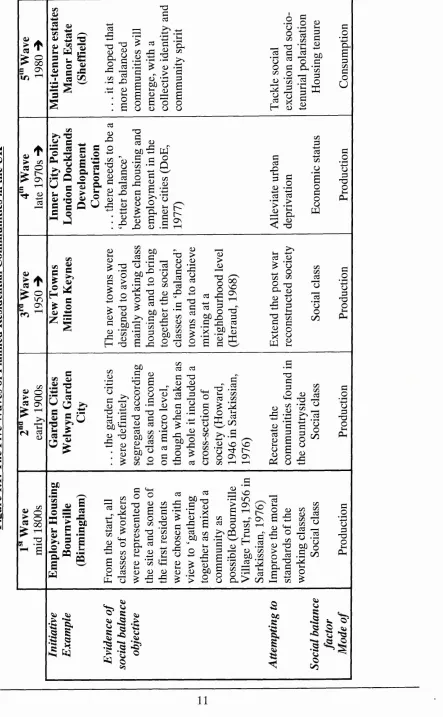
balanced residential communities in the UK. In Figure 1.1, p. 11, the author has
summarised the literature to outline what could be termed the five ‘waves’ of planned
residential communities which contained within them the objective of social balance. It
can be seen that multi-tenure estates could be viewed as the fifth ‘wave’ of such
developments. The four other initiatives outlined in Figure 1.1, will be discussed in the
following section of the chapter whilst exploring the notion of social balance which
provides a rationale for the formulation of a policy to develop mixed tenure estates.
It has been proposed that the achievement of social mix, or balance, whether in a
smaller or a larger area, should be a planning objective (Evans, 1976:247). What is
social balance; where does it originate from; and what is its history in terms of planning
and housing policy?
Social balance, or mixing, is precisely what the term implies the integration of the
population of a newly built residential area according to their social characteristics.
This has mainly been conceived in terms of social class in the twentieth century.
Etherington (1976:231-234) stated the reasons for encouraging social mixing and
F ig u re 1. 1: T he F iv e W av es of P la n n ed R e si d e n ti a l C o m m u n it ie s in th e U K
I'M'I/t {>%/ • JL YJL <L/ M/M » I'Vl'
> ^ S 1 > o
^ 00
s O n
T/o ^
*
>• C/3 3 O
^ On
c ^
^ £
3
C /3
4/
B aj
s 3 ® Si w "
s
C *- § C © 4) 2 S ■©
1 3 C« 2 S
3
S
3 —
-5 •*©
■S 73 ^
O « & 8 -SCC3 .*3
"3 ©
.3 i s 2
X 4) §
' ° I : £ p
03 o .3 TO 3 03
3 Q, 2 ^
3 >. 00
O
3 3
£ B - E
B O O
0 ) 0 0
« > O *3 3D o 5 «
C /3
*►> r©
2 e -5 ©
£ 2 £» © •- Q U B
g - S
£ c
© o
3 0) X>
B 3 O § O ^
a *-§ -s
5 2 S
OJ &► ^ £
« r9 o Q W -S
O .3
o x
TO 3 3 4) W)X-4—4
3 3
C/3 •1—1 3 -4— 4
O 3
X 4)
3 3>4 4) 0
X -4— 4
4) X £4)
W o Q, C/3 0) t-~ r-ON
—, TO ,3 3
’o ^
O 3 C/3 O
0 ty) 3
32 © 3
1 « e
H o ! ! E 3D O 3
’5 3 O X 3 3 2 -
3 § - 33 3
> *C X &
£ o 3 O O X 3 .2 a. £ £ 3 O U 3 _o ■*—> O 3 X O 3 O IT) ON
“ 3 c £,
£ O r® ^
^ B £ O © 2
z 3
0) £ C/3 3 £ o X-» £ O 3 0) X H C/3 3 TO O ’o W)
> £ 3 £ ° o +-> o TO ^ © 2^ .®P.© O <— TO 3
bfl 3 »-h X o 3 O o
* - * C /3
X 0)
£ -©
3 •>->
. s i
1 & 2 o
a)
x >
0 ) 0 )
3 ^
§ 2
X 2
. S © c/3 «* D c£ c/3 3
C /3 >
3 I> o 2
3 O > 2 TO o o x 00 x ON 3 3 00 5
S § S £
TO 3 3
3 O
* 8
^ c3
o -a
CL, QJ
o to -© 3
© 3 £ o >< 2 w £
o ^3 ‘o o CO 3 ^O -4—1 o 3 TO o OJO c/3
4) O
S; °
3 ON
ha r4 s 4) -X C/3 2-4— 4
3 • »“H TOH
U 0 n
3 ^4 C)
O • mm
3 4) X 4) O3
C u Hi
3 3 TOn>
£ 3D X4) -4— 1
3 ©
£
4) X■*—4TO4)
J—4 4)
bJD 4) 5— 1
3D o £ o o 3 • T3 3 C/3 3 3 3 O X X
4) 3
>
O C —‘ <u P -© 8 ^ 3 X © Ofi 3 3
S j=
TO 1) 3 X o
3 « .£ o • - o 4J O
3 X 3 TO .i-H
>- c/3 3 c/3 ^ X 2 S3 P5. c/3
TO 3 3 2 O g
x .;-4—4
O
o co x ‘o Tt O
o ON ON
c/3 t — I r H
3 3
£
2 I a 3 O •— O
C /3
O S 2 O
C/3
b . s s 3 ° 3 ° o ^ o o 3 #o o 3 TO o C/3 o O 00
« TO
00 s ’c/3
© = 2 S ■> M
h P fi
►
» § a
© © C
a « g
W
£ = 52
« 44-( (!■>
3 -4—4 C/3 <U X £ o U4 [X
3 '+_( c^ O O
x £ £
= § 8
- S Io x ^ «a P ©
4) X
C« 4) CA C/3 ^ 3 4) 4) 0 ^ 2
3 c/3 X © ‘5 4) ^ 2 3 C/3 (U 4) C/3
«-> o
e •S
hm pXh 4) 4) 2 £
3 c? 5 D *s - I
2 B
3 C/3 3JD 3
j-i
O 4) X ^ 3 4) tDD
> 2
4) • ^
> 3 C/3 3 «* o >^CQ
[image:26.621.97.540.47.764.2]4) 3
£ r |
S <Xt
CA
© 2
o X X Xi _
On On
C/3 rH
3
r-H i
4) C/3
bJD CA
2 XVh
•X 3 > CO
2 c«
© © ?3
S O <30 3 2 CO ° 4) ^ c3 ^ X © 7 - 5 3
^ V3 © *Q
^ M o
o 3 .S C/D 3 2 X Oh 3 3
S 3 O
+-; >
1—i c/3 !>
3 _o -4— 4
O 3 TO
O
4) 4) > "S
1 !
£ rH
5 C*3
. 4)
^ c
s | § •«
1 1
ttl o !>3 O -*«44 4) 30 >■ 3 -Hi4) 4) '3 -C5 O £ 4) 4)
.2 x o 5 .S 2 ^
t3 *s
•24J ~
1. to improve the functioning of the city and the welfare of its inhabitants by
• ensuring the provision of leadership
• promoting economic stability; and
• helping to maintain essential services at minimum expense through mixing in
housing
2. to ‘raise the standards of the lower classes’ by nurturing the spirit of emulation
3. to encourage aesthetic diversity and raise aesthetic standards
4. to encourage cultural cross fertilisation
5. to increase equality of opportunity
6. to promote social harmony by reducing social and racial tensions
7. to promote social conflict in order to foster individual social maturity
8. to maintain stable residential areas
9. to reflect the diversity of the urbanised world
The above objectives outlined by Etherington (1976) demonstrate just how diffuse the
aims and objectives of socially balanced communities can be and Gans (1961:180) also
highlights the benefit of population heterogeneity on children. He argues that it
provides them with a broadening educational influence, by exposure to alternative ways
of life. The above would appear to be the main reasons for advocating social mix.
Those which would appear to be most pertinent to the development of multi-tenure
estates in the 1990s are points 2, 6 and 8, whereby the mixing of housing tenures aims to
improve standards in social housing by following the example set by home owners, and
to promote social harmony by reducing in particular social tensions between tenures,
and to maintain stable residential area, it is hoped by mixing housing tenures balanced
As Figure 1.1, p. 11, shows the development history of planned residential communities
has been broken down into five ‘waves’ by the author of the thesis. This was done in an
attempt to clarify how the term ‘social balance’ is amorphous and how different
elements have been emphasised at different times. The rest of this section of the chapter
looks at each of the different waves in turn, starting below with the first: employer
housing.
a) Employer Housing
Sarkissian (1976:234) points to the development of a village near Ilford station in 1845
by a London architect, which could accommodate a mixed group of ‘pretty self-
contained cottages’, as the starting point of the social balance idea. The stated aims of
the residential ‘mix’ were to establish housing groups small enough to achieve a
‘country character’ but ‘not too small as to diminish the probabilities of social
intercourse’ (Bell & Bell, 1969 cited in Sarkissian, 1976:234).
In the same decade as the Ilford plan, a similar project was devised by John Cadbury
(Williams, 1931 cited in Sarkissian, 1976:235). This is commonly thought of as the
start of the social balance concept, through the building of Bournville near Birmingham.
This is represented by the first wave of planned residential communities in Figure 1.1, p.
11. From the start, all classes of workers were represented on the site and some of the
first residents were chosen with a view to ‘gathering together as mixed a community as
possible applied to the character and interests as well as to income and social class’
(Bournville Village Trust, 1956 cited in Sarkissian, 1976:235). Bournville is given in
the literature as the first practical implementation of planned residential mix, although
---±
---Social balance aimed to improve the moral standards of the working classes through
integration by class and to provide a more compliant workforce for the employers,
b) The G arden Cities
Social balance was revived through the spread of ‘Garden Cities’, which were based on
the ideas of Ebenezer Howard. However, the garden cities were definitely segregated
according to class and income on a micro-level, though when taken as a whole it
included a cross-section of society (Howard, 1946 cited in Sarkissian, 1976:235). The
garden cities were designed to reflect and recreate the communities that were found in
the countryside. It was thought, especially during the nineteenth century, that real
communities were found in the English countryside (Davidoff et al, 1976 cited in
Mitchell & Oakley, 1976:146). These rural communities were the epitome of the stable
social hierarchy; therefore the garden city movement attempted to recreate them with a
desire for an ordered social world (Davidoff et al, 1976 cited in Mitchell & Oakley,
1976:170).
In both employer housing and the garden cities social balance could also be seen as
promoting social order. The planning of social balanced communities aimed to order
the social groups and create a social hierarchy: bosses - employees; landed gentry -
tenants. People were not expected to move from one category/class to the other. This is
significantly different to the view of social balance in relation to subsequent
developments and multi-tenure estates where social balance could be viewed as a means
of achieving diversity as opposed to order. People were expected to intermingle and
interact in subsequent attempts at social balance, as can be seen in the third wave: the
new towns. This could be viewed as a movement from a more ‘static’ to ‘fluid’ state of
c) The New Towns
The idea of social mix was revived on a large scale at the end of the World War II by
the development of the New Towns. The philosophical origin of the New Towns and
their planning was largely attributed to the principles of the garden city movement
(Derbyshire, 1967:430). The New Towns were constructed in three phases. The Group
I towns were all started in 1950, after which there followed a pause between 1951 and
1961 whilst the Town Development Act got underway. New Town development
stopped for ten years, except for Cumbernauld and Hook, which were both started in
1955. These are the Group II towns. Group III towns were started in 1961. The design
standards of the Group I towns were assembled into a brief by the Reith Committee.
They thought “the minimum for a workable community was 20000 and the maximum
that needs to be striven for was 60000...it was also assumed that these towns were
balanced” (Derbyshire, 1967:430).
This arose out of a desire to extend the post-war, reconstructed society, the
‘togetherness and lack of social barriers exhibited during the war years’ in the armed
forces and the civil defense services. It led to a renewed interest in the concept of
‘social balance’ at the neighbourhood level as the end of the war approached (Thorns,
1972 cited in Sarkissian, 1976:239). This was reflected in the Reith Committee report
in 1946. Housing was split up into “neighbourhoods...and these neighbourhoods were
supposed to encourage the formulation of social grouping” (Llewelyn-Davis, 1966:158).
The neighbourhoods were to consist of about 5000 people who were provided with a
primary school, local shopping and a little meeting hall for that group. These were then
grouped into districts of 15-20000 with secondary schools, a health centre and bigger
notions of community, as opposed to order (waves 1 and 2) or diversity (multi-tenure
estates). It was hoped that people from different class backgrounds would mix in the
same way as they had during the war, if they lived in residential areas that were in close
proximity to one another. Therefore, it can be seen that the way in which social balance
is perceived by planners reflects the social setting of the time.
The New Towns were designed, therefore, to avoid mainly working class housing and
aimed to bring together the social classes in ‘balanced towns’ and achieve mixing at
neighbourhood level (Heraud, 1968:33). However, they anticipated the problems that
might arise by the indiscriminate mixing of dwellings for families of different income
levels. The solution suggested was a clustering of families with similar characteristics
(Heraud, 1968:37). It was hoped that through physical proximity and sharing of
facilities, such as community centres, mixing would occur,
d) Inner City Policy
Bournville, the garden cities and the new towns were the first three attempts that
included a commitment to promote socially balance residential communities. In the late
1970s/1980s urban policymakers resurrected the concept (fourth wave, Figure 1.1, p.
11) and applied it to inner city policy in an attempt to combat the problems facing
Britain’s cities. However, social balance was not the sole objective of such policies but
more an ancillary one.
MacGregor (1990) states that the inner city had become a public issue, as it represented
a ‘constellation of social worries, to do with urban poverty, squalor, ill-health,
deprivation, decay, crime, social disintegration and social polarisation’ (cited in
MacGregor & Pimlott, 1990:65). Housing is represented in this statement in the
Department of the Environment (DoE) in its 1977 document Policy for the Inner Cities
noted that the inner cities were in physical decay, due to the age of its housing (Para.
11), at a social disadvantage due to the concentration of poor people living in these areas
(Para. 14) which led to the problem of social polarisation and disintegration in these
areas, and the physical environment demonstrated many of the country’s worst housing
problems. Improvements were needed to relieve overcrowding and give older houses a
new lease of life and provide basic amenities to those who live there now (Para. 28).
The 1977 document outlined that there needed to be a ‘better balance’ between housing
and employment in the inner cities. . . a greater variety of tenure forms may well help
mobility (annex Para. 4). (This is perhaps the first explicit reference to social balance in
a policy document). The idea of balance resurfaced again in the policy literature, but
this time its overriding goal would appear to be economic, an attempt to rematch the
skills of the residents to the employment opportunities in the inner cities. The above
statement suggests that as with multi-tenure estates, social balance in the fourth ‘wave’
could be viewed as diversity, reflecting concerns with segregation and polarisation in
society during the 1980s and 1990s. Therefore, there has been a movement away from
the perspectives of the early half of the twentieth century concerning diversity within
tenure groups, towards trying to achieve diversity via employment.
There were also housing improvement schemes, such as the Priority Estates Project,
Estate Action, Housing Action Trusts and the Housing Investment Programme (Deakin
& Edwards, 1993:58), but on the whole the strategy for the inner cities was not designed
The situation which arose from inner city policy objectives in the late 1970s and early
1980s in relation to housing were viewed negatively by existing residents. Many
overriding policy tools came into effect through legislation. Urban Development
Corporations (UDCs) and Enterprise Zones (EZs) were set up during the 1980s to
regenerate the inner cities, however, as mentioned earlier, their aim was not to include
housing, but to encourage investment into the areas (economically driven). Although
housing may not be a direct function of the UDCs, they had under Section 136 of the
1980 Local Government Planning and Land Act a responsibility for ‘bringing land and
buildings into effective use, encouraging the development of existing new industry and
commerce, creating an attractive environment and ensuring that housing and social
facilities were available to encourage people to live and work in the area’ (Deakin &
Edwards, 1993:99, emphasis mine).
Housing, therefore, became an issue. Cameron (1990) noted that housing policies in the
inner cities had been greatly affected by the reduction in the role of the public sector. . .
(and). . . one response has been to try and involve the private sector developers in
housing in inner city areas (cited in Cameron, 1992:5). This has led to a distinction
between two types of area:
1. the existing inner city residential areas - housing sold rather than rented, but usually
low-cost which can be afforded by local residents (Cameron & Thornton, 1986 cited
in Cameron, 1992:6); and
2. the non-residential areas of the inner city - previously industrial, often this housing is
expensive and beyond the reach of most inner city residents.
In Newcastle, and other UDCs, the second type of area became very important. The
relatively small, as the development was placed on housing for sale and the attractions
of a riverside location to those with high incomes. This meant that most of the housing
provision did not meet the needs of the low-income residents of the inner city
(Cameron, 1993:10). Although these developments do not directly displace the existing
inner city residents, they utilise the land that is available for the construction of housing
which could be afforded by local residents.
Evidence of this is strong when looking at the London Docklands Development
Corporation (LDDC). The LDDC, although not technically a housing authority, had a
major impact on the local housing market. Of the 15220 new dwellings constructed in
the area. . . 81% were built by private developers and a further 14% by housing
associations, and 804 were built by local authorities (LDDC, 1991 cited in Deakin &
Edwards, 1993:112-3). It did, therefore, achieve a substantial increase in the number of
dwellings and an almost equally spectacular turnaround in tenure mix.
Inspite of this it would appear that this round of inner city policy did not achieve its goal
of encouraging ‘better balance’. The effects of the investment inducements into the
inner cities did not create jobs for the local residents or provide them with affordable
housing. Instead it encouraged employers to locate there who did not demand their
skills and provided housing which was out of their reach. The problems of poverty in
the inner city ‘stems from the persistence of the divisions in status and income’ (Inner
Area Studies, 1977a cited in Cheshire, 1979:41). The inevitable feature of this social
fact is that as long as society is unequal and undivided, residential segregation will tend
to reflect these divisions. Perhaps then it should be questioned why social balance has
been taken up so recently as a policy objective? As it would appear that social balance
polarisation, the very phenomena it was attempting to solve. As the policy instruments
employed were helpless in the face of global economic shifts.
1.3 The Scale of Social Balance
One factor determining the degree of social mix in an urban area is its size. If the urban
area is small there is very little opportunity for much social segregation to occur; as the
size of the urban area increases so do the incentives for a household to optimise its
location costs (Evans, 1976:248). Residential areas became socially homogeneous.
Therefore, the neighbourhood has emerged over time as the most favoured ‘unit’ within
which to attempt to achieve ‘social balance’. The neighbourhood unit concept has been
a cornerstone in planning, especially in the towns (Heraud, 1968:43).
Mann (1954:163) stated that the core of the neighbourhood unit theory is as follows:
‘The unplanned growth of towns and cities has resulted in the breakdown of social
relationships of the Gemeinschaft or primary group type’.
If new towns are built and old towns re-planned so that the residential areas become
physically delineated units, each with certain amenities, such as schools, shops and
other services appropriate to their size and population, then the social integration of the
inhabitants of these areas will be facilitated. Therefore, the balanced residential
community would be advocated at the neighbourhood level, containing typical cross-
section of dwelling unit types and population characteristics, notably age groups and
socio-economic levels (Gans, 1961:176).
The neighbourhood unit was to be a self contained residential unit bounded by main
traffic roads, without any main traffic routes. The unit was to provide all the housing,
with the school and community buildings as its centre (Pearson, 1972 cited in Bell &
Tyrwhitt, 1972:255).
1.4 Problems associated with social balance and the neighbourhood
unit concept.
One of the most fundamental problems of social balance and the neighbourhood unit
concept is, according to Sarkissian (1976:240), that since the ideas became an accepted
part of town planning, architects, planners and legislators have rarely shown that they
understand the complexity of the issues involved. Another problem facing those
researching social mix is that remarkably little attention has been paid to the vital
question of scale. There is still no concrete agreement between academics or planners
about which level to promote social mix. In the first three waves of socially balanced
residential communities, mix would appear to have been at the settlement level, with
neighbourhoods containing households with similar characteristics, as for example in
the new towns. The development of multi-tenure estates is different in that it aims to
promote balance at a local neighbourhood or ‘estate’ level.
There is also little empirical evidence to support the claims of those who favour social
mix. In fact most studies which have been carried out would suggest that social mixing
cannot be achieved through planning measures. The belief in population heterogeneity
is based on the assumption that if diverse people live together, they will enviably
become good neighbours and, as a result, learn to respect their differences (Gans,
1961:177). But this is not always the case. People with higher incomes and more
education may feel that their children are being harmed by living among less
advantaged neighbours. Therefore, the neighbourhood plan needs to engender a sense
allocation of amenities should seek to foster community spirit (Broady, 1961:88). But
does this happen?
Form’s study of Greenbelt, a planned community in Maryland, USA, found that
although a non-stratified society was envisaged, a complex status structure had begun to
emerge after a few years. The Greenbelt experience suggests therefore a ‘strain for
stratification’, as the planned community cannot be completely divorced from those
factors which underpin the status structures in the larger society (1945:610-12).
However, it should be noted that there are limitations associated with directly
transferring research findings from the USA to the UK.
So what about the British experience? Heraud (1968:52) looked at the effect of the
policy in the New Towns. Was social balance achieved? He noted that class enclaves
had arisen within neighbourhoods, possibly due to the fact that dwellings for different
classes had been built in groups and not scattered through the neighbourhood.
Therefore, class segregation may have been promoted due to the building programme,
leading to the development of socially ‘unbalanced’ neighbourhoods. Could this have a
similar effect as the lack of pepper-potting properties on multi-tenure estates - a theme
that will be explored later in the thesis?
Heraud (1968:52) noted that differences in tenure would always be associated with
differences in status. Even though more and more working class people are now
purchasing their homes, home ownership was still predominately a middle class
characteristic. Therefore, the question of how far is it possible to inhibit the
development of class anomalies by the way housing of different kinds is allocated had
affect widespread social mixing on a local basis, however designed, would be met with
little success.
Krupak (1985:177) has also pointed to the fact that some forms of tenure are
stigmatised, a negative identity being particularly associated with public housing. This
could prevent social balance from achieving success within residential areas. The
stigma associated with public housing can lead to self-depreciation and helplessness
among residents and exploitation by non-residents. The issue of stigma amongst
residents will also be explored in more detail later in the thesis.
The apparent lack of empirical evidence to suggest that previous attempts at social
balance have succeeded in meeting their objectives raises questions as to its
effectiveness as a mechanism for achieving social integration. Combined with issues
such as the stigmatisation of social housing in particular may suggest that this policy is
fundamentally flawed. However, the goals of social balance, as outlined by Etherington
(1976) and Gans (1961), provide a compelling theoretical or moral justification for
attempting to implement multi-tenure estates.
1.5 Conclusion
Chapter One has introduced the focus of the thesis, the multi-tenure estate, and through
situating it within the framework of previous attempts at planning socially balanced
residential communities highlighted theoretically why planners and policymakers are
interested in promoting such developments. However, the chapter has also
demonstrated that little empirical evidence exists to suggest that the previous ‘waves’ of
social balance have succeeded in creating balanced communities, yet the goals and
objectives of social balance have endured despite having received little empirical
the ways in which multi-tenure estates themselves have been implemented or are
meeting their social objectives.
Chapter One has attempted to locate the development of multi-tenure estates within a
historical framework and has shown how such estates selectively address some of the
objectives of social balance, but differ in scale and focus from previous attempts yet
retains clear echoes of previous initiatives.
Chapter Two, therefore, moves on to locate multi-tenure estates in an conceptual
framework by providing one possible view as to why the present British Government
are so keen to promote multi-tenure estates, considering the apparent failure of previous
K ^ n a p m r i w u i s u c i u i i h X L i u s i u n , o u l i u i u i v i&i u u u u u m / w j n » 5
Tenure
Chapter Two provides the conceptual and academic, as opposed to historical, context
within which multi-tenure estates have been developed. Namely the debates around
increasing social inequality, division, polarisation and exclusion - the issues that the
proposed development o f multi-tenure estates aim to solve. The chapter relates these
debates in particular to housing tenure in an attempt to illustrate why policymakers,
planners and academics feel that multi-tenure estates can help to solve such problems.
2.1 Introduction
As outlined in the conclusion to Chapter One, this chapter explores the debates in social
policy and sociology that help to explain why policymakers and planners are advocating
multi-tenure estates as a policy solution, even though the estates in existence have not
been evaluated and little evidence exists of their success in other guises, such as the
New Towns.
Chapter Two begins by exploring the debates surrounding social exclusion, with
particular reference to housing tenure. However, as housing tenure is of central
importance to the doctoral research it is first important to explore the meaning of the
term.
2.2 Defining Housing Tenure
Tenure is a term that has evolved historically. It was initially purely a legal term,
developed to refer to the conditions of occupying and using land in a feudal society.
These customary feudal tenures were abolished in the 1660s after which time, it
appears, that tenure began to refer more to property in general rather than simply land
---Barlow & Duncan, 1988:219). Dwellings need land on which to be built and are a very
visible, and usually valuable, form of property. It is unsurprising, therefore, that the
now hybrid term ‘tenure’ - referring to both land and property - eventually became
grafted onto housing itself. Tenure has undergone a transformation from a means of
defining land occupancy rights in a European feudal society, to a term describing
occupancy rights in English speaking capitalist nations (Barlow & Duncan, 1988:220).
Gray (1982:267) has asserted that for a number of decades, and in particular the post
war period, there has been an increasing tendency to fetishise the impact of owner
occupation - as a tenure form - on social relations. Gray claims that rather than
fetishising the tenure as an object with necessarily distinctive qualities which, in turn,
confer upon home owners specific social relations, it could be argued that both the
tenure and the social relations of owner occupiers should be seen to be dependent upon
a host of external variables a processes that are not uniform over space and time.
However, does the development of multi-tenure estates recreate this fetishism for home
ownership by emphasizing its central role in the creation of a balanced community?
There would appear to be some controversy about what the term ‘tenure’ represents or
means. Home ownership has been promoted through national housing policy and one of
the aims of developing multi-tenure estates is often the introduction of home ownership,
as a tenure category, with assumptions made about the social characteristics of home
owners. However, Lee & Murie’s (1997) research, among others, has demonstrated that
there are differences, in terms of poverty and social exclusion, both within and between
tenures. Therefore, this confusion as to the meaning of tenure or what it represents may
social balance and integration may be flawed. Could the pursuit of multi-tenure estates
as a policy objective, therefore, be viewed as updating the UK’s fetishism for housing
tenure, in particular home ownership? (see Balchin, 1996). If so, the widespread nature
of home ownership in the UK may have led to any tenurial influences on behaviour to
have become so elastic as to render any theoretical reference to tenure redundant.
However, housing tenure is still seen as an important indicator of social circumstance
despite the dominance of home ownership. It is seen as particularly important within
the social exclusion debates that have risen to prominence since the mid-1970s.
Housing tenure was an important aspect of the Social Exclusion Unit’s agenda outlined
in 1997 (SEU, 1997). These debates also form part of the conceptual framework and
context for the development of multi-tenure estates, therefore the chapter now turns to
look at them in more detail.
2.3 Social Exclusion and Housing Tenure
The idea of ‘social exc