delivering
outcomes
2018
Office of the Ombudsman Annual Report 2018
2019 © Office of the Ombudsman
Office of the Ombudsman 18 Lower Leeson Street Dublin 2
Postcode: D02 HE97
Telephone: 01 - 639 5600 E Mail: [email protected]
Website: www.ombudsman.ie Twitter: @officeombudsman
Report Number 35
2
Office of the Ombudsman Annual Report 2018Contents
Chapter 1: Introduction from the Ombudsman -
Delivering Outcomes
7
1.1 Introduction 7
Chapter 2: Delivering Outcomes through complaint
examination
10
2.1 Role of the Ombudsman 10
2.2 Complaints received and completed: An analysis 11
2.3 Nursing home complaints 13
2.4 ‘Direct Provision’ complaints 14
2.5 Complaints under the Disability Act 15 2.6 The value of a single complaint: Non repayment of a refundable deposit by
an adoption agency 15
2.7 Department of Employment Affairs and Social Protection:
Complaints about overcharging 16
2.8 Possible extension of the Ombudsman’s jurisdiction to prisons 16 2.9 Notices issued to service providers under section 7 of the Ombudsman Act 17
Chapter 3: Delivering Outcomes through
investigations and follow-up
19
3.1 Learning to Get Better: Progress Report 19 3.2 A Good Death: Progress Report on developments in end-of-life care 20
UPDATE ON RECENT INVESTIGATIONS 22
3.3 Opportunity Lost: Magdalen Restorative Justice scheme 22 3.4 Lost at Sea: Refusal to approve a family’s application for redress 23 3.5 Taking Stock: Complaint handling by the Child and Family Agency (TUSLA) 24
3.6 Treatment Abroad Scheme 25
Chapter 4: Delivering Outcomes: Case Studies
27
4.1 €25,000 funding for youth centre withheld due to error in tendering process 27 4.2 Medical card refused for terminally-ill woman 28 4.3 Woman refused parking permit despite being entitled to one 30 4.4 Typing error leads to confusion over whether man suffered a stroke 30 4.5 Man distressed by the noise of his own surgery 31 4.6 Woman awarded €12,500 Guardian’s Allowance as father had little contact
with his son 32
4.7 Medical staff unable to access patient records over the weekend 32 4.8 HSE used cancelled application date when calculating ‘Fair Deal’ entitlement 33 4.9 Woman’s housing entitlement changed because daughter attended UK college 34 4.10 Man pays rent to Council but informed his account is in arrears 35 4.11 Farmer medically unfit to work land was not allowed to transfer his
Department contract 36
4.12 Woman mistakenly given 2009 nursing home subvention rate 36
Chapter 5: Delivering Outcomes through
external engagement
39
5.1 Bringing the Ombudsman service to the regions 39 5.2 ‘Complaint clinics’ at Citizens Information Centres 41 5.3 Visits to Direct Provision accommodation centres during 2018 41 5.4 Participation at exhibitions: 50PlusExpo shows in Dublin, Cork and Galway 41
5.5 The Ombudsman’s Casebook 42
5.6 The International Ombudsman Institute 43
Chapter 6: Delivering Outcomes by improving
our service
45
6.1 Strategic plan and values 2016-2018 45 6.2 Delivering our services efficiently 46 6.3 Quality Assessment and review process 46 6.4 The Ombudsman Association Service Standards Framework 47
6.5 Customer Charter 47
6.6 Public Sector Equality and Human Rights duty 47
4
Office of the Ombudsman Annual Report 2018Report to the Oireachtas
I hereby submit the Annual Report of the Office of the Ombudsman to the Dáil and Seanad pursuant to the provisions of Section 6(7) of the Ombudsman Act 1980 (as amended). This is the 35th Annual Report submitted in relation to the work of the Office of the Ombudsman since it was established in 1984.
Peter Tyndall Ombudsman
Ms Jacqui McCrum Director General
Chapter
Chapter 1: Introduction from the
Ombudsman - Delivering Outcomes
1.1 Introduction
The work of an Ombudsman is to consider complaints from users of public services, and where these are well founded, and the individual has suffered an injustice because of the actions of a public service provider, to obtain redress for the complainant. However, the real strength of the role lies in the opportunity to put things right, so that the same errors are not repeated.
Sometimes, the need to make changes is evident from a single complaint. On other occasions, it becomes obvious because of multiple complaints on the same topic. My Office undertakes systemic investigations where it seems likely that the failing is not a one-off event, and these often lead to reports.
My Office makes recommendations for change. We do not have binding powers, but all of the recommendations made in the last 33 years have been accepted. However, that is often not the end of the story. We want to make sure that recommendations are implemented, that the promised changes are made, and that the desired outcomes are achieved.
In recent years, my Office produced two reports about aspects of the health service. ‘Learning to Get Better’, was about how the health service deals with complaints. ‘A Good Death’
8
Chapter 1: Introduction from the Ombudsman: Delivering OutcomesAnother systemic report, ‘Opportunity Lost’ was into the Magdalen Restorative Justice Scheme. This was completed in November 2017, but required considerable work during the year to follow up on the recommendations. I was grateful to the Taoiseach and Minister for Justice and Equality who both personally committed to accepting the report. My staff have continued to work through the year to ensure that the women who were originally excluded, or who did not receive the appropriate redress, obtain justice. We will continue to keep the scheme under scrutiny until all of the recommendations are fully implemented.
Our role is to make sure that providers of public services in Ireland learn from complaints. Our work through the year has focused on delivering outcomes, to ensure that commitments are kept and results delivered.
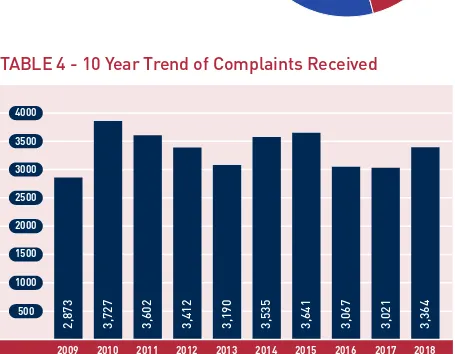
We received over 3,300 complaints in 2018 – an 11% increase on 2017. We have seen an increase in the number of complaints across all the major sectors that we deal with,
including government, local authorities and the health sector. The increase is largely due to an increased profile for the Office arising from the various reports we have published and investigations we have carried out. In Chapter 2 I go into more detail in relation to the trends in complaints we received during the year.
We completed our examination of over 3,200 complaints during 2018 which is 5.5% more than in the previous year. Ninety per cent of cases were dealt with within six months of receipt. None of this would be possible without our highly skilled teams and I want to thank them for their work and commitment. I also want to mention the work of Jacqui McCrum, our former Director General whose drive and leadership were at the heart of our work in the year.
Peter Tyndall Ombudsman
Chapter
10
Chapter 2: Delivering Outcomes through complaint examinationChapter 2: Delivering Outcomes
through complaint examination
2.1 Role of the Ombudsman
As Ombudsman my main role is to examine complaints from people who feel they have been unfairly treated by certain public service providers, including:
• government departments
• local authorities
• the Health Service Executive (HSE)
• public hospitals
• publicly-funded third level education institutions
• public and private nursing homes
• ‘direct provision’ accommodation centres
The services of my Office are free to use. We examine complaints in a fair, independent and impartial way. Before bringing a complaint to my Office the person who has been adversely affected must usually have tried to resolve the complaint with the service provider complained about.
When we receive complaints we consider if the action complained about (for example a decision or failure to act) was made:
• without proper authority
• on irrelevant grounds
• in a negligent or careless manner
“I do thank you sincerely for your kindness on
my behalf and for all the good work you done
for me. I appreciate your kindness more than I
can say.”
• in a way that improperly discriminated against the individual
• based on bad administrative practice or
• in a way that did not demonstrate fair or sound administration.
In practice, many complaints are resolved informally after my Office has brought the complaint to the attention of the public service provider concerned.
If I uphold a complaint I will recommend appropriate redress. I may also make
recommendations which aim to reduce the likelihood of others being similarly affected in the future.
As Ombudsman, I can also examine complaints under the Disability Act 2005. These
complaints relate to access to information and services by people with disabilities. I report on complaints under the Disability Act later in this Chapter.
I am appointed by the President and report to the Oireachtas only.
2.2 Complaints received and completed: An analysis
In 2018, the total number of complaints received by my Office about service providers within my jurisdiction was 3,364 compared with 3,021 in 2017. This was an increase of 11% on 2017. 3,228 complaints were completed in 2018 which again was a 5% increase on the number of complaints completed in 2017.
As has been the case for a number of years Caseworkers are encouraged to communicate where possible by email and telephone in order to speed up our communication process. As a result 75% of cases were closed within 3 months, 90% within 6 months while overall 98 % of cases were closed within 12 months which compares well with previous years. This was encouraging especially since a new IT complaint management system was introduced into the Office in June 2018.
Of the 1,530 cases within my jurisdiction that were substantively examined, 26% of cases were fully upheld, 3% were partially upheld and 52% were not upheld. In 19% of cases assistance was provided. Even where complaints are not upheld we are often able to provide an
12
Chapter 2: Delivering Outcomes through complaint examinationBefore complainants bring complaints to my Office they must take reasonable steps to resolve their complaint with the provider of the public service. In a number of cases (916 in 2018) my Office provided advice and assistance to those who made their complaint prematurely to us and usually directed them back to the local service but inviting them to come back to us if the case was not resolved at that level.
An additional 782 complaints were either discontinued, withdrawn or were outside remit. In cases outside remit we generally try to provide contact details for the appropriate body who can consider their complaint.
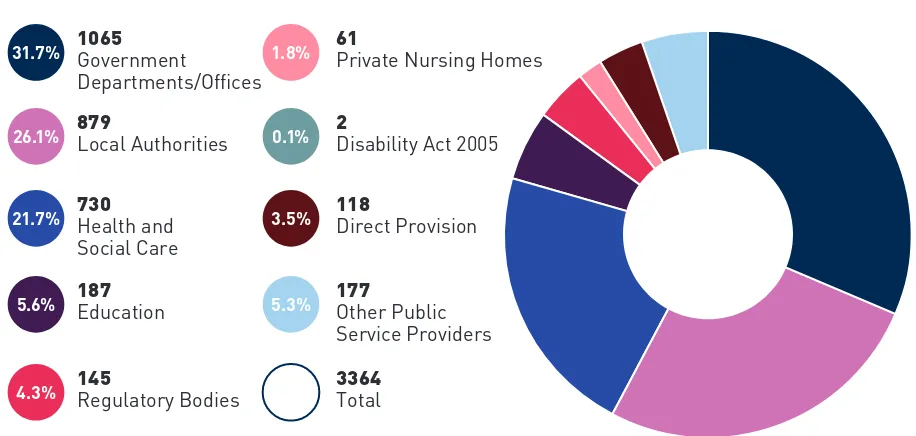
In 2018 the largest number of complaints received concerned Government Departments and Offices (31.7% in 2018), which includes the Department of Employment Affairs and Social Protection, followed by Local Authorities (26.1% in 2018) and the Health and Social Care sector (21.7%). These percentages are broadly in line with the 2017 figures and would be consistent with the volume of interactions that these bodies have with service users.
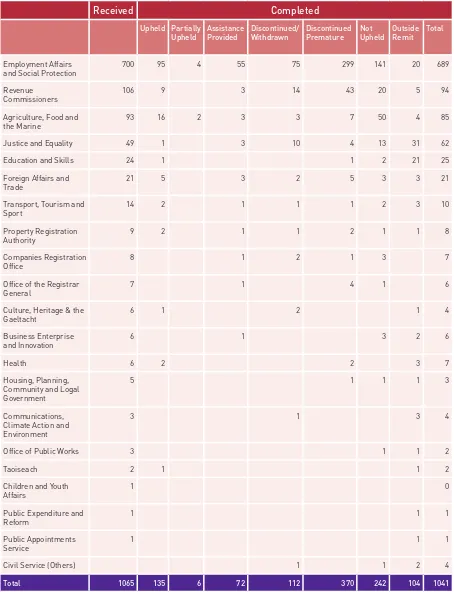
Of the 1,065 complaints received about Government Departments and Offices, 700 of these were about the Department of Employment Affairs and Social Protection, 106 about the Revenue Commissioners, 93 about the Department of Agriculture, Food and the Marine, and 49 about the Department of Justice and Equality.
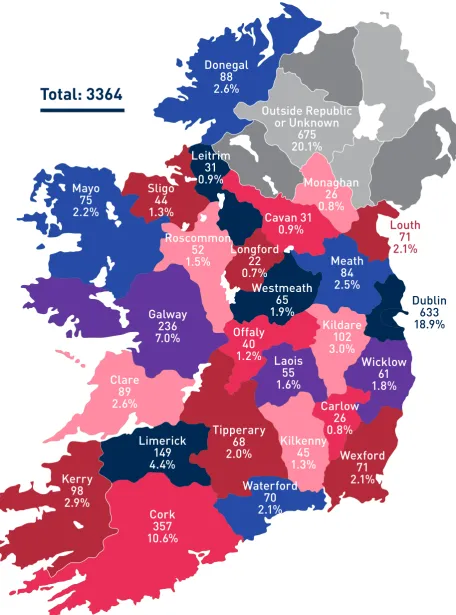
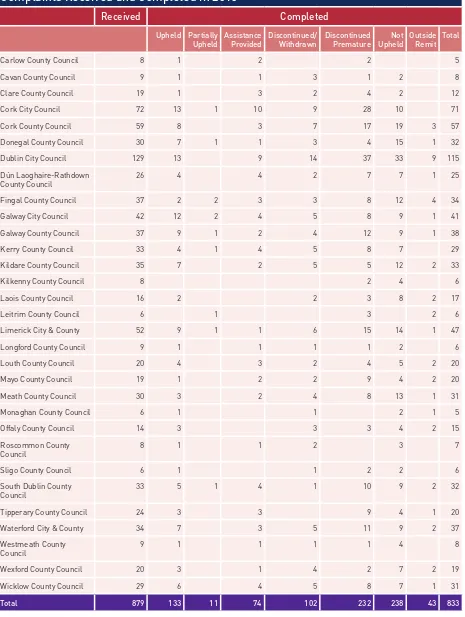
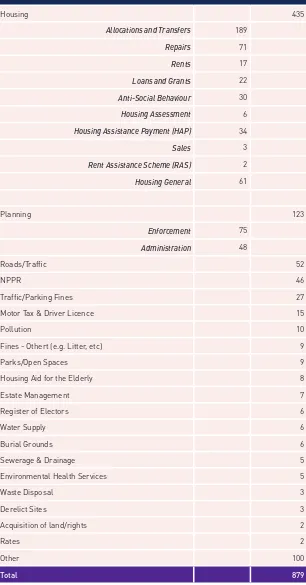
In 2018, 879 complaints were received about Local Authorities. 129 of these complaints were about Dublin City Council, 72 were about Cork City Council, 59 about Cork County Council, 52 were about Limerick City and County Council and 42 about Galway City Council. 435 of the complaints about Local Authorities concerned housing, 189 of which related to housing allocations and transfers and 71 complaints related to housing repairs.
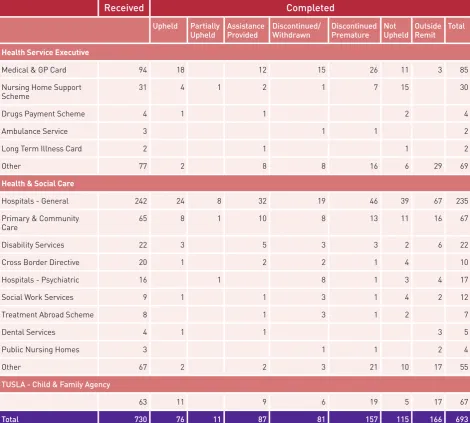
242 of the 667 complaints about the HSE concerned hospitals. 94 involved medical or GP cards.
My Office received 61 complaints about private nursing homes in 2018 but completed 65 cases, some of which had carried over from the previous year. 12 of these cases were either upheld or partially upheld.
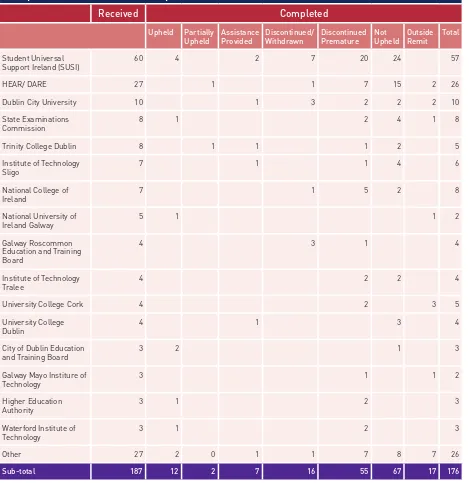
A total of 187 complaints were received in relation to the Education Sector which includes publically funded third level education bodies, Student Universal Support Ireland (SUSI) and HEAR/DARE schemes operated by institutions within the sector.
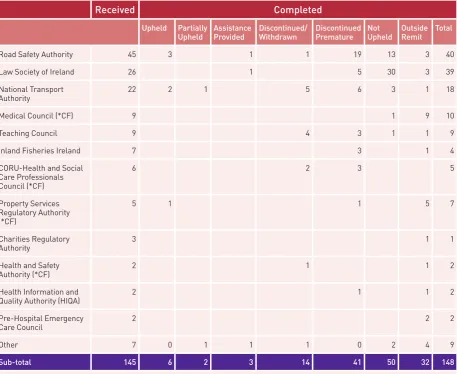
I received 145 complaints about regulatory bodies which included 45 complaints concerning the Road Safety Authority, 26 complaints about the Law Society (none of which were upheld in 2018) and 22 complaints about the National Transport Authority.
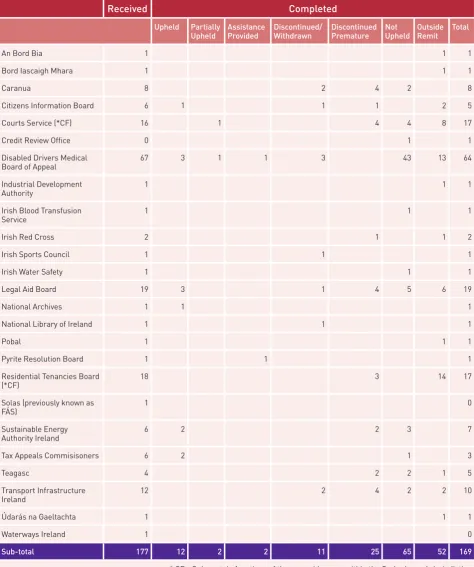
177 complaints were received about a range of other public service providers. 67 of these complaints concerned the Disabled Drivers Medical Board of Appeal.
Finally, I received a total of 152 complaints from people living in direct provision
(RIA), 39 related to the accommodation centres, 18 were about the Irish Refugee Protection Programme (IRPP) and one about an Emergency Reception and Orientation Centre (EROC). The remaining 34 complaints received from people living in direct provision accommodation were about public service providers not directly related to direct provision such as the
Department of Employment Affairs and Social Protection, the health sector and other bodies.
2.3 Nursing home complaints
In 2018 I received 61 complaints from members of the public about private nursing homes. This number was consistent with the number of complaints received the previous year. Only five complaints were fully upheld and seven partially upheld. In nine cases assistance was provided by way of a better explanation.
Indeed, the number of complaints to my Office is relatively small when you consider that there are 122 public nursing homes and 458 private nursing homes which cater for around 30,000 residents. During the year I worked with HIQA to strengthen the transfer process for complaints between our Offices. However, I should point out that not every concern received by HIQA would be appropriate for my Office.
In light of my experience in dealing with nursing home complaints and looking at the current wider regulatory and public policy landscape a number of issues emerged which I felt
demanded the attention of our legislature and public policy-makers. Therefore, I produced a Nursing Home themed edition of the Ombudsman’s Casebook which drew specifically on the general issues and trends noted in the complaints to my Office. The main themes related to transparency and clarity around the terms and conditions contained in the contracts of care in a nursing home, especially in relation to additional charges and security of tenure. Access to community allied health professionals and advocacy were also addressed. In May 2018 I was invited to address the Oireachtas Joint Committee on Public Petitions. I raised a number of these issues and addressed the need to adequately resource alternate care models, such as increased support to enable people to remain in their own homes. Home support should be on a statutory footing.
14
Chapter 2: Delivering Outcomes through complaint examination2.4 ‘Direct Provision’ complaints
In 2018, I published a Commentary on my Office’s engagement with the sector, in which I described what my staff discussed with the residents in the centres and what happened following our visits. I published my second Commentary on 13 March 2019 where I set out the main themes that emerged during our 2018 programme of visits, including any new developments reported back by my staff.
In total I received 152 complaints from people living in direct provision accommodation. 118 of these complaints were about bodies providing direct provision services such as the accommodation centres, Reception and Integration Agency, Irish Refugee Protection Programme, and Emergency Reception and Orientation Centres. 34 complaints received were about the Department of Employment Affairs and Social Protection, the Health Sector and other bodies.
My staff visited 26 direct provision accommodation centres during 2018. Overall, we noticed higher levels of dissatisfaction from residents at newer centres when compared to the more established centres. There were also more complaints taken at the newer centres than at the others. My staff did not observe any great difference in the facilities available at the newer centres, or in how centre staff and residents in them interacted. It could be that the higher levels of reported dissatisfaction and complaint numbers are simply linked to residents taking time to adjust to new surroundings and a communal living environment. We also saw a welcome increase in cooking facilities in several centres, and a roll-out of food halls where residents can buy and prepare their own choice of food. My Office is engaging with the relevant agencies in the Department of Justice and Equality on the further provision of these facilities. I am also pleased to note the positive impact of the right to work which some residents benefited from during the year.
As was the case in 2017, my Office received complaints from residents about food, facilities and the standard of accommodation in centres, and about refusals of requests for transfers from one centre to another. A new source of complaints was about refusals of requests for re-admittance to Direct Provision from asylum seekers who had left the service and wished to return, or who had not entered the system when they first arrived in Ireland. I am pleased to report that, following engagement with my Office, 10 of the 13 asylum seekers who had complained about this were re-admitted into Direct Provision.
Department, the centres remain unsuitable for long term occupation. There needs to be a formal resettlement programme in place, but any success in this work will be hindered by the desperate shortfall of affordable housing, which is also evidenced in the complaints about local authorities.
2.5 Complaints under the Disability Act
The Disability Act 2005 imposes significant obligations on government departments and other public service providers to work proactively towards the improvement of the quality of life of people with disabilities. A complaint can be made to my Office regarding a public service provider’s failure to comply with Part 3 of the Disability Act. Specifically, my Office can investigate complaints about access by people with disabilities to public buildings, services and information.
As I have reported in previous years, the low number of complaints under Part 3 of the Disability Act is very disappointing. Only two complaints were received in 2018. It is vitally important that people with disabilities are informed as to their rights on access to services and information and that they are aware of their right of recourse to me as Ombudsman to examine their unresolved complaints. It is also crucial that both professional and non-professional people involved in the disability sector are knowledgeable about the Disability Act 2005.
2.6 The value of a single complaint: Non repayment of
a refundable deposit by an adoption agency
I welcomed a Government decision to establish a scheme to repay clients who lost money following the closure of an adoption agency in 2015. The development of this scheme came about following extensive discussions between my Office, the Department of Children and Youth Affairs, and the Adoption Authority of Ireland, and was as a direct result of a single complaint to my Office.
A couple complained to my Office in 2015 that they had not received re-payment of a
refundable deposit of €2,750 which they paid as part of a fee to Arc Adoption Ltd. Arc Adoption Ltd, which was accredited by the Adoption Authority of Ireland to provide adoption services connected to the facilitation of inter-country adoption to Ireland, went into liquidation in 2015. While there was only one complaint to my Office it soon became clear that there were nearly 70 clients who had been similarly affected when the agency closed down.
16
Chapter 2: Delivering Outcomes through complaint examinationI welcomed the decision to establish this redress scheme. The process of adopting a child can be a difficult and emotionally stressful process. In 70 cases this process was made even more stressful when clients lost out on a refund of fees they were entitled to. This was a case that highlighted how one complaint to my Office can yield benefits for others in a similar position.
2.7 Department of Employment Affairs and Social
Protection: Complaints about overcharging
In my 2017 Annual Report (page 16) I outlined in some detail the concerns I had about the volume and nature of complaints I had been receiving over the last few years from people who were being pursued by the Department of Employment Affairs and Social Protection (DEASP) in cases where the Department believed the complainants had been overpaid.
My Office had identified a range of systemic issues in relation to the identification, pursuit and recoupment of overpayments by the Department. Further concerns arose around such issues as record keeping, the burden of proof and adherence to the principles of natural justice.
As I indicated in my 2017 Annual Report, my Office has had very positive engagement with the Department, not only in dealing with individual cases and resolving them by agreement but also in seeking to ensure a uniformity of approach by staff in the Department throughout the country.
During 2018 the Department has been working, through its Central Debt Unit, on the drafting of a procedures manual ‘Management of Customer Overpayments and Recovery of Customer Debt’. This is a comprehensive document which seeks to identify the various types of overpayment cases that may arise as well as providing detailed guidance to staff on the practices and procedures to be followed in identifying possible overpayments and how to handle them. It also includes instructions on how to reduce the possibility of the incidence of overpayment and the circumstances under which overpayments which do occur may be written-off or written-down. Helpfully, it also includes a section on the role of my Office and how to assist in the resolution of complaints which I raise with the Department.
I commend the Department for its work on this issue. I understand that the manual is due to be rolled out to all staff during 2019.
2.8 Possible extension of the Ombudsman’s jurisdiction
to prisons
I anticipate that, subject to approval by the Department of Public Expenditure and Reform, my remit will be extended to allow me to consider complaints about the prison service.
“A very sincere ‘Thank You’ seems to very
insufficient to be saying to you and your
team, not alone for your perseverance to
the very end, but also for your courtesy and
professionalism throughout.”
For its part, the IPS has taken a number of measures towards putting in place a revised internal complaints system. This includes the revision of policy and procedures manuals, an updated IT system and the drafting of proposed revisions to the statutory prison rules.
2.9 Notices issued to service providers under section 7
of the Ombudsman Act
Section 7 of the Ombudsman Act 1980 (as amended) confers very significant powers on the Ombudsman in terms of acquiring documents and information necessary for the examination or investigation of complaints. Under the Act, there is a legal obligation placed on “any person who, in the opinion of the Ombudsman, is in possession of information, or has a document or thing in his power or control, that is relevant to the examination or investigation” to provide that material to the Ombudsman.
All requests for information from public service providers made by my Office are made in accordance with the provisions of section 7. A request made under section 7 enables a public service provider to comply with its obligations under the General Data Protection Regulation (GDPR), as implemented by the Data Protection Act 2018.
Where a public service provider does not comply with my request for information within a given timeline, I may issue a formal section 7 notice to demand the required information.
In almost every case the information I need is provided to my Office without the necessity to issue a section 7 notice. My Annual Report is used to publish the number of occasions where I have issued a section 7 notice.
Chapter
Chapter 3: Delivering Outcomes
through investigations and follow-up
3.1 Learning to Get Better: Progress Report
In November 2018, I published my Progress Report into the implementation of the 36 recommendations which I made in my 2015 systemic investigation report ‘Learning to Get Better’. That report had examined complaint handling in the acute hospital sector throughout the country. The HSE and the Department of Health accepted all the recommendations. The HSE had decided to implement the recommendations, where relevant, in the community health care sector as well as in acute hospital settings.
At the launch of the Progress Report, I expressed my disappointment that all the
recommendations had not, at that stage, been fully implemented. I found that only ten of the recommendations were fully implemented by the HSE, while 17 were partially implemented and nine were either not implemented or were still being considered.
However, I did acknowledge positive developments such as improved facilities for complaints officers and patients making complaints (Tallaght hospital), initiatives to ensure early
resolution of complaints (St John’s Community hospital Sligo), and audits of patient complaints to assess the quality of the complaints process (RCSI hospital group).
I understand that, since the publication of the Progress Report, there has been further work undertaken by the HSE in relation to embedding a standardised system for the recording of complaints at a local level and training staff to ensure this happens in a consistent manner. In addition, two e-learning modules have been rolled out, one of which is for front line staff and the other for Complaints Officers. During 2019 audits of local compliance with all my recommendations will be conducted and fed back to the National Complaints Governance and Learning Team in the HSE. I am encouraged by this evidence of continued progress.
20
Chapter 3: Delivering Outcomes through investigations and follow-upAt the launch of ‘Learning to Get Better: Progress Report’ Ombudsman Peter Tyndall, Presenter Jonathan Healy, Patrick Lynch HSE.
3.2 A Good Death: Progress Report on developments
in end-of-life care
In September 2018, I published ‘A Good Death: Progress Report on Developments in End of Life Care in Irish Hospitals’. This was a follow-up to my previously published report ‘A Good Death’ in 2014. This initial report had raised a number of thematic issues that I had identified relating to end-of-life care in hospitals. It had been prompted by engagement with the Irish Hospice Foundation (IHF), and reflected on the lessons that needed to be learned arising from complaints to my Office over the years.
The Progress Report identified very significant progress in a range of areas.
These included:
• increases in the range and extent of education and training for staff in end of life care;
• improved physical facilities for dying patients and their families, and
• greater emphasis on the provision of information to patients and their families on all aspects of end of life.
• The Progress Report also highlighted a number of particular initiatives including:
• the IHF’s CEOL (Compassionate End of Life) Programme for residential settings. This provides a framework for staff to reflect, review and enhance the end of life care provided in nursing homes and a system for introducing improvements;
• a pilot project in the Emergency Department of St Vincent’s University Hospital introduced new guidelines and systems for the early identification of patients with palliative care needs;
• the IHF’s suite of seven guidance documents to improve palliative care for people with dementia;
• Phase 1 of the HSE’s Project ECHO (Extension for Community Healthcare Outcomes) allowing nursing home staff to train with hospice staff to support residents with palliative care needs.
The HSE and the IHF are continuing their vital work in this area. As Ombudsman, I am
pleased that substantial progress has been made in the area of end-of-life care which is most encouraging. My report also highlights certain aspects of the services that require urgent focus and further attention. These areas were also highlighted by the Survey of Bereaved Relatives: Voices MaJam which was a detailed survey undertaken by the Mater and St. James Hospital in 2017.
To coincide with the publication of my Progress Report, we also launched the HSE/IHF’s public information booklet: ‘When someone you care about is dying in hospital – What to expect’. This information booklet has been distributed throughout the acute hospital system and has been well received by staff and families alike.
The full report is available on my Office’s website.
“You are outstanding at what you do and
are shining examples of what works well in
this country. For people like me, who would
have no hope against an institution it is very
22
Chapter 3: Delivering Outcomes through investigations and follow-upAt the launch of ‘A Good Death: Progress Report’ left to right; Alice Anderson Irish Hospice Foundation, Patsy Fitzsimons Office of the Ombudsman, Margaret McKiernan Mercy University Hospital Cork, Tom Curran Patient Representative, Marie Lynch Irish Hospice Foundation.
UPDATE ON RECENT INVESTIGATIONS
3.3 Opportunity Lost: Magdalen Restorative
Justice scheme
My investigation report into the Magdalen Restorative Justice Scheme was published in November 2017. It contained three recommendations directed at the Department of Justice and Equality:
1. Eligibility for admission to the Scheme
Where there is evidence that a woman worked in one of the listed laundries but was officially recorded as having been “admitted to” a training centre or industrial school located in the same building, attached to or located on the grounds of one of the laundries, the Department should fully reconsider their application with a view to admitting them to the Scheme;
2. Application Process
stay. All available sources of evidence and information should be pursued and considered in this regard;
3. Capacity
The Department should work closely with the Courts Service to ensure that wardship applications in respect of the women who are deemed to lack capacity are processed in a timely manner and proactively provide practical support to the appropriate persons to ensure that these applications are made.
The recommendations were accepted. Arising from recommendation 1 above, the Government decided that the Department should re-advertise the scheme with an addendum to the
original scheme. In addition, Ms Mary O’Toole SC was engaged by the Department to assist in the implementation of recommendations 2 and 3.
There has been commendable progress in implementing recommendation 3. In January 2018 the Department had indicated that, at that time, 17 successful applicants had been unable to receive the redress they were entitled to as they did not have the necessary capacity to sign legal documents. By early 2019, Ms O’Toole had resolved all those cases, bar one, and they had received their awards. The remaining case was due to be resolved following the outcome of an application to the High Court. It did not prove necessary to use the mechanism of a wardship application to resolve all the cases identified.
In relation to recommendation 2, Ms O’Toole identified 214 cases which fell into this category. Three of these applicants did not want their cases reviewed. By early 2019 the examination of six files had been completed and the level of award had been increased in two of these. Enquiries had been initiated in 68 further cases, most of which required additional information from the religious congregations.
In relation to recommendation 1, 52 of the original applicants who had originally been refused access to the Scheme were deemed to be qualified under the terms of the addendum. The Department has reported to my Office that by early 2019 an additional 35 applications had been received following the re-advertisement of the Scheme. Of the total of 87 cases, seven had received their ex gratia award, one of whom had received the maximum amount of €100,000. Offers had been issued to two further applicants.
I will continue to closely monitor progress until all of the recommendations are fully implemented.
3.4 Lost at Sea: Refusal to approve a family’s
application for redress
24
Chapter 3: Delivering Outcomes through investigations and follow-upSince becoming Ombudsman in 2013 I have repeatedly highlighted this case and called for the compensation to be paid. The case had also been taken up by the Petitions Committee of the European Parliament. I was delighted that, in May 2018, it was announced by the Minister for Agriculture, Food and the Marine that the recommended compensation of €245,570 was being paid to the Byrne family.
The full reports on the case are available on my Office’s website.
3.5 Taking Stock: Complaint handling by the Child
and Family Agency (TUSLA)
In my 2017 Annual Report (pages 20 and 21) I gave an overview of a range of areas that needed improvement which had been identified in my systemic investigation report into complaint handling by the Child and Family Agency (Tusla).
Having accepted my recommendations, Tusla has put an “Action Plan” in place to bring about the necessary improvements and has undertaken a number of follow up measures. The main actions taken to date include:
1. A national electronic case management system is now operational in all geographical areas;
2. Training for complaints officers was rolled out in 2018 and further sessions are planned in 2019;
3. Additional staff were recruited to support the complaints handling and feedback processes;
4. Training initiatives highlight the need to signpost the Office of the Ombudsman in
appropriate cases and also underline the importance of due process and fair procedures in dealing with abuse allegations;
5. A cross directorate National Quality Improvement Collaborative Forum has been established to embed and support on-going strategic approaches to learning and
improvement arising from Ombudsman reports and other relevant sources such as HIQA;
6. An on-line basic complaints handling module is being developed which will be available to all staff.
During 2019, Tusla plans to audit the management of complaints relating to foster carers and the management of complaints from foster carers.
Tusla’s Policy and Procedures for Responding to Allegations of Abuse and Neglect is still that which was in operation in 2014. The delay in publishing a new procedure for responding to allegations of abuse and neglect was due to consideration being given to the impact of certain court decisions and on-going engagement with staff.
established to oversee the implementation of the policy and to drive a nationally consistent approach to the management of retrospective and extra-familial referrals.
I remain concerned about the way that Tusla is dealing with complaints and will keep matters under review to determine whether further action is required.
3.6 Treatment Abroad Scheme
I indicated in my 2017 Annual Report (page 22) that the Health Service Executive (HSE) had accepted all the recommendations set out in my investigation report into the administration of the Treatment Abroad Scheme (TAS).
The HSE set up a Working Group to oversee and advise on how best to implement the 11 recommendations. The Group included an independent member to represent the interests of patients. Following completion of its deliberations I am due to receive an implementation report from the HSE in early 2019.
3.7 Mobility Allowance and Motorised Transport
Grant schemes
In my 2017 Annual Report (pages 8 and 23) I expressed my concern about the extremely long delay in legislating for a new unified statutory scheme to replace the Mobility Allowance and Motorised Transport Grant Schemes which had been closed to new applicants in 2013 by the Department of Health.
Most regrettably, there has been no progress in dealing with this matter in 2018. I am aware that a Memorandum to Government on proposals for a new Transport Support Payment Scheme was sent forward in May 2018 but was withdrawn from the Cabinet agenda at the time. It seems that, arising from Cabinet discussions, a set of revised proposals was to be drawn up. At the time of going to print I have seen no evidence of any revised proposals being put forward. It is simply not acceptable that this very vulnerable group of people has, up to now, waited nearly six years for a replacement scheme to be put in place.
“By the way it is refreshing that your
organisation has the capacity to quickly and
meaningfully respond to a question like mine.
Chapter
Chapter 4: Delivering Outcomes:
Case
Studies
In Chapter 2 I summarised a number of the complaints my Office received in 2018. In 29% of cases I either upheld or partially upheld the complaint against the service provider. In this Chapter I present summaries of some of the complaints that I upheld.
4.1 €25,000 funding for youth centre withheld due to
error in tendering process
Background
A man complained to the Ombudsman that the Department of Rural and Community Development had unfairly withheld part of the final payment of a LEADER grant.
The man was a member of a local parents’ committee who had applied for funding under the 2007-2013 LEADER programme. The funding had been sought to turn a derelict building into a youth education centre, promoting science and entrepreneurship. The Local Area Group (LAG) had approved funding and the work went ahead.
The grant had been drawn down at various stages of the project. After the project had been completed and the man had applied for final payment, the Department carried out an audit of the project. The Department found that the development was in breach of the conditions of the LEADER programme in relation to how the promoter had carried out the tendering process for the development works.
28
Chapter 4: Delivering Outcomes: Case StudiesExamination
The man came to the Ombudsman as he felt that he had worked closely with the LAG
throughout the application process. He contended that any errors in relation to the tendering process should have been highlighted by the LAG on the submission of the application, and not the Department after the project had been completed. The man had taken out a personal loan to ensure completion of the project and was repaying the loan at the time of making his complaint.
The Ombudsman asked the Department to review its decision as it was clear that the man had taken advice from the LAG in relation to the tendering process. The Department had previously acknowledged that there was an issue around lack of clarity in relation to the tendering process for members of the public applying for funding under the scheme. The Ombudsman was also concerned that the committee was adversely affected on an ongoing basis, as once there was a sanction in place no further applications for funding could be made for future projects.
Outcome
After reviewing the case the Department removed the sanction and paid the outstanding €24,745 to the committee.
4.2 Medical card refused for terminally-ill woman
Background
A man complained that the HSE refused to process his wife’s application for a medical card. The HSE did not register or process her application as she was not resident in Ireland.
The couple, who were both Irish citizens, had moved to America in 1999 but had planned to retire to their home in Clare. However, in June 2016 the man’s wife was diagnosed with cancer and given 12 months to live. The couple were anxious to return to Clare where they could spend time with family and friends. The woman needed a medical card as she had no private medical insurance in Ireland and there were significant costs for treatment of her cancer.
In October 2016, she applied, through her hospital in Ireland, to the HSE for a medical card. The HSE told the hospital that the woman would have to live in Ireland and have proof of residency in order to apply for a medical card.
The woman made a second application, again through her hospital, in November 2016, enclosing a social worker’s letter setting out the complexities of her case. Again, the HSE did not communicate directly with her. Nor did it register or process her application.
The woman’s health deteriorated and the woman moved back to Clare in April 2017. Two days later the HSE issued her with an Emergency Medical Card. However, the following day the woman died at her home in Ireland.
Examination
Emergency Medical Cards are granted to people who are certified as terminally ill and who are receiving end-of-life care. These cards are not generally subject to an assessment of financial means. Eligibility is normally granted to such people within 24 hours of receipt of an application. All applicants must satisfy the HSE that they are “ordinarily resident”. That means that they are living in Ireland for at least a year and / or they intend to live here for at least one year.
The Ombudsman was concerned that the HSE did not communicate directly with the woman, as the applicant, but rather communicated with her hospital.
The Ombudsman also believed there was sufficient evidence that the woman intended to live in Ireland particularly given that:
• She was an Irish citizen
• She had maintained a home here and visited regularly
• She had been diagnosed as terminally ill and wanted to spend her remaining time with family and friends, and
• She had a bank account in Clare.
The Ombudsman asked the HSE to review its handling of the case.
Outcome
The HSE acknowledged that it should have communicated more clearly, and directly, with the family in relation to the earlier applications. It apologised for the stress and upset it caused to the woman and her family at a very challenging period in their life.
30
Chapter 4: Delivering Outcomes: Case Studies4.3 Woman refused parking permit despite being
entitled to one
Background
A woman complained about Cork City Council’s refusal to give her a resident’s parking permit at the apartment building where she lived. The woman said that she was aware other residents of the building had been granted permits. Because she did not have a parking permit the woman was incurring significant costs to park outside her home.
Examination
Under the Council’s parking policy residents of a purpose-built apartment block where development of the complex was completed after March 2004 are not eligible for a resident’s parking permit. The policy came into effect in November 2016. Any residents who had applied for, and been granted a parking permit before the policy came into effect, had been allowed to keep their parking permits. The apartment complex where the woman lived was completed after 2004 and therefore no new resident parking permits would be issued for residents.
When reviewing its files, the Council discovered that the woman’s first application for a
resident’s permit had been made before November 2016. Therefore the policy should not have applied to the woman and she should have been granted a parking permit.
Outcome
The woman had since moved from the apartment complex so no longer required the permit. The woman had receipts for parking tickets purchased online to the value of €802 whereas the fee for the parking permit would only have been €10 per year.
The Council agreed to an ex gratia payment of €802 to the woman to compensate her for the parking tickets she paid for over the two years she lived in the apartment building.
4.4 Typing error leads to confusion over whether man
suffered a stroke
Background
A man experienced symptoms that led him to believe he had suffered a stroke. He had brain scans carried out in Tallaght Hospital and was told that nothing showed up on his scan. The man and his GP sought a second opinion from Beaumont Hospital.
The man had a number of tests in Beaumont Hospital. However he experienced difficulties getting doctors in the hospital to review his scans from Tallaght Hospital. The man
complained to Beaumont Hospital about these difficulties.
complained to the Ombudsman that he could not get a clear answer as to whether he had suffered a stroke in the recent past.
Examination
The Ombudsman cannot examine ‘clinical judgement’ such as diagnosis and therefore could not direct the hospital to review the man’s scans. The Ombudsman‘s examination focused on the communication between the hospital and the patient.
The Ombudsman discovered a significant typing error in the man’s report. Where the doctor in Beaumont Hospital had made reference to the man’s brain scans showing evidence of a previous stroke, the word ‘not’ had accidentally been omitted from the letter. The letter was supposed to read that the man’s brain scans did not show evidence of having previously suffered a stroke.
Outcome
The administrative error had understandably caused distress and confusion to the man. The Ombudsman requested that a suitable medical professional from Beaumont Hospital contact the man to account for the typing error and explain the results of his scans.
4.5 Man distressed by the noise of his own surgery
Background
A woman complained that while her father underwent surgery in Limerick University Hospital, he could hear the noise of the instrument used for his surgery. This caused him distress.
Examination
As the man was not a suitable candidate for a general anaesthetic, he had surgery under a ‘spinal block’. This meant that he was awake during the operation. The hospital said that staff offer ear phones and music to patients undergoing surgery under regional anaesthesia involving loud surgical instruments.
However, it could not say whether this offer was made to the patient during his procedure. Examination of the medical and nursing notes found no record of the patient being offered, or using, earphones.
Outcome
The hospital apologised to the patient for the experience. It acknowledged that the incident had increased the stress for the patient. The hospital purchased disposable earphones for use by patients during surgery involving regional anaesthesia.
32
Chapter 4: Delivering Outcomes: Case Studies4.6 Woman awarded €12,500 Guardian’s Allowance as
father had little contact with his son
Background
A woman complained that her application for a Guardian’s Allowance for her grandson had been refused by the Department of Employment Affairs and Social Protection. The refusal was upheld in two separate appeals to the Social Welfare Appeals Office. The Department refused the application as it believed that the child had not been abandoned by his father and that the woman’s role in the care of her grandchild was a private arrangement between her and the child’s father.
Examination
The level of contact the child’s father had with his son was minimal and confined to a few visits to a restaurant over the course of a year. It appeared that the child’s father had failed to maintain a reasonable degree of interest and responsibility for the child’s welfare and that the child was in effect, ‘an orphan’, within the meaning of social welfare legislation. The Ombudsman asked the Chief Appeals Officer to review the refusal of the application.
Outcome
The Appeals Officer accepted the evidence and revised the earlier decisions. The woman was awarded the Guardian’s Allowance and arrears of €12,517.
4.7 Medical staff unable to access patient records over
the weekend
Background
A man had a procedure in Connolly Hospital. Two days later the man was experiencing chest pains so he went to the Emergency Department in Connolly Hospital. However the hospital staff could not access the medical records from the procedure the man had undergone two days before.
The man complained that there could have been serious consequences in an emergency as hospital staff were unable to access his medical records.
Examination
The man’s procedure had taken place on Thursday. Following his procedure staff sent the man’s medical records to the Hospital In-Patient Enquiry (HIPE) Department on Friday for coding.
Speedy access to a patient’s medical records is essential to assist hospital staff provide the best care to any patient and a lack of up to-date information can lead to the unnecessary duplication of tests or misdiagnosis.
Outcome
Following the complaint, the hospital introduced new protocols. These protocols facilitate the retrieval of charts out-of-hours. Security staff will now help Emergency Department staff to access the HIPE over the weekend and during out-of-hours periods.
In addition, the hospital undertook an audit to test the accessibility of healthcare records to clinicians, out-of-hours and at weekends. Finally, the hospital reassured the man that the lack of availability of his medical records on that occasion did not alter the clinical management of his condition.
The Ombudsman was satisfied that the hospital took the matter seriously, acknowledged there was a problem and took the necessary corrective action to address the issue.
4.8 HSE used cancelled application date when
calculating ‘Fair Deal’ entitlement
Background
A woman complained to the Ombudsman when the HSE refused her application under the Nursing Home Support Scheme (NHSS). The HSE had decided to use the date of an earlier application which the woman had cancelled to calculate her means.
The woman initially applied to the HSE for support under the NHSS (or ‘Fair Deal’ scheme) in 2013. The woman had been encouraged by her hospital to apply for NHSS. However the woman changed her mind and her family withdrew her application within three weeks of submitting it. The HSE accepted the withdrawal and cancelled the application.
In 2015 the woman made another NHSS application to the HSE. The woman did not avail of any nursing home care or support in the period between 2013 and 2015.
The HSE includes any assets that an applicant transferred in the five years before the
application to the NHSS as part of their financial assessment to the scheme. The woman had transferred a half-share in the family home to her daughter in 2008.
34
Chapter 4: Delivering Outcomes: Case StudiesExamination
The HSE said that it was necessary to include the transferred asset when calculating the woman’s contribution towards her Nursing Home Support as legislation is explicit on this issue and it must be applied in a consistent manner.
The Ombudsman took the view that as the application in 2013 was cancelled, it was unfair to use 2013 as the start date for the woman’s current application to the scheme. The woman had transferred the asset to her daughter seven years before she applied for and availed of nursing home support in 2015.
Outcome
The HSE agreed to accept the 2015 application as the first application. This resulted in the transferred asset not being included in the woman’s financial assessment and the cost of her contribution to nursing home support was significantly lowered. The HSE reviewed the amount the woman had already contributed and she received a refund of €7,938.
4.9 Woman’s housing entitlement changed because
daughter attended UK college
Background
A woman complained to the Ombudsman when her housing requirements were reduced from a three-bedroom house to a two-bedroom house after her 17 year-old daughter went into third level education in the UK.
The woman had been on Fingal County Council’s waiting list for social housing since 2006. She had been assessed as requiring a three-bedroom house as she had a 17 year-old daughter and two young sons.
The woman’s daughter commenced third level education in the UK in October 2017. In November 2017 the Council updated the woman’s housing file. As the woman’s daughter was now in college in the UK the woman was re-assessed as requiring a two-bedroom house. Subsequently the woman was offered a two bedroom house, which she felt she had to accept.
The woman complained to the Ombudsman as she felt her daughter was still part of her family composition as she is only in the UK for the college term and otherwise lives with the family.
Examination
A letter from the UK university indicated that she was enrolled as a full time student from October 2017 until June 2020. Therefore, the Council decided that the daughter was residing in the UK and was not deemed part of the household.
Although the Housing Allocations Scheme does not provide for the woman’s particular
still part of the family composition and would return to her family home for the periods outside the academic terms of her university.
Outcome
The Ombudsman asked the Council to reconsider its position given the specific circumstances of the case. Although the woman’s daughter was attending college outside of Ireland, the student accommodation she was residing in was not of a permanent nature. The Council reviewed its position and decided that the family required a three-bedroom property.
4.10 Man pays rent to Council but informed his account
is in arrears
Background
A man complained to the Ombudsman after he received a statement from Galway City Council showing that his rent was in arrears. The man had not missed any rent payments and had a standing order from his bank to make the payments.
The Council carried out a search of its records but could not identify any unallocated funds paid into its account which could account for the man’s rent payments. The Council then issued a further letter requesting payment of the rent arrears before the man contacted the Ombudsman.
Examination
The Ombudsman contacted the Council and a detailed search of its accounts was carried out. The Council searched for all payments in the amount of the man’s rent which was a significant task as the figure involved was a common amount.
The Council discovered that the man’s payments were being paid into a different account. It transpired that the man had changed bank accounts. When he set up his regular payment to the Council from the new account he had not included his unique rent account reference number. An unrelated reference number from the man’s bank account was mistakenly taken as his rent account reference which resulted in his payments going into a different tenant’s account. The Council did not find his payments when it searched for ‘unallocated funds’, as his payments were being allocated but to the wrong account.
Outcome
36
Chapter 4: Delivering Outcomes: Case Studies4.11 Farmer medically unfit to work land was not
allowed to transfer his Department contract
Background
A man complained to the Ombudsman when the Department of Agriculture Food and the Marine refused to allow him transfer his Green, Low-Carbon, Agri-Environment Scheme (GLAS) contract to another farmer. The man had been certified as being medically unfit to work on his farm and he wanted to lease his farm to another farmer. Most of the farm was a Special Area of Conservation (SAC). The man was a participant in the GLAS scheme which is designed to incentivise farmers to be environmentally friendly. He wanted to transfer his GLAS contract to the person taking the lease of his land. However the Department said that it could only transfer the GLAS contract to a member of the man’s family.
Examination
GLAS provides that: “Contracts are non-transferable except in the case of: 1. Certified serious illness; 2. The transfer of an entire holding subject to prior approval of the Department; 3. Death of the participant;”.
The Department has a policy of only permitting the transfer of a GLAS contract to a family member. However, the terms and conditions of GLAS do not limit transfers to family members only. As the man had a certified serious illness, it appeared that he met the conditions
necessary to transfer his contract.
Outcome
The Ombudsman asked the Department to review its decision. The Department reviewed the case, and due to the exceptional circumstances of the man’s medical conditions, it agreed to permit the transfer.
4.12 Woman mistakenly given 2009 nursing home
subvention rate
Background
A woman living in a private nursing home in Galway complained that her contribution towards her nursing home fees was constantly increasing, while the subvention being paid by the HSE was reducing. The woman was receiving support from the HSE to meet her nursing home costs on the Subvention Scheme which was the predecessor to the Nursing Home Support Scheme (also known as Fair Deal). When Fair Deal was introduced in 2009 the woman opted to remain on the Subvention Scheme instead of switching to Fair Deal.
Examination
As Fair Deal had replaced the Subvention Scheme in 2009 it appeared that the HSE did not review the contribution it paid to the woman’s nursing home costs since that time. However, the woman’s overall nursing home costs had increased significantly since then.
In 2009 nursing home costs in the Galway region were approximately €700 - €800 per week. Today nursing home costs in the region are typically €1,200 - €1,500 per week. However, the subvention was still based on the rates applying in 2009 and the increase in nursing home costs in the intervening years did not seem to be accounted for in the case of those remaining on the Subvention Scheme. As a result, those who had opted to remain on Subvention as opposed to transferring to Fair Deal were now at a financial disadvantage.
Outcome
Following discussions with the Ombudsman, the HSE agreed to update the rates used to calculate entitlements under the Subvention Scheme.
Chapter
Chapter 5: Delivering Outcomes
through external engagement
5.1 Bringing the Ombudsman service to the regions
While complaints can be made to my Office by letter, email, online and in person at our Dublin Office, I am aware that many people want to meet in person outside Dublin and may need assistance with their complaint. I also wish to engage with public representatives and the many providers of public services located around the country.
Louth Outreach Event 2018
On 27 and 28 September 2018 my Office organised a major outreach event in Drogheda, County Louth. The event consisted of a number of initiatives over the two days:
• Conference: ‘Learning from Louth’s complaints : How complaints can improve Louth’s public services’
This half-day conference was attended by key officials from public service providers in Louth such as the HSE, hospitals and local authorities. A local TD, and a number of local councillors also attended along with representatives from various voluntary groups. At the conference we described the type of complaints we receive from Louth. We explained the purpose of the quarterly Ombudsman’s Casebook and how we can work together to improve the delivery of public services.
The conference concluded with a very positive Q and A session which should benefit all in the future.
• Meetings with local public service providers
40
Chapter 5: Delivering Outcomes through external engagement‘Direct Provision’ centre and met with residents, centre management and representatives of local voluntary bodies.
• Training session for staff of Citizens Information Centres in Louth
Citizens Information Centres (CICs) provide an excellent service to people around the country, providing advice and assistance to the public in their dealings with the public service providers under my jurisdiction. In Louth we made a presentation to local CIC staff on the type of complaints we can deal with, and how local staff can take complaints from the public on our behalf. Again, this event was extremely useful and we look forward to working closely with the CICs in the future to benefit the public.
• Complaint-taking service for the public
Staff from my Office held a full day clinic in Drogheda, to take complaints from the public and provide advice and assistance to callers. We took 31 complaints on the day from members of the public. Visitors commented on the benefits of being able to meet our staff and avail of our services. I am pleased to say that we received extremely positive feedback from those we met and we plan to arrange a similar event in another part of the country in 2019.
5.2 Complaint clinics at Citizens Information Centres
To improve access to people living outside Dublin, staff from my Office visit Citizens
Information Centres (CICs) to take complaints from members of the public. Monthly visits to Cork, Limerick and Galway continue to provide a valuable local service, easily accessible to people living there.
During 2018, Ombudsman staff were available on 35 occasions to provide advice and assistance and to take complaints from the public.
Limerick CIC: 57 Complaints were received Galway CIC: 67 Complaints were received Cork CIC: 53 Complaints were received
Our visits to the CICs also gave us the opportunity to provide assistance to nearly 123 other people whose complaints were not within remit, or where they had not taken up the matter with the public service provider in the first instance.
5.3 Visits to Direct Provision accommodation centres
during 2018
My Office also operates a programme of visits to the Direct Provision accommodation centres which house asylum seekers while their applications for asylum are processed. These visits are to help raise awareness among the residents of the services provided by my Office and give residents the opportunity to raise any issues they may have about how they are treated at their centres. My staff visited 26 of the centres during 2018.
5.4 Participation at
exhibitions: 50PlusExpo
shows in Dublin, Cork
and Galway
The 50PlusExpo shows are popular events attracting approximately 23,000 people over the three shows. Staff members were present at shows in Dublin, Galway and Cork to answer questions about the role of the Office, and provide advice and assistance to members of the public on the complaints process.
42
Chapter 5: Delivering Outcomes through external engagement5.5 The Ombudsman’s Casebook
Providers of public services can learn from both the complaints they receive and from complaints examined by my Office. I have been working to make the learning from cases considered by my Office much more widely available.
One of the ways of doing this has been through ‘The Ombudsman’s Casebook’, a quarterly publication.
The quarterly Casebook provides summaries of cases we have dealt with over the previous months in the Office. It describes complaints across all the areas the Office deals with, such as Health, Social Welfare, Education, Local Government, Agriculture, Taxation and Nursing Homes.
It is circulated in electronic format to over 1,800 officials in public service providers, members of the Oireachtas and other public representatives, and other interested groups. It is also available on my website, www.ombudsman.ie.
I am pleased to say that the Casebook continues to receive a very positive response and the number subscribing has continued to increase.
During 2018 I also published a special ‘Louth edition’ of the Casebook, summarising complaints I received from that county, to coincide with our Louth Outreach event in September 2018.
5.6 The International Ombudsman Institute
The International Ombudsman Institute (IOI) is the only global organisation for the cooperation of more than 190 independent Ombudsman institutions from around 100 countries worldwide. In its effort to focus on good governance and capacity building, the IOI directly supports its members in a threefold way: training, research and regional subsidies for projects. In 2016 I was honoured to be appointed IOI President.
During 2017 my Office led the IOI work in producing a best practice paper - Securing Effective Change - which draws on the experience of IOI members from across the world in ensuring that their recommendations are accepted and, more importantly, fully implemented.
In 2018, I worked with the Office of the Ontario Ombudsman to consider best practice around conducting ‘own initiative’ investigations. The resulting paper is available on the IOI website: www.theioi.org
Finally, I am delighted that Ireland has been chosen to host the next world conference of the IOI. I look forward to welcoming my ombudsman colleagues from around the globe to Dublin in May 2020.
“Words cannot express my genuine gratitude
for all the work you did for me. Thank
you so much for all your time, effort and
Chapter
Chapter 6: Delivering Outcomes
by improving our service
6.1 Strategic plan and values 2016-2018
My Office is about to enter into a new strategic planning phase as we reach the end of the current three year plan, which set out the following objectives:
1. We will drive improvements in the wider public service.
2. We will deliver a customer focused service that reflects our core values and those we can be proud of.
3. We will develop and enhance our management and administrative frameworks to enable and underpin our objectives of improving the wider public service and delivering an excellent customer focused service.
During the past three years, my Office invested considerable time into transforming the way that we work in order to optimise the use of our resources. We harnessed digital technology to both improve the efficiency of our daily activities, while also simplifying our customers’ experience of public services.
The development of the 2019-2021 Strategic Plan will be heavily influenced by existing commitments but we plan to further build upon our achievements with the aim of optimising fairness, transparency and accountability in the public service.
“Just to thank you for your help in relation
to my aunt. You were very courteous
and competent in your dealings which I
appreciate. If there are any more issues, I will
46
Chapter 6: Delivering Outcomes by improving our service6.2 Delivering our services efficiently
New Ombudsman website, online complaint form and case
management system
I am committed to ensuring that my Office successfully harnesses new technologies to deliver better customer service and knowledge management. Over the past number of years, we implemented an extensive ICT renewal and improvement plan. I am delighted that in 2018 we delivered the final key elements of this plan – a new website and a modern case management system.
In June we launched our new website - ombudsman.ie. The site provides enhanced online services for both members of the public and other stakeholders. In developing the website we focused on providing a site that is easy to use, secure and reliable. The site includes a fast and efficient facility to submit complaints to my Office. It is also a useful resource for both members of the public and service providers. We intend to enhance the portal platform in 2019. We will also continue to engage with our stakeholders to ensure that our online facilities meet their needs. I am delighted that in 2019 the website received a special commendation award from the National Adult Literacy Agency for its use of ‘plain English’.
Delivery of our new case management system in mid-2018 facilitated further digitalisation of services, where appropriate, and automation of routine tasks. We expect to see further efficiencies in 2019 now that the system has bedded in. The new system also provides enhanced facilities to identify learning from complaints. We will use this information to drive improvements in our own quality standards and in public services.
Our new website received a ‘Plain English’ award from NALA
6.3 Quality Assessment and review process
As part of our strategic plan we are continuously improving the level of services we provide and ensuring that our systems and processes allow us to deliver on our strategic objectives. To ensure the quality of our case handling we introduced quality standards which set
objectives for casework in the areas of procedures, timeliness, communications and accuracy.
To ensure we meet our quality standards we have a Quality Assessment process in place. Every month our QA Team examines 15% of cases closed in the previous month and:
1. assesses cases against our quality standards
2. identifies and suggests solutions to any process issues arising from monthly quality audits
6.4 The Ombudsman Association Service Standards
Framework
During 2017 my Office helped develop a Service Standards Framework for use by all members of the Ombudsman Association. The Ombudsman Association (OA) is a network of Irish and British Ombudsman offices. Following public consultation the framework was published in May 2017 and is available at www.ombudsmanassociation.org
In 2018 my Office participated in discussions on how to progress the adoption and self-assessment of the framework by all members of the OA. The quality standards we have developed are consistent with t