ISSN Online: 2152-7199 ISSN Print: 2152-7180
DOI: 10.4236/psych.2019.1015134 Dec. 26, 2019 2080 Psychology
The Influence of Sexual Objectification
Experience on Chinese Female College
Students’ Selfie-Posting Behavior: A Mediated
Moderation Model
Mingming Huang
1, Shouying Zhao
2*, Qiannan Ma
3, Wenhao Pan
21Inner Mongolia Normal University, Hohhot, China 2Guizhou Normal University, Guiyang, China 3Zhoukou Normal University, Zhoukou, China
Abstract
Sexual objectification experience is that person experienced life with objecti-fied information. In order to explore the influence of the sexual objectifica-tion experience on female college students’ selfie-posting behavior, 700 fe-male college students were surveyed with the Interpersonal Sexual Objectifi-cation scale, Enjoyment of Sexualization scale, Social Network Selfile-posting scale and Imaginary Audience Ideation scale. The results show that: 1) Sexual objectification experience is significantly correlated with female college stu-dents’ selfie-posting behavior and enjoyment of sexualization. Female college students’ enjoyment of sexualization is significantly correlated with sel-fie-posting behavior. 2) Sexual objectification experience can predict female college students’ selfie-posting behavior through the partial mediating role of enjoyment of sexualization, and the mediating role of enjoyment of sexualiza-tion is moderated by female college students’ imaginary audience ideasexualiza-tion. This research revealed the mechanism of the relationship between sexual ob-jectification experience and selfie-posting behavior, which helps to guide fe-male college students to actively and healthfully participate in social activities.
Keywords
Sexual Objectification Experience, Selfie-Posting Behavior, Enjoyment of Sexualization, Imaginary Audience Ideation, Chinese College Students
1. Introduction
Selfie-posting behavior (SPB) is a kind of sharing behavior in which individuals How to cite this paper: Huang, M. M.,
Zhao, S. Y., Ma, Q. N., & Pan, W. H. (2019). The Influence of Sexual Objectifica-tion Experience on Chinese Female College Students’ Selfie-Posting Behavior: A Me-diated Moderation Model. Psychology, 10, 2080-2090.
https://doi.org/10.4236/psych.2019.1015134
Received: November 2, 2019 Accepted: December 23, 2019 Published: December 26, 2019
Copyright © 2019 by author(s) and Scientific Research Publishing Inc. This work is licensed under the Creative Commons Attribution International License (CC BY 4.0).
DOI: 10.4236/psych.2019.1015134 2081 Psychology use their mobile phones or cameras to upload photos to social networking sites (Sorokowski, Sorokowska, Oleszkiewicz et al., 2015); it is a new way of self-disclosure in social networks. Studies have shown that excessively posting photos with objectification information is likely to lead to female students’ self-objectification (Cohen, Newton-John, & Slater, 2018;Luo, Niu, Kong et al., 2019), which will make them ignore their own traits of personality and have se-rious effects on their physical and mental health. Female college students are a special group; the frequency of their selfie-posting behavior is very high. There are many factors that can cause female college students to post their selfies on social networking sites. Exploring the impact of these factors on selfie-posting behavior is of great significance to reduce the negative effects of selfie-posting behavior on Female college students’ physical and mental health.
Sexual Objectification Experience (SOE) is that person experienced life with objectified information, and Interpersonal Sexual Objectification (ISO) refers to the sexual objectification experience in actual interpersonal relationships and social interactions, such as looking at women or giving sexual comments on women (Fredrickson & Roberts, 1997). For women, interpersonal objectification exists everywhere; women experience an average of 1.38 sexual objectifications and behaviors every week (Swim, Hyers, Cohen, & Ferguson, 2001). Women with these sexual objectification experience often mistakenly believe that they have a good appearance to attract men. Previous studies found that sexual objec-tification experience can tend to get high level of self-objecobjec-tification(Li, Yin, &
Shen, 2015). Mabe & Forney et al. (2014) found that selfie-posting behaviors
play a mediating role in young women’s self-objectification and eating disorders (Mabe, Forney, & Keel, 2014); it can be seen that self-objectification can signifi-cantly predict individual selfie-posting behavior.Yang Xiujuan, Zhou Zongkui,
Liu Qingqi et al. (2017)found that college students’ self-posting is influenced by
self-objectification when it affects women’s selfie-posting behavior. When the level of self-objectification is high, college female students’ selfie-posting beha-vior tends to be obvious, thus indicating that self-objectification can promote the level of college students’ self-posting (Yang, Zhou, Liu et al., 2017). The objecti-fication theory points out that sexual objectiobjecti-fication experiences make women look at themselves as observers(Fredrickson & Roberts, 1997), which will lead women to show a high degree of attention to their physical appearance, and tend to upload more photos to social networking sites (Aubrey, 2006). Therefore, this study assumes that H1: Sexual objectification experience can predict female col-lege students’ selfie-posting behavior.
DOI: 10.4236/psych.2019.1015134 2082 Psychology and encouraged by society, such as dance performances, etc. (Gill, 2008), people often regard it as a kind of beauty and go to enjoy it. When women benefit from being “sexualized”, they tend to enjoy the sexual objectification experience, and upload their own photos to social networking sites. In daily life, men usually look back to them, which make female college students often think that they have high enough charm and attractiveness. In addition to this, previous studies found that Enjoyment of Sexualization can significantly predict the level of self-objectification and their self-posting release behavior (Mabe, Forney, & Keel, 2014). Therefore, this study assumes that H2: Enjoyment of Sexualization plays a mediating role between sexual objectification experience and female stu-dents’ selfie-posting behavior.
We are also worth paying attention to the individual differences in the me-diating role of Enjoyment of Sexualization between sexual objectification expe-rience and selfie-posting behavior. Imaginary audience ideation (IMAI) refers to the fact that an individual has a belief that others have been paying attention to himself or herself (Martin & Sokol, 2011). Women with obvious feminist ten-dencies have higher acceptance of sexual objectification experience and are more interested in “sexualized” feelings(Erchull & Liss, 2013), they are eager to get others’ attention, then the level of Enjoyment of Sexualization will be higher. Women with high levels of Imaginary audience ideation are more sensitive to interpersonal objectification experiences, which may awake women’s attention to their own self-physical appearance, then their sexual self-objectification can be formed easily(Zheng, Ni, & Luo, 2018). The objectification theory also points out that the sexual objectification experience will make individuals have more social comparisons with other women, when comparing the downward society, their self-assessment will be higher(Fredrickson & Roberts, 1997). Women with high level of Imaginary audience ideation will feel more enjoyable and will be more likely to post selfies on social networking sites. Therefore, this study as-sumes that H3: Imaginary audience ideation may moderate the mediating role of Enjoyment of Sexualization between sexual objectification experience and fe-male students’ selfie-posting behavior.
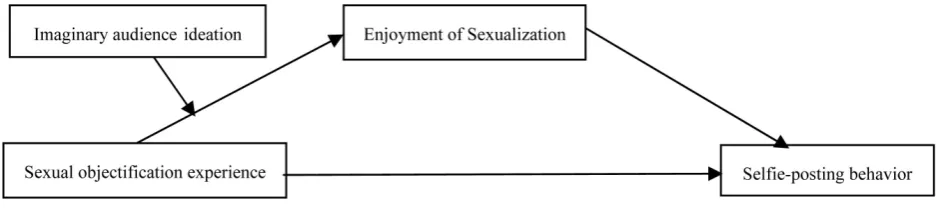
[image:3.595.64.533.607.711.2]In summary, this study intends to explore the influence of sexual objectifica-tion experience on female college students’ selfie-posting behavior, and analysis mediating role of Enjoyment of Sexualization and the moderating role of Imagi-nary audience ideation (Figure 1).
DOI: 10.4236/psych.2019.1015134 2083 Psychology
2. Methods
2.1. Participants
Participants were randomly selected from 2 universities from Jiangxi province in China. 700 questionnaires were received and the valid sample included 668 fe-male college students. Participants’ age ranged from 18 to 25 years old with a mean age of 20.57 (SD = 1.07).
2.2. Measures
2.2.1. Interpersonal Sexual Objectification Scale
The Interpersonal Sexual Objectification Scale (ISOS) was developed by Kozee, Tylka, Augustus-Horvath and Denchik (Kozee, Tylka, Augustus-Horvath et al., 2007). The scale has 15 items, which are all rated on 5-point Likert scale (1 = never, 5 = almost always). This scale includes two dimensions of physical as-sessment and sexual harassment, and it is used to measure the individual’s Sex-ual Objectification experience in interpersonal relationships in the past one year. This scale is mainly used for women. When the total score of this scale is high, women had more Sexual Objectification experience. Studies have shown that this scale has good reliability and validity in the female population (Meghan,
Gervais, Canivez et al., 2013). In this study, the Cronbach α coefficient of the
scale is 0.825. The fit index of confirmatory factor analysis is good (χ2/df = 3.478;
GFI = 0.951; TFI = 0.911; CFI = 0.973; RMSEA = 0.074).
2.2.2. Enjoyment of Sexualization Scale
The enjoyment of sexualization scale (ESS) was developed by Liss et al. (Liss, Erchull, & Ramsey, 2010), and then was translated into Chinese by Hou Fuyuan (Hou, 2018). The scale has 8 items for measuring individual level of Enjoyment of Sexualization, and it is mainly used to measure the degree that women enjoy the sexual attention from men. All the items are all rated on 5-point Likert scale (1 = very disagree, 6 = very agree). In this study, the Cronbach α coefficient of the scale is 0.809. The fit index of confirmatory factor analysis is good (χ2/df =
3.478; GFI = 0.951; TFI = 0.911; CFI = 0.973; RMSEA = 0.074).
2.2.3. Social Network Selfile-Posting Scale
The selfie posting behavior questionnaire was develpoed to measure the fre-quency of individuals post selfie on social networking sites by Fardouly J and Vartanian L R (Fardouly & Vartanian, 2015). Selfie-posting frequency was measured using one item, “How often would you say that you take and post sel-fies on SNSs?”, a total of 0 - 8 The frequency ranges from “less than once a year” to “a few times a day”. In this study, we asked two Masters of English major and one doctor of Psychology major to translate this scale into Chinese version.
2.2.4. Imaginary Audience Ideation Scale
DOI: 10.4236/psych.2019.1015134 2084 Psychology disagree, 5 = completely agree). When the total score is higher, the level of im-aginary audience ideation will become higher. Previous study has shown that this scale has good reliability and validity among college students(Yang, Song, &
Lian, 2018). In this study, the Cronbach α coefficient of the scale was 0.764. The
fit index of confirmatory factor analysis is good (χ2/df = 4.517; GFI = 0.951; TFI
= 0.911; CFI = 0.973; RMSEA = 0.076).
2.3. Data Analysis
In this study, SPSS21.0 was used to conduct descriptive analysis, correlation analysis and common method variance analysis. AMOS21.0 was used for con-firmatory factor analysis, and bias-corrected Bootstrap method was used to analysis the mediating effect of enjoyment of sexualization and the moderating effect of imaginary audience ideation.
3. Results
3.1. Common Method Variance Analysis
In this study, Harman single-factor method was used to analyze the data. The results show that there were 9 common factors being extracted and the first common factor explained 28.3% of the total variance, it was far less than 40% (Podsakoff, MacKenzie, Lee et al., 2003), so, this current study doesn’t exist ob-vious common method variance.
3.2. Description and Correlation Statistics
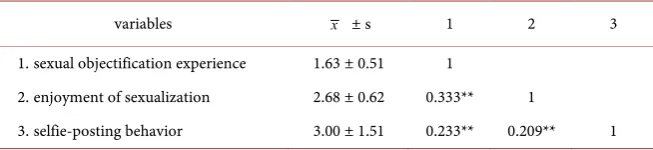
Descriptive statistics and correlation analysis were performed on each variable in the study (Table 1). The correlation analysis between variables shows that there is a significant positive correlation between Sexual objectification experience and the Enjoyment of Sexualization among female college students, and there is a significant positive correlation with the selfie-posting behavior. There is also a significant positive correlation between the Enjoyment of Sexualization and sel-fie-posting behavior.
3.3. The Moderated Mediation Model
[image:5.595.211.538.635.710.2]Firstly, the total effect of sexual objectification experience on female college stu-dents’ selfile-posting behavior is examined. It is found that the total effect of
Table 1. Descriptive analysis and correlation matrix of each variable in the study (n = 688).
variables x ± s 1 2 3
1.sexual objectification experience 1.63 ± 0.51 1
2.enjoyment of sexualization 2.68 ± 0.62 0.333** 1
3.selfie-posting behavior 3.00 ± 1.51 0.233** 0.209** 1
DOI: 10.4236/psych.2019.1015134 2085 Psychology sexual objectification experience on female college students’ selfie-posting beha-vior is significant (β = 0.25, t = 3.99, p < 0.001), and the 95% confidence interval is [0.12 0.37]. Next, we examine the moderating mediation model.
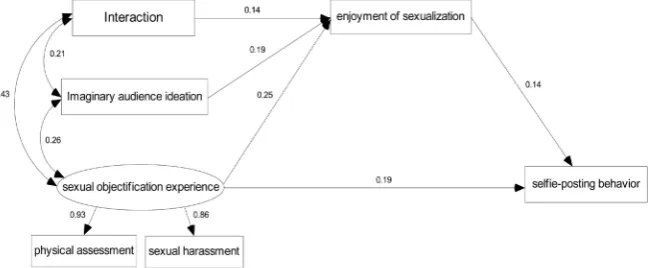
[image:6.595.213.539.557.691.2]Bias-Corrected Percentile Bootstrap Method derived from 2000 bootstrap re-samples was estimated to test for the significance of conditional direct and indirect effects. The results showed that the moderated mediating model fits well (χ2/df = 2.73, CFI = 0.99, TLI = 0.93, RMSEA = 0.049), as is shown below
(Figure 2). The sexual objectification experience can positively predict female students’ enjoyment of sexualization (β = 0.25, t = 4.06, p < 0.001), and also can positively predict female college students’ selfie-posting behavior (β = 0.19, t = 3.02, p = 0.003 < 0.05); the level of Enjoyment of Sexualization can positively predict female college students’ selfie-posting behavior (β = 0.14, t = 2.41, p = 0.016 < 0.05). So, Enjoyment of Sexualization plays a partial mediating role be-tween the sexual objectification experience and the selfie-posting behavior.
In addition to this, the interaction between sexual objectification experience and Imaginary audience ideation can positively predict the level of female col-lege students’ Enjoyment of Sexualization (β = 0.14, t = 2.42, p = 0.016 < 0.05), which indicates that the mediating role of enjoyment of sexualization is mod-erated by the level of Imaginary audience ideation.
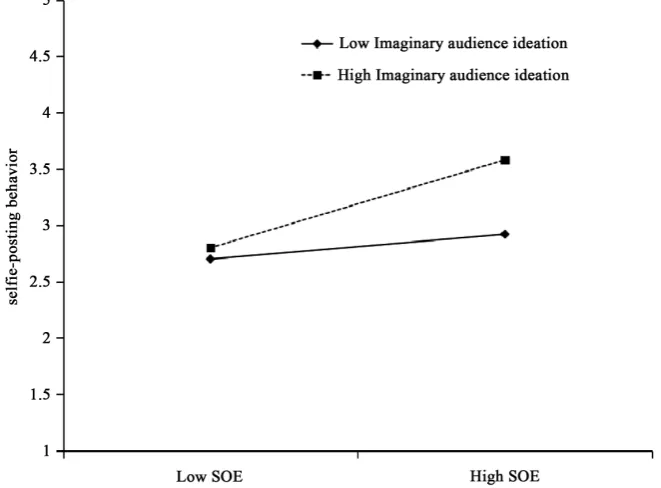
In order to clearly reveal the moderating effect of the Imaginary audience ide-ation, this study divided participants into two groups by the level of imaginary audience ideation: high group (M + 1SD) and low group (M 1SD) based on one standard deviation, and then the simple slope test is performed. The result shows that: the prediction effect of sexual objectification experience on Enjoyment of Sexualization has a significant effect in high group (β = 0.423, t = 3.083, p < 0.05), but the prediction effect is not significant in the low group (β = −0.040, t = −1.263, p = 0.205 > 0.05), as shown in Figure 3. The results show that: The Bootstrap 95% confidence interval of the mediating effect does not contain 0 at different levels of the Imaginary audience ideation, and the mediating effect rises (0.019, 0.081, 0.134) with the increasing level of the Imaginary audience idea-tion, which indicates that the mediating role of Enjoyment of Sexualization in
DOI: 10.4236/psych.2019.1015134 2086 Psychology
Figure 3. Simple slope test of the Imaginary audience ideation.
between sexual objectification experience and selfie-posting behavior will be moderated by the level of female college students’ Imaginary audience ideation, that’s to say, with the increasing of female college students’ imaginary audience ideation, the mediating effect of Enjoyment of Sexualization will be promoted.
4. Discussion
This study found that the sexual objectification experience can significantly pre-dict female college students’ selfie-posting behavior, which is consistent with the previous studies(Mabe, Forney, & Keel, 2014), this result indicates that sexual objectification experience can significantly influence individual’s selfie-posting behavior, thus verified the hypothesis H1 of this study. Female college students with more sexual objectification experience would like to pay more attention to their own body image, when they are stared by men or sexually commented, they tend to think that they have an attractive body image, and then glad to post their own photos on social networking sites to show their charming body image (Cohen, Newton-John, & Slater, 2018). So, sexual objectification experience is one of the important factors to predict female students’ selfie-posting behavior.
sa-DOI: 10.4236/psych.2019.1015134 2087 Psychology tisfied with their body image, they tend to show their own good image, which is conducive to improving themselves (Ridgway & Clayton., 2016). After expe-riencing sexual objectification, women usually mistakenly think that they have attractive body image, and then post their own photos on social networking sites. Secondly, female college students’ Enjoyment of Sexualization also plays a mediating role. When female college students’ body image can cause others’ at-tention, then they will enjoy it and have feeling of being sexualized (Langlois et al., 2000). Some studies have pointed out that Enjoyment of Sexualization will bring a series of serious social consequences (Pellizzer et al., 2016), the reason for this difference may be that women have different attitudes on being sexua-lized. Studies show that the charm of their own appearance is also the standard that men give them some evaluation on their body image, and women who meet these social ideal standards will get a greater reciprocation(Fiske, Bersoff, Bor-gida et al., 1991), so, female students often choose to post their own photos on social networking sites. Therefore, we can reduce the frequency of objectifying selfie-posting behavior by making an intervention on female college students’ Enjoyment of Sexualization.
In addition to this, the influence of sexual objectification experience on female college students’ selfie-posting behavior will be moderated by the level of Imagi-nary audience ideation, that’s to say, compared with the female college students with lower level of Imaginary audience ideation, female college students with high level of Imaginary audience ideation have a more significant prediction on selfie-posting behavior, which verified the hypothesis H3 and is consistent with the previous research (Zheng, Ni, & Luo, 2018), this result illustrated that indi-vidual differences in the mediating role between Enjoyment of Sexualization and selfie-posting behavior. Goossens, L. (1984) pointed out that people with high-level Imaginary audience ideation is very concerned about others’ percep-tions of themselves (Goossens, 1984). When experiencing sexual objectification, women are confusing “attractiveness” with “being sexualized”, then they will enjoy with their own physical appearance.
This study applies the moderating role of Imaginary audience ideation to the mediating role of Enjoyment of Sexualization and reveals that Imaginary au-dience ideation can promote mediating effect of Enjoyment of Sexualization, which enriched our recognition about the factors of the selfie-posting behavior. At the same time, the mediating role of Enjoyment of Sexualization can be mod-erated by level of female college students’ Imaginary audience ideation.
5. Conclusion
1) Sexual objectification experience has a significant effect on female college students’ selfie-posting behavior.
2) Sexual objectification experience can influence female college students’ sel-fie-posting behavior through Enjoyment of Sexualization.
DOI: 10.4236/psych.2019.1015134 2088 Psychology
Funding
General Project of Post-funded Project of Philosophy and Social Science Re-search of Ministry of Education (Project Number: 14JHQ016); General Project of Science and Technology Fund of Guizhou Province (Project Number: 15XJC880007).
Conflicts of Interest
The authors declare no conflicts of interest regarding the publication of this pa-per.
References
Aubrey, J. S. (2006). Effects of Sexually Objectifying Media on Self-Objectification and Body Surveillance in Undergraduates: Results of a 2-Year Panel Study. Journal of Communication, 56, 21-28.https://doi.org/10.1111/j.1460-2466.2006.00024.x
Barnett, M., Maciel, I., & Gerner, M. (2018). Enjoyment of Sexualization and Feminism: Relationships with Sexual Self-Schema and Psychosexual Health. Sexuality & Culture, 22, 669-684.https://doi.org/10.1007/s12119-018-9515-5
Cohen, R., Newton-John, T., & Slater, A. (2018). Selfie-Objectification: The Role of Selfies in Self-Objectification and Disordered Eating in Young Women. Computers in Human Behavior, 79, 68-74.https://doi.org/10.1016/j.chb.2017.10.027
Erchull, M. J., & Liss, M. (2013). Feminists Who Flaunt It: Exploring the Enjoyment of Sexualization among Young Feminist Women. Journal of Applied Social Psychology, 43, 2341-2349.https://doi.org/10.1111/jasp.12183
Fardouly, J., & Vartanian, L. R. (2015). Negative Comparisons about One’s Appearance Mediate the Relationship between Facebook Usage and Body Image Concerns. Body Image, 12, 82-88. https://doi.org/10.1016/j.bodyim.2014.10.004
Fiske, S. T., Bersoff, D. N., Borgida, E. et al. (1991). Social Science Research on Trial: Use of Sex Stereotyping Research in Price Waterhouse v. Hopkins. American Psychologist, 46, 1049-1060. https://doi.org/10.1037/0003-066X.46.10.1049
Fredrickson, B. L., & Roberts, T. (1997). Objectification Theory: Toward Understanding Women’s Lived Experiences and Mental Health Risks. Psychology of Women Quarter-ly, 21, 173-206.https://doi.org/10.1111/j.1471-6402.1997.tb00108.x
Gill, R. (2008). Empowerment/Sexism: Figuring Female Sexual Agency in Contemporary Advertising. Feminism & Psychology, 18, 35-60.
https://doi.org/10.1177/0959353507084950
Goossens, L. (1984). Imaginary Audience Behavior as a Function of Age, Sex and Formal Operational Thinking. International Journal of Behavioral Development, 7, 77-93.
https://doi.org/10.1177/016502548400700106
Hou, F. Y. (2018). The Effect of Media Information on College Female Students’ Self-Objectification: The Mediating Role of Enjoyment of Sexualization. Master Thesis, Changchun: Jilin University.
Kozee, H. B., Tylka, T. L., Augustus-Horvath, C. L. et al. (2007). Development and Psy-chometric Evaluation of the Interpersonal Sexual Objectification Scale. Psychology of Women Quarterly, 31, 176-189.https://doi.org/10.1111/j.1471-6402.2007.00351.x
Langlois, J. H., Kalakanis, L., Rubenstein, A. J. et al. (2000). Maxims or Myths of Beauty? A Meta-Analytic and Theoretical Review. Psychological Bulletin, 126, 390-423.
DOI: 10.4236/psych.2019.1015134 2089 Psychology
Li, J.-Y., Yin, Q., & Shen, X.-X. (2015). Effect of Sexual Objectification on Women’s Self-Objectification: Moderated Mediating Effect. Chinese Journal of Clinical Psychol-ogy, 23, 1089-1093.
Liss, M., Erchull, M. J., & Ramsey, L. R. (2010). Empowering or Oppressing? Develop-ment and Exploration of the EnjoyDevelop-ment of Sexualization Scale. Personality and Social Psychology Bulletin, 37, 55-68.https://doi.org/10.1177/0146167210386119
Liu, J. J. (2006). Commentary on Impression Management and Its Relative Research. Ad-vances in Psychological Science, 14, 309-314.
Liu, J. R., & Li, L. (2007). Preliminary Investigation on the Self-Centered Status of 93 High School Students in a School in Fuzhou City. Chinese Mental Health Journal, 21,
461-463.
Luo, Y.-J., Niu, G.-F., Kong, F.-C. et al. (2019). Online Interpersonal Sexual Objectifica-tion Experiences and Chinese Adolescent Girls’ Intuitive Eating: The Role of Broad Conceptualization of Beauty and Body Appreciation. Eating Behaviors, 4, 55-60.
https://doi.org/10.1016/j.eatbeh.2019.03.004
Mabe, A. G., Forney, K. J., & Keel, P. K. (2014). Do You “Like” My Photo? Facebook Use Maintains Eating Disorder Risk. International Journal of Eating Disorders, 47, 516-523.
https://doi.org/10.1002/eat.22254
Martin, J., & Sokol, B. (2011). Generalized Others and Imaginary Audiences: A Neo-Meadian Approach to Adolescent Egocentrism. New Ideas in Psychology, 29,
364-375.https://doi.org/10.1016/j.newideapsych.2010.03.006
Meghan, D. M., Gervais, S. J., Canivez, G. L. et al. (2013). A Psychometric Examination of the Interpersonal Sexual Objectification Scale among College Men. Journal of Coun-seling Psychology, 60, 239-250.https://doi.org/10.1037/a0032075
Pellizzer, M., Tiggemann, M., & Clark, L. (2016). Enjoyment of Sexualisation and Positive Body Image in Recreational Pole Dancers and University Students. Sex Roles, 74,
35-45.https://doi.org/10.1007/s11199-015-0562-1
Podsakoff, P. M., MacKenzie, S. B., Lee, J. Y. et al. (2003). Common Method Biases in Behavioral Research: A Critical Review of the Literature and Recommended Remedies.
Journal of Applied Psychology, 88, 879-880.
https://doi.org/10.1037/0021-9010.88.5.879
Ridgway, J. L., & Clayton, R. B. (2016). Instagram Unfiltered: Exploring Associations of Body Image Satisfaction, Instagram Selfie Posting, and Negative Romantic Relationship Outcomes. Cyberpsychology Behavior and Social Networking, 19, 2-7.
https://doi.org/10.1089/cyber.2015.0433
Sorokowski, P., Sorokowska, A., Oleszkiewicz, A. et al. (2015). Selfie-Posting Behaviors Are Associated with Narcissism among Men. Personality & Individual Differences, 85,
123-127.https://doi.org/10.1016/j.paid.2015.05.004
Swim, J. K., Hyers, L. L., Cohen, L. L., & Ferguson, M. J. (2001). Everyday Sexism: Evi-dence for Its InciEvi-dence, Nature, and Psychological Impact from Three Daily Diary Stu-dies. Journal of Social Issues, 57, 31-53.https://doi.org/10.1111/0022-4537.00200
Visser, B. A., Sultani, F., Choma, B. L. et al. (2014). Enjoyment of Sexualization: Is It Dif-ferent for Men? Journal of Applied Social Psychology, 44, 495-504.
https://doi.org/10.1111/jasp.12241
Yang, P.-F., Song, Y.-H., & Lian, S.-L. (2018). Effect of Imaginary Audience on Sense of Alienation in Adolescents: The Mediating Role of Social Anxiety. Chinese Journal of Clinical Psychology, 26, 74-77.
DOI: 10.4236/psych.2019.1015134 2090 Psychology