A Codebook Design Method for Robust VQ-Based
Face Recognition Algorithm
Qiu Chen1, Koji Kotani2, Feifei Lee1, Tadahiro Ohmi1 1
New Industry Creation Hatchery Center, Tohoku University; 2Department of Electronics, Graduate School of Engineering, Tohoku Univer-sity, Japan..
Email: [email protected]
Received September 5th, 2009; revised November 2nd, 2009; accepted November 6th, 2009.
ABSTRACT
In this paper, we present a theoretical codebook design method for VQ-based fast face recognition algorithm to im-prove recognition accuracy. Based on the systematic analysis and classification of code patterns, firstly we theoretically create a systematically organized codebook. Combined with another codebook created by Kohonen’s Self-Organizing Maps (SOM) method, an optimized codebook consisted of 2×2 codevectors for facial images is generated. Experimental results show face recognition using such a codebook is more efficient than the codebook consisted of 4×4 codevector used in conventional algorithm. The highest average recognition rate of 98.6% is obtained for 40 persons’ 400 images of publicly available face database of AT&T Laboratories Cambridge containing variations in lighting, posing, and expressions. A table look-up (TLU) method is also proposed for the speed up of the recognition processing. By applying this method in the quantization step, the total recognition processing time achieves only 28 msec, enabling real-time face recognition.
Keywords: Face Recognition, Vector Quantization (VQ), Codebook Design, Code Classification, Histogram Method
1. Introduction
After September 11th, security systems utilizing per-sonal biometric features, such as, face, voice, finger-print, iris pattern, etc. are attracting a lot of attention. Among them, face recognition have become the subject of increased interest [1], which seems to be the most natural and effective method to identify a person since it is the same as the way human does and there is no need to use special equipments. In face recognition, personal facial feature extraction is the key to creating more robust systems.
A lot of algorithms have been proposed for solving face recognition problem. Based on the use of the Kar-hunen-Loeve transform, PCA [2] is used to represent a face in terms of an optimal coordinate system which contains the most significant eigenfaces and the mean square error is minimal. However, it is highly compli-cated and computational-power hungry, making it diffi-cult to implement them into real-time face recognition applications. Feature-based approach [3,4] uses the rela-tionship between facial features, such as the locations of eye, mouth and nose. It can implement very fast, but recognition rate usually depends on the location accuracy of facial features, so it can not give a satisfied recogni-tion result. There are many other algorithms have been
used for face recognition. Such as Local Feature Analysis (LFA) [5], neural network [6], local autocorrelations and multi-scale integration technique [7], and other tech-niques [8–14] have been proposed.
Kotani et al. [15] have proposed a novel informa-tion-processing algorithm called Vector Quantization (VQ) codebook space information processing which dif-fers from the traditional ways of processing algorithm. Based on this algorithm, we have developed a very sim-ple yet highly reliable face recognition method called VQ histogram method by using a systematically organized Codebook for 4×4 blocks with 33 codevectors having monotonic intensity variation without DC component.
VQ algorithm [16] is well known in the field of image coding (compression). Input image is first divided into small blocks, which are taken as input vectors in VQ operation. Each input vector is then matched with code-vectors in a codebook by calculating distances between them. The codevector having the maximum similarity to the input vector is selected by searching the minimum distance and the index number of the selected codevector is output.
codevector, contains very effective facial feature infor-mation. By utilizing this technique, a novel face recogni-tion algorithm called VQ histogram method has been developed.
A codebook is very important since it directly affects the quality of VQ processing. In [15], a special codebook was used, which is systematically organized for 4x4 blocks with 33 codevectors having monotonic intensity variation without DC component.
In this paper, a theoretical codebook design method is proposed. At first, a systematically organized codebook is created based on the distribution of code patterns ab-stracted from facial images [21], and then another code-book with the same size is created using Kohonen’s Self-Organizing Maps (SOM) [20]. Combining the two codebooks obtained above, final optimized codebook consisted of 2×2 codevectors for facial images will be generated [22,23]. It can represent the features of the facial images more adequately. Furthermore, a table look-up (TLU) method is also proposed for the speed up of the recognition processing.
This paper is organized as follows. First, VQ histo-gram method will be introduced in detail in Section 2. Proposed codebook design method combining classifica-tion of code patterns and Kohonen’s Self-Organizing Maps (SOM) will be described in Section 3. Experimen-tal results compared with the algorithms employing original codebook or SOM codebook separately will be discussed in Section 4. Finally, we make a conclusion in Section 5.
2. Vector Quantization Histogram Method
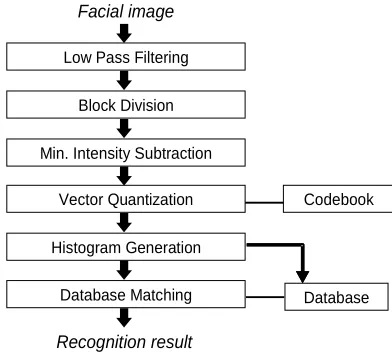
In this section, we will describe the face recognition algorithm using Vector Quantization (VQ) histogram method [15]. Figure 1 shows face recognition process steps. First, low-pass filtering is carried out using sim-ple 2-D moving average filter. This low-pass filtering is essential for reducing high-frequency noise and ex-tracting most effective low frequency component for recognition. Block segmentation step, in which facial image is divided into small image blocks (for example, 2×2) with overlap, namely, by sliding dividing-partition one pixel by one pixel, is the following. Next, minimum intensity in the individual block is searched, and found minimum intensity is subtracted from each pixel in the block. Only the intensity variation in the block is ex-tracted by this process. This is very effective for mini-mizing the effect of overall brightness variations. Vec-tor quantization is then applied to intensity-variation blocks (vectors) by using a codebook which prepared in advance. The most similar (matched) codevector to the input block is selected.
After performing VQ for all blocks divided from a fa-cial image, matched frequencies for each codevector are counted and histogram is generated. This histogram be-
Facial image
Low Pass Filtering
Block Division
Min. Intensity Subtraction
Vector Quantization
Histogram Generation
Database Matching
Recognition result
Codebook
[image:2.595.323.519.87.265.2]Database
Figure 1. Face recognition process steps
comes the feature vector of human face. In the registra-tion procedure, this histogram is saved in a database as personal identification information. In the recognition procedure, the histogram made from an input facial im-age is compared with registered individual histograms and the best match is output as a recognition result. Manhattan distance between histograms is utilized as a matching measure.
Codebook which consists of typical feature patterns for representing the features of face image is very im-portant. In [15], 32 codevectors of 4x4 codebook are cre-ated by changing the direction (8 different directions) and the range of intensity variation (Step values are 2, 6, 10, and 20). By adding one codevector having no inten-sity variation, complete codebook is organized.
In the next section, we will propose a novel codebook design method for 2×2 codebook, which can represent the features of the facial image more adequately.
3. Codebook Design
3.1 Previous Work
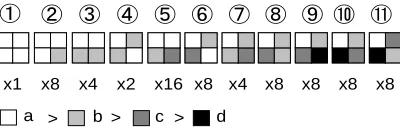
Nakayama et al. [17] proposed a complete classification method for 2×2 codebook design in image compression. Figure 2 shows all categories for the 2×2 image block patterns without considering the location of pixels. In a 2×2 block, pixel intensities are marked by alphabet ‘a’, ‘b’, ‘c’, ‘d’, and a>b>c>d is prescribed. In [17], it was found that the number of typical patterns for all 2×2 im-age block is only 11. The number of varieties in pixel arrangement of each 2×2 typical pattern is also shown in Figure 2. That means the total number of image patterns for 2×2 pixel blocks is theoretically only 75.
By the similar consideration, we classified and ana-lyzed the code patterns in the face images [21]. We found that in all filter size, the numbers of code patterns belong to categories 7, 10, and 11 are very few. It means such code patterns are almost not used in face images. Based on this result, we created a new code-book for 2×2 code patterns, and the rules of codecode-book creation are as follows.
1) Create very small intensity-variation (intensity dif-ference among the block is only 1 or 2) code patterns having monotonic intensity variation, the number of code pattern is 16 by changing the direction of intensity variation.
2) Create code patterns of category No.2, 3, 4, 5, 6, 8 and 9, and intensity differences among the blocks are set to be 3, 6, and 10.
3) Do not make code patterns of category No. 7, 10, and 11.
4) Add one code pattern having no intensity variation. Thus, complete codebook is systematically organized with 169 code patterns.
By using publicly available face database of AT&T Laboratories Cambridge [19], highest average recogni-tion rate of 97.4% is obtained. Compared to the results of 4x4 codebook which the highest average recognition rate is 95.6%, recognition rate increases by about 2%.
But in [22], it was found that such distribution of codevectors appears non-uniform and concentrated only in some of the regions. According to Maximum Entropy
Principle (MEP), the maximum entropy distribution
① ② ③ ④ ⑤ ⑥ ⑦ ⑧ ⑨ ⑩ ⑪
x1 x8 x4 x2 x16 x8 x4 x8 x8 x8 x8
[image:3.595.72.272.597.661.2]a > b > c > d
Figure 2. Categories of 2×2 code patterns. Pixel intensities are marked by alphabet ‘a’, ‘b’, ‘c’, ‘d’, and a>b>c>d is prescribed. The number of typical patterns for all 2×2 im-age block is only 11, thus total number of imim-age patterns for 2×2 pixel blocks is theoretically only 75
will be achieved when the value of a random variable (counts) equals the average. Such a non-uniform distri-bution can not satisfy the MEP, so the recognition per-formance can not be expected be best because the aver-age information content will not be maximum.
As a solution, Chen et al. [22] optimized the codebook by sorting the frequencies of all individual codevectors abstracted from facial images and excluding the code-vectors in the codebook with low frequency. This method improved recognition performance and highest average recognition rate of 98.2% is obtained by using the same face database of AT&T Laboratories Cambridge [19].
3.2 Proposed Codebook Design Method
The essence of the method in [22] is to abstract the code patterns which are most frequently used in facial images. The consideration is correct, but it ignored the differ-ences between different persons. The frequencies of some code patterns used in facial images may vary greatly for different persons and the values appear small. The code patterns selected to be used in codebook should not only present the most common features of faces, but also discriminate the difference of persons. The latter characteristic is very important in recognition task and can be evaluated by mean square error (MSE) of code patterns. Figure 3(a) shows the average histogram of 40 facial images in the database of AT&T Laboratories Cambridge [19] by using the 2×2 codebook generated according to the method proposed in [22]. In this case, the codebook size is set to be 80. The distribution is sorted in order of frequency. But the order of respective MSE values is out of accord as shown in Figure 3(b). The code patterns with high frequencies but low MSE values are useful to generate feature vectors but poor benefit recognition result. So we should consider both factors of frequencies and MSE values.
As a solution, our strategy is as follows.
Step 1: Create a systematically organized codebook by applying an improved method based on the code classi-fication including frequencies and MSE values.
Step 2: Create another codebook with the same size using Kohonen’s Self-Organizing Maps (SOM) [20].
Step 3: Combine the two codebooks obtained above to generate the final optimized codebook consisted of 2×2 codevectors.
3.3 Data Set for Codebook Design
0 20 40 60 80 100
0 10 20 30 40 50 60 70
C ode num ber
No
rm
al
iz
ed
C
ount
s
(a)
0 20 40 60 80 100
0 10 20 30 40 50 60 70
C ode num ber
N
o
rm
a
liz
e
d
M
S
E
(b)
Figure 3. (a) Average histogram of 40 facial images using codebook of size 80. (b) MSE of code patterns. The distri-bution is sorted in order of frequency in (a). But the order of respective MSE values is out of accord as shown in (b)
[image:4.595.63.276.86.397.2](a) (b)
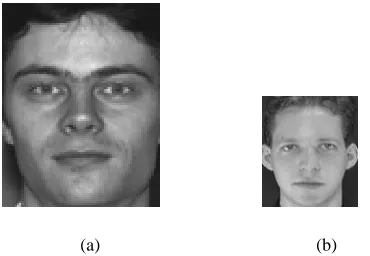
Figure 4. Data set for analysis of code patterns: (a) FERET database, (b) AT&T database
3.4 Codebook Generated by Code Classification
[image:4.595.82.267.462.590.2]In the rules No. 2 of codebook creation in Subsection 3.1, the intensity variation steps are set to be 3, 6, and 10. From the distribution of the average histogram, we can see the steps for creating code patterns are not suitable obviously. We modify the rules and propose our im-proved codebook design method.
Figure 5 shows the processing steps of the codebook generation. At first, we change intensity differences among the blocks to be from 1 to 10, and implement the rules No.1–4 in Subsection 3.1 to create an initial large codebook of size 517. Thus the code patterns can almost cover all intensity variation. Utilizing this initial code-book, VQ processing is performed for all intensity varia-tion blocks divided from the facial image in dataset de-scribed above, matched frequencies for each codevector are counted and histogram of each facial image is gener-ated. Then average histogram and the normalized fre-quencies (fi) are calculated, where M is the number of facial images. MSE ( ) (using RMSE, the square root of MSE) of individual codevectors is calculated by For-mula 1 and then the scores ( ) are computed by the weighted average between the normalized frequencies (
i e
i s
i
f ) and MSE (ei) as shown in Formula (2).
2
1 1
( ( )
M
i i i
j
e f f
M
j ) (1)
2
1 2 1
j j
i i i
k e k f k
s (2)
where ki (i=1, 2) is a weighting coefficient of
respec-tive component. The values of k1, k2 are 1, 1
respec-tively for all images used in our experiments, which determined by actual experiments.
Next, the scores ( ) of individual codevectors are sorted, and the codevectors with high scores will be ex-tracted. In this way, a systematically organized codebook is generated.
i s
3.5 Codebook Generated by Kohonen’s SOM
As a neural unsupervised learning algorithm, Koho-nen’s Self-Organizing Maps (SOM) [20] is one of the
Small intensity-variation codes
One large codebook (size 517)
systematically organized codebook
(size N)
Input image
Histogram of each image
Average histogram VQ
Extract codes with high frequency and high mean square error (MSE) by sorting Intensity-variation codes of No.
2,3,4,5,6,8 and 9 (step 1)
No intensity-variation code Small intensity-variation codes
One large codebook (size 517)
systematically organized codebook
(size N)
Input image
Histogram of each image
Average histogram VQ
Extract codes with high frequency and high mean square error (MSE) by sorting Intensity-variation codes of No.
2,3,4,5,6,8 and 9 (step 1)
No intensity-variation code
[image:4.595.311.529.526.691.2]standard algorithms used for codebook design in image coding. In this paper, SOM algorithm will also be em-ployed to generate a SOM codebook with the same size as in Subsection 3.4.
Step 1: Transform the facial images in dataset to in-tensity variation vectors, and combine all data together into one training set.
Step 2: Specify the size of the codebook to N and ini-tialize the codevectors by using continuous intensity variation vectors.
Step 3: Select a new training vector from the training set. Step 4: Find the best-matching codevector closest to the training vector.
Step 5: Move the best-matching and its neighborhood codevectors towards the training vector.
Step 6: Repeat from Step 3 until the map converges.
3.6 Generation of Optimized Codebook
After the two codebooks described above are generated, they will be combined into one codebook of size 2N. Overlapped codevectors in codebook will be excluded. Next, like the processing in Subsection 3.4, VQ process-ing is also performed for all intensity variation blocks divided from the facial image in dataset, and average histogram of all images is calculated. The scores of all individual codevectors are calculated and sorted, and the codevectors in this codebook with low scores will be excluded. Thus, the size of codebook will be decreased from 2N to N, and the final optimized codebook con-sisted of 2×2 codevectors is generated.
4. Experiments and Discussions
4.1 Database
Face database of AT&T Laboratories Cambridge [19] is used for recognition experiments. In the database, 10 facial images for each of 40 persons (totally 400 im-ages) with variations in face angles, face sizes, facial expressions, and lighting conditions are included. Each image has a resolution of 92×112. Five images were selected from each person’s 10 images as probe images and remaining five images are registered as album im-ages. Recognition experiment is carried out for 252 (10C5) probe-album combinations by rotation method.
The algorithm is programmed by ANSI C and run on PC (Pentium(R)D processor 840 3.2GHz).
4.2 Experimental Results and Discussions
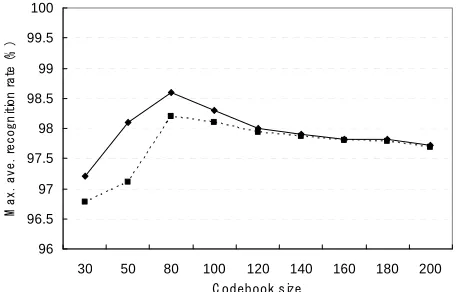
[image:5.595.311.539.373.519.2]Firstly, we discuss the codebook size N. It is necessary to choose a suitable size of codebook. As the codebook size is too large, number of codevectors increases, the resolution of the histogram may become so sensitive that noise-corrupted codevectors may significantly distort the histogram. On the contrary, if the number of codevectors is too small, the histogram can not suffi-ciently discriminate between different faces.
Figure 6 shows the comparison of the recognition
results using codebooks with different sizes from 30 to 200. The highest average recognition rates obtained in each codebook are shown here. The best performance is obtained at codebook size of 80 which is the same as in [22]. Maximum of the average rate 98.6% is achieved, which is 0.4% higher than that in [22].
We also compare the proposed algorithm with con-ventional algorithms. Figure 7 shows the recognition results. Recognition success rates are shown as a function of filter size which changes from none fil-tering to filter size of 23×23. The curve with rhombus marks stand for the average results in 252 (10C5)
probe-album combinations using the 2×2 codebook created by proposed design method. The codebook size of 80 is used here. The curve with triangle marks and circular marks refer to the results reported in [21,22] which use original 2×2 codebook. The curve with open square marks refers to the results of 4×4 codebook [15]. In the curve with rhombus marks, recognition rate first increases with increase in filter size, and then, saturated or gradually decreases. The highest average recognition rate of 98.6% is obtained at the filter size of 13×13 while that of 98.2%, 97.4% and 95.6% using codebooks in [15,21,22], respectively. It can be said
96 96.5 97 97.5 98 98.5 99 99.5 100
30 50 80 100 120 140 160 180 200
C odebook size
M
a
x
.
a
v
e
. re
c
o
g
n
iti
o
n
ra
te
(%
)
Figure 6. Comparison of recognition results in different codebook size
86 88 90 92 94 96 98 100
none 3x3 5x5 7x7 9x9 11x11 13x13 15x15 17x17 19x19 21x21 23x23
Filter size
Re
c
o
g
n
it
io
n
Ra
te
(
%
)
[image:5.595.310.536.566.706.2]CB2x2_80new CB2x2_80 CB2x2_169 CB4x4_original
that the 2×2 codebook created by proposed method represent the features of the facial images more ade-quately than conventional codebooks.
4.3 Processing Time
Processing time for single image in the face database of AT&T Laboratories Cambridge [19] is about 57 msec using a codebook of size 80, which is composed of 15 msec for pretreatment including filtering, block divi-sion, and minimum intensity subtraction, 30 msec for VQ processing, and 12 msec for database matching.
Furthermore, because a 2×2 codevector can be rep-resented by an array of 4 dimensions, by utilizing the table look-up (TLU) method in the VQ processing step, the VQ processing time can be shorten to be about 1 msec, and the total running time will be 28 msec. It means our fast recognition algorithm achieves real- time face recognition.
5. Conclusions
In this paper, a theoretical codebook design method for robust VQ-based face recognition algorithm is pro-posed. Combining a systematically organized codebook based on the classification of code patterns and another codebook created by Kohonen’s Self-Organizing Maps (SOM), an optimized codebook consisted of 2×2 code-vectors for facial images is generated. Utilizing such a codebook of size 80, the highest average recognition rate of 98.6% is obtained for 40 persons’ 400 images of the database of AT&T Laboratories Cambridge.
REFERENCES
[1] K. W. Bowyer, “Face recognition technology and the security versus privacy tradeoff,” IEEE Technology and Society, pp. 9–20, Spring 2004.
[2] M. Turk and A. Pentland, “Eigenfaces for recognition,” Journal of Cognitive Neuroscience, Vol. 3, No. 1, pp. 71–86, March 1991.
[3] L. Wiskott, J. M. Fellous, N. Kruger, and C. von der Mals-burg, “Face recognition by elastic bunch graph matching,” IEEE Transactions Pattern Analysis and Machine Intelli-gence, Vol. 19, No. 7, pp. 775–779, July 1997.
[4] R. Brunelli and T. Poggio, “Face recognition: Features versus templates,” IEEE Transactions Pattern Analysis and Machine Intelligence, Vol. 15, No. 10, pp. 1042–1052, October 1993.
[5] P. S. Penev and J. J. Atick, “Local feature analysis: A general statistical theory for object representation,” Net-work: Computation in Neural Systems, Vol. 7, No. 3, pp. 477–500, 1996.
[6] R. Chellappa, C. L. Wilson, and S. Sirohey, “Human and machine recognition of faces: A survey,” Proceedings IEEE, Vol. 83, No. 5, pp. 705–740, May 1995.
[7] S. Z. Li and A. K. Jain, “Handbook of face recognition,” Springer, New York, 2005.
[8] F. Goudail, E. Lange, T. Iwamoto, K. Kyuma, and N. Otsu, “Face recognition system using local
autocorrela-tions and multi-scale integration,” IEEE Transacautocorrela-tions Pat-tern Analysis and Machine Intelligence, Vol. 18, No. 10, pp. 1024–1028, 1996.
[9] K. M. Lam and H. Yan, “An analytic-to-holistic approach for face recognition based on a single frontal view,” IEEE Transactions Pattern Analysis and Machine Intelligence, Vol. 20, No. 7, pp. 673–686, 1998.
[10] B. Moghaddam and A. Pentland, “Probabilistic visual learning for object representation,” IEEE Transactions Pattern Analysis and Machine Intelligence, Vol. 19, No. 7, pp. 696–710, 1997.
[11] W. Zhao, “Discriminant component analysis for face recog-nition,” Proceedings ICPR’00, Track 2, pp. 822–825, 2000. [12] M. S. Bartlett, J. R. Movellan, and T. J. Sejnowski, “Face
recognition by independent component analysis,” IEEE Transactions on Neural Networks, Vol. 13, No. 6, pp. 1450–1464, 2002.
[13] S. G. Karungaru, M. Fukumi, and N. Akamatsu, “Face recognition in color images using neural networks and genetic algorithms,” International Journal of Computa-tional Intelligence and Applications, Vol. 5, No. 1, pp. 55–67, 2005.
[14] S. Aly, N. Tsuruta, and R. Taniguchi, “Face recognition under varying illumination using Mahalanobis self-orga-nizing map,” Artificial Life and Robotics, Vol. 13, No. 1, pp. 298–301, 2008.
[15] K. Kotani, Q. Chen, and T. Ohmi, “Face recognition using vector quantization histogram method,” IEEE 2002 Interna-tional Conference on Image Processing, II–105–108, 2002. [16] A. Gersho and R. M. Gray, “Vector quantization and
signal compression,” Kluwer Academic, 1992.
[17] T. Nakayama, M. Konda, K. Takeuchi, K. Kotani, and T. Ohmi, “Still image compression with adaptive resolution vector quantization technique,” International Journal of Intelligent Automation and Soft Computing, Vol. 10, No. 2, pp. 155–166, 2004.
[18] P. J. Phillips, H. Wechsler, J. Huang, and P. Rauss, “The FERET database and evaluation procedure for face rec-ognition algorithms,” Image and Vision Computing Journal, Vol. 16, No. 5, pp. 295–306, 1998.
[19] AT&T Laboratories Cambridge, “The database of faces,” at: http://www.cl.cam.ac.uk/research/dtg/attarchive/face database.html
[20] T. Kohonen, “Self-Organizing Maps,” Springer, USA, 1995.
[21] Q. Chen, K. Kotani, F. Lee, and T. Ohmi, “Face recogni-tion using codebook designed by code classificarecogni-tion,” 2006 IEEE International Conference on Signal and Image Processing, Hubli, India, pp. 397–401, December 2006. [22] Q. Chen, K. Kotani, F. Lee, and T. Ohmi, “A VQ-based
fast face recognition algorithm using optimized code-book,” Proceedings of the 2008 International Conference on Wavelet Analysis and Pattern Recognition, Hong Kong, pp. 298–303, August 2008.