In recent years significant reconstructions have
been done in the programs of genetic improvement
of farm animals. Although long-term selection for
the improvement of production traits has reached
the assumed objectives, it has also contributed to
the degradation of the so-called functional traits
(Hansen, 2000). Most production traits are
geneti-cally and phenotypigeneti-cally continuous. For this
rea-son linear models could be successfully used for
their analysis. However, even though determined
by the number of loci, some functional traits are
discontinuous variables. They are called threshold
traits. Many of them, for instance fertility,
hatch-ability or resistance to certain diseases are binary
traits.
In order to take into consideration the specific
character of threshold traits, threshold models are
used for their analysis (Gianola and Foulley, 1983;
Harville and Mee, 1984). In these models it is
as-sumed that the phenotypic categorized variability
of a trait is determined by the values of a certain
unobserved random continuous variable, called
li-ability. This variable is linked with the limits of
cat-egories (thresholds), i.e. the observation is classified
on the basis of the phenotype to a given category
if the value of the unobserved variable exceeds the
threshold of this category (also unobserved). In
the hidden scale standard deviation of the
unob-served variable is used as the unit of measurement
(Falconer, 1989). In the case of two categories it is
assumed, without the loss of generality, that the
threshold between these categories lies at point 0
(Gianola and Foulley, 1983; Misztal
et al.
, 1989).
Threshold models are an effective alternative to
data transformation. It was shown that the adoption
of such models gives more accurate estimates of
genetic parameters (Matos
et al.
, 1997; Abdel-Azim
and Berger, 1999; Dobek
et al.
, 2003).
Some of the threshold traits have a complex
genet-ic background. They may be determined to a large
extent by indirect maternal effects, both genetic and
environmental ones (Sewalem, 1989). In this paper
we extend a previously described model (Moliński
et al.
, 2003) by the genetic maternal and permanent
environmental effects. We present an algorithm for
the estimation of genetic parameters in a two-trait
The study was conducted within the research project of the Commi�ee for Scientific Research (Grant No. 5 P06 D 02019).
The algorithm of Bayesian estimation of maternal
genetic and permanent maternal environmental
variances in a two-trait binary threshold model
E. S���������
1, M. S���������
2, A. D����
1, K. M�������
1, T. S�����������
21
Department of Mathematical and Statistical Methods,
2Department of Genetics and Animal
Breeding, August Cieszkowski Agricultural University of Poznań, Poland
ABSTRACT: The paper presents an algorithm for the estimation and prediction of parameters in a two-trait binary threshold model. The model includes fixed effects and the following random effects: genetic direct additive, genetic maternal additive and permanent maternal environmental effects. The Gibbs sampling procedure was used to estimate the parameters. The algorithm was illustrated with a numerical example showing appropriateness of the proposed method.
model when the interesting traits are threshold
traits with two categories (binary traits).
MODEL
Let us consider the vector of observations
y
. The
components of
y
are taking values 0 or 1. The value
of
y
is conditioned by an unobservable vector
w
(liabilities). When
w
is positive, the phenotypic
expression
y
is 1, otherwise it is 0. For the vector
w
we are assuming the following model:
where:
and
w(k) = the N-vector of the values of the unobserved
random variable(liability) β(k) = the p-vector of fixed effects
a(k) = the q-vector of random genetic direct additive
effects
m(k) = the q-vector of random genetic maternal
tive effects
c(k) = the v-vector of random permanent maternal
environmental effects
e(k) = the N-vector of effects of residuals for the k-th
trait, k = 1, 2
I = the identity matrix of a given dimension X, Z1, Z2, Z3 = known matrices of corresponding dimensions with elements equal to 0 or 1
Further:
n = the number of observed animals
, while ni is the number of observations (equal for two traits) for the i-th animal
q = the number of all the investigated animals
v = the number of dams
For the model parameters the following
assump-tions are adopted:
Moreover:
where: A = the q x q additive relationship matrix (Quaas, 1976)
σ2
ak = the genetic direct additive variance for
k-th trait σ2
mk = the genetic maternal additive variance
for k-th trait σa
kak’ = the covariance between direct additive
effects for k-th and k’-th traits σa
kmk’ = the covariance between direct and maternal
additive effects for k-th and k’-th traits σm
kmk’ = the covariance between maternal additive
effects for k-th and k’-th traits σ2
ck = the permanent maternal environmental
variance
k = 1, 2, k’ = 1, 2
ESTIMATION OF PARAMETERS
Estimators and predictors of unknown model
parameters may be obtained by Gibbs sampling
(Sørensen
et al.
, 1995; Moliński
et al.
, 2003). In the
Gibbs sampling method, the values of the
param-eter are generated from its
a posteriori
conditional
distribution, assuming all the other parameters are
known. The generated values may be treated as a
sample from corresponding marginal distribution,
when the condition of the stationarity of the process
is satisfied. Let us adopt the following assumptions
concerning the conditional distributions for the
pa-rameters (Sørensen
et al.
, 1995):
wlj(k)| all the other parameters and y
lj(k) = 1 ~ N(xljβ(k) + z
1lja(k) + z2ljm(k) + z3ljc(k) ; 1) (le�-truncated)
wlj(k)| all the other parameters andy
lj(k) = 0 ~ N(xljβ(k) + z
1lja(k) + z2ljm(k) + z3ljc(k) ; 1) (right-truncated) where: ylj(k) = the j-th observation of the k-th trait for the
l-th animal (ylj(k)= 1or y lj(k)= 0)
xlj, z1lj, z2lj, z3lj = the lj-th row of corresponding
matrices
l = 1, 2, ..., n j = 1, 2, ..., nl
Let the inverses of
V
uand
V
cbe:
Elements of vectors
β, a, m, c
are generated from
normal distributions, the parameters of which are
determined from the formulas given below:
� � � � � � � � � ((21))
w w w , � � � � � � � � � � � � � � � � � � � � � � � � � � � � � � � � � � � � � � � � � � � �
� ((12)) , ((12)), ((12)) , ((12)) , ((21)) e e e c c c m m m a a a � � � � � �n
i ni N 1 e c Z I m Z I a Z I � X I
w�( 2� ) �( 2� 1) �( 2� 2) �(2� 3) �
) , ( ~ 2 ) ( k a q k N 0A�
a , m(k)~Nq(0,A�2mk), ()~ v( , v 2ck) k N 0I�
c , e(k)~NN(0,IN)
A V A m a m a
u � � u�
� � � � � � � � � � � � � � � � � � � � � � � � � � � � � � � � � � 2 2 2 1 1 2 ) 2 ( ) 2 ( ) 1 ( ) 1 ( 2 2 2 2 1 2 1 2 2 2 1 2 2 1 2 1 1 2 1 1 2 1 2 1 1 1 ) ( m m a m m m a m a a m a a a m m m a m m a m a a a m a a � � � � � � � � � � � � � � � � Var Var v v c c � � Var
Var I V I
c c
c � � c�
� � � � � � � � � � � � � � � � � � 2 2 ) 2 ( ) 1 ( 2 1 0 0 ) ( 0 c m 0 c
a; )� , ( ; )�
( Cov Cov � � � � � � � � � � � � � � 44 34 24 14 34 33 23 13 24 23 22 12 14 13 12 11 1 d d d d d d d d d d d d d d d d u
V
,
�i) fixed effects (
i
= 1, ...,
p
;
k
= 1, 2):
ii) genetic direct additive effects (
i
= 1, ...,
q
):
iii) genetic maternal additive effects (
i
= 1, ...,
q
):
iv) permanent maternal environmental effects (
i
=
1, ...,
v
):
where: Aii = the i-th diagonal element of A–1
Ai. = the i-th row vector of A–1
Ai, –i = the i-th row vector of A–1 with the i-th
ment skipped a(k)
–i , m(–ki )= vectors a(k) and m(k) with i-th element removed
xi, z1i, z2i, z3i = the i-th columns of corresponding matrices
The distributions for unknown components of
variance and covariance are as follows:
Vu| all the other parameters~IW4[(U1A–1U)–1, q]
where: U = [a(1), m(1), a(2), m(2)]
σ2
ck| all the other parameters~
and IW denotes inverted Wishart distribution
SIMULATION STUDY
Data
The correctness of the proposed algorithm was
checked through simulation studies. Therefore we
simulated a female-limited trait for a real pedigree.
The pedigree was taken from a layer flock and
con-sisted of 9 generations, 6 476 birds, including 5 980
with known parents, out of which 5 353 were female.
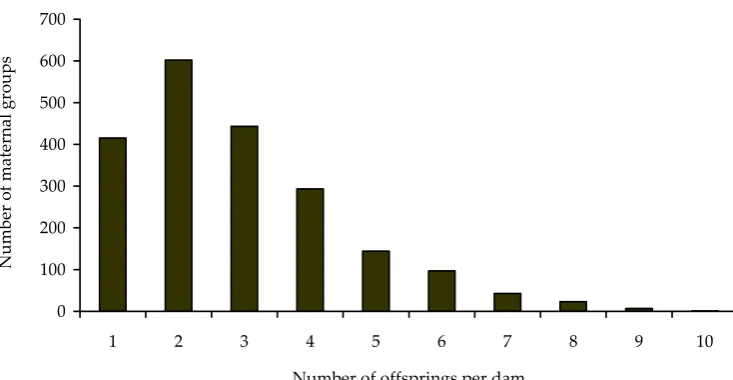
The distribution of the size of maternal groups is
given in Figure 1. For each dam two binary traits
were generated in 30 replications (corresponding to
the average number of eggs destined for hatching).
The simulation
of data was conducted in two stages.
] ) (' [ ) ' ( ) ( ) 2 ( . 14 ) 2 ( . 13 ) 1 ( . 12 ) 1 ( , 11 ) 1 ( 3 ) 1 ( 2 ) 1 ( ) 1 ( 1 1 11 1 1 ) 1 ( m A a A m A a A c Z m Z X� w z A z z a i i i i i i i ii i i i d d d d d E � � � � � � � � � � � � 1 11 1 1 ) 1 ( ) ( ' )
( i � i i�d ii �
Vara z z A
] ) (' [ ) ' ( ) ( ) 1 ( . 23 ) 1 ( . 13 ) 2 ( . 34 ) 2 ( , 33 ) 2 ( 3 ) 2 ( 2 ) 2 ( ) 2 ( 1 1 33 1 1 ) 2 ( m A a A m A a A c Z m Z X� w z A z z a i i i i i i i ii i i i d d d d d E � � � � � � � � � � � � 1 33 1 1 ) 2 ( ) ( ' )
( � � ii �
i i
i d
Vara z z A
] ) (� [ ) � ( ) ( ) 2 ( . 24 ) 2 ( . 23 ) 1 ( , 22 ) 1 ( . 12 ) 1 ( 3 ) 1 ( 1 ) 1 ( ) 1 ( 2 1 22 2 2 ) 1 ( m A a A m A a A c Z a Z X� w z A z z m i i i i i i i ii i i i d d d d d E � � � � � � � � � � � � 1 22 2 2 ) 1 ( ) ( � )
( i � i i�d ii �
Varm z z A
] ) (� [ ) � ( ) ( ) 1 ( . 24 ) 1 ( . 14 ) 2 ( , 44 ) 2 ( . 34 ) 2 ( 3 ) 2 ( 1 ) 2 ( ) 2 ( 2 1 44 2 2 ) 2 ( m A a A m A a A c Z a Z X� w z A z z m i i i i i i i ii i i i d d d d d E � � � � � � � � � � � � 1 44 2 2 ) 2 ( ) ( � )
( i � i i�d ii �
Varm z z A
) (' ) ' ( )
( (ik) i i 1 i (k) 1 (k) 2 (k) 3 (k)
E� � x x � x w �Za �Z m �Zc
1 )
( ) ( ' ) ( ik � i i �
Var� x x
)] (' [ ) ' ( )
(c(i1) � z3iz3i�d55 �1z3i w(1)�X�(1)�Z1a(1)�Z2m(1) E 1 55 3 3 ) 1 ( ) ( ' )
( � �d �
Varci z izi
)] (' [ ) ' ( )
(ci(2) � z3iz3i�d66�1z3i w(2)�X�(2)�Z1a(2)�Z2m(2) E 1 66 3 3 ) 2 ( ) ( ' )
( � �d �
Varci z iz i
2 ) ( )' ( ) ( v k k � c c 0 100 200 300 400 500 600 700
1 2 3 4 5 6 7 8 9 10
Number of offsprings per dam
[image:3.595.115.482.542.732.2]N um be r o f m at er na l g ro up s
In the first stage, elements of vector
w
were
gener-ated according to the studied model with one fixed
effect. The assumed true values of the components
of variance and covariance as well as the levels of
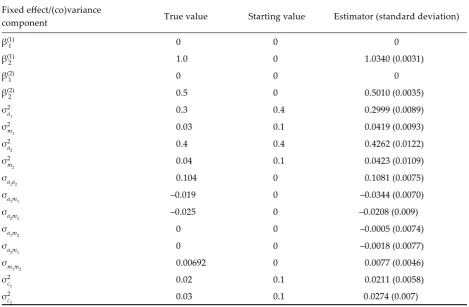
fixed effect are presented in Table 1. In the second
stage variables
y
ljwere determined based on the
pre-viously obtained vector
w
. The true values of the
parameters used in simulation are given in Table 1.
Results
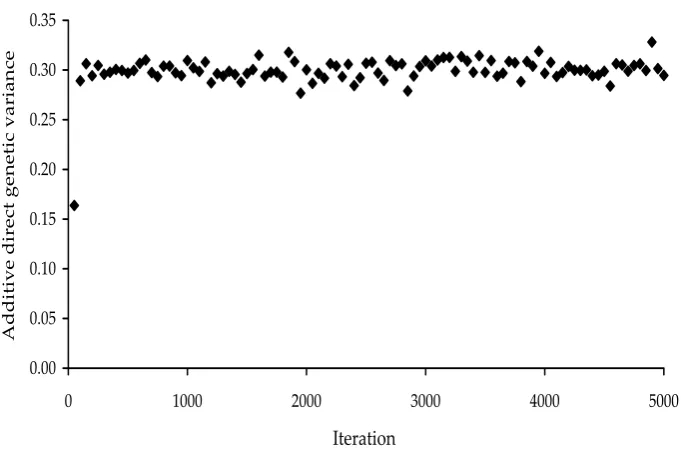
The stationarity of the process is illustrated by
random values for direct additive genetic variance
σ
2a1
(Figure 2). Similar stationarity of the random
process was observed for other parameters as well.
Point estimators and predictors of parameters of the
model were calculated as averages from 20 000
ran-dom values coming from each 50-th iterative step.
The starting values and estimates of parameters are
presented in Table 1. The obtained results indicate
the correctness of the method, the estimators of
parameters are close to the true values.
PRACTICAL IMPLICATIONS
As it was already mentioned, the proposed
algo-rithm exhibits good properties especially
concern-ing the low values of the estimated parameters.
Roughsedge
et al
. (2001) reported that the
accu-racy of the estimation of maternal variances was
positively correlated with the actual value of this
parameter.
[image:4.595.62.532.103.410.2]It needs to be mentioned that the satisfactory
re-sults were obtained for the population whose size
Table 1. The results of simulation studies – estimators of fixed effects and variance and covariance componentsFixed effect/(co)variance
component True value Starting value Estimator (standard deviation) β(1)
1 0 0 0
β(1)
2 1.0 0 1.0340 (0.0031)
β(2)
1 0 0 0
β(2)
2 0.5 0 0.5010 (0.0035)
σ2
a1 0.3 0.4 0.2999 (0.0089)
σ2
m1 0.03 0.1 0.0419 (0.0093)
σ2
a2 0.4 0.4 0.4262 (0.0122)
σ2
m2 0.04 0.1 0.0423 (0.0109)
σa
1a2 0.104 0 0.1081 (0.0075)
σa
1m1 –0.019 0 –0.0344 (0.0070)
σa
2m2 –0.025 0 –0.0208 (0.009)
σa
1m2 0 0 –0.0005 (0.0074)
σa
2m1 0 0 –0.0018 (0.0077)
σm
1m2 0.00692 0 0.0077 (0.0046)
σ2
c1 0.02 0.1 0.0211 (0.0058)
σ2
c2 0.03 0.1 0.0274 (0.007)
Note on symbols: β(k)
1 = the first level of the fixed effect for k-th trait, β(k2) = the second level of the fixed effect for k-th trait, σ2ak = the genetic
direct additive variance for k-th trait, σ2
mk = the genetic maternal additive variance for k-th trait, σakak’ = the covariance
between direct additive effects for k-th and k’-th traits, σa
kmk’ = the covariance between direct and maternal additive
effects for k-th and k’-th traits, σm
kmk’ = the covariance between maternal additive effects for k-th and k’-th traits, σ 2
ck =
and structure were not very suitable for the
esti-mation of maternal genetic environmental effects
(Figure 1). It indicates considerable universality of
the proposed method. On the other hand, further
simulation studies are required. They should
con-sider pedigrees of different size and structure.
REFERENCES
Abdel-Azim G.A., Berger P.J. (1999): Properties of thresh-old model predictions. J. Anim. Sci., 77, 582–590. Dobek A., Szydłowski M., Szwaczkowski T., Skotarczak
E., Moliński K. (2003): Bayesian estimates of genetic variance of fertility and hatchability under a threshold animal model. J. Anim. Feed Sci., 12, 307–314. Falconer D.S. (1989): Introduction to Quantitative
Genet-ics. Third edition. Longman Scientific and Technical. John Wiley and Sons, Inc., New York.
Gianola D., Foulley J.L. (1983): Sire evaluation for ordered categorical data with a threshold model. Génét. Sél. Evol., 15, 201–224.
Hansen L.B. (2000): Consequences of selection for milk yield from a geneticist’s viewpoint. J. Dairy Sci., 83, 1145–1150.
Harville D.A., Mee R.W. (1984): A mixed – model proce-dure for analysing ordered categorical data. Biometrics,
40, 393–408.
Matos C.A.P., Thomas D.L., Gianola D., Perez-Enciso M., Young L.D. (1997): Genetic analysis of discrete repro-ductive traits in sheep using linear and nonlinear models. I. Estimation of genetic parameters. J. Anim. Sci., 75, 76–87.
Misztal I., Gianola D., Foulley J.L. (1989): Computing aspects of a nonlinear method of sire evaluation for categorical data. J. Dairy Sci., 72, 1557–1568.
Moliński K., Szydłowski M., Szwaczkowski T., Dobek A., Skotarczak E. (2003): An algorithm for genetic variance estimation of reproductive traits under a threshold model. Arch. Tierzucht, 46, 85–91.
Quaas R.L. (1976): Computing the diagonal elements and inverse of a large numerator relationship matrix. Bio-metrics, 32, 949–953.
Roughsedge T., Brotherstone S., Visscher P.M. (2001): Bias and power in the estimation of a maternal family variance components in the presence of incomplete and incorrect pedigree information. J. Dairy Sci., 84, 944–950.
Sewalem A. (1998): Genetic study of reproduction traits and their relationship to production traits in White Leghorn lines. [PhD thesis.] Swedish University of Agricultural Sciences, Uppsala.
Sørensen D.A., Andersen S., Gianola D., Korsgaard I. (1995): Bayesian inference in threshold model using Gibbs sampling. Genet. Sel. Evol., 27, 229–249.
[image:5.595.124.465.81.309.2]Received: 03–07–14 Accepted a�er corrections: 03–12–29 Figure 2. The Gibbs sampling process – the first 5 000 samples for the direct additive genetic variance
2
0.000.05 0.10 0.15 0.20 0.25 0.30 0.35
0 1000 2000 3000 4000 5000
Iteration
A
d
d
it
iv
e
d
ir
ec
t
g
en
et
ic
v
ar
ia
n
ABSTRAKT
Algoritmus Bayesovského odhadu maternálně genetických a permanentních maternálně genetických
variancí ve dvouznakovém binárním prahovém modelu
V práci je předložen algoritmus pro odhad a předpověď parametrů ve dvouznakovém binárním prahovém modelu. Tento model obsahuje pevné efekty a následující náhodné efekty: genetické přímé aditivní, genetické mateřské adi-tivní a efekty trvalého mateřského prostředí. Pro odhad parametrů byl použit postup Gibbsova výběru. Algoritmus byl znázorněn na numerickém příkladě, který prokázal vhodnost navržené metody.
Klíčová slova: binární znaky; genetické efekty; Gibbsův výběr; prahový model; maternální efekty
Corresponding Author
Prof. Dr. Tomasz Szwaczkowski, Department of Genetics and Animal Breeding, August Cieszkowski Agricultural University, Wołyńska 33, PL 60-637 Poznań, Poland