A STUDY OF THE NITROPRUSSIDE ANION AND SOME OF
ITS ANALOGUES
John Reglinski
A Thesis Submitted for the Degree of PhD
at the
University of St Andrews
1981
Full metadata for this item is available in
St Andrews Research Repository
at:
http://research-repository.st-andrews.ac.uk/
Please use this identifier to cite or link to this item:
http://hdl.handle.net/10023/13557
A Study of the
Nitroprusside Anion
and some of its
Analogues
A Thesis presented fcr the degree of DCCTCR CF ÏKILCSCPHY
in the Faculty o f Science of the U niversity of S t. Andrews
John R eglinski, I,S c .
ProQuest Number: 10166297
All rights reserved
INFORMATION TO ALL USERS
The qua lity of this reproduction is d e p e n d e n t upon the qua lity of the copy subm itted.
In the unlikely e v e n t that the author did not send a c o m p le te m anuscript and there are missing pages, these will be noted. Also, if m aterial had to be rem oved,
a n o te will in d ica te the deletion.
uest
ProQuest 10166297
Published by ProQuest LLO (2017). C o pyright of the Dissertation is held by the Author.
All rights reserved.
This work is protected against unauthorized copying under Title 17, United States C o d e M icroform Edition © ProQuest LLO.
ProQuest LLO.
789 East Eisenhower Parkway P.Q. Box 1346
To Ky Parents
Codiiim nitrop ru sside ic a pctent vasod ilator and is w idely used for lowering the blood press^jre during major surgery. The p h y sio lo g ica l response is said to occur due tc a n itro sa tio n rea ctio n at the smooth muscle membrane. The use o f sodium nitrop ru ssid e has been r e str ic te d due to i t s a b ilit y to r e le a se to x ic cyanide in -v iv o and in -v itr o , which can cause severe com plications during surgery.
Chapter one is a study o f the aqueous chem istry of sodium
nitrop ru ssid e with amines and t h io ls . I t is shown that s te r ic fa cto rs play an important ro le and th at th io ls are more rea c tiv e than amines. The inform ation is used to evaluate the chemical changes expected a t the smooth muscle membrane and p o ssib le mechanisms for biochem ical a ctio n . I f the to x ic it y o f n itrop ru ssid e anion cannot be alev ia ted the
informa.tion can be used to evaluate the p o ten tia l of other inorganic complexes as p o ten tia l hypertensive agents.
Chapter two d eals with the biochem ical and medical problems associated with sodium n itrop ru ssid e therapy. The in tera ctio n o f the complex w ith human erythrocytes is explored and the reasons fo r cyanide relea se are d iscu ssed . The to x ic it y associated with the complex is shown to be im possible to erad icate com pletely and short term measures to minimise the e ffe c t s are given .
Chapter three explores the im p lications o f the n itr o sy l stretch in g frequency and how i t s value could be used to in d ica te whether a compound would be expected to ex h ib it n itrop ru ssid e-typ e chem istry. The
r e a c tiv ity o f fiv e nitrosylpentacyan om etallates w ith the simple
th is inform ation could he e a s ily acquired from the stretch in g
L'eclarr, tion
I declare that th is th esis is my oim composition, that i t is based on the resu lts of experiments carried out by me, and i t has not previously been presented for s. higher degree.
This th esis describes the resu lts of research carried out in the Department of Chemistry o f the United College of S t. Salvatcr and S t. Leonard, U niversity of S t. Andrews, under the supervision of Dr. A.H. Butler and Dr, C. G lidewell between October 1978 and September 1981.
(ii)
C e r tific a te
I h e r e b y c e r tify th at John R e g lin sk i h a s sp en t tw e lv e
te r m s o f r e s e a r c h w o rk u n d er m y su p e r v is io n , h a s fu lfille d
the c o n d itio n s o f O rd in a n ce G e n e r a l N o. 12 and R e s o lu tio n of
the U n iv e r s ity C ou rt, 1 9 6 7 , N o. 1, and i s q u a lifie d to su b m it
the a c c o m p a n y in g t h e s is in a p p lic a tio n fo r th e d e g r e e o f
D o cto r o f P h ilo so p h y .
(iii)
C e r tific a te
I h e r e b y c e r tify th a t John R e g lin sk i h a s sp e n t tw e lv e
t e r m s o f r e s e a r c h w o rk u n d er m y s u p e r v is io n , h a s fu lfille d
th e c o n d itio n s o f O rd in a n ce G e n e r a l N o. 12 and R e so lu tio n o f
th e U n iv e r s ity C ou rt, 1 9 6 7 , N o. 1, and i s q u a lifie d to su b m it
th e a c c o m p a n y in g t h e s is in a p p lic a tio n fo r th e d e g r e e o f
D o cto r o f P h ilo so p h y .
(iv)
Acknowledgements
I wish to express my gratitude to Dr. A.R. Dut 1er o,nd
Dr. C. Glidewell for th eir help and encouragement over the past three years and during the course of th is work. There are many other
people who have helped to make th is study a success for me and I would lik e to mention them here; Dr. A.R. Butler, for h is g ift o f blood; Kinewells Hospital Blood Transfusion U nit, for th eir help in removing the blood from Dr. Butler and myself; Dr. W.l.K. E isset (Department of Anaesthesia, Rinewells H ospital) and Dr. K.G. Durdon (Department of Biochemistry and microbiology, U niversity of S t. Andrews), for th eir
helpful discussions on matters medical and biochemical; Hinewells H ospital, Department of Pharmacology and Therapeutics, for the animal te stin g and the technical s t a f f of the Chemistry Department at
S t, Andrews, without whom e.ll th is would have been im possible.
There are many people who have given help and encouragement over the pa.st three years in matters other than chemistry; these people I w ill never forget; they have helped to make my stay at S t. Andrews happy and in terestin g, I owe them a. debt. I would also lik e to thank K ristine VJiecsorek for tjpiing th is work and my w ife, Susan, for the endless cups of tea and kind words. It should now be p ossib le to spend more time together.
I would lik e to thank the S cottish Hospitals Endownments Research Trust for the grant.
Content:
C e rtific a te s - C hapter I
R eaction o f Sodium N itro p ru ssid e w ith Amines a.nd T h io ls In tro d u c tio n
R e su lts and D iscussion E xperim ental
Chapter I I
R eactio n s o f Sodium N itro p ru ssid e in B io lo g ic a l Nedia In tro d u c tio n
R esu lts and D iscussion E xperim ental
Chapter I I I
Some N o tio n al Analogues o f Sodium N itro p ru ssid e In tro d u c tio n
R esu lts and D iscussion E xperim ental
Appendix I : Kezdy-Swinhourne method fo r th e d e te rm in a tio n o f a. f i r s t o rd e r r a te co n stan t (k)
Appendix I I : D etectio n and d eterm in a tio n o f cyanide u sin g c o lo rim e tric tech n iq u es
Appendix I I I ; The c a lib r a tio n o f th e cyanide s e n s itiv e e le c tro d e in aqueous s o lu tio n
R eferences C hapter I Chapter I I Chapter I I I
CHAPTER I
(CNiFeOH
(CNlFeAsO;"(C N )/e S (|
(CN^FeNO^'
(C N ^N O SC (N H ,)=
n h
^~
(CNlFeNO,CH.Ac
3-(ChD/eNHj
( ÇN ) g F i e N ( c N ) g P e nos'*'
(CNlFeNO-CH^C
@ 3—
0
[(CNlFeN-OH]
(CNÿet[JS.CH2CH(C00H)NH:
(C N lF eN = G CH=CH- N=CH^"
HO '--- '
3
-Br
SodiiM nitroprusside (sodium n itrosylp en tacyan oferrate(ll)) was f ir s t prepared by Lyon Playfair^ in 1849. He claimed that h is compound was a "New cla ss of salt" even though he had fa iled to elucidate the correct formula. His an alysis produced the em pirical formula Na5Fe^(CN)12^03. P la y fa ir's study was lim ited to
p recip itation of the anion with various cations (co p p er(ll),
n ic k e l( ll) , le a d ( ll) , z in c ( ll) , m ercury(ll), potassium and sodium), but he did document reactions of the nitroprusside anion with three nucleophiles namely hydroxide, ammonia and sulphide (the mercury counter io n ).
Stadeler^ gave the correct formula in 1868 as Na2 [Fe(CN)3N0] but i t was Hofraan^ ^ who began the rea l chemical study of the
nitroprusside anion in the la te 1890's. R ealising that the complex could react with other anions rather than cations; he spent fiv e years studying various reactions and the products (figure 1) .
3 6
Hofman^ made no attempt to explain how the reactions came about or what had happened to the n itro sy l group, but was su ccessfu l in
preparing many new pentacyanoferrate complexes, 8 11
In 1914 Cambi * discovered that sodium nitroprusside reacted with activated methylene groups. He managed to produce samples of the interm ediates and products, both organic and inorganic (figu re 2) , This scheme was among the f i r s t to show that th e.reaction a ctu a lly took place at the n itro sy l group and what subsequently happened at
10
a- fi /
OH
f i s-(CN)FeNO + CH-C-ph -UgOH/MeONa ^(CM)FeN=CH C ph
(CNliFeN=CHCph
--- (CN^FeOH
+ HON=CH C'ph
II(Figure 2)
0
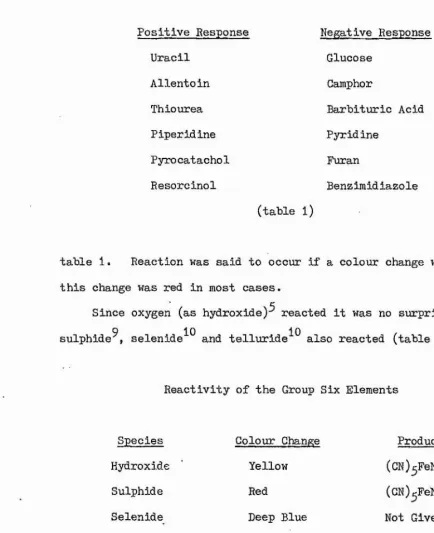
A Selection of Compounds Tested by Pavoline
P o sitiv e Response U racil A llentoin Thiourea Piperidine Pyrocatachol Eesorcinol
Negative Response Glucose
Camphor
Barbituric Acid Pyridine
Furan
Benzimidiazole (table 1)
tab le 1. Reaction was said to occur i f a colour change was observed; th is change was red in most cases.
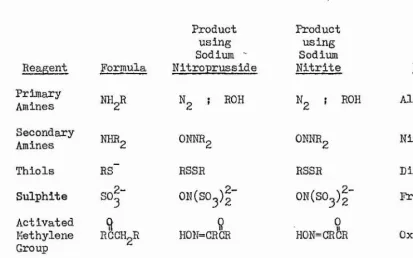
Since oxygen (as hydroxide)^ reacted i t was no surprise that sulphide^, selenide^^ and telluride^^ also reacted (table 2 ).
R eactivity o f the Group Six Elements
Species Hydroxide Sulphide Selenide Telluride
Colour Change Yellow Red
Deep Blue Black
(tab le 2)
4 “ Product (GN)^FeN02 (CN)^FeKOS^' Not Given Not Given
[image:18.615.78.512.138.670.2]9 10 13 7 attracted some a tten tio n . Sulphide , cystein e and thiourea are some of the reaction s which appear in the litera tu re (figu re i ) . The colour changes which occured with th io ls were so marked that
13
S cagliarin i in 1936 tried to develop a colorim etric te s t fo r the nitroprusside anion using cy stein e.
A ll the chemistry reported so far was carried out without any Intimate knowledge of the electron ic structure of the compound and products they were in v estig a tin g . They had r elied quite su ccessfu lly on em pirical data, molecular ra tio s and comparative chemistry.
Although Hofman had formulated the iron a s ir o n ( lll) , he had no evidence to support h is hypothesis. The question had to wait u n til the la te 1950*s early 1960's, when the techniques of infra-red, X-ray and u ltr a -v io le t spectroscopy had been developed and were used to study the nitroprusside anion.
Infra-red Data fo r Sodium Nitroprusside; KGl Disc^^
Group Frequency cm“^ HgO 3 580 (strong)
3 440 (shoulder)
GN 2 152 (strong)
NO 1 938 (strong)
%0 1 618 (strong)
M-CN 663 (medium)
Although a ll groups agreed (within experimental error) about the infra-red data (table 3) there was some disagreement about the interp retation . Gotton^^ stated that the ion is ir o n (ll), Bor^"^ defined i t as ir o n (lll); Herington^^ said i t was both. Cotton quotes Lewis^® and h is theory that i f the n itro sy l frequency is
—1 —1
between 1 575 cm and 2 000 cm" the group can be form ally w ritten as
no'*', th is is true for sodium nitroprusside leaving the iron in
oxidation sta te two. Bor omitted to d iscuss the p osition of the n itro sy l frequency.
The X-ray structure was determined in 1963 by Manoharan^^ (table 4) and shown to have approximately C^y symmetry. The iron was s lig h tly displaced out of the plane in the d irection of the n itro sy l group. The iro n -n itro sy l grouping is lin ear suggesting strongly that the structure is ir o n (ll) bound to a p o sitiv e n itro sy l group. I t is in terestin g to notice that the ir o n (ill) n itro sy l grouping would be bent.
X-ray Data fo r Sodium Nitroprusside^^
. o
Grouping Bond length % 0-.02A ’ Grouping Bond Angle
Fe—C 1.90 p_F e —Ceq 96°
CsN 1.16 _ Fe —NeO 180°
F e - N 1.63
NhO 1.13
Following on from h is X-ray study Manoharan did a molecular o rb ita l calcu lation in conjunction with a study of the electro n ic spectrum. He again form ally classed the anion as iron(I I ) with a p o sitiv e n itro sy l group. His data are shown in table 5»
20 U ltra -v io let Band Assignments for Sodium Nitroprusside
Observed frequency cm"^ Galculate frequency cm*"^ Assignment
50 000 (200 nm) 49 900 dxy-*-7T*CN
25 380 (394 nm) 25 090
20 080 (480 nm) 20 540 dxy-_»7l*N0
(tab le 5 )
21 13
Manoharan published the ^GNMR data on pentacyanoferrates (tab le 6) in 1978. This produced no su rprises, showing ax;ial and equatorial cyanides (except in two cases) in the approximate ra tio of one to four.
13GNMR Data For Pentacyanoferrates
Ion Equatorial ^^G nom Axial 13-^0 ppm
GN" 135.2
-(GNj^FeNoZ" 104.2 102.2
(GN)^FeOH^" 147,1
-(CN)fFeNO^- 146.1 145.8
(GN)^FeS05- 147.3 145.7
Fe(CN)^" 146.4
(CN^F
eNO'“+ 2NH,
R —
(CN)F
eNH
R+ Nz+ H""
+ ROH
T
he Reaction of Sodium Nitroprusside
and Primary Amines ,
The structural information compiled over the la s t two decades explains the early chem istry. The nitroprusside anion being
formulated as iron(I I ) with a p o sitiv e n itro sy l group^^*^^*^^ is d^ 7 9 13
su b stitu tion in ert; th is explains why attack by th io ls * ' and activated methylene groups^,10,12,14 the n itro sy l group and the
in teg rity of the Fe(CN)^” sp ecies in the product.
Progress in the chemistry o f sodium nitroprusside continued in i 960. Two groups of workers investigated the reaction s o f the anion
22
with amines. Kenney showed that simple primary amines reacted d ir e ctly with the complex to produce aminopentacyanoferrâ tes(I I ) in a molar ratio of two amines to one nitroprusside anion. Maltz^^
working on the same scheme showed that the organic products were the relevant alcohol and nitrogen (figure 3)•
But the rea l innovation was the advent of mechanistic stu d ies on the anion. Swinehart has made two such k in etic stu d ies; the f ir s t being the hydroxide reaction^^’^^ and the second the
hydrogen-sulphide^'^’ reaction using spectrophotometric techniques,
Swinehart's k in etic data and reaction schemes are in figu re 4 and table 7 for the sodium nitroprusside-hydroxide system. His data for the sodium nitroprusside-hydrogen sulphide system are shown in
The Reaction of Sodium Nitroprusside with Hydroxide
(CN)^FeNoZ- + OH" (CN)^FeN02H^" (1) (GlO^FeNOgH^" + OH" - f a s t ^ (crO^FeNOg" + H^O (2) (CN)^FeNO^" + HgO (CN)^FeOH|" 4- NO" (3)
32
(figure 4)
Reaction k S ^ K
(GN)^FeNO^" + 20H" (GN)^FeNOg" + HgO 0 .5 5 1.5*0.3x10"^ (GN)^FeN02“ + H2O (GN)^FeOH^" + NO2 1.4x10"^ (*) 3.1-lxlO"^
0.46 (**) * Rate constant for forifard reaction ** Rate constant for reverse reaction 400 nm; 298 K; 1.0 M Ionic Strength (NaGl)
(tab le 6)
The Reaction of Sodium Nitroprusside with Hydrogen Sulphide
(GN)cFeNO^" + SH" ■ (GN)^FeNOSH^" (4) (GN)^FeNOSH^” + 0h“ . ^^3.. ^ (CN)^FeNOS^” (5)
Reaction k (CN)^FeNO^- + SH" --- »-(CN)^FeNOSH^"
(CN)^FeNOSH^" + OH" --- ► (CN)^FeNOS^" + H^O 1.3xlO"^s"^ 540 nm; 298 K; 1.0 M Ionic Strength (NaCl)
(tab le 8)
These k in etic stud ies are explained by attack of bases at the n itro sy l group. I t is th is type of reaction which w ill be the subject of the study to be reported. Apart from the in terest in th is
particular metal n itro sy l fo r chemical reasons, there is another reason for the study. Sodium nitroprusside has become a common drug in
surgery to lower blood pressure. A more detailed description of the biochemistry w ill be given in chapter 2, but what is important in th is chapter is that the hypotensive properties are believed to be a
28 29
n itrosation reaction of a th io l group * at the smooth muscle receptors. Notice that amines are also reactive and should not be dism issed. Listed in table 9 are the s ix common amino acid residues which could be reactive to sodium nitroprusside in th eir form at pH 7
.
0,
Notice that only one th io l is present and chem ically speaking i t should be unreactive.become clear in chapter 2.
The Amino Acid Residues which may be reactive with Sodium Nitroprusside
Amino Acid Formula pIG (resid u e)
Cysteine HS-GHg- 8*33
Arginine NH2-G-NH-(CH2)^- 12.48
+NH2 Asparagine NHg-G-GHg"
0
Glutamine NH?G(GH9) -^11 ^ 2
0
' +
H istidine CHg-NH^GH-NH-GH-GHg- 6,0
+
Lysine . NH^-(GH2)^- ’10.53
( F
igu
re 6 )
VI'
Absorbance
product
Wavelength
350
400
KCNlFeNO] = 5 0
5x
10'
m
Reading every two minutes
450
10
1. Primary Amines
Reactions of sodium nitroprusside with primary amines are w ell known. Hofman^ studied the reaction of ammonia and su ccessfu lly id en tified the am inopentacyanoferrate(ll) anion as the product.
22
Kenny investigated the inorganic products of the reactions with methylamine, ethylamine, propylamine and hutylamine. He sta te s that the relevant aminopentacyanoferrate(ll) is produced. Maltz^^
investigated the organic products of sodium nitroprusside and henzylamine, butylamine, allylam ine, cyclohexamine and octylamine. In the absence of oxygen the f ir s t three produce only the respective alcohol, the others produced predominantly the alcohol but with some elim ination product (cyclohexene, 1-ootene and 2-octen e). Their proposed reaction is shown in figu re 3»
__Ejkh%lamlne
The proposed reaction of sodium nitroprusside and ethylamine, which produces ethylam inopentacyanoferrate(ll) is shown in scheme 1. The unprotonated, rather than the protonated form of the amine is viewed as the reactive sp ecies. The product of reaction is highly coloured and i t s formation is shown in figure 6, In every Instance the reaction was f ir s t order in the appearance of the product.
11
[EtNH,] ” constant H-^s"^ (6) where
= Total Amine Concentration
[EtKHg] = Concentration of the Unprotonated Amine [EtNH^] = Concentration of the Protonated Amine By varying the degree of n eutralisation and monitoring the
observed rate constant we get the resu lts shown in table 10; column fiv e is a constant (w ithin experimental error), proving the above hypothesis to be correct »
The E ffect of the Degree of N eutralisation on
Degree of Ratio [k ™ 2 ^t/~ rEtMH^I/K Neutralisation l^ &o bs/k Z l lO’^ir^s"^
0.20 0.16 1/5 9.19 5 .7
0.20 0.12 2/5 6.11 5.1
0,20 0.10 1/2 5.70 5 .7
0.20 0.08 3/5 5.20 6 .5
^00 nm; 3O3 K;- 1.0 M Ionic Strength (KCl) Sodium Nitroprusside concentration = 2.5x10"'%
(table 10)
S
cheme 1
.2
-(CNI
5F
eNO + NHB
^r.a.s
[(CN)g
F
eNO'NH,Ef]---EfOH +
TRANSIENT
SPECIES ' ^ ( C N ) F e N .^
'5 2Ks— [Si.
(CN^
Fë
3“*li
•f-|-| ^
ON-NHE
t
^
3
“ EtNH?
(CN^
F
eNlf t
(CN|
F
eOH
3—2
2
-
OH
(CNl^RaNO ^
^(CN)
F
g
NO,
(base reacti
o
n due to p
H)
* M
ixed p
r
o
duct identified u
sing. I.R.
The Reacti
o
n of Sodium Nit
r
o
p
russide and
Ra
ie Con
stant = 0 0237 M
Intercept
= 84x10 V
Plo
t of t
he Amine Dependent
K
inetic Data
fo
r the
So
dium Nit
r
o
p
russide-Ethylamine
12
Kinetic Data for the Ethylamine Kinetics of Sodium Nitroprusside
f £ l
0.99 2.42 ; 2.42 0.79 2.05 ; 2.16 0,60 1.35 ; 1.45 0.40 1.14 ; 0.95 0.20 0.61 Î
400 nm; 3^3 K; 1.0 M Ionic Strength (KCl) Sodium Nitroprusside concentration = 2.5^'xlO~^M
(table 11)
The reaction is f ir s t order in both sodium nitroprusside and tota l amine concentration. This is consistent with the b e lie f that the rate determining step is the formation of the anion-amine adduct
shown in scheme 1. The tota l amine concentration is d ir e c tly related to the concentration o f the unprotonated form of the amine, The intercept in figure 7 can be explained as the hydroxide reaction o f sodium nitroprusside^^
Calculation of the Value of due to the Hydroxide Reaction present in the Sodium Nitroprusside-Bthylamine reaction
NHgEt + H3O NH^Et + H2O -11
= 1 ,56X10
13
The amine was h alf neutralised for internal buffering purposes, therefore
[NHgEt] = [NHjEt] [NHgEt]^ = ZCNHgEt] also
pH = pK^ = 10.81 [oh"] 8 .4 x l0 " \
-1 Rate Constant the hydroxide reaction (figure 4) - 0.55M s
- Expected for hydroxide reaction
in the amine k in etics = 0.55x8.4x10””^ = 5xl0~^s"^
-4 -1 Observed Intercept = 8x10 s These two figures are the same within experimental error
(figure 8)
Swinehart * value for the rate constant of the hydroxide reaction
-1 _ i 30
is 0.55m 8 . The pK^ of ethylamine is documented as 10.807, since
the amine is half neutralised th is is also the approximate pH of solution (figure 8 ). The approximate hydroxide concentration is 8.4x10 ^M. The observed rate constant at th is concentration for the hydroxide-sodium nitroprusside reaction is 5xlO"^s"'^. This value compares favourably with that o f the intercep t.
The mechanism is believed to go via the production of the
Ab
sorb
a
nce
p
rod
u
ct
s
0-8
," " ^ r t i n g
mate
ri
al
s
04-450
400
350
W
av
elengt
h nm
KCN
l
gFeNO] =2-0x10M
Reading eve
ry two min
u
te
s.
The Re
a
ction of Sodium Nit
ropr
u
sside in Isopropy
lam
ine
Solution
Ab
sorb
a
nce
p
rod
u
ct
s
08
st
a
rtin
g ____
mate
ri
al
s
0 2
400
350
450
W
av
elengt
h nm
[{CN
lF
eNd] = 2 0 x 10
Reading eve
ry two min
u
te
s
14
ejection of a poor leaving group from a substitution in ert sp ecies. This, if i t occurred, would be an extremely slow, rate determining process with approximately amine independant k in etics. The
mechanism producing nitrogen which is an excellen t leaving group is favoured. The steps involved in th is process are hydrogen transfer
and nitrogen elim ination both of which could be expected to be rapid. No deviation from f ir s t order k in etics is observed when the amine concentration is reduced and therefore no change o f mechanism is
thought to occur. 1.2 Isopropylamine
The proposed reaction for sodium nitroprusside with isopropylamine producing a mixture of nitropentacyanoferrate(II), aquopentacyano- ferrate(II) and isopropylaminopentacyanoferrate(II) (Scheme 2 ). The
u .v .-vis ible spectral change between 350 nm and 450 nm is shown in figure 9. This is id en tical to the u .v .-vis ible spectral change in the same region for the hydroxide reaction at the same sodium nitroprusside concentration (figure 10),
Evidence that i t is the hydroxide reaction which is being observed is indicated by the wide range o f amine independant k in etics shown in table 12. The reactions were a ll f ir s t order in appearance of product.
S
c
heme 2
(CNIFeNO
2-(3)
NH,R ^ H N-CH(CH
l
ROM + N,
20H'
n
(CN|F
eOF^"
HO
F
e(CN);
(CNlFeNOf
Î
5 ^
%
(CN^FeN
H^R
(a)
T
he m
a
in
re
a
ction; P
rod
u
ction of Nit
ropent
a
cyanofe
rr
a
teII
(b) A mino
r re
a
ction in aqueou
s so
lu
tion
100
8 0
6-0
4 0
20
lOkob
s/ï
-1A
«3>
¥
A
A
A
o
(A)
(©)
-(o )
[ Isopropy
lam
ine]^.x y / M
» « t t * .
20
40
6 0
8 0 100
o y= 10
-2 A y = 10
o y = 5 x i o '
Plot of t
he Kinetic D
a
ta fo
r the Amine Indépend
a
nt Kinetic
s
o
f Sodium Nit
ropr
u
sside in Isopropy
lam
ine Solution
15
Kinetic Data for the Isopropylamine Independant K inetics of Sodium Nitroprusside
^ -— ---—
---4 .1 4.1 4 .4 Sodium Nitroprusside concentration = 2 .6 lx l0 “\
temperature == 301 K
Clsopropylaminel^^M 0.10 0.08 0.06 0.04 0.02 lo‘" \ b s A ’ ^ 6.0 5.3 4 .8 5.5 6.0
Sodium Nitroprusside concentration = 2.4?x10"^M
temperature = 303 K
rIsopropylaminel^/m 0.020 0.016 0 .004
3 -9 3 .8 3 .1
Sodium Nitroprusside concentration = 2,97x10’' temperature = 301 K
A ll reactions carried out at 400 nm and 1.0 M Ionic Strength (KCl) (tab le 12)
Some am inopentaoyanoferrate(ll) is present in low concentration in the product isolated from aqueous solution. Its presence is indicated by the comparison of the infra-red spectra of the aqueous product and the methanolic product ("pure" isopropylam inopentacyanoferrate(ll)). A weak CH stretching frequency at 2980cm”^ in the aqueous product
16
the methanolic product.
The aminopentacyanoferrate(ll) could be produced in two ways. Since the am inopentacyanoferrate(ll) can be made in methanol, possibly through a sim ilar mechanism to ethylamine, i t is reasonable to suggest that the same reaction occurs in aqueous solution but that i t is much slower than the hydroxide reaction . The hydroxide reaction is
believed to be dominant at the buffering pH. Another method of producing aminopentacyanoferrâtes is by an extension of a proven
reaction . Swinehart^^* has shown that the product of hydroxide action on sodium nitroprusside, the n itropen tacyan oferrate(ll), equilibrates with the so lven t, as ■shown below,
(GN)^FeNOg~ + H^O (CN)^FeOK^" + N0~ (3)
= 3.1x10
The fin a l spectrum in figure 10 is therefore the mixed product. It is not impossible that the small amounts of am inopentacyanoferrate(ll) is produced by a sim ilar equilibration as the solvent in th is study could
21
17
u .v ,-vis ib le spectrum.
7.
Relative Preference of Binding of Ligands to Fe(CN)g no’*' > CO > CN" > S0^~> NO^ > H^O > NH^
[(CN)rFeN0_]4- > » [(CN)e-FeOH_]^" » > [(CN) „FeNH_R]^'
where
5 2-" “2'*
NHgR = Isopropylamine
(figure 11)
It is important to rea lise that isopropylamine is capable of reacting with sodium nitroprusside to form isopropylaminopentacyanoferrate(II) even although the reaction is slow,
1.3 t-Butylamine
There is no d irect action between sodium nitroprusside and t-butylam ine. This is substantiated by the products of reaction in aqueous solution being the nitropentacyanoferrate(II) and the aquo- pentacyanoferrate(II). The aqueous reaction which occurred had
18
Kinetic Data for the t-Butylamine Independant K inetics of Sodium Nitroprusside
ft-hutylam lnel^^M 1,0 0.8 0 .6 0.4 0.2
10^%Q^g/s"^ 6.0 6.1 6,1 5.1 5.7
_o Sodium Nitroprusside concentration = 2.48x10 M
temperature = 3^3 K
r t-butyl aminel 0. 10 0.08 0,06 0.04 ^obsi
10^3[j y g -l 10.9 10.7 11.2 12.1 Sodium Nitroprusside concentration = 2.21x10" M
temperature - 302*5
A ll reactions were carried out at 400 nm and 1.0 M Ionic Strength (KCl) (table 13)
The resu lts show that the lower amine concentration range is causing a fa ster reaction even though i t has a lower temperature and sodium
nitroprusside concentration. This could only be explained as a medium e ffe c t or an error in h alf neu tralisation of the solution.
Unlike isopropylamine5 t-butylamine does not react in methanol. Steric factors must be playing an important r o le , preventing attack at the n itro sy l group. An experiment was designed to try and make
t-butylam inopentacyanoferrate(ll) (Scheme 3)* Sodium nitroprusside is allowed to react with n-propylamine (extremely dry) in the presence of excess t-butylamine in dry methanol. (The sodium nitroprusside
S
ch
eme 3
(CNIFeNO'"-^ N
H / C,H,
w
n f'
w . X
o
QJN, + C^H^OH + H
Î
(CN)
g
F
e^
T
ransi
ent,
r
eactive
sp
ecie
s
F
e,(CN),„
P
rod
u
ct isolat
ed f
rom
m
et
hanolic sol
u
tion
(CN)
F
e.N
H /C (C H
3
)
Not obs
e
rv
ed in p
rod
u
ct
Absorbanc
e
p
rod
u
ct
350
400
Wav
elengt
h nm
450
[(CNls
F
eNOl = 5
x
10
‘'
m
R
eading eve
ry t
wo m
in
u
t
e
s
R
eaction of Sodium Nit
ropr
u
ssid
e and
19
concentration.) Diazotisation of the simple amine would be expected with the subsequent production of Fe(CN)| in solution. This should be
highly reactive and attack t-butylam ine, since there should be no
propylamine or any other reactive species present. This should produce t-butylaminopentacyanoferrateCII) but the reaction does not occur and the methanolic solution turns red. Aminopentacyanoferrates(II) are yellow and insoluble in methanol as has been shoivn by the other members of th is cla ss of complex, i t is therefore proposed that t-butylamine cannot, for ster ic reasons, complex to the Fe(CN)g species.
_Ben^l^aMne
The reaction of sodium nitroprusside and benzyiamine produces benzylaminopentacyanoferrate(II) and aquopentacyanofefrate(II) and the proposed reaction is set out in scheme 4. The products of reaction is highly coloured and their formation is shown in figure 12, in every instance the reaction was f ir s t order in appearance of product. Both aquopentacyanoferrate(II) and benzylaminopentacyanoferrate(II) as "pure" products absorb strongly at 400 nm. Evidence that the scheme is
correct is supported by the amine dependant k in etics displayed in figure 13 and table 14. The data are explained by allowing the rapid formation of a nitroprusside-am ine equilibrium, A nitroprusside-am ine adduct then reacts further with another amine in the slower rate
o b s /
S
[B
enzylaminej/M
02
0-4
0 6
0 8
10
25-20
15
[ Benzyiamine ]/M^
Third Ord
e
r
- _
R a f
e C o ^ W " 2 3 9 x 1 0 M
s
Int
e
rc
ept
=1-8x10
s
Plo
ts of th
e Amine Dependant Kinetic Data fo
r
th
e Sodium Nit
ropr
u
ssid
e-Benzylamine Reaction
20
Amine dependant K inetics for Benzyiamine - Sodium Nitroprusside Reaction
[Benzylaminel^^M [Benzylamine]^M^
1.0 1,00 21.59 ; 26.24
0.8 0.64 16.90 ; 13.35
0.6 0,36 11.53 ; 11,76
0,4 0.16 5.35 ; 7.28
0.2 0.04 2,40 ;
400 nm; 301*5 K; 1.0 M Ionic Strength (KGl) Sodium Nitroprusside concentration = 2.42x10”
(table 14)
The intercept in figure 13 can again be explained as the hydroxide
reaction, but at the buffering pH of the amine ( ' ^ 9 • 5 ) It does not make a great impact on the overall reaction . No nitropentacyanoferrate(ll) is observed in the infra-red of the aqueous product. (The stretching frequencies due to NO2 are quite d is tin c tive .) The low pH (considering other amine stud ies) at which th is reaction is studied may have an
important e ffe c t on the rate determining step . At higher pH's hydrogen abstraction could not be viewed as a slow, rate determining, process.
At higher pH's the hydroxide reaction would become more prominent a lso , possib ly taking precident over the benzyiamine reaction , th is is observed with isopropylamine.
S
ch
em e 4
(CN)gFeNO'" + N
H / C H / p H
(CN)g
F
eNO - N
H / C H / p H
kg SlOLU
B
enzyiamine cataly
s
ed
(
ra t
e dete
rmining st
ep )
N+
H +pH'CH/OH
pH-CHg-NH
B
enzyiamine
21
Fe(CN)| species which must e x ist or equilibration sim ilar to that described previously and shown below for th is particular amine. HgO + (CNjgPeNHgCHgpH^- (CNjgFeOHg" + NH^CH^pH
2. Secondary and Tertiary Amines
Reactions of sodium nitroprusside with secondary and tertia ry 23
amines are not so well documented. Maltz br ie fly studied a reaction between the nitroprusside anion and diethylamine and stated that the product of reaction was N ,N ,-diethyinitrosam ine, but no mention was
12
made of the inorganic product. Scagliarin i studied pyrrole and
11
Cambi indole, 2-m ethylindole and 3-methylindole. The f ir s t three
react but not at the amine group, 3-methylindole does not even react. The organic products are said to be oximes, but again the inorganic products escape id e n tific a tio n .
Diethylamine and Triethylamine have been chosen for study as they complete a series o f simple amines, the f ir s t member of which was
ethylamine.
_Di.®^hylamjji£
The proposed reaction of sodium nitroprusside and diethylamine is shown in scheme 5. Unlike the previous amine investigated a deeply coloured intermediate is formed (figure 14) in solution (A max 580 nm), th is subsequently reacts further to produce a highly coloured product
S
ch
eme 5
2
-(CN)g Fe NO + N
HEt,
20 h
:
I
( C N l sFe N O ' N H E f ;
3
-Bl
u
e Inte
rm
ediate
\
HjOÎ
(CNL
F
eNO
O N ^ N E L (o
rganic prod
u
ct)
4—
F
e(CN)
3-# -#
(CN),FeO
H,
?
R
eaction of Sodium N it
ropr
u
ssid
e
Absorbanc
e
650
700
600
550
Wavelengt
h nm
KCNl/
eNOl = 005M
p
ropos
ed
str
u
ct
u
r
e
(CNlFe-N
^ 0^E t
" " E t
Vi
sibl
e Spect
r
um o
f th
e Blue Inte
rm
ediate (A^S^SOnm) in
t
h
e Reaction of Sodium Nit
ropr
u
ssid
e and Diet
hylamin
e
22
Absorbanc
e
p
rod
u
ct
05-400
450
350
Wav
elengt
h nm
[(CNl
F
eNOl = 2-5 x lf M
sp
ect
r
um
r
eco
rd
ed afte
r th
e
r
eaction
•
had gon
e to completion.
T
h
e P
rod
u
ct of th
e Reaction of Sodium
Nit
ropr
u
ssid
e and Diet
hylamin
e
23
is o s b e s tic p o in t a t 460 nm, p ro vin g th a t th is is indeed a sequence o f
re a c tio n s w ith v e ry d if f e r e n t r a t e s . Attem pts to is o la te th e in te rm e d ia te f a ile d and i t s s tru c tu re has had to be in f e r r e d . The
product o f aqueous re a c tio n is not th e d ie th y la m in o p e n ta c y a n o fe rra te (ll) as would be expected but th e a q u o p e n ta c y a n o fe rra te (ll) w ith no evidence
f o r any amino product being p re s e n t. In m ethanol th e re is strong evidence th a t th e b is p e n ta c y a n o fe rra te (ll) anion is the product and a g ain not th e amino p ro d u c t. Th is is an in te rm e d ia te s itu a tio n between
eth ylam in e and t-b u tly la m in e , th e amine is capable o f re a c tin g w ith the n it r o s y l group b u t unable to occupy the vacant s it e o f th e n itro sam in e
e je c te d . M alta has p re v io u s ly s ta te d th a t th e o rg an ic product was N ,N ,-d ie th y ln itro s a m in e .
The re a c tio n scheme proposed is supported by t'Cv'D sets o f amine dependant k in e t ic s . T ab le 15 and fig u r e 16 show th e k in e tic d a ta f o r
th e r is e in absorbance asso ciated w ith th e p ro d u ctio n o f th e blue in te rm e d ia te a t 580 nm.
T h is r e s u lt is exp lain ed by a llo w in g th e re a c tio n o f one
n itro p ru s s id e anion w ith one d ie th y la m in e m olecule to be th e r a te
lim it in g s te p . T h is is th e basis f o r th e b e lie f th a t th e b lu e complex b ein g observed has th e s tru c tu re shown in scheme 5*
T ab le 16 and fig u r e 16 show the k in e t ic d a ta asso ciated w ith th e f a l l in absorbance a t 580 nm th e decom position o f th e blue
in te rm e d ia te .
The k in e tic s f o r t h is process can be described sim ply as th e
24
Kinetics of Formation of the Blue Intermediate (580 nm) [Et^Mlt^M
0,27 2.33
0.50 4.36
0.53 4.22
0.60 4.35
0.80 6.34
1.00 7.63
580 nm; 3^3 K; 1.0 M Ionic Strength (KGl) ~3 • Sodium Nitroprusside concentration = 2.0x10 M
(table 15)
Kinetic Data for the Decomposition of the Blue Intermediate (580 nm)
1.00 10.6
0.80 9.6
0.50 7.7
0.27 6.7
58O nm; 303 K; 1.0 M Ionic Strength (KCl) .e concentra
(table 16)
- 3
25
6
2
0-0-2 0-4
0-6
0-8
1-0
« Data for th
e fo
rmation of th
e
inte
rm
ediate
Rate Con
st = 7-1 x 10 Ms"*
â Data for th
e decompo
sition of th
e
inte
rm
ediate
Plot of t
h
e Kinetic Data fo
r th
e Sodium
Nit
ropr
u
ssid
e - Diet
hylamin
e Reaction
26
The k in etic data (figure 16) shows that the f ir s t reaction , the formation o f the blue intermediate, is amine dependent while the second, the decomposition of the intermediate, is amine independent. This
is to be expected in a system whose one reactant is rapidly converted to an intermediate which slowly breaks down to give products.
A study of the amine dependant k in etics at 400 nm (figure 15) was unsuccessful giving resu lts which were inconsisten t and in poor agreement. Diethylamine would seem to undergo a reaction in aqueous solution when h a lf neutralised. A d e fin ite yellowing o f stock
solutions was observed over a short period of time. This reaction would seem to interfengwith the observations at 400 nm. The reaction observed at th is wavelength is believed to be the slow process
associated with the decomposition o f the blue intermediate. This is reasonable as th is reaction is believed to be the reaction of the nitrosaminefrom the intermediate (k^). The iron is d^ su bstitution inert and any process involving ligand exchange (eg. water foT nitrosamine) would be expected to be very slow and a like ly rate determining step for the overall reaction.
The fa ct that there are two reactions present could p ar tia lly
explain why Maltz^^ only achieved a 44% y ield o f nitrosam ine. Another reason for such a poor y ield could be that sodium nitroprusside
reacts with N,N -diethylam ine. 2,2 N,N,-Diethylnitrosam ine
23
27
diethylamine proved that N,N -diethylnitrosam ine was the organic product of reaction. He achieved a maximum y ield of 44%, I t is of some in terest to discover i f th is compound reacts further with more
sodium nitroprusside (explaining such a low yie ld ) .
There is no spectral evidence for a reaction between sodium
nitroprusside and N,N -diethylnitrosam ine. The only reason for Maltz achieving such a low yield is the argument put forward in the previous section about com petitive reactions. Considering both of the reactions present in diethylamine solution produce the same inorganic product
(aquopentacyanoferrate(II)) Maltz would not have suspected that there was anything wrong with h is data.
2.3 Tri-ethylamine
There is no spectral evidence for a reaction between sodium
nitroprusside and tri-ethylam ine. There is s t i l l , however, the
fam iliar hydroxide reaction caused by the buffering action of the amine. Reaction at the n itro sy l group (with amines) requires the amine to have a la b ile proton; th is is not the case with tertia ry amines and i t is subsequently no surprise that they do not react,
3. Thiols
AAbsorbanc
e
r
ed
inte
rm
ediate
05-r
eactant
s
►
500
550
600
Wav
elengt
h nm
KCN
L
F
eNdl = 20 x 1
o
'
m
Reading
s thirty s
econd
s apart
Th
e inte
rm
ediate
starts to d
ecompo
s
e befo
V-r
e t
h
e
sp
ect
r
um
can b
e p
rop
e
rly r
eco
rd
ed
Reaction of Sodium Nit
ropr
u
ssid
e and
Cy
st
eine at 540 nm
2g
A'l.
Cysteine was chosen as an example of the th io ls as i t is an e asily accessib le and safe member o f the group, i t is also important
13 b io lo g ic a lly. Cysteine has been br ie fly looked at by S cagliarin i ; he iso la ted a red product from methanolic solution and formulated i t as [ (CN)gPeNOSCHgCCOOH)
The reaction between cystein e and sodium nitroprusside is a three
stage reaction [figures 17, 18, 19). The f ir s t reaction [figure 1?) is the rapid r ise in absorbance at 540 nm associated with the
formation o f Sc a g lia r in i’s red product. The second reaction is the f a ll in absorbance at 540 nm and the subsequent r ise in absorbance at 300 nm [figure 18). There is an iso sbestic point at 400 nm indicating that these two processes are the same chemical reaction , the product of
which was not iso la ted and has been inferred. The third and fin a l reaction [figure 19) is the slow f a ll in absorbance at 300 nm which produces the eventual product of reaction: S-me
rcaptoalanyl-pentacyanoferrate[II) [hereafter thiopentacyanoferrate[II)) . Due to the pH [8 to 9) of solution l i t t le or no nitropentacyanoferrate[II) is produced v ia a hydroxide reaction . We would expect sulphur complexes to bind more strongly than water to the iron [figure 11), which
explains the high concentration of the thiopentacyanoferrate[II) in the product and the u .v .-v is ib le spectral evidence that there is l i t t le or no aquopentacyanoferrate[II) [no absorption at 400 nm by product).
g:
29O* un
> c r
Uü
s
-o
fD m
■O
U ü
—h
C L
%)
m
CL
o
C L
I I
OÛJ
C
30
Absorbanc
e
1
5-final
p
rod
u
ct
05-—
400
325
350
300
Wav
elengt
h nm
[C N I/
g
NO]
4-0
x
1
ô
"
m
R
eading eve
ry fiv
e minute
s
Fo
rmation of th
e
Final P
rod
u
ct in th
e Sodium Nit
ropr
u
ssid
e
— Cy
st
eine Reaction
31
shaken, the solution will return to the red form. This reverse process is not complete and the system eventually exhausts i t se l f . Solutions used for study were de-oxygenated using a nitrogen flush but traces of oxygen w ill always be present.
The organic product of reaction is cystine which p recip ita tes in large amounts from the reacting solution , being highly in solu b le.
I
The proposed reaction of sodium nitroprusside and cysteine to produce thiopentacyanoferrate(II) and cysteine is shown in scheme 6. The
hypothesis goes unsupported by any k in etic data, for reasons to be explained, but does not contradict any of the simple chemical evidence observed.
Reaction I. Formation of (CN)^FeN0.S.CH2.CH(C00H)NH2. Reaction I
shown in figure 17 is the formation o f Sca g lia rin i's red product.
This reaction was extremely rapid, too rapid even for stopped-flow k in etic. The reaction was complete in fiv e m illiseconds or les s.
Although i t cannot be proved at th is moment in time, i t is believed that th is reaction is unidirectional in a sim ilar fashion to the
hydrogen sulphide system.
Reaction II. Decomposition of Sca g lia rin i’s Product.
An attempt was made to in vestigate the k in etics of th is process
S
ch
eme 6
2
-HgO
V —
NO,
(CN)^
F
g
NO
+ SR
(fa st)
REACTION I
_ 3
-(CN)g
F
eNOSR
(Scaglia
inte
rini's r
rm
ediate)
ed
SR
R E A C T IO N ]!
[ ( C N )
R S S R V i
4
-^eN O (SR ),
infe
rr
ed p
rod
u
ct
1 k jS lo u j
n
N IT R O X y i
^ COM
POUND
'
--- F
e(CN)
3-SR
SR
(CN)gFeO
H,-^^(CN)g
F
eSR
2
4
-SR" ^"S-C
H,*CH(COOH)NH,
* R
ev e
rs
e
hydroxid
e
r
eaction taking place at louj p
H(TO)
32
cause of the scatter in the data can be attributed to oxygen in
solution. Although precautions are taken oxygen w ill re-d isolve quite
rapidly during the transfer operations before the k in etic in vestigation s ta r ts. But for the conditions used (300 K; 1.0 M lio n ic Strength;
Sodium nitroprusside concentration - 5%10 ^M; Cysteine concentration b.lO - 0.02M) the reaction was rapid, being complete within two minutes. This reaction cannot therefore be associated with the
d isso cia tive process producing the transient species pentacyanoferrate(II), which should be its la s t spectral change and very slow (of the order
o f tens of m inutes).
It is thought that another th io l species attacks the n itro sy l group producing a ternOfyproduct described in scheme 6. This species
would be expected to be unstable in so lid foriT) due to its crowded nature and i t is no surprise that i t could not be iso la ted . It does, however, have some structural resemblance to a transient species observed by West^^ in the ESR spectrum ((CN)gFeN0(S0g)2^ 3*
Reaction III, Formation o f Thiopentacyanoferrate(II).
The solutions used for studying th is process were exactly the
same as used in the previous sectio n . The problem of oxygen in
solution was sim ilar and no k inetic resu lts leading to a mechanistic argument were obtained. The reaction however was slow taking some th irty minutes to be complete, th is was taken as an indication that