Continuous-variable quantum digital signatures over insecure channels
Matthew Thornton,*Hamish Scott, Callum Croal, and Natalia Korolkova
School of Physics and Astronomy, University of St Andrews, North Haugh, St Andrews, Fife KY16 9SS, Scotland
(Received 23 December 2018; published 25 March 2019)
Digital signatures ensure the integrity of a classical message and the authenticity of its sender. Despite their far-reaching use in modern communication, currently used signature schemes rely on computational assumptions and will be rendered insecure by a quantum computer. We present a quantum digital signatures (QDS) scheme whose security is instead based on the impossibility of perfectly and deterministically distinguishing between quantum states. Our continuous-variable (CV) scheme relies on phase measurement of a distributed alphabet of coherent states and allows for secure message authentication against a quantum adversary performing collective beamsplitter and entangling-cloner attacks. Crucially, in the CV setting we allow for an eavesdropper on the quantum channels and yet retain shorter signature lengths than previous protocols with no eavesdropper. This opens up the possibility to implement CV QDS alongside existing CV quantum key distribution platforms with minimal modification.
DOI:10.1103/PhysRevA.99.032341
I. INTRODUCTION
Digital signatures are among the most commonly used primitives in modern cryptography [1,2]. Like a handwritten signature, a digital signature ensures the authenticity of both a classical message and its sender. Inherently involving multiple parties, the signature prevents a malevolent party from creat-ing a false message and attributcreat-ing it to an honest party; and if the signature convinces one party that a message is genuine then it should convince the other parties. Despite their far-reaching use in our modern technological infrastructure—e.g., in e-commerce, online banking, and checking the integrity of downloads—currently used signature schemes such as RSA, DSA, and ECDSA will be rendered insecure by a future quantum computer [2–5].
Quantum digital signatures (QDS) rectify this by basing their security not on computational assumptions about diffi-cult to invert “one-way functions,” but on physical properties, namely, the impossibility to perfectly and deterministically distinguish between nonorthogonal quantum states [4–16]. Quantum states are used to distribute a classical signature which is later used to sign a classical message. While modern QDS shares some similarities in implementation with quan-tum key distribution (QKD), their aims differ significantly. The most notable difference is that that—unlike QKD—in QDS any subset of the participants may be dishonest, and each dishonest player may have different goals and strategies which must be considered in a full proof.
Although the first QDS schemes [6] relied on infeasible requirements like the production and storage of large entan-gled states, there has since been a push towards practical and implementable QDS. The past decade has done away with the need for an optical multiport [7,8], quantum memory [9,10], and recent progress has even removed the need for
single photon sources [11–14] for secure QDS. More recently, the assumption of secure quantum channels for distribution of quantum states has been discarded, and modern QDS protocols take into account both the ability for a player inside the scheme to be dishonest, and the presence of an external eavesdropper [13,15,16].
As with QKD, there are two approaches to QDS, the discrete-variable (DV) and continuous-variable (CV) proto-cols. DV QDS relies on photon-number detection of ei-ther weak coherent pulses [13,14,17–19] or single photons [16,20]. The relatively low-dimensional Hilbert space re-quired for these schemes allows for an advanced level of security analysis, and their high resilience to loss allows for long distances to be bridged securely, withO(10−1) s required
to sign a 1-bit message [17,21,22]. The first QDS scheme over insecure channels required a signature length of 7.7×10⁵to
sign a 1 bit message, in a scheme similar to decoy-state QKD [13].
In contrast, CV QDS encodes information into continuous degrees of freedom, usually the phase of the electromag-netic field, and homodyne detection [11]—though a “hybrid” scheme has been proposed [12] and implemented [23], relying on both phase-encoded coherent states and single-photon detection. Despite the theoretical difficulties in dealing with large Hilbert spaces in a cryptographic setting the CV plat-form is much easier to implement, operates at room tem-perature and can use standard telecom hardware, making it thus closer to currently implemented large-scale infrastructure [24,25].
not only against dishonest participants inside the protocol but also against an external eavesdropper.
Our scheme is a fully CV QDS scheme to run over in-secure quantum channels. Remarkably, despite relaxing an assumption on the quantum channels we are able to reduce the number of quantum states required to securely sign a message. We provide a security proof and demonstrate that the success probability of an eavesdropper can be made arbitrarily small. Our security proof provides collective security against both beamsplitter attacks and entangling-cloner attacks, with the main feature of the proof being that a dishonest player may fail to correctly identify an element of the signature and yet still remain undetected to the honest parties.
The paper is structured as follows. In Sec.IIwe describe our protocol and briefly discuss the origin of its security. Our security proof follows in Sec.III, and in Sec.IVwe analyse the protocol’s performance. Finally, in Sec. V we compare our protocol to its nearest competitors and discuss potential extensions to our security analysis. Technical details and a generalization of the protocol may be found in the appendices.
II. PROTOCOL DESCRIPTION
In the simplest instance we consider a signature scheme involving three parties: a sender, Alice (A), and recipients, Bob (B) and Charlie (C). Alice wishes to send a classical 1 bit messagemto Bob, which he will forward to Charlie. This scheme may be readily extended to include more players [26] or longer messages [27,28].
In a successful QDS scheme, Bob and Charlie should be able to determine that Alice is the genuine author of m. In particular, the scheme should guard against a dishonest player—or an external Eve—from successfully forging a mes-sage which is then accepted as genuine. It should also prevent Alice fromrepudiating, which occurs if Alice convinces Bob that a message is genuine and Charlie that it is fake. The scheme should succeed if all parties are honest, except with negligible probability. We allow at most one of the players to be dishonest, noting that a three-party protocol fails trivially if more dishonest players are permitted.
We focus on the quadrature phase-shift keying (QPSK) alphabet of four phase-encoded coherent states, denoted A4
[24,25,29] distributed equally around the axis in phase space (Fig. 1, inset). In Appendix B we demonstrate how larger alphabetsANmay be incorporated into our proof and analysis.
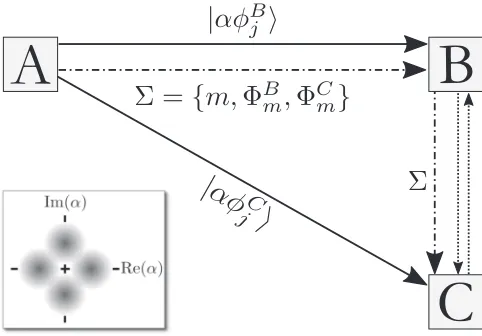
The QDS scheme is split into two stages, distribution and messaging, which can occur with significant time delay. The coherent states are sent by Alice and measured by Bob and Charlie during distribution, while during messaging Alice will send the messagemto Bob, accompanied by a classical signature. This signature is her classical declaration of which quantum states she sent. By comparing her declaration to their measurement outcomes, Bob and Charlie can determine whethermis genuine. Our protocol is outlined in Fig.1and described in full, below.
A. Distribution stage: 1–4
[image:2.608.314.555.70.238.2](1) Alice wishes to send a signed 1 bit messagemto Bob and Charlie. For each possiblem, Alice creates two different
FIG. 1. Schematic of three-party QDS. The parties share quan-tum distribution channels (solid lines), public classical channels (dot-dashed lines), and Bob and Charlie share an encrypted classical channel (dashed lines). Initially, senderA distributes her classical signatures{B
m, C
m}via the quantum states|αφ B,C
j by encoding into
the QPSK alphabet. Then she sends a messagemto recipients Bob (B) and Charlie (C), with the corresponding signatures, through the public classical channel.BandCuse the signatures to authenticatem. The encrypted classical channel is used during the Symmetrization step of the protocol. Inset: the QPSK alphabet of coherent states with amplitudesα∈C.
classical strings, one for Bob and one for Charlie,(B,C) m =
{φ(B,C) j }
L
j=1 where the φj are phases chosen uniformly at
random from our alphabetA4= {1,i,−1,−i}. The signature
lengthLis an integer suitably chosen to ensure security. (2) For each elementφ(Bj ,C)Alice forms the corresponding coherent state |αφ(Bj ,C) and sends it to B,C, Fig. 1. The amplitudeαis chosen to optimise security. By analogy with classical digital signatures, we may think of the (Bm,C) as
Alice’s private keys, and the corresponding sequences of quantum states as her public keys. In contrast to our previous QDS protocol we take B
m=Cm [11,13]. Since coherent
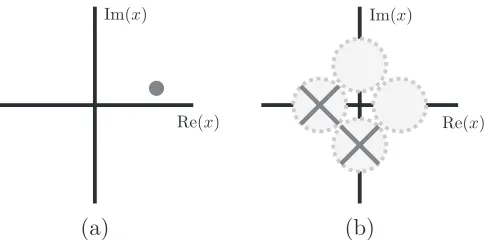
states are nonorthogonal an eavesdropper on the quantum channel cannot gain full information about Alice’s signatures. (3) Bob and Charlie measure the phases of the received states by heterodyne detection [24], and keep a record of the alphabet states which are most incompatible with their measurements, Fig. 2. For example, if Bob measuresb∈C
with Re(b)>0 and Im(b)>0 then he will “eliminate” states
| −αand| −iα since these are the least likely of Alice’s sent states to generate this outcome. Recipients Bob and Charlie each now possess an “eliminated signature” [7,8,11] of length L containing a record of which states were elimi-nated at each position in the sequence. Since measurements are performed immediately on receipt of the states, no quan-tum memory is required [7].
FIG. 2. After measuring the phase of a distributed coherent state, Bob and Charlie eliminate the two alphabet states which were least likely to have given that outcome. (a) An individual measurement outcomexwith Re(x)0, Im(x)0. (b) The corresponding elimi-nated signature element. The states| −α,| −iαare the least likely from our alphabet to givex, so they are eliminated.
against repudiation. Bob and Charlie each now possess an eliminated signature in two halves, those elements received directly from Alice and those received during this Sym-metrization step.
B. Messaging stage: 5–7
(5) Messaging can occur at any time after distribution. To sign m, Alice sends to Bob the classical triplet = (m, Bm,
C
m), consisting of the message mand classical
in-formationBm,Cabout the corresponding sent quantum states.
(6) Bob compares elements of(B,C)
m with the
correspond-ing elements of his eliminated signatures, and counts the num-ber of mismatches. A mismatch occurs if Bob has eliminated a state which Alice claims to have sent. Note that even when all parties are honest there will still be some probability of mismatch as the alphabet states are not orthogonal, so if Alice sent|α, Bob or Charlie can still measure Re(x)<0. If there are fewer thansBL/2 mismatches, for thresholdsB, between
each half of his eliminated signature and Alice’s declaration, then Bob acceptsmas genuine. Otherwise, he rejects it and the protocol aborts.
(7) Bob forwards to Charlie, who similarly checks for mismatches. Charlie accepts the message if there are fewer thansCL/2 mismatches between elements ofand each half
of his eliminated signature. If Charlie also accepts m, then the protocol has succeeded; otherwise, it aborts. The crucial parameters in steps 6 and 7 are thes(B,C), which can be chosen
to optimize security.
III. SECURITY PROOF AND ATTACK ANALYSIS
To be secure, a QDS protocol must abort when a forging or repudiation attack is attempted. From steps 6 and 7 in the protocol, the protocol aborts if the number of mismatches observed by Bob or Charlie is abovesBL/2 orsCL/2,
respec-tively. We now demonstrate that a forgery or repudiaton attack will induce such a large number of mismatches, so the attacks are therefore detectable. We also show that in the absence of an attack the protocol succeeds, that is, it is robust. The protocol fails if it allows a forging or repudiation attack, or if it aborts even when all parties are honest. The proofs of
robustness and security against repudiation from Ref. [11] can be directly applied to our protocol. For completeness we reproduce the key results in Eqs. (2) and (3) below, and full proofs may be found in Ref. [11]. Importantly, the security against forgery requires an alternative analysis and this will be one of the main results presented in the paper.
A. Robustness
A QDS protocol is calledrobustif it succeeds when all par-ties are honest, except with a negligible probabilityεrob. Since
the alphabetA4of distributed states is highly nonorthogonal,
even when all parties are honest there is still a probability perr that a recipient eliminates the state which Alice sent.
However, perris predictable and can be estimated during the
protocol. For a pure loss channel with transmissionT, the rate perrcorresponds to the probability of a heterodyne
measure-ment outcome Re(x)<0 when Alice sent the coherent state
|αwithα∈R0,
perr=
1 2erfc
T 2α
. (1)
With mismatch rateperr, we may use Hoeffding’s inequalities,
Appendix A, to bound the probability that Bob or Charlie detect more thans(B,C)L/2 mismatches as
εrob2 exp[−(s(B,C)−perr)2L] (2)
provided thats(B,C)>perr. Equation (2) is derived in Ref. [11]
using Eq. (A3). The probabilityεrob of the protocol aborting
even when all parties are honest can thus be made arbitrarily small by choice ofL.
B. Security against repudiation
Alice succeeds in a repudiation attack if she convinces Bob that a message is genuine and Charlie that it is fake. During messaging, Alice will declare ˜Bmand ˜
C
mchosen with the aim
that there should be fewer thansBL/2 mismatches with each
half of Bob’s signature, but more thansCL/2 mismatches with
at least one of Charlie’s halves.
Intuitively, security against repudiation arises from Sym-metrization (step 4 of the protocol). Since the swapping occurred in secret from Alice, she does not know who holds a particular eliminated signature element. Alice is therefore unlikely to succeed in creating a declaration which will pass Bob’s test but fail Charlie’s.
The probability of successful repudiation is
εrep2 exp
−(sC−sB)2
L 4
, (3)
provided that sC>sB. Equation (3) is derived fully in
Ref. [11] using Eqs. (A2) and (A3). The probabilityεrep of
successful repudiation can thus be made arbitrarily small by choice ofL.
C. Security against forgery
is accepted as genuinely having originated with Alice. The messagem must have an appended signatureC
m, and so a
forger’s goal is to determine a fake signature which will be ac-cepted. Since Bob already knows half of Charlie’s eliminated signature elements—those which Bob himself forwarded— and since it is easier to convince Charlie than Bob to accept a fake signature (sC >sB), the most dangerous forger is a
dishonest Bob. A bound for the probability that Bob succeeds in a forging attack provides an automatic upper bound against any other forging player.
Since the emphasis of earlier papers [6–11] was on in-ternal dishonesty between participants, eavesdropping on the quantum channels was not permitted. A dishonest Bob had only his states received from Alice with which to gain infor-mation about Charlie’s outcomes. However, Alice distributed identical signatures Bm=
C
m to Bob and to Charlie, so in
effect Bob had a perfect copy of Charlie’s signature. Now, to mitigate against an eavesdropping Bob, we chooseB
m=Cm,
so that even though dishonest Bob can gain some additional information on Charlie’s quantum states, Bob now has a less perfect copy of Charlie’s states than he did previously [13].
Dishonest Bob will eavesdrop on the quantum states as Alice is distributing them to Charlie, and will try to deter-mine what he can declare in C
m to not cause a mismatch.
Defining pe as the probability that Bob will induce a
mis-match on a given signature element, andsCas Charlie’s
mis-match threshold, the probability εforg of a successful forging
attack is
εforg2 exp[−(pe−sC)2L], (4)
which is derived via Eq. (A2) by analogy with Ref. [11]. Since sCpecan be freely chosen, we must now calculate a lower
bound on the probability pe.
D. Calculatingpe
Our main contribution is a bound forpe, which fully takes
into account the ambiguity in Bob’s declaration. This ambigu-ity stems from the following. Because Charlie eliminates two states, Fig.2, there are two possible states fromA4which Bob
can declare without introducing a mismatch. Therefore, the probability that Bob misidentifies an element of the eliminated signature is not equivalent to the probability of mismatch. We allow for this discrepancy by working directly in terms of mismatch probability pe via an error variable E, and in
the proof we highlight quantities which are affected by the degeneracy in Bob’s possible declaration. In what follows we explicitly consider the QPSK alphabet A4. Our security
proof readily generalises to larger alphabets AN with N=
6,8,10, . . ., and the required modifications to the proof are discussed in AppendixB.
Let Xj,1 jL/2 be an element of the half of C’s
eliminated signature which he received directly from Alice and on which Bob will attempt to gain some information. We writeXj= {x
j 1,x
j
2}, wherex j 1 andx
j
2describe the states from
A4which Charlie eliminated. Thex j 1andx
j
2must be adjacent
inA4, e.g., ifx j
1 =1, thenx j
2 = ±i. Let the stringY = {yj}j
be Bob’s declaration, subject to an unspecified but optimal POVM and classical strategy.
A mismatch occurs whenyj =x j
1 or yj =x j
2. To analyze
the probability that this occurs we define a variableEj, which
takes value 1 if a mismatch occurs at position j and 0 oth-erwise. Then Bob’s average mismatch rate pe=P(Ej=1).
BecauseEjcan take one of two values, the Shannon entropy
H(Ej) is equal to the binary entropy h(pe)= −pelogpe−
(1−pe) log (1−pe).
Consider the conditional entropy H(Ej,x j 1,x
j
2|yj), which
is related to the uncertainty about whether a mismatch has occured under Bob’s declarationyj. Using the chain rule for
conditional entropies [5] we write
HEj,x j 1,x
j 2|yj
=HEj|x j 1,x
j 2,yj
+Hx1j,x2j|yj
. (5)
Since a choice ofyj,x1j andx2j uniquely determines Ej, the
first term on the right-hand side of Eq. (5) must equal 0, so we have
HEj,x j 1,x
j 2|yj
=Hx1j,x2j|yj
. (6)
Using the chain rule for conditional entropies once more on the left-hand side of Eq. (5),
HEj,x1j,x2j|yj
=Hx1j,x2j|Ej,yj
+H(Ej|yj)
Hx1j,x2j|Ej,yj
+H(Ej), (7)
where we can write the upper bound because conditioning cannot increase entropy.
Combining Eqs. (6) and (7),
Hx1j,x2j|yj
Hx1j,x2j|Ej,yj
+H(Ej)
=(1−pe)H
x1j,x2j|E =0,yj
+peH
x1j,x2j|Ej=1,yj
+H(Ej). (8)
Now because of the ambiguity in Bob’s declaration, i.e., because there are two eliminated signature elements con-sistent with a given Ej=0 and yj, and since we can
per-mute and relabel x1j↔x2j, we have H(x1j,x2j|Ej =0,yj)
log24=2. We also use the fact that Charlie eliminates ex-actly half of the alphabet to write H(x1j,x2j|Ej=0,yj)=
H(x1j,x2j|Ej=1,yj). Therefore,
Hx1j,x2j|yj
2+H(Ej)=2+h(pe). (9)
From the definition of mutual information [5], we have
Hx1j,x2j|yj
=Hx1j,x2j−Ix1j,x2j:yj
3−χx1j,x2j :yj
, (10)
where we have used that the Holevo information χ maxi-mizes the mutual information I over all POVMs, and that H(x1j,x2j)=log28=3 because of the four possible elimi-nated signature elements, and an additional factor of 2 due to relabeling.
Combining Eqs. (9) and (10) we arrive at
h(pe)1−χ
x1j,x2j:yj
, (11)
which is one of the main results of the paper. This inequality can be implicitly solved for Bob’s mismatch ratepe, and
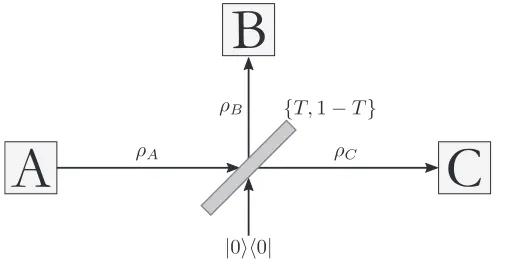
FIG. 3. Schematic of the beamsplitter attack. Alice distributes her stateρAthrough a lossy channel with transmissionT, modeled
as a{T,1−T}beamsplitter with vacuum input at the fourth port. Bob and Charlie collect their states from the reflected and transmitted ports, respectively.
E. Attack analysis
Equations (4) and (11) determine the required signature length to provide security of our scheme in any situation where χ can be bounded. To gain some insight into the behavior of our protocol, in what follows we restrict Bob to two classes of attack, the beamsplitter attack and the entangling-cloner attack, which correspond to a pure-loss (ξ =0%) and thermal-loss (ξ =0%) channel, respectively. In an implementation it is the measured excess noise ξ at the receiver which will determine the attack class that Bob is assumed to have performed [25]. In Sec.Vwe remark about the optimality of these attacks.
By definition Bob’s Holevo information is [5]
χx1j,x2j:yj
=SρBj
−
x1j,x2j
px1j,x2jSρx
j 1,x
j 2
B
, (12)
withS(.) the Von Neumann entropy,ρBj Bob’s totala priori
mixed state at positionj, andρx
j 1,x
j 2
B Bob’s state conditioned on
Charlie’s jth eliminated signature elementXjbeing{x1j,x2j}.
1. Beamsplitter attack
We first consider the so-called beamsplitter attack, Fig.3, in which a purely lossy channel is modeled using a beam-splitter with transmission T and vacuum input at the fourth port, and in which Bob collects his stateρBjfrom the reflected
output port.
Letting|αkαk| withk=1,2,3,4 be an element ofA4,
Alice’s average input state may be written as
ρj A=
1 4
4
k=1
|αkαk|, (13)
which is transformed by the beamsplitter with vacuum input to become
ρj BC =
1 4
4
k=1
|√TαkC
√
Tαk| ⊗ |
√
1−TαkB
√
1−Tαk|.
(14)
FIG. 4. A single eliminated signature element corresponds to an entire phase quadrant as an allowed region for the phase measure-ment outcome. (a) An eliminated signature elemeasure-ment. (b) The elemeasure-ment can be generated by any heterodyne measurement outcome in the shaded region.
Then Bob’sa prioristateρBjis given by
ρj B=
1 4
4
k=1
|√1−TαkB
√
1−Tαk|, (15)
from which the first term in Eq. (12) can be calculated. Charlie performs heterodyne measurement on his half of ρj
BC and receives outcome cj∈C. The state ρ j
BC is
trans-formed as
ρj B|c=
1 4
4
k=1
c|√Tαk
√
Tαk|c|
√
1−TαkB
√
1−Tαk|
= 1
4
4
k=1
p(c|αk)|
√
1−TαkB
√
1−Tαk|, (16)
where p(c|αk)=1/πexp (−|c−
√
Tαk|2) is the probability
of Charlie measuring cwhen the state |√Tαk is received,
and|cis a coherent state centered onc∈C.
On average, each eliminated signature element Xj=
{x1j,x2j} is equally likely, so for Eq. (12) it will suffice to calculate S(ρx
j 1,x
j 2
B ) for just one. An element Xj is uniquely
determined by the quadrant in which the outcome c lies, Fig.4. Using Eq. (16) we may write
ρx1j,x2j B =
ρj B|cd
2c, (17)
where the integration is performed over an entire quadrant in phase space. The statesρBjandρx
j 1,x
j 2
B from Eqs. (15) and (17)
can be inserted into Eq. (12) and the mismatch ratepecan now
be calculated.
2. Entangling cloner attack
The thermal loss channel exhibits both loss and excess noise and can be modeled by a beamsplitter with a thermal stateρt h( ¯n) input into the fourth port, where ¯nis the average
[image:5.608.44.560.68.202.2] [image:5.608.48.310.71.203.2]FIG. 5. Schematic of the entangling cloner attack. Bob replaces the vacuum input into the beamsplitter by one of his TMSV modes, and collects the output. Correlations between the output and his retained TMSV mode provide him with an additional advantage, while the attack manifests itself just as thermal noise in the channel. Charlie measures an excess noiseξabove shot noise.
two-mode squeezed vacuum (TMSV) state, and one of the two entangled modes is injected into the fourth port of the beamsplitter, Fig. 5. Once again he collects the reflected output, and performs an optimal collective measurement on his two modes. Since the TMSV state purifies the thermal state [24], this attack manifests itself just as thermal noise in the channel.
After the beamsplitter, Bob holds a two-mode state which is entangled with Charlie’s. The full state is
|j B1B2C =
ˆ DB1(
√
1−Tα) ˆDC(
√
Tα)
∞
m=0
Gm
√
m!
√
Taˆ†B
1−
√
1−TaˆC†
m
|0B1|mB2|0C, (18)
where Gm=(tanhr)m/coshr; ¯n=sinh2r is the average
number of thermal photons in one mode of the input TMSV state; and ˆD(α)=exp (αˆa†−α∗aˆ) is the displacement
oper-ator. After performing heterodyne measurement on modeC and receiving outcomec∈C, the stateρBj|c( ¯n)= c||c can be used to calculate the Holevo information as before via Eqs. (12) and (17). The states|B1B2Candρ
j
B|c( ¯n) are derived
in AppendixC.
Finally, we note that Charlie’s probability of measuring c∈Cwhen Alice sends state|αkthrough the channel with
transmissionT and thermal noise inputρt h( ¯n) is [25]
p(c|αk)( ¯n)=
exp
−|c−√Tαk|2
1+(1−T) ¯n
π[1+(1−T) ¯n], (19) and so the excess noise measured at Charlie is ξ = (1−T) ¯n/2. From Eq. (19) we can calculate perr(ξ) as the
probabilityP(Re(c)<0|α)( ¯n) that Charlie’s heterodyne out-put eliminates the sent state, analogously with Eq. (1).
F. Signature lengthL
Now that we have calculated pe and perr for both
beam-splitter and entangling-cloner attacks, the probabilityεfailthat
the protocol fails can be found by calculating via Eqs. (2), (3), and (4) the probability that the protocol is not robustεrob; the
FIG. 6. Signature lengths L required to securely sign a 1 bit message, for channel transmissionT and coherent state amplitude
α. The length L→ ∞ as T →0, but remains modest at the
re-alistic distances denoted by vertical gridlines. Left gridline: T =
0.20 (approximately 20-km fiber); right gridline:T =0.48 (approx-imately 1-km fiber). Solid:ξ=0% (beamsplitter attack). Dashed: ξ=2% (entangling-cloner attack). The required signature lengthL
is strongly influenced by the choice ofα.
probability of successful repudiationεrep; and the probability
of successful forgeryεforg. For a figure of merit, we assume
that the protocol can fail in any of these ways with equal probability and set
εfail=εrob=εrep=εforg. (20)
By choosing sB =perr+(pe+perr)/4 and sC =perr+
3(pe−perr)/4 we satisfy the second two equalities, and so
the overall probability of failure becomes
εfail2 exp
−(pe−perr)2
L 16
, (21)
provided that pesC sBperr. The security parameter
g=pe−perr quantifies the advantage that an honest party
holds over a dishonest party, and if g>0, then our QDS protocol can be made arbitrarily secure by an appropriate choice ofL. The signature lengthL required to sign mto a security levelεfailmay thus be calculated using Eq. (21).
IV. PERFORMANCE OF THE PROTOCOL
The main figure of merit for a QDS protocol is the signature length, L, required to sign a 1 bit message to a given security levelεfail. We choose the probability of failure
to be εfail=0.01% and solve Eq. (21) for L, under both
beamsplitter and entangling-cloner attacks, corresponding to ξ =0% and ξ >0%, respectively, and for several different coherent state amplitudes used in the alphabet.
The signature lengths for theA4alphabet are displayed in
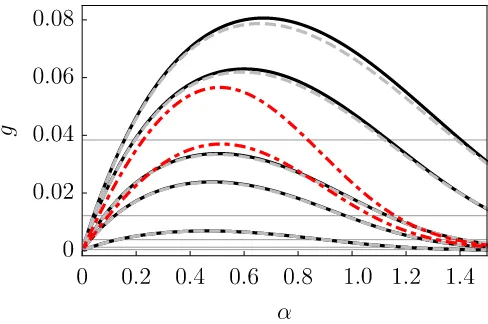
[image:6.608.49.293.69.182.2]FIG. 7. Security parameter g as it varies with α for T =
[0.61 (upper curve),0.47,0.19,0.11,0.01 (lower curve)]. Solid: ξ=0%. Dashed:ξ=1%. The optimalαwhich players should pick varies withT but only slightly varies withξ. Horizontal gridlines denoteO(L) starting fromL∼105atg=0.038 (top) and increasing by a factor of 10 at subsequent lower gridlines, Eq. (21). Red, dot-dashed: Thegvarying withαfor 1 km (upper curve) and 20 km fiber (lower curve) under the previous protocol [11], forξ=0%. Note that under [11] the optimalα’s do not vary with eitherT orξ.
effects at small T—even though Charlie will allow fewer thermal photons in the channel asT decreases.
For values ofT corresponding to realistic metropolitan dis-tances we observe that our QDS scheme can be made secure with surprisingly short signature lengthsL. Assuming optical fiber with 0.2 dB loss per km, we calculateT corresponding to 1- and 20-km channels. At these distances, displayed in the vertical gridlines of Fig.6, we can securely sign a 1 bit message with only L∼O(105) coherent states. Combined
with fast sending rates typical to the CV platform, this opens up the possiblity of signing a message in times competitive with theO(10−1) s found in DV schemes [17] (and see Fig.7 of Ref. [21]). For example, with a feasible sending rate of 100 MHz our protocol could securely sign a 1 bit message inO(10−3) s over 20 km.
The signature lengths required under our security proof are shorter than under our previous protocol, despite now mak-ing fewer assumptions about the power of an eavesdroppmak-ing party. For example, at T =0.5, our current protocol gives L=34 139, whereas the protocol from Ref. [11] would give L=44 010. This improvement is because in our protocol we have chosenBm=
C
m, so a dishonest party is forced to
eavesdrop and thus receives an imperfect copy of Charlie’s states, whereas previously they were given a perfect copy [11,13].
To understand the optimal behavior of our protocol, we consider security parameterginstead of signature length, via Eq. (21). We observe in Fig.7that the maximumg—therefore smallestL—varies strongly withT andαand only slightly withξ. Therefore, for a given channel it is important to pick the optimalαto minimize the quantum resources required for security. This is in sharp contrast to Ref. [11], shown in Fig.7 by red, dot-dashed lines, where the optimalα≈0.5 for all channels.
FIG. 8. Optimal signature lengthL forξ=0%. At each trans-missionT the coherent state amplitudeαopt is chosen to minimize
L. We have considered alphabets A4,A6, A8, andA2. Solid:A4. Dashed:A6. Gray, solid:A8. Dot-dashed:A2. Inset: the correspond-ing αopt. Choosing an alphabet size larger than A4 decreases the optimalαopt while slightly increasing the required signature length
L. As the alphabet size increases it becomes closer to a Gaussian distribution, and so the beamsplitter and entangling-cloner attack become increasingly optimal. The largest jump in protocol efficiency occurs fromA2toA4. Vertical gridlines denoteT corresponding to the 20-km (left) and 1-km (right) fiber.
For each channel we minimize L by optimizing over α, and the results are plotted in Fig. 8, with the required αopt
displayed in the inset. For largeT a largeαis optimal. In this case an eavesdropper gains little information so honest parties should try to minimize their mismatch rate. As T decreases a smaller α will increase the eavesdropper’s mismatch rate but at the cost of also increasing honest mismatches. Taking ξ =0% was found to slightly decreaseαopt.
We have also considered the alphabet sizes A6,A8, and
A2, AppendixB, with their optimalL’s also plotted in Fig.8.
Surprisingly, although for larger alphabets the optimal α is decreased, the minimal L is slightly increased. As has been found elsewhere [29], the biggest leap in behavior should oc-cur betweenA2→A4, and indeed this is what we see, noting
that for A2 we no longer need to think about an eliminated
signature or ambiguity and we simply consider optimal guess-ing probabilities. As the alphabet tends toward a Gaussian mixture of coherent states, we expect the two attack strategies considered in this paper to become increasingly optimal, which explains the slight increase inLfor larger alphabets.
V. DISCUSSION
[image:7.608.316.558.69.242.2]over metropolitan distances. The security proof has enabled us to include the fact that for each eliminated signature element there are multiple “correct” declarations which a dishonest player can make, and which must be taken into account.
Our security proof relied on several assumptions which re-flect the state-of-the-art of CV quantum cryptography with our chosen alphabet, but which future work should endeavour to relax [24,25,31,32]. First, the eavesdropping attacks permitted by a malevolent Bob in this work do not give him the full power afforded by quantum mechanics. The non-Gaussianity of our alphabet is restrictive here, and the entangling-cloner attack is only expected to be optimal as the limiting case that the alphabet becomes Gaussian, i.e., forα→0 [33,34]. For our alphabet with discrete modulation, a wider class of non-Gaussian attacks may provide an eavesdropper with an advantage, and more work is needed to explore optimal classes of non-Gaussian attack. In a general protocol these effects could be taken into account for example by tomograph-ically reconstructing the stateρBwhich maximizes the Holevo
information χ, while remaining consistent with Charlie’s measurement outcomes—though we note that the resources required for this will be expensive and may undermine the ease-of-use which our scheme currently boasts. Another pos-sible route towards improving security would be an extension of results known for QKD with two-state [31] and three-state [32] alphabets to ourA4, noting recent progress in Ref. [25].
Techniques used in our security proof will in future allow us for possibility to explore different security tasks, such as secret sharing [35] or oblivious transfer [36], and to design protocols relying on the same modest physical requirements which we used here. One may also begin to consider con-sider finite-size effects [37], which are intrinsic to any QDS scheme, noting the operational links between the guessing probabilities considered in this paper and the smooth min-entropy [38]. Advances in calculating optimal lower bounds for the smooth min-entropy will have immediate and direct application to CV QDS, and may be readily incorporated into our security proof.
The security of our QDS protocol and the short time required to sign a message, stemming both from the security proof and the practical advantages of the CV platform, make CV QDS an attractive scheme for secure communications in a quantum future. It may soon be possible to move to real-world implementation of our scheme, with opportunity to run alongside related QKD schemes [39].
ACKNOWLEDGMENTS
The authors gratefully acknowledge the support from the Scottish Universities Physics Alliance (SUPA) and the Engi-neering and Physical Sciences Research Council (EPSRC). The project was supported within the framework of the International Max Planck Partnership (IMPP) with Scottish Universities.
APPENDIX A: HOEFFDING’S INEQUALITIES
Hoeffding’s inequalities [40,41] provide a bound for the probability that the empirical mean of n independent out-comes differs from the expectation. The most useful form for
our purposes is shown below, and we briefly demonstrate how they may be utilized in our security proof. A full treatment can be found in Refs. [10,11].
1. Hoeffding’s inequalities
Let X1, . . . ,Xn be independent binary random variables.
Let ¯X be their empirical mean, and letE( ¯X) be their expected value. Then for everyε0 the following are true
P( ¯X−E( ¯X)ε)exp(−2ε2n),
P(E( ¯X)−X¯ ε)exp(−2ε2n). (A1)
2. Application to QDS
LetF be a string of declared phases, and G be an elimi-nated signature. Define a stringE
Ej=
1 ifFjis eliminated inGj,
0 otherwise,
which measures the number of mismatches betweenFandG. All strings are of lengthn. We wish to bound the probability that the number of mismatches is below some thresholdsn, or equivalently the probability P( ¯E s) that the observed mismatch rate ¯E =1/nnj=1Ejis belows. Then we have
P( ¯E s)=P[E( ¯E)−E¯ E( ¯E)−s]
exp{−2[E( ¯E)−s]2n}, (A2) where the equality follows trivially provided thatE(E)−s 0, and the inequality is an application of Eq. (A1). Bounds on P(sE¯) may be similarly derived:
P(sE¯)exp{−2[s−E( ¯E)]2n}. (A3)
APPENDIX B: LARGER ALPHABETS
We show that our central result, Eq. (11), holds for all alphabets AN with N =2k; k∈N; consisting of coherent
states equally distributed about the origin in phase space. We also remark on any required modifications to the calculations presented in the paper.
During the protocol, Bob and Charlie should eliminate exactly N/2 coherent states, using the same strategy as in Fig 2. Otherwise, the running of the protocol remains the same.
As before, Eqs. (5)–(7), we start with H(Ej,x j 1, . . . ,
xNj/2|yj) and use the chain rule for conditional entropies twice,
giving
Hx1j, . . . ,xNj/2|yj
=Hx1j, . . . ,xNj/2|Ej,yj
+H(Xj|yj),
once we have taken into account that H(Ej|x j 1, . . . ,
xNj/2,yj)=0. UsingH(Ej|yj)h(pe) and the fact that Bob
and Charlie eliminate exactlyN/2 out ofNpossible alphabet states, we arrive at
Hx1j, . . . ,xNj/2|yj
Hx1j, . . . ,xNj/2|Ej =0,yj
+h(pe),
therefore
Hx1j, . . . ,xNj/2−χx1j, . . . ,xNj/2 :yj
Hx1j, . . . ,xNj/2|Ej=0,yj
To complete the proof of Eq. (11) we simply observe
Hx1j, . . . ,xNj/2=log2
N×N 2!
,
Hx1j, . . . ,xNj/2|Ej=0,yj
=log2
N 2 ×
N 2!
,
where we have taken into account relabeling, and Eq. (11) follows immediately.
The quantities used to calculate the Holevo information must also be altered to reflect the different alphabet. Bob’s a prioristate becomes
ρj B =
1 N
N
k=1
|√1−TαkB
√
1−Tαk|, (B1)
the stateρBj|cis similarly transformed—both for beamsplitter attack and entangling-cloner attack. The integration limits of Eq. (17) are also altered so that each segment now occupies an angular width of 2π/N. Finally, since Bob and Charlie eliminate exactlyN/2 of the alphabet, the probabilityperrthat
a heterodyne measurement should eliminate Alice’s sent state remains unchanged.
APPENDIX C: TWO-MODE SQUEEZED VACUUM
We will calculate the|Bj1B2C andρBj|c required for the entangling cloner attack, Fig. 5. Our starting point is the
state shared between Alice and Bob before the channel. Alice generates coherent state |αand Bob generates a two-mode squeezed vacuum (TMSV) state [42]. Then Alice and Bob share the three-mode state,
|αA|TMSVB1B2 =DˆA(α)|0A
∞
m=0
Gm
ˆ a†B1m
√
m! |0B1|mB2, (C1)
where |α =Dˆ(α)|0 and ˆD(α)=exp (αˆa†−α∗aˆ) is the
displacement operator; and where we have written |mB1=
( ˆa†B1)
m
/√m!|0B1. The coefficient Gm=(tanhr)
m/
coshr whererparametrizes the number of thermal photons ¯nin each of the two modes via ¯n=sinh2r.
The beamsplitter transforms our creation operators as
ˆ aC
ˆ aB1
=
√
T −√1−T
√
1−T √T
ˆ aA
ˆ aB1
. (C2)
Using Eq. (C2) we transform our input state to give
|j B1B2C =
ˆ DB1(
√
1−Tα) ˆDC(
√
Tα)
∞
m=0
Gm
√
Taˆ†B
1−
√
1−Taˆ†C
m
√
m! |0B1|mB2|0C,
(C3)
where we have used the fact that ˆaB1 and ˆaC commute.
The state Eq. (C3) may be computed by using the binomial expansion on the brackets, and the stateρBj|c( ¯n)= c||c can now be computed.
[1] W. Diffie and M. Hellman,IEEE Trans. Inf. Theory22,644
(1976).
[2] B. Schneier,Applied Cryptography: Protocols, Algorithm, and Source Code in C(John Wiley & Sons, Verlag, 1996). [3] P. W. Shor,SIAM J. Sci. Stat. Comput.26,1484(1997). [4] R. Amiri and E. Andersson,Entropy17,5635(2015).
[5] M. A. Nielsen and I. L. Chuang, Quantum Computation and Quantum Information(Cambridge University Press, Cam-bridge, 2010).
[6] D. Gottesman and I. L. Chuang, arXiv:quant-ph/0105032, 2001.
[7] P. Wallden, V. Dunjko, A. Kent, and E. Andersson,Phys. Rev. A91,042304(2015).
[8] R. J. Donaldson, R. J. Collins, K. Kleczkowska, R. Amiri, P. Wallden, V. Dunjko, J. Jeffers, E. Andersson, and G. S. Buller,
Phys. Rev. A93,012329(2016).
[9] V. Dunjko, P. Wallden, and E. Andersson,Phys. Rev. Lett.112,
040502(2014).
[10] R. J. Collins, R. J. Donaldson, V. Dunjko, P. Wallden, P. J. Clarke, E. Andersson, J. Jeffers, and G. S. Buller,Phys. Rev. Lett.113,040502(2014).
[11] C. Croal, C. Peuntinger, B. Heim, I. Khan, C. Marquardt, G. Leuchs, P. Wallden, E. Andersson, and N. Korolkova, Phys. Rev. Lett.117,100503(2016).
[12] E. Andersson, M. Curty, and I. Jex,Phys. Rev. A74,022304
(2006).
[13] R. Amiri, P. Wallden, A. Kent, and E. Andersson,Phys. Rev. A. 93,032325(2016).
[14] R. J. Collins, R. Amiri, M. Fujiwara, T. Honjo, K. Shimizu, K. Tamaki, M. Takeoka, E. Andersson, G. S. Buller, and M. Sasaki,
Opt. Lett.41,4883(2016).
[15] I. V. Puthoor, R. Amiri, P. Wallden, M. Curty, and E. Andersson,
Phys. Rev. A.94,022328(2016).
[16] H.-L. Yin, Y. Fu, and Z.-B. Chen, Phys. Rev. A93, 032316
(2016).
[17] R. J. Collins, R. Amiri, M. Fujiwara, T. Honjo, K. Shimizu, K. Tamaki, M. Takeoka, M. Sasaki, E. Andersson, and G. S. Buller,
Sci. Rep.7,3235(2017).
[18] G. L. Roberts, M. Lucamarini, Z. L. Yuan, J. F. Dynes, L. C. Comandar, A. W. Sharpe, A. J. Shields, M. Curty, I. V. Puthoor, and E. Andersson,Nat. Commun.8,1098(2017).
[19] C. H. Zhang, X. Y. Zhou, H. J. Ding, C. M. Zhang, G. C. Guo, and Q. Wang,Phys. Rev. Appl.10,034033(2018).
[20] H.-L. Yin, Y. Fu, H. Liu, Q.-J. Tang, J. Wang, L.-X. You, W.-J. Zhang, S.-J. Chen, Z. Wang, Q. Zhang, T.-Y. Chen, Z.-B. Chen, and J.-W. Pan,Phys. Rev. A95,032334(2017).
[21] R. J. Collins, R. J. Donaldson, and G. S. Buller, Proc. SPIE 10771,107710F(2018).
[23] P. J. Clarke, R. J. Collins, V. Dunjko, E. Andersson, J. Jeffers, and G. S. Buller,Nat. Commun.3,1174(2012).
[24] C. Weedbrook, S. Pirandola, R. García-Patrón, N. J. Cerf, T. C. Ralph, J. H. Shapiro, and S. Lloyd,Rev. Mod. Phys.84,621
(2012).
[25] P. Papanastasiou, C. Lupo, C. Weedbrook, and S. Pirandola,
Phys. Rev. A98,012340(2018).
[26] J. M. Arrazola, P. Wallden, and E. Andersson, Quantum Inf. Comput.6,0435(2016).
[27] T.-Y. Wang, X.-Q. Cai, Y.-L. Ren, and R.-L. Zhang,Sci. Rep.5,
9231(2015).
[28] T.-Y. Wang, J.-F. Ma, and X.-Q. Cai,Quantum Inf. Process.16,
19(2017).
[29] A. Leverrier and P. Grangier, Phys. Rev. A 83, 042312
(2011).
[30] F. Grosshans, G. V. Assche, J. Wenger, R. Brouri, N. J. Cerf, and P. Grangier,Nature421,238(2003).
[31] Y.-B. Zhao, M. Heid, J. Rigas, and N. Lütkenhaus,Phys. Rev. A79,012307(2009).
[32] K. Brádler and C. Weedbrook, Phys. Rev. A 97, 022310
(2018).
[33] M. Navascués, F. Grosshans, and A. Acín,Phys. Rev. Lett.97,
190502(2006).
[34] R. García-Patrón and N. J. Cerf,Phys. Rev. Lett.97,190503
(2006).
[35] I. Kogias, Y. Xiang, Q. He, and G. Adesso,Phys. Rev. A95,
012315(2017).
[36] A. Broadbent and C. Schaffner,Des. Codes Cryptogr.78,351
(2016).
[37] M. Tomamichel,Quantum Information Processing with Finite Resources—Mathematical Foundations(Springer International Publishing, Berlin, 2016).
[38] R. König, R. Renner, and C. Schaffner,IEEE Trans. Inf. Theory 55,4337(2009).
[39] B. Heim, C. Peuntinger, N. Killoran, I. Khan, C. Wittmann, C. Marquardt, and G. Leuchs, New J. Phys. 16, 113018
(2014).
[40] W. Hoeffding,J. Am. Stat. Assoc.58,13(1963).
[41] J. Watrous,The Theory of Quantum Information(Cambridge University Press, Cambridge, 2018).