Coordinate Based Random Effect Size meta-analysis of neuroimaging studies
Tench CR1*
Radu Tanasescu1,2
Constantinescu CS 1
[email protected] Auer DP3
Cottam WJ3
1Division of Clinical Neurosciences, Clinical Neurology, University of Nottingham, Queen's Medical
Centre, Nottingham, UK
2Department of Neurology, University of Medicine and Pharmacy Carol Davila Bucharest, Colentina
Hospital, Bucharest, Romania
3Division of Clinical Neuroscience, Radiological Sciences, University of Nottingham, Queen's
Medical Centre, Nottingham, UK
*Corresponding author
Keywords
1
Abstract
Low power in neuroimaging studies can make them difficult to interpret, and Coordinate based
meta-analysis (CBMA) may go some way to mitigating this issue. CBMA has been used in many analyses
to detect where published functional MRI or voxel-based morphometry studies testing similar
hypotheses report significant summary results (coordinates) consistently. Only the reported
coordinates and possibly t statistics are analysed, and statistical significance of clusters is determined
by coordinate density.
Here a method of performing coordinate based random effect size meta-analysis and meta-regression
is introduced. The algorithm (ClusterZ) analyses both coordinates and reported t statistic or Z score,
standardised by the number of subjects. Statistical significance is determined not by coordinate
density, but by a random effects meta-analyses of reported effects performed cluster-wise using
standard statistical methods and taking account of censoring inherent in the published summary
results. Type 1 error control is achieved using the false cluster discovery rate (FCDR), which is based
on the false discovery rate. This controls both the family wise error rate under the null hypothesis that
coordinates are randomly drawn from a standard stereotaxic space, and the proportion of significant
clusters that are expected under the null. Such control is necessary to avoid propagating and even
amplifying the very issues motivating the meta-analysis in the first place. ClusterZ is demonstrated on
both numerically simulated data and on real data from reports of grey matter loss in multiple sclerosis
(MS) and syndromes suggestive of MS, and of painful stimulus in healthy controls. The software
implementation is available to download and use freely.
2
Introduction
Neuroimaging studies often involve few subjects and have low statistical power to detect true effects,
and with lack of power comes increased risk that significant results are false positives [1]. Add to this
the common use of uncorrected p-value thresholds [2], and neuroimaging studies can become difficult
to interpret. This situation may be compounded if the data violate the methodological assumptions of
the analysis [3]. Meta-analysis can be used to synthesize the evidence across similar neuroimaging
studies going some way to mitigating these problems [4], and there are various methods of
statistically combining the results [5]. Image based meta-analysis (IBMA) is the most powerful
approach, but is currently limited by availability of suitable statistical images. Coordinate based
meta-analysis (CBMA), on the other hand, uses just the available summary reports (coordinates and
possibly Z scores or t statistics) from functional MRI/PET or voxel-based morphometry studies
measuring common effects, and has been utilised in many published studies; the aim is similar to that
of IBMA within the limits of the available data [6]. The results of CBMA consists of clusters of
coordinates where studies have reported significant effect in similar anatomical locations,
representing concordance and indicating relevancy of brain structures, while coordinates not recruited
into clusters are considered study specific. Concordance of the reported coordinates is determined
statistically relative to a null hypothesis that the coordinates in different studies are uncorrelated,
which in practice is simulated by replacing the reported coordinates by random coordinates. Popular
CBMA algorithms include the activation likelihood estimate (ALE) [7-11] and the multi-level kernel
density (MKDA) algorithm [12]. Signed differential mapping (SDM) [13] is similar to the ALE but
incorporating the sign of effect at the reported coordinates to distinguish grey matter loss from grey
matter increase, or fMRI activation from deactivation. Effect size SDM (ES-SDM) [14] takes this
further and uses the reported t statistic associated with each coordinate, and can also incorporate
statistical parametric maps.
There are technical limitations with these CBMA algorithms that impact interpretability and
specificity. Firstly statistical tests are performed voxel-wise making the relevant cluster-wise type 1
error rates difficult, if not impossible, to assess. Secondly the significance is, at least in part,
determined by the density of coordinates from different experiments meaning that coordinates
forming a small cluster are more significant than if they formed a larger cluster. Yet it is not clear, for
example, that studies reporting thalamic coordinates producing a cluster over the thalamic volume
should be less significant than the same studies reporting coordinates producing a smaller cluster in
the smaller putamen structure. Finally, the uncorrected p-value threshold employed by both SDM and
ES-SDM does not control the type 1 error rate in a principled way [2], and without estimated error
rates there is no way to assess the significance of the results given the ~2105 voxel-wise statistical
LocalALE is a CBMA algorithm [16, 17] that addresses some of these limitations. It employs an
interpretable cluster-level type 1 error rate control scheme, the false cluster discovery rate (FCDR),
made possible by performing statistical tests at the coordinate, rather than the voxel, level. The results
are such that at-most some specified proportion of the clusters declared significant are expected under
the null hypothesis. LocalALE also adjusts its parameters to avoid false negatives when there are few
studies and avoid false positives when there are many studies. Furthermore, LocalALE assigns
coordinates to clusters in a binary fashion (belonging to a specific cluster, or no cluster), and as a
consequence can analyse positive and negative effects (activation and deactivation, for example)
simultaneously, allowing post-hoc checks for sign consistency. Nevertheless, LocalALE is unable to
utilise the sign or magnitude of the reported effect to perform statistical inference, and the cluster
significance is determined by coordinate density biasing the results to smaller clusters.
Here a new coordinate based random effect size (CBRES) meta-analysis (MA), and meta-regression,
method (ClusterZ) is detailed. The algorithm deviates from other CBMA methods by performing
inference on a standardised effect size, which is related to the Z score or t statistic reported by most
studies. Consequently the density of coordinates within cluster does not influence statistical
significance, so large and small clusters are considered on an equal footing. A random effects
meta-analysis approach is taken and model parameters are estimated by maximum likelihood estimation
(MLE) and significance assessed by comparing models using a likelihood ratio test (LRT). This is a
common approach to meta-analysis, and one that has been applied to neuroimaging studies previously
[18], but using a different null hypothesis, that the effect size is zero, to other CBMA methods.
Models can be devised to test for evidence of a non-zero effect size, effect size difference between
groups, or significant linear regression. ClusterZ also requires consistent spatial effect across studies
for significance, and uses this to control the type 1 error rate such that quantifiably more clusters are
declared significant than are expected if the studies report uncorrelated spatial effects. Furthermore, it
adjusts parameters to avoid false positive and false negative results depending on the number of
studies. ClusterZ is similar to traditional MA in that estimates of effect and variance are computed. It
provides an alternative to ES-SDM for coordinate based meta-analysis but with the advantage that the
type 1 error rate is controlled, quantified, and interpretable. ClusterZ is implemented into NeuRoi,
which can be downloaded and used freely:
3
Methods
There are several steps to the ClusterZ algorithm, detailed below. In summary, clusters are formed by
reported coordinates that are more densely packed than average. Then, a random effects analysis is
performed to give a p-value in each cluster. The same analysis is then performed on many pseudo
experiments, in which each coordinate has been replaced by a random one to simulate studies
reporting spatially uncorrelated effects. Declaration of significance in ClusterZ has two requirements:
1) that within cluster there is a consistent effect size reported such that the p-value is small, and 2) for
a given p-value threshold the number of observed clusters with smaller p-values is quantifiably
greater than average for the pseudo experiments. The second requirement indicates how ClusterZ
controls the type 1 errors through the false cluster discovery rate.
3.1 Cluster forming
The clustering algorithm is identical to that used by LocalALE, and is detailed in [16] but recapped
here. It is based on a popular algorithm: density based spatial clustering of applications with noise
(DBSCAN) [19]. The aim is to produce clusters of densely packed coordinates while not recruiting
coordinates outside these clusters, which DBSCAN considers noise; in the present application these
coordinates are considered study specific effects rather than noise. The initial step is a measure of
overlap of coordinates in different studies. A coordinate that overlaps (they are separated by a
distance < ) coordinates in n other studies has an overlap score of n. For a coordinate to be
considered part of a cluster, its overlap score must be at least 3 according to the DBSCAN algorithm,
since an overlap score of 2 or less means the coordinate is link in a chain, rather than a cluster, of
coordinates. The peak of any cluster is the coordinate, or collection of coordinates, with the highest
overlap score. The clustering algorithm proceeds by finding the peak coordinate that is not already
assigned to a cluster and assigns it a cluster number. Coordinates overlapping members of this cluster,
and have equal or lower overlap score, are recruited to the cluster. This continues until there are no
more valid overlapping coordinates to be added to the cluster. The process then continues starting
with the coordinate with the highest overlap score that is not already part of a cluster. The result is a
set of clusters of coordinates that have a reducing (but not strictly) overlap score moving away from
the peak; this can help to prevent close neighbouring clusters merging into one bigger cluster [16].
The clustering process depends on the clustering distance , which is analogous to the FWHM
parameter used in other CBMA algorithms [7, 13], and the algorithm to compute this has been
detailed previously [17]. The choice of is determined by three aims of the clustering algorithm: 1) to
allow the true clusters to form, 2) to prevent study specific coordinates forming clusters, and 3) to
prevent study specific coordinates being recruited into the true clusters. The first aim requires to be
large enough so that the densely packed coordinates within-cluster overlap. The second and third aims
not overlap on average. The density of coordinates within, and between, clusters is unknown, but the
density of random coordinates can be estimated, and in the true clusters the coordinates are more
densely packed than this and between clusters the coordinates are packed with lower density on
average. The algorithm proceeds by redistributing the coordinates randomly (see below) within an
anatomical mask, which depending on the problem might be a grey-matter, white-matter, or
whole-brain mask. For these coordinates a small value of results in few coordinates having non-zero
overlap scores, but this increases for larger . It is helpful to consider the proportion of coordinates
with non-zero overlap scores (divided by 2 to avoid coordinate A overlapping coordinate B being
considered a second time as B overlapping A) as a function of the clustering distance: (), the
overlap fraction. The clustering distance used is that which, on average, just causes each random
coordinate to overlap with another in one other study such that ()=05. With this value of the
coordinates within the clusters become density reachable [19], satisfying aim 1. The study specific
coordinates, on the other hand, are not density reachable satisfying aims 2 & 3. For larger the study
specific coordinates will (wrongly) begin to form clusters or make them density reachable from the
clusters violating aims 2 & 3, while for smaller the true clusters may not form at all violating aim 1.
This method adapts to the number of studies, such that it is small for many studies because the
density of coordinates is higher. Consequently the false negatives are reduced when there are fewer
studies (the low density of coordinates when few studies are included requires to be large so that
clusters still form), while false positives are reduced when there are many studies (because the small
prevents the study specific coordinates being recruited into clusters) [17]; this is in contrast to the
fixed FWHM parameter used in other algorithms that can paradoxically increase the false positives
with an increasing number of studies [17].
A subtlety in this algorithm is that independence of the coordinates within study cannot be guaranteed
[9, 12]. Reported coordinates that are very close to each other may be related, and the aim is to
preserve this relationship. Independently randomising the coordinates within a mask using a uniform
distribution would violate this aim, and therefore a more sophisticated approach is taken and has been
described in detail previously [16]. Within-study clusters of coordinates (each coordinate separated by
a distance <from at least one other coordinate from the same cluster) are formed. Each within-study
cluster has a centroid, and the mean and standard deviation of the distances from the centroid, of the
coordinates belonging to the cluster, computed. Each centroid is then randomly placed, with uniform
probability, within the mask, and the cluster coordinates randomly placed about the centroid with the
computed mean and standard deviation distance. A randomisation is rejected, and subsequently
repeated until successful, if the within-study clusters of coordinates are randomised such that they
3.2 Models of effect size
In fMRI a biologically meaningful measure of effect is not available, although %BOLD (blood
oxygenation level dependent) signal change has been suggested [20]. In VBM studies a more
meaningful measure in terms of volume reduction is possible, but not routinely reported. Typically
neuroimaging studies only report effect sizes reflecting statistical significance: the t score or Z score.
These are dimensionless and relative effect sizes similar to Cohen’s d if scaled [21]; t and Z are both
scaled by subject numbers. The meaning, from a biological perspective, of such effects is not directly
apparent, and often cannot be inferred from the report [20]. Prospective studies of regions known to
be consistently reported as significant could be designed to answer this question, but first the regions
must be identified and a statistical effect size estimated so that a sample size might be computed [21].
ClusterZ can be used to provide this detail.
Within clusters the Z scores or t statistics are be combined to test if there is consistent statistical
significance; publication bias or outlying effects, for example, might be reported by only one study
and would not be consistent. Methods combining p-values (or equivalent), reviewed in [5], are
appropriate for IBMA, where the test is for significant effect within a voxel given multiple statistical
images. In CBMA, however, each reported coordinate has already been declared as significant by the
reporting study, and the relevant question is about significant consistency of the reported effects
across studies. Combining p-values (known to be significant already) is then not appropriate, so a
meta-analytic method of combining results from different studies [5] is employed instead,
necessitating an effect size and estimate of variance.
Under certain assumptions the t statistic or Z score can be transformed and used as a dimensionless
effect for MA or meta-regression. Assuming that studies report analyses of one or two groups of
subjects then the t statistic, which has a student’s t distribution, is a measure of effect, or difference in
effect between groups, reported in multiples of the standard error. The first difficulty with the t
statistic as an effect size is that the standard error depends on the number of subjects, so larger studies
appear to report larger effects. Therefore, the effect used in CBRES analysis is the t statistic, or Z
score, scaled to obtain an estimate measured in multiples of the sample standard deviation, which does
not depend on the number of subjects. A basic analysis is assumed, whereby simple t tests are
performed. Then the effect size is computed from the t statistic by dividing by a function of the
number of subjects n*
′𝑖 =√𝑛𝑡∗, (1)
and the within-study variance is
′𝑖2= 𝑑𝑓 𝑑𝑓−2
1
which includes the variance of the Student’s t distribution with df degrees of freedom. For a one
sample study, for example just healthy control (HC) subjects, then n* is the number of subjects and df=n*-1. For a two sample study, such as a patient versus HC study, then
𝑛𝑖∗=𝑛1× 𝑛2
𝑛1+ 𝑛2, (3)
where n1 and n2 are the numbers of subjects in each sample and df=n1+n2-2; this assumes equal
variance of effect in both groups. These standardised effect size and distributional assumptions
assume a random effects approach has been used for analysis.
Under the given assumptions behind equations (1) to (3), they provide an effect size that is
standardised against the number of subjects and have an associated variance estimate as required for
MA. However, many studies employ a more sophisticated analysis and include multiple regressors
[22]. This is partly corrected for by modifying the degrees of freedom of the t distributions by the
number of extra regressors included; if the number of regressors is unknown, some underestimation of
the effect variance will result. Furthermore, scaling the t statistic by 1/n* will not standardise to the
same sample standard deviation across studies. This is not correctable, due to the limitations of
reported effect, and will result in some between-study variance in effect size due to the range of
analyses employed. Nevertheless, standardising the reported statistics should result in an effect with
approximately known variance, and which tends to be larger for larger effects. Furthermore, ClusterZ
attempts to make allowance for this limitation by including a between-study variance as a random
effect.
One more assumption is made, for convenience, in what follows: that the subject numbers are
sufficiently large that the reported t statistics are well approximated by Z scores such that the effect is
𝑖 = 𝑍
√𝑛∗ (4)
with variance
𝑖2 = 1
𝑛𝑖∗. (5)
The Z scores are standardised by comparison to the range of possible Student’s t distributions making
them easier to consider for the purpose of experimentation. However, ClusterZ does have the option
to deal with either t of Z for effect sizes using either equations (1) and (2) or equations (4) and (5).
3.3 Random effect model
A random effects approach is employed to combine the effects given by equations (1-5), making some
allowance for the often appreciable differences in experimental design and analysis between studies.
To perform inference a random effect distribution must be assumed. Typically a normal distribution is
𝜀𝑖~𝑁(𝜃𝑖, 𝜎2+𝑖2). (6)
The parameter i is modified to reflect different models, and are estimated using MLE. The total
variance is composed of the within-study variance 𝑖2 (equation (5)) and the between-study variance
2, which is also estimated by MLE. With this model estimates are weighted more heavily to the
larger studies due to the smaller within-study variance.
Various models are possible using different parameterisations of equation (6). To model the effect
sizes by a grand mean the parameterisation is i=µ. For meta-regression the grand mean is modulated
by a study specific covariate so i=µ-βci, where β models the change in the grand mean due to the
covariate c; this could be a continuous variable such as age, or a group indicator to investigate
differences in effect size between groups.
3.3.1 Maximum likelihood estimation with censoring
The maximum likelihood estimates of parameters and are generally straight forward to compute.
However, a subtlety is that not all studies will report a coordinate and effect in every cluster, and
those that don’t are censored by the statistical threshold used [18]; for example a study applying an
uncorrected p-value threshold of 0·0001 reports only Z scores exceeding 3·72 in magnitude. Left,
right, and interval censoring need to be considered. The log likelihood, which is maximised for
parameter estimation, is a sum of contributions from uncensored and censored terms.
For uncensored data the log likelihood contribution for a single study is given by the probability
(density) that effect size E=i given the parameters i and (P(E=i|i,))
𝐿𝑖 = −𝑙𝑜𝑔(√2𝜋𝑖) − (𝑖−𝑖)2
2i2 , (7)
where
𝑖2= 𝜎2+ 𝑖
2. (8)
Left censoring occurs when a study reports a significant negative effect (for example deactivation)
within a cluster but no effect size is given. If study i reports an effect size threshold such that E≤ -Ti,
where Ti is the threshold magnitude, then the contribution to the likelihood is the probability P(E≤
-Ti|i,). Given the random effects model (equation (6)) this probability can be computed accurately
using the error function (erf) [23]. The contribution to the log likelihood for a single left censored
study is therefore
𝐿𝑙𝑒𝑓𝑡𝑖 = 𝑙𝑜𝑔 (1
2[1 + 𝑒𝑟𝑓 ( −𝑇𝑖−𝜃𝑖
With right censoring study i reports an effect size threshold such that E≥Ti and the contribution to the
likelihood is the probability P(E≥Ti|i,), and log likelihood
𝐿𝑟𝑖𝑔ℎ𝑡𝑖 = 𝑙𝑜𝑔 (1 −12[1 + 𝑒𝑟𝑓 (𝑇√2𝑖−𝜃𝑖
𝑖)]). (10)
Interval censoring occurs when a study does not report a significant result within a cluster. In this case
all that is known is that |E|≤Ti, and the likelihood is the probability P(|E|≤Ti|i,). In this case the
contribution to the log likelihood is
𝐿𝑖𝑛𝑡𝑖 = log (12[𝑒𝑟𝑓 (𝑇√2𝑖−𝜃𝑖
𝑖) − 𝑒𝑟𝑓 (
−𝑇𝑖−𝜃𝑖
√2𝑖 )]). (11)
Summing these contributions over all studies gives the log likelihood
𝐿𝑙(𝜃, 𝜎) = ∑ 𝐿𝑖 𝑖 ∈ 𝑢𝑛𝑐𝑒𝑛𝑠𝑜𝑟𝑒𝑑
+ ∑ 𝐿𝑙𝑒𝑓𝑡𝑖
𝑖 ∈ 𝑙𝑒𝑓𝑡 𝑐𝑒𝑛𝑠𝑜𝑟𝑒𝑑
+ ∑ 𝐿𝑟𝑖𝑔ℎ𝑡𝑖 𝑖 ∈ 𝑟𝑖𝑔ℎ𝑡 𝑐𝑒𝑛𝑠𝑜𝑟𝑒𝑑
+ ∑ 𝐿𝑖𝑛𝑡𝑖
𝑖 ∈ 𝑖𝑛𝑡𝑒𝑟𝑣𝑎𝑙 𝑐𝑒𝑛𝑠𝑜𝑟𝑒𝑑
(12)
which is maximised for parameter estimation.
Effect size thresholds are often given in studies that employ uncorrected p-values. However, they are
sometimes omitted. In the absence of a stated threshold, ClusterZ estimates them from the smallest
magnitude effect size reported by the study. If no effect size is reported, then conservative low
magnitude default threshold of 309 (corresponding to p<0001) is used by default; a high default
threshold might overestimate the effect and drive significance.
3.3.2 Inference using the likelihood ratio test
Without the censoring, a one sample t-test or simple linear regression (SLR) model can be used for
inference. However, neuroimaging study reports are censored so a likelihood ratio test, a general
scheme for performing a statistical test by approximating the difference of two log likelihoods to a chi
squared distribution, is used. The two likelihoods in question are the maximum likelihoods computed
under the null and alternative hypotheses. To test the hypothesis that coordinates in a cluster have a
non-zero grand mean effect size µ compute
𝐷𝜇 = 2 (max 𝜇,𝜎1
𝐿𝑙(𝜇, 𝜎1) − max 𝜎0
𝐿𝑙(0, 𝜎0)) (13)
and compare Dµ to a chi square distribution with one degree of freedom to compute the p-value. For
𝐷𝛽 = 2 ( max𝜇
1,𝛽,𝜎1𝐿𝑙(𝜇1, 𝛽, 𝜎1) − max𝜇0,𝜎0𝐿𝑙(𝜇0, 𝜎0)) (14)
to a chi square distribution with one degree of freedom to compute the p-value.
3.4 Type 1 error control
The null hypothesis of the LRT’s is that there is zero mean effect, which has been used previously for
the meta-analysis of neuroimaging studies [18]. The null hypothesis used by ClusterZ and CBMA
algorithms, however, is that studies report no common spatial effect. The clustering algorithm detailed
above does nothing to statistically preclude clusters forming even for studies reporting different
spatial effects, and results of the LRT are no indication of significant spatial clustering. Therefore, the
peak summary effects reported by studies, which by definition already surpass a study dependent
threshold for significance, may well produce significant meta-analytic results in any incidentally
formed clusters; the same is also true of meta-regression if reported Z scores all correlate with the
regressor. Consistency in reported effect size, while necessary for significance in CBRES, is not
sufficient and a further step is required to prevent studies testing different hypotheses producing such
incidental significant results frequently i.e. to control the family wise error rate (FWER). Furthermore,
when studies test related hypotheses controlling the type 1 error rate such that the significant clusters
quantifiably outnumber those expected under the null makes interpretation simple. In ClusterZ, this is
performed using the FCDR.
The concept is that results declared significant by ClusterZ should be more significant than incidental
results that might arise if the studies were measuring different effects. A null hypothesis based on an
unbiased sample of unrelated studies with similar characteristics (subject numbers, effect sizes etc) is
needed, but such samples are not readily available; indeed it is not obvious how unbiased might be
defined for a sample of neuroimaging studies. In CBMA approximations to unrelated studies are
computed by spatial randomisation of the reported coordinates; ClusterZ uses the algorithm detailed
in section 3.1. To be specific, ClusterZ produces 4000 pseudo experiments by replacing the reported
coordinates with random coordinates; while preserving the reported effect sizes, subject numbers,
censoring thresholds, and covariate. For each of these, clusters are formed and inference on the effect
sizes, using the likelihood ratio test, performed. If a total of N0 clusters are formed by these pseudo
experiments, then there are an associated set of p-values: p0i (1≤i≤ N0). Similarly, using the reported
coordinates a set of N clusters are formed having an associated set of p-values: pj (sorted such that p1≤
p2 ≤p3≤… pN). To control the type 1 error rate, the false cluster discovery rate is limited to a level
such that
𝑘 = max 𝑗
1 4000
∑1≤𝑖≤𝑁0I(𝑝0𝑖≤𝑝𝑗)
In equation (15) I(E) is an indicator function that equals one if E is true, and equals zero otherwise.
The interpretation of this is that k is the maximum number of significant clusters such that the
expected number of clusters per pseudo experiment is at most k.
The FCDR is very similar to the more familiar false discovery rate (FDR) method [24] on which it is
based, and is exactly the same as that employed by LocalALE [16]. It imposes control such that at
most a specified proportion of clusters declared significant would be expected from the pseudo
experiments used as surrogate experiments involving unrelated studies. Furthermore, it controls the
FWER under the null hypothesis [16] just as FDR [24].
3.4.1 Family wise error rate control in ClusterZ
Beyond FCDR, it is also straight forward to control the FWE rate in ClusterZ. By taking the minimum
p-value for each of the 4000 pseudo experiments, sorting them into ascending order, then picking the
α×4000th p-value in the sorted list as the threshold for significance, the family wise error rate will be
controlled at a level α. This is an option in the ClusterZ software, but it is conservative and has the
disadvantage that there is no indicator of the proportion of clusters declared significant that are to be
expected under the null, which is why FCDR is the default and recommended option.
4
Experiments
4.1 Estimation
The first necessary step in performing CBRES meta-analysis is to estimate the effects, only then can
inference using the likelihood ratio test be valid. To demonstrate the utility of equations (7-12)
numerical simulation was performed. Samples representative of effects in a single cluster were
generated using the model
𝜀𝑖 = 𝜇 + 𝛽𝑐𝑖+ 𝜂𝑖+ 𝜌𝑖, (16)
where the within-study error is
𝜂𝑖~𝑁(0,𝑖2)
and the between-study error is
𝜌𝑖~𝑁(0,𝜎2).
Samples of parameters µ and were selected at random (independently) from uniform distributions
with range -1 to +1, and was selected from a standard uniform random distribution but constrained
algorithm [25]. For the purpose of this experiment the covariate ci was set equally spaced between –a
and +a
𝑐𝑖 = −𝑎 + 2(𝑖−1)
𝑁𝑠−1𝑎, (17)
which is centred on zero and has a standard deviation of
𝑐 = √𝑎2[13+23(𝑁1
𝑠−1)] . (18)
To simulate censoring any sample i with magnitude <T was removed.
A pragmatic (given knowledge of previous coordinate based meta-analyses) set of model values was
employed: n*=20, Ns=20, and censoring threshold T=379/n* (which represents a commonly used uncorrected p-value threshold of 00001). The covariate range (-a to a) was set such that c=1, which
according to the SLR model makes the standard errors of parameters µ and equal. The model was
generated 100 times and the estimated parameters plotted against the true parameters. It was expected
that the number of studies improves the estimates, therefore a further similar experiment with Ns=100
studies, representing a large MA, was simulated and results plotted.
4.1.1 Estimation Results
Plots of grand mean, between-study standard deviation, and regression coefficient against their
maximum likelihood estimates are shown in figure (1). MLE has been successful, over a pertinent
range of parameter values, in the presence of censoring typical of whole-brain neuroimaging studies.
Figure 1. Utility of MLE to estimate the model parameters in the presence of censoring at Z>379 (p≤0·0001). Estimates, as expected, are more accurate for many studies.
4.2 Validation of clustering distance
To consider how sensitive ClusterZ is to , numerical simulation was used. Experiments with 20
subjects were simulated with activation Z scores normally distributed with a mean of 379 and
standard deviation 10; truncated to a maximum of 60 to avoid unrealistically large values from the
tails of the normal distribution. The Z scores were truncated below 379 so that half of the generated
coordinates were censored on average. This censoring simulates a large effect [26] to avoid false
negatives as the purpose here is to demonstrate the clustering method, rather than the sensitivity of the
ClusterZ. Each study included an average, after censoring, of 10 randomly (uniformly from a GM
mask) distributed coordinates, and up to 5 (depending on the censoring) coordinates spatially
distributed about known clustering points; this spatial distribution was Gaussian, using a standard
deviation of the distances from the centre points of 45mm corresponding to a higher limit (least
dense) of standard deviations measured in clusters detected in CBMAs [26]. Three experiments were
generated with 20, 50 and 100 studies representing small to large meta-analyses. Clustering was
performed with ()=05, ()=01, and ()=005 for each number of studies. It was expected that
for smaller clustering distances the clusters would fail to form. Clustering was also performed for
fixed clustering distance, with deduced such that ()=05 for the 20 study experiment. For this
fixed it was expected that the clusters would grow by erroneously recruiting the random coordinates
as the number of simulated studies was increased.
Erroneous inclusion of coordinates to clusters, or erroneous exclusion of coordinates from clusters,
may make interpretation more difficult, and at least some such errors are inevitable at the edges of
clusters where the coordinates truly belonging to the clusters are closest to those that do not belong.
As well as being an issue for interpretation, these errors can bias the estimated effect sizes. To
consider the bias an experiment involving two clusters was devised, each with standard deviation of
coordinate distance from the cluster centre of 45mm as above; low density clusters with standard
deviation of 8mm are also considered. The Z scores are drawn from a normal distribution with mean
magnitude of 379 and standard deviation of 10, one cluster having negative mean and one positive;
with 20 subjects this is an effect size magnitude of 379/20=085. Between the clusters 20 random
coordinates per experiment were generated, half of which had a positive mean Z of 379, and half with
negative 379. As above all Z scores were censored below a magnitude of 379 and capped at
magnitude 60. The clusters were placed at three different distances relative to each other, ranging
from being placed at distance in different hemispheres to touching. The number of studies considered
fraction. It was expected that for small () the clusters would fail to form and the effect size would
be underestimated. At the limit of large overlap fraction it was expected that random coordinates
would be recruited to the clusters and reduce the estimated effect size because of the different effect
signs. With the clusters close together it was expected that large overlap fraction (large clustering
distance) would cause the clusters to merge resulting in an underestimated mean effect size because of
the different effect signs.
4.2.1 Validation of clustering distance Results
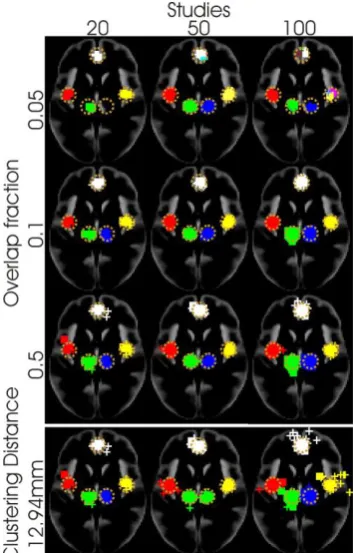
Figure (2) shows the effect of the clustering distance; note that the ClusterZ depicts clusters as +
markers for each member coordinate, rather than as a cluster of voxels, making them appear
somewhat blocky. As expected when the overlap fraction is ()=005 the clusters can fail to form
because is too small for coordinates to overlap, and where they do form they can be fractured. For a
wide range of () (01 to 05) the clusters successfully form so, at least for this data, the method is
not overly sensitive to the clustering distance. This is because the coordinates in the true clusters are
generally considerably more densely packed than the between cluster coordinates.
The important feature of the adaptive clustering scheme is that the clusters are generally independent
of the number of studies in the analysis. This does not hold when the clustering distance is held fixed,
as seen on the bottom row of figure (2). Fixing the clustering distance causes recruitment of the
between-cluster coordinates into the true clusters as the density increases with the number of studies;
this is most evident from an increased inclusion of coordinates outside of the cluster boundary for 100
studies and clustering distance 1294mm. This leads to a paradoxically increasing number of false
positives for larger meta-analyses. It is important to note that this is not a feature specific to ClusterZ,
as it will affect any method employing a fixed FWHM; the clustering distance equivalent. Indeed this
has previously been shown to happen in the ALE algorithm [17, 26].
Figure 2. Showing the effect of clustering distance on simulated data with 5 clusters. Significant clusters are represented by + markers for each coordinate in the cluster, and different clusters are indicated by different colour markers; the boundaries of the true clusters are indicated by dashed-line
circles. For small overlap fraction (top), clusters can fail to form or be fragmented as indicated by multiple colours within-cluster. For fixed clustering distance (bottom), the clusters grow to erroneously include study specific coordinates. Importantly, allowing the clustering distance to vary
with the number of studies produces similar results for large (100 studies) and small (20 studies) meta-analyses.
In figure (3) the overlap fraction is plotted against estimated effect size to show the impact of varying
clustering distance. When the two opposite effect size clusters are well spatially separated (figure
(3a)) the plots are quite independent of the number of studies; despite the clustering distances for the
different numbers of studies being different. For very small () the clusters fail to form and the
effect sizes are underestimated; this is the same feature seen in figure (2). At the other extreme large () results in an underestimated effect size due to recruitment of between cluster coordinates; again
this is seen in figure (2). Once the coordinates are fully formed the effect size estimate is accurate, but
with increasing bias as the overlap fraction increases, and at ()=05 there is some underestimation.
This bias increases ever more rapidly as () increases, as does the standard error of the estimate. It
would appear that for smaller bias a smaller value of cluster fraction is preferable, but this comes at
the expense of an increased risk of lower density clusters not forming. This can be seen in figure (3a)
As the clusters are placed closer together, another phenomenon becomes apparent. For large
clustering distance it is not possible for the clustering algorithm to resolve two nearby clusters. In
figure (3b) this impacts the 20 study experiment mostly as the larger clustering distances cause
coordinates in the two clusters to overlap. This is even more obvious when the clusters slightly
overlap (row c), where only the experiment with 100 studies is able to properly resolve the two
clusters with an overlap fraction of 05. When clusters of opposite effect size are not resolved the
effect estimate due to the combined coordinates may be near zero, and consequently no significant
cluster would be declared. However, this can be detected by inspection of forest plots (see figure (9)),
where the mixing of positive and negative effects would be highlighted. A solution employed by other
algorithms is to perform separate positive and negative reported effect meta-analyses, but this is not
ideal as the effects are not independent. The solution offered by ClusterZ is to modify the clustering
algorithm such that only coordinates of the same effect sign can overlap, producing positive effect
clusters and negative effect clusters with no sign mixing. The application of this to the touching
clusters is shown in figure (3d), which shows the bias has been eliminated and the clusters are
resolved. There is a caveat to this modification, however, in that it can mask true heterogeneity in
reported effects. This modified algorithm should therefore only be used if the forest plots indicate
Figure 3. Showing the impact of overlap fraction (and therefore clustering distance) on effect size estimates. Two clusters are simulated, as depicted on the left; the clusters are placed at distance, near, or overlapping. True effect sizes are +085 and -085, and between cluster coordinates have the same magnitude effect. Here S.E.M is the standard error on the effect size estimate. Coordinates are placed with a standard deviation of 45mm from the cluster centre, or 8mm for the low density example.
4.3 Type 1 error control
To confirm that FCDR controls the FWER under the null hypothesis, pseudo experiments were
generated by randomly placing coordinates, independently and with uniform probability, within a GM
mask. This simulation used 40 studies, and the Z scores were sampled at random from a Gaussian
distribution with mean 379, standard deviation 10, and truncated such that 379≤|Z|≤6; this simulates
Z scores from studies reporting significant and censored activation (for example). Therefore,
incidental clusters formed by the random coordinates may be expected to have a significant positive
mean, yet there should be few significant results with FWER control. Five hundred such experiments
were analysed and the number that produced significant results counted while controlling the FCDR
expected that the pseudo experiments would produce significant results around 1%, 5%, and 10%,
respectively, of the time.
Control of the FWER is important, but does not then place a quantifiable limit on the number of
clusters, from those declared significant, that might be expected under the null hypothesis. This is an
aim of FCDR. To test this, experiments involving known numbers of true clusters (1, 3, and 5) were
simulated; with 500 simulations per experiment. Since the point of the experiment is control of false
positive results, forty studies were simulated, providing sufficient statistical power to avoid many
false negative results. As above, all Z scores were sampled at random from a Gaussian distribution
with mean 379, standard deviation 10, and truncated such that 379≤|Z|≤6. Each study had twenty
random coordinates, which was reduced to 10 on average after censoring. Added to these were a set of
true clusters distributed about fixed Talairach [27] coordinates; the spatial distribution was Gaussian,
using a standard deviation of the distances from the centre points of 45mm corresponding to a higher
limit (least dense) of standard deviations measured in clusters detected in CBMAs [26].
To compare with the ALE and ES-SDM algorithms, 50 experiments were generated (as detailed
above) for each of 0, 1, 3, and 5 fixed clusters and saved in the ALE and ES-SDM formats; these files
are included as supplemental material. The distributions of clusters detected using ALE and ES-SDM
were plotted as histograms, along with equivalent results from ClusterZ using the experiments
detailed above with FCDR 005. FDR of 005 was used with a minimum 200mm3 cluster size for ALE
[26], and the recommended settings (uncorrected p-value 0005, minimum cluster size 10 voxels, and
a minimum Z threshold of 1) were used with ES-SDM [14]; in addition the default anisotropic
smoothing kernels were employed [28]. Ideally the recommended cluster based threshold method
would have been employed with the ALE algorithm, but the execution time (around one day per
experiment) prevented its use for the 200 experiments performed. Nevertheless, the limitations of
FDR in the context of CBMA are well understood [26] and can be considered in the comparison.
4.3.1 Type 1 error control Results
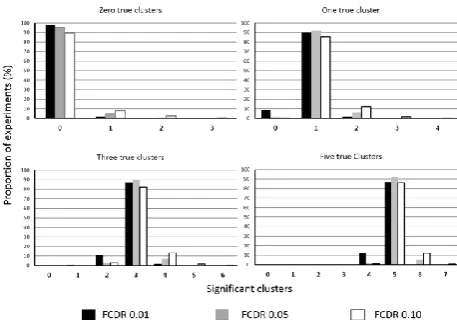
Five hundred pseudo experiments, with zero fixed clusters, were processed. A histogram of the
number of clusters detected are shown in figure (4). At FCDR of 001 the total number of experiments
declaring significant clusters was 9/500, which is an estimated FWER of 0018. Similarly at FCDR of
005 and 01 the total number of experiments declaring significant clusters was 24/500 and 54/500
respectively, representing family wise error rates of 0048 and 011. This experiment suggests that
FCDR is able to control the FWER under the null hypothesis, just as the FDR scheme it is based on.
The ability of FCDR to control the type 1 error rate was also tested in experiments with up to 5 true
significant clusters, and also shown in figure (4). The number of clusters declared significant was
FDCR of 001, the number of false positives was highest for 01, while the typical setting of 005 fell
between the two. This experiment demonstrates that, at least for the simulated data, FCDR does
[image:20.595.182.411.130.292.2]control both the FWE rate and the cluster-wise type 1 error rate.
Figure 4. The number of clusters declared significant by ClusterZ for known numbers of clusters (0, 1, 3, and 5) and FCDR (001, 005, and 01).
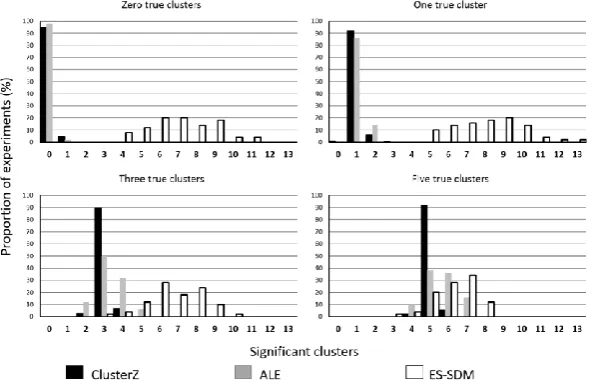
The results of the comparison between ClusterZ and the ALE and ES-SDM algorithms is shown in
figures (5) & (6). The ALE algorithm controls the FWER when there are zero true clusters since FDR
was used, but the rate of false positive clusters begins to increase for 3 and 5 clusters. However, these
extra clusters were small and are a known consequence of voxel-wise FDR in ALE. Taking into
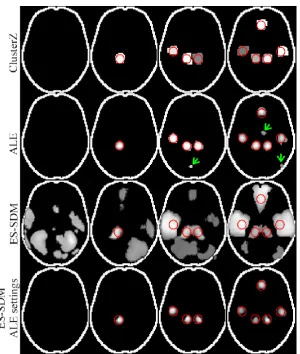
account the limitations of voxel-wise FDR, the ALE algorithm performs similarly with ClusterZ for
this data, as can be seen in figure (6), where the small false clusters are highlighted; note the
smoothness of the ALE algorithm is due to the Gaussian kernel used by the method, while ClusterZ
depicts significant clusters by + markers for each coordinate contributing to the cluster. The ES-SDM
algorithm, on the other hand, has been unable to demonstrate control of either the FWE rate, or the
number of false clusters. This is probably a result of the uncorrected p-value threshold employed.
Figure (6) shows the extent of the issue, with multiple clusters detected under the null hypothesis
(zero true clusters) and results that are quite different to both ALE (despite the same coordinates being
used) and ClusterZ, and also not constrained to the regions where the true clusters are placed.
The contrast in clusters produced by ES-SDM, on the one hand, and ClusterZ and ALE on the other,
is expected to be due to the parameters being set for different aims. The ALE algorithm attempts to
model the spatial probability distribution of activation foci on a voxel-wise basis [7]. A statistical
threshold applied to this probability reveals voxel clusters that might then be loosely interpreted as the
distribution of reported activation foci. ClusterZ also attempts to find the distribution of reported
coordinates (activation and deactivation), but by clustering coordinates rather than voxels. ES-SDM
possible, to incorporate statistical parametric maps into the analysis [14]. As a consequence the
clusters are much larger than those of ALE and ClusterZ.
To consider whether the differences in clusters between ES-SDM and ClusterZ/ALE might be
completely explained by the differences in parameters, a set of equivalent (as far as is possible)
parameters values were established to reflect those used by the ALE algorithm: p-value threshold due
to FDR, the FWHM, and the minimum cluster volume. These parameters were then used with
ES-SDM, and the analysis shown in figure (6) repeated. For zero, one, three, and five clusters, the
threshold p-values were 00, 4410-6, 1710-5, and 2910-5 respectively in the respective ALE
analyses; however ES-SDM allows a minimum p-value threshold of 1010-5, which was therefore
used where necessary. The FWHM was set to 10mm, and the minimum cluster size 200mm3; these
are similar to those typically used in ALE. There is no equivalent of the anisotropic kernels or Z value
threshold in ALE, so they were set to isotropic and the default Z>1. The results shown in figure (6)
(bottom row) demonstrate that using similar parameter settings modifies the output of ES-SDM to be
similar to ALE, and ClusterZ, for this experiment. However, this is at the expense of changing the
[image:21.595.144.441.398.591.2]original aim of the method.
Figure 5. Comparison of ClusterZ, ALE, and ES-SDM using simulated data with known numbers of clusters. For ClusterZ an FCDR of 005 was employed, and FDR of 005 with a minimum cluster size
Figure 6. Typical results of numerical experiments with fixed numbers of clusters superimposed onto an axial outline of the brain. The red circles indicate the placement of coordinates belonging to the fixed clusters. The resulting significant clusters are shown as maximum intensity projections. For the ALE results, the arrows indicate small false clusters due to the use of voxel-wise FDR. The results for
ES-SDM are shown with the default parameter settings and with settings equivalent to those used by ALE (bottom).
4.4 Coordinate Based Random Effect analysis of real data
Numerical experiments verify the functionality of the algorithms and demonstrate their features, but it
remains to be shown that ClusterZ performs on real data. Full meta-analyses are a study in themselves
and beyond this demonstration, so data adapted from two previously published analyses [29, 30] are
used. The first is a meta-analysis of VBM studies of clinically isolated syndrome (CIS) and multiple
sclerosis (MS); subjects diagnosed with CIS are at risk of developing clinically definite MS, which is
known to result in grey and white matter atrophy. The studies compared grey matter density or
volume of patients to healthy controls. In total there are 21 studies reporting 29 experiments
comparing patients to healthy controls, and of these 4 were CIS, 16 RRMS, 3 BMS, 2 SPMS, 2
PPMS, 1 classical MS, and 1 cortical MS; details are in supplement 2. The second is a meta-analysis
of fMRI studies of mechanically induced pain in healthy volunteers. These studies compared
functional activation under painful stimulus to activation at rest or innocuous stimulus. In total this
performed using ClusterZ (FCDR 005 & FWE 005), ALE (default cluster forming threshold
p<0001, cluster-level FWE 005, 1000 iterations), and ES-SDM (default uncorrected p<0005,
minimum cluster size 10 voxels, Z>1, and anisotropic smoothing kernels).
ClusterZ reports its results in several ways. Cluster images use colour coding to show each significant
cluster, and the reported foci are indicated by + markers. Details of each cluster are tabulated,
including effect size estimates, cluster centroid, and Talairach labels as detailed in [31] to locate the
anatomy implicated. ClusterZ does not work voxel-wise, so the cluster volumes typically reported by
both the ES-SDM and ALE methods are not directly computable. However, an equivalent voxel-based
volume is estimated by filling an image array with overlapping cube markers for each reported
coordinate to form a solid cluster of voxels with computable volume that encompasses the distribution
of reported foci; these volumes are also reported. An important aspect of MA is data checking and
forest plots are the standard way to visualise the data in context, which is invaluable for quickly
identifying problems. Data checking is particularly important for ClusterZ, where multiple
meta-analyses (one per cluster formed) are performed. The use of random effects meta-analysis in clusters
means that forest plots become viable, and code (written for the R statistical package [32]) to draw the
plots is automatically generated for each cluster detected regardless of significance level. Forest plots
4.4.1 Real data CBRES Results
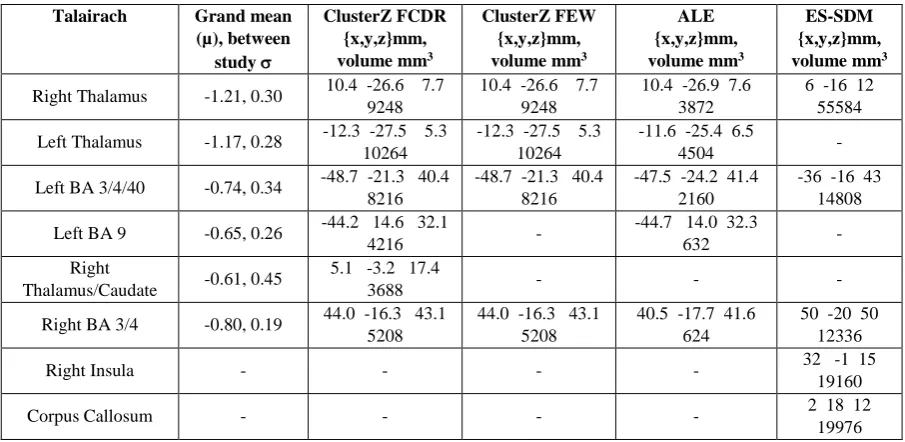
ClusterZ detected 6 significant clusters in the MS data using FCDR, which are listed in table 1. Most
covered more than one Talairach structure as indicated in the table. Using ClusterZ FWE method
reduced the significant clusters to 3, but it is worth noting that they are identical to the respective three
from the FCDR analysis; clusters, formed by the clustering algorithm, are independent of the
threshold level in ClusterZ unlike voxel-wise analyses. The ALE algorithm has declared 5 significant
clusters in in the MS data, which are very similarly located to those detected by ClusterZ. The
similarity between the ALE and ClusterZ results extends somewhat to the characteristic cluster
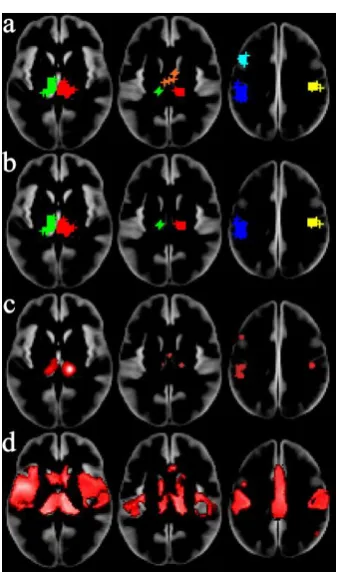
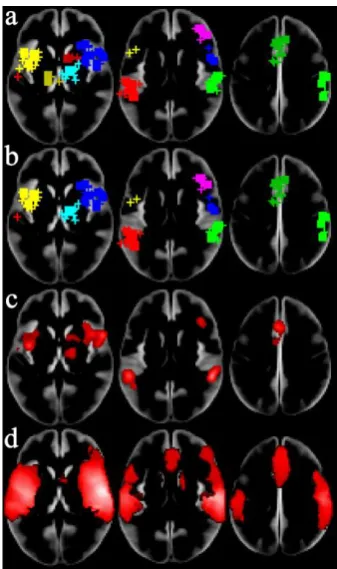
shapes, as can be seen by comparing rows a & b with row c in both figure (7) and figure (8), however
the ALE clusters tend to be smaller. This is a result of the different way that ALE represents clusters
(voxel-wise activation likelihood measure) compared to ClusterZ. Comparison with the ES-SDM
algorithm is not straight forward. ES-SDM declares clusters that are comparatively large, and having
different centroids; this is evident from both figure (7) and (8). The relatively large clusters reflect the
different aim of ES-SDM compared to ALE and ClusterZ. Where possible the reported cluster
centroids were matched to those detected by ClusterZ and ALE and reported in table 1.
ClusterZ declared 9 significant clusters with the pain data using FCDR; table (2) and figure (8). A
useful feature of ClusterZ is that the FCDR is estimated for every cluster, and post-hoc analysis
revealed a tenth cluster just beyond significant at FCDR 006; ClusterZ automatically estimates, and
reports, FCDR and FWE rates for every cluster detected. This is reduced to 7 clusters when FWE is
employed. ALE agreed on 8 of these. Again the ES-SDM results were somewhat different, and
matching cluster centres in table 2 was not possible for most.
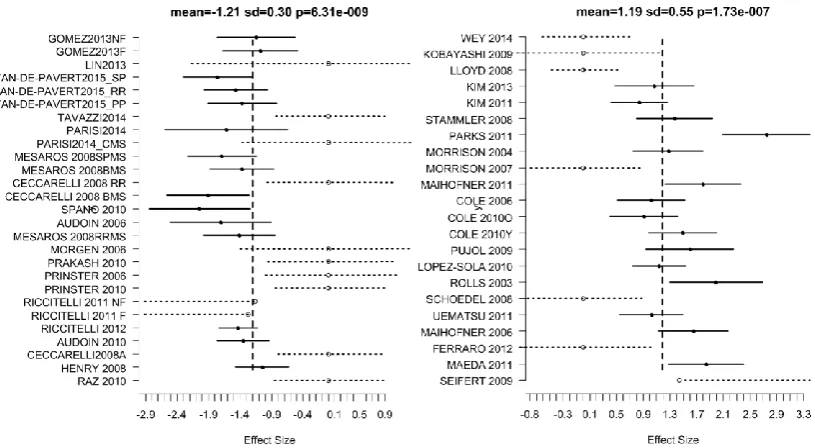
Figure (9) shows forest plots from the most significant clusters from the MS and pain analyses. These
indicate the reported effect sizes and a range deduced from the within-study standard deviation, an
overall estimate of grand mean and standard deviation, and the p-value for the cluster. Censored
studies are also depicted in the plots by empty circle markers and dashed line range indicators derived
from the study thresholds. For censored studies the markers do not indicate the contribution to the
estimate of the model parameters, but the dashed lines indicate the range over which the contribution
Talairach Grand mean (µ), between
study
ClusterZ FCDR {x,y,z}mm, volume mm3
ClusterZ FEW {x,y,z}mm, volume mm3
ALE {x,y,z}mm, volume mm3
ES-SDM {x,y,z}mm, volume mm3
Right Thalamus -1.21, 0.30 10.4 -26.6 7.7 9248
10.4 -26.6 7.7 9248
10.4 -26.9 7.6 3872
6 -16 12 55584
Left Thalamus -1.17, 0.28 -12.3 -27.5 5.3 10264
-12.3 -27.5 5.3 10264
-11.6 -25.4 6.5
4504 -
Left BA 3/4/40 -0.74, 0.34 -48.7 -21.3 40.4 8216
-48.7 -21.3 40.4 8216
-47.5 -24.2 41.4 2160
-36 -16 43 14808
Left BA 9 -0.65, 0.26 -44.2 14.6 32.1
4216 -
-44.7 14.0 32.3
632 -
Right
Thalamus/Caudate -0.61, 0.45
5.1 -3.2 17.4
3688 - - -
Right BA 3/4 -0.80, 0.19 44.0 -16.3 43.1 5208
44.0 -16.3 43.1 5208
40.5 -17.7 41.6 624
50 -20 50 12336
Right Insula - - - - 32 -1 15
19160
Corpus Callosum - - - - 2 18 12
[image:25.595.66.519.97.318.2]19976 Table 1. Significant clusters with their estimated grand mean effect size and between-study standard deviation, volume, and centre Talairach location, for the MS data. The results are shown to compare
ClusterZ, ALE, and ES-SDM methods.
Talairach Grand mean (µ), between
study
ClusterZ FCDR {x,y,z}mm, volume mm3
ClusterZ FEW {x,y,z}mm, volume mm3
ALE {x,y,z}mm, volume mm3
ES-SDM {x,y,z}mm, volume mm3
Left BA 13/40 1.20, 0.56 -52.3 -28.9 19.9 13512
-52.3 -28.9 19.9 13512
-52.2 -27.5 20 5760
-
Right BA 13/44 1.18, 0.21 41.3 8.4 10.1 21920
41.3 8.4 10.1 21920
41.3 9.7 6.8 6472
-
Right BA 40 1.17, 0.27 53.2 -25.1 26.0 12048
53.2 -25.1 26.0 12048
52.3 -24.4 20.5 3832
-
Left BA 13 1.1, 0.27 -38.2 5.3 11.3 14520
-38.2 5.3 11.3 14520
-38.2 1.9 10.4 4432
-
Right BA 9/10/46 0.75, 0.54 36.7 37.3 23.7 6264
36.7 37.3 23.7 6264
36.3 39.2 24 1144
-
Right Thalamus 0.82, 0.58 13.4 -12.6 9.6 8208
13.4 -12.6 9.6 8208
12.9 -12.7 9.7 1672
-
Right Caudate/putamen
0.67, 0.62 13.4 6.5 5.4 4832
- 14.6 6.9 5.2
1160
-
Right BA 6/8/24 0.91, 0.37 -2.0 17.6 40.1 15248
-2.0 17.6 40.1 15248
-1.6 17.8 38.8 5072
-3 22 42 28120 Left Thalamus 0.65, 0.15 -10.9 -17.7 5.7
4136
- - -
Right BA 7/40 *0.56, 0.56 *38.5 -55.7 47.4 3336
- - -
Right BA 44/45/48 - - - - 51 -5 13
110088
Left BA 40/41/48 - - - - -38 -13 8
76352
Undefined - - - - 11 -1 22
2296 Left Caudate
Nucleus
- - - - -11 6 18
792 Table 2. Significant clusters with their estimated grand mean effect size and between-study standard deviation, volume, and centre Talairach location, for the pain data. The results are shown to compare
Figure 7. Significant clusters detected in the MS coordinates. a) is ClusterZ using FCDR 005, b) is ClusterZ using FWE 005, c) is ALE algorithm employing p<0001 cluster forming threshold and
cluster threshold of 005 (FWE corrected), and d) is ES-SDM using the recommended p<0005 threshold and cluster extent of 10 voxels. For the ClusterZ results coordinates contributing to clusters
Figure 8. Significant clusters detected in the pain coordinates. a) is ClusterZ using FCDR 005, b) is
ClusterZ using FWE 005, c) is ALE algorithm employing p<0001 cluster forming threshold and
cluster threshold of 005 (FWE corrected), and d) is ES-SDM using the recommended p<0005
threshold and cluster extent of 10 voxels. For the ClusterZ results coordinates contributing to clusters
Figure 9. Forest plots of the effect sizes in the most significant cluster from the MS (left) and pain
(right) meta-analyses. Solid circle markers indicate the effect size reported by the study in the cluster,
while the confidence intervals are depicted as solid horizontal lines spanning ±1.96 times the within
study standard deviation of the effect size. Censored values are indicated by open circle markers and
the intervals by dashed lines (---o---); these are determined by the study thresholds and indicate
5
Discussion
Here a method of performing coordinate based random effect meta-analysis and meta-regression was
presented. ClusterZ utilises the Z scores (or t statistics) and coordinates, typically reported by
functional MRI or VBM studies, to detect where studies report effects consistently. The reported
statistics are not suitable effect measures for meta-analysis directly, but they can be transformed
(equations 1-5) into an approximate effect size that is suitable for a random effects meta-analysis. The
advantages of ClusterZ include estimates of effect size, the possibility of meta-regression, and that
cluster-wise statistical significance is determined by the reported effect rather than the density of
clustering, which is not so interpretable. Furthermore, analysis at the cluster-, rather than voxel-, level
makes type 1 error control using the easy to interpret false cluster discovery rate feasible.
ClusterZ relies on multiple established methods to perform its analysis. Firstly, clusters are formed
based on the DBSCAN algorithm, which aims to differentiate true clusters from study specific effects.
The clustering algorithm has a parameter that is analogous to the FWHM parameter in CBMA
algorithms, but in ClusterZ this automatically adapts to the experiment to avoid false negatives when
there are few studies and avoid false positives when there are many studies; the fixed FWHM used in
other algorithms paradoxically increases the false positives for increasing numbers of studies.
Estimation of model parameters is based on the standard statistical technique of maximum likelihood
estimation, which also allows for censoring. The subsequent inference on the parameters is based on
the generalised likelihood ratio test, which has well known statistical properties in the asymptotic
limit. Finally, principled control of the false positives clusters is based on the popular FDR method,
which controls the FWER under the null hypothesis, and then limits the proportion of clusters
expected under the null hypothesis to a user specified level; by comparison the ES-SDM method
employs no disciplined control of the false positive clusters. This is perhaps the most important
feature of ClusterZ, since false positives results might propagate and even amplify the very issues that
motivated the meta-analysis in the first place.
Maximum likelihood estimation is used to estimate model parameters in the presence of censoring.
MLE is one of multiple methods of performing meta-analysis, and has been shown to perform well in
comparison [33]. Numerically MLE is a nonlinear problem, with no guarantee of convergence to the
correct solution. However, because ClusterZ computes estimates only at clusters, rather than voxels,
the algorithm is very efficient (~1minute for typical analyses such as the MS and pain studies) so
considerable computations effort is dedicated to finding the global maximum solutions. Numerical
experiments confirmed its validity, being able to accurately estimate the parameters of the models