Using a prisoner advisory group to develop diversity
research in a maximum-security prison
COWBURN, Malcolm and LAVIS, Victoria
Available from Sheffield Hallam University Research Archive (SHURA) at:
http://shura.shu.ac.uk/7589/
This document is the author deposited version. You are advised to consult the
publisher's version if you wish to cite from it.
Published version
COWBURN, Malcolm and LAVIS, Victoria (2013). Using a prisoner advisory group to
develop diversity research in a maximum-security prison. Groupwork, 23 (3), 32-44.
Copyright and re-use policy
See
http://shura.shu.ac.uk/information.html
Sheffield Hallam University Research Archive
Groupwork Vol. 23(3), 2013, pp.67-79. DOI: 10.1921/55011230301
Using a prisoner advisory group to develop diversity research in a maximum-security prison: A means of
enhancing prisoner participation
Malcolm Cowburn1 and Victoria Lavis2
Abstract: This paper addresses groupwork processes with a group of prisoners advising a research project in a maximum-security prison in England. The research project (Appreciative Inquiry into the Diversity Strategy of HMP Wakefield. RES-000-22-3441) was funded by the Economic and Social Research Council (ESRC) and lasted 9 months. The research explored the experiences of prisoners in diverse minority groupings and the strategies of the prison to accommodate the complex needs of these groups. The Prisoner Advisory Group (PAG) was made up of representatives from Black and Minority Ethnic (BME) prisoners; older prisoners (over 60s); Disabled prisoners (with physical disabilities, learning difficulties; and mental health problems); Gay, Bi-sexual and Transgender prisoners; and prisoners affiliated to Faith groups. It met regularly during the research. The paper considers the forming norming and performing aspects of establishing an effective participant voice in a prison-based project. It considers the contribution of the PAG to developing a research strategy that engaged prisoners in the research. It reflects on the nature of ‘participative research’ in general and whether such research is possible within a high-security prison environment.
Keywords: appreciative inquiry; action research; research advisory group; prisons; diversity; groupwork; group work
Introduction
This paper reports on work with a group of prisoners during a research project in a maximum-security prison in England. The research project was funded by the ESRC and lasted 9 months. It explored the experiences of prisoners in diverse minority groupings and the strategies of the prison to accommodate the complex needs of these groups. Diversity is a complex concept that is dynamically enacted in everyday prison life. Hudson (2007, p. 158) offers this definition ‘the range of identities to be found within any population (local, national, global), such as young, old, male, female, indigenous, immigrant, foreign,
Christian, Muslim, rich, poor, homosexual, heterosexual and so on’.
Current legislation requires public bodies to promote equality and prevent discrimination in the
following areas: age, disability, gender, race, religion and belief and sexual orientation. Each strand is covered by specific government legislation. In terms of ‘diverse minority identities’ in prison we focussed on the needs and experiences of: Black & Minority Ethnic (BME) prisoners; older prisoners (over 60s); Disabled prisoners (with physical disabilities, learning difficulties and mental health problems); Gay, Bi-sexual and Transgender prisoners; and prisoners affiliated to Faith groups. We worked intensively on one wing but also met regularly with a Prisoner Advisory Group (PAG) throughout the duration of the research.
This paper reflects on the work of the PAG and considers how prisoners may be more centrally involved in prisons research. We first outline the origins, aim and objectives of the research; we then discuss the design of the project; the main section of the paper describes the development and work of the PAG and we conclude by reflecting on the nature of research with prisoners.
Values, aims and objectives of groupwork in criminal justice settings
Groupwork within a Criminal Justice setting inevitably embodies values.
The aims objectives and content of groupwork programmes identify what is of importance to the organisation that delivers the programme. That which is important is of value; ‘value’ or more particularly ‘values’ in this context can be a vague concept. Banks (2006, p. 6) offers this working definition:
Historically, therefore, it can be said that at different times groupwork within the Criminal Justice System (CJS) has ‘valued’ different aspects of the people involved in groups. Psychodynamic initiatives (sharply criticised by Martinson, 1974) valued the gaining of insight that it was assumed would lead to the resolution of inner conflicts and a happier life. A by-product of the happier life was the cessation of offending. However, as the tide was turning against psychodynamic approaches (in part helped by Martinson’s work) and in particular their apparent ineffectiveness at reducing offending behaviour, Anna Salter (1992) noted that such approaches created offenders with insight.
Following psychodynamic approaches to groupwork, social skills became a valued approach in working with offenders in the late 1970s through much of the 1980s (Priestley & Maguire, 1978, 1983). Many people who committed offences, it was suggested, lacked the basic skills to interact with others and because of such
deficiencies they were unable to secure employment, make friends or sustain close personal relationships. Groups focussing on learning and rehearsing new skills proliferated (see Brown & Caddick, 1993). The value of sociability was asserted. However, whilst the cessation of offending behaviour was not the main objective of either of the previous approaches it was such for cognitive-behavioural groups that were also developing in the 1980s under the umbrella of the ‘What works agenda’. Responding directly to Martinson’s (1974) critique that psychodynamic approaches did not ‘work’ in reducing offending behaviour, cognitive behavioural approaches valued the reduction of offending behaviour as the desired outcome of groupwork programmes.
This shift in focus from individual well being to reducing offending behaviour carried with it a change in what was valued. This can be described as a move from Kantian to Utilitarian ethics: a Kantian approach focuses on how individuals are treated (i.e. on the processes of respect or not); whilst utilitarian approaches are exclusively concerned with beneficial outcomes for the ‘majority’ (in this case the reduction or cessation of offending). It is argued that in this shift to groupwork underpinned by Utilitarian ethics concern and care for individual group-members has been lost. This is nowhere more sharply seen than in relation to issues of voluntarism and consent to treatment.
The origins of this project date back to 2007 when one of us (MC) as a member of the Independent Monitoring Board at HMP Wakefield discussed with the Diversity Governor the prison’s developing strategy for working with diversity. The governor noted that whilst the practices of the prison were subjected to a range of scrutiny - the two main sources of external scrutiny being inspections conducted by Her Majesty’s Chief Inspector of Prisons and Probation and research conducted bi-annually under the auspices of the University of Cambridge ‘the
Measurement of the Quality of Prison Life’ (MQPL) - most of this was brief in nature and failed to capture the ongoing efforts of some prison staff to work positively with prisoners from a variety of minority groupings. Additionally, it was noted that the Prison’s ‘Diversity Strategy’ was only recently developed and had not had time to impact on the daily life of prisoners. There followed a series of meetings in which the present project was developed. Key to the research was identifying a methodology that enabled both good and problematic practices to be identified. It was therefore decided, largely on the basis of the work of Alison Liebling and colleagues (Liebling & Arnold, 2005; Liebling et al, 2001; and Liebling et al, 1999), to test an Appreciative Inquiry (AI) approach in the project (see below for more details). The aim of the research was twofold: to develop an in depth method for researching diversities in prison; and to discover how minority groups experience the diversity policies and procedures in place at HMP Wakefield. In order to achieve these aims we identified the following objectives: (i) To identify what aspects of the diversity policies and procedures in the prison are perceived by minority groups to promote the intended feelings of respect and well-being; (ii) To ascertain in what ways these policies and procedures could be improved to promote a greater feeling of respect and well being in minority groups; (iii) To identify whether the Appreciative Inquiry methodology was useful in developing an understanding of diversity in prisons.
The exploratory nature of the study, particularly in relation to testing the methodology, meant that it was designed and funded as a pilot study. We worked primarily on one Wing in the prison for the duration of the project.
An appreciative inquiry into the Diversity Strategy of HMP Wakefield
other areas, including research in prisons. We have already referred to the work of Liebling and her colleagues who suggest that AI enables prisoners to describe their positive experiences in prison whilst also talking, often more freely than in problem-focussed interviews, about their negative experiences.
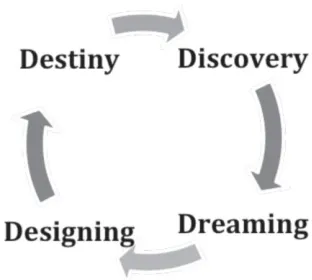
There are four phases to AI research; discovery, dreaming, designing and destiny (Reed, 2007).
‘Discovery’ is the start of the inquiry and is concerned with identifying best experiences rather than commencing from a problem focus. Although this phase aims at identifying best experience, it inevitably also gathers
information about experiences that are not ‘best’. ‘Dreaming’ moves the inquiry on and changes the focus; it asks research participants to imagine how the subject under inquiry (in this case the prison’s response to diversity) might be improved. This enables the research participant to link their ‘best’ experience to how things may be further enhanced, thereby highlighting elements and issues which are important to the research participant. ‘Designing’ involves the research participant in identifying practices, relationships and processes which might be necessary to support the ideas outlined in dreaming and articulated as ‘best’ in discovery. The final phase of AI ‘Destiny’ concentrates on what is needed to maintain and sustain the changes that have been dreamed about and designed. These elements guided the design and collection of data in each of the four phases of the research. Figure 1, below, represents these four elements and shows how they flow from one to the other.
[image:6.595.82.238.555.695.2]In the present project we used AI in four phases of data collection: documentary analysis, interviews with prisoners, a survey of prisoners and focus groups with staff. However, a key element in AI research is the involvement of those being researched in the design and ongoing management of the project.
We did this primarily through the development of two groups – the Project Steering Group (PSG) and the PAG – that met, at least three times during the project. The PSG was made up of members of prison staff and some external people from diversity based organisations and one academic, who had experience of researching ethnicity and faith issues in prisons, from another University. However, the concern of this paper is the other group that was made up solely of prisoners.
Engaging with prisoners
Prior to receiving funding we were invited to give a presentation for prisoners during ‘Diversity Week’ 2008. ‘Diversity week’ was a part of the prison’s overall strategy to give diversity issues a higher profile within prison life. Speakers and events linked to many of the diversity strands occurred throughout the particular week. Approximately ten prisoners of various ages, and race/ethnicities came to our event. We explained what we were hoping to do in the diversity research and began asking their advice on how we could develop the project. Perhaps unsurprisingly, the group was initially suspicious of us and asked us many challenging questions. Hopefully we answered the questions sufficiently well for the group to engage with thinking about our project.
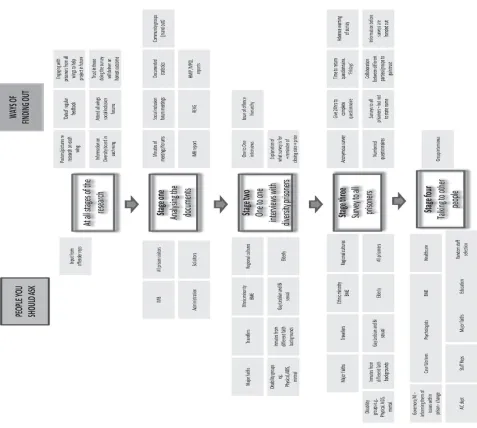
The group had lots of ideas but unfortunately we could not finish our discussion before the session had to end. We told the group that we would return when we knew about our funding situation. When we heard that the project was to be funded we returned to the prison and continued our work with the group. The technique that we used in these two sessions is known as the ‘Wonderwall’. Gottesdeiner (2002, p. 199) coined the term Wall of Wonder to describe a technique ‘a process of reciprocal collaboration [in which] participants work together to create common deliverables, mutually adjusting their activities in real time to take one another’s edits into account’.
The group’s responses to these two questions resulted in the development of a ‘WonderWall’ that we mapped onto the aims of the project to develop a final design of the stages of data collection (see figure 2).
The WonderWall activity and its outcome were central in developing the trust of this group of prisoners and involving them in refining the design of the project. The technique offers a way of working collaboratively with participants to generate research designs/materials where knowledge and understanding of traditional research methods are limited. The technique also offers a way of developing rapport with challenging
[image:8.595.58.535.294.722.2]participants and engendering trust and engagement in the research process. Prisoners experience the intrinsic reward of having
‘shaped’ the research and thereby have some sense of ownership of the research.
It was from this initial diverse group of men that we developed our PAG who provided help and support to the project throughout its duration. A key area that this group was particularly helpful with was in designing and reducing the length of the survey phase of the research. Their assistance was invaluable and greatly increased the rigour of the final instrument.
Working with the Prisoner Advisory Group (PAG)
The PAG was made up of the men who attended the two meetings described above, plus all of the diversity representatives from the pilot wing where the study was to be carried out. Generally the group was made up of between 6-8 men. It was scheduled to meet three times during the project (at the beginning, in the middle and at the end). However, it met on at least six occasions, as we asked for additional help from the group in designing the prisoner survey.
The aim of the survey was to collect the views of all prisoners on the pilot wing about the prison’s response to diversity. The survey was designed using material from the prisoner interviews that generated an initial 148 items, across the four AI elements. Initially in the survey we intended to use the generic term ‘staff’ when asking respondents to comment on how staff contributed to the diversity strategy. The PAG criticised this and suggested that they would answer the questions very differently according to what category of staff was being referred to (incidentally, the PSG critiqued the questionnaire on similar grounds). When we adapted the survey to allow the rating of different staff, the survey had 148 items (34 pages inn length) to be completed by respondents. This was far too lengthy to expect prisoners to complete it. We asked the PAG to help us to reduce the size of the survey. All of the PAG members individually completed the full 148-item version of the survey, ranking items and providing feedback on each of them. The PAG then met to discuss their work and how to reduce the size of the survey. This process enabled us to reduce the survey to a final 54 items (14 pages) whilst ensuring that it retained a focus on key issues. Additionally, the PAG discussed at length strategies for
within the prison. Moreover, it represents a return rate of 1 in 5.5. If this return rate were to be repeated in a full prison study this would generate a return of 124 surveys; sufficient to enable a detailed analysis of the data.
Apart from the more formal or timetabled meetings with the PAG we also met individual members of the group as we walked around the prison. People were always keen to stop and ask about the research or discuss research related matters that they had, individually, been reflecting upon. This informal time, particularly on the pilot wing, was very important in cementing positive and mutually respectful relationships.
An element in developing and sustaining respectful relationships within the group was conflict
resolution. Open disagreements rarely occurred in group sessions and when they did they tended to be resolved by agreeing to disagree and moving on to the areas where reciprocal work could occur. However, on one
occasion one group member wrote to us saying that he wished to resign from the group. We contacted him and one of us arranged to speak with him. He stated that he felt that he was not being allowed to express himself fully in the group and that certain group members tended to dominate and it was their voices that were heard. We recognised his experience as valid and worked with him to identify what he and we could do differently to prevent him from feeling unheard in future groups. At the end of the conversation he withdrew his resignation and thereafter continued to participate fully in group discussions.
‘Participatory research’ or participating in research: On not taking sides but listening carefully
incident highlights issues that, as prison researchers, we cannot ignore issues related both to taking sides but also to contributing to issues related to social justice.
Liebling (2001) has explored the issue of ‘allegiances in prisons research’. She has noted the
shortcomings of earlier sociological research (particularly the work of Becker; 1967) that suggests that social research should side with the less powerful, the subordinate groups in society/ies and in prisons. In our project, it could be argued that there is a hierarchy of power with governor grades at the top, uniformed staff in the middle and prisoners at the bottom. However, for us it was important that we listened to all participants and tried to make sense of what we heard without trying to resolve conflicting stories or establish ‘the true version’. Commenting particularly on ethnographic research, Liebling (2001) notes:
that world views are ‘situated’ in meanings constructed by language, symbols and practices, it aims to fill the gap between correlation and explanation, through meaningful understandings. (p. 475)
It is here that there is a link with research committed to social justice.
Fine, Torre et al (2004) reporting on a research project within a women’s maximum security prison in the USA note that taking an explicitly ‘participatory action research’ stance ‘… assumes knowledge is rooted in social relations and most powerful when produced collaboratively.’ (p.95) The present project was concerned with helping the prison to understand the experiences of prisoners in diverse minority groupings and to develop further strategies to allow these prisoners a life in prison that is respectful of their diversity – thus allowing them a form of social justice whilst serving their prison sentences. To do this rigorously we could not have allegiance to any particular side but we could allow all sides the opportunity to express their experiences of living in prison. Liebling (2001) acknowledges this as not only possible but also desirable in prison-based research:
It is possible to take more than one side seriously, to find merit in more than one perspective, and to do this without causing outrage on the side of officials or prisoners …, (p. 473)
but, more significantly, to be involved in the design and conduct of the research endeavour. This enabled them to shape not only what was asked, but who was asked and how they were asked.
Although our project did not set out to be ‘participatory research’, by reflecting on issues of taking ‘sides’ and involving prisoners in the design of the research we recognise that the project shares some of the strengths of participatory research and that the PAG was a committed and crucial part of the success of the project. We will finish this paper with a quotation from Fine, Torre et al (2004) who reflected on the nature of participatory research which captures the complexities of prison research that seeks to recognise and involve prisoners:
All research is collaborative and participatory, even though typically respondents are given code names and rarely acknowledged as coauthors.
More researchers must acknowledge the co-construction of knowledge and the material gathered from, with and on any community … constitutes a participatory process. … Insiders and outsiders know much, and know much deeply. Between us there is a powerful co-construction of critical knowledge about … prison life. (p. 119)
References
Banks, S. (2006) Ethics and Values in Social Work, 3rd edn, Basingstoke: Palgrave Macmillan Becker, H. (1967) Whose Side Are We On? Social Problems, 14, 3, 234-247
Brown, A. and Caddick, B. (Eds.)(1993) Groupwork with Offenders. London: Whiting & Birch
Fine, M., Torre, M. E., Boudin, K., Bowen, I., Clark, J., Hylton, D. et al. (2004) Participatory Action Research: From Within and Beyond Prison Bars. in L. Weis & M. Fine (Eds.) Working Method: Research and Social Justice. New York & Abingdon: Routledge (pp. 95-120)
Gottesdiener, E. (2002) Requirements by Collaboration: Workshops for defining Needs. Boston, San Francisco: Addison-Wesley
Hudson, B. (2007) Diversity, Crime, and Criminal Justice. In M. Maguire, R. Morgan, & R. Reiner (Eds.) The Oxford Handbook of Criminology. Oxford: Oxford University Press (pp. 158-175)
Liebling, A. & Arnold, H. (2005) Prisons and their Moral Performance: A study of Values, Quality and Prison Life. Oxford: Oxford University Press
Liebling, A., Elliott, C. & Arnold, H. (2001) Transforming Prison: Romantic Optimism or Appreciative Realism? Criminology and Criminal Justice, 1, 2,161-180
Liebling, A., Price, D. & Elliott, C. (1999) Appreciative inquiry and relationships in prison. Punishment & Society, 1, 1, 71-98
Martinson, R. (1974) What works? Questions and answers about prison reform. The Public Interest, 23, 22-54 Priestley, P. and McGuire, J. (1978) Social Skills and Personal Problem Solving. London: Tavistock
Priestley, P. and McGuire, J. (1983) Learning to Help: Basic Skills Exercises. London: Tavistock Reed, J. (2007) Appreciative Inquiry. London: Sage