Multi-stakeholder enquiry for securing e-Business
environments : A socio-technical security framework.
AL-QATAWNA, Ja'Far S.
Available from Sheffield Hallam University Research Archive (SHURA) at:
http://shura.shu.ac.uk/19255/
This document is the author deposited version. You are advised to consult the
publisher's version if you wish to cite from it.
Published version
AL-QATAWNA, Ja'Far S. (2010). Multi-stakeholder enquiry for securing e-Business
environments : A socio-technical security framework. Doctoral, Sheffield Hallam
University (United Kingdom)..
Copyright and re-use policy
See
http://shura.shu.ac.uk/information.html
anenjeia s i 1WD
1 0 1 9 7 8 0 1 9 3
Sheffield
. Learning e.nJ midir
j Aalssits Centfei€iV
LjZsaew»ti«E.
/
ProQuest Number: 10694135
All rights reserved
INFORMATION TO ALL USERS
The quality of this reproduction is dependent upon the quality of the copy submitted.
In the unlikely event that the author did not send a com plete manuscript and there are missing pages, these will be noted. Also, if material had to be removed,
a note will indicate the deletion.
uest
ProQuest 10694135
Published by ProQuest LLC(2017). Copyright of the Dissertation is held by the Author.
All rights reserved.
This work is protected against unauthorized copying under Title 17, United States C ode Microform Edition © ProQuest LLC.
ProQuest LLC.
789 East Eisenhower Parkway P.O. Box 1346
M u l t i- St a k e h o l d e r En q u i r y f o r Se c u r i n g E -Bu s i n e s s
E N V IR O N M E N T S : A S O C IO -T E C H N IC A L SE C U R ITY F R A M E W O R K
JA'FAR S. ALQATAWNA
A thesis submitted in partial fulfilment of the requirements of
Sheffield Hallam University
for the degree of Doctor of Philosophy
will ami m de</r€e dto6e of^w wla lelieoe a/nddto6e wlalaoo lean
grantedl/towlod/o. 3fnd 3fflal (6 well-aeyaain/odwt’il wlaiajoa do ”
Sfdol/' Qjom/t <
dSla/jfer 38. (fordo //
“(flfoooor /alod a/jail iiv dea/roAfo'P /mowleds/e, ffdlal wdljacdiiaiejbr lint a
/jail to ffa/mdi6e ”
ffro/jlol Sffola/ntntad 6 3da(li/t/6
Cryptography is a branch o f mathematics. And like all mathematics, it involves numbers, equations, and logic. Security, palpable security that you or I might fin d useful in our lives, involves people: things people know, relationships between people, people and how they relate to machines. Digital security involves computers: complex, unstable, buggy computers. Mathematics is perfect; reality is subjective. Mathematics is defined; computers are ornery. Mathematics is logical; people are erratic, capricious, and barely comprehensible. The error o f Applied Cryptography is that I didn't talk at all about the context. I talked about cryptography as if it were The Answer™. I was pretty naive... If you think technology can solve your security problems, then you don’t understand the problem s and you don't understand the technology.
A bstract
Increasing the security of e-Business is best achieved by considering the environment in which e-Business applications need to be implemented and used; this implies that e-Business should be viewed as a complex socio-technical system with three interconnected and interacting elements: stakeholders, enabling technology, and business processes. This multiple perspective has rarely been captured by previous studies of e-Business security which perceive security from a narrow, single-sided technical view. This thesis argues that the predominant technical security approaches consider neither the multifaceted nature of e- Business security nor the requirements and influences of the various stakeholders involved in its context. In Jordan e-Business adoption is still in its early stages and is gaining the attention of several parties. Therefore, the primary approach in this research is an interpretive stakeholder analysis in which notions of a socio-technical perspective are employed as required in order to develop a conceptual framework for better understanding of e-Business security in the context of Jordan. In other words, an interpretive approach has been adopted as a mean of inquiry aiming at developing a holistic understanding of e- Business security in relation to its context as well as considering all the stakeholders in the problem area. This methodological choice was influenced by three factors: the nature of the research problem, the researcher’s theoretical lens, and the degree of uncertainty in the study environment. Consequently, four major stakeholders were identified and their security implications were explored. The study’s findings provide rich insights into the security of e-Business by identifying and interpreting the roles, the perceptions, and the interactions of several groups of security stakeholders. The theoretical contributions include: an explanatory framework of organisational, legal, human and technical factors affecting security in e-Business environments which was developed by employing an inductive stakeholder analysis as well as the identification of several organisational aspects, such as governance, communication, power conflict, awareness, and resistance to change, and their relationships to security as well as their practical implications at individual, organisational, and national levels. Additionally, the findings provide insights into the customers’ side of the security problem and explain its relationships with other stakeholders, including government, business and technology providers. This is a sound practical contribution which can help these stakeholders to design better security approaches based on a deeper understanding of customers’ security requirements.
List of Publications
ALQATAWNA, J., SIDDIQI, J., AKHGAR, B. and HJOUJ BTOUSH, M. (2010). SECURITY IN E-BUSINESS: Understanding customers perceptions and concerns. In: The 6th International Conference on Web Information Systems and Technologies (WEBIST).
Valencia, Spain.
SIDDIQI, J., ALQATAWNA, J. and HJOUJ BTOUSH, M. (2010). Do insecure systems increase global digital divide? Book chapter in: KAMEL, S. (ed.). Strategies fo r technological diffusion and Adoption: National ICT Approaches fo r socioeconomic development. IGI Global.
ALQATAWNA, J., SIDDIQI, J., AKHGAR, B. and HJOUJ BTOUSH, M. (2009). E-Business security: Methodological considerations. In: World Congress on Science, Engineering and Technology. Dubai, UAE.
ALQATAWNA, J., SIDDIQI, J., AKHGAR, B. and HJOUJ BTOUSH, M. (2008). Towards holistic approaches to secure e-Business: A critical review. In: The 2008 International Conference on e-Learning, e-Business, Enterprise Information Systems, and e-Government (EEE'08). Las Vegas, Nevada, USA.
A cknow ledgm ents
First and foremost, I thank Allah Almighty for giving me the power of knowledge and the opportunity to improve my qualifications and fulfil my desires.
I am heartily thankful to my supervisor, Professor Jawed Siddiqi. Without his endless support, encouragement, constructive comments and great trust in me, this work would not have been possible. I shall always be grateful to him for his moral support and tolerance throughout the course of this thesis. I also thank him for navigating this research along the thin line between practice and theory. His red ink was worth more to me than gold.
I am indebted to Prof. Louise Yngstrom who helped in shaping my perspective on information security. Her holistic approach inspired me and opened my eyes to the multidisciplinary nature of information security.
A special word of thanks is due to Professor Trevor Wood-Harper from The University of Manchester and Dr. Murray Clark from Sheffield Hal lam University for being part of the examination committee of this thesis.
It is a pleasure also to thank my colleagues at Cultural, Communication and Computing Research Institute (C3RI) for their support and encouragement. Furthermore, I wish to extend my appreciation to all my friends, especially the Jordanian community in Sheffield, for their encouragement and valuable discussions, and for the good times we spent together.
Words are not enough to express my deepest gratitude to my parents, who through the years have provided me with endless love, support, patience and continuous encouragement.
My warmest gratitude goes to my beloved wife Fida’ Al-Obaisi; her unwavering belief in me motivated me and gave me the confidence to complete this work. Without her and our dazzling daughter Jana this achievement has no meaning.
Finally, I wish to acknowledge with gratitude the financial support I have received from the University of Jordan.
Table of Contents
A B S T R A C T ...Ill LIST OF P U B L IC A T IO N S ...IV A C K N O W L E D G M E N T S ...V TABLE OF C O N TE N TS ... V I LIST OF F IG U R E S ...X LIST OF TA B LES ... XI
CHAPTER 1 : RESEARCH O R IE N T A T IO N ...1
1 .1 Pr o b l e m Sit u a tio na n d Rese arch Ga p...2
1 .2 Aima n d Objec tiv e s... 5
1 .3 Su m m a r yo f Co n t r i b u t i o n...6
1 . 4 St r u c t u r ea n d Co n t e n t s...7
CHAPTER 2 : LITERATURE R E V IE W A N D C O N C EP TUA L F O R M W O R K ... 9
2 . 1 e-Bus in es s OVERVIEW...1 0 2.1.1 A working definition fo r e-Business... 11
2.1.2 e-Business components and transaction m odes...12
2.1.3 Potential benefits o f e-Business...15
2.1.4 e-Business adoption issues...15
2 . 2 Sta k eh o l d e ranalysisa n ditspo te n t ia lforexploringe-Bu s i n e s s...1 9 2 . 3 To w a r da Sta k eh o l d e r Mo d e lfore- Bu s in e s s... 2 2 2 . 4 e- Bu s in es s Security Ov e r v i e w... 2 5 2.4.1 Security is hard to define...26
2.4.2 Information Security Services fo r e-Business System s...28
2 .5 The Na t u r e o fe- Business Se c u r it y...3 0 2 . 6 Then e e dforas o c i o-tech nic ala p p r o a c ht oe-Bu sin esss e c u r i t y... 3 2 2 . 7 Co n c e p t u a lf r a m e w o r ko fen q u ir yo fthiss t u d y...3 3 2 . 8 Su m m a r y...4 0 CHAPTER 3 : M E T H O D O L O G IC A L C O N S ID E R A T IO N S ... 42
3 . 1 Und erl ying Pa r a d i g m s... 4 3 3 . 2 Researc h Ap p r o a c h e s: Qualitativev s. Qu a n t it a t iv e...4 5 3 . 3 Suitabilityo f Qualitative Me t h o d sinth e fieldo fe- Bus iness Se c u r i t y...4 7 3.3.1 The nature o f research problem...47
3.3.2 The researcher's theoretical lens...45
3.3.3 The degree o f uncertainty surrounding the phenom enon...48
3 . 4 Qualitative Rese arc h St r a t e g i e s... 4 8 3 . 5 Suitabilityo f Case St udy Stra teg yinthis Re s e a r c h...5 0 3 . 6 Rese arch Designa n d Unitso f An a l y s is... 5 1 3.6.1 Sampling considerations... 53
3.6.2 Data collection techniques within case study m e th o d...56
CHAPTER 4 : ANALYSING THE SECURITY ROLE OF TECHNOLOGY PROVIDERS... 66
4 . 1 Te c h n o l o g y Pr o v id e rs' Ba c k g r o u n d s... 6 7 4 . 2 The Useo f Fr a m e w o r k Analysis... 7 0 4 . 3 St a k eh o l d e r Iden tific a tio na n d Analy sis... 7 8 4.3.1 Im pact o f clients' requirem ents...80
4.3.2 Im pact o f absence o f clear guidance and regulations fro m the governm ent...81
4.3.3 Im pact o f absence o f real collaboration w ith the g o ve rn m e n t...82
4.3.4 Im pact o f citizens' lack o f e-Business culture and distrust o f technology...83
4.3.5 Pressure o f standards com pliance...83
4 . 4 Pr o v id e r s' o p e r a t i n g e n v i r o n m e n ta n dtheirp e r c e p t io n so fe- Bu sin ess Secu rity...8 4 4.4.1 Perceptions o f e-Business in the study e n viro n m e n t...85
G ro w th o f e - B u s in e s s ...85
E-Business e n a b l e r s ... 86
E-Business b a r r i e r s ... 87
4.4.2 Perceptions o f e-Business security...87
G e n e r a l a p p r e c i a tio n o f s e c u rit y ...88
S h a r e d re s p o n sib ility t o w a r d s e c u r i t y ...88
R ecognising t h e Im p a c t o f S e curity o n B usiness & P e o p l e ...89
S e c u rity is a F u n c tio n o f C ost a n d C lient's R e q u e s t ... 89
4 . 5 . Su m m a r yo fthe Pr o v id e r's Security Rolea n dthe Way Fo r w a r d...9 0 C H A P T E R 5 : A N A L Y SIN G SE CU R IT Y W IT H I N E -B U S IN E S S O R G A N I S A T I O N S ...9 3 5 . 1 Unito fanalysisb a c k g r o u n d...9 4 5.1.1 Early days o f e-Business in RJ...9 5 5.1.2 The emergence o f B2B and B2C e-Business in RJ...9 5 5.1.3 O rganisational S tructure and Security Function... 9 7 5 . 2 Op er a tin g En v i r o n m e n ta n d Ide ntific ationo f Security St a k e h o l d e r s...1 0 1 5 . 3 Analysiso ft h e In tern a l St a k eh o l d e r s' Security Pe r c e p t i o n s...1 0 7 5 . 4 View so f Te c h n o l o g y Ma n a g e m e n t... 1 0 8 5.4.1 A doption o f e-Business: perceptions...108
A d o p tio n i n c e n t i v e s ... 10 8 A d o p tio n b a r r i e r s ...H O Critical s u c c e s s f a c t o r s ... H I 5.4.2 Security pe rce p tio n s... 2 1 2 U n d e r s t a n d in g e -B u sin e s s s e c u r it y ...112
S ecurity t h r e a t s ...11 3 S ecurity re s p o n sib ility & r e f e r e n c e s o u r c e ... 114
Se c u rity r e q u i r e m e n t s ... 115
S e curity t e c h n i q u e s a n d d e sig n i s s u e s ... H O Staff s e c u rity tra in in g & a w a r e n e s s ...11 5 T o p m a n a g e m e n t c o n tr ib u tio n to s e c u r i t y ... 117
5 . 5 Bu sin ess Ma n a g e m e n t Vi e w s...1 1 8 5.5.1 A doption o f e-Business: perceptions...118
5.5.2 Security p e rce p tio n s... 2 2 9 U n d e r s t a n d in g e -B u sin e s s s e c u r it y ... 119
S e curity t h r e a t s ... 119 S e curity r e s p o n s ib ility ...12 0
5 . 6 IT Staff Vi e w s...1 2 0
5.6.1 A doption o f e-Business: perceptions...2 2 0
5.6.2 Security perceptions...121
U n d e r s t a n d in g s e c u r it y ... 121
Se c u rity t h r e a t s ... 121
Se c u rity r e s p o n s ib ility ...122
Se c u rity r e q u i r e m e n t s ...122
T o p m a n a g e m e n t c o n t r i b u t i o n ...123
5 . 7 No n-IT sta f fv i e w s...1 2 3 5.7.1 Awareness o f security and security good practices...124
5.7.2 Com mitment toward security...124
5.7.3 Security responsibility...125
5.7.4 Promoting security to the custom er...125
5 . 8 H o w e-Bu s in es ssecurityisa d d r e s s e dw it h ine-Bus inesso r g a n is a t i o n...1 2 6 5 . 9 Fa c t o r sa ffec tin g e-Bu sin esso r g a n is a t io nsecuritya p p r o a c h...1 2 8 5.9.1 Organisational Factors...131
5.9.2 Internal Stakeholders' Perceptions...134
5.9.3 Individual/Fluman Factors...136
5.9.4 Technological Factors...137
5.9.5 Legal Factors...140
5.9.6 Factors related to Business Partners...141
5 . 1 0 Su m m a r y...1 4 3 C H A P T E R 6 : A N A LY SIN G C U S T O M E R S ' SIDE O F E -B U S IN E S S S E C U R I T Y ...1 4 5 6 . 1 Cu s t o m e r s' Unito f Analysisa n d Fi n d i n g s... 1 4 6 6 . 2 Cu s t o m e r s' Security Pe r c e p t i o n s...1 4 7 6.2.1 Security & privacy needs...148
6.2.2 Limitations of technical security solutions...149
6.2.3 Building trust with supplier...150
6.2.4 Self-capability to protect online security...151
6.2.5 Threats o f the online environm ent...152
6 . 3 Cu s t o m e r s Security Aw a r e n e s s...1 5 4 6.3.1 Limited awareness o f good security practices...154
6.3.2 Limited awareness o f companies' mechanisms to provide online security...156
6 . 4 Cu s t o m e r s' Security Ex p e c t a t i o n s...1 5 7 6.4.1 Customer responsibility...158
6.4.2 e-Business organisation responsibility...158
6.4.3 Government responsibility...150
6 . 5 Su m m a r y... 1 6 2 C H A P T E R 7 : A N A L Y SIN G TH E ROLE O F G O V E R N M E N T IN E -B U S IN E S S S E C U R IT Y ...1 6 4 7 . 1 E-Bu sin ess Securityinth e Cu r r e n t Legal Fr a m e w o r k...1 6 6 7.1.1 Overview o f the Electronic Transaction Law (ETL)...156
7.1.2 Analysing ETL in Relation to e-Business Security...158
7 . 2 Securityint h elighto ft h e Na tio n a le-Co m m e r c e St r a t e g y... 1 7 1 7.2.1 Overview o f the National E-Commerce Strategy...171
7.2.3 Analysing e-Business security aspects within the strategy...174
W h a t h a s b e e n a d d r e s s e d ...174
S ecurity de fic ie n cie s of t h e n a tio n a l e - C o m m e r c e s t r a t e g y ... 175
CHAPTER 8 : SYNTHESIS, DISCUSSION AND EVALUATION 181
8 . 1 Dis c u s s io no ft h e Ma in Fin d in g sa n dt h e ir In t e r r e l a t io n s h ip s...1 8 1
8.1.1 Issues surrounding top m anagem ent support to security...183
8.1.2 Internal communication and its effect on risk perception and stakeholders' support of security 185 8.1.3 External communication and its security implications...186
8.1.4 Security policy and its implications fo r responsibility...188
8.1.5 Lack o f leadership and decision making pow er...189
8.1.6 S ta ff security awareness and its implications...190
8.1.7 Security as an add-on com ponent...191
8.1.8 Effect o f the absence o f an effective governmental role...193
8.1.9 Factors underlying the customer side o f the security problem...195
8 . 2 T he sis Co n t r ib u t io n... 2 0 1
8 . 3 In t e r p r e t iv e Re sea r c h Ev a l u a t io n...2 0 3
8 . 4 Li m i t a t i o n s... 2 0 5
8 . 5 Fu t u r e Dir e c t io n s...2 0 6 REFERENCES...20 8 A P P E N D IX A: TO P IC GU ID ES USED IN THE CASE STU D Y P R O TO C O L... 2 2 0
List of Figures
Figure 1.1: Structure of the Thesis...7
Figure 2.1: The Electronic Business framework (Cunningham and Froschl, 1999)... 13
Figure 2.2: e-Business Concept model (Jones et al., 2000)... 23
Figure 2.3: Study e-Business Stakeholder M odel...24
Figure 2.4: A socio-technical framework of enquiry for e-Business security...39
Figure 3.1: Epistemological Assumptions for Qualitative and Quantitative Research (Straub et al., 2004)...46
Figure 3.2: Research Design; the overall plan for conducting the study... 52
Figure 3.3: Inductive coding process adopted from Creswell (2002, p. 266, Figure 9.4). .. 63
Figure 4.1: Factors affecting the security role of technology providers in e-Business environment...90
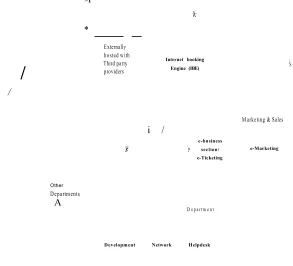
Figure 5.1: Part of the company organisational structure (adopted from the company organisational chart shown in 2006 annual report)... 99
Figure 5.2: The IT department structure... 99
Figure 5.3: Operating Environment and Security Stakeholders (constructed by the researcher based on field notes and interviews with different stakeholders)...103
Figure 5.4: Themes which emerged from analysing the internal stakeholders’ perceptions. ... 107
Figure 5.5: Explanatory framework of factors affecting e-Business organisation’s approach to security...130
Figure 8.1: Socio-technical factors affecting the security of e-Business environments and their relationships... 182
Figure 8.2: Factors affecting top management support for information security... 183
Figure 8.3: Communication, risk perception and internal stakeholders’ support... 186
Figure 8.4: Factors affecting external communication and its security implications 187
Figure 8.5: Lack of security policy and its implications... 188
Figure 8.6: The effect of IT lack of power on internal stakeholder support and commitment. ... 189
Figure 8.7: Factors affecting staff security behaviour... 190
Figure 8.8: Factors making security an add-on component and outsourcing implications. 192 Figure 8.9: The effect of the absence of an effective governmental role on e-Business security... 194
List of Tables
Table 2.1: Summary of e-Business benefits... 16
Table 2.2: Summary of reviewed studies...35
Table 3.1: Sample within the second unit of analysis... 55
Table 3.2: Case study sources of evidence: strengths and weaknesses (Yin, 2003)... 57
Table 3.3: Data sources in the second unit of analysis...60
Table 3.4: Official document reviewed in the fourth unit of analysis... 61
Table 3.5: Five stages of data analysis in the framework approach, adopted from Pop et al. (2002, p. 115)...64
Table 4.1: Technology Providers included in this study...68
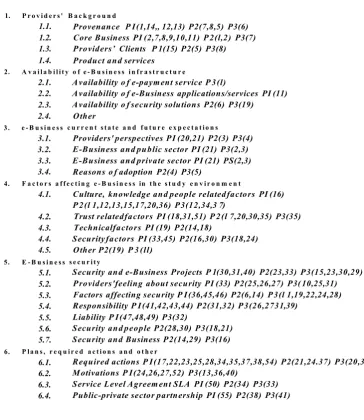
Table 4.2: Main themes emerging from the Providers’ unit of analysis with their index, sub-topics and locations... 72
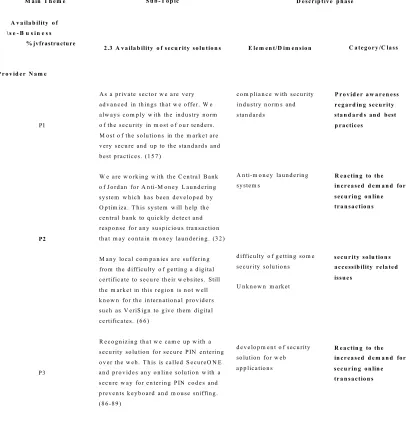
Table 4.3: An example of thematic chart generated during the analysis... 73
Table 4.4: Key elements and categories identifying providers’ security role in e-Business environment...75
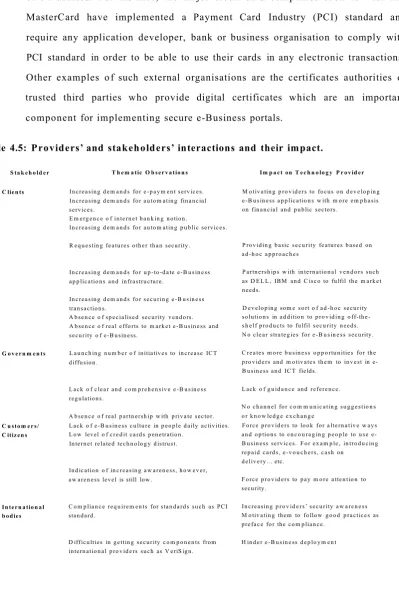
Table 4.5: Providers’ and stakeholders’ interactions and their impact...79
Table 4.6: Providers’ perceptions and their impact on e-Business and security...85
Table 5.1: Internal and external security stakeholders... 106
Table 5.2: Emergent conceptual elements related to e-Business security... 129
Table 6.1: Themes and categories which emerged from the customers’ case study 147 Table 6.2: List o f perceived security threats associated with e-Business... 153
Table 6.3: Terms related to common web security mechanisms...157
Table 7.1: Goals and objectives of the national e-Commerce strategy (MoICT, 2008).... 172
Table 7.2: Enablers of the National E-commerce Strategy (MoICT, 2008)... 173
C hapter 1 : R esearch O rientation
E-Business is more than just combining business with Internet technologies. Diverse issues face organisations endeavouring to adopt e-Business to reap its potential benefits. Security of e-Business is one of the major issues facing a wide range of stakeholders including e- Business organisations, customers, governments and technology providers. Unfortunately, this issue is usually overlooked, comes as an afterthought or is perceived from a purely technical dimension, with a notable increase in the number of online security breaches such as identity theft, privacy violation, vandalism, and infringement of intellectual property rights. This gives a clear indication that traditional security approaches and ad hoc security solutions are insufficient to thwart this dramatic increase in security breaches. These approaches, which perceive security from one dimension, seem unable to provide adequate security levels for today’s business environment. This encourages us to change our way of thinking and investigate other approaches that perceive security as an integrated part of business in the first place and then follow a holistic way o f understanding and solving the e-Business security problem.
This thesis is concerned with information security within e-Business environments. It views e-Business systems as interconnecting and interacting components (people, software, hardware, procedures and data) and Information System (IS) with a technological infrastructure and organisational framework, rather than as a purely technological infrastructure (Katsikas at al., 2005). It argues that the predominant technical security approaches do not consider the multifaceted nature of e-Business security nor the requirements and influences of the various stakeholders involved in its context. Therefore, it devises an interpretive stakeholder analysis with a socio-technical framework of inquiry, used to support the research design and outcomes. This will assist in developing a better understanding of e-Business security in the context of Jordan, where e-Business adoption, still in its early stages, is gaining the attention of several parties.
This chapter provides a background to the problem situation; it sets the scene of e-Business security in the context of the study and identifies the research gap that is intended to be
filled by the proposed study. Additionally, it outlines the research’s aims, objectives and contributions, and then introduces the rest of this thesis.
1.1 Problem Situation and Research Gap
Jordan has experienced a technological evolution which started during the nineties and continues until today (Al Nagi & Hamdan, 2009; Al-Jaghoub & Westrup, 2003). This means ICT plays a significant role in the Jordanian economy. A rapid development in several ICT sectors is notable (ESCWA, 2005). One aspect of this development is the adoption of e-Business by a number of local companies which have started to provide more advanced electronic services that utilise different e-Business transaction modes, including Business-to-Business, Business-to-Customers and Business-to-Government.
Despite the fact that this diffusion is still in its early stages, different parties are showing their interest. For instance, in the banking sector, the majority of local banks have launched online banking services which allow their customers to manage their accounts and pay some utilities bills over the internet. Moreover, local technology providers became more interested in developing and providing e-Business-enabling technologies and services, including customised e-Business applications, e-payment systems and web hosting services. Other e-Business activities, including online retail and delivery services, are also notable. On the government side, two actions characterise its interest in e-Business1. First, it enacted The Electronic Transaction Law, which was introduced to be applicable to any transactions that may include electronic processing, transmitting and storing o f data (ETL, 2001). The law attempts to regulate a number of e-Business aspects including electronic contracts, recodes, messages and signature. It seems that this step came as a response to a number of economical changes and international agreements signed by Jordan. According to Obaidat (2001), after the government had liberated the economy and entered into a number of international agreements, including Jordanian-European Partnership Agreement, World Trade Organisation (WTO) membership and Free Trade Agreement with the Unites States, the economic environment became ready for e-Business activities, therefore, regulating the online environment was an important step to be accomplished by the government. The second notable government step was introducing the national
e-1 Government literature uses the term e-Commerce which is included in this study's definition for e- Business.
Commerce strategy in 2008 which reflects its desire to exploit the potential benefits of e- Business at a national level (MoICT, 2008). This strategy came as a reaction to the government policy for ICT and postal sectors which called for more efforts to encourage local companies to offer e-services, especially e-Commerce services (ICT-Policy, 2007). The strategy action plan attempted to cover a wide range of e-Business areas including technology, laws and regulations, transportation and logistics, utilities, customs, taxation and financial services.
Nevertheless, security aspects of the e-Business environment in Jordan are not getting very much attention. Several security issues are frequently reported by international organisations as well as a few interested researchers. For instance, a security assessment performed by McConnell International (2002) highlighted the need for improvement in several areas of information security. Its report identified issues such as the lack of cyber crime and privacy laws, digital signatures and e-payment infrastructure. The report emphasised the importance of establishing a secure e-Business environment by enacting cyber crime law, secure transaction certificates and privacy laws. Also, it highlighted the need for developing an infrastructure that enables secure e-Business, and it recommended the development of encryption infrastructure. Other unsettling results in a United Nation’s report ranked Jordan at maturity level one, which is “characterised by an almost total absence of data security, privacy policies and laws governing ICT abuse” (ESCWA, 2007).
Although little academic research can be found in relation to this problem situation, it gives us an indication that security issues exist in the context of the study and represent a serious barrier for e-Business adoption in the country. For instance, a survey o f 453 Jordanian consumers (Alsmadi, 2002) found that while those customers are likely to have enough knowledge and skills to use the internet, online security is a major factor that prevents them from online shopping. Similar findings were reported by a recent survey (Khasawneh, et al., 2009) covering a random sample of 270 internet users from Jordan.
readiness and cost. Two-thirds of the sample stated that privacy and data security are among the major barriers. Another related barrier highlighted by the survey was the difficulty that companies face when dealing with legal issues such as electronic signatures and contracts, as well as consumer rights. A more recent study has used a case study to identify factors influencing e-commerce adoption in a private company in Jordan (Al-Qirim 2007). It reported the company’s concerns about the lack of confidentiality of information processed by e-commerce systems in addition to the lack of secure local infrastructure, including secure e-payment systems and an effective legal framework to regulate online activities. The case study found that these issues complicate the process of adoption and securing e-Business as companies would be required to get in touch with international service providers which involves extra time, effort and cost. In an attempt to explore e- commerce security perception of customers and organisations as a single phenomenon in the context of the study, Halaweh and Fidler (2008) found contradictions between customers and business perspectives in how security concerns are better addressed. The study has revealed that online companies give more weight to tangible security features to encourage customers to use their websites; they use trusted third party logs, privacy policies or statements to the customers telling them that the website is secure. On the other hand, customers were found to be less interested and less aware o f such features; they looked for intangible features such as company identity, brand name, and reputation.
While these previous studies raise our attention regarding e-Business security in the context of Jordan, they do not offer a deep analysis of the problem situation; this in turn limits our understanding of the various aspects that need to be considered to develop a secure e- Business environment. The limitations emerge from the fact that most of these studies did not consider security as their primary focus; therefore, little effort has been devoted to exploring this issue in detail. Moreover, the positivist approach underlying most of these studies limited their findings into a set of specific questions which often try to explore the existence of predefined security issues without offering an explanation o f how and why these issues emerged. Even when other studies have attempted to explore the problem domain using an interpretive approach which can give more insight into e-Business security, only one or two stakeholders (customer, business or both) have been considered, which did not help in addressing the influence and requirements of other relevant stakeholders such as government and technology providers. To this extent it can be argued
that the existing literature does not capture the complexity of the problem domain nor develop knowledge and/or understanding o f the various associated issues. This encourages the researcher to develop better research design to fill the existing research gap. By combining the socio-technical perspective and stakeholder analysis with a well-designed knowledge generating approach, a holistic understanding of e-Business security in the context of the study is likely to be developed. Such understanding can be extended to generate ideas to deal with the multifaceted nature of the e-Business security problem.
1.2 Aim and Objectives
In the light of the above identified research gap, the overall aim of this research is to develop a conceptual framework for better understanding of the problem of e-Business security based on an interpretive stakeholder inquiry. This aim will be achieved through the following objectives:
1. To identify the multifaceted nature of information security within the complex and dynamic e-Business environment.
2. To construct a framework of inquiry to allow the researcher to investigate the e- Business security environment from a socio-technical perspective.
3. To identify the various groups of stakeholders involved in the context of the study and explore their interrelationships and roles toward e-Business security.
4. To identify the set of socio-technical factors affecting the e-Business security environment and their interrelationships.
To fulfil these objectives the following general research question is formalised:
How can security be incorporated in e-Business in the context of the study to provide a trustworthy e-Business environment which considers the roles and requirements o f the various security stakeholders?
To answer this question four specific research questions representing the units of analysis in this research are formalised:
2. How is security of e-Business perceived and addressed in e-Business organisations in the context study?
3. How do customers’ perceptions, awareness, education and expectations affect e- Business security in the problem situation?
4. What is the current role of the government regarding e-Business security? And how it can be an effective partner in the problem situation?
1.3 Summary of Contribution
This thesis is expected to contribute to the growing body of research in the field of information security in general and e-Business security in particular for the following reasons:
1. The literature review shows that few stakeholders are likely to be considered, predominantly, customers and internal organisations, and this significantly limits our understanding of the role and the effect of other important stakeholders such as governments and technology providers. In contrast, this study uses the concept of ue- Business stakeholder” as a meta-theory to facilitate deeper understanding of security in the e-Business environment. Consequently, an interpretive stakeholder analysis was used and four major stakeholders in the problem situation were identified and their security implications were explored. These stakeholders included: technology providers, e-Business organisations, government and customers.
2. Through an inductive coding process an explanatory framework o f organisational, legal, human and technical factors affecting security in e-Business environment has been developed. Additionally, the study brings these factors together, identifies their interrelationships and implications, and positions them in the relevant existing knowledge.
3. While the literature calls for more socio-technical information security thinking, this study contributes to this emerging body of research with empirically grounded security research adopting the socio-technical perspective as an underlying assumption for its inquiry which will help in identifying and better understanding the various dimensions affecting e-Business security environments.
inductive approach realised through thematic framework analysis to provide a systematic and rigorous methodology.
The study theoretical, methodological and practical contributions are discussed in more details in Chapter 8, Section 8.2.
1.4 Structure and Contents
This section provides an overview of the contents of this thesis. Figure 1.1 illustrates its structure which consists of eight chapters.
Findings Synthesis, Discussion
and Evaluation (Chapter 8)
Interpretive Stakeholder Analysis (Chapters 4-7)
Technology Providers
E-Business Organisation
(Ch. 5)
Customers/
Citizens Government
(Ch. 7)
{Ch. 4) {Ch. 6)
M ethodological Considerations (Chapter 3)
Literature Review & Conceptual Framework (Chapter 2)
Research Orientation: Problem situation(Chapter 1)
The first three chapters o f this thesis set out the theoretical and methodological foundations of this research. Chapter 1 sets the scope of this research which is concerned with e- Business security and describes the research context. Additionally, it defines the study’s aim and objectives and formulates specific research questions to be answered by this study. Towards the end, it briefly summarises the expected contributions of the study. Chapter 2 reviews the literature and builds a conceptual framework to guide inquiry of this research. It sets the study’s terminology by defining and discussing the basic terms, concepts and issues associated with e-Business and information security. Moreover, it presents the current trends in information security research, including e-Business security research, and critically evaluates the major research contributions which represent a paradigm shift in this domain. Chapter 3 discusses the methodological considerations in the process of selecting a suitable research method for conducting the inquiry. After identifying the research assumptions underlying each available research method and assessing their potential for this study, a justification of the selected research method is given; this followed by a complete research design including research strategy, data collection techniques and analysis procedure.
Through an iterative and inductive coding process, four major security stakeholders in the context of the study have been identified and their security roles have been explored. These stakeholders are technology providers, e-Business organisations, customers/citizens and government. Analysis and findings of these four units of analysis are presented in
Chapters 4-7.
C hapter 2 : L iterature R eview and C onceptual F orm w ork
The proliferation of Internet technologies has encouraged organisations to reshape their business models to achieve several advantages such as increasing their productivity, profits and customer satisfaction. This increases the flow of electronic information, either between businesses or between business and customers, which raises many concerns about the secure storage, processing and exchange of this information. Consequently, the term ‘information security’ has evolved to include other issues with a strong social foundation such as trust, privacy, legal liability and intellectual property rights (Beznosov & Beznosova; 2007). Additionally, several parties became involved and have interest in this domain; these include governments, citizens/customers, and businesses along with technology vendors and academic researchers (Chu et al., 2005).
Unfortunately, a great deal of research work in security has focused on producing theoretical models or technical solutions without addressing the real world where the research outcomes are supposed to be used (Siponen & Oinas-Kukkonen, 2007; Clarke, 2001). This gives a clear indication that there is a lack of understanding of the security problem as well as the effect of its context.
This chapter reviews the relevant literature and defines the key terminology in order to establish a conceptual foundation to support the research inquiry identified in the previous chapter. It discusses how traditional security approaches and pure technological solutions are not sufficient to provide adequate security for today’s complex electronic business environment. It also identifies the trend in information security research and highlights the need for new approaches for e-Business security. Additionally, it reviews and compares the major research contributions which represent a shift and a new paradigm in the field of information security. Finally, it presents a conceptual framework of inquiry to guide this research.
contrast to theory-testing research, which depends on conducting a comprehensive review of pre-existing theories and literature prior to the data collection phase, the literature review in inductive research is a continuous process throughout the whole research. At the beginning of the research it serves as a foundation for the study’s conceptual framework which identifies the boundaries of the study including the main aspects to be investigated (Miles and Huberman, 1994). This framework should not be based on an overly comprehensive review as this will constrain the exploratory power of the study (Josselson and Lieblich, 2003 in Rudestam and Newton, 2007). Therefore, the initial review should be to an extent which informs the reader about the existence of the problem and why it is worthwhile. Creswell (2007) suggested that the qualitative researcher should review the literature to build a rationale for the problem and place his/her study within the ongoing literature about the topic. The initial review is also important for demonstrating the underlying assumptions and the theoretical perspective behind the general research questions (Marshall and Rossman, 1999). Additionally, it defines the topic’s key terminologies that will be used throughout the study. The content of this chapter reflects the roles for the literature review discussed above. As the study evolves and moves into the data collection and analysis phases the literature can be used to develop explanations, validate findings and suggest interrelationships between them (Richie et al., 2003; Marshall & Rossman, 1999). Towards the end of the study the literature plays an important role in discussing the emerged findings, positioning them within existing knowledge and seeking wider implications (Rudestam and Newton, 2007).
2.1 e-Business overview
This section provides an overview of e-Business as an emergent concept; it starts by reviewing and critically evaluating the existing definitions in an attempt to formulate a working definition of e-Business to be used by this study, then it discusses e-Business components and transaction modes, highlighting the complexity of its environment. The overview also discusses the potential benefits of e-Business followed by the associated adoption issues with more emphasis on the security issue which is then discussed in more detail in a separate section.
2.1.1 A working definition for e-Business
In its broad sense electronic business, or simply “e-Business”, refers to the use of Information and Communication Technology (ICT) for various business activities. One of the early definitions of e-Business is provided by IBM which defines e-Business as “a business process transformed to leverage WWW (Internet, intranet, and extranet) technology fo r business benefit. It is about using the Internet infrastructure and related technologies to enable business anywhere and anytime” (Smith, et al., 2001). However, the definition may differ from one perspective to another, which usually causes confusion with other terms such as e-service, e-commerce and e-learning. Often the term e-Business is confused with e-Commerce (Turban et al., 2008), and this should be clarified before choosing a working definition for e-Business in the context of this study.
When compared to e-Commerce, e-Commerce is regarded a sub-set of e-Business, which is much broader and may include most business activities (Groucutt and Griseri, 2006). E- commerce is used to describe online buying and selling activities, which can be viewed as a contact-driven process (Rodgers, et al., 2002) which requires the customer to get in touch with an online company in order to initiate the process. On the other hand, many e-Business activities might be accomplished without human intervention. E-Business is an umbrella term for a wide range of business processes which may include one or more of the following: customer relationship management; enterprise resources planning; and supply chain management.
Many valid e-Business definitions can be found in the literature (de Graaf and Muurling, 2003). For example, Clarke (2000) defines it as “the conduct o f business with the assistance o f telecommunications and telecommunications-based tools”. Clarke's definition does not specify any specific communication technology for conducing e-Business, which makes it applicable to the wireless and mobile technologies which are utilised these days in e- Business. Nevertheless, if we consider the communication media and related tools as infrastructure for the Internet, IBM's definition encompasses Clarke’s definition as well. Tracy (2000) argues that the definition of e-Business varies; however, it is usually similar to IBM's definition.
activities such as online order, e-payment, online customer service and e-billing. If IBM's definition, which implies a complete transformation of business processes using Internet technology, is adopted, few companies from the study context will fall under this condition. Business to customer interaction is viewed as a partial transformation of business processes and the complete transformation involves company to company interaction (Tracy, 2000). Therefore, the study will consider both the partial and complete transformation of business process using Internet technologies as the basic definition for e-Business in this study. Many e-Business startups do not use e-Business to its full potential. We could find some of them using ICTs to improve their internal business operations. Others may use the web service for marketing purpose or for price comparison. Those who have just started simple e-Business initiatives or just use ICTs to improve their business, will after few years be forced to upgrade their simple models of e-Business to include ordering, payment, contracting, invoicing and delivery. For this purpose we may define e-Business in a broad way to include any utilisation of ICTs in these organisations to help them improve business and interaction with government, customers or suppliers.
2.1.2 e-Business components and transaction modes
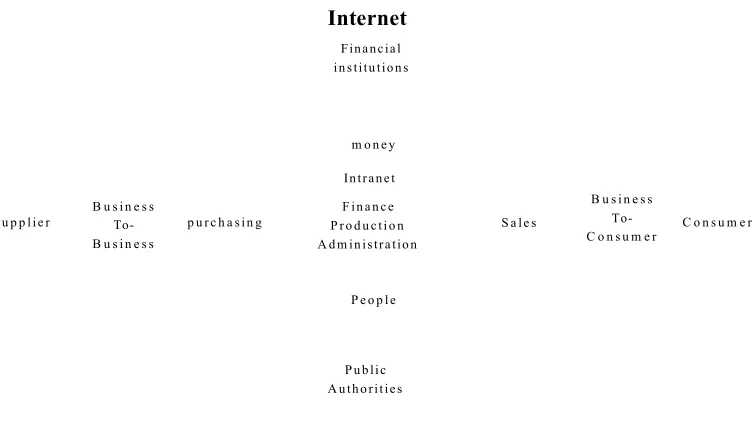
E-Business transactions include two or more parties such as customers, sellers, suppliers, intermediaries or business partners: see Figure 2.1, which views e-Business as a process that spans the entire spectrum of human activity (Cunningham and Froschl, 1999). Although this framework abstracts the complexity of the e-Business environment, it identifies three main e-Business components; enabling technologies (Internet or Intranet),
stakeholders (customers, suppliers, regulators and financial institutions) and business processes (internal, intra-organisational and with customers). This implies that e-Business
can be viewed as a socio-technical system with a set of interacting elements. Some o f these interactions may involve direct intervention from a particular stakeholder; for example, a customer placing an online order through the seller website. Other interactions may be performed without intervention and on behalf of the interested stakeholders; for example, credit card information is checked automatically on behalf of the merchant. Based on the nature of the transaction and the relationship between the transacting parties, e-Business can be classified into different modes (Turban et al. 2008). Accordingly several e-Business modes can be found:
Internet
Financial institutions
m o n e y
Intranet
B u s i n e s s To-C o n s u m e r B u s i n e s s
To-B u s i n e s s
F in a n c e P r o d u c tio n A dm inistration
s u p p lie r p u rc h a s in g S a le s C o n s u m e r
P e o p le
[image:28.612.96.473.70.284.2]Public A uthorities
Figure 2.1: The Electronic Business framework (Cunningham and Froschl, 1999).
• Business-To-Customer (B2C): Electronic commercial transactions directly between business (mainly private organisations or companies) and individual customers. Many examples of companies using B2C mode can be found worldwide. A good example is the well-known online bookshop Amazon.com. Amazon.com started with selling books online: a customer can go to its website, select the book s/he wants, pay online and then the book will be delivered to customer’s address. Nowadays, Amazon.com is not only an online bookshop; it sells many other items. Another example o f a well-known B2C company is Dell Computers. This is one of the first companies which realised how the B2C mode could improve its business and increase its customer satisfaction. Through the Dell portal, the customer can place an order, check the status of his order, get technical support and access many other services.
have been integrated and automated through the use of Enterprise Resources Planning systems (ERP). The second type includes Intra-organisational activities with suppliers and distributors which have been automated using e-Business technologies. An example of an application using this mode is the Supply Chain Management systems (SCM).
• Customer-To-Customer (C2C'): In this mode, customers can directly sell and buy from each other over the internet. A good example of the C2C e-business mode is ebay.com which is an online marketplace where sellers and buyers can meet and communicate in order to sell or buy new or used items. It is an online platform for direct trading between customers.
• Business-To-Govem m ent (B2G'): Provides information regarding contracts and business investment that the private organisations want to do with the government. This mode can be considered as a bidirectional mode, either G->B or B->G. Some governments provide a central online portal for private business owners and suppliers who want to sell services or goods to governments. Such government websites may contain all the relevant information about government tenders, announcements, or requests for proposal. In the other direction, some private organisations provide information about services that the government can get from them through websites containing product description, promotions, offers and other information customised to suit the government’s needs.
• Government-To-Citizen (G2C)\ Provides citizens with access to a government information service or/and electronic transactions such as e-Voting, e-Tax. For example the Jordan e-Government portal (http:/Avww. iordan.uov.io) provides a central government portal where citizens can search for and find information and services provided by the Jordanian government.
B2B represents the largest percentage of e-Business transactions worldwide (Mockler et al., 2006). On the other hand, B2C is the second largest and earliest form of e-Business. Following the argument for selecting a broad definition for e-Business, this study will focus on B2C in addition to B2B for the following reasons:
• B2C mode is the predominant e-Business mode in the study environment.
• It is a feasible option for small private companies in developing countries, bearing in mind that these companies count for more than 70% of all employment in developing countries (Payne, 2002).
• B2C affects a wider range of stakeholders; individual consumers, businesses from small to large, technology vendors, and governments which are responsible for protecting their citizens. Thus, many implications need to be considered.
2.1.3 Potential benefits of e-Business
Numerous e-Business benefits are reported in the literature (Kalakota and Robinson, 2001; Rodgers et ah, 2002; Amor, 2000; Smith, et al. 2001; Sanders, 2007; Turban et al., 2008). As many o f these reported benefits are a result of real world case studies and surveys, they reflect the positive impact of the adoption of e-Business on different levels of society. E- Business creates new relationships between businesses and customers which can be personalised to suit different customers’ needs, and hence increase customers’ satisfaction. Also, it enables more efficient co-operation between business partners. Smith, et al. (2001) argue that e-Business could lead to higher customer satisfaction for numerous reasons, examples of which are that customers have personalised 24x7 access to online business and that information is better, faster, and easier to access. Another benefit to companies is increasing company visibility (Amor, 2000) which is very important for newly established ones. Because of the availability of the internet, this can be achieved at a lower cost and can lead to increase in company revenue. Moreover, internal business process automation and intra-organisational interaction facilitated by e-Business technologies is likely to improve company performance and enhance communication (Sanders, 2007). Following the classification of Turban et al. (2008), these benefits can be summarised as shown in fable
Table 2.1: Summary of e-Business benefits.
Classification Potential Benefits
Benefits to Organisations
- Reducing cost.
- Improving Performance - Expanding to new markets
- Improving communication with partners and customers - Improving availability and accessibility
- Increasing visibility
Benefits to Customers
- Lower Prices - More choices - Less physical effort
- Personalised products and services - Information availability
Benefits to society
- Increasing Business opportunity
- Reducing traffic and pollution (people work or shop from home)
- Greener world and less paperwork - Better standard of living
In contrast to the above very optimistic view about the potential of e-Business, other researchers seem more realistic. For instance, Siddiqi et al. (2002) argue that many of these claimed benefits cannot be guaranteed because of several cultural, technological and economical barriers to the growth of e-Business. They discuss a number o f B2C scenarios in which potential benefits such as convenience, cost-effectiveness and capability requirements cannot be realised for many reasons such as the nature of products, usability issues, hidden costs and user socio-technical requirements. Despite the fact the e-Business seems promising and has many potential benefits, the adoption process is not straightforward and there are diverse issues hindering the proliferation of e-Business. The next section will discuss these impediments that need to be considered if the adoption of e- Business is to be fruitful.
2.1.4 e-Business adoption issues
The adoption of e-Business has an impact on organisations; it improves efficiency and productivity, opens new market channels and increases the competitive position of the organisation. On the other hand, it has several impediments and raises many issues. The rapid development of e-Business introduces serious issues regarding privacy, information
security and other legal, ethical, and social issues (Li, 2007). Many researchers have discussed e-Business issues in terms of inhibitors, impediments and barriers (Papazoglou and Ribbers, 2006; Barsauskas and Sarapovas, 2004; Jennex and Amoroso, 2002). In general we may categorise these issues as:
• Technological Issues: implementing and deploying e-Business initiatives requires knowledge and skills related to various Internet technologies and infrastructure which are the building blocks for e-Business. Several studies suggest that the lack of in-house technical skills prevents companies from implementing and running e- Business systems (Chapman et al. 2000; Windrum and Berranger 2004). Other technical issues are related to interoperability and compatibility of legacy systems with new ones. Deploying e-Business applications such as CRM, ERP, and SCM involves consolidating data from different sources which usually reside in legacy systems; this requires integration and business process reengineering to enable these systems to work together. Most of the time, this integration is not an easy task because the legacy systems were built based on standards which do not support Web services supporting e-Business applications (Chen, 2003).
• Financial Issues: in many countries the cost of setting up online business is still high. The cost includes Internet connection, web hosting, delivery costs, staff training and the cost of hiring skilful employees. Such financial issues are more notable in small companies (Al-Qirim, 2004). However, costs have started to decrease and more companies and customers have begun to benefits from the new technology.
• Legal and Regulation Issues: in many countries there is still no clear legal framework for e-Business (ESCWA, 2007). Issues related to intellectual property, liability and taxation need to be considered (Frynas, 2002). Other issues are related to the legal recognition of electronic records and some security mechanisms, such as digital signatures, as legal evidence in case of dispute resolution.
• Management and Cultural Issues', the lack of clear vision and strategy for how a company may benefit from e-Business initiatives and in some cases the lack of management support make a barrier for successful e-Business adoption (Dezalak, et al., 2006). Other issues are related to changing business processes and how people react to such changes. Employees might resist using new technology in their work, and here good management is necessary to help staff accept and use new technologies (Somers and Nelson, 2004).
In addition to the above issues, developing countries have other issues that are worth mentioning. The use of e-Business in the developing world which represents a large part of the marketplace is still insufficient. The use and development of e-Businesses in this part of the world is faced with many challenges and issues. Without serious effort to remove these challenges, developing countries might not benefit from the great technological revolution. Deployment of ICT, which is the backbone of e-Business in developing countries, is facing many obstacles and constraints. These include lack of or poor infrastructure, social problems and the lack of an appropriate legal, political and economic framework (Bakari, 2007; Jennex and Amoroso, 2002). Some e-Business barriers which particularly face developing countries are (Gregorio D. at al, 2005; Kshetri, 2007):
• Low levels of Internet and personal computer penetration.
• Poor e-Business infrastructure including ICT, logistics and fulfilment.
• Low level of credit or debt card penetration.
• Lack of e-payment gateways.
• Computer illiteracy in general, lack of knowledge about e-Business and lack of basic English language skills.
• Preference of traditional facto-face communication over other means such as e-mail and instant messages.
Dada (2006) argues that effective e-Business depends on a critical threshold of online use. This suggests that, as more people use the Internet, the network value and the opportunity for e-Business will increase. Unfortunately, the online population in developing countries is far from the critical threshold. According to Pahladsingh (2006) there are a number of barriers to increasing the online population in these countries; they are: low level of computer penetration, because of the high cost of having a personal computer; the cost of Internet connection (using technologies such as Dialup or Broadband); unreliable communication infrastructures; cultural issues such as the language barrier; and other economic, political and business issues.
In the context of Arab countries, including Jordan, similar adoption barriers have been reported by recent studies (Pons et al., 2003; Yasin and Yavas, 2007; Al-Qirim, 2007; ESCWA, 2007). Remarkably, security of e-Business is frequently citied as one of the major issues that impede both consumers and business organisations from utilising e-Business in these countries. Yet no previous study has attempted to explore this issue in detail and in relation to other adoption barriers and stakeholders. E-Business security issues will be the primary focus of this study, but in contrast to the previous studies, which considered security from a very narrow perspective and in isolation from its wider context, this study will consider the multifaceted nature of e-Business security in relation to its context and stakeholders. As a starting point for developing a framework of inquiry to guide this study, the next section discusses the concept of the “e-Business stakeholder” as a meta-theory to facilitate deeper understanding of security in the e-Business environment.
2.2 S tak eh old er analysis and its potential for exp lorin g e-B u sin ess
environment increases, leaving the organisation subject to additional risks especially with different and conflicting stakeholders' interests. This suggests that e-Business cannot be studied in isolation from its environment and wider implications need to be considered. As a starting point for exploring this complex and dynamic environment it is important to identify all the interested parties and investigate their interrelationships, interactions and impact on the e-Business environment. This can be achieved by the use o f stakeholder analysis which facilitates holistic understanding of the problem situation.
It has been argued that stakeholder analysis is not so much a unique research approach but is an organising principle for research which can be used within various research methods (Burgoyne, 1994). It captures the diversity of perspectives and interests in the problem domain, allowing the research to develop a richer picture which facilitates better understanding of the problem in hand. The foundation of stakeholder analysis is the concept of the ‘"Stakeholder”. According to the stakeholder theory (Freeman, 1984; Donaldson and Preston, 1995) an organisation is surrounded by a set of stakeholders. A Stakeholder is any individual (such as a customer), or organisation (such as business partners) influenced by the attainment of the organisation’s goals, and who is likely to hinder this organisation’s achievement if its own requirements are not fulfilled. Stakeholder can be defined by two functions (Philips et al., 2003); a utility function that measures the level of the stakeholder's satisfaction, and an influence function that measures the damage or benefit the stakeholder can cause an organisation given a level of utility. According to Philips et al., the organisation should work towards minimizing the damage and maximizing the benefit. Freeman (1984) provided a general definition for the term “stakeholder
“ A sta k eh o ld er in an o rg an izatio n is (by d e fin itio n ) any gro u p o r individual w ho can affect o r is
affected by the ach iev em en t o f the o rg a n iz atio n ’s o b jec tiv e s” (F reem an , 1984, p. 46).
The definition highlights different aspects that need to be considered when using the stakeholder concept:
1. A stakeholder can be either a group or an individual.
2. The relationship between the stakeholder and the organisation is bidirectional.
3. The impact/influence is either negative or positive.
4. The stakeholder’s interest versus the organisation’s objectives.
Although the notion of the stakeholder has its roots in management literature, it has been used extensively in Information System (IS) studies (Flak and Rose, 2005; Papazafeiropoulou et al., 2001; Avison and Wood-Harper, 1990; Pouloudi and Whitley 1997). Pouloudi (1999) has reviewed extensively the use of the stakeholder concept in IS literature. Based on that, she argued that stakeholder analysis is implicitly embedded in IS development approaches such as Soft System Methodology (SSM) and Effective Technical and Human Implementation of Computer-based Systems (ETHICS) method which both emphasise the involvement of all interested parties in the IS development process. She concluded that:
T h e notio n o f stak eh o ld er is not new in in fo rm atio n sy stem s research. A lth o u g h the actual use o f the
term is relativ ely recen t it does not signify a rev o lu tio n or ‘p aradigm sh ift’ in o u r th in k in g o f
in fo rm atio n sy stem s d ev elo p m en t and im p lem en tatio n . It rep resen ts a p ro g ressio n from d ev elo p er-
and user- cen tered p ro b lem s to o rg an izatio n -w id e and in tero rg an izatio n al in fo rm atio n system s
p ro b lem s. It is also a sign o f m atu rity o f In fo rm atio n sy stem s research as it reflects a sh ift to w ard s
ap p ro ach es th at can afford a m ore ho listic rep resen tatio n o f the parties inv o lv ed in th e m ore co m p lex
sy stem s cu rren tly d ev elo p ed . (P o u lo d i, 1999, p. 14).
In the realm of information security a number of authors use the stakeholder notion in order to get more insight into the socio-technical aspects of security problems, but without explicitly acknowledging the use of stakeholder analysis. For instance, Flechais and Sasse (2007) used “participant” analysis to investigate usability issues of security mechanisms by exploring how participants perceive and interact with security. They did not use the terms stakeholder analysis, however the concept of stakeholder was the primary component of their final model. Other researchers use the same approach to investigate how the commitment of different stakeholders affects security awareness training in organisations (Abawajy, et al. 2008). On the other hand, explicit references can be found in quite similar fields; for instance, Shankar et al. (2002) used the stakeholder theory to propose a theory which incorporates a multi-stakeholder perspective for trust in the online environment.
environment and identify its stakeholders, however, its instrumental aspect can be used to explore the linkages or lack of linkages between the e-Business stakeholders. This implicitly implies looking for the implications of their interrelationship and interaction with the e-Business environment, hence the use of impact analysis. The normative aspect of the theory can be used to explain the security role of each stakeholder from an ethical point of view. Both descriptive and instrumental aspects of the stakeholder theory will be used in the study to facilitate a deeper understanding of problem situation.
2.3 Toward a Stakeholder Model for e-Business
Diffe