A systemic governance framework for information
technology outsourcing.
SLINGSBY, Martin.
Available from Sheffield Hallam University Research Archive (SHURA) at:
http://shura.shu.ac.uk/20369/
This document is the author deposited version. You are advised to consult the publisher's version if you wish to cite from it.
Published version
SLINGSBY, Martin. (2008). A systemic governance framework for information technology outsourcing. Doctoral, Sheffield Hallam University (United Kingdom)..
Copyright and re-use policy
U C Q 1 I III i y C*I IVJ II IIW I ! • IWWVJ. I w w s -Adsetts Centre, City Campus
Sheffield S1 1WD
ProQuest Number: 10701015
All rights reserved
INFORMATION TO ALL USERS
The quality of this reproduction is dependent upon the quality of the copy submitted.
In the unlikely event that the author did not send a com plete manuscript and there are missing pages, these will be noted. Also, if material had to be removed,
a note will indicate the deletion.
uest
ProQuest 10701015
Published by ProQuest LLC(2017). Copyright of the Dissertation is held by the Author.
All rights reserved.
This work is protected against unauthorized copying under Title 17, United States C ode Microform Edition © ProQuest LLC.
ProQuest LLC.
789 East Eisenhower Parkway P.O. Box 1346
‘A Systemic Governance
Framework for
Information Technology
Outsourcing’
Martin Slingsby
A Thesis submitted in partial fulfilment of the requirements of Sheffield
Hallam University for the degree of Doctor in Business Administration.
December 2008
ABSTRACT
The IT outsourcing market has experienced staggering growth over recent years; however, evidence suggests that this IT outsourcing movement has been problematic. (Gartner (2002) estimated that 80% of IT Outsourcing deals failed to deliver their original anticipated business objectives). This thesis examines organisational outsourcing trends within a wider organisational context, for example the positioning of outsourcing within the ‘flexibility offensive’ (Atkinson and Gregory (1986)). The focus then shifts to IT outsourcing and specifically how the IT outsourcing environment is governed.
This research programme utilises action research as the research method. This involves the adoption of the ‘4 moments of action research’ (Carr and Kemmis (1986)) namely 4planning\ ‘acting’, ‘observation’ and ‘reflection’. Soft Systems Methodology (SSM), initially developed by Checkland in 1969, is adopted as the theoretical framework. This framework enables the development, implementation and subsequent reflection on ‘A Systemic Governance Framework for IT Outsourcing’
When this research programme was initiated, Royal Mail was at the early stages of considering an IT outsourcing route. Royal Mail subsequently entered into a £1.5Billion (over a ten-year period) outsourcing deal in June 2003. Within my role as Royal Mail Head of Governance I had a unique opportunity to bridge the gap between theoretical / academic and practitioner perspectives and to provide a unique and original application or practical intervention within the Royal Mail IT outsourcing environment. This intervention has the objective of utilising an original IT Governance Framework, which is designed and applied as part of this research programme, as a practical toolkit within the Royal Mail IT outsourced environment. From a theoretical perspective, the use of SSM and systems thinking in developing a systemic governance framework for IT outsourcing represents an original approach which offers new insights into this area of research.
Acknowledgements
I wish to thank my doctorate programme research directors Professor Jim Bryant and Doctor John Kawalek for their support, direction and encouragement throughout the course of this research programme. Both Jim and John’s boundless enthusiasm for my work and provision of different perspectives, have I believe, enabled a more balanced and considered thesis to be completed.
My gratitude also goes to the organisations who agreed to take part in this research programme in such a candid manner, with special thanks to Royal Mail who agreed to participate in the research programme action research process. This has enabled a unique and real world perspective to be achieved.
Confidentiality Statement
This thesis contains information of a highly commercial and contractually sensitive nature. The organisations who participated in this research programme only did so with the proviso that their engagement would be carried out in the strictest of commercial confidence and that their respective issues and comments would remain anonymous. To maintain this research anonymity and integrity some of the research outputs that follow are therefore a broad and generalised interpretation of the key research findings and proposals.
Table of Contents
Chapter 1 - Research Positioning
1.1 Introduction - Background to the research 13 1.1.1 Royal Mail - The research context 14 1.2 Organisational context - Positioning of the outsourcing 16
phenomenon within the wider business and organisational context
1.3 The growth of IT outsourcing 20 1.4 The drivers behind IT outsourcing 22 1.5 Justification for the research - The problems with IT 25
outsourcing
1.6 The research programme objectives 27 1.7 Outline of the thesis 30
Chapter 2 -IT Governance Literature Review
Chapter
5 -
Research Methodology
3.1 The research choices 53 3.2 Action research utilised as the research method 55 3.3 Soft Systems Methodology (SSM) - Justification as the 61
research theoretical framework
3.4 The epistemological considerations and positioning 67
Chapter 4
-
Defining the IT Outsourcing Problem Situation
4.1 Soft Systems Methodology (SSM) in Practice 71 4.2 SSM Stage 1: Real World - The IT outsourcing problem 72
situation
4.2.1 The research questions 74 4.2.2 The research organisations 82 4.3 The Problem Situation: Pre - IT outsourcing 86 4.3.1 Business environment and background 86 4.3.2 Anticipated Information Technology benefits 89 4.4 The Problem Situation: Information Technology contract 91
negotiation and agreement
4.4.1 IT contract formulating and letting 91 4.5 The Problem Situation: IT outsourcing transition period 96
through to post outsourcing
Chapter 5
-
Design o f an IT Governance Framework
SSM Stage 2: Systems World - Purposeful activity models
and systems 118 Systemic design of an IT governance framework 119 5.2.1 Control area 1 - Setting direction 123 5.2.2 Control area 2 - Managing direction 124 5.2.3 Control area 3 - Changing direction 125 5.2.4 Development and construction of the monitoring
sub-systems 128 The finalised and detailed IT governance framework 132 5.3.1 Setting Strategic Direction - Design of Sub System
Integration of IT Strategy with Business Strategy’ 133 5.3.2 Setting Strategic Direction - Design of Sub System ‘IT 134
Policies and Standards’
5.3.3 Setting Strategic Direction - Design of Sub System
‘Organisational Accountabilities and Responsibilities’ 136 5.3.4 Setting Strategic Direction - Design of Sub System ‘Skills
and Professionalism’ 137 5.3.5 Setting Strategic Direction - Design of Sub System
‘Common Objectives Based on ‘Shared Risk/Reward” 141 5.3.6 IT Service Management and Delivery - Design of Sub 142
System ‘IT Service Management’
5.3.7 IT Service Management and Delivery - Design of Sub
System ‘Commercial Interface Processes’ 145 5.3.8 IT Service Management and Delivery - Design of Sub
System ‘Effective Communications’ 146 5.3.9 IT Change Management - Design of Sub System ‘Project
and Programme Management’ 147 5.3.10 IT Change Management - Design of Sub System ‘IT
Service and Contract Improvement and Change’ 149 5.3.11 IT Change Management and Delivery - Design of Sub
System ‘Joint IT Innovation and Exploitation’ 150 5.3.12 Benefits Management - Design of Sub System ‘IT Balanced
Scorecard’ 150
5.3.13 Benefits Management - Design of Sub System ‘Strategic
Contract Annual review’ 152 5.3.14 Compliance Monitoring - Design of Sub System
‘Compliance Monitoring Processes’ 153 5.3.15 Audit and Risk Management - Design of Sub System
‘Right and Access to Audit’ 154 5.3.16 Audit and Risk Management - Design of Sub System ‘Risk
5.4 SSM Stage 3: Real World - Comparison and debating 155 5.5 SSM Stage 4: Real World - Action to improve 159
Chapter 6
-
Application o f an IT Governance Framework
6.1 Action research in practice 161 6.1.1 Action research - Planning 162 6.1.2 Action research - The Application ‘Bringing to life’ 163
the IT governance framework
Chapter 7
-
Observation o f the IT Governance Framework
7.1 Action research - Observation 176 7.1.1 Is IT outsourcing within Royal Mail delivering the 178
anticipated business benefits?
7.1.2 Observing the IT governance framework 188 7.1.3 Observing the IT governance relationships 195 7.1.4 Observing the IT Outsourcing Contract Principles 202
Chapter 8
-
Reflection on the Research Outcomes - The
Contribution to Knowledge
8.1 Action research: Reflection - The contribution to 205 knowledge
8.2 The contribution to theory 206 8.2.1 A systems approach to addressing the IT 206
outsourcing phenomenon
8.2.2 The core controlling the periphery debate 206 8.2.3 An emerging IT outsourcing model 207 8.2.4 The IT Governance Framework 209 8.2.5 The IT Governance Framework as a model of 217
8.2.6 Research programme covering the ‘End to End’ IT 225 outsourcing lifecycle
8.3 The contribution to practice 227 8.3.1 The IT governance framework - ‘A practical 227
‘Toolkit’
8.3.2 The IT outsourcing relationship framework 231 8.3.3 The IT outsourcing contract principles 233 8.3.4 The research methodology - Towards Mode 2 234 8.4 A critical evaluation of the research programme 236 8.4.1 Why is the research important and who cares? 236 8.4.2 Learning from my own practice and from this 238
intervention and change
8.4.3 What are the problems with, and limitations of, the 240 research programme?
Chapter 9 - Conclusions and Future Research
9.1 The thesis conclusions - Have the research programme 243 objectives been achieved?
9.2 Future research and direction 246
Appendices
Appendix A Summary of output from interview sessions with the 249 research Organisation
List of Figures
Figure
Number Figure Title PageNumber
1.1 The Research Programme Timeline 14
1.2 UK Outsourcing Market Size 21
1.3 Selective IT Outsourcing - The Business Factors Matrix 23
1.4 The Research Process 30
2.1 An Output Based Administrative Control System 39
2.2 The COBIT Framework 41
2.3 The VAL-IT Domains and Processes 43
2.4 The Kaplan and Norton Balanced Scorecard Framework 47
3.1 The Spiral of Action Research 58
3.2 The 4 Moments of Action Research 60
3.3 The 7 Stages of SSM 63
3.4 The 4 Key Stages of SSM 64
3.5 The Research Epistemological Positioning 67
4.1 The Research Programme and SSM 71
4.2 The IT Outsourcing Lifecycle 75
4.3 Rich Picture - IT Outsourcing 106
4.4 Rich Picture - The Royal Mail IT Outsourcing
Environment 110
4.5 The Royal Mail IT Outsourcing Motives and Anticipated
IT Outsourcing Benefits 113
5.1 A Simple Management Control Mechanism 122
5.2 The 3 Renamed Controlling Sub Systems 127
5.3 The IT Governance Framework - The 6 Controlling and
Monitoring Sub Systems or ‘Building Blocks’ 131
5.4 Development and Construction of the Detailed IT
Governance Framework 132
6.1 The 4 Moments of Action Research 161
6.2 Typical Customer / IT Service Provider Relationship 164
6.3 Proposed Royal Mail / IT Service Provider Relationship
Model 166
7.1 The Royal Mail IT Outsourcing Motives and Anticipated
IT Outsourcing Benefits 178
7.2 The Royal Mail IT Outsourcing Realised Benefits 185
7.3 Initiating the Second Spiral of Action Research 186
7.4 The Gartner IT Outsourcing Relationship Model 196
7.5 Royal Mail Relationship Maturity Positioning Using the
Gartner IT Outsourcing Relationship Model 198
7.6 The Revised Royal Mail / IT Service Provider
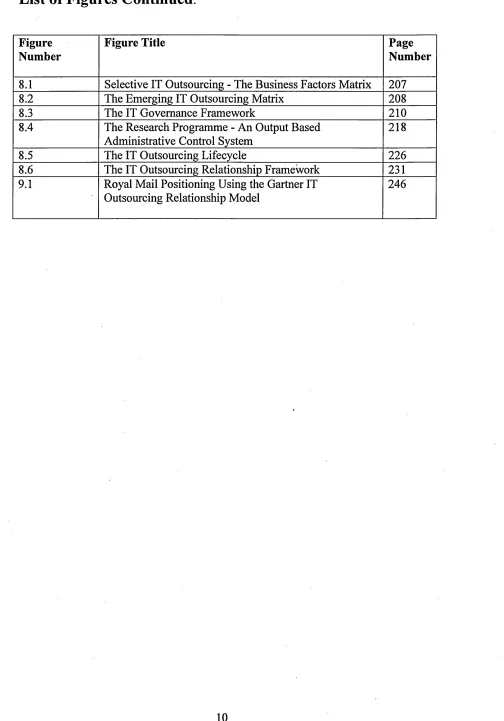
[image:13.612.59.537.58.742.2]List of Figures Continued:
Figure
Number Figure Title PageNumber
8.1 Selective IT Outsourcing - The Business Factors Matrix 207
8.2 The Emerging IT Outsourcing Matrix 208
8.3 The IT Governance Framework 210
8.4 The Research Programme - An Output Based
Administrative Control System 218
8.5 The IT Outsourcing Lifecycle 226
8.6 The IT Outsourcing Relationship Framework 231
9.1 Royal Mail Positioning Using the Gartner IT
[image:14.612.46.550.40.761.2]L ist o f T ab les
Table
Number Table Title PageNumber
1.1 The Boundary Less Organisation 17
2.1 The Four Categories of Motives for IT Outsourcing
Decisions 48
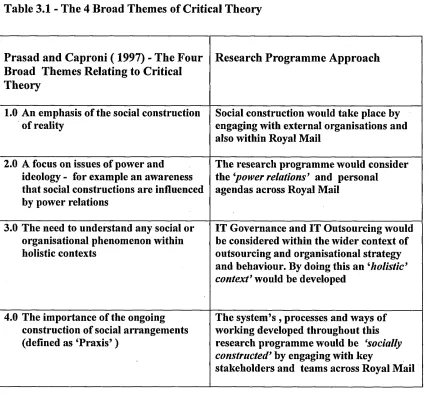
3.1 The Four Broad Themes of Critical Theory 69
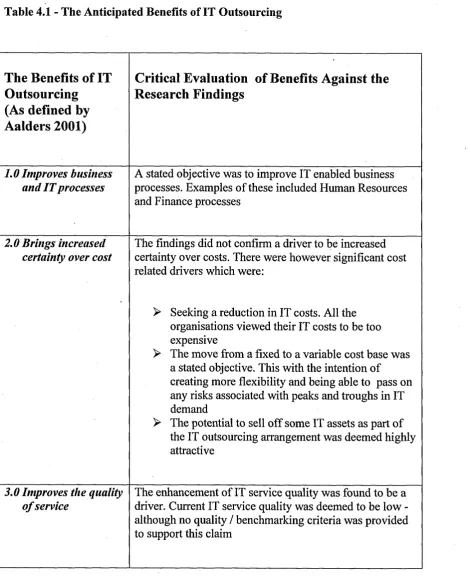
4.1 The Anticipated Benefits of IT Outsourcing 89
4.2 The Kaplan and Norton Critical Success Criteria 91
4.3 Best Practice Contract Principles 94
4.4 The Four Faces of Post Outsourced IT Organisations 97
4.5 The Determinants of Degree of Alignment and Level of
Intimacy 101
5.1 Skills and Professionalism Capability Requirements 137
5.2 Additional Skills and Professionalism Requirements 140
5.3 IT Infrastructure Service Management Tasks 142
5.4 Royal Mail Performance Metrics 151
5.5 Summary of the IT Outsourcing Contract Principles 158
7.1 Observation of the IT Outsourcing Contract Principles 202
8.1 The Four Elements of Control Related to the IT
Governance Framework 219
8.2 Comparison of IT Governance Framework with t he
COBIT and VAL-IT Domains and Sub - Processes 220
.8.3 The Five Case Studies - How the IT Governance
Framework Might Have Assisted 227
8.4 Summary of the IT Outsourcing Contract Principles 233
8.5 Mode 2 Research and the Features of this Research
[image:15.612.52.525.69.732.2]CHAPTER 1
1.1 Introduction - Background to the Research
IT Outsourcing represents a complex area of study and is an area where there are apparently contradictory views. The available literature provides strong evidence that IT Outsourcing business benefits realisation has been far from impressive. To illustrate this point research by Gartner (2002) estimated that ‘80% of IT Outsourcing deals failed to deliver their original anticipated business objectives Further studies from Lacity and Willcocks (2001) concluded that ‘actual benefits from IT outsourcing are invariably less than those expected\ Strassman (1995) used somewhat more alarmist language when his research and analysis argued that ‘IT Outsourcing is a game for losers’. Various other studies have also argued that IT Outsourcing did not provide the anticipated business benefits realisation. Examples of these studies included the work of Gordon (1994), Grover, Cheon and Teng (1994), Willcocks, Fitzgerald and Lacity (1996), Earl (1996), Farrell (1999) and McDowall
(2001).
However, in the face of this evidence that IT outsourcing has been far from successful there has been a recent and rapid expansion of the IT Outsourcing market. Morgan Chambers (2007) estimated that the UK IT Outsourcing market has seen rapid expansion over recent years from £6 Billion per annum in 2000 to an anticipated level of £40 Billion per annum in 2010. Further, the global IT Outsourcing market has seen growth from $140 Billion per annum in 2001 to an estimated $350 Billion per annum in 2008 (International Data Corporation 2007). Evidently the IT Outsourcing business and practitioner communities were still proceeding with adopting an IT outsourcing approach despite the poor business benefits realisation warnings suggested by the various (primarily academic) sources.
1.1.1 Royal Mail - The Research Context
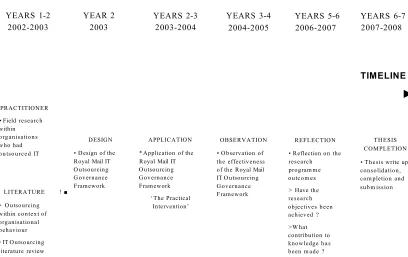
[image:18.615.77.485.271.528.2]This research programme addresses the IT outsourcing process within Royal Mail. The role of Royal Mail within the overall context of this research programme is summarised in the figure that follows:
Figure 1.1 - The Research Programme Timeline
YEARS 1-2 2002-2003
YEAR 2 2003
YEARS 2-3 2003-2004
YEARS 3-4 2004-2005
YEARS 5-6 2006-2007
YEARS 6-7 2007-2008
TIMELINE
►
PRACTITIONER • Field research within organisations who had outsourced IT
LITERATURE ! ■ • O utsourcing within context of organisational behaviour • IT O utsourcing literature review
DESIGN • Design of the Royal Mail IT O utsourcing G overnance Framework
APPLICATION * Application of the Royal Mail IT O utsourcing G overnance Framework
‘ The Practical Intervention’
OBSERVATION • Observation of the effectiveness of the Royal Mail IT O utsourcing Governance Framework
REFLECTION • Reflection on the research program me outcom es > Have the research objectives been achieved ? >W hat contribution to knowledge h as been m ade ?
THESIS COMPLETION
• Thesis write up, consolidation, com pletion and subm ission
provide a unique practical intervention within the Royal Mail real world IT outsourcing environment.
This research programme addresses the significant challenges Royal Mail faced in moving from internal IT service provision to a highly commercial and contractual IT outsourced environment. This was at a time when Royal Mail was facing major financial (Royal Mail was losing £1 Million per day at the time of considering IT outsourcing) and commercial pressures coupled with increased competition.
As Figure 1.1 shows, the design of the Royal Mail IT outsourcing governance framework is based on knowledge gained by carrying out field research within organisations that had previously outsourced their IT capability coupled with using knowledge from the available IT outsourcing literature. The design of the Royal Mail IT outsourcing governance framework lead to the application and practical intervention of the framework, and associated systems and processes, within the Royal Mail IT outsourced environment.
1.2 Organisational Context - Positioning of the Outsourcing Phenomenon within the W ider Business and Organisation Context
Although the overall aim of this research programme is to make a credible contribution to knowledge within the IT Outsourcing, IT management and specifically IT Governance fields, it is important to ensure that a holistic rather than reductionist research approach is adopted. Alvesson and Skoldberg (2002) stated:
‘The meaning of a part can only be understood if it is related to the whole ’
This chapter provides an understanding of the general outsourcing phenomenon within the overall context of organisational strategy and behaviour. This ensures that the platform for the specific issues of IT Outsourcing will be addressed. Houghton (1995) stated that outsourcing has been a long established element of business strategy and that ‘Outsourcing is a new name for an old practice \ Houghton cites examples of early outsourcing over the past 50 years in the areas of advertising, legal services, building maintenance and catering. The reasons cited for the early outsourcing activities are primarily that the outsource provider could provide the service better or cheaper (or in some cases better and cheaper).
In wishing to understand outsourcing within the ‘whole’ context of organisational behaviour it could be argued that outsourcing may have been part of the move from a modem to a post modem epoch and part of a methodology for coping with an increasingly turbulent and uncertain environment. Clegg (1990) described the move towards post modem organisations, which ‘might be centered on a concern with flexible specialism’. Therefore outsourcing with its implications of moving from a
fixed to variable cost, material and labour bases could represent an element of this
The move away from the bureaucratic organisation to managing in a post modem epoch is classified by what was described by Wood (1989) as ‘new wave’
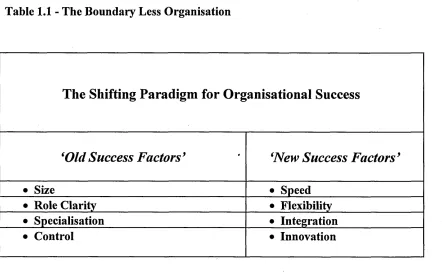
[image:21.616.59.501.254.531.2]management literature (examples include Peters and Waterman (1982), Peters (1987), Handy (1989) and Deal and Kennedy (1982). It could be argued that outsourcing may have assisted the drive towards a less bureaucratic organisation, not least because outsourcing of a service previously provided in house will reduce internal staff numbers, management layers and the amount of internal processes and procedures. To assist with the analysis of the shifting organisation paradigms the work of Jick, Kerr and Ulrich (1998), who described the ‘boundary less organisation’, is detailed in the table that follows:
Table 1.1 - The Boundary Less Organisation
The Shifting Paradigm for Organisational Success
‘Old Success Factors ’
‘New Success Factors
9
• Size • Speed
• Role Clarity • Flexibility • Specialisation • Integration • Control • Innovation
change in product. This may not be the case when considering outsourcing of a true non-core activity such as building maintenance, however, it may have relevance when considering outsourcing of a key business process such as Information Technology. The second new success factor is that of flexibility. This is one of the drivers cited for undertaking an outsourced arrangement (Morgan Chambers 2002) with the potential move from a fixed to variable cost, manufacturing and labour base proving an attractive incentive for organisations. The third success factor of integration was described by Jick, Kerr and Ulrich (1998) as:
‘Organisations that can shift directions quickly and flexibly having processes that carry concepts of change into the institutional bloodstream, disseminating new initiatives quickly, and mobilising the right resource to make things happen’
Outsourcing is one way of mobilising the right level of resource to, as the quotation states, ‘make things happen’. The final and fourth success factor is innovation. Recent trends (Morgan Chambers 2002) have shown an increasing willingness for organisations to tap into the external environment by outsourcing existing internal innovation capability or using external expert consultants and expertise. This strategy allows a more holistic and global approach to be utilised particularly when looking for new market and product opportunities through the use of innovative solutions. For impact it is useful to quote the example of General Motors when considering what a
‘boundary less organisation’ might look like. General Motors was cited (Aalders 2001) to have about 80,000 suppliers and service providers. The scale and complexity of this sourcing arrangement may be difficult to comprehend however it is a strategy that ensures that competition is brought into all areas of General Motor’s motor vehicle manufacturing capability.
When analysing outsourcing within the wider organizational context, it was useful to look at the empirical evidence regarding the organisational trend towards what has been termed the ‘flexibility offensive’ (Atkinson and Gregory 1986). This trend is also articulated by for example, Nichols 1986 and Prowse 1990, who identified an organisational trend towards differentiating between what is ‘core’ and what is
flexible and non permanent ‘peripheral’ workforce. In the case of outsourcing it can be argued that outsourcing has assisted in creating the flexible or ‘peripheral’ element of an organization. Streeck (1987) claimed that the move towards a ‘flexible’
organisation has increased the ‘general capacity to re-organise in close response to fluctuations in their environment’.
Mary Jo Hatch (1997), when discussing, the ‘flexible’ post modem organisation, highlighted:
‘ Predictions are that the future will find us occupying smaller, more decentralised,
informal and flexible organisations that will be primarily service or information oriented and will use automated production strategies and computer based technology’
Hatch highlighted the increasing importance of creating ‘flexible’ organisations as well as the increased role of information and computer based technology within today’s business and manufacturing environment. This serves as an excellent lead into the next section of this thesis which looks at the growth of organisations that are outsourcing their information and computer based technology.
1.3 The Growth of Information Technology Outsourcing
The IT Outsourcing trend began in the USA when in 1990 Eastman Kodak announced that it was outsourcing its entire IT Function. Observers at the time may have wondered if outsourcing, which had been seen as a traditionally inherent in-house service, was just another passing management trend or fad. History has shown that IT Outsourcing has not been a passing management trend and other senior executives of the USA’s major companies have been keen to follow Kodak’s example and outsource their IT Functions. Examples include Continental Airlines, Continental Bank, Enron, First City, General Dynamics, Me Donnel Douglas and Xerox (Lacity, Willcocks and Feeney (1995)).
As detailed earlier, global IT Outsourcing has continued to accelerate over recent times. The global IT outsourcing trend has expanded from the mega deals of the late eighties and throughout the nineties to mid-sized deals in more recent times (Outsourcing Institute - Mid-sized Companies Discover Outsourcing (2001)). Chief Information Officers and Executive Boards in the UK have been quick to seize on this apparent global best practice and organisations such as British Aerospace, BP Exploration, Inland Revenue and Philips Electronics have all followed suit and outsourced their IT capability (Willcocks and Fitzgerald (1994)). This despite the well documented warnings of surrendering direct management control of what can be deemed a ‘critical strategic asset* (Bergstrom (1991), Buck-Lew (1992) and Ganz (1990)).
Figure 1.2 - UK Outsourcing Market Size
40
2000
2002
2004
2006
2008
2010
□ ACTUAL
■ FORECAST
UK IT Outsourcing Market Size £ Billion per Annum
Source - Morgan Chambers (2007)
1.4 The Drivers Behind Information Technology Outsourcing
Morgan Chambers (2001) found that the major reasons (37%) why companies outsource are predominantly to make cost savings on their IT budgets and expenditure Other key reasons for outsourcing were cited by Morgan Chambers as being to improve quality of IT Service and to use IT Outsourcing as a change enabler (for example IT outsourcing could be part of a business transformation programme). Lacity and Willcocks (2001) cited two phenomena that may have led many senior executives to be attracted to IT outsourcing. The first is a desire to refocus on core competencies and the second is the issue that IT is perceived by many senior executives to be a significant cost burden and drain on an organisation’s finances.
With financial savings being a prime driver for IT outsourcing, a report prepared by the National Audit Office (March 1996 ref HC255) may well have helped to fuel the fire of the IT Outsourcing phenomenon. This report provided a case study of the IT Outsourcing carried out within the Department of Social Security and provided data suggesting that over 30% of IT Budget could be saved by outsourcing their IT capability. There is a health warning on this information source as no follow up report was prepared confirming if these savings had been "achieved. However, at the time it proved a catalyst for other government departments to follow suit (examples include the Home Office and The Department of Work and Pensions)
Figure 1.3 - Selective IT Outsourcing - The Business Factors Matrix
Critical
Contribution of IT Activity to
Business Operations
Useful
Source- Lacity and Willcocks (2001)
The model highlights the recent IT Outsourcing trend which has seen a move away from a single IT Outsourcing contract towards selective sourcing. Note that selective sourcing comprises of a combination of sourcing options as shown in the 4 segments of the business factors matrix and represent the sourcing model that 73% of organisations adopt (1999 - 2000 study by Lacity and Willcocks). The four sourcing options are summarised as follows:
(Critical Differentiators’ - These are IT activities that are not only critical to business operations, but also help to distinguish the business from its competitors. The recommended sourcing option is to ‘In Source ’
‘Critical Commodities’ - These are IT activities which are critical to business operations but fail to distinguish the business from its competitors. The recommended sourcing option is to ‘Best Source’
BEST-SOURCE
IN
SOURCE
OUT
SOURCE
ELIMINATE
Commodity Differentiator
*Useful Commodities’ - These are IT activities that provide incremental benefits to the business but fail to distinguish it from its competitors. The recommended sourcing option is to ‘Outsource’
‘Useful Differentiators’ - These are IT activities that differentiate the business from its competitors, but in a way that is not critical to business success. The sourcing option is to *Eliminate’
The move away from a single supplier to a new breed of complex selective sourcing or what Lacity and Willcocks (2001) have also termed ‘Multi - sourcing’ is summarised below:
‘Newly signed mega-deals are rarely based on fixed-price, long term, exchange based relationships with a single supplier. Instead, customers are seeking to avoid these pitfalls through value-added outsourcing, equity deals, multi-sourcing, co sourcing and creative contracting’
The move from single supplier multi sourcing contracts to multi sourcing made the
The ‘control’ (or lack of control) issues were not just limited to the management of external IT contracts. Coombs, Knights and Wilmott (1992) highlighted the importance of IT with respect to internal management practices. They argued that IT is a means to direct ‘thought and action* in organisations and that ‘IT is a controlling mechanism to ensure that the senior management’s desires and expectations are understood and implemented*. It was interesting to note that senior managers were ready to put IT, which is regarded as their ‘controlling mechanism *, in the hands of external IT service providers. There may be a risk with this sourcing strategy of losing internal control and influence. However, the undoubted growth and momentum of the IT outsourcing market is an indicator that that the potential rewards of IT outsourcing outweighed the risks.
1.5 Justification for the Research - The Problems with Information Technology Outsourcing
Having highlighted the rapid growth of IT Outsourcing it is interesting, and somewhat disturbing, to note the views of Lacity and Willcocks (2001):
‘Actual benefits from IT outsourcing are invariably less that those expected*
To support this view Strassman (1995) published a paper entitled ‘Outsourcing - A Game for Losers*. This paper contained an analysis of the IT outsourcing deals which took place during the early to mid 1990’s. Some of the outsourcing deals analysed included Eastman Kodak, Me Donnel Douglas, US Air, Polaroid and Xerox. The results of Strassman’s study are summarised by the following quotation;
When Royal Mail outsourced its IT capability it was losing £1.0 Million per day. It could be argued that Royal Mail was in the ‘financial trouble’ that Strassman referred. Also at the time of outsourcing Royal Mail was undergoing a significant downsizing exercise, or this could be termed the *shrinking9 again to which Strassman referred.
To cast further doubt on the effectiveness of IT Outsourcing, Gartner Dataquest (2002) carried out research into over 400 outsourcing deals. The general conclusion from the research undertaken was that:
‘Gartner estimate that 80% of outsourcing deals fail to deliver their original business objectives, and are either terminated or significantly restructured before the end of the original contract period9
The costs for organisations of restructuring or terminating IT outsourcing contracts were deemed by Gartner (2002) to be expensive both ‘financially and emotionally9.
A reason for outsourcing IT capability was to achieve cost savings (Morgan Chambers 2001). Research carried out by Lacity and Willcocks (2001) found that out of 600 outsourcing deals only approximately half claimed to have realised some cost savings. This research had however been carried out in a largely quantitative manner and did not get to the issues of why cost savings benefits realisation had been so poor.
To support the view that cost savings have not been achieved by IT Outsourcing, SOCITM (A government agency) undertook a significant IT Outsourcing study in 2001 within 49 local authorities across the UK. One of the key findings was that the authorities who had outsourced their IT capability had an annual IT spend per user of 25% more than the authorities who had not outsourced their IT capability. This report used a quantitative approach and no information was published as to why the anticipated cost savings had not been achieved.
McDowall (2001) have argued that IT outsourcing has not realised the anticipated benefits.
Therefore this chapter has highlighted that IT Outsourcing is a complex and problematic area where a fascinating conundrum and apparent opposing forces exist. The conundrum, and therefore opposing forces, being the strong evidence that the IT Outsourcing market is set to continue its rapid expansion despite equally strong evidence that the realised benefits of IT outsourcing has been far from impressive. To add to the IT Outsourcing conundrum, it is unclear on how to enter into a successful IT outsourcing arrangement and in particular how an IT outsourcing relationship can be effectively managed, controlled and ‘governed’ to ensure that benefits realisation is achieved. Inadequate governance may have resulted in a ‘loss of control’ over the IT outsourcing environment (highlighted in the work of Farrell (1999), Gallivan and Wonseak (2004) Willcocks, Fitzgerald and Lacity (1996), Grover Cheon and Teng (1994) and Gordon (1994). The addressing of the governance and ‘control’ issues formed a key aspect of this research programme.
1.6 The Research Programme Objectives
This research programme has the objectives of addressing both academic and practitioner perspectives. These differing perspectives are summarised by the work of Pettigrew (1995, 2001) who drew attention to the need for researchers to clear
‘double hurdles’ which are ‘simultaneously delivering practitioner relevance and scholarly excellence’.
The theoretical (or academic) objectives of this research programme are detailed below:
> Evaluate IT outsourcing within the wider context of organisational behaviour. For example an objective is to position IT outsourcing within the ‘core controlling the periphery ’ debate ( Nicholls (1986) and Prowse (1990))
> Provide further insights into the current (and indeed future) trends of the IT Outsourcing phenomenon. This is an opportunity to provide views on new and emerging IT outsourcing models
> Develop, from basic principles, original and leading edge systems derived constructs with the end product being the development and application of an original IT Governance Framework. This framework represents a new model of control and adds to the current academic views on this subject area (for example the work of Otley and Berry (1980))
> Because this research programme takes place over a period of 7 years there is a unique opportunity to carry out research over the full extent of the IT outsourcing lifecycle. Therefore the research is able to provide an end to end and holistic view across the key stages of the IT outsourcing lifecycle as defined by Aalders (2001), namely Pre- IT Outsourcing, IT Contract negotiation and agreement, IT outsourcing transition period and Post IT outsourcing study
The practitioner objectives of the research programme can be summarised as follows:
> Physical relationships and interfaces are developed and implemented with the objective of bringing to life the IT Governance Framework processes and systems
> A number of IT Outsourcing contract principles are developed and implemented within a practical and real world environment
> This research programme seeks to build upon the relatively new Mode 2 research concept. Mode 2 being defined by MacLean, Macintosh and Grant (2002) as:
‘Research carried out in the context of application ’
> This research approach should enhance the practical and practitioner nature of the research which is a key focus of the Doctorate in Business Administration research programmes. The Sheffield Hallam University Doctorate in Administration 2001 brochure states:
*The Doctorate in Business Administration (DBA) is aimed at those who want to make a difference to the way that management will be practised in the futuref
1.7 Outline of the Thesis
This thesis is organised into nine chapters. A diagrammatic outline of the research process is presented in the figure below which details the links between the chapters:
Figure 1.4 - The Research Process
CHA PTER3 Research Methodology CHAPTER2
IT Governance Literature Review
CHAPTER 1 Research Positioning
CHAPTER 4
Defining the IT Outsourcing Problem Situation
CHAPTER 7
Observation of the IT Governance Framework
CHAPTER 9 Conclusions and Future Research
CHAPTER 5
Design of on IT Governance Framework
CHAPTER 6
Application of an IT Governance Framework
CHAPTER 8
Reflection on the Research Outcomes - The Contribution to Knowledge
defined the IT outsourcing problem situation, to be constructed. This leads to the design (Chapter 5) and then application or practical intervention (Chapter 6) of an IT Governance Framework within the Royal Mail IT outsourced environment.
CHAPTER 2
2.1 Information Technology Governance
The previous chapter positioned IT outsourcing within the wider organisational and business context. This chapter examines the specific literature and issues relating to how the IT outsourcing environment is ‘governed’:
‘The idea of IT Governance has come about as a way of imposing order on chaos’
Thomas (2005)
The concept of IT Governance has evolved following the widely reported collapse or
‘chaos’ associated with Enron in 2000, this coupled with the problems associated with Arthur Anderson and Worldcom in the early 2000’s, where the duties and responsibilities of the boards of directors for public and privately held corporations were seriously questioned. As a response to these issues, and to prevent any reoccurrence, the US Sarbanes - Oxley Act (2002) and European Union Basel II (2006) Acts were introduced. These Acts, along with the IT industry acknowledgement that complex IT projects can easily get out of control, have proved to be a catalyst for the further development of IT governance which had an objective of imposing ‘order’ over the IT environment.
Because the IT Governance phenomenon is relatively new (particularly IT Governance within an IT outsourced environment) it is expected that this research programme will shed new light and thinking on how to ‘govern’ an IT outsourced environment. This research programme also provides a unique opportunity to apply the IT Governance systems and models, developed later in this thesis, within the real world of the Royal Mail IT Outsourced environment.
‘IT Governance is a structure of relationships and processes (1) to direct and control (2) the enterprise in order to achieve the enterprise’s soals (3) by adding value (4) while balancing risks (5) versus return over IT and its processes ’
Various IT Governance definitions exist, however they all have common themes which are numbered 1-5 within the IT Governance Institute definition detailed below:
1. Relationships and Processes - these should exist to ensure that the IT governance processes are directed and controlled
2. IT Control - IT should operate within a ‘controlled’ environment
3. Enterprises Goals - IT should be aligned with the enterprise’s strategy and goals
4. IT Value - IT should add value
5. IT Risks - IT risks should be managed to ensure an adequate balancing of return on IT processes and investment
2.1.1 Relationships and Processes
Following any IT outsourcing arrangement it is necessary to retain an IT organisation in house which is capable of providing appropriate and effective relationship interfaces with the IT service providers. These relationships are the practical mechanisms that ensure that the IT governance processes are brought to life within the context of the overall IT outsourcing relationships. Lacity and Willcocks (2001) articulated the four faces’ or tasks of the emerging IT relationship functions in a post outsourced environment as follows:
> ‘The business face’ - concerned with the elicitation and delivery of business requirements
> ‘The technical face’ - this ensures that the organisation has access to the technical capability that it needs
> ‘The governance face’ - concerned with information management strategy which defines the governance and coordination of the organisation’s IT activity
> ‘The supply face’ - this encompasses the understanding and use of IT services
Lacity and Willcocks provided a theoretical insight with respect to what faces’
should exist within the relationships and interfaces of a retained IT organisation. They had however, not provided information on how these faces’ will practically operate within the coalface of the relationship between the customer and IT service provider organisations. This research enables a practical perspective to be achieved and also to critically evaluate my own research findings against those of Lacity and Willcocks.
relationship ’. It is argued that this ‘degree of alignment ’ between a customer and IT service provider may be broadly determined by a list of basic relationship questions that McKeen and Smith (2001) have suggested as follows:
‘Do they understand your business? Do they have the same priorities?
Do they understand the ‘non specified’ issues? Do they have the urgency?
Do they anticipate what you need?
Do they care for your budgetary constraints ? ’
These questions relate to what McKeen and Smith term the ‘level of intimacy’
between the customer and IT service provider. It is argued that achieving a ‘level of intimacy ’ will provide an opportunity to build ‘trust’ into a relationship. This research programme enables a first hand understanding and insight of how relationships operated within a real world practical environment. It also enables comparisons to be drawn against some of the theoretical relationship perspectives that existed. First hand knowledge is gained on how (or if?) a ‘level of intimacy’ and ‘trust’ is developed within the context of the IT outsourcing relationships that were examined. This research programme is able to test the theory of, for example, Kim and Lee (2003) that:
‘Relationships based on formal contract and rooted in mutual trust give rise to stronger bonds between clients and their service providers’
The literature review highlights the importance of having effective IT outsourcing change management mechanisms in place, for example the work of Farrell (2002) and Morgan Chambers (2002) who stated that:
Therefore this research programme ascertains, first hand, the change mechanisms that are in place within an IT outsourcing environment and obtains views on how effective these are with the objective of developing new perspectives and thinking.
Lacity and Willcocks (2001) recognised the importance of capabilities and skills and professionalism in creating effective relationships and therefore competitive advantage within the context of an IT outsourcing environment. They identified 9 areas of key skills and professionalism as follows:
1. *IS/IT Governance’ - Establishing and maintaining the orientation and vision of the customer /IT service provider relationship
2. ‘Business Systems Thinking’ - Contributes to the overall development of business strategy and identifies IT interdependencies 3. ‘Business/IT Relationship Building’ - Develops business
understanding of potential of IT
4. ‘Designing Technical Architecture’ - Analysis of trends in development of a range of technologies
5. ‘Making Technology Work’ - Focuses on action and problem solving aspects of successful IT delivery
6. ‘Informed Buying of IT Service’ - Monitors available services of external IT supplier(s)
7. ‘Contract Facilitation’ - Facilitate and manage people and contractual relationships
8. ‘Contract Monitoring’- Monitor results against goals
9. ‘Vendor Development’ - Identifies opportunities for added value to business and vendor
2.1.2 IT Control
In discussing the role of IT Governance, Sherer (2004) provided the following definition:
‘IT Governance is the system of structures and processes for directing and controllins Information Systems ’
The importance of directing (or managing) and controlling within the context of structures and processes which form an overarching IT Governance framework is highlighted by Sherer. However the work of Farrell (1999) cast doubt over how successfully organisations are able to ‘c o n tro land therefore govern, their respective IT outsourced environments:
‘In many organisations wholesale IT outsourcing has been the norm - handing over the entire range of technology problems to someone else. Unfortunately they have found after about six to nine months that the problems haven’t gone away but what little control they had over them certainly has,
Gallivan and Wonseak (2004) also provided a warning with respect to a ‘loss of controT which may be related to the size (and complexity) of the IT outsourcing arrangement:
‘As the size of the contract increases , the client tends to lose control over its internal resources and becomes more dependent on itfs vendor *
The ‘loss of control’ issue was supported by other research, including the work of Willcocks, Fitzgerald and Lacity (1996), Grover Cheon and Teng (1994) and Gordon (1994). It is therefore important from both academic and practitioner perspectives that consideration is given to appropriate control mechanisms within the design of any IT Governance processes or systems.
their model provides a grounding to begin analysis using a ‘systems based’ model to represent whatever it is that is being ‘controlled’. This systems based model was termed ‘A basic output based administrative control system’ and is detailed in the figure that follows:
Figure 2.1 - An Output Based Administrative Control System
TRANSFORMATIONAL
PROCESSES OUTPUTS
INPUTS
Adapted from Otley and Berry (19 8 0)
This output based administration control system demonstrates how various resources or inputs are combined together and subsequently changed to create the various outcomes or outputs. Otley and Berry argued that in order for an activity or system to be controlled at least four necessary conditions must exist:
2.0 ‘Activities outputs must be measured’ - This allows the assessment of the extent to which the activity is attaining the objectives defined
3.0 ‘Causes of non attainment of objectives must be determined / monitored’ - This enables the identification of any non-attainment of objectives to be determined and the effects of any possible actions to correct the situation to be forecasted and evaluated
4.0 ‘Capacity to take action relating to non attainment of objectives1 - There must be some capacity for taking action so that deviations in attainment (outputs), relative to the objectives set for the activity, can be reduced
The work of Otley and Berry assisted with providing a basic understanding of control theory. Further, this work (in particular the output based administrative control system and the four control principles) would also prove to be a good evaluation tool for the models and systems developed and implemented as part of this research programme.
Having understood the basic controlling principles, at the other end of the scale is the IT industry recognised Control Objectives for Information and Related Technology (COBIT) framework. This framework was developed in the USA in 1996, is issued by the IT Governance institute, and:
‘is arguably the most appropriate control framework to help an organisation ensure alignment between IT and its business goals, as it places emphasis on the business need that is satisfied by each control objective9
Colbert and Bowen (1996) - quotation made in the year of the COBIT publication
Figure 2.2 - The COBIT Framework
B U S I N E S S O B JE C T IV E S
IT G O V E R N A N C E
M l m onitor the processes M 2 assess internal control ad e q u ac y M 3 obtain independent assurance M 4 provide for independent audit
*
IN F O R M A T IO N
P 0 1 define a strategic IT plan P 0 2 define the inform ation architecture P 0 3 determ ine the technological direction P 0 4 define the IT organisation a n d relationships P 0 5 m an a g e the IT investment
P 0 6 com m unicate m anagem ent aim s an d direction P 0 7 m an a g e hum an resources
P 0 8 ensure com pliance with external requirem ents P 0 9 assess risks
P 0 1 0 manage projects
P O 1 1 m an a g e quality *
^ ______
mEXZZWF
B
B
p
A C Q U IS IT IO N & IM P L E M E N T A T IO N
DS1 define an d m an a g e service levels DS2 m an ag e third-party services DS3 m an a g e perform ance an d capacity DS4 ensure continuous service DS5 ensure systems security DS6 identify an d allocate costs DS7 ed u cate an d train users
DS8 assist a n d advise custom ers j DS9 m an a g e the configuration D SIO m an ag e problem s an d incidents DS11 m an a g e d ata
D S12 m an a g e facilities DS1 3 m an a g e operations
A ll identify autom ated solutions
AI2 acquire an d m aintain application softw are AI3 acquire an d m aintain technology infrastructure AI4 develop a n d m aintain procedures AI5 install an d accredit systems AI6 m an a g e changes
Source - IT Governance Institute www.itqi.org.uk (2004)
Since it was developed in 1996:
‘COBIT has been adopted in corporations and by government entities throughout the world*
Guldentops (2004)
However, the research of Ridley, Young and Carroll (2004) found ‘A low level of COBIT implementation* and, where implemented, this was primarily due to reasons of compliance and risk management, for example in USA financial institutes (primarily due to legal requirements compliance and risk mitigation with the Sarbanes Oxley Act (2002)). Reasons cited for the low level of COBIT implementation were that it is too expensive to implement, primarily due to it’s complexity and overly bureaucratic nature and therefore widespread implementation has not been forthcoming (Ridley, Young and Carroll (2004)).
COBIT is not a control framework that was developed for *specific* IT outsourcing arrangements (which is the subject of this thesis) but more for ‘generic* IT services and management, which at the time of development in 1996, was for primarily non IT outsourced environments.
Following on from the development of COBIT, and as a result of the work of the IT Governance Institute, the VAL-IT framework was launched in April 2006. This framework was developed with the backing of, and in collaboration with, major IT organisations such as IBM, Fujitsu, KPMG and Price Waterhouse Coopers and was described by the IT Governance Institute (2008) as:
‘A comprehensive and pragmatic organising framework that enables the creation of business value from IT enables investments. Designed to align with and complement COBIT, VAL-IT integrates a set of practical and proven governance principles, processes, practices and supporting guidelines that help boards,
The IT Governance Institute argued that VAL-IT provides an enterprise level perspective on the creation of business value and also that the framework complements COBIT by focusing on the IT function’s role in creating and delivering value from IT enabled business change initiatives and investments. VAL- IT deals with the enterprise governance of IT as opposed to COBIT which addresses specifically IT governance.
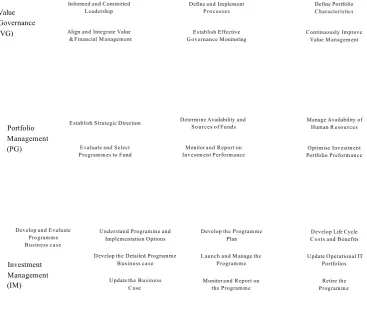
[image:47.617.72.440.310.630.2]The VAL-IT principles are contained within 3 domains, namely Value Governance, Portfolio Management and Investment Management. These domains along with the associated and supporting processes are detailed in the Figure that follows:
Figure 2.3 - The VAL-IT Domains and Processes
Value Informed and Committed Leadership Define and Implement P ro cesses Define Portfolio Characteristics
Governance
(VG) Align and Integrate Value
& Financial M anagement G overnance MonitoringEstablish Effective Continuously Improve Value M anagement
Portfolio Management (PG)
Establish Strategic Direction Evaluate and Select Program m es to Fund
Determine Availability and S ources of Funds Monitor and Report on Investm ent Perform ance
Manage Availability of Human R esources Optimise Investm ent Portfolio Preform ance
Develop and Evaluate Program me B usiness case
Investment Management (IM)
Understand Program me and Implementation Options Develop the Detailed Programme
B usiness case Update the B usiness
C ase
Develop the Program me Plan Launch and M anage the
Program me Monitor and Report on
the Program me
Develop Life Cycle C osts and Benefits Update Operational IT
This Figure details the domains and processes which are required to create business value from IT investments. This is in support of the findings of an IT Governance Global Status report (2008) which highlighted that ‘a significant number of organisational leaders are questioning IT’s return on investment\ The work of Weill and Ross (2004) and more recently De Haes and Van Grembergen ( 2008) also provided evidence that IT value and benefits management are difficult governance practices to implement.
The work of Bell Wellington (2006) also highlighted the pitfall that may lie in store when implementing VAL-IT:
‘Installing VAL-IT in an organisation will be a major change demanding appropriate change management, and may attack the ‘power base’ of some employees in both IT and management, who will attempt to resist it’
The fact that VAL-IT practices and processes span both IT and the business means that the ‘resistance to change’ to which Bell Wellington referred may have to be overcome in both the organisations business and IT communities and that any change management approach adopted would have to be highly collaborative in nature.
The understanding of basic control theory (Otley and Berry), coupled with an understanding of the highly complex and bureaucratic control and governance frameworks that COBIT and VAL-IT represent, is valuable when designing and applying the ‘IT Governance Framework’ which is carried out later within this research programme
2.1.3 Enterprise Goals
professionals ( hence the black box mentality). It is argued that IT governance should be an integral part of organisations Enterprise governance (or some have termed corporate governance). This may be due to the fact that:
‘The business dependency on Information Technology has made it so that the enterprise governance issues cannot be solved without considering Information Technology’
Van Grembergen (2004)
The view of Van Grembergen was further enforced by the IT Governance Institute (2007) fwww.itgi.org.uk):
‘IT governance and the effective application of an IT governance framework are critical in helping enterprises gain more value from information and information technology while ensuring that IT remains aligned with the enterprise strategy,
values and culture’
The importance of ensuring alignment or fusion ’ of business and IT strategies was highlighted by Brancheau, Janz and Wetherby (1996), Plowman (1998) and Farrell (2003). The need to create this fusion ’ was further articulated by Van Grembergen
(2002):
‘ IT Governance is the organisational capacity exercised by the Board, executive management and IT management to control the formulation and implementation of IT strategy and in this way ensure thefusion of business and IT’
Indeed Chan, Huff, Barclay and Copeland (1997) summarised the importance of companies aligning business and IT strategies:
‘Companies that appear to perform best are companies in which there is alignment between realised business strategy and realised IT strategy’
‘The disciplines you need to have good IT governance actually align with the disciplines you need to have good business strategy and governance ’
Although there are few critics to the idea of integrating IT Governance with the enterprises goals, Carr (2004), in his publication ‘Does IT Matter - IT and the corrosion of competitive advantage\ raised the idea that IT does not imply strategic or competitive advantage. This line of criticism might imply that significant attention to IT governance is not a worthwhile pursuit for senior business and corporate
leadership. An objective of this thesis is to test this theory by developing and implementing systems and processes which seek to align IT with the enterprises strategy and goals in pursuit in assisting with the creation of ‘competitive advantage ’
2.1.4 IT Value
Figure 2.4 - The Kaplan and Norton Balanced Scorecard Framework
Kaplan and Norton (1993)
FINANCIAL
' To succeed financially, liow should we appear to our shareholders ’
'To achieve our vision, how should we appear to our customers ’
CUSTOMER
LEARNING AND GROWTH
'To achieve our vision, how will we sustain our ability to change and im prove’
PROCESSES
' To satisfy our shareholders and customers, what processes must we excel at ’
The Kaplan and Norton IT balanced scorecard operates with the fundamental premise that the evaluation of a firm should not be restricted to a traditional financial evaluation but should be supplemented with measures concerning customer satisfaction, internal processes and the ability to innovatef (Van Grembergen (2004)).
The balanced scorecard can also be applied to the IT function and its processes (Gold (1992, 1994), Willcocks (1995), Van Grembergen and Van Bruggen (1997), Van Grembergen and Timmerman (1998) and Van Grembergen (2000, 2004).
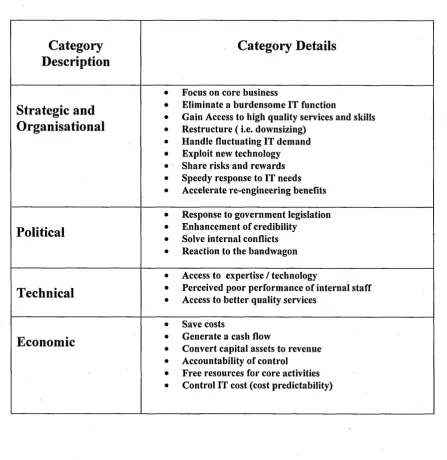
information source. These authors identified four generic motives for IT outsourcing decisions which had the objective of providing IT value. These are contained in the table that follows:
Table 2.1 - The Four Categories of Motives for IT Outsourcing Decisions
Category
Description
Category Details
Strategic and
Organisational
• Focus on core business
• Eliminate a burdensome IT function
• Gain Access to high quality services and skills • Restructure ( i.e. downsizing)
• Handle fluctuating IT demand • Exploit new technology • Share risks and rewards • Speedy response to IT needs • Accelerate re-engineering benefits
Political
• Response to government legislation • Enhancement of credibility • Solve internal conflicts • Reaction to the bandwagon
Technical
• Access to expertise / technology
• Perceived poor performance of internal staff • Access to better quality services
Economic
• Save costs
• Generate a cash flow
• Convert capital assets to revenue • Accountability of control • Free resources for core activities • Control IT cost (cost predictability)
The research undertaken by Baldwin, Love and Irani (2001) is useful in the later part of the research programme in that these motives are compared with the real world Royal Mail motives for IT outsourcing.
‘Improves business and IT processes Brings increased certainty over cost Improves the quality of service
Enables a company to keep pace with its competitors Allows focus on core competency and revenue generation
Offers flexibility in the quantity of staff
Provides access to specialist skills and knowledge 9
As Aalders publication is primarily about the how to implement IT outsourcing it does not contain any information on what might be the problems with, or case against, IT outsourcing. Without wishing to be overcritical with respect to the work of Aalders, (a consultant within PA Consulting Group) he was writing his IT Outsourcing Guide primarily for use by IT Outsourcing consultants who have much to gain by managing the lengthy and complex outsourcing process. These benefits identified by Aalders are later analysed against the field research findings which enables comparisons to be drawn, again within a real world environment.
The work of Weill and Ross (2004) highlighted that organisations with *Above average IT governance performance had superior results\ Indeed a specific example of how an organisations ‘value9 could be enhanced by effective IT governance was provided in a case study, again by Weill and Ross (2004 ) of United Parcel Service (UPS). This case study concluded that where ‘IT Governance first helped the firm survive a competitive threat, now UPS9s governance mechanisms position IT as a strategic weapon 9. The ‘value9 and any links to strategic advantage
2.1.5 IT risks
Thomas (2005) explained the role of risks within the context of an overall IT governance strategy:
‘The central plank of the IT governance strategy should be about understanding the risks to the organisation and putting procedures in place to manage them’
There is no single accepted set of generic IT risk definitions, however a study taken from the Economist Intelligence Unit (2002) is recognised as providing a general view on what constitutes general IT risks:
> Investment or expense risk: The risk that the investment being made in IT fails to provide value for money or is otherwise excessive or wasted
> Access or security risk: The risk that confidential or otherwise sensitive information may be divulged or made available to those without appropriate authority
> Integrity risk: The risk that data cannot be relied on because they are unauthorised, incomplete or inaccurate
> Relevance risk: The risk associated with not getting the right information to the right persons (or process or systems) at the right time to allow the right action to be taken
> Availability risk: The risk of loss of service
> Project Ownership Risk: The risk of IT projects failing to meet objectives through lack of accountability and commitment
The specific IT outsourcing literature review highlighted that IT outsourcing represents a dynamic and high