Vibrational Pooling and Constrained Equilibration on
Surfaces
Thesis by
E. T. D. Boney
In Partial Fulfillment of the Requirements
for the Degree of
Doctor of Philosophy
California Institute of Technology
Pasadena, California
2014
c 2014
E. T. D. Boney
Acknowledgments
Who knows how long it took Mike Slackenerny? After seven years, I appear to have finally done
enough to graduate.
My supporting cast of characters is wide, and I do not thank them enough. First, thanks go to
my wife Susanna, whose support has helped me through the long laborious years. I love you, Mrs.
Dooley Boney; thank you for all the bike rides to concerts, across the Black Rock Desert, and all
the sunsets down at the Japes.
Secondly, I must thank my family for raising me with an appreciation of science and knowledge,
and raising me safe and sound as well. Mom and dad, thank you.
Scientifically, I have the most debt to my advisor, Rudy Marcus, and I will spend a few winding
paragraphs thanking him. I came to Caltech because Rudy had not changed his research philosophy
his whole career: theory guided first and foremost by interesting experiments. If you cannot explain
what people are interested in, then what is your theory good for?
His philosophy is unique, and in my work with him, Rudy has never given in to my urge to
publish prematurely. We did not explain experimental results that wound up retracted with my first
big paper; this prudence was his, not mine. When that retraction wound up wasting about four
years of mean-field work on H:Si(111) and other surfaces, his focus on experiments guided us.
In the end, we found some cool fluorescence results from the late 1980s and early 1990s, and
explained vibrational population inversion on surfaces in a way that has previously been done in
gases by Treanor. Such inversion could change every sort of measurement at surfaces, not just old
fluorescence experiments, from STM and AFM to SFG and SHG, there is now a new possibility
besides defect, bridge, dimer or trimer that demands consideration: the vibrational pool! Because
of his inkling that we had more to discover, we were able to do unifying work between the gas phase
and interfaces that I find very philosophically satisfying in a way that has nothing, and everything,
to do with experiment.
Other advice of his that cannot be ignored by anyone searching here for his wisdom is to know
the literature. Because we want to be guided by experimental results, we have to find and correctly
interpret the existing data as soon as we can. If we reach the bounds of the literature and have not
with. Along those lines, I owe a great debt to Huan-Cheng Chang, Hugh Richardson, George Ewing,
Chifuru Noda, Steven Corcelli, Phillippe Guyot-Sionnest, and John Tully, who did the bulk of the
experimental and theoretical work underpinning my thesis. Without them, I would not have had
anything to do. I owe a special debt to collaborator Jim Lyons, who developed the isotope mixing
code and edited the chapter on self-shielding.
Besides advice from Rudy, I also benefited greatly from the comments of my committee, and
thank them now by name for their general wisdom as well as cumulative specific advice: Rob
Phillips, Aron Kupperman, Tom Miller, and Jim Heath.
Furthermore, in my time at Caltech, I have had the opportunity to know unique individuals
that have shaped my way of thinking about the world in positive and permanent ways. They are,
in no particular order (lots of Doctors, so forget the honorifics): Nima Ghaderi, Oliver Eslinger,
Jorge Cham, Jonny Haug, Allyce Ozarski, Lauren Lebon, Nicolas LaCasse, Sanza Kazadi, Andy
Downard, Glenn Garrett, Michael Shearn, Dan Riley, Anna Beck, Faisal Amlani, Paul Minor, Jerry
Maine, Alex Romero, Vahe Gabuchian, Drew Kennedy, Meg Rosenberg, Meher Ayalasomayajula,
Yousung Jung, Maksym Kryvohuz, Nick Agich, Josh Moorhead, J. P. Chism, Brian Duistermars,
Young-In Oh, Ronnie Bryan, Artur Menzeleev, Jason Goodpaster, Rosemary Rohde, Scott Kelber,
Geo↵rey Lovely, Travis Essl, Chris Dae✏er, Ian Tonks, Nathan Hodas, Wei-Chen Chen, Zhaoyan Zhu, Yun-Hua Hong, and Sandor Volkan-Kacso. I also have had several cats whose company I have
enjoyed thoroughly, despite my cat allergies: Mrs. Kitty, LadyBird Johnson, Trash Cat, and Flea,
you were all good kitties.
At MIT, I developed my love of theoretical physical science combined with video games,
au-tomaton programming competitions, ten consecutive Mystery Hunts, Hoegaarden, and philosophical
musings, thanks in large parts to MIT dorm mates who remain some of my closest friends:
Den-nis Wei, Billy Waldman, Sheel Dandekar, Jon Ursprung, Downtown Twarog, Robert Jason Harris,
Gabe Durazo, and Michael Mooney. I may stand on the shoulders of great scientists I’ll never meet
in my research, but I stood with you in reality, contemplating the wonders of the universe from a
revolutionary war park in the dead of night.
Finally, it would be remiss of me not to thank the ARO, ONR, and NSF for their financial
Abstract
In this thesis, we provide a statistical theory for the vibrational pooling and fluorescence time
dependence observed in infrared laser excitation of CO on an NaCl surface. The pooling is seen
in experiment and in computer simulations. In the theory, we assume a rapid equilibration of the
quanta in the substrate and minimize the free energy subject to the constraint at any time t of a fixed number of vibrational quantaN(t). At low incident intensity, the distribution is limited to one-quantum exchanges with the solid and so the Debye frequency of the solid plays a key role in limiting
the range of this one-quantum domain. The resulting inverted vibrational equilibrium population
depends only on fundamental parameters of the oscillator (!e and !e e) and the surface (!D and
T). Possible applications and relation to the Treanor gas phase treatment are discussed. Unlike the solid phase system, the gas phase system has no Debye-constraining maximum. We discuss the
possible distributions for arbitrary N-conserving diatom-surface pairs, and include application to H:Si(111) as an example.
Computations are presented to describe and analyze the high levels of infrared laser-induced
vibrational excitation of a monolayer of absorbed 13CO on a NaCl(100) surface. The calculations
confirm that, for situations where the Debye frequency limitedn domain restriction approximately holds, the vibrational state population deviates from a Boltzmann population linearly inn. Nonethe-less, the full kinetic calculation is necessary to capture the result in detail.
We discuss the one-to-one relationship between N and and the examine the state space of the
new distribution function for varied . We derive the Free Energy,F =N kT kT ln(PPn), and
e↵ective chemical potential, µn ⇡ kT, for the vibrational pool. We also find the anti correlation
of neighbor vibrations leads to an emergent correlation that appears to extend further than nearest
c 2014
E. T. D. Boney
Contents
Acknowledgments iv
Abstract vi
1 Theory of Vibrational Equilibria and Pooling at Solid-Diatom Interfaces 5
1.1 Introduction . . . 5
1.2 Statistical Treatment Of Vibrational Energy Distribution . . . 6
1.3 Resulting Dynamics . . . 7
1.4 Discussion . . . 9
1.5 Conclusions . . . 13
2 On the Infrared Fluorescence of Monolayer 13CO:NaCl(100) 14 2.1 Introduction . . . 14
2.2 Vibrational Exchange for monolayer CO . . . 15
2.3 Kinetic Monte Carlo Results . . . 17
2.4 Discussion . . . 18
2.5 Conclusions . . . 20
2.6 Chapter Appendix A: Rate constants . . . 21
2.7 Chapter Appendix B: Units . . . 22
3 Vibrational Pools at Solid-Diatom Interfaces: Chemical Potential and Emergent Correlation 30 3.1 Introduction . . . 30
3.2 Formation of higher pools . . . 30
3.3 Evaluation ofPn for several N and . . . 31
3.4 Analysis of the Correlation Function vs. Distance of Separation . . . 32
3.5 Introduction of the Free Energy and Chemical Potential . . . 34
3.6 Results and Discussion . . . 36
4 On the Laser-Induced Desorption of H2 from an H:Si(111) surface 39
4.1 Background and Introduction . . . 39
4.2 Results . . . 41
4.3 Discussion . . . 43
4.4 Conclusions . . . 47
5 Self-shielding in the E1⇧(1)-X1⌃+ g(0) band of CO in a hot solar nebula 48 5.1 Introduction and Background . . . 48
5.2 Computation of Absorption Spectra . . . 51
5.3 Line-by-line calculation of CO photodissociation . . . 54
5.4 Comparison with Navon and Wasserburg . . . 59
5.5 Absorption by H2. . . 60
5.6 Conclusions . . . 61
List of Figures
1.1 The fit for the parameter, . The representative pool is derived from monolayer
popu-lations, calculated elsewhere by kinetic Monte Carlo,1as the slope ofln(P
n) +En/kT,
vs. n, the vibrational state. For the Pn calculated near the end of a pulse of the
conditions of the previous monolayer experiment,2 = 131. . . . 8
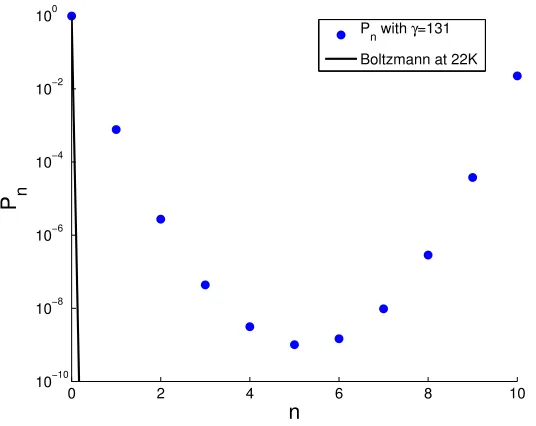
1.2 This figure shows thePn from Eq. 1.4 compared to the Boltzmann distribution at 22K
for = 131. . . 8
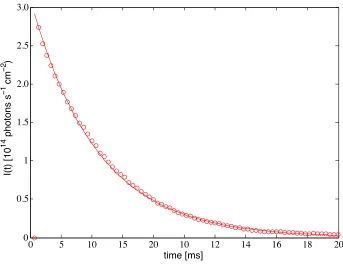
1.3 Calculated 1/ (t) versus time, compared with the single exponential observation. . . 10 1.4 The total overtone fluorescence decay (circles computed) matches experiment (solid
single exponential with⌧=4.3 ms). . . 10
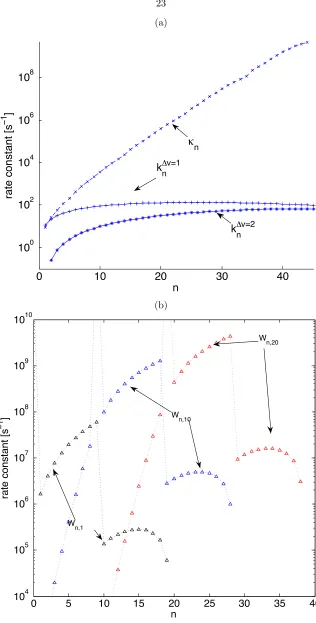
2.1 Comparison of relevant rate constants: (a) first-order rate constants of relaxation (n), fluorescence (k v=1
n ) and overtone fluorescence(knv=2) (b) second-order rate constants
of pooling (Wn,mp form=1,10 and 20). The second order e↵ect of pooling to state n
from anm= 1 state which requires an additional phonon to transfer to n 10, and soW10,1p ⇡10 3Wp
9,1. As second order rate constants, the pooling and depooling rate
constants should be multiplied by a conditional probability if one wishes to compare
with the first order rate constants, leading to units [s 1per unit conditional probability
P(m|n)], as discussed in Chapter Appendix B. . . 23 2.2 The total overtone fluorescence decay (circles computed) matches experiment (solid
single exponential,I(t) =I(0)exp( t/⌧), with time constant⌧=4.3 ms). . . 24 2.3 The vibrational population 6µsfollowing beginning of pulse (near end of lasing). . . 24 2.4 The vibrational population 1 ms following the beginning of lasing. . . 25
2.5 The fit of the computed results to the theory-based expression permits the evaluation
of statistical parameter = 130, from the slope of the linear fit on the restricted n
domain. A typical result forPnafter 4 ms following monolayer excitation is displayed,
2.6 The theoretical dispersed fluorescence (assuming perfect collection efficiency) for a monolayer under the experimental monolayer lasing conditions (kabs=9 x 10⁴s 1),
in-tegrated over a (a) 1 ms and (b) 20 ms period after the beginning of lasing.2 The
temporal integration was calculated trapezoidally fromPn(t) at 79 time points spread
equally over the length of calculation. . . 26
2.7 The theoretical dispersed fluorescence (assuming perfect collection efficiency) after (a) 1 ms and (b) 8 ms following CLIO excitation of a monolayer (averaged over a macro pulse
for the highest fluence currently available at that wavelength, kabs,CLIO= 5 x10⁷s 1
for 8µs, or 20 mJ). We note that, in (a), the appearance of a tiny higher nshoulder around n = 22 (which is even more pronounced as a relative peak at shorter times, not shown), but that the signal on the ms timescale is overwhelmed by fluorescence
from lowernand the distribution becomes the same as that for the monolayer under continued observation. . . 27
2.8 Snapshots of the theoretical dispersed fluorescence for a monolayer under the
exper-imental monolayer lasing conditions (kabs=9 x 10⁴s 1). The snapshots given are (a)
1 µs between 77 and 78 µs following beginning of excitation and (b) 12.7 µs period ending 1 ms after the beginning of lasing, representative of the di↵erence in results at di↵erent temporal resolutions of collection. . . 28 2.9 The vibrational population of the surface for a single trajectory at the conclusion
of a CLIO FEL pulse (figure (a), 8 µs excitation) and 1 ms thereafter (figure (b),
kabs,CLIO = 5 x10⁷s 1 for 8 µs excitation for both). For (a), the legend is:
n=0-black, 10-red, 20-orange, 25-yellow, 32-white, highest level. For (b) : n=0-n=0-black, 5-red,
10-yellow, 12-white, highest level. . . 29
3.1 This figure shows the formation ofP2, notingP1,ss⇡0.5 . . . 31
3.2 This figure shows N vs. for the domain restricted theory. . . 32
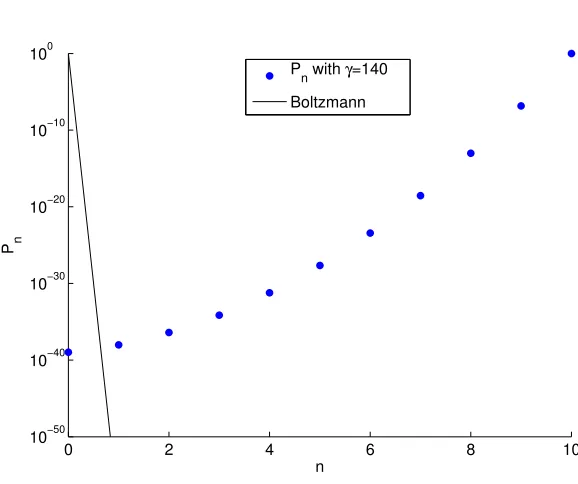
3.3 This figure shows thePn compared to the Boltzmann distribution at 22K for = 130. 33
3.4 This figure shows thePn compared to the Boltzmann distribution at 22K for = 125. 33
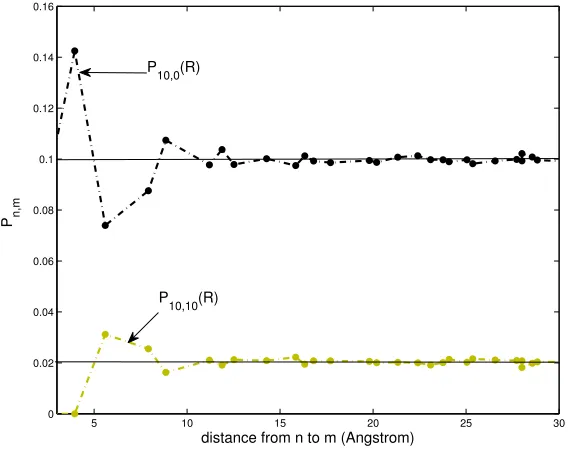
3.6 The vibrational pairwise population 1 ms following the beginning of lasing, compared
with the mean-field expectation of the pair considered, the dashed lines are guides for
the eye: (black)-P10,0, the pairwise probability of an= 10 state next to an= 0 state
(orange)-P10,10, the pairwise probability of an= 10 state next to an= 10 state (note
complete anti-correlation of nearest neighbors). The mean field result for P10,0 and
P10,10 are given by the horizontal lines. Note that, for neighbors, mean-field is a bad
approximation, but for R >> R0, the nearest neighbor distance of 3.96 Angstroms,
mean-field is recovered. . . 35
3.7 In this figure, we see F vs. N, and see the chemical potential (slope) is 2120 cm 1. From kT in our prior work, we had estimated 1960 cm 1based on from the domain restricted theory. . . 37
3.8 The fit of N kT for 20 ms following Monolayer lasing.2;1;3 . . . . 37
3.9 The fit of N kT for 30 ms following CLIO lasing.3 . . . . 38
4.1 The fit to the experimental loss ofP1,4 1= 1/(5x10 9) s 1 . . . 42
4.2 ThePn vs. n 1.9 ns after lasing with prior conditions.4 . . . 43
4.3 Snapshots of the evolution ofH2from a 50x50 surface under FEL excitation: (a) after 100 ns (b)after 500 ns (c) after 1µs (d) halfway through lasing. We note that the colors indicate black forn = 0 white for n= 21 in (b)-(d), with n= 21, outside the n= 1 20 domain, used to mark the sites that have evolved o↵the surface by associative desorption (white). While we are unable to render the 111 surface (a hexagonal lattice), the square lattice connectivity in figures shown includes diagonals up and to the right and down and to the left of each site, e↵ectively giving 6 neighbors of equal distance. Thus we see diagonally desorbed molecules on the square lattice representation of the 111 surface. . . 44
4.4 Yield ofH2 after a single macropulse vs. Power of macropulse, assuming fast-pooling (calculations shown forµ0 = 1e). . . 45
5.1 A visual representation of the Aikawa-Herbst model. The colors indicate the number densities of molecular hydrogen (red-highest, yellow-medium high, green-medium low, blue- lowest). The arrows in the negative z-direction indicate the direction of incident intensity. The spirals at large R are representative of vertical mixing. Their amplitude indicates the strength of the mixing. Reproduced with permission.5 . . . . 50
5.4 The synthetic 12C16O spectrum calculated at 50K (black), 300K (red), and 1500K
(blue). The 50K and 1500K spectra have been shifted -/+0.5 nm respectively for
clarity. The ratio of maxima is approximately 12:4:1. . . 56
5.5 The spectra for the X1⌃+
g(0) - E1⇧(1) transition of 12C16O,12C17O, and 12C18O at
1500 K . . . 56
5.6 The bandhead in the12C18O spectrum at 1500 K . . . . 57
5.7 Evidence of a bandhead. This graph shows a bandhead between the 66th and 67th
rotational state for12C18O. . . . 57
5.8 3-isotope plot at 30 AU with temperature dependent CO cross sections. H2absorption
by shielding function.7. . . 60
5.9 The three isotopomers of12CxO with a fictitiously high natural linewidth are compared. 61
5.10 (a)12C17O, (b)12C16O, and (c) 12C18O cross section (red) with overlay of H
2
trans-mission (black). Q-branch of C17O coincides with H
2 transmission feature causing the
vertical 3-isotope trajectory at high temperatures. . . 62
5.11 3-isotope plot with H2 absorption cross sections at 0.035 AU, 0.87 AU, and 30 AU at
List of Tables
2.1 The calculation times and results for a single trajectory on a 100x100 grid with three
di↵erent resonant rate conditions 1ms following monolayer excitation. They each have relative peaks atn= 10, not shown. . . 18 5.1 Molecular Constants for the various isotopomers of CO in the X1S
g ground state. All
values given in cm 1. Note that e-parity is used for the P and R branches and f-parity
is used for the Q branch. . . 51
5.2 Molecular Constants for the various isotopomers of CO in the E1P excited state. All
values given in cm 1. Note that e-parity is used for the P and R branches and f-parity
is used for the Q branch. . . 51
Bibliography
[1] E. T. D. Boney and R. A. Marcus, J Chem Phys, 139, 124107 (2013).
[2] H.-C. Chang and G. E. Ewing, Phys. Rev. Lett.,65, 2125 (1990).
[3] E. T. D. Boney and R. A. Marcus, J Chem Phys (accepted, A13.08.0077).
[4] P. Guyot-Sionnest, P. Dumas, and Y. J. Chabal, J. Electron Spectrosc. Relat. Phenom.,54/55,
27 (1990).
[5] Lyons, J. R., personal communication.
[6] G. Stark, P. L. Smith, K. Ito, and K. Yoshino, Astrophys. J.,395, 705 (1992).
[7] S. R. McCandliss, Pub. Astron. Soc. Pac.,115, 651 (2003).
[8] M. Eidelsberg, J. J. Benayoun, Y. Viala, and F. Rostas, Astron. and Astrophy. Supplement
Series,90, 231 (1991).
[9] S. A. Corcelli and J. C. Tully, J Phys Chem A,106, 10849 (2002).
[10] S. A. Corcelli and J. C. Tully, J. Chem. Phys.,116(2002).
[11] H.-C. Chang and G. E. Ewing, J Chem. Phys.,94, 7635 (1990).
[12] H.-C. Chang and G. E. Ewing, J Chem. Phys.,92, 7635 (1990).
[13] C. E. Treanor, J. W. Rich, and R. G. Rehm, J. Chem. Phys.,48, 1798 (1968).
[14] D. McQuarrie,Statistical Mechanics (University Science Books, 2000).
[15] C. Kittel,Introduction to Solid State Physics (8th ed.) (John Wiley & Sons, 2004).
[16] P. Guyot-Sionnest, Phys. Rev. Lett.,67(1991).
[17] I. H. Bachir, R. Charneau, and H. Dubost, Chem. Phys.,177, 675 (1993).
[18] H. Gai and G. A. Voth, J. Chem. Phys.,99(1993).
[20] Z. Liu, L. C. Feldman, N. H. Tolk, Z. Zhang, and P. I. Cohen, Science,312, 1024 (2006).
[21] H.-C. Chang, C. Noda, and G. E. Ewing, J. Vac. Sci. Tech.,8, 2644 (1990).
[22] H.-C. Chang, H. H. Richardson, and G. E. Ewing, J Chem. Phys.,89, 7561 (1988).
[23] H.-C. Chang and G. E. Ewing, Chem. Phys.,139, 55 (1989).
[24] K. A. Fichthorn and W. H. Weinberg, J. Chem. Phys.,95, 1090 (1991).
[25] L. Aleese, A. Simon, T. McMahon, J.-M. Ortega, D. Scuderi, J. Lemaire, and P. Maitre,
International Journal of Mass Spectrometry,249-250, 14 (2006).
[26] D. S. Anex and G. E. Ewing, J. Phys. Chem.,90, 1604 (1986).
[27] H.-C.Chang, personal communication.
[28] P. F. Bernath,Spectra of Atoms and Molecules (Oxford University Press, 2005).
[29] J. A. C. Gallas, Phys. Rev. A.,21, 1829 (1980).
[30] G. S. Higashi, Y. J. Chabal, G. W. Trucks, and K. Raghavachari, Appl. Phys. Lett.,56(1989).
[31] Y. Chabal, P. Dumas, and P. Guyot-Sionnest, Phys. Rev. Lett.,64(1990).
[32] P. Jakob and Y. Chabal, J Chem Phys,95(1991).
[33] P. Jakob, Y. J. Chabal, and K. Raghavachari, Chem. Phys. Lett.,187(1991).
[34] M. A. Hines, Y. J. Chabal, T. D. Harris, and A. L. Harris, J Chem Phys,101(1994).
[35] P. Guyot-Sionnest, P. H. Lin, and E. M. Miller, J. Chem. Phys.,102(1995).
[36] R. Honke, P. Jakob, Y. J. Chabal, A. Dvorak, S. Tausendpfund, W. Stigler, P. Pavone, A. P.
Mayer, and U. Shroder, Phys. Rev. B,59(1999).
[37] P. Dumas and e. al., Phys. Rev. Lett.,65(1990).
[38] H. Sano and S. Ushioda, Phys. Rev. B,53(1996).
[39] P. Gupta, V. L. Colvin, and S. M. George, Phys. Rev. B,37(1988).
[40] G. A. Reider, U. Hofer, and T. F. Heinz, J. Chem. Phys.,94(1990).
[41] H. H. Richardson, G.-C. Chang, C. Noda, and G. E. Ewing, Surf. Sci.,216, 93 (1989).
[42] B. G. Koehler, C. H. Mak, D. A. Arthur, P. A. Coon, and S. M. George, J Chem. Phys., 89
[43] B. Wu, P. I. Cohen, L. C. Feldman, and Z. Zhang, Appl. Phys. Lett.,84(2004).
[44] Y. Miyauchi, H. Sano, J. Okada, H. Yamashita, and G. Mizutani, Surf. Sci.,603, 2972 (2009).
[45] Y. Amelin, A. N. Krot, I. D. Hutcheon, and A. A. Ulyanov, Science,297, 1678 (2002).
[46] R. N. Clayton, L. Grossman, and T. K. Mayeda, Science,182, 485 (1973).
[47] R. N. Clayton, L. Grossman, and T. K. Mayeda, Nature,415, 860 (2002).
[48] J. R. Lyons and E. D. Young, Lunar Planet. Sci. Conf. XXXIV, abst. 1981 (2003).
[49] Q.-Z. Yin, Science,305, 1729 (2004).
[50] E. F. van Dishoeck and J. F. Black, Astrophys. J.,334, 771 (1988).
[51] K. I. ¨Oberg, H. Linnartz, R. Visser, and E. F. van Dishoeck, Astrophys. J.,693, 1209 (2009).
[52] J. R. Lyons and E. D. Young, Nature,435, 317 (2005).
[53] R. A. Marcus, J. Chem. Phys.,121, 8201 (2004).
[54] K. D. McKeegan, A. P. A. Kallio, V. S. Heber, G. Jarzebinski, P. H. Mao, C. D. Coath,
T. Kunihiro, R. C. Wiens, J. E. Nordholt, R. W. Moses, D. B. Reisenfeld, A. J. G. Jurewicz,
and D. S. Burnett, Science,332, 1528 (2011).
[55] H. E. Heidenreich and M. H. Thiemens, Science,219, 1073 (1983).
[56] K. Mauerseberger, Geophys. Res. Lett.,8, 935 (1981).
[57] M. M. Abbas, J. Guo, B. Carli, F. Mencaraglia, M. Carlotti, and I. G. Nolt, J. Geophys. Res.,
92, 13231 (1987).
[58] B. Carli and J. H. Park, J. Geophys. Res.,93, 3851 (1988).
[59] E. J. Moyer, F. W. Irion, Y. L. Yung, and M. R. Gunson, Geophys. Res. Lett.,23, 2377 (1996).
[60] D. Krankowsky, P. L¨ammerzahl, and K. Mauersberger, Geophys. Res. Lett.,23, 2377 (1996). [61] O. Navon and G. J. Wasserburg, Earth Planet. Sci. Lett.,73, 1 (1985).
[62] Y. Q. Gao and R. A. Marcus, Science,293, 259 (2001).
[63] Y. Aikawa and E. Herbst, Astron. Astrophys.,371, 1107 (2001).
[64] W. Ubacs, I. Velchev, and P. Cacciani, J. Chem. Phys.,113, 547 (2000).
[65] K.-N. Liou,Radiation and Cloud Processes in the Atmosphere: Theory, Observation, and
[66] P. F. Bernath,Handbook of Molecular Physics and Quantum Chemistry: Volume 3: Molecules
in the Physicochemical Environment: Spectroscopy, Dynamics and Bulk Properties(John Wiley
and Sons, Ltd., 2002).
[67] H.-H. Lee, E. Herbst, G. Pineau des Forˆets, E. Roue↵, and J. Le Bourlot, Astron. Astrophys., 311, 690 (1996).
[68] G. Herzberg,Spectra of Diatomic Molecules (Litton Education Publishing, Inc., 1950).
[69] J. W. Sutherland, Symp. Int. Combust. Proc.,21, 929 (1986).
[70] D. L. Baulch, C. J. Cobos, R. A. Cox, C. Esser, P. Frank, J. Th., J. A. Kerr, M. J. Pilling,
J. Troe, R. W. Walker, and J. Warnatz, J. Phys. Chem. Ref. Data,21, 411 (1992).
Chapter 1
Theory of Vibrational Equilibria
and Pooling at Solid-Diatom
Interfaces
1.1
Introduction
Recently, the infrared absorption of CO on NaCl at low temperatures was calculated using Monte
Carlo.9;10 In this chapter, we describe such a statistical theory to explain two key e↵ects:9;10;1;11;12
(1) an inversion of the population of CO vibrational states and (2) the origin of the single
expo-nential overtone fluorescence decay, the many contributing second-order and first-order steps in the
mechanism notwithstanding.
The present statistical form is of the same type as that derived by Treanor13 for pooling of
vibrational energy, except that since his treatment dealt with gases, he did not have a Debye cuto↵. A comparison and possible extension of Treanor’s results are given in Section 1.4.
A relative inverted peak in the vibrational population distribution is possible when there is a
phonon bottleneck, e.g. when the average energy of the phonons emitted by a pooling step to reach
a still higher vibrational statenexceeds ¯h!D, where!D is the Debye frequency of the solid. This situation is somewhat unusual, because it requires there are no low energy electronic, rotational,
bending or vibrational transitions with which the high frequency stretch, in this caseCO, can decay in less than a large number of quanta, resulting in relaxation on themstimescale.2
In this work, we derive an expression for the approximate statistics and dynamics of
single-phonon processes up to the first pooling maximum, recognizing that higher fluence results may lead
1.2
Statistical Treatment Of Vibrational Energy
Distribu-tion
In the theory, we assume that after injection of infrared quanta, vibrational pooling and depooling
lead to rapid equilibration among the vibrational states of the system at each time t. Consistent with the available information on the individual rate constants for CO:NaCl, but applicable to
monolayers on other surfaces if pooling occurs, we assume that the multi phonon relaxation by
energy transfer to the solid is slower than the single-phonon-mediated pooling equilibration, so we
treat the deactivation separately, as in Section 1.3. The number of sitesM and the total number of quantaN(t) in the system (the adsorbed CO) can be expressed in terms of the occupation numbers
mn of each site as:
M =X
n
mn(t) (1.1)
N(t) =X
n
nmn(t) (1.2)
F(t) =E(t) T S(t) =X
n
mn(t)✏n kT lnQ M! nmn(t)!
(1.3)
where E is the total vibrational energy at time t, ✏n is the energy of then-th vibrational state of an adsorbed molecule,S(t) is the entropy of the adsorbate, F(t) is the free energy, and S=klnW, whereW is the number of ways of distributing theN quanta among the adsorbed molecules. For the purposes of simplicity, given the long timescales of the relaxation in question, we consider primarily
an after laser excitation picture, where quanta are initially distributed according to the absorbed
fluence in the calculations.
We minimizeF subject to constraints on totalM and N above, apply Stirling’s formula to the factorials, introduce a Lagrangian multiplier (t) and obtain:
mn(t)
M =
e (t)n ✏n kT
P
ne (t)n
✏n kT
(1.4)
Phenomenologically, we note that inversion occurs when the energy change for additional pooling
requires additional phonon excitation of the solid that exceeds the Debye peak discontinuity in
phonon density of states of the solid. We thereby assume that the vibrational number domain for
pooling is restricted by (units ¯h= 1):
!D ✏1,0 ✏nmax,nmax 1 (1.5)
n= 1 neighbor by pooling, and so satisfies Eq. 1.5. The pooling maximum arises because of the discontinuity in the density of states at the Debye frequency !D (223 cm 1) where in Eq. 1.5, ✏n,m=✏n ✏m, with✏n, the vibrational energy of the oscillator, in this case the adsorbed diatomic molecule, given by:
✏n=!e(n+1
2) !e e(n+ 1 2)
2 (1.6)
Here,!e e= 11.5 cm 1is the anharmonicity and!e= 2130 cm 1, known from CO infrared spectra.
In virtue of Eq. 1.5, we restrict the domain to [0, nmax].
We rewrite Eq. 1.4 as:
ln(mn) +
En
kT = n+ln(M) (1.7)
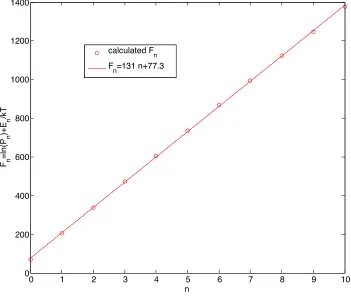
We note that ifln(Pn) +En/kT is a linear function ofn, then the slope is , the only parameter in
our distribution.
We can test Eq. 1.7 by comparing with kinetic Monte Carlo results on the ms experimental
timescale (the reference1gives further details of the calculation). The result is seen in Fig. 1.1 and
is evidence of the usefulness of the theory in the present chapter for the constrained distribution
of vibrational quanta among the quantum states of the oscillator. The distribution given by Eq.
1.4 is not exact. Nevertheless the results demonstrate that it is a useful description of the inverted
distribution with its cuto↵at n=10.
The appearing in Eq. 4 can be evaluated independently from the following:
N M =
P
ne n ✏n kT
Pe n ✏n
kT (1.8)
A simple way of obtaining from the value of N/M is to evaluate the right hand side of this function for varied , and then find the corresponding to the experimentally known N/M. Given an absorption rate constant from lasing ofkabs = 9.0 x 10 4, one expects a long term excitation of
N/M = (1 exp( kabs⌧))/2 = 0.18 for the lasing duration ⌧.2 From this value for N/M, we find
= 130, agreeing to every significant figure with the result derived from kinetic Monte CarloPn, as
shown in Fig. 1.2.
1.3
Resulting Dynamics
The dynamics in the Monte Carlo Simulations are quite complex,10;9;1 in containing hundreds of
0 2 4 6 8 10 0
200 400 600 800 1000 1200 1400
n
F
n=ln(P
n
)+E
n
/kT
calculated F
n
F
[image:22.612.181.446.98.347.2]n
=131 n+77.3
Figure 1.1: The fit for the parameter, . The representative pool is derived from monolayer popu-lations, calculated elsewhere by kinetic Monte Carlo,1 as the slope ofln(P
n) +En/kT, vs. n, the
vibrational state. For thePn calculated near the end of a pulse of the conditions of the previous
monolayer experiment,2 = 131.
0 2 4 6 8 10
10−10 10−8 10−6 10−4 10−2 100
n
P n
P
n with γ=131
Boltzmann at 22K
Figure 1.2: This figure shows thePn from Eq. 1.4 compared to the Boltzmann distribution at 22K
[image:22.612.182.450.454.667.2]number of quanta in any one site:
N =Xnmn (1.9)
In the loss ofN vibrational quanta from the pooled surface, the non-radiative excitation of phonons in the solid involves many phonons, and is slow relative to single-quantum pooling equilibration: the
latter involves only single excitations, whereas the former involves many such excitations
simulta-neously. The slow disappearance of quanta in the adsorbate is given by:
dN dt =
X
nmn (1.10)
If there is at each time t a rapid equilibration among the quanta in the adsorbate, then there is a single exponential decay of N, N = N0e t and mn = mn0e
t, so from Eq. 1.9 we have
dN/dt = Pnmn. We note that this temporal dependence of the mn, under rapid pooling
equilibration, leads to the same, single-exponential, temporal decay of all states equilibrated, with
time constant 1/ , in contrast to prior expectations for pooling on the H:Si(111) surface.4
Comparing with Eq. 1.10, we then have:
=
Pnm
n
Pnm
n
(1.11)
When applied to the present problem,1 this model with the theoretical constrained equilibrium
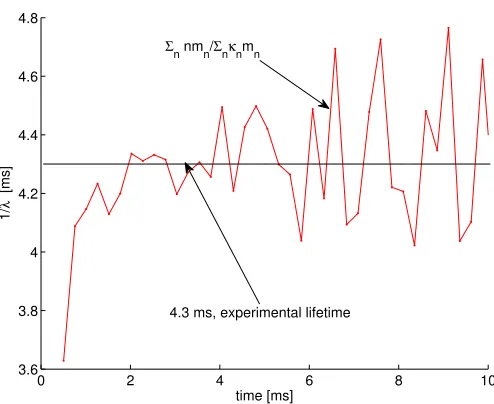
distribution given in Eq. 2.10 recovers a reasonably close time constant (3.6 ms for the present
theoretical result of Eq. 1.11 vs. 4.3 ms in the full Monte Carlo calculation and experimentally) and
single exponential behavior for each state in the pool with the same time constant. We can compare
the e↵ective single exponential decay rate with the actual computed results for the monolayer, as in Fig. 1.3.
1.4
Discussion
The consequences of a novel regime of distribution of the vibrational quanta among the di↵erent vibrational states are several-fold.14;13 We note the unifying simplicity of application of the model
for di↵erent surfaces and phases. While our CO:NaCl(100) simulations at several laser intensities is a time-consuming calculation,1 the simplicity of the present approximate analytical distribution,
when valid, allows one to describe readily other results that may occur experimentally.
We note that the single exponential decay for individual states calculated in this work and
else-where9;10;1indicates that a single exponential decay of individual states cannot be taken as evidence
de-0 2 4 6 8 10 3.6
3.8 4 4.2 4.4 4.6 4.8
1/
λ
[ms]
time [ms] 4.3 ms, experimental lifetime
Σ
[image:24.612.197.444.106.308.2]n nmn/Σnκnmn
Figure 1.3: Calculated 1/ (t) versus time, compared with the single exponential observation.
0 0.005 0.01 0.015 0.02
0 1 2 3 4 5 6 7x 10
8
I(t) in counts
time [s] computed I(t)
single exponential τ = 4.3 ms
[image:24.612.202.448.402.651.2]cay, even of individual states as observed experimentally (see the discussion preceding Eq. 1.11),
does not rule out pooling of the vibrational excitation as long as the latter is rapid relative to the
decay to the solid, and this point plays a major role when considering fast bimolecular vibrational
processes such as single-quantum assisted non-resonant energy transfer. The key to a single
expo-nential is the validity of the approximation of rapid equilibration between the quantum states of
CO molecules on the surface. For example, if a particular staten0 has a relatively rapid decay rate
by energy loss to the solid (still slow relative to the pooling equilibration, but fast relative to all
other processes), the otherns rapidly refill then0population, so that all statesndecay at the same rate. In summary, rapid equilibration among the states relative to loss of quanta to the solid is
the key to understanding the single-exponential decay observed both in the experiment and in the
computations.
A comparison of the present derivation (CO on a solid) with Treanor’s13(CO in a gas) is
inter-esting. TheN-conservation step is crucial in both, and, up to our Debye-based cut-o↵, the resulting distribution function is of the same form for both (Treanor’s Eq. 4.8 and our Eq. 2.10). In our case,
there is a restriction of domain of allowed n-states in the single-quantum exchange with the solid, whereas in the gas phase the non-resonant transfer was aided by a smooth translational energy
dis-tribution. However, another di↵erence, purely technical, rather than physical, is in the minimization of free energy in our derivation, as opposed to an entropy-maximization and a temperature ansatz
for in Treanor’s. The latter ansatz requires further steps to be made rigorous, namely a calculation
of the energyE, entropyS, and an introduction of temperature, 1/T =dS/dE, to reach a rigorous result, a result obtained simply by a free energy minimization as above.
Of particular interest in the present study is the inverted nature of the distribution, with a
maximum at somenmax=d!D/2!e eefollowing a period of excitation. We note that this limit is
proportional to the Debye cuto↵frequency and inversely proportional to the anharmonicity, sonmax
for CO:Si(100) would be 20 because!D=448 cm 1 for Si(100),15assuming the same anharmonicity
for CO, while for H:Si(111) it would be 5, since 2!e e = 90 cm 1 for that surface, assuming the
same!D as Si(100). Additional investigation of these surfaces using kinetic Monte Carlo and treat-ing several experimental results4;16 is the topic of forthcoming work. Pooling equilibration, while
minimizing the free energy, also conserves the total number of quanta. Because of this constraint,
the population tends to lower its energy by occupying the highest vibrational states, and so
inver-sion is thermodynamically allowed, consistent with a constrained equilibrium statistical mechanics.
Complete decay, radiatively and non-radiatively, will occur to eventually yield a thermal equilibrium
population distribution, largely in then= 0 state.
The present approximation is not restricted to phonon relaxation of high frequency vibrations on
than dissipative processes. In all cases, there is then superimposed on these rapid exchanges the
slow decay ofN. The theory may be extended to treat isolated molecules in matrix solids,17 and
multilayers of CO on NaCl(100).11;12
The validity of the equilibration approximation depends on the absorbed laser intensity. It
may be expected to be valid when the intensity is sufficiently high. The argument is as follows: equilibration is valid when the decay rate for loss of quanta to the solid is small relative to the rates
of the pooling and depooling processes. Pooling is a second-order process and proportional to the
square of the light intensity. If the absorbed intensity is too low, the rate of realized pooling will be
too slow and the approximation fails.
Quantitatively, for monolayer CO:NaCl(100), where the observed fluorescence relaxation lifetime
is 4.3 ms, the calculated rate constant for the 1+ 9 to 0 + 10 pooling reaction is 5 x 10⁷ s 1 from
the kinetic Monte Carlo calculations.1;10For this case, wee see that the pooling rate constant,k pool
is 2 x 10⁵ times faster than the rate of loss of single quanta to the solid,
⇡ 1/(4.3ms) (noting again slight variation around this mean lifetime over time as in Fig. 1.3). IfkpoolP1P9>> P9, we
expect the equilibration condition to be satisfied when P1 >> /(kpool) ⇡5 x 10 6. Knowing or
estimating the cross-section for the absorption and a lifetime for the loss, fromn= 1 to n= 0, for quanta to the solid, one can estimate what laser intensity is needed to obtain anyP1.
In the case of possible vibrational pooling in H:Si(111) Sum Frequency Generation (SFG)
pump-probe experiments, there was observed single exponential decay of then= 1 state.4 There was also
observed a hot band,16 whose observed lifetime is the same as that for recovery of the fundamental
at room temperature, 0.9 ns. If the rapid equilibration (fast-pooling) approximation holds, then all
0 < n nmax should have the same single-exponential rate of relaxation, identical to the rate of
n = 0 recovery. If there were no equilibration, the lifetimes forn = 1 and n = 2 would be quite di↵erent. For example, computations18 for a Bloch-Redfield dynamics gave an intrinsic lifetime for
then= 2 state of 0.13 ns, and for then= 1 state, 0.9 ns. From previous calculations of the pooling rate constant,19 the rate constant for the 1 + 1 to 0 + 2 pooling reaction can be as high as
⇡2 x 10⁸ s 1 on H:Si(111) under some experimental conditions.4;16 Based on the trends in pooling rate
constants for CO:NaCl(100),1we expect the pooling rate constant for the 1 +n
max 1 to 0 +nmax
pooling reaction,kSiH
pool, to be 7 x 10⁹ s 1. In this case, the calculated pooling rate constant is⇡10
times the observed rate of loss of single quanta to the solid ( SiH ⇡1/0.9 ns =1 x 10⁹ s 1), and
P1>>0.1 would meet the equilibrium condition.
One can also examine the spectrally integrated SFG intensity in the previous hot band
pump-probe experiment for evidence of pooling on H:Si(111).16 We calculate that, after pumping, the
spectrally integrated SFG intensity is approximately 1/3 the value before pumping (inferred from
Fig. 1 of the reference16). One possibility for this reduction in integrated signal is that pooling is
the previous experiment, following the pump, the SFG probed the 1840-2125 cm 1 range.16If one
extended the SFG probe range to 1600-2125 cm 1following the same pump as before,16then it may
be possible to see if the majority of the spectrally integrated SFG intensity after pumping occurs at
n= 5. If fast-pooling occurs, one expects to see the 5!6 transition dominate the post-pumping SFG, which is expected to be around 1630 cm 1. We plan to discuss these and other issues20 for
the H:Si(111) system further in a later publication.
1.5
Conclusions
In the present theory, a simple distribution is derived by a free energy minimization during
vibrational-quanta-conserving pooling equilibration on solids. In particular, the following experimentally testable
predictions are made:
1- Statistical behavior is expected in vibrational equilibria, subject to the constraint of a slowly
decaying number of quantaN(t) when the vibrational equilibration is fast relative to all radiative and non-radiative processes. This behavior can be described by the temperature and Debye frequency of
the solid along with the anharmonicity and fundamental frequency of the high frequency vibration.
2- All vibrational populations on surfaces in this model are described by restricting quantum
state n to the domain [0,d!D/2!e ee]. The vibrational pools are coupled by all resonances and near-resonances consistent with the preservation of the number of quanta.
3- Temporal single-exponential decay cannot be taken as evidence against vibrational pooling
despite the bimolecular rate constant behavior of individual rates and the unimolecular dependence
of other steps. Indeed, single exponential decay is the expected result if pooling equilibration is
Chapter 2
On the Infrared Fluorescence of
Monolayer
13
CO:NaCl(100)
2.1
Introduction
Carbon monoxide (CO) on an NaCl(100) surface has been used as a model system for surface
vibrational excitation since around 1990.21;22;11;12;2 Several low temperature experiments have been
conducted on monolayers and multilayers of 12CO and 13CO, observing overtone (n+ 2 ! n)
infrared fluorescence from monolayer13CO excitation between the 2nd and 16th vibrational state2
and multilayer13CO excitation reaching the 30th vibrational state.11;12In the monolayer case, these
states were inferred by application of a filter (4200 - 3400 cm 1transmitted) to the total integrated
overtone emission, and in the multilayer case these states were observed directly by the collection of
dispersed fluorescence.
Ewing et al.2suggested that the mechanism for this localization of vibrational energy may be the
energetically favored vibrational pooling reaction, where a pair of Morse-like oscillator neighbors
non-resonantly transfer a vibrational quantum in a step that is exothermic due to the anharmonicity. This
vibrational energy transfer can in principle occur with sites further removed than nearest-neighbors,
but as a first approximation we focus on nearest-neighbor and single vibrational quantum exchanges.
The present formulation builds on a model of pooling and depooling rate constants given by
Corcelli and Tully for this system and this surface.9;10 We also use the same Kinetic Monte Carlo
(KMC) algorithm to evaluate the vibrational population evolution.9;10 We extend their pioneering
work to larger grid sizes (10,000 sites instead of 256), higher vibrational states (n= 45 instead of
n= 15 20), and to higher fluence laser conditions, including stimulated emission. Additionally, we test our previous theoretical prediction of the explicit form of the constrained vibrational population
distribution function.1In it, then- domain of a pool is restricted by the maximum energy that can
2.2
Vibrational Exchange for monolayer CO
In a resonant vibrational exchange, the vibrational energy of the pair of neighbors is conserved in the
energy transfer, whereas in a non-resonant exchange, some of the energy excites or removes phonons
from the solid. This non-resonant case provides both a ladder-climbing mechanism for vibrational
excitation and a ladder-descending pathway for vibrational relaxation of the energy di↵erence in the transition. This pooling-depooling e↵ect is described for a vibrational staten in the following equations:
|ni+|miW
p n,m
! |n+ 1i+|m 1i (2.1)
|n+ 1i+|m 1iW
d n+1,m 1
! |ni+|mi (2.2)
where theWp
n,mare pooling rate constants for a site in statenreceiving a single vibrational quantum
of energy from a neighboring CO site initially in statem, and the reverse reaction is described by a depooling rate constantWd
n+1,m 1 .
We treat the e↵ect of pooling on the time-evolution ofPn(t), the probability of a single site being
in thenth vibrational state at timet, where nis the specific vibrational level whose time-evolution
is being described. We have:
1 X
n=0
Pn= 1 (2.3)
noting that, in the present model, every site is occupied and thus is in some CO vibrational state,
n= 0 and upward. Adsorption and desorption of CO are not considered, since the experimentally observed dissociation rate is slower than 10 4s 1at 22 K,23 and so should not be observed on the
20 ms experimental timescale, being 6 orders of magnitude slower.2All simulations are at 22 K, the
temperature of the experiments.2;11;12
We define (dPn/dt)pd as the net rate of pooling and depooling of staten with nearest neighbors.
The pooling and depooling terms are described in Eqs. 1 and 2 in terms of the e↵ect on a specific vibrational staten:
dPn
dt pd=
X
m
(Wnp 1,m)Pn 1,m+
X
m
(Wn+1,md )Pn+1,m
X
m
(Wn,mp )Pn,m
X
m
(Wn,md )Pn,m (2.4)
wherePn,mdenotes the joint probability that there is a site in a vibrational statenand that there
is an adjacent site havingmquanta (such that PmPn,m= 4Pn, since every site has 4 neighbors).
vibrational state probability evolution of a site on a CO surface is:
dPn
dt pdrf =
dPn
dt p d nPn+n+1Pn+1 (2.5)
where thendenote the relaxation rate constants for transfer of energy to multiphonons in the solid. The formulae for the relevant rate constants are given in Chapter Appendix A. A comparison of the
resulting rate constants of pooling, depooling, and relaxation along with fluorescence and overtone
fluorescence is given for manyn’s in Figs. 2.1 (a) and (b).
These equations are used for 1< n <45, with a closure introduced into the equation forn= 45 in Eq 2.4 by making transfer to P46 impossible (P46 = 0). The vibrational populationsPn(t) can
then be obtained by kinetic Monte Carlo integration24 of all possible rates, as discussed by Corcelli
and Tully10 and references cited therein, using site-to-site surface hopping methods for the energy
transfer.
To allow the intensity of incoming light to be treated explicitly, we added to the KMC code terms
containing the absorption coefficientkabs,l, the Einstein coefficient for each laser, to (dPn/dt)pdrf in
Eq. 2.5. We considered only single-photon excitations fromn= 0 to then= 1 state:
dP0
dt = kabs,l(P0 P1) + dP0
dt pdrf (2.6)
dP1
dt =kabs,l(P0 P1) + dP1
dt pdrf (2.7)
where the (dPn/dt)pdrf are calculated as in Eq. (2.5) above, andkabs,M ono=I /(¯h!) is calculated
to be 9 x 10⁴s 1 for monolayer laser conditions, 25 µJ in 5 µs, = 3 x 10 17cm2molecule 1.2
To examine populations under lasing by higher fluence sources, we also examined excitation by the
CLIO Free Electron Laser (FEL) by following a single averaged macropulse,kabs,CLIO= 5 x 10⁷s 1,
from 20 mJ in 8 µs.25 We note that, for higher fluence lasers, one must include both stimulated
absorption and emission.
Given that the rate of overtone fluorescence is slower than the energy transfer from thenstate to multiple phonons in the solid, the total overtone fluorescence intensity at time t,I(t), is given by:
I(t) =Nsim
A
X
n
kfv=2Pn(t) =
X
n
In(t) (2.8)
where In(t) = (Nsim/A)kfv=2Pn(t) and there are Nsim = 104 sites per trajectory, representing a
surface areaA= 1.57 x 10 11cm2as in Corcelli and Tully.9Resonant di↵usion out of the illuminated
spot is not considered.
intensity over a time⌧i, the overtone fluorescence lines summed over all wavelengths:
S(!) =
45
X
n=2
Ln
Z ⌧i
0
In(t)dt (2.9)
with the integrals approximated trapezoidally given Pn(t) and t from the program output up to
integration time ⌧i. The times ⌧i are chosen to represent di↵erent length fluorescence collection experiments. Ln is the line shape, approximated for each line as a normalized Gaussian with
FWHM 10 cm 1. This lineshape is preferred over the Lorentzian by a fit to the experimental
dispersed overtone fluorescence emission from multilayers of CO on NaCl(100), for each overtone
line, at the same temperature as the monolayer experiment.26;11Snapshots of Eq. 2.9 are also given.
We study the 13CO monolayer rather than a 12CO system following the experimental work
of Ewing et al.2;11;12and the simulation of Corcelli and Tully9;10. This isotope was chosen for the
experiments to enhance the overlap of its fundamental frequency with the12CO gas laser emission.27
Following Corcelli and Tully,9;10 the relaxation rate constants (n) are found by introducing a
system-bath coupling scale parameter which multiplies the Debye density of states as a rough
estimate of the strength of coupling between surface oscillators and bath, and fixed such that the
experimentally observed total overtone fluorescence lifetime (4.3 ms) is recovered under monolayer
conditions. We find a single exponential decay matching the experimental observations, as in Fig.
2.2, for = 0.470, close to the value of Corcelli and Tully ( CT = 0.522), and similar relaxation
rates of 1 = 6.7s 1 compared to 5.7 s 1 in the previous simulation. We find di↵erent rates in
the present calculation primarily because we use the experimental decay of overtone fluorescence
to fix the calculated e↵ective decay rate of overtone fluorescence, whereas the previous simulation appears to have matched the computed fundamental fluorescence decay to the experimental overtone
fluorescence results.9;10;2
2.3
Kinetic Monte Carlo Results
We first analyze the total overtone fluorescence in Fig. 2.2 which has been fit via the system-bath
coupling parameter . The calculated vibrational populations at the end of each laser-on period and
1 ms thereafter are compared in Figs. 2.3 and 2.4, respectively. We confirm that for the monolayer,
the overtone fluorescence results primarily fromn=8 10, as previously calculated.9;10
We also confirm in the computations the theoretically predicted distribution function derived
in another work,1 as in Fig. 2.5. Shown is the deviation that is linear in n, a deviation from the
Boltzmann distribution across the one-phonon domain restricted regime, with slope = 131. We
discuss this result further in the next section.
Table 2.1: The calculation times and results for a single trajectory on a 100x100 grid with three di↵erent resonant rate conditions 1ms following monolayer excitation. They each have relative peaks atn= 10, not shown.
resonant rate factor computational time (min.) P10(1 ms)
1/1000 9 0.0196
1/100 91 0.0206
1/10 1179 0.0182
2.8 is integrated over a short time relative to the full time of simulation. These times are e↵ectively snapshots since the small timescale of the observation is ms. The timescale of the snapshot is
varied between simulations, but the integration is not converged: since fluorescence is ongoing from
changing populations, the timescales of integration are representative of experimental binning e↵ects, given fixed bin sizes for collecting fluorescence ranging from⇡1 10µs.
To understand further the evolution of the vibrational excitation of the CO molecules on the
surface, we have examined representative snapshots from a single trajectory at the end of the first
laser pulse and 1 ms thereafter in the high energy case in Figs. 2.9.
The results for thePn(t) are robust to grid size, since 10 trajectories on a 100 x 100 surface give
results for thePn(t) that are indistinguishable from those obtained from 1 trajectory on a 300x300
grid after 1 ms for monolayer excitation conditions. The two sets of trajectories have roughly the
same implied maximum resolution inPn(t), namelyNtraj1 N 1
sites= 10 5vs. (1/9)x10 4. The results
are also robust with respect to variation of the resonant transfer rate constant, which is reduced
by three orders of magnitude to realize similar order gains in computational time. Increasing the
resonant rate constant by two orders of magnitude showed no noticeable change in the results for
the Pn distribution obtained for monolayer fluence conditions calculated at 1ms, except for the
significant additional computational time, as seen in Table 2.1.
While the results show pronounced maxima based on the e↵ect of the single-phonon Debye cuto↵
(peaks aroundn= 10, 19 and 27 in the figures), the results including two-phonon assisted rates were indistinguishable from those including only single-phonon transfers. This is not surprising, since the
two-phonon rates are expected to be significantly slower, as in Fig. 2.1.
2.4
Discussion
The present computational results agree with those in the previous simulation9;10on this CO/NaCl(100)
surface in finding a vibrational pooling peak around then=10 state on the ms timescale. The
mono-layer excitation condition in Fig. 2.3 and 2.4 can be compared directly with Figs. 3 a and b in the
reference,10 finding the peak aroundn= 10 and similar trends on both sides of the peak.
We have described in a previous work1(Chapter 1) a statistical theory of the distribution function
emission in pooling, limited by the Debye frequency, ¯h!D of the solid. The distribution function as derived in the reference,1 is given by:
Pn(t) =mn(t)
M(t) =
e (t)n ✏n kT
P
ne (t)n
✏n
kT (2.10)
In this approximation, while in the domain of change ofnby energy transfer accompanied by one-phonon pooling, thePn are primarily constrained in the interval [0,10]. Clearly this constraint on
ndoes not hold for the CLIO excitation at short times, as in Fig. 2.3, but by 1 ms the assumption appears to hold reasonably well for both lasing conditions, as in Fig. 2.4. As a result, we are able
to confirm in Fig. 2.5 that the constrained statistical theory described in the previous Chapter1
is in agreement with the presently calculated dependence on n. The systematic deviation from the Boltzmann expectation with n is as theoretically expected in Eq. 2.10:1 is the slope of
Fn = ln(Pn) +En/kT, vs. n, the vibrational state. If there is no component of the Free Energy
(Fn) which is dependent onn, then there should not be a dependence.
Using higher laser fluences than before and examining populations during the duration of lasing,
we have found substantial populations of manyn >16 states, as in in Fig. 2.3, including evidence of strong inversion near then= 22 state (3.5x10¹⁰photons cm 2 after 1 ms of collection, as in Fig.
2.7). By extending earlier work to higher intensities, these high lying states have been calculated
to exist in significant populations on this surface, and they result from the complex interplay of
rates, some of which are given in Fig. 2.1. Experimentally, levels as high as the n = 26 state were inferred to have been observed in the dispersed fluorescence of multilayers of13C18O.11 The
extent of the observability of higher states experimentally depends on the temporal resolution of the
apparatus. To our knowledge there have been no further experiments on the CO:NaCl(100) system
since 1990, and none with a higher fluence free electron laser source of the sort described here. These
calculations have spawned the related theory, and remain an important first step.
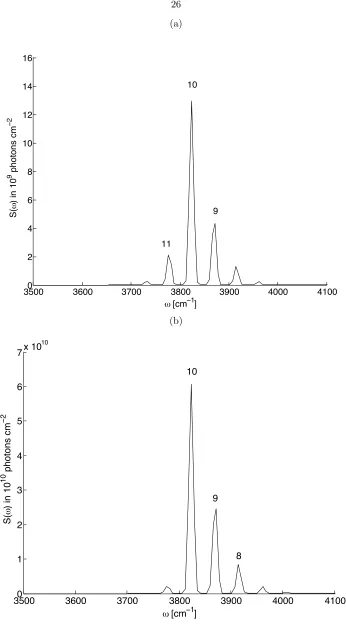
As seen in Figs. 2.6 and 2.7 after 1 ms following excitation, the distribution is more narrowly
peaked around an n = 10 maximum at lower fluences, and becomes broader and peaked around slightly higher values at higher fluences. Over time, the evolution of pools by relaxation leads to a
characteristic dispersed fluorescence signature, calculated by Eq. 2.9.
For all the systems with high levels of excitation, as in Figs. 2.9, one notices immediately
a checkerboard pattern as a result of competition between di↵erent sites for the accumulation of quanta. When excitation levels are somewhat lower, as in the snapshots 1 ms following excitation,
this competition is limited to single-phonon-assisted transfer rates, which are much faster than
multi-phonon-assisted transfer. This pattern is identified as an anti correlation between pooling
simulations, as long as the pool states exist (four orders of magnitude in time). As a result, the
mean-field approximation of the master equation is not expected to give accurate results.
We include stimulated emission in these calculations for the first time. We suggest that the
previous experiments could not measure fluorescence (instead measuring the overtone) because of
the overwhelming stimulated emission signal during lasing. While arising from the much faster
stimulated emission process (kabs= 9 x 10⁴ s 1), the photons collected would be indistinguishable
from fluorescence (k v=1
f = 11.4s 1). This e↵ect also adds many more Monte Carlo steps to the
calculation at the higher lasing fluence, more than doubling the computational time required.
It may appear at first unusual that, over time, the populations excited by higher intensity lasers
relax to similar distributions as those at lower fluence light, since three orders of magnitude of fluence
are spanned. This calculated result may be the signature of a constrained statistical behavior in a
physically based vibrational energy distribution, as explored theoretically in the previous chapter.1
2.5
Conclusions
In the present model, vibrational pooling leads to the accumulation of vibrational energy in 13CO
on NaCl(100). The model suggests substantial vibrational population inversion under existing laser
conditions.
Importantly, the calculation supports the constrained vibrational population distribution
re-cently derived theoretically for monolayers of high-frequency vibrations at solid surfaces where the
assumptions of the model hold.1 Further theoretical characterization of this high fluence regime,
where the previous theoretical assumptions fail, is the topic of ongoing research.
The following experimentally testable predictions are also made:
1- States as high asn= 32 may be excited with currently available laser conditions (1.5x10⁴photons
cm 2 7-8µs following lasing under CLIO FEL conditions), although the continued brightness of the
n⇡10 pooled states through the ms timescale (4x10¹¹ photons cm 2 after 8 ms as in Fig. 2.7 (b)
may restrict the observability of these higher states by dispersed fluorescence.
2- In addition to the inverted distribution with a peak at n= 10 persisting to 20 ms, there is predicted to be a second inverted peak in the dispersed overtone fluorescence expected to appear
2.6
Chapter Appendix A: Rate constants
We use the relaxation rate expression from Corcelli and Tully:10
n=
1 X
p=1
fpIp
!np!|hn|x|n 1i|
2[n(!n
p ) + 1]
p (2.11)
fp= ( 1)p(2p+1 2)D0↵0p+1
mO
MCO
) (2.12)
Ip= p !n !D
r
75⇡
p exp[ (
75 4p)(
!n !D
4p
5 )
2] (2.13)
n(!) = (ekT! 1) 1 (2.14)
wherepis the order of phonon excitation of the solid and is the only free parameter (in Eq. 8). We note two slight typos inIp in the original work have been identified (compared to the reference),10
but there was no corresponding typo in the program. The remaining quantities are the temperature
of the solid (22K), the Debye cuto↵!D= 223 cm 1,10the energy levels of the CO Morse oscillator !n, the mass of oxygen mO = 16 amu, the total mass of CO,mCO = 29 amu, and the properties
of the Morse coupling of the CO to the NaCl, the binding energy D0 = 0.168 eV and ↵0 = 0.816
˚ A 1.10
To calculate the vibrational pooling rate constants, Wp
n,mwe use:9;10
Wm,np = P1p=12⇡p!2pg2p|hn|x|n 1i|2
|hm|x|m+ 1i|2[n(
!n,m p )+1 MN a ]
pH
p (2.15)
gp= ( 1)p µ
02(p+1)(p+2) 2Rp+3
0
(2.16)
Hp= R01d!1· · ·R01d!p⇢(!!11)· · ·⇢(!!pp)
(!m,n !1 · · · !p) (2.17)
noting that depooling ratesWp
m,n=Wm+1,nd 1e !n,m are also known immediately by detailed
bal-ance. Besides p, the number of phonons of the solid needed to mediate the transfer, the other parameters are: the energy dissipated by the pooling !m,n =!n !m+1, the site-to-site distance between nearest neighbor CO moleculesR0= 3.96˚A, the mass of the Na+ ionMN a= 23 amu, and
the normalized phonon density of states⇢= 3!2/!D3 for!<!D= 223 cm 1, for a Debye solid.9;10
Thek n=i
n , fluorescence rate constant for a CO withnvibrational energy quanta, are obtained
from the standard relations:28
knn=1=
16⇡3!n3µ02
3✏0hc3 |hn|x|n 1i|
2 (2.18)
k n=2
n =
16⇡3!3 n 2µ02
3✏0hc3 |hn|x|n 2i|
where !n 2 is the frequency of the n to n-2 overtone fluorescence, µ0 is the coefficient in the
transition dipole moment, dµ(x)/dx|x=0 (1.8D/˚Ain the case of 13CO),10 and the matrix elements
can be evaluated, for example in a Morse oscillator basis. Following Gallas,29 the Morse oscillator
matrix elements are given by:
hn|x|n 1i = 1 a(k 2n)
⇣n(k 2n 1)(k 2n+1)
(k n)
⌘1/2
(2.20)
hn|x|n 2i= 1 2a(k 2n+ 1)
⇣n(n 1)(k 2n 1)(k 2n+3)
(k n+1)(k n)
⌘1/2
(2.21)
where the Morse constants area=2.209 ˚A 1 andD = 12.3 eV and k=!e/!e e = 185, !e=2130
cm 1 is the fundamental frequency of the Morse oscillator and !e e = 11.50 cm 1 is the
anhar-monicity (such that!2= 2084 cm 1). The resulting overtone fluorescence rate constants range from
k n=2
2 = 0.239 s 1 to k44n=2 = 60.2s 1. The fundamental fluorescence rate constants range from
k n=1
1 = 11.6s 1 tok26n=1= 135s 1.
2.7
Chapter Appendix B: Units
To connect with units traditionally used in chemical kinetics, we describe the population evolution
equations below, adapting (dPn/dt)pdrf in Eq. 2.5 to more familiar units. LetMnbe the number of
sites that havenquanta. We then havePn =Mn/M. LetP(m|n) be the conditional probability, in
particular the probability that given a site withnquanta, there is an adjacent site withmquanta. So in Eq. 2.5 we replace the Pn,m’s withPnP(m|n)’s. ThePn’s replace the normal concentrations
cn in kinetics,
dPn
dt pd=
X
m
(Wnp 1,m)Pn 1P(m|n 1)+
X
m
(Wn+1,md )P(m|n+ 1)Pn+1
X
m
(Wn,mp )P(m|n)Pn
X
m
(Wn,md )P(m|n)Pn (2.22)
As a result, the units of the second-order rates are technically per conditional probability of an
(a)
0
10
20
30
40
10
010
210
410
610
8n
rate constant [s
−
1
]
κ
nk
Δv=1n
k
Δv=2n
(b)
0 5 10 15 20 25 30 35 40
104
105
106
107
108
109
1010
n
rate constant [s
−
1 ]
Wn,20
Wn,10
[image:37.612.163.479.56.679.2]Wn,1
Figure 2.1: Comparison of relevant rate constants: (a) first-order rate constants of relaxation (n), fluorescence (k v=1
n ) and overtone fluorescence(knv=2) (b) second-order rate constants of pooling
(Wp
n,m for m =1,10 and 20). The second order e↵ect of pooling to state n from an m = 1 state
which requires an additional phonon to transfer to n 10, and so W10,1p ⇡10 3Wp
9,1. As second
order rate constants, the pooling and depooling rate constants should be multiplied by a conditional probability if one wishes to compare with the first order rate constants, leading to units [s 1 per
0 5 10 15 20 10 12 14 16 18 20 0
0.5 1 1.5 2.0 2.5 3.0
time [ms]
I(t) [10
14 photons s
−
1 cm
−
[image:38.612.148.491.84.351.2]2 )
Figure 2.2: The total overtone fluorescence decay (circles computed) matches experiment (solid single exponential,I(t) =I(0)exp( t/⌧), with time constant⌧=4.3 ms).
5 10 15 20 25 30 35
0 0.05 0.1
n
P n
PCLIO(6 µs)
P
ML(6 µs)
[image:38.612.147.491.417.686.2]2 4 6 8 10 12 14 16 18 20 0
0.02 0.04 0.06 0.08 0.1 0.12 0.14 0.16
n
P n
PCLIO(1 ms)
[image:39.612.147.498.354.650.2]PML(1 ms)
Figure 2.4: The vibrational population 1 ms following the beginning of lasing.
0 1 2 3 4 5 6 7 8 9 10
0 200 400 600 800 1000 1200 1400
n F n
=ln(P
n
)+E
n
/kT
calculated Fn
F
n=131 n+77.3
Figure 2.5: The fit of the computed results to the theory-based expression permits the evaluation of statistical parameter = 130, from the slope of the linear fit on the restrictedndomain. A typical result forPnafter 4 ms following monolayer excitation is displayed, although this is representative
(a)
35000 3600 3700 3800 3900 4000 4100
2 4 6 8 10 12 14 16 S( ω
) in 10
9 photons cm
−
2
ω [cm−1] 10
11
9
(b)
35000 3600 3700 3800 3900 4000 4100
1 2 3 4 5 6 7x 10
10
S(
ω
) in 10
10
photons cm
−
2
ω [cm−1] 10
9
[image:40.612.148.494.55.679.2]8
Figure 2.6: The theoretical dispersed fluorescence (assuming perfect collection efficiency) for a mono-layer under the experimental monomono-layer lasing conditions (kabs=9 x 10⁴s 1), integrated over a (a)
1 ms and (b) 20 ms period after the beginning of lasing.2 The temporal integration was calculated
(a)
3000 3100 3200 3300 3400 3500 3600 3700 3800 3900 4000 41000
1 2 3 4 5 6
ω [cm−1]
S(
ω
) in 10
10 photons cm
− 2 15 20 22 10 (b)
35000 3600 3700 3800 3900 4000 4100
.5 1 1.5 2 2.5 3 3.5 4 4.5 5 S( ω
) in 10
11
photons cm
−
2
ω [cm−1]
10
9
[image:41.612.165.479.63.656.2]8
Figure 2.7: The theoretical dispersed fluorescence (assuming perfect collection efficiency) after (a) 1 ms and (b) 8 ms following CLIO excitation of a monolayer (averaged over a macro pulse for the highest fluence currently available at that wavelength,kabs,CLIO = 5 x10⁷s 1 for 8µs, or 20 mJ).
(a)
36500 3700 3750 3800 3850 3900 3950 4000 1 2 3 4 5 6 7 8 9 S( ω
) in 10
6 photons cm
−
2
ω [cm−1]
9 10
11
(b)
37000 3750 3800 3850 3900 3950 4000 4050 4100
.2 .4 .6 .8 1 1.2 1.4 1.6 1.8 2 S( ω
) in 10
8 photons cm
−
2
ω [cm−1] 10
9
[image:42.612.183.463.71.606.2]8
Figure 2.8: Snapshots of the theoretical dispersed fluorescence for a monolayer under the experi-mental monolayer lasing conditions (kabs=9 x 10⁴s 1). The snapshots given are (a) 1µs between 77
(a)
(b)
Figure 2.9: The vibrational population of the surface for a single trajectory at the conclusion of a CLIO FEL pulse (figure (a), 8µsexcitation) and 1 ms thereafter (figure (b),kabs,CLIO= 5 x10⁷s 1