seIENC,
&..J
E
May,
Vo
l.
22,
No.5
COII.puters
and automation
and people
The Evolution of Man-Computer Symbiosis
Good Management of
~mputerOperations
Protest: A Language for Testing
The
Ca~efor Benchmarking
The New Orleans Portion of the Conspiracy
t~Assassinate President John F. Kennedy -
II
I nvestigative Reporting
The People's Need to Know - II
STROKE VICTIM "SPEAKS"
- C. J. Testa
- ADL Systems
- M.
H. Gill
- Norris
S.
Goff
- Edmund C. Berkeley
and Jim Garrison
- A. M
.
Rosenthal
- Charles
L. Whipple
T F.OR
ClBCllLATION
- -
-
-2
C
17
2
1
Pre-publication offer expiring June 30, 1973:
2
"RIDE THE EAST WIND:
Parables of Yesterday and Today"
by Edmund
C.Berkeley,
Author and AnthologistOver forty parables (including anecdotes, allegories, and fables) by Berkeley and many other authors, modern and ancient, dealing with famous problems, modern, classic, or ageless. Many parables are decorated by a bouquet of proverbs and quotations - for readers who like to choose which variety of lesson appeals to them. A short guide to some patches of common sense and wisdom. An ideal gift. Illustrated. Hard cover. Over 250 pages.
The eagle in the great forest flew swiftly, but the Eastwind flew
more swiftly still
Do you remember the story of the fox and the grapes? illustrating a principle of such timeless value that the phrase "sour grapes" has been used and understood by millions of people for 2000 years?
Well, why not make a collection of ideas and principles of common sense and wisdom - and why not illustrate them with fables, allegories, and anecdotes of enormous impact?
That was the plan of this book.
It comes right out of our work on the "Notebook on Common Sense and Wisdom, Elementary and Advanced" - which we have been tal ki ng about for two years to anyone who would listen.
Some of the issues of the Notebook roused the interest of the president of Quadrangle Books - and this book is one of the results.
You can't lose by taking a look at this book:
• You might enjoy it.
• You might find much of it humor-ous and imaginative - as did Aesop's listeners.
• You might find it instructive, phil-osophical, worth thinking about, and more besides.
You can see it, read it, keep it for 7 days, return it, and back comes the full price of the book.
How can you lose?
We want only satisfied customers.
COMPUTERS and AUTOMATION for May. 1973
·"RIDE THE EAST WIND:
Parables of Yesterday and Today"
Table of Contents
(partial)Part 1. The Condition of Man
The Garden of Paradise* / Hans Christian Andersen
*to which the King's son was transported by the Eastwind
Pandora and the Mysterious Box / H. A. Guerber
The History of the Doasyoulikes / Charles Kingsley The M~ker of Computing Machines / George R. Price The Locksmith and the Stranger / Edmund C. Berkeley(B) Where that Superhighway Runs, There Used to be a
Cornfield / Robert Redfield The Fire Squirrels / B
Part 2. On Flattery
The Crow and the Fox / La Fontaine
The Visitor who Got a Lot for Three Dollars / George Ade
The Cuckoo and the Eagle / Ivan Krylov The Butterfly that Stamped / Rudyard Kipling
Part 3. On Perseverance
Robert Bruce and the Spider / Sir Walter Scott The Blue Cream Pitcher and the Pink Sugar Bowl / B The Fly, the Spider, and the Hornet / B
Part 4. Behavior - Moral and Otherwise
A Small Wharf of Stones / Benjamin Franklin The Three Bricklayers / B
Hannibal Mouse and the Other End of the World / B The Good Samaritan / Jesus of Nazareth
The King of the Golden River / John Ruskin The Fisherman, the Farmer, and the Peddler / B
Part 5. The Problem of Truth
On Being a Reasonable Creature / Benjamin Franklin The Monkey and the Spectacles / Ivan Krylov The Golden Trumpets of Yap Yap / Mike Quin The Barrels and the Pittsburgh Manufacturer / B The Empty Column / William J. Wiswesser
The Differences in Two Strains of Corn / Edgar Anderson
The Fox of Mt. Etna and the Grapes
Once there was a Fox who lived on the lower slopes of Mt. Etna, the great volcano in Sicily. These slopes are
ex-tremely fertile; the grapes that grow there may well be the most delicious in the world; and of all the farmers there, Farmer Mario was probably the best. And this Fox longed and longed for some of Farmer Mario's grapes. But they grew very high on arbors, and all the arbors were inside a vineyard with high walls, and the Fox had a problem. Of course, the Fox of Mt Etna had utterly no use for his fam-ous ancestor, who leaping for grapes that he could not reach, called them sour, and went away.
The Fox decided that what he needed wa~ Engineering Technology. So he went to a retired Engineer who lived on the slopes of Mt. Etna, because he liked the balmy climate and the view of the Mediterranean Sea and the excitement of watching his instruments that measured the degree of sleep-ing or waksleep-ing of Mt. Etna. The Fox put his problem be-fore the Engineer.
The Six-Day War / B
Doomsday in St. Pierre, Martinique / B
Part 7. Problem Solving
The Wolf and the Dog of Sherwood / Aesop, B The Three Earthworms / B
The Hippopotamus and the Bricks / B
The Cricket that Made Music / La Fontaine, B The Fox of Mt. Etna and the Grapes / B
The Mice of Cambridge who Wanted to Bell the Cat / Aesop, B
Brer Badger's Old Motor Car that Wouldn't Go / B
The First Climbing of the Highest Mountain in the World / Sir John Hunt
The Evening Star and the Princess / B
Bibliography & Index
Expected to be published in October 1973 by
Quadrangle Books, a subsidiary of The New York Times, hard cover, probable price, $6.00
Prepublication offer expiring June 30: Book $4.50 (25% discount), plus postage and handling costs $.50
=
$5.00The Six Blind Men of Nepal / B 1 - -- - -
-I (may be copied on any piece of paper)
-The Sighting of a Whale / B I . To: The Stars and the Young Rabbit / B
Part 6. On Common Sense
The Bear and the Young Dog / B The Bear and the Young Calf / B The Bear and the Young Beaver / B Falling 1800 Feet Down a Mountain / B The Cochrans vs. Catastrophe / B Missile Alarm from Greenland / B
COMPUTERS and AUTOMATION for May. 1973
Computers and Automation
815 Washington St., Newtonville, Mass. 02160
Please send me when published (October publication expected) copy(ies) of Ride the East Wind: Parables of Yesterday and Today by Edmund C.
Berkeley. I enclose $5.00 (Pre-publication price
+
Postage and Handling) per copy.
Total enclosed (Prepayment is necessary) Returnable in 7 days for full refund if not satisfactory. My name and address are attached.
Vol.
22,
No. 5
May,
1973
Editor
Assistant Editors
Software Editor
Advertising Director
Art Director
Contributing Editors
Advisory Committee
Editorial Offices
Advertising Contact
Edmund C. Berkeley Barbara L. Chaffee Li nda Ladd Lovett Neil D. Macdonald Stewart B. Nelson Edmund C. Berkeley Ray W. Hass John Bennett Moses M. Berlin Andrew D. Booth John W. Carr III Ned Chapin Leslie Mezei
Bernhard W. Romberg Ted Schoeters
Richard E. Sprague Ed Burnett James J. Cryan Bernard Quint
Berkeley Enterprises, Inc; 815 Washington St.
Newtonville, Mass. 02160 617-332-5453
The Publisher
Berkeley Enterprises, Inc. 815 Washington St.
Newtonville, Mass. 02160 617-332-5453
"Computers and Automation" is pub-lished monthly, 12 issues per year, at 815 Washington St., Newtonville, Mass. 02160,
by Berkeley Enterprises, I nco Printed in
U.S.A. Second Class Postage paid at Boston, Mass., and additional mailing points.
Subscription rates: United States, $9.50 for one year, $18.00 for two years. Canada: add 50 cents a year for postage; foreign, add $3.50 a year for postage.
NOTE: The above rates do not include our publication "The Computer Directory
and Buyers' Guide". If you elect to
re-ceive "The Computer Directory and Buyers' Guide", please add $9.00 per year to your subscription rate.
Please address all mail to: Berkeley
Enterprises, Inc., 815 Washington St., New-tonville, Mass. 02160.
Postmaster: Please send all forms 3579
to Berkeley Enterprises, Inc., 815 Washing-ton St .. NewWashing-tonville, Mass. 02160.
© Copyright 1973, by Berkeley
Enter-prises, Inc.
Change of address: If your address
changes, please send us both your new address and your old address (as it ap-pears on the magazine address imprint), and allow three weeks for the change to be made.
4
cornI?,H~!'!:i!
and people
Computers and Applications
13 Good Management of Computer Operations [T A]
1. Finishing the Software Job: There Must Be a Better Way
2. Data Communications: Solving the Puzzle is Possible by ADL Systems, Inc., Acorn Park, Cambridge, Mass.
The Computer Industry
23 The Case for Benchmarking [T A]
by Norris S. Goff, U.S. Dept. of Agriculture, Washington, D.C. The total throughput capability of proposed computer systems must be measured by some precise means; bench-marks are determined by selecting reasonable, practical subsets of the requirements which a system must meet.
26 The Dvorak Keyboard, The QWERTY Keyboard, and Others
[NT F]
by John J. Seitz, Sherbrooke, Quebec, and Robert Parkinson, Mississauga, Ontario
Some more points on the design of keyboards which will be 30 to 50% more efficient for human beings to use.
Computers and Software
11 The Evolution of Man-Computer Symbiosis [T A] by C. J. Testa, University of Maryland, College Park, Md.
A review of the development of cooperative interaction between man and the computer - with assistance from logic and human factor design.
17 PROTEST: A Language for Testing [T A]
by M. H. Gill, Standard Telecommunication Laboratories, Harlow, England
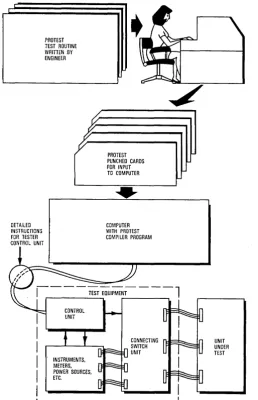
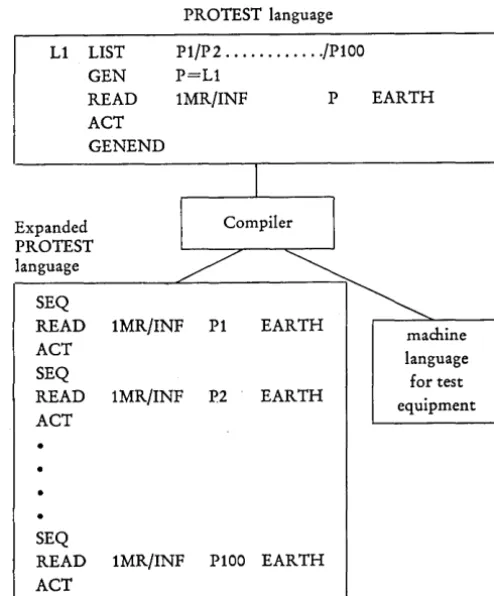
A high-level language for defining and communicating test specifications, in a form that is entirely independent of the test equipment to be used, and enables the writer of the test specification to concentrate his attention on the equipment to be tested.
The Profession of Information Engineer and the Pursuit of Truth
27 Unsettling, Disturbing, Critical [NT F] Statement of policy by Computers and Automation
6 Burying Facts and Rewriting History [NT E] by Edmund C. Berkeley, Editor, Computers and Automation
Taken together, the information published May 1970 to May 1973 in Computers and Automation effectively de-stroys a large segment of the beliefs, the rewritten history, that the establishment in the United States has arranged for the people in the United States to believe.
7 The Watergate Crime [NT R]
I nventory of 9 articles published in Computers and
Automation August 1972 to May 1973 on the
The magazine of the design, applications, and implications of
information processing systems - and the pursuit of truth in
input, output, and processing, for the benefit of people.
The Profession of Information Engineer and
the Pursuit of Truth (continued)
8 Political Assassinations in the United States [NT R] I nventory of 35 articles published in Computers and
Automation May 1970 to May 1973 on the
assassina-tions of President John F. Kennedy, Senator Robert Kennedy, Reverend Martin Luther King, and other polit-ically important persons in the United States: titles, authors, and summaries
30 The New Orleans Portion of the Conspiracy to Assassinate [NT A] President John F. Kennedy - Part 2: Articles 3 and 4
On November 30, 1972, the Supreme Court of the United States refused to permit Jim Garrison, District Attorney, New Orleans, to prosecute Clay Shaw for perjury. On November 21, Jim Garrison issued a statement comment-ing on this refusal, which is Article 4 (published in this issue). Article 1 (in the April issue) by E. C. Berkeley is an introduction; Article 2 (in the April issue) by Jim Gar-rison is the prosecutor's opening statement to the trial jury in the February 1969 trial of Clay Shaw in New Orleans; Article 3 (published in this issue) is the opening statement of F. Irving Dymond, attorney for the defendant.
33 Investigative Reporting [NT A] by A. M. Rosenthal, Managing Editor, The New York Times,
New York, N.Y.
Statement before a subcommittee in the House of Repre-sentatives defending the right of investigative reporters to keep confidential their news sources.
36 The People's Need To Know - Part 2, Conclusion [NT A]
by Charles L. Whipple, Editor of the Editorial Page,
The Boston Globe, Boston, Mass.
How recent Supreme Court decisions and the jailing of re-porters for refusal to reveal confidential sources is sabotag-ing freedom of the press in the United States; and how an unqualified Federal "shield" law is needed.
The Golden Trumpet
38 The Eleventh Annual Computer Art Contest - Notice
Computers and Puzzles
22 Numbles, by Neil Macdonald
25 Problem Corner, by Walter Penney, CDP
[T G]
[T C]
[T C]
NOTICE: The official name of this magazine throughout 1973 is
Computers and Automation. We expect to change the name
officially as of January 1, 1974, to Computers and People.
During 1973 from time to time, unofficially, and irregularly, we plan to use the name Computers and Automation and
People as a way of informing our subscribers and readers of
the intended change on January 1, 1974.
COMPUTERS and AUTOMATION for May. 1973
Front Cover Picture
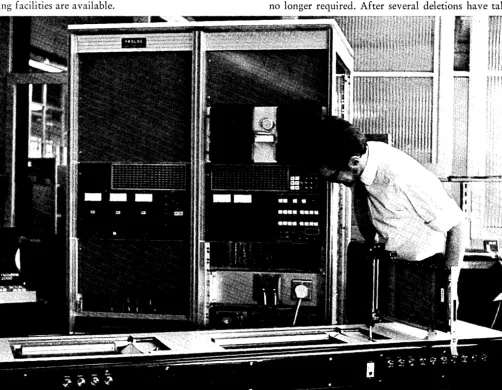
L. A. Lavigne of South Burlin-ton, Vt., suffered a stroke in 1971
which left him paralyzed and un-able to speak. Four Univ. of Vt. students enabled him to communi-cate with the world again. The stu-dent ... shown standing are (from the left) Michael E. Grant, Gary Hazard, John C. Lang, and Romaine N.
Tomlin;~on. For more information, see page 40.
Departments
40 Across the Editor's Desk -Computing and Data Processing Newsletter 25 Advertising Index
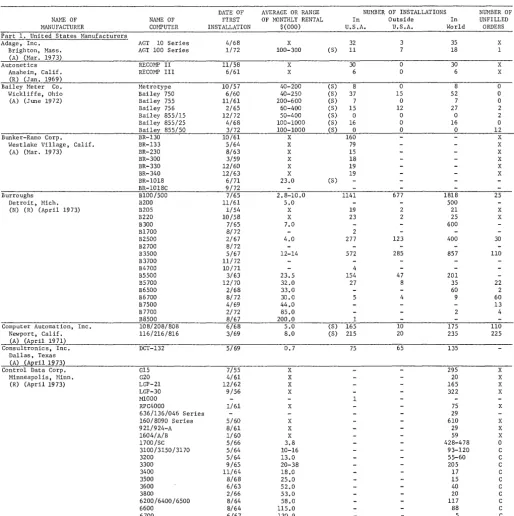
50 Calendar of Coming Events 46 Monthly Computer Census 44
45 29
Key
New Contracts New Installations Who's Who Entry Form
Article
Monthly Column Editorial
Forum [A]
[C]
[E] [F]
[G] [NT]
[R] [T]
The Golden Trumpet Not Technical
Reference Information Technical
NOTICE
*0 ON YOUR ADDRESS IMPRINT MEANS THAT YOUR SUBSCRIP-TION INCLUDES THE COMPUTER DIRECTORY. *N MEANS THAT YOUR PRESENT SUBSCRIPTION DOES NOT INCLUDE THE COM-PUTER DIRECTORY.
EDITORIAL
Burying Facts and
One of the efforts of this magazine is to pursue truth. One of the ways in which truth is pursued is not to let statements of the utmost importance be buried and for-gotten in the pages of daily newspapers, nor unreported and lost because they are no longer well covered in nation-al news magazines.
Among those statements are three of great interest in connection with the Watergate Caper (this phrase is estab-lishmentese for "the Watergate Crime").
The statement by Bernard L. Barker, one of the con-victed operatives, which explains his motivation and background (see November 1972, Computers and Automation);
The statement by Alfred Baldwin, 3rd, ex-FBI agent, an employee of the Republican Committee to Re-elect the President, telling what he did and saw while five men burglarized the Watergate offices of the Democratic National Committee on June 17,1972, about 2:30 a.m. (see December 1972,
C&A);
The statements of Martha Mitchell (wife of former Attorney General John Mitchell) who was molest-ed and who forcmolest-ed her husband to resign and who has continually referred to "dirty politics" (see December 1972, C&A).
In addition, we have published five installments of re-ports on the Watergate Crime by our contributing editor, Richard E. Sprague (a computer professional of 25 years standing) who as an avocation has studied for many years dirty political operations in the United States, including the assassinations by conspiracies (not "lone assassins") of President John F. Kennedy, Senator Robert Kennedy, and Reverend Martin Luther King.
Three years ago in May 1970, when we began to pub-lish this type of article, we could not have spoken confi-dently of "the assassination by conspiracies" of two Kennedys and one King. But the articles we have pub-lished - which are listed and characterized on the follow-ing pages - have together a remarkable impact.
Taken together, the information published May 1970 to May 1973 in Computers and Automation effectively
de-stroys a large segment of the beliefs, the rewritten history, that the establishment in the United States has arranged for people in the United States to believe. I do not assert that the establishment is a conscious organism or organi-zation; perhaps the best description is this: a loose confed-eration of overt conspiracies, silent conspiracies, and biased wealthy persons, with very intelligent orchestration stem-ming from the Pentagon, the Central Intelligence Agency, and the Presidency.
Rewriting History
We challenge any fairminded person to read this col-lection of articles (back copies of Computers and Automa-tion should be available in many large public libraries), and
after reading them, to still believe that the assassinations are actually the actions of "lone psychopaths," instead of fitting together into a plan to install a certain kind of au-tocracy in the United States.
This kind of autocracy claims to be democratic, to stand up for "national security," "executive privilege," "separation of Constitutional powers," etc. It offers ap-pearances of democracy, but it seizes the realities of money and power. It cuts programs of social benefit; but it allo-cates $80 billion a year to be paid to the military-indus-trial-Pentagon complex. .
In the 1940's there was a name for this kind of autoc-racy. Its name was "fascism," effectively a dictatorship in the interests of big business. What is now appearing in the U.S. is "fascism" in the form of a dictatorship by the military-ind ustrial complex.
Here in a nutshell is an example of the present uneven contest: it takes the form of two sentences in a report by E. Drake Lundell, Jr., in Computerworld for April 11,
1973:
• The Antitrust Division of the Justice Department is "outmanned and outgunned" when it comes to prosecuting cases like the current action against IBM, Senate investigators were told last week.
• In addition, witnesses before the Senate Antitrust and Monopoly Subcommittee stated that often the division cannot do its job properly because of po-litical pressure from the White House. . .. These two statements contain a world of implications. Essentially, the Department of the United States Gov-ernment which is charged with enforcing certain U.S. laws against monopoly, can no longer properly function because of
(1)
the enormous power of just one business, IBM, and (2) political pressure from the White House (this phrase is establishmentese for "President Richard M. Nixon").We must dig up facts, remember them, and write his-tory the way it is.
Edmund
C.
Berkeley
Editor
The Watergate Crime
Articles Published in
Computers and Automation
August 1972 to April 1973
Inventory of Titles, Authors, and Summaries
The Watergate Crime consisted of the breaking in of the offices of the National Committee of the Democratic Party, on the 6th floor of the Watergate Office Building, Washington, D.C., and resulting arrests. The forced entry took place around 2:30 a.m., Saturday, June 17; five men were arrested by Wash-ington police. They had with them extensive photographic equipment and electronic surveillance devices, and wore rubber surgical gloves. The five men arrested were:
James W. McCord; a Lt. Colonel in the U.S. Air Force Reserve; 19 years service with the CIA; head of a se-curity agency; on the payroll of the Committee to Re-elect the President as late as May 31, 1972; an organizer of the CIA for the Bay of Pigs invasion of Cuba in 1961.
Bernard L. Barker; a Cuban-born Miami business man; long associated with the CIA; he established secret Guatemalan and Nicaraguan invasion bases. Frank Fiorini (alias Frank Sturgis, Edward Hamilton);
former American marine; soldier of fortune; friend
August 1972
33 The June 1972 Raid on Democratic Party Head-quarters - Part 1
by Richard E. Sprague, Hartsdale, N.Y.
A report on five men who have numerous
con-of Jack Anderson; anti-Castro-Cuban organizer; in-volved in the Bay of Pigs preparations.
Eugenio R. Martinez (alias Gene Valdes); former CIA agent; real estate agent for Bernard L. Barker in Miami; anti-Castro activist; friend of E. Howard Hunt. Virgilio R. Gonzales (alias Raoul Godony); former CIA
agent active in the Bay of Pigs affair; anti-Castro activist.
These men were closely connected with: the Republican Party,
the White House,
President Richard M. Nixon the Central Intelligence Agency, and
the Committee for Re-Election of the President. These five men and two more, E. Howard Hunt and G. Gordon Liddy, were tried in the court of Judge Sirica in Wash-ington, D.C., and found guilty.
A report on further developments in the June 1972 raid by James McCord, Bernard Barker, and others, on National Democratic Party Headquarters, and implications affecting a number of Republican leaders and President Richard M. Nixon.
nections with the Republican Party, the White 26 Martha Mitchell and the Watergate Incident House, the Central I ntelligence Agency, anti-Castro
Cubans, and plans for the assassination of President John F. Kennedy, and who were arrested seeking to bug Democratic National Headquarters at 2 :30 a.m., June 17, 1972.
October 1972
by Martha Mitchell, the magazine Parade, and Richard E. Sprague
How Martha Mitchell (wife of former Attorney General John Mitchell) was molested and kept in-communicado and a prisoner - reported on by Mrs. Mitchell and the editor of Parade magazine.
18 The Raid on Democratic Party Headquarters (The 27 Watergate Incident) - Part 2
The Watergate Crime: An Eye-Witness Account by Alfred Baldwin, 3rd
by Richard E. Sprague, Hartsdale, N.Y.
A report on further developments in the June 1972 raid by James McCord, Bernard Barker, and others, on National Democratic Party Headquarters, and implications affecting a number of Republican leaders and President Richard M. Nixon.
November 1972
26 Bernard L. Barker: Portrait of a Watergate Burglar by Edmund C. Berkeley, Editor, Computers and Automation
How a cloak and dagger operative and right-wing activist, who was caught as a burglar in the Water-gate Hotel offices of the Democratic National Headquarters, looks at himself and his line of work.
29 Walter Sheridan - Democrats' I nvestigator? or Re-publicans' Countermeasure?
by Richard E. Sprague, Hartsdale, N.Y.
Walter Sheridan, recently employed by the Demo-cratic National Committee to investigate the Watergate I ncident, may actually be a "counter-measure" by the Republicans to defeat the Demo-cratic investigation.
December 1972
24 The Raid on Democratic Party Headquarters (The Watergate Incident) - Part 3
by Richard E. Sprague, Hartsdale, N.Y.
COMPUTERS and AUTOMATION for May, 1973
A round-by-round account by an ex-FB I agent, an employee of the Republican Committee to Re-elect the President, of what went on while five men burglarized the Watergate offices, June 17, 2:30 a.m. Baldwin's main assignment was listening to bugged calls to the Democratic National Com-mittee.
January 1973
33 President Richard M. Nixon, the Bay of Pigs, and the Watergate Incident - Part 4
by Richard E. Sprague, Hartsdale, N.Y.
How President Nixon lied in 1960 about the plans for the Bay of Pigs I nvasion, and is suppressing in 1972 the investigations of the Watergate Incident.
March 1973
26 The Watergate Crime and the CoverUp Strategy -Part 5
by Richard E. Sprague, Hartsdale, N.Y.
A report on the trial of E. Howard Hunt, James McCord, Bernard Barker, and four other persons' for their raid on Democratic National Committee Headquarters in June 1972 using funds of the Re-publican Committee for the Re-Election of the President; and the strategies of cover-up that have been employed.
Political Assassinations in the United States
Articles Published in
Computers and Automation
May 1970 to May 1973Inventory of Titles, Authors, and Summaries
May 1970
30 The Assassination of President John F. Kennedy: The Application of Computers to the Photographic Evidence
by Richard E. Sprague
A reexamination of some of the evidence relating to the assassination of John F. Kennedy - with emphasis on the possibilities and problems of computerized analysis of the photographic evi-dence.
July 1970
29 The May Article, "The Assassination of President John F. Kennedy: The Application of Computers to the Photographic Evidence" - Report No.2: 32 More About Ji m Hicks
32 Confirmation of FBI Knowledge 12 Days Before Dallas of a Plot to Kill President Kennedy 35 The Second Conspiracy About the Assassination
of President Kennedy
August 1970
48 The Assassination of Senator Robert F. Kennedy: 48 Preface, by Edmund C. Berkeley
50 Two Men With Guns Drawn at Senator Kennedy's Assassination: Statement to the Press, by Theo-dore Charach
50 Map of the Scene of the Assassination of Senator Robert Kennedy
51 The Pantry Where Senator Robert Kennedy was Assassi nated
52 Bullet Hole in the Frame of a Door
53 Two Bullet Holes in the Center Divider of the Pantry Door
September 1970
39 Patterns of Political Assassination: How Many Coin-cidences Make a Plot?
by Edmund C. Berkeley, Editor, Computers and Automation
How the science of probability and statistics can be used as an instrument of decision to determine if a rare event is: (I) within a reasonable range; (2) unusual or strange or suspicious; or (3) the re-sult of correlation or cause or conspiracy.
48 Computer-Assisted Analysis of Evidence Regarding the Assassination of President John F. Kennedy
-Progress Report
by Richard E. Sprague
October 1970
52 The Conspiracy to Assassinate Senator Robert F. Kennedy and the Second Conspiracy to Cover It Up
by Richard E. Sprague
A sum~ary of what researchers are uncovering in their investigation of what appears to be not one but two conspiracies relating to the assassination of Senator Robert F. Kennedy.
56 Index to "Special Unit Senator: The Investigation of the Assassination of Senator Robert F. Kennedy"
An index is supplied for the Random House book written by Robert A. Houghton, of the Los Angeles Police Department, about the investigation of the assassination of Senator Robert F. Kennedy.
November 1970
44 Confidential and Secret Documents of the Warren Commission Deposited in the U.S. Archives
by Neil Macdonald, Assistant Editor
A list of the subjects of over 200 documents of the Warren Commission which were classified con-fidential, secret, and top secret.
December 1970
39 The Assassination of Reverend Martin Luther King, Jr., The Role of James Earl Ray, and the Question of Conspiracy
by Richard E. Sprague
James Earl Ray says he was coerced into entering a plea of guilty to killing Martin Luther King . . . and contrary evidence (plus other evidence) have led to filing of legal petitions for relief.
January 1971
45 The Death of Walter Reuther: Accidental or Planned? by Edmund C. Berkeley and Leonard Walden
Some significant questions about the plane crash in May 1970 in which Walter Reuther was killed.
February 1971
48 The Report of the National Committee to Investigate Assassinations
What the National Committee in Washington, D.C. is doing about computerizing files of evidence, in-itiating lawsuits to obtain information, etc.; and comments on two new books by District Attorney Jim Garrison and Robert Blair Kaiser.
March 1971
35 "The Assassination of President Kennedy: The Ap-plication of Computers to the Photographic Evi-dence" - Comment
35 I. Another View, by Benjamin L. Schwartz, Ph.D. A polemical attack on "The Assassination of President Kennedy: the Application of Com-puters to the Photographic Evidence" by
Richard E. Sprague published May 1970. 40 II. Response, by Edmund C. Berkeley, Editor
45 District Attorney Jim Garrison on the Assassination of President Kennedy: A Review of Heritage of StOnE.
by Neil Macdonald, Assistant Editor
April 1971
32 The Right of Equal Access to Government Information
by the National Committee to Investigate Assassi-nations, Washington, D.C.
May 1971
27 The Assassination of President Kennedy: The Spatial Chart of Events in Dealey Plaza
41
by Robert B. Cutler, Architect
The chart, first published in May 1970, is revised and brought up to"date.
June 1971
The Case of Secret Service Agent Abraham W. Bolden by Bernard Fensterwald, Attorney, Executive Di-rector, National Committee to I nvestigate Assassi-nations
Bolden wanted to tell the Warren Commission about a Chicago plot to kill President Kennedy, and was jailed six years on a framed-up charge for trying to do so.
July 1971
51 The Central Intelligence Agency and The New York Times
by Samuel F. Thurston, Newton, Mass.
The issue of systematic suppression of questions about the assassination of President John F. Kennedy, and a hypothesis.
August 1971
37 Jim Garrison, District Attorney, Orleans Parish, vs. the Federal Government
by Bernard Fensterwald, Attorney, Executive Di-rector, National Committee to I nvestigate Assassi-nations
How District Attorney Jim Garrison of New Orleans became interested in the New Orleans phase of the assassination of President Kennedy; and how the Federal government frustrated and
COMPUTERS and AUTOMATION for May, 1973
blocked his investigation in more than a dozen ways.
September 1971
26 The Federal Bureau of I nvestigation and the Assassi-nation of President Kennedy
by Bernard Fensterwald, Attorney
How J. Edgar Hoover and the FBI withheld much pertinent information from the Warren Commis-sion, flooded them with irrelevant information, and altered some important evidence, thus concealing Oswald's connections with the FBI.
October 1971
41 The Assassination of President Kennedy - Declassi-fication of Relevant Documents from the National Archives
by Richard E. Sprague
The titles of the documents and other evidence indicate convincingly that Lee Harvey Oswald was trained in spy work by the CIA before his visit to Russia; etc. Like the Pentagon Papers, these doc-uments should be declassified.
November 1971
24 The Assassination of President Kennedy: The Pattern of Coup d'Etat and Public Deception
by Edmund C. Berkeley, Editor, Computers and Automation
Five significant, eye-opening events from May 1970 to October 1971, showing patterns of coup d'etat, assassination, and concealment; and some predic-tions.
December 1971
32 The Assassination of President John F. Kennedy: A Model for Explanation
by Vincent J. Salandria, Attorney, Philadelphia, Pa. A study of the reasons why a great deal of the Federal government's own evidence in the assassi-nation of President John F. Kennedy declared "conspiracy" - and a hypothesis, supported by considerable evidence, about why the President was assassinated and how the implications of that action were to be signaled to those who could read the signals.
6 The Strategy of Truth-Telling by Edmund C. Berkeley
Editorial
January 1972
57 Spotlight on McGeorge Bundy and the White House Situation Room
by Robert B. Cutler, Manchester, Mass.
An argument that the "lone assassin - no con-spiracy" announcement from the White House Situation Room could have resulted from infor-mation available in Dallas and Washington prior to the announcement - and thus does not actually demonstrate that someone there had a guilty fore-knowledge of the shooting.
February 1972
43 Who Shot President Kennedy? - Or Fact and Fable in History
by Gareth Jenkins, Weston, Mass.
How the physical evidence actually published by the Warren Commission relating to the assassina-tion of President John F. Kennedy shows con-clusively that more than one man was responsible for the shooting - contrary to the Commission's own report.
March, April, May, June 1972
28 Dallas: Who, How, Why? (in four parts) by Mikhail Sagatelyan, Moscow, USSR
A long report published in Leningrad, USSR, by an ace Soviet reporter about the circumstances of the assassination of President John F. Kennedy, and their significance from a Soviet point of view.
July 1972
32 The Shooting of Presidential Candidate George C. Wallace: A Systems-Analysis Discussion
by Thomas Stamm, Bronx, N.Y., and Edmund C. Berkeley, Editor
An analysis of the shooting of Governor Wallace of Alabama; and a discussion of systematic methods for protecting American leaders from violent at-tacks.
10 The Shooting of Governor George C. Wallace, Can-didate for President
by Edmund C. Berkeley, Editor Editorial
September 1972
24 The Assassination of Senator Robert F. Kennedy: Proofs of Conspiracy and of Two Persons Firing
by Richard E. Sprague, Hartsdale, N.Y.
A review and summary of the evidence showing conclusively the fact of conspiracy and the pres-ence of two guns firing, at the time of the assassi-nation of Senator Robert F. Kennedy.
November 1972
32 The Central Intelligence Agency: A Short History to Mid-1963 - Part 1
by James Hepburn, author of Farewell America
The unverified, but probably largely true, secret history of the Central I ntelligence Agency of the U.S. - as a preliminary to its involvement in the assassination of President John F. Kennedy.
December 1972
34 The Central I ntelligence Agency: A Short History to Mid-1963 - Part 2
38 Le Francais Qui Devait Tuer Kennedy (The French-man Who Was To Kill Kennedy)
by Philippe Bernert and Camille Gilles, Paris, France
January 1973
37 The Frenchman Who Was To Kill Kennedy by Philippe Bernert and Camille Gilles, L 'Aurore,
Paris, France; translated by Ann K. Bradley
English translation of the French newspaper re-port on Jose Luis Romero, which was reprinted in French in the December issue.
40 Why I Distrust the Romero Story
by Robert P. Smith, Director of Research, Commit-tee to Investigate Assassinations, Washington, D.C.
The Romero report reprinted from L 'Aurore has many earmarks indicating that it is very difficult to believe.
February 1973
26 Analysis of the Autopsy on President John F. Ken-nedy, and the Impossibility of the Warren Commis-sion's "Lone Assassin" Conclusion
30
31
by Cyril H. Wecht, M.D., Institute of Forensic Sciences, Pittsburgh, Pa.
The coroner of Allegheny County, Pa., reports on his examination of the evidence that still remains (some of it is missing) locked up in the National Archives of the United States, not accessible to ordinary investigators.
U.S. Electronic Espionage: A Memoir - Part 1 by Ramparts, Berkeley, Calif.
How the U.S. National Security Agency intercepts, decodes, and understands almost all secret and top secret electronic communications and signals of all nations all over the world.
March 1973
U. S. Electronic Espionage: A Memoir - Part 2 by Ramparts, Berkeley, Calif.
How the National Security Agency intercepted and decoded enemy messages in order to direct bomb-ing strikes in Viet Nam, and often failed; and how the hideousness of what the American military forces were doing in Southeast Asia finally led this interviewee to resigning and termi nating.
April, May 1973
34 The New Orleans Portion of the Conspiracy to As-sassinate President John F. Kennedy - Four Articles:
(1) by Edmund C. Berkeley, in the April issue; (2) by Jim Garrison, in the April issue; (3) by F. Irving Dymond, in the May issue; (4) by Jim Garrison, in the May issue
On November 20, 1972, the Supreme Court of the United States refused to permit Jim Garrison, Dis-trict Attorney, New O~leans, to prosecute Clay Shaw for perjury. On November 21, Jim Garrison issued a statement commenting on this refusal, which is Article 4 of this set; Article 1 is an intro-duction; Articles 2 and 3 are opening statements to the trial jury, by Jim Garrison, Prosecutor, and F. Irving Dymond, attorney for the defendant, in the February 1969 trial of Clay Shaw in New Orleans; Clay Shaw was charged by the grand jury with "having conspired with David W. Ferrie and
The Evolution of Man-Computer Symbiosis
C. J. Testa
College of Business & Public Administration
Dept. of Information Systems Management University of Maryland
College Park, Md. 20742
"User instructions for interacting with the computer are often difficult and complex. In most cases, the user is a manager with little or no computer experience. If he cannot easily interact with the computer, he may not interact at all."
In a seminal paper on man-computer symbiosis, Licklider (1960) described the expected development of a cooperative interaction between men and com-puters. He viewed this symbiosis as occuring some-where on a continuum between "mechanically extended man" and "artificial intelligence". A major obj ec-tive of his argument was to have man and computer closely interact in the problem-solving sequence.
Human-factors handbooks list various capabilities which make humans essential in the problem-solving environment. These include the ability to: project missing information from experience; perceive pat-tern in a situation; develop hypotheses about cause-effect relationships; make probability estimates of conditions; optimize on uncertain criteria and ob-jectives; and generalize from one context of events to another.
Thus, man is uniquely suited to set goals, formu-late hypotheses, develop models, define criteria, and evaluate results. On the other hand, computers can be used to convert hypotheses into models for testing, perform simulations, and display results. The integration of these capabilities should lead to better system performance.
Licklider listed certain prerequisites which he believed were essential to the development of this symbiotic relationship. Among these prerequisites were the following: time-sharing systems for more efficient and economical computer operation; in-creased memory hardware capability; language for easy communication with the machine; and input/out-put equipment other than electric typewriters (vis-ual and audio).
It is interesting to note that in spite of the fact that these broad prerequisites have been met, advancement of the symbiotic concept has indeed been limited. What are some potential reasons for this lack of advancement? First, the frequent occurence of response delays in time-sharing systems can be
Charles J. Testa is an assistant professor in the Information Systems Management Department at the University of Maryland, College Park, Md. He re-ceived a B.S. from Lafayette College in 1964, a M.S. in business administration from U.C.L.A. in 1966, and a Ph.D. in biotechnology from U.C.L.A. in 1969. After serving as a member of the tech-nical staff at BELLCOM for one year, he joined the facul ty at the Uni versi ty of Maryland where he has worked on curriculum and course development inin-formation systems management. He is a member of the Human Factors Society and the Association for Computing Machinery.
COMPUTERS and AUTOMATION for May. 1973
disruptive to problem solving. Miller (1968) esti-mated that delays of approximately 15 seconds cause deteriorated performance in problem-solving situa-tions. Second, user instructions for interacting with the computer are often difficult and complex. In most cases, the user is a manager with little or no computer experience. If he cannot easily inter-act with the computer, he may not interinter-act at all. Finally, although other input/output modes have been demonstrated in'research applications, the major de-vice in practical applications remains the teletype-writer. Since the user may not be a typist, he will have to develop some "skill" to interact with the computer.
Time-Sharing vs. Batch Systems
In recent years the concept of man-computer in-teraction has almost been synonymous with online, multi-access, time-sharing computer systems. For purposes of the discussion which follows, an online system is defined as one with direct access to the central processing unit of the computer. This capa-bili ty permits managers to query the system for "im-mediate" responses to questions. A batch system is defined as one which requires submission of jobs to a particular site and a varying amount of time (turn-around) to receive output.
A major topic of investigation in recent years has been the comparison of human performance in a time-sharing (online) environment versus a batch en-vironment. Studies by Grant and Sackman (1967) and Erikson (1966) support the contention that debugging language is the main reason that online data process-ing involves less man-hours than batch. Grant and Sackman, however, attribute differences in online vs. batch performance to turnaround time, i.e., if turnaround time is decreased, differences tend to disappear. Erikson, on the other hand, suggests that the interactive mode itself is a factor since batch users can utilize waiting time by working on program bugs. One of the main findings of both studies was the very large individual differences between subjects regardless of whether the sample population was experienced programmers or trainees.
With the recent development of fast batch pro-cessing, both conventional and remote, the interac-tive distinction may not be as critical. A study by Adams and Cohen (1969) compared subject performance in a programming course on time-sharing and "instant" batch systems. Although students expressed a sub-jective preference for the instant batch mode, there
wer~ no significant performance differences between
methods. This unusual preference may be explained by the slow terminal response and frequent busy sig-nals experienced by subjects on the time-sharing
system. As in the previous studies, the main find-Ing was the large individual differences between subjects; this led to the conclusion that a good programmer was more important than the mode of operation.
Problems in Comparing Studies
It is difficult to make comparisons among re-ported studies because of differences in computer systems, programming languages, and user's experi-ence and capability. Computer systems vary f,rom small machines such as the PDP-S to large machines such as the IBM/370 or UNIVAC-lIaS. Each of these machines is characterized by certain distinct hard-ware features which affect response time and which make comparison difficult. In a previously de-scribed study, Adams and Cohen defined "instant" batch processing as requiring from a few seconds to 10 or 15 minutes for short jobs. Variability in time-sharing response is not as unfavorable but de-lays do range from a few seconds to minutes depending on the system load. It is not certain what effect these variable delays have on human performance. Users are annoyed by unpredictable system response time, but one cannot conclude that a reduction in system response time will necessarily improve human performance. In fact, Simon (1966) contends that a standard or consistent response time is more impor-tant than immediacy of response.
Another problem area has been the lack of applied research to investigate the comparative effective-ness of different general purpose languages such as FORTRAN, COBOL, and PL/l. The scope of these lan-guages is constantly increasing so that almost any programming task can be accomplished using these high-level languages. The FORTRAN programming lan-guage is used primarily for solving mathematical or scientific problems while COBOL is used for process-ing large volumes of business data. The PL/l lan-guage is reputed to be capable of handling both sci-entific and business problems and thus, probably has the broadest scope.
Few studies have investigated the utility to users of specific language features. As a result, the following questions naturally arise: 1) how dif-ficult is it to learn a particular language? 2) is an English-like quality desirable? 3) how adjusta-ble is the language to the experience of different users? 4) what criteria should be used to evaluate languages? and 5) how efficient are the coded pro-grams?
In order to examine some of these questions, my comments will be limited to the COBOL language. The organization of COBOL results in its being easy to learn and understand. Thus, it is very useful for both man-to-man and man-to-machine communications. Because of COBOL's narrative nature and English-like syntax, a certain amount of documentation is inherent. Generally, the quality and quantity of documentation produced by the use of COBOL is super-ior to that of other languages. This is very impor-tant for the maintenance and revision of programs. COBOL is a language for programmers. While it is
not intended to be used by people unfamiliar with computers, it can be used by systems designers who are oriented to applications.
The preceding features have been used to justify the adoption of COBOL in particular processing en-vironments. A familiar criticism of COBOL was ex-pressed by Moressi (1967) who claimed that COBOL was incapable of translation into efficient computer code. It is true that certain COBOL elements
con-tribute to inefficiency. However, a programmer can consciously and consistently strive to write effi-cient COBOL programs by adhering to guidelines such as; 1) minimize the number of READ and WRITE state-ments; 2) denote items used in arithmetic operations as usage computational not display; 3) avoid use of the rounded and size error options, if possible; 4) limit the use of GO TO and IF statements, utilize PERFORM; and 5) avoid use of verbs such as DISPLAY, EXHIBIT, etc. except for debugging purposes.
In a related study using a time-shared system, Jutila and Baram (1971) found that the choice of programming language had a significant effect on the user's learning rate for a particular type of problem solving application. Turnaround time at the ;erminal was $ignificantly lower for those users coding in BAStC rather than FORTRAN. Surprisingly, factors such as previous programming experience, in-structor, grade point average, and typing experience were not significant. Since the problem-solving tasks were not described, one may question whether or not the tasks were too simple to be discriminat-ing. From this summary of results, it seems clear that performance standards must be developed before any meaningful comparative evaluation can result.
User Differences
In the final analysis, however, the major problems will be caused by the vast differences that exist in user experience and capability. As pointed out by Nickerson et al (196S), novices prefer instructional assistance from the computer and detailed error di-agnostics. On the 'other hand, experienced users prefer abbreviated commands and coded messages. These differences will have a major impact on the training programs developed to assist users in im-plementing complex systems.
Large individual differences between subjects are reported in the reviewed studies, and these differ-ences focus on the potential benefit of developing a preliminary screening tool to equalize subject "abili ty" before experimentation. If valid results are to be attained in future man-computer experi-ments, the differences which have been described (computer systems, languages, etc.) must be controlled.
Programmer Aptitude Tests
Many organizations throughout the country use aptitude tests to screen computer programmer appli-cants. The results of these tests are claimed to be valid and reliable indicators of programmer potential.
Among the most popular tests are the IBM apti-tude test for programmer personnel (ATPP), the com-puter programmer aptitude battery (CPAB) developed by Science Research Associates (SRA) , and a test battery developed by Rigney et al at the University of Southern California. These tests all utilize number series, arithmetic reasoning, geometric fig-ures, etc. as measures of pTogrammer aptitude.
In a recent study conducted by Testa (1973), the author attempted to find a predictor which would have a logical relationship to programmer aptitude. An analysi s of the programmi ng task revealed per·cep':-tual and cognitive factors which seemed related to Witkin's (1962) concept of perceptual style. Pro-gramming requires an ability to perceive the whole and a concomitant ability to proceed from the gen-eral to the particular. After conducting numerous studies, Witkin concluded that a person's manner of
Good Management of Computer Operations:
1.
Finishing the Software Job:
There Must Be a Better Way
2.
Data Communications:
Solving the Puzzle is Possible
ADL Systems, Inc.
A Subsidiary of Arthur D. Little, Inc. Acorn Park
Cambridge, Mass. 02140
1. Finishing the Software Job: There Must Be a Better Way
Finishing the Software Job
" ... All of the big problems seem to sur-face after 90 per cent of the job is sup-posed to have been done."
With that statement, the vice president of one of the nation's largest commer-cial banks came to grips with the most difficult task in software development -getting the job done.
For as long as computer users have built software, they have lamented their inability to achieve that final ten per cent that means project completion. There are, of course, no easy ways to reach completion milestones in major systems projects. It takes sound plan-ning, hard work, and the commitment of good "people. But even with those factors working for you, reaching the final goal of fully operational software systems is a real challenge.
But it is a challenge that can be met, especially if management is alert, early in the life of a project, to the "telltales" that signal danger. By acting on these early warning signs as they appear, the likelihood of finishing the job on sched-ule and on budget is greatly enhanced. What are some of these telltales? They can be classified, for memorability, by their most glaring attribute. In our experience, the presence of anyone of "these conditions on a major
develop-ment program will spell tail-end trouble. So be wary of:
The Slippery Specification
Every software project begins with a set of specifications, which is simply a
COMPUTERS and AUTOMATION for May. 1973
detailed statement of the requirements to be met by the project. If it doesn't, then that already portends labor problems.
If minor and major specifications con-tinue to change, and user departments continue to "evolve their needs" after work has begun, there is little chance of satisfactory or timely completion. The rippling effect that small changes cre-ate over an entire project fs probably the most common cause of delays. And yet this insidious practice is consid-ered, by many software developers, as a preferred method of project manage-ment.
They theorize that systems that develop in small incremental steps permit greater project control, firmer measure-ment guidelines and the flexibility to introduce the newest concepts at var-ious stages of project development. The fallacy of that theory, verified time and again in cases we have partici-pated in over the past decade, is that control, measurement and the freedom to introduce new techniques are in fact seriously impaired in direct relation to the number of specification changes initiated.
A preferred approach is to plan systems efforts in major steps, during which design specifications are frozen. Each step should be equivalent to a signifi-cant and free-standing segment of the total project. Important changes or additions can be accumulated in par-allel with the work effort, and de"signed into successive stages after each major milestone is accomplished. In this
man-ner, the desired control, measurement and improvement requirements can be met in orderly fashion.
The analogy to this recommended ap-proach is the aerospace industry, in which modifications are introduced by generations, thus assuring consistent progress. The slippery specification must be made to conform to an engi-neering discipline, rather than an evolving art form.
Excessive Confidence
Because of the complexity of large sys-tems projects, there is a high probability that many problems, unforeseen obsta-cles, and delays will occur. In fact, it is rare that a project does not encounter at least one or two major crises during its development. Time and again we have seen it demonstrated that: "If it can happen, it will ... "
While this truism is known to every experienced systems designer, it is still common to see systems scheduling, staffing, budgeting and resource allo-cations that represent the height of optimism. Such confidence is rarely justified, and its predictable conse-quence is major budget overrun, dis-enchantment of the user department, management and the technical staff, and often hastily drawn compromises that fall far short of the original design goals.
Avoid excessive confidence by build-ing in appropriate cushions durbuild-ing the initial design phase. If you insist that this is done as a routine condition of planning your software projects, you
will quickly discover that the confi-dence level will reach new and justi-fied heights.
The Missing Manager
A general management precept, and one that applies particularly to soft-ware development projects, is: "If the senior manager doesn't know fully the
status
of the project, then he has every right to expect it to fail."This rule-of-thumb fits software proj-ects in two ways. The first and most obvious is that the senior responsible executive must exercise management control by being informed and inter-ested in the progress of each project. This is easier said than done, because for reasons of management span and "the buzzword gap" senior manage-ment is often dissociated from the actual conditions of each project. Yet, despite the pain of having to con-front and understand such cataclysms as "We had a B37 ABEND in our new job set up," the precept of involvement from the top must apply.
The second and perhaps most danger-ous application of that old saw is at the project management level. The project manager is and should be an executive fully knowledgeable in the details of the task to be done, with sufficient authority to get it done. Most computer sites have personnel qualified for such tasks. Invariably, however, project managers are assigned to direct major efforts on a part-time basis. This easily correctable problem is a major cause of project failure, and yet it persists throughout computer sites around the world. Missing ·managers cannot man-age. And since control of a complex project is always more than a part-time job, personnel assignments should be made accordingly.
The Last-Minute Test Plan
A component of every software project is a test plan. The .purpose of these plans is to enable program developers to fully exercise, debug and tune up system components before they are
integrated into the final production system.
Very often, plans for testing are built into the latter phases of a project, which is too late in terms of discover-ing the myriad of little problems that cause aggravating delays and overruns.
It is common to find major systems well into their development, yet lacking in such simple features as restart or rerun facilities, intermediate methods of out-put, adequate formatting and carefully designed diagnostic routines to spot programming flaws.
It is relatively simple to avoid such problems by building into a systems plan adequate time, progressive docu-mentation of work accomplished, and easy-to-attain standards for testing each component of work as it is completed. Last-minute testing will guarantee that the last ten per cent of the job will be tough to finish.
The "Lack of Resources" Excuse Every software developer knows that, in the priorities of his computer center, production work always takes preced-ence over development work. In fact, this excuse prevails today as one of the biggest barriers to getting new projects finished.
"Our test time was bumped by the monthly bill of materials update" is a frequent complaint of development programmers. And often it is a valid one.
Senior managers should insure that every new software project has as-signed to it the proper equipment resources to complement the financial and personnel resources. Lack of com· puter time to test programs and ex-periment with file organization, diag-nostics and other programming tech-niques wastes time and money, and for little reason.
In addition, there is a tendency for designers to build systems that require more memory, or more disk drives, or more peripherals and terminals than are presently on site. If budgets don't permit additional hardware, then the
system must be redesigned. If budg-etary funds are available, they often must clear a long approval cycle. In either case, the undesirable effect is project delay.
Insist that your development teams work within the resources available-and make sure they have access to those resources to get their jobs done. The final ten per cent will always be difficult to achieve. But if you plan through these "telltales," you'll reach
it much more efficiently.
2. Data Communications:
Solving the Puzzle is Possible
"Data communications is like a jigsaw puzzle which changes before your eyes. Lots of subtle parts that are tough to piece together, with new ones coming all the time."
That view of one of the fastest-grow-ing functions in information processfastest-grow-ing is shared by many senior executives with whom we talk.
With costs decreasing and hardware, software and people better able to han-dle the technology, data communica-tions is fast becoming a key element in information systems.
Data communications provides more immediate access to information in files and permits immediate updating, thereby reducing-or eliminating-the cycle time in information processing and related business operations. Through immediate and selective ac-cess, data communications also makes possible one of the fundamental goals of modern information systems- to pro-vide the information which is needed just when it is needed.
Yet data communications is a com-plex technology, often more compli-cated than the central computer facility. In this issue of The Casebook, we will stake out the broad parameters and present some of the principal functional considerations and trade-offs faced by communications systems designers in an effort to make that jigsaw puzzle a little more understandable.
What It's All About?
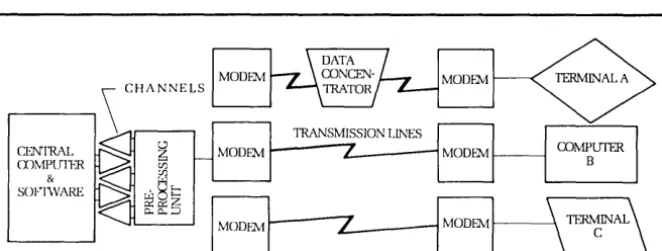
As we will discuss it, data communi-cations deals with the transmission of (digital) data between a computer and some other device (another computer or one or more terminals) over a link such as a telephone line.