warwick.ac.uk/lib-publications
Original citation:
Zhao, Nan, Cheng, Fen, Yu, F. Richard, Tang, Jie, Chen, Yunfei, Gui, Guan and Sari, Hikmet.
(2018) Caching UAV assisted secure transmission in hyper-dense networks based on
interference alignment. IEEE Transactions on Communication.
Permanent WRAP URL:
http://wrap.warwick.ac.uk/98753
Copyright and reuse:
The Warwick Research Archive Portal (WRAP) makes this work by researchers of the
University of Warwick available open access under the following conditions. Copyright ©
and all moral rights to the version of the paper presented here belong to the individual
author(s) and/or other copyright owners. To the extent reasonable and practicable the
material made available in WRAP has been checked for eligibility before being made
available.
Copies of full items can be used for personal research or study, educational, or not-for profit
purposes without prior permission or charge. Provided that the authors, title and full
bibliographic details are credited, a hyperlink and/or URL is given for the original metadata
page and the content is not changed in any way.
Publisher’s statement:
“© 2018 IEEE. Personal use of this material is permitted. Permission from IEEE must be
obtained for all other uses, in any current or future media, including reprinting
/republishing this material for advertising or promotional purposes, creating new collective
works, for resale or redistribution to servers or lists, or reuse of any copyrighted component
of this work in other works.”
A note on versions:
The version presented here may differ from the published version or, version of record, if
you wish to cite this item you are advised to consult the publisher’s version. Please see the
‘permanent WRAP URL’ above for details on accessing the published version and note that
access may require a subscription.
Caching UAV Assisted Secure Transmission in Hyper-Dense
Networks Based on Interference Alignment
Nan Zhao,
Senior Member, IEEE,
Fen Cheng, F. Richard Yu,
Senior Member, IEEE,
Jie Tang,
Member, IEEE,
Yunfei Chen,
Senior Member, IEEE,
Guan Gui,
Member, IEEE,
and Hikmet Sari,
Fellow, IEEE
Abstract—Unmanned aerial vehicles (UAVs) can help small-cell base stations (SBSs) offload traffic via wireless backhaul to improve coverage and increase rate. However, the capacity of backhaul is limited. In this paper, UAV assisted secure transmission for scalable videos in hyper-dense networks via caching is studied. In the proposed scheme, UAVs can act as SBSs to provide videos to mobile users in some small cells. To reduce the pressure of wireless backhaul, UAVs and SBSs are both equipped with caches to store videos at off-peak time. To facilitate UAVs, a single antenna is equipped at each UAV and thus, only the precoding matrices of SBSs should be cooperatively designed to manage interference by exploiting the principle of interference alignment. On the other hand, the SBSs replaced by UAVs will be idle. Thus, in order to guarantee secure transmission, the idle SBSs can be further exploited to generate jamming signal to disrupt eavesdropping. The jamming signal is zero-forced at the legitimate users through the precoding of the idle SBSs, without affecting the legitimate transmission. The feasibility conditions of the proposed scheme are derived, and the secrecy performance is analyzed. Finally, simulation results are presented to verify the effectiveness of the proposed scheme.
Index Terms—Caching, interference alignment, physical layer security, small-cell networks, unmanned aerial vehicles.
I. INTRODUCTION
In 5G mobile networks, data traffic will increase unprece-dentedly. In order to meet the increasing data demands, small-cell networks will be widely deployed, which can achieve much higher throughput and energy efficiency [1]. However, owing to the dense deployment of small-cell base stations (SBSs), the interference between users becomes more serious, which may lead to performance degradation. Thus, it is very important to properly manage interference to further improve the performance of small-cell networks [2]. As an emerging technique for interference management in wireless networks, interference alignment (IA) can be utilized in hyder-dense cell networks [3]–[8]. In addition, the security of
small-N. Zhao and F. Cheng are with the School of Inform. and Commun. Eng., Dalian University of Technology, Dalian, Liaoning, P. R. China (email: [email protected], [email protected]).
F.R. Yu is with the Department of Systems and Computer Engi-neering, Carleton University, Ottawa, ON, K1S 5B6, Canada (email: [email protected]).
J. Tang is with the School of Electronic and Information Engineering, South China University of Technology, Guangzhou, Guangdong, P. R. China(Email: [email protected]).
Y. Chen is with the School of Engineering, University of Warwick, Coventry CV4 7AL, U.K. (e-mail: [email protected]).
G. Gui is with Nanjing University of Posts and Telecommunications, Nanjing, Jiangsu, P. R. China (e-mail: [email protected]).
H. Sari is with Sequans Communications, 92700 Colombes, France. He is also with Department of Telecommunication, CentraleSupelec, 91192 Gif-sur-Yvette France (email: [email protected]).
cell networks is also a critical issue, which has attracted significant attention [9]–[14].
To alleviate the pressure of small cells and reduce the cost of densely deployed SBSs, unmanned aerial vehicles (UAVs) can be exploited to assist small cells in providing high-speed transmission due to their low cost and high mobility. UAV-aided wireless networks can establish wireless connections without infrastructure, realize larger wireless coverage, and achieve higher transmission rate. Thus, a number of research works on this topic have been done in recent years [15]– [22]. In [15], three typical cases of utilization for UAV-aided wireless communications were summarized by Zeng
et al., including UAV-aided ubiquitous coverage, UAV-aided
relaying, and UAV-aided information dissemination. In [16], Guptaet al. discussed the key issues of routing and protocol in UAV-aided communications. A sub-modular game perspective of energy consumption optimization of UAV-aided network was provided in [17] by Koulali et al. In [18], Sharma et al. proposed a user demand based network model to achieve prolonged connectivity, bigger capacity and better reliability in heterogeneous networks assisted by UAVs. In [19], a spiral algorithm was proposed by Lyuet al. to minimize the number of required UAV-mounted mobile base stations to cover all the ground terminals. Zenget al. optimized the throughput for UAV-aided mobile relaying system by transmitting appropriate source/relay power along with selecting appropriate relay trajectory in [20]. While in [21], energy-efficient network was achieved through optimizing the UAV’s trajectory by Zeng and Zhang. In addition, in small-cell networks, UAVs can serve as mobile base stations to assist SBSs in offloading data traffic via wireless backhaul [22].
However, UAVs can provide data transmission only by connecting to the macro-cell base station (MBS) via wireless backhaul. Due to the limited capacity of wireless backhaul, the transmission rate by UAVs is also limited, which will degrade the quality of service (QoS) when mobile users are crowded. To solve this problem, caches can be equipped at UAVs to store the popular contents at off-peak period [23], and thus, when the users’ requested contents exist at local caches of UAVs, they can be delivered to the users directly without wireless backhaul at peak period. Thus, the load via limited wireless backhaul can be reduced, which makes UAVs more feasible.
off-peak time, and the pressure of backhaul will be significantly relieved [28]. In addition, caching at the edge of networks makes the data traffic much closer to the mobile users. Thus, the transmission latency can be reduced, and the quality of experience for users will be enhanced. Furthermore, caching can also be utilized in interference networks, especially, IA-based networks, to facilitate the interference management and improve the performance [7], [8], [29], [30]. In [29], each file was divided into some nonoverlapping subfiles cached at different transmitters, and then, those subfiles would be transmitted to users cooperatively by managing interference effectively with IA gain. Deghel et al. demonstrated that caching can provide benefits for IA networks in [30]. In [7], caching and computing were jointly utilized by Zhaoet al., to simplify the topology of IA networks, reduce backhaul load, and thus improve the throughput. In [8], power allocation was researched by Chenget al. in cached-aided small-cell networks with limited backhaul.
Motivated by the above works, in this paper, UAVs with caching are utilized as mobile base stations (BSs) to provide video streaming to the mobile users along with SBSs. To effectively eliminate the interference between users, IA is exploited in the proposed scheme. In addition, to guarantee the secure transmission, the idle SBSs replaced by UAVs are further utilized to generate jamming signal to disrupt the potential eavesdropping, without affecting the legitimate transmission. The key contributions of this paper can be summarized as follows.
• To the best of our knowledge, there are very few works on UAV-aided wireless networks with caching [23]. Thus, in this paper, we propose a comprehensive framework for hyper-dense small-cell networks assisted by caching UAVs, analyze its feasibility, and discuss the secure transmission.
• To relieve the transmission pressure of SBSs, UAVs are utilized to provide data traffic to mobile users cooper-atively with SBSs, due to their lower cost and higher mobility. Caches are equipped at UAVs to store popular files in advance, which can relieve the pressure on the wireless backhaul at peak time significantly.
• A single antenna is equipped at each UAV to facilitate its transmission, and the idea of IA is leveraged to perform interference management in the network through designing the precoding matrices of SBSs cooperatively. The feasibility conditions of the proposed scheme are also derived.
• Another key issue for the UAV aided small-cell network is the secure transmission. In this paper, the idle SBSs re-placed by UAVs are further utilized to generate jamming signal to disrupt the potential eavesdropping, which will not affect the transmission of the legitimate network. The security performance of the proposed scheme is analyzed.
In addition, some issues for adopting IA in our proposed scheme are discussed as follows.
[image:3.612.313.565.54.215.2](1) The performance of IA will degrade at low SNRs, due to the fact that it only concentrates on interference, instead of noise. First, to make it more practical to be utilized at
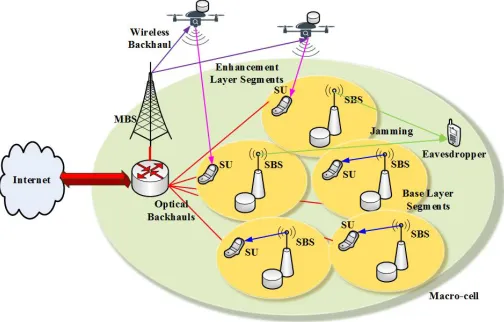
Fig. 1. UAV assisted secure transmission in hyper-dense networks via caching.
low SNRs, plenty of research has been done to improve its performance [31]–[34]. In addition, although the performance of IA is not optimal at low SNRs, it will instruct the optimal transceiver design of MIMO interference network, according to its feasibility conditions [35], i.e., the optimal MIMO transceiver design scheme can achieve reliable performance only when the feasibility conditions of IA can be satisfied. Last, although we adopt IA to achieve interference manage-ment in this manuscript, the framework can also be achieved by other interference management techniques, e.g., optimal transceiver design [36].
(2) Channel state information (CSI) estimation errors will degrade the performance IA obviously. Nevertheless, there have been a lot of research efforts focusing on this aspect [6], [37]–[39], e.g., CSI overhead reduction, limited quantization, channel prediction, blind IA, etc. These achievements can be further combined with our proposed scheme to overcome the CSI problem, which is not the main task of this paper. In addition, only one single antenna is equipped at each UAV, which does not need the CSI knowledge. Thus, the challenge for the estimation of CSI for mobile UAVs can be avoided.
The rest of this paper is organized as follows. In Section II, the system model is described. In Section III, the interference management scheme for the caching UAV assisted hyper-dense network with jamming signal is proposed, and its feasibility conditions are derived in Section IV. In Section V, the security performance of the proposed scheme when there exists an eavesdropper is analyzed. Simulation results are presented in Section VI, followed by conclusions and future work in Section VII.
Notation: A† is the conjugate transpose of matrix A. IN
representsN ×N indentity matrix.CN(a,A) represents the complex Gaussian distribution with mean a and covariance matrixA.vi(A)andA⋆lare the eigenvector corresponding to
the ith smallest eigenvalue and the lth column of matrix A, respectively.
II. SYSTEMMODEL
Kcorresponding mobile users, operate in a specific frequency band1. The MBS is connected to the core network via optical backhaul. In addition, there exist A (A < K) UAVs served as mobile BSs, which are connected to the MBS via wireless backhaul to alleviate the data transmission load of SBSs and achieve higher transmission rate. However, due to limited batteries, limited wireless backhaul and high mobility, some special properties of UAVs are considered in the network as follows.
• Only one single antenna is equipped at each UAV2, due
to the fact that the scattering in UAV environment is inadequate, the size, weight and power of UAVs are limited, and CSI cannot be obtained easily at UAVs [15].
• According to the DoF requirement of multi-input and multi-output (MIMO) system, only one data stream can be transmitted by the UAV owing to the single antenna.
• UAVs do not need the CSI knowledge, due to the fact that no precoding is needed with single antenna.
• Caches are equipped at UAVs in order to alleviate the load of wireless backhaul and save energy. Popular videos can be proactively cached at UAVs during off-peak period or when replenishing batteries on the ground.
• Rotary wing UAVs are adopted, which can stay stationary in the air when offloading data, and the transmit power of UAVs cannot be neglected due to the limited batteries, especially when they are far from terrestrial users.Thus, UAVs should fly close enough to the corresponding users
when offloading.
To make the caching of videos at UAVs and SBSs more effective, a special video caching strategy is adopted. In this strategy, each video file is divided into two layers, i.e., base layer (BL) and enhancement layer (EL) [40]. When a user requires standard-definition video streaming, only the BL segment of the video file should be transmitted. When the user need high-definition video streaming, both the EL and BL segments should be delivered. To reduce the load and save caching resource, only EL segments are cached at UAVs, while at SBSs, both BL and EL segments are cached. The SBSs can support the BL transmission, and the UAVs only help to offload data traffic when high-definition video streaming is required. Assume that only one layer of the video can be transmitted to each user within each time slot, and thus, at a specific time slot, UAVs can replace SBSs to serve the corresponding users with EL segments in some of the small cells. In this paper, we only consider a special scenario for video streaming transmission. Actually, we can easily extend our proposed scheme to some more general cases when the SBSs and UAVs have cached totally different contents.
Without loss of generality, we assume that the 1st user to the Ath user require EL segments from their corresponding UAVs, and the remaining(K−A)users want to obtain BL segments from their corresponding(K−A)SBSs at a specific time slot.
1We assume that only one active user exists in a certain frequency band of each small cell. Nevertheless, more users can be accommodated by orthogonal frequency-division multiple access or other ways, which is beyond the scope of this paper.
2The proposed scheme can be easily extended to the case when each UAV
[image:4.612.317.561.52.222.2]is also equipped with multiple antennas.
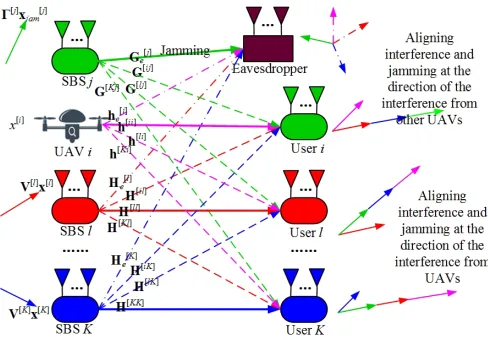
Fig. 2. Interference management for UAV assisted small-cell networks with jamming signal.
Thus, the 1st to the Ath SBSs are idle at the time slot. To fully utilize the resource and guarantee secure transmission, these A SBSs are utilized to generate jamming signal to disrupt potential eavesdropping, without affecting legitimate transmission. Besides, we assume that Mjam antennas are
active at each jamming SBS. For the remaining lth SBS, M antennas are active, and d independent data streams are transmitted to its corresponding user,l=A+ 1, A+ 2, ..., K. Each mobile user is equipped withN antennas.
When the transmission is performed in the hyper-dense small-cell network, interference between users may become much more serious. Thus, IA is exploited to effectively man-age the interference in the small-cell network, as illustrated in Fig. 2. When IA is performed, no precoding matrices are needed at UAVs as they only have a single antenna. The received signal at theith user served by UAV can be expressed as
y[i]=u[i]†h[ii]x[i]+
A
∑
a=1,a̸=i
u[i]†h[ia]x[a]
+
K
∑
k=A+1
u[i]†H[ik]V[k]x[k]+u[i]†z[i],
(1)
wherei= 1,2, . . . , A.h[ia] is the N×1 channel coefficient vector between the ath UAV and the ith user, each entity of which is independent and identically distributed (i.i.d.) following CN(0,1). Similarly, H[ik] is the N ×M channel coefficient matrix between the kth SBS and the ith user. V[k] is the M ×d precoding matrix of the kth SBS with V[k]V[k]† = Id. u[i] is the N ×1 decoding vector of the
ith user with u[i]u[i]† = 1. x[i] is the signal transmitted by the ith UAV with power P1. x[k] is the signal vector that
consists of d independent data streams with power P2. z[i]
is the N ×1 additive white Gaussian noise (AWGN) vector with distributionCN(0, σ2I
N)at theith user, whereσ2is the
user served by SBS can be expressed as
y[l]=U[l]†H[ll]V[l]x[l]+
A
∑
a=1
U[l]†h[la]x[a]
+
K
∑
k=A+1
k̸=l
U[l]†H[lk]V[k]x[k]+U[l]†z[l],
(2)
where l =A+ 1, A+ 2, . . . , K.U[l] is the N×ddecoding matrix of the lth user, withU[l]U[l]†=Id.
We also assume that there exists a passive eavesdropper with Neantennas, which tries to eavesdrop the legitimate
transmis-sion of the network. The received signal at the eavesdropper without considering the jamming from SBSs can be denoted as
ye=
A
∑
i=1
h[ei]x[i]+
K
∑
l=A+1
H[el]V[l]x[l]+ze, (3)
where h[ei] is the Ne×1 channel coefficient vector between
theith UAV and the eavesdropper.H[el]is theNe×M channel
coefficient matrix between thelth SBS and the eavesdropper. zeis theNe×1AWGN vector with distributionCN(0, σ2INe)
at the eavesdropper.
Remark 1:Despite of the mobility of UAVs, they will stop
moving when performing transmission to the users. Thus, IA is suitable to be leveraged in the UAV assisted hyper-dense networks, due to the slow change of CSI.
III. UAV ASSISTEDHYPER-DENSENETWORKS WITH JAMMINGSIGNAL
In this section, the interference management scheme is first proposed for the UAV assisted hyper-dense network without jamming signal. Then, the jamming signal is designed without affecting the legitimate transmission. Finally, an algorithm is proposed to fulfill the scheme.
A. Interference Management in the UAV Assisted Network
From Section II, we know that the recovered signal of the mobile user can be expressed as (1) or (2) without considering jamming signal when IA is performed. In order to effectively eliminate the interference between users, the precoding and decoding matrices should be cooperatively designed. In par-ticular, the precoding of UAVs need not be considered due to single antenna equipped. Thus, at theith user,i= 1,2, . . . , A, the interference from all the SBSs should be constrained by their precoding matrices into the same subspace of the interference from UAVs. Then, all the interference can be eliminated perfectly using its decoding vector u[i] to recover
the desired signal, based on (4) and (5). Similarly, at the lth user, l = A+ 1, A+ 1, . . . , K, the interference from other SBSs should be constrained by the precoding matrices into the same subspace of the interference from UAVs. Then, all the interference can be eliminated perfectly by its decoding matrix U[l] to recover the desired signal, based on (6) and (7). Therefore, in order to perfectly eliminate the interference between users, the following conditions (4)-(9) should be
satisfied for i = 1,2, . . . , A and l = A+ 1, A+ 2, . . . , K according to the idea of IA:
u[i]†h[ia]= 0, ∀a= 1,2, . . . , A, a̸=i. (4) u[i]†H[ik]V[k]=0, ∀k=A+1, A+2, . . . , K. (5) U[l]†h[la]=0, ∀a= 1,2, . . . , A. (6) U[l]†H[lk]V[k]=0, ∀k=A+1, A+2, . . . , K, k̸=l. (7) u[i]†h[ii] ̸= 0. (8) rank
(
U[l]†H[ll]V[l]
)
=d. (9)
When (4)-(7) can be met, the conditions (8) and (9) will be satisfied almost certainly due to the fact that there is not any special structure of the channel matrices. Thus, when (4)-(7) can be solved by the precoding and decoding matrices cooperatively, the proposed scheme will be feasible, and the interference can be perfectly eliminated. The received signal of theith user served by UAV in (1) can be simplified as
y[i]=h[i]x[i]+z[i], (10) wherei= 1,2, . . . , A,h[i],u[i]†h[ii]andz[i],u[i]†z[i]. The received signal of thelth user in (2) can be updated as
y[l]=H[l]x[l]+z[l], (11) where l = A+ 1, A+ 2, . . . , K, H[l] , U[l]†H[ll]V[l] and z[l] ,U[l]†z[l]. Thus, the sum rate of the small-cell network can be expressed as
Rsum= A
∑
i=1
log21+P1 σ2h
[i]
h[i]†+
K
∑
l=A+1
log2Id+
P2
dσ2H [l]
H[l]†. (12)
B. Design of Jamming Signal
When there exists a potential eavesdropper, the idle SBSs that replaced by UAVs can be further utilized to generate jam-ming signal to disrupt the eavesdropping. Then, the received signal of thekth user in (10) and (11) can be rewritten as
b
y[i]=h[i]x[i]+
A
∑
j=1
u[i]†G[ij]Γ[j]xjam[j] +z[i], i= 1,2, . . . , A, (13)
b
y[l]=H[l]x[l]+
A
∑
j=1
U[l]†G[lj]Γ[j]xjam[j] +z[l], l=A+1, A+2, . . . , K, (14) where j = 1,2, . . . , A, G[kj] is the N × Mjam channel
coefficient matrix between thejth SBS and thekth user,Γ[j]
is theMjam×djamunitary precoding matrix of thejth SBS,
and x[jamj] is the jamming vector that consists of djam data
streams with transmit powerPjam.
satisfied fori= 1,2, . . . , A andl=A+ 1, A+ 2, . . . , K as
u[i]†G[ij]Γ[j]=0, ∀j = 1,2, . . . , A, (15) U[l]†G[lj]Γ[j]=0, ∀j= 1,2, . . . , A. (16) Based on the interference management scheme in Section III-A, the jamming signal should be constrained in the same subspace of the interference at each legitimate user. In other words, the decoding vectorsuand matricesUin (15) and (16) have been determined by the conditions (4)-(7) and should not be changed. Thus, only the precoding matrices Γ should be well designed to make (15) and (16) feasible.
When the interference from the undesired transmitters and jamming signal from the idle SBSs can be both perfectly eliminated at each legitimate user, the sum rate of the network is still given by (12).
C. Distributed Algorithm to Achieve the Proposed Scheme
In the proposed scheme, UAVs and SBSs are utilized to provide scalable video segments to their corresponding users. For each mobile user, the interference from other SBSs and UAVs can be eliminated perfectly by IA. In addition, the idle SBSs can be re-utilized to generate jamming signal to disrupt the eavesdropping, which can be perfectly zero-forced at the legitimate users. Thus, a distributed algorithm for UAV assisted hyper-dense networks with jamming signal is proposed, in which the precoding matrices and decoding vectors and matrices can be calculated iteratively. Then, the precoding matrices Γ for jamming can be obtained through zero-forcing.
In the forward direction of iterations, when we consider the interference from other SBSs and UAVs, the interference covariance matrices at the legitimate users can be written as
Q[i]=
K
∑
k=A+1
P2
d H
[ik]
V[k]V[k]†H[ik]†
+
A
∑
a=1,a̸=i
P1h[ia]h[ia]†,∀i= 1,2, . . . , A.
(17)
Q[l]=
K
∑
k=A+1, k̸=l
P2
dH
[lk]V[k]V[k]†H[lk]†
+
A
∑
a=1
P1h[la]h[la]†,∀l=A+ 1, A+ 2, . . . , K.
(18)
According to (18), U[⋆sl] for thesth data stream at thelth user can be calculated as
U[⋆sl] =vs(Q[l]), s= 1, . . . , d, (19)
wherel=A+1, A+2, . . . , K. Then, the decoding matrixU[l] can be obtained by combining the vectors of U[⋆sl]. Specially, due to the fact that there is only one data stream transmitted by each UAV, we have
u[i] =v1
(
Q[i]
)
, (20)
wherei= 1,2, . . . , A.
In the reverse direction, the interference covariance matrices can be computed as
←− Q[k]=
A
∑
i=1
P1←H−[ki]←−v[i]←−v[i]†←H−[ki]†
+
K
∑
l=A+1
l̸=k
P2
d ←−
H[kl]←V−[l]←V−[l]†←H−[kl]†,∀k=A+1, A+2, . . . , K,
(21)
where←H−[kj]=H[jk]†,←−v[i]=u[i], and←V−[l]=U[l].
According to (21), ←U−[⋆sk] for the sth data stream of the
reverse direction can be calculated as ←−
U[⋆sk]=vs
(←−
Q[k]
)
, s= 1, . . . , d, (22)
wherek =A+ 1, A+ 2, . . . , K. Then, the decoding matrix ←−
U[k] of the reverse direction can be obtained by combining the vectors of ←U−[⋆sk]. Thus, we can set the precoding matrices
of the (A+ 1)th SBS to the Kth SBS as V[k] = ←U−[k]. The
iterations between the forward and reverse directions continue until the algorithm converges, which is similar to the MinIL algorithm in [31].
Using the above process, the precoding matrices V, the decoding vectors u and matrices U can be obtained. Based on these solutions, we can calculate the precoding matrices of jamming signal by zero-forcing. The jamming covariance matrices in the reverse direction can be expressed as
←− Q[jamj] =
A
∑
i=1
P1←G−[ji]←−v[i]←−v[i]†←G−[ji]†
+
K
∑
l=A+1
P2
d ←−
G[jl]←V−[l]←V−[l]†←G−[jl]†,∀j= 1,2, . . . , A, (23)
where←G−[ji]=G[ij]†.
Then, the jamming precoding matrixΓ[j] (j= 1,2, . . . , A)
can be obtained by combining the vectorsΓ[⋆sj] expressed as
Γ[⋆sj]=vs
(←−
Q[jamj]
)
, s= 1, . . . , djam. (24)
Thus, the distributed algorithm for the proposed scheme can be summarized as Algorithm 1. According to [31], Algorithm 1 can be implemented distributedly in two ways. (1) The algorithm can be implemented through communication and training in the forward and reverse directions iteratively until convergence, in which only local CSI needs to be estimated. (2) If the global CSI is available at each node, precoding and decoding matrices can be calculated at each node distributedly following Algorithm 1.
According to the above algorithm, all the interference and jamming signal can be eliminated perfectly at each legitimate user when the feasibility conditions can be satisfied, which can be performed at each node in a distributed way.
IV. FEASIBILITYCONDITIONS
Algorithm 1 Distributed Algorithm for the Proposed Scheme
1: Start with arbitraryM ×dmatricesV[l] withV[l]V[l]†=
Id,∀i=A+ 1, A+ 2, . . . , K.
2: repeat
3: In the forward direction, calculate the interference co-variance matrix Q[k] at the kth user according to (17) and (18),k= 1, . . . , K.
4: Compute the decoding matrixu[i]at theith user andU[l] at thelth user according to (20) and (19), respectively, i= 1, . . . , A,l=A+ 1, . . . , K.
5: Reverse the direction.←− ←H−[kj]=H[jk]†,←v−[i] =u[i], and V[l]=U[l].
6: Calculate←Q−[k] according to (21),k=A+ 1, . . . , K.
7: Compute the decoding matrix ←U−[k] according to (22), k=A+ 1, A+ 2, . . . , K.
8: Reverse the communication direction.V[k] =←U−[k], k=
A+ 1, A+ 2, . . . , K.
9: untilconvergence
10: Calculate ←Q−[jamj] according to (23),j= 1,2, . . . , A.
11: ComputeΓ[j] according to (24),j = 1,2, . . . , A.
12: Output the solutions asV[k], k=A+ 1, . . . , K,u[j], j=
1, . . . , A,U[k], k=A+ 1, . . . , K andΓ[j], j= 1, . . . , A.
should be satisfied, through which the minimal number of antennas can be obtained to achieve perfect IA. In [35], Yetiset al. demonstrated that the feasibility conditions can be derived by comparing the number of equations and the number of variables. In this section, the feasibility conditions for the proposed UAV assisted hyper-dense network are derived first without considering jamming signal. Then, the feasibility conditions for the jamming signal are also derived.
A. Feasibility Conditions of the UAV Assisted Network
According to Bezout’s theorem, a general polynomial sys-tem can be solved if and only if the number of equations does not exceed that of variables. Thus, an IA network can be classified as feasible or infeasible by comparing the number of equations with that of variables in [35]. Correspondingly, theproperconditions for the proposed scheme can be derived in Theorem 1 based on Lemma 1 and Lemma 2.
Lemma 1:The total number of equations in (4)-(7) can be calculated as
Nε=A(A−1) +A(K−A)d+ (K−A)Ad
+ (K−A)(K−A−1)d2. (25)
Proof:First, the number of equations in (4) can be derived
as
Nε1=A(A−1). (26)
Then, we can obtain the number of equations in (5) as
Nε2=A(K−A)d. (27)
We can also know that the number of equations in (6) can be denoted as
Nε3= (K−A)Ad. (28)
Besides, the number of equations in (7) can be expressed as
Nε4= (K−A)(K−A−1)d2. (29)
Thus, the total number of equations in (4)-(7) can be calculated as
Nε=Nε1+Nε2+Nε3+Nε4
=A(A−1) +A(K−A)d
+ (K−A)Ad+ (K−A)(K−A−1)d2.
(30)
Lemma 2:The total number of variables in (4)-(7) can be calculated as
Nv=A(N−1)+(K−A)(N−d)d+(K−A)(M−d)d. (31)
Proof: The total number of variables in the decoding
vectorsu[i],i= 1,2, . . . , A, can be denoted as
Nv1=A(N−1). (32)
The total number of variables in the decoding matrices U[l], l=A+ 1, A+ 2, . . . , K, can be expressed as
Nv2= (K−A)(N−d)d. (33)
In addition, the number of variables in the precoding matrices V[k],k=A+ 1, A+ 2, . . . , K, can be calculated as
Nv3= (K−A)(M −d)d. (34)
Thus, the total number of variables in (4)-(7) can be caculated as
Nv =Nv1+Nv2+Nv3
=A(N−1)+(K−A)(N−d)d+(K−A)(M−d)d. (35)
Theorem 1: The proper conditions of the proposed UAV assisted hyper-dense network can be expressed as (36) (on the next page).
Proof:According to [35], the proposed scheme is feasible
if and only if Nε ≤ Nv. Thus, according to Lemma 1 and
Lemma 2, the proposed scheme isproper if and only if (37) is satisfied (on the next page), which can be simplified as the first inequality in (36).
Besides, each of the (A + 1)th user to the Kth user should recover d streams transmitted by its corresponding SBS. According to the DoF requirement of MIMO network, the values ofM andN should satisfy M ≥dandN ≥d.
Furthermore, we can notice that the solutions to (4) and (6) only depend on the decoding matrices. Thus, the feasible value ofN can be obtained by comparing the total number of variables in (4) and (6) with that of equations in (4) and (6). According to Lemma 1, the total number of the equations in (4) and (6) can be given by
Nε1+Nε3=A(A−1) + (K−A)Ad. (38)
According to Lemma 2, the total number of the variables in (4) and (6) can be expressed as
Nv1+Nv2=A(N−1) + (K−A)(N−d)d. (39)
AN+ (K−A)(M +N)d≥A2+A2d2−2A2d+K2d2−2KAd2+ 2AKd+Kd2−Ad2,
N ≥d+A− Ad (K−A)d+A, M ≥d.
(36)
A(N−1) + (K−A)(N−d)d+ (K−A)(M−d)d≥A(A−1) +A(K−A)d+ (K−A)Ad+ (K−A)(K−A−1)d2. (37)
variables should be no less than that of their equations as
Nv1+Nv2≥Nε1+Nε3,
A(N−1)+(K−A)(N−d)d≥A(A−1)+(K−A)Ad, (40) which can be simplified as
N ≥d+A− Ad
(K−A)d+A. (41) Therefore, from the above analysis, the proper conditions of the proposed scheme can be derived as (36).
According to the conclusions in [35], the proper condition is not always equivalent to the feasibility condition in IA. Nevertheless, the proper system is feasible in most of the cases with few counter-examples. In addition, the proposed Algorithm 1 can also be adopted as a theoretical tool for examining the feasibility of the proposed scheme off-line.
B. Feasibility Conditions of the Jamming Signal
In the proposed scheme, the jamming signal should be generated by the idle SBSs to disrupt the potential eavesdrop-ping without affecting the legitimate transmission. Thus, the jamming signal should be constrained into the same subspace of the interference at each user, i.e., conditions (15) and (16) should be satisfied by designing the precoding matrices of jamming properly.
Lemma 3: The total number of equations in (15) and (16) can be calculated as
Njam ε =A
2d
jam+A(K−A)ddjam. (42)
Proof: The number of equations in (15) can be given as
Nε5=A2djam. (43)
In addition, the number of equations in (16) can be given as
Nε6=A(K−A)ddjam. (44)
Thus, the total number of equations in (15) and (16) can be given asNεjam=Nε5+Nε6=A2djam+A(K−A)ddjam.
Lemma 4: The total number of variables in (15) and (16) can be calculated as
Njam
v =Adjam(Mjam−djam). (45)
Proof: Due to the fact that the decoding matrices in (15)
and (16) have been determined by the proposed scheme, the effective variables in (15) and (16) only exist in the precoding matrices Γ[j] for jamming signal. Thus, the total number of
variables in (15) and (16) can be derived as Njam
v =Nv4=
Adjam(Mjam−djam).
Theorem 2:The feasibility condition of the jamming signal for the proposed scheme can be expressed as (46).
Mjam≥A+ (K−A)d+djam. (46)
Proof:It is known thatNjam
v ≥ Nεjamshould be satisfied
to make (15) and (16) solvable. Thus according to Lemma 3 and Lemma 4, we haveAdjam(Mjam−djam)≥A2djam+
A(K−A)ddjam, which can be simplified as (46).
Remark 2: The minimal number of antennas equipped at
SBSs and users to perfectly eliminate the interference between users can be determined by the feasibility conditions in The-orem 1. Then, based on the proposed scheme, the minimal number of antennas to generate jamming signal, which can be zero-forced at the legitimate users, can be determined by the feasibility condition in Theorem 2.
V. PERFORMANCEANALYSIS OF THEEAVESDROPPER
In the proposed scheme, the 1st to theAth SBSs are replaced by UAVs to provide video streaming service to mobile users, and thus, theseASBSs can be exploited to generate jamming signal to guarantee the security of the legitimate transmission. Thus, in this section, the eavesdropping performance is ana-lyzed with and without jamming signal, respectively, to show the effectiveness of the proposed jamming design in secure transmission3.
A. Eavesdropping Performance without Jamming Signal
As mentioned in Section, an eavesdropper withNeantennas
exists in the UAV assisted hyper-dense network. We assume that the CSI between the legitimate transmitters and the eavesdropper can be obtained by the eavesdropper. However, the CSI between the legitimate transmitters and mobile users are unavailable at the eavesdropper, and thus, the number of data streams for each transmitter is difficult to know at the eavesdropper.
First, we consider the case when the eavesdropper attempts to eavesdrop the information for theith legitimate user served by the UAV,i= 1,2, . . . , A. When decoding is performed at
3In the proposed scheme, the jamming signal can be eliminated together
the eavesdropper, the recovered signal without jamming signal can be expressed as
ye[i−]1=ue[i]†h[ei]x[i]+
A
∑
a=1,a̸=i
u[ei]†h[ea]x[a]
+
K
∑
k=A+1
u[ei]†H[ek]V[k]x[k]+u[ei]†ze,
(47)
whereu[ei] isNe×1decoding vector for the eavesdropper to
obtain the information of theith user.
In order to eliminate the interference from other users effectively, the following conditions should be satisfied.
u[ei]†h
[a]
e = 0,∀a= 1,2, . . . , A, a̸=i, (48)
u[ei]†H
[k]
e V
[k]
=0,∀k=A+ 1, A+ 2, . . . , K. (49)
To make (48) and (49) solvable, enough antennas should be equipped at the eavesdropper. The minimal required number of antennas by the eavesdropper is derived in Proposition 1.
Proposition 1:For the eavesdropper in the proposed scheme without jamming signal, at least(K−A)d+Aantennas are needed to eavesdrop theith user served by the UAV with inter-user interference perfectly eliminated.
Proof: The total number of equations in (48) and (49)
can be expressed as
Ne
ε−1= (A−1) + (K−A)d. (50)
Since the precoding matrices in (49) are determined by the proposed scheme, the effective variables in (48) and (49) only exist in the decoding vector u[ei] of the eavesdropper, which
can be expressed as
Ne
v−1=Ne−1. (51)
Therefore, (48) and (49) can be solved only when Ne v−1≥
Ne
ε−1⇒Ne≥(K−A)d+A.
Based on Proposition 1, we can know that the eavesdropping rate of theith user, i= 1,2, . . . , A, can be expressed as
R[ei−]1= log2
(
1+P1u
[i]†
e h[ei]h
[i]†
e u
[i]
e
σ2
)
. (52)
On the other hand, we consider the case when the eaves-dropper wants to eavesdrop the lth legitimate user served by the SBS, l = A+ 1, A+ 2, . . . , K. When decoding is performed, the recovered signal at the eavesdropper can be written as
y[el−]2=
d
∑
s=1
u[el]†H
[l]
eV
[l]
⋆sx[sl]+ A
∑
a=1
u[el]†h
[a]
e x[a]
+
K
∑
k=A+1
k̸=l
u[el]†H
[k]
e V
[k]
x[k]+u[el]†ze,
(53)
wherex[sl]is thesth data stream for thelth user. To eliminate
the interference from other users, the following conditions should be satisfied:
u[el]†h
[a]
e = 0,∀a= 1,2, . . . , A, (54)
u[el]†H
[k]
e V
[k]= 0,∀k=A+ 1, A+ 2, . . . , K, l̸=k. (55)
Similar to Proposition 1, we can conclude that if we want to eliminate the inter-user interference from other legitimate user when eavesdropping a certain SBS served user, the following condition should be satisfied.
Ne≥(K−A−1)d+A+ 1. (56)
Nevertheless, the interference of other data streams of this user cannot be eliminated. Therefore, the eavesdropping rate of the lth user,l=A+ 1, A+ 2, . . . K, can be calculated as
R[el−]2=
d ∑ s=1 log2 1+
P2u [l]†
e H[el]V[⋆sl]V
[l]†
⋆sH
[el]†
u[el]
dσ2+P 2
d
∑
i=1,i̸=s
u[el]†H[el]V
[l]
⋆iV
[l]†
⋆i H
[el]†u[l]
e . (57)
B. Eavesdropping Performance with Jamming Signal
When the jamming signal is generated by the idle SBSs, the potential eavesdropping will be disrupted. According to Proposition 1, when the eavesdropper is equipped with(K− A)d+Aantennas and attempts to eavesdrop theith user served by the UAV,i= 1,2, . . . , A, we can know that the interference from other legitimate users can be eliminated. The recovered signal at the eavesdropper can be expressed as
y∗e−[i]1=u[ei]†h
[i]
e x[i]+ A
∑
j=1
u[ei]†G
[j]
e Γ[j]x
[j]
jam+u
[i]†
e ze, (58)
and the eavesdropping rate can be rewritten as
R∗e−[i]1=log2
1+ P1u
[i]†
e h[ei]h
[i]†
e u
[i]
e
σ2+Pjam
djam
∑A j=1u
[i]†
e G[ej]Γ[j]Γ[j]†G
[j]†
e u
[i]
e
.
(59) Similarly, when the eavesdropper is equipped with(K−A− 1)d+A+ 1antennas and attempts to eavesdrop the lth user served by the SBS,l=A+ 1, A+ 2, . . . , K, the interference from other user can be eliminated. The recovered signal at the eavesdropper can be expressed as
ye∗−[l]2=
d
∑
s=1
u[el]†H[el]V[⋆sl]x[sl]+
A
∑
j=1
u[el]†G[ej]Γ[j]x[jamj] +u[el]†ze, (60)
and the eavesdropping rate can be rewritten as (61) (on the next page).
Remark 3:According to (52), (57), (59) and (61), we can
conclude that R[el−]2 > R∗e[−l]2 and R[ei−]1 > R∗e−[i]1 for the same number of eavesdropping antennas, due to jamming. However, the transmission rate of the legitimate users will not be changed by the jamming signal. Thus, the secrecy rate of the legitimate users will be increased through introducing the jamming signal into the network. In addition, when the transmit power of the jamming signal Pjam becomes larger,
the secrecy rate will increase accordingly.
R∗e−[l]2=
d
∑
s=1
log2
1 + P2u
[l]†
e H[el]V
[l]
⋆sV
[l]†
⋆sH
[l]†
e u
[l]
e
dσ2+P 2
∑d i=1,i̸=su
[l]†
e H[el]V
[l]
⋆iV
[l]†
⋆i H
[l]†
e u
[l]
e +dPdjam
jam
∑A j=1u
[l]†
e G[ej]Γ[j]Γ[j]†G
[j]†
e u
[l]
e
. (61)
signal, the following condition should be satisfied along with (48) and (49) or (54) and (55):
u[ek]†G
[j]
e Γ
[j]=0. (62)
When the eavesdropper wants to eavesdrop the information of theith user served by UAV,i= 1,2, . . . , A, (48), (49) and (62) should be all satisfied, and the minimal required number of antennas of the eavesdropper is derived in Proposition 2.
Proposition 2: For the eavesdropper, at least(K−A)d+ A+Adjam antennas should be equipped to eavesdrop theith
user served by UAV without interference from other users and jamming signal,i= 1,2, . . . , A.
Proof: The number of equations in (62) is equal to
Adjam. Thus, according to (50), the total number of equations
in (48), (49) and (62) can be expressed as
Ne
ε−2= (A−1) + (K−A)d+Adaj. (63)
The total number of variables in (48), (49) and (62) can still be expressed as (51). Thus, (48), (49) and (62) can be solved only when Nve−2≥Nεe−2⇒Ne≥(K−A)d+A+Adjam.
Similar to Proposition 2, when the eavesdropper wants to eavesdrop the information of the lth user served by the SBS, l=A+ 1, A+ 2, . . . , K, at least
Ne= (K−A−1)d+A+ 1 +Adjam (64)
antennas should be equipped to eliminate the interference from other legitimate users and jamming signal perfectly.
Remark 4: According to the above analysis, we can
con-clude that Adjam more antennas should be equipped at the
eavesdropper to successfully eavesdrop the kth user when jamming signal is generated by the idle SBSs. In other words, the eavesdropper should make more effort to eavesdrop the kth user when jamming signal is generated.
VI. NUMERICALRESULTS ANDDISCUSSION
In this section, the performance of the proposed UAV as-sisted hyper-dense small-cell network is presented and verified through extensive simulations. We assume that the transmit power of UAVs and SBSs are equal, i.e., P1=P2=Pjam=
1.
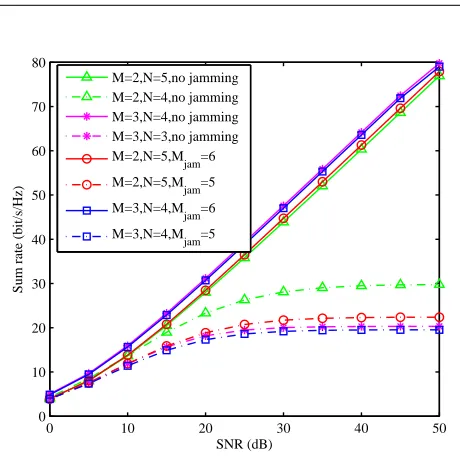
The sum rate of the small-cell network with different numbers of M and N is shown in Fig. 3 without jamming signal, whereK= 5,A= 2, andd= 1. From the results, we can see that the sum rate will increase linearly with SNR only when the feasibility conditions in Theorem 1 can be satisfied, i.e., 5N+ 3M ≥28andN ≥3, and all the interference can be eliminated. When 5N + 3M < 28, we can see that the sum rate of the network is much lower than that when it is feasible, due to the residual interference. In addition, based on the feasibility numbers of M andN, the sum rate of the network with the jamming signal is also compared in Fig. 3for
0 10 20 30 40 50
0 10 20 30 40 50 60 70 80
SNR (dB)
Sum rate (bit/s/Hz)
M=2,N=5,no jamming M=2,N=4,no jamming M=3,N=4,no jamming M=3,N=3,no jamming M=2,N=5,M
jam=6
M=2,N=5,M
jam=5
M=3,N=4,M
jam=6
M=3,N=4,M
[image:10.612.322.552.100.329.2]jam=5
Fig. 3. Sum rate comparison of the small-cell network with and without jamming signal, with different number of antennas equipped at each SBS, each mobile user and each jammer (K= 5,A= 2, andd= 1).
different numbers of antennas equipped at the jammers,Mjam,
when the feasibility conditions in Theorem 1 are satisfied. K = 5, A = 2, d = 1, and djam = 1. From the results,
we can see that the interference can be perfectly eliminated and the sum rate of the network increases linearly with SNR, only when the feasibility condition of the jamming in Theorem 2 can be satisfied, i.e.,Mjam≥6. In addition, we can see that
the the feasible value ofMjam only depends onA,K,dand
djam, instead ofM andN.
To further verify the feasibility conditions in Theorem 1, the interference leakage at each mobile user with different values of M andN is compared in Fig. 4, without jamming, when K = 5, A = 2, d = 2, and SNR=25dB. From the results, we can note that the interference leakage can be eliminated perfectly only when the feasibility conditions in Theorem 1 can be satisfied, i.e., 3M + 4N ≥ 38 and N ≥ 4. We can also see that, when M becomes smaller, larger N is needed to make it feasible.
Similarly, to verify the feasibility condition in Theorem 2, we compare the interference leakage at each mobile user with different values ofd,djam,M andN in Fig.5, with jamming
signal generated, whenK= 5,A= 2and SNR=25dB. From the results, we can see that only when the feasibility condition Mjam≥A+ (K−A)d+djamin Theorem 2 can be satisfied,
the interference can be eliminated perfectly. In addition, we can find that the feasible value of Mjam is only related to
the values of d, djam, K and A, and it will not be affected
by the values ofM andN when the feasibility conditions in Theorem 1 have already been satisfied.
3 4 5 6 7 8 9 0
0.1 0.2 0.3 0.4 0.5
N
Interference Leakage per User (P
1
)
[image:11.612.323.550.56.257.2]M=3 M=4 M=5 M=6
Fig. 4. Comparison of interference leakage at each mobile user with different values ofM andN. (K= 5,A= 2,d= 2and SNR=25dB).
5 6 7 8 9 10
0 0.05 0.1 0.15 0.2 0.25 0.3 0.35
M jam
Interference Leakage per User (P
1
)
d=d
jam=2,M=N=6 d=d
jam=2,M=5,N=6 d=d
jam=1,M=N=6 d=d
[image:11.612.64.288.56.256.2]jam=1,M=N=4
Fig. 5. Comparison of interference leakage at each mobile user with different values ofMjam. (K= 5,A= 2and SNR=25dB).
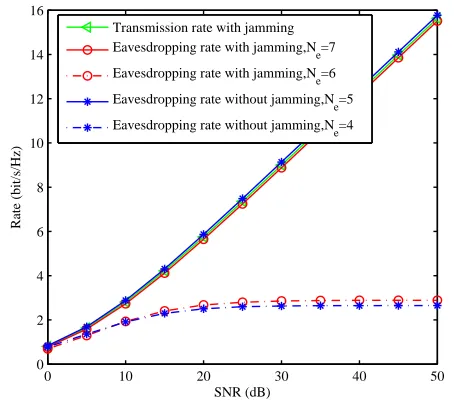
transmission of a certain UAV, the transmission and eavesdrop-ping rate of a certain UAV served user is compared in Fig. 6
with different number ofNe, with or without jamming signal.
We also assume that the legitimate network is feasible with K= 5,A= 2,d= 1,M =N = 4,djam= 1andMjam= 6
according to Theorem 1. From the results, we can note that when no jamming is generated, at least Ne = 5 antennas
are needed to perfectly eavesdrop a certain UAV served user, which is consistent with the conclusion in Proposition 1. On the other hand, we can also see that when jamming signal is generated by the idle SBSs, at least Ne = 7 antennas
should be equipped at the eavesdropper to eavesdrop a certain UAV served user, which is consistent with the conclusion in Proposition 2. Therefore, we can conclude that additional Adjam= 2 antennas should be equipped at the eavesdropper
to successfully eavesdrop a UAV served user when jamming
0 10 20 30 40 50
0 2 4 6 8 10 12 14 16
SNR (dB)
Rate (bit/s/Hz)
Transmission rate with jamming Eavesdropping rate with jamming,N
e=7
Eavesdropping rate with jamming,N
e=6
Eavesdropping rate without jamming,N
e=5
Eavesdropping rate without jamming,N
[image:11.612.63.286.303.502.2]e=4
Fig. 6. Comparison of the transmission and eavesdropping rate of a certain UAV served user in the small-cell network with different numbers ofNe. (K= 5,A= 2,M=N= 4,d= 1, anddjam= 1).
0 10 20 30 40 50
0 5 10 15 20 25 30 35
SNR (dB)
Rate (bit/s/Hz)
Transmission rate Eavesdropping rate,N
e=5
Eavesdropping rate,N
e=4
Eavesdropping rate,N
e=3
Fig. 7. Comparison of the transmission and eavesdropping rate of a certain SBS served user in the small-cell network without jamming signal, with different number ofNe. (K= 3,A= 1,M=N= 4, andd= 2).
signal is generated by the idle SBSs, compared to the case without jamming signal. In other words, the jamming signal can make the legitimate network much securer.
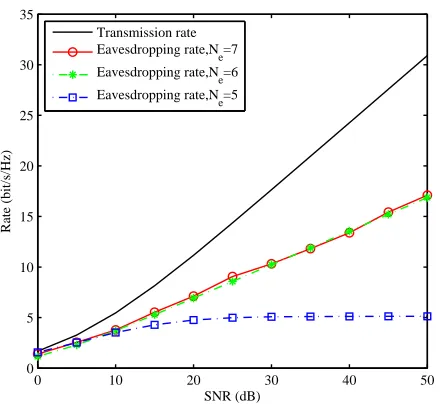
In Fig. 7, the transmission and eavesdropping rate of a certain SBS served user is compared without jamming signal, when an eavesdropper intends to eavesdrop its transmission. We setK = 3,A= 1,d= 2 andM =N = 4to make the small-cell network feasible, according to Theorem 1. From the results, we can observe that the eavesdropping rate is very low whenNe<4, due to the fact the interference cannot be
perfectly eliminated at the eavesdropper, which will affect its eavesdropping performance. WhenNe≥4, the eavesdropping
[image:11.612.323.549.317.515.2]0 10 20 30 40 50 0
5 10 15 20 25 30 35
SNR (dB)
Rate (bit/s/Hz)
Transmission rate Eavesdropping rate,N
e=7
Eavesdropping rate,N
e=6
Eavesdropping rate,N
[image:12.612.65.285.54.256.2]e=5
Fig. 8. Comparison of the transmission and eavesdropping rate of a certain SBS served user in the small-cell network with jamming signal, with different numbers ofNe. (K= 3,A= 1,M =N = 4,Mjam = 7,d= 2, and djam= 2).
achieved eavesdropping rate is also lower than the transmis-sion rate, due to the fact the the interference between data streams of the SBS served user cannot be eliminated by the eavesdropper. Then, similar results are provided in Fig. 8, in which the jamming signal is considered. We set K = 3, A = 1, d = 2, Mjam = 7,djam = 2 andM = N = 4 to
make the small-cell network feasible, according to Theorem 1 and Theorem 2. Comparing the results in Fig. 7 and Fig. 8, we can conclude that Adjam = 2 more antennas should
be equipped at the eavesdropper to eavesdrop a certain SBS served user with jamming signal, compared to that without jamming signal, according to the conclusion in (56) and (64). Thus, the proposed scheme with jamming signal can make the network much securer.
The interference leakage at the eavesdropper with different number of Ne when the eavesdropper tries to eavesdrop a
certain UAV served user or a SBS served user, is compared in
Fig. 9 and Fig. 10, respectively. K= 5,A= 2,M =N = 6 and Mjam = 10 are set to make the legitimate network
feasible, according to Theorem 1 and Theorem 2. SNR=25dB. From the results in Fig. 9, we can see that the interference leakage can be perfectly eliminated at the eavesdropper aiming at a certain UAV served user, only when enough antennas are equipped at the eavesdropper to satisfy the conditions in Proposition 1 or Proposition 2. Especially, larger d, larger djamcan make the user more difficult to eavesdrop. From the
results in Fig. 10, we can note that the interference between users can be perfectly eliminated at the eavesdropper aiming at a certain SBS served user, only when enough antennas are equipped at the eavesdropper to satisfy the conclusions in (56) or (64). In addition, when d= 2, there exists some residual interference, due to the fact that the interference between data streams of the target user cannot be eliminated perfectly.
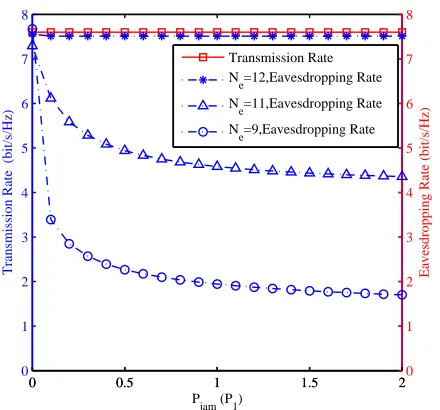
Finally, the transmission and eavesdropping rate of a tar-geted UAV served user is compared in Fig. 11, when the
2 4 6 8 10 12
0 1 2 3 4 5 6
N e
Interference Leakage (P
1
)
d=2,d
jam=2,with jamming d=2, without jamming d=1,d
[image:12.612.323.547.57.256.2]jam=1,with jamming d=1, without jamming
Fig. 9. Comparison of interference leakage at the eavesdropper with different number ofNewhen the eavesdropper tries to eavesdrop a certain UAV served user (K= 5,A= 2,M=N= 6,Mjam= 10and SNR=25dB).
2 4 6 8 10 12
0 1 2 3 4 5 6 7
N e
Interference Leakage (P
1
)
d=2,d
jam=2,with jamming d=2, without jamming d=1,d
jam=1,with jamming d=1, without jamming
Fig. 10. Comparison of interference leakage at the eavesdropper with different number ofNe when the eavesdropper tries to eavesdrop a certain SBS served user (K = 5, A = 2, M = N = 6, Mjam = 10and SNR=25dB).
transmit power of the jamming signal Pjam becomes larger.
K = 5, A = 2, M = N = 6, Mjam = 10 and
d=djam= 2 are set to make the scheme feasible according
to Theorem 1 and Theorem 2. SNR=25dB. From the results, we can see that whenNe <12, the transmission of the user
cannot be perfectly eavesdropper, which is consistent with the conclusion of Proposition 2. In addition, we can find that the eavesdropping rate will decrease with higherPjamor smaller
Ne. Thus, we can increase Pjam,dor djam to guarantee the
secure transmission of the legitimate network.
VII. CONCLUSIONS ANDFUTUREWORK
[image:12.612.324.549.312.512.2]0 0.5 1 1.5 2 0
1 2 3 4 5 6 7 8
P
jam (P1)
Transmission Rate (bit/s/Hz)
0 0.5 1 1.5 20
1 2 3 4 5 6 7 8
Eavesdropping Rate (bit/s/Hz)
Transmission Rate N
e=12,Eavesdropping Rate N
e=11,Eavesdropping Rate N
[image:13.612.68.288.56.261.2]e=9,Eavesdropping Rate
Fig. 11. Comparison of a certain UAV served user’s transmission and eavesdropping rate with different number of Ne, when the transmit power of the jamming signal becomes larger (K = 5, A= 2,M = N = 6, Mjam= 10,d=djam= 2and SNR=25dB).
based on IA. In the scheme, UAVs are utilized to provide data traffic to mobile users cooperatively with SBSs to relieve the transmission pressure of SBSs, due to the low cost and high mobility. Cache is equipped at each UAV to store popular files in advance, which can be delivered to the mobile users directly when needed at off-peak time. A single antenna is equipped at each UAV to facilitate its transmission, and the idea of IA is exploited to perform interference management in the network through designing the precoding matrices of SBS cooperatively. We derived the feasibility conditions of the proposed scheme. In addition, we proposed to use the idle SBSs replaced by UAVs to generate jamming signal to disrupt the potential eavesdropping, which would not affect the transmission of the legitimate network. Plenty of simulation results have been presented to show the effectiveness of the proposed scheme. In our future work, we will focus on the optimal wireless coverage of UAVs for the small-cell network.
ACKNOWLEDGMENT
We thank the editor and reviewers for their detailed reviews and constructive comments, which have greatly improved the quality of this paper.
REFERENCES
[1] N. Wang, E. Hossain, and V. K. Bhargava, “Backhauling 5G small cells: A radio resource management perspective,”IEEE Wireless Commun., vol. 22, no. 5, pp. 41–49, Oct. 2015.
[2] H. Zhang, C. Jiang, J. Cheng, and V. C. M. Leung, “Cooperative interference mitigation and handover management for heterogeneous cloud small cell networks,”IEEE Wireless Commun., vol. 22, no. 3, pp. 92–99, Jun. 2015.
[3] V. R. Cadambe and S. A. Jafar, “Interference alignment and degrees of freedom of theK-user interference channel,”IEEE Trans. Inf. Theory, vol. 54, no. 8, pp. 3425–3441, Aug. 2008.
[4] N. Zhao, F. R. Yu, M. Jin, Q. Yan, and V. C. M. Leung, “Interference alignment and its applications: A survey, research issues, and chal-lenges,”IEEE Commun. Surveys Tuts., vol. 18, no. 3, pp. 1779–1803, 3rd Quart. 2016.
[5] A. Dong, H. Zhang, D. Yuan, and X. Zhou, “Interference alignment transceiver design by minimizing the maximum mean square error for MIMO interfering broadcast channel,” IEEE Trans. Veh. Technol., vol. 65, no. 8, pp. 6024–6037, Aug. 2016.
[6] F. C. Kavasoglu, Y. Huang, and B. D. Rao, “Semi-blind interference alignment techniques for small cell networks,”IEEE Trans. Signal Proc., vol. 62, no. 23, pp. 6335–6348, Dec. 2014.
[7] N. Zhao, X. Liu, F. R. Yu, M. Li, and V. C. M. Leung, “Communications, caching, and computing oriented small-cell networks with interference alignment,”IEEE Commun. Mag., vol. 54, no. 9, pp. 29–35, Sept. 2016. [8] F. Cheng, Y. Yu, Z. Zhao, N. Zhao, Y. Chen, and H. Lin, “Power allocation for cache-aided small-cell networks with limited backhaul,”
IEEE Access, vol. 5, pp. 1272–1283, Jan. 2017.
[9] N. Zhao, F. R. Yu, M. Li, Q. Yan, and V. C. M. Leung, “Physical layer security issues in interference-alignment-based wireless networks,”IEEE Commun. Mag., vol. 54, no. 8, pp. 162–168, Aug. 2016.
[10] Y. Wu, R. Schober, D. W. K. Ng, C. Xiao, and G. Caire, “Secure massive MIMO transmission with an active eavesdropper,”IEEE Trans. Inf. Theory, vol. 62, no. 7, pp. 3880–3900, Jul. 2016.
[11] F. Zhu, F. Gao, M. Yao, and H. Zou, “Joint information- and jamming-beamforming for physical layer security with full duplex base station,”
IEEE Trans. Signal Process., vol. 62, no. 24, pp. 6391–6401, Dec. 2014. [12] L. Fan, S. Zhang, T. Q. Duong, and G. K. Karagiannidis, “Secure switch-and-stay combining (SSSC) for cognitive relay networks,”IEEE Trans. Commun., vol. 64, no. 1, pp. 70–82, Jan. 2016.
[13] H. M. Wang, T. X. Zheng, J. Yuan, D. Towsley, and M. H. Lee, “Physical layer security in heterogeneous cellular networks,” IEEE Trans. Commun., vol. 64, no. 3, pp. 1204–1219, Mar. 2016.
[14] W. Wang, K. C. Teh, and K. H. Li, “Artificial noise aided physical layer security in multi-antenna small-cell networks,”IEEE Trans. Inf. Forens. Security, vol. 12, no. 6, pp. 1470–1482, Jun. 2017.
[15] Y. Zeng, R. Zhang, and T. J. Lim, “Wireless communications with un-manned aerial vehicles: Opportunities and challenges,”IEEE Commun. Mag., vol. 54, no. 5, pp. 36–42, May. 2016.
[16] L. Gupta, R. Jain, and G. Vaszkun, “Survey of important issues in UAV communication networks,”IEEE Commun. Surv. Tuts., vol. 18, no. 2, pp. 1123–1152, 2nd Quart. 2016.
[17] S. Koulali, E. Sabir, T. Taleb, and M. Azizi, “A green strategic activity scheduling for UAV networks: A sub-modular game perspective,”IEEE Commun. Mag., vol. 54, no. 5, pp. 58–64, May. 2016.
[18] V. Sharma, M. Bennis, and R. Kumar, “UAV-assisted heterogeneous networks for capacity enhancement,”IEEE Commun. Lett., vol. 20, no. 6, pp. 1207–1210, Jun. 2016.
[19] J. Lyu, Y. Zeng, R. Zhang, and T. J. Lim, “Placement optimization of UAV-mounted mobile base stations,”IEEE Commun. Lett., vol. 21, no. 3, pp. 604–607, Mar. 2017.
[20] Y. Zeng, R. Zhang, and T. J. Lim, “Throughput maximization for UAV-enabled mobile relaying systems,”IEEE Trans. Commun., vol. 64, no. 12, pp. 4983–4996, Dec. 2016.
[21] Y. Zeng and R. Zhang, “Energy-efficient UAV communication with trajectory optimization,”IEEE Trans. Wireless Commun., vol. 16, no. 6, pp. 3747–3760, Jun. 2017.
[22] M. Mozaffari, W. Saad, M. Bennis, and M. Debbah, “Optimal transport theory for cell association in UAV-enabled cellular networks,” IEEE Commun. Lett., to appear.
[23] M. Chen, M. Mozaffari, W. Saad, C. Yin, M. Debbah, and C. S. Hong, “Caching in the sky: Proactive deployment of cache-enabled unmanned aerial vehicles for optimized quality-of-experience,”IEEE J. Sel. Areas. Commun., vol. 35, no. 5, pp. 1046–1061, May 2017.
[24] H. Liu, Z. Chen, X. Tian, X. Wang, and M. Tao, “On content-centric wireless delivery networks,”IEEE Wireless Commun., vol. 21, no. 6, pp. 118–125, Dec 2014.
[25] E. Bastug, M. Bennis, and M. Debbah, “Living on the edge: The role of proactive caching in 5G wireless networks,”IEEE Commun. Mag., vol. 52, no. 8, pp. 82–89, Aug. 2014.
[26] Z. Zhao, M. Peng, Z. Ding, W. Wang, , and H. V. Poor, “Cluster content caching: An energy-efficient approach to improve quality of service in cloud radio access networks,”IEEE J. Sel. Areas. Commun., vol. 34, no. 5, pp. 1207–1221, May. 2016.
[27] C. Yang, Y. Yao, Z. Chen, , and B. Xia, “Analysis on cache-enabled wireless heterogeneous networks,” IEEE Trans. Wireless Commun., vol. 15, no. 1, pp. 131–145, Jun. 2016.
[28] M. A. Maddah-Ali and U. Niesen, “Fundamental limits of caching,”
IEEE Trans. Inf. Theory, vol. 60, no. 5, pp. 2856–2867, May 2014. [29] M. A. Maddah-Ali and U. Niesen, “Cache-aided interference channels,”