warwick.ac.uk/lib-publications
Manuscript version: Author’s Accepted ManuscriptThe version presented in WRAP is the author’s accepted manuscript and may differ from the published version or Version of Record.
Persistent WRAP URL:
http://wrap.warwick.ac.uk/107539
How to cite:
Please refer to published version for the most recent bibliographic citation information. If a published version is known of, the repository item page linked to above, will contain details on accessing it.
Copyright and reuse:
The Warwick Research Archive Portal (WRAP) makes this work by researchers of the University of Warwick available open access under the following conditions.
Copyright © and all moral rights to the version of the paper presented here belong to the individual author(s) and/or other copyright owners. To the extent reasonable and
practicable the material made available in WRAP has been checked for eligibility before being made available.
Copies of full items can be used for personal research or study, educational, or not-for-profit purposes without prior permission or charge. Provided that the authors, title and full
bibliographic details are credited, a hyperlink and/or URL is given for the original metadata page and the content is not changed in any way.
Publisher’s statement:
Please refer to the repository item page, publisher’s statement section, for further information.
1
The determinants and valuation effects of classification choice on the statement of cash flows
Andreas Charitou
Irene Karamanou
Anastasia Kopita
ABSTRACT:
2
The determinants and valuation effects of classification choice on the statement of cash flows
“Therefore, how an entity presents information in its financial statements is of utmost
importance in communicating financial information to those who use that information to
make decisions in their capacity as capital providers.” (IASB, October 2008, p.21)1
1. Introduction
The ongoing project of the International Accounting Standards Board (IASB) on financial statement presentation addresses concerns that the choices embedded in existing disclosure requirements result in information that is inconsistently presented. As the above quote by the IASB suggests, these inconsistencies can limit users’ understanding of the relationship between an entity’s financial statements and its financial results (IASB, October 2008, p.13).
In this paper, we provide empirical evidence on this assertion by first examining whether firm incentives explain the decision not to include interest payments in the cash-flows from operating activities section of the statement of cash flows, (CFOA), and second by linking this choice to firm value. Given that cash flows from operations, (CFO), is an important measure of firm performance and hence valuation, we examine whether the decision not to include interest paid in CFOA is driven by opportunistic motives.
We acknowledge that choosing not to classify interest payments in CFOA can be explained in two ways. First, firms may choose to classify interest payments in cash flows from financing activities (CFFA) under the assumption that this classification better reflects the nature of these expenditures, in the spirit of IASB’s proposed treatment. Second, firms may choose not
to include these payments in CFOA in an attempt to inflate the CFO number. Mulford and Comiskey, (2005, p.131), acknowledge that the classification choice allows firms to inflate the CFO number: “Within the boundaries of GAAP are numerous opportunities to alter operating cash flow by classifying what are seemingly financing items as operating or vice versa. In the process, apparent operating performance can be altered.” We, thus, argue that if firms exploit the choice allowed by IFRS to inflate their CFO number, their choice not to include interest payments in CFOA should be explained by the contractual or market incentives they face. Contractual incentives motivate managers to inflate CFO to avoid violating contractual agreements which are based on financial information, such as debt covenants, while market incentives motivate managers to inflate CFO to influence
3
shareholder perceptions. In addition, if the classification choice reflects management’s opportunistic behavior, it is possible that this choice should also be associated with firm value. We argue that if the decision not to include interest paid in CFOA is motivated by the need to inflate CFO, then such choice should be associated with lower firm valuations for two reasons: First, the resulting lower comparability between earnings and CFO may reflect lower disclosure quality, increasing the likelihood that the firm is also withholding value-relevant information, and increasing in turn, perceived information asymmetry. Second, a firm that cannot commit to including interest payments in CFOA signals the market that a favorable future financial performance cannot be assured. Both of these arguments suggest that the choice not to include interest payments in CFOA should be associated with lower firm valuations.
The mandatory switch to IFRS in the UK entailed the use of an altogether different format for reporting changes in cash flows from the more rigid treatment required under UK GAAP, providing a unique setting to examine our research question. Examining the choice of UK firms has the added advantage of being observed in a country with high levels of judicial efficiency and information transparency enabling us to more effectively link the presentation choice to individual firm characteristics. In addition, unlike earnings management or classification shifting studies, our research setting does not entail the concealment of accounting measurement changes. In essence, we are able to examine whether reporting incentives affect pure presentation choices, a simpler but perhaps more fundamental question, which is not influenced by reputational or litigation concerns, but can be motivated by both contractual and market incentives. Unlike other research settings for which the timing of an accounting choice is difficult to discern, the switch to IFRS provides firms with a one-time decision that is aligned in time, creating a unique research setting that allows us to more strongly link the presentation choice both to firm characteristics before, and to firm value, after this is made.2
Our sample consists of 231 UK firms that mandatorily adopted IFRS during the year 2005 and for which valuation information is available. Results provide evidence that contractual and market incentives are associated with lower, whereas strong corporate governance with higher likelihood of including interest paid in CFOA. Specifically, firms reporting losses,
2 The classification choice of interest paid is rather sticky and is, at least to some extent, related to IASB
4
with greater increases in leverage, with a greater proportion of their debt being public instead of private and with CFO related covenants are less likely to classify interest paid in CFOA, consistent with contractual agreements affecting their presentation choices. Results also suggest that the incentive to meet or beat analyst cash flow forecasts is associated with a lower firm tendency to classify interest paid in CFOA. Finally, we find that the presence of a financial expert on the audit committee, and the effort exerted by the auditor as captured by higher audit fees are associated with a higher likelihood of including interest payments in CFOA.
We also examine whether the presentation choice made on the statement of cash-flows, (SCF), is associated with firm value. Our results suggest that the choice of firms not to present interest payments in CFOA is associated with lower values of Tobin’s q, suggesting that this choice provides new, albeit, negative information to the market. We corroborate these results by examining the change in firm valuations around the IFRS switch. Results confirm the conclusion that the decision not to classify interest payments in CFOA is associated with smaller changes in firm values. Overall, this evidence suggests that the classification choice allowed under IFRS has not benefited all adopting firms, in line with the results in Charitou, Karamanou and Lambertides (2014) who find that for some firms the move to IFRS induces them to reveal their bad news, in turn increasing the firm’s default
risk. Even though Charitou et al. (2014) do not discuss how this negative news is actually revealed to the market, our evidence suggests that a possible mechanism through which this negative information is conveyed is the firm’s classification choice on the statement of cash flows. Taken together, our results suggest that financial statement presentation choices are exploited by firms when the incentives to do so are strong, but at the same time, they are significantly related to firm value. We, thus, infer that the firm’s choice even though driven by contractual and market incentives, also serves as an indication of lower financial information quality and a negative signal regarding the firm’s future performance.
5
classification shifting though, this classification choice is a pure presentation choice that does not involve questionable reporting practices, thus enabling us to isolate and examine management presentation decisions independently from those whose impact on measurement is difficult to detect. In addition, the fact that the timing of the presentation choice can be accurately defined, enables us to examine whether this presentation choice is related to firm valuations.
Second, we extend the limited literature that examines the importance of the CFO number, in general, and the tendency of firms to manipulate it, in particular. Nurnberg (2006) suggests that CFO is important not only because it is used in fundamental investment analysis but also because it is used as a measure of corporate performance that can, often, be superior to net income. Yet, despite the importance of CFO only a handful of studies were able to document that CFO can be subject to manipulation (Mulford and Comiskey, 2005; Lee, 2012). This limited evidence on CFO management is consistent with the general belief that CFO is less prone to manipulation than earnings are, as often claimed in the financial press. One of the reasons that contribute to this belief is the limited discretion managers have in computing CFO in contrast to the considerable discretion that GAAP provides in the computation of net income. The switch to IFRS increases this discretion, creating a unique opportunity to provide further evidence on CFO management.
Finally, we contribute to the IFRS literature which has predominantly examined the effects of accounting measurement choices on important firm financial characteristics. The 2005 mandatory adoption of International Financial Reporting Standards (IFRS) aimed to enhance the comparability of financial statements, improve corporate disclosure, and increase the quality of financial reporting (EC Regulation No. 1606/2002). Consistent with these expectations, the majority of related studies find that IFRS adoption resulted in significant capital market benefits to firms.3 Perhaps more closely related to our research question is research examining the effects of IFRS adoption on properties of accounting earnings, but the evidence is mixed. On one hand, Barth, Landsman, Land and Williams (2012), and Gebhardt and Novotny-Farkas (2011) find evidence consistent with IFRS improving accounting quality, while Christensen, Lee and Walker (2008), Ahmed, Neel and Wang (2013), and Atwood, Drake, Myers and Myers (2011) fail to document such improvement. This difference in documented research results highlights the need for more research in the area to
3
6
help regulators and academics form a better understanding of the effects of the mandated IFRS adoption. A complete answer to this question cannot ignore the effects of IFRS on financial statement presentation, a question that has been largely ignored by related research. Our results should thus be of importance to capital market participants, practitioners, and standard setters as they still strive to assess the overall effect of the switch to IFRS.4
The remainder of the paper is organized as follows: Section 2 provides an overview of the regulatory environment and develops our expectations based on a review of the theoretical and empirical literatures; section 3 describes our research design, while empirical results are presented in section 4; section 5 reports on additional robustness analyses and section 6 concludes.
2. Theoretical development, related literature and expectations
2.1 Regulatory environment and firm accounting choice
The more recent and limited literature on classification shifting examines whether firms utilize the different categories of financial statements to influence investor perceptions about the firm. Admittedly, classification shifting differs from the standard earnings management studies in that the misrepresentation of particular items on the financial statements is effected without altering bottom line earnings. One could argue that this type of manipulation is less invasive than earnings management as it does not alter the overall financial picture of the firm, even though it more strongly relies on investor fixation with specific line items on the financial statements or the differential importance of some items for contractual agreements. Bowen, Davis and Rajgopal (2002), for example, find that internet firms with greater individual investor interest adopt policies that inflate revenues but which do not affect bottom line net income. Engel, Erickson and Maydew (1999) find that firms reclassify obligations out of the liability sections of the balance sheet through the use of trust preferred stock issuance. McVay (2006) finds that managers opportunistically shift expenses from core
4
7
expenses to special items overstating core earnings but not affecting bottom line net income. Fan, Barua, Cready and Thomas (2010) extend McVay’s (2006) results and find that classification shifting is related to managers’ constrained ability to manipulate accruals, while
Barua, Lin and Sbaraglia (2010) find that expense shifting is facilitated through income-decreasing discontinued operations. All these studies employ a research setting that at least to some extent entails an element of earnings management or questionable reporting practices that cannot be easily detected. Unlike classification shifting studies, our research setting provides an opportunity to examine the much simpler and perhaps more fundamental question of whether firms alter their presentation choices when these have the power to affect contractual and market outcomes without being influenced by reputational or litigation concerns.
To examine this research question we exploit the 2005 mandated IFRS adoption in the EU which forced UK firms to move from a rigid and inflexible format of the cash flow statement to one that allows flexibility in reporting specific cash outflows and inflows. Specifically, under UK GAAP (FRS 1) the cash flow statement is divided into nine clearly defined categories which do not provide much choice in the classification of specific items.5 Even if UK GAAP is rather strict in the way interest paid is classified, under IFRS (IAS 7) entities, other than financial institutions, have discretion over in which category of the SCF to include interest paid, interest received and dividends received. In this paper we examine the classification choice of interest paid given its negative effect on important financial performance measures, in general, and cash flows in particular. According to IASB interest paid may be classified as cash flows from operating activities given that it is included on the income statement and enters into the determination of profit and loss; alternatively, it can be classified as cash flows from financing activities as these are costs which arise from financing firm activities.
Based on IASB’s logic it is entirely possible that firms may choose to include interest
payments in the CFFA category on the statement of cash flows if they believe that this choice better depicts their financial circumstances and more appropriately relates these payments to their financing activities. It is also possible, however, that their classification choice is driven by opportunistic motives to inflate the CFO number. Related research explaining other
5 Standard headings in FRS 1 are: Net cash from operating activities, Dividends from associates, Returns on
8
accounting choices documents that firms choose methods allowed by GAAP in response to opportunistic incentives but which may not necessarily be the most appropriate, given their specific circumstances. Cormier and Magnan (2002) for example, find that oil and gas companies overstate earnings by using the full cost method, while Christensen and Nikolaev (2013) find that firms which exploit the option embedded in IFRS to revalue non-financial assets do so in response to contractual incentives. Thus, even though it is difficult to disentangle the two competing explanations, we posit that not choosing CFOA as the classification category cannot be completely independent from an attempt to affect the balance of CFO. We base this conjecture on two important facts:
First, we argue that the importance of CFO in fulfilling the stewardship and valuation roles of financial information creates strong incentives to manipulate the reported number. Mulford and Comiskey (2005) acknowledge that “our fundamental concepts of credit quality and valuation are based on projections of cash flow” (p. xiii). According to them a strong CFO number reflects the firm’s sustainable and strong cash-generating capability and captures an important measure of financial performance (p. xiii). Yet, in contrast to the underlying common belief, operating cash flow can be manipulated, and this can be achieved either within or outside the boundaries of GAAP (Mulford, and Comiskey, 2005, xiii). Importantly, Mulford and Comiskey (2005, p.6), also acknowledge that even though the ending balance of cash is difficult to manipulate, the balances of cash flows from operating, investing, and financing activities are more susceptible to management. In essence, firms can show increases in CFO by shifting disbursements in the investing and financing sections of the SCF, thus, seemingly improving operating performance without changing the balance of total cash flows (Mulford, and Comiskey, 2005, xiii). Anecdotal evidence, thus, suggests that the importance of CFO for valuation and stewardship purposes can create a strong incentive for managers to manipulate the number leaving open the question of whether managers will exploit the classification flexibility allowed by IFRS to influence investor perceptions.
9
is greater information uncertainty about the firm. Given the importance of operating cash flows, Lee (2012) hypothesizes that firms face incentives to manage reported CFO and finds that firms tend to manage CFO by shifting items between the categories of the SCF and by timing transactions that can boost the reported number, such as delaying payments to suppliers or accelerating collections from debtors.
Second, we argue that in the absence of incentives to manage operating cash flows, firms would choose to classify interest payments in the CFOA section of the statement of cash flows as this would be more consistent with higher quality reporting. We base this conjecture on the comparability concept, an important characteristic of accounting quality. Even though the notion of comparability applies generally to financial statements, the FASB decided to require interest payments to be included in CFOA to better facilitate the comparison between net income and net cash flow from operating activities. Consistency in the determination of the two numbers is important since market participants rely on these two numbers to better gauge into the firm’s earnings quality. Comparing CFO to net income is a method that helps
investors to assess the company’s ability to translate or convert profitability to cash generation. According to the Wall Street Journal, “Many investors take comfort in the quality of a company's earnings if they also see robust operating cash flow”.6 For example, higher CFO values positively affect the cash realization ratio, a common metric of earnings quality. Anecdotal evidence and standard accounting textbook discussions assert that higher values of the cash realization ratio reflect an increasing ability of the firm to realize cash from profits.7 To evaluate earnings quality, such comparisons are also commonly suggested in financial statement analysis textbooks (e.g., Penman, 2001). Hence, the decision not to include interest paid in CFOA may capture an attempt by management to mislead investors regarding the reliability of the earnings number lowering in turn, the quality of the firm’s financial
reporting.
Thus, even though it is plausible that firms may choose to classify interest payments in the CFFA category if it better depicts their financial circumstances, the above discussion suggests that this choice cannot be completely unrelated to an attempt to inflate the CFO number. In essence, the choice firms face is a trade-off between enhancing the quality of financial reporting by increasing the comparability between earnings and operating cash flow
6
https://www.wsj.com/articles/SB108206503284984227
10
and inflating the CFO number by including interest payments in CFFA to meet important contractual objectives or market thresholds.
The UK setting is ideal to examine our research question not only because the move to IFRS provides firms with a choice that was not available before, but also because the UK institutional environment is characterized by enhanced enforcement while differences between UK GAAP and IFRS are small (Ding, Hope, Jeanjean and Stolowy, 2007; Bae, Tan and Welker, 2008). Most papers examining the impact of IFRS adoption have documented that the beneficial effect of IFRS is confined to countries with strong legal enforcement. This result has spurred the debate in the accounting literature on whether the observed IFRS capital market benefits are related to the accounting standards per se, or the concurrent changes in enforcement that the switch to IFRS has induced (Soderstrom and Sun, 2007; Christensen, Hail and Leuz, 2013). Examining firm presentation choices allowed under IFRS in the UK, a country with strong legal enforcement in particular, provides an ideal research setting since in such environment firm reporting incentives are not affected by poor country enforcement, low quality local GAAP, or even investor lack of sophistication. Thus, our research design enables us to better link the presentation choice to individual firm characteristics and, in turn, to firm valuation.
2.2 Classification choice and firm incentives
In the Jensen and Meckling (1976) agency theory framework, separation of ownership and control results in information asymmetries and conflicts of interest between managers and the firm’s outside stakeholders. The resulting information asymmetry allows managers to act
opportunistically, in turn, motivating them to manage financial information in order to conceal their private control benefits and/or to deter outside stakeholders from interfering (Leuz, Nanda and Wysocki, 2003). On the other hand, strong corporate governance mechanisms, should restrain the ability of managers to act opportunistically, and hence improve the financial reporting quality of the firm (Healy and Palepu, 2001).
11
to influence a more specific group of stakeholders, i.e., shareholders and information intermediaries (see, Walker, 2013).
Undoubtedly, CFO is an important financial statement number that can be especially important for contractual purposes. Anecdotal evidence suggests that among the most common financial ratios used in debt covenants is debt to cash flows from operations, i.e., the debt coverage ratio.8 Healy and Wahlen (1999), among others, suggest that managers’ opportunistic behavior towards CFO can derive, among a number of other motives, from their incentive to reduce the likelihood of violating loan covenants. Consistent with the debt-covenant hypothesis, we expect that contractual incentives are stronger when a firm is close to violating a debt covenant or when its poor financial condition restricts its ability to meet contractual terms. Specifically, we expect that the existence of CFO related covenants and binding restrictions would affect managers accounting choices (DeAngelo, DeAngelo and Skinner, 1994). We, also, expect that firms in poor financial position face a greater risk of violating a debt contract or experiencing a decrease in value, and hence will be more likely not to include interest paid in CFOA. DeFond and Jiambalvo (1994), Sweeney (1994) and Charitou, Lambertides and Trigeorgis (2011), among others, suggest that firms in financial distress have incentives to engage in earnings management. Sweeney (1994), in particular, suggests that accounting flexibility is an important determinant of the managers’ accounting
response to impending financial trouble. We also expect that the firm’s overall financial standing is associated with the materiality of the interest payment, as well as the type of the debtholder. Private debtholders possess superior information access and processing abilities that reduce adverse selection costs (Bharath, Sunder and Sunder, 2008), rendering their reliance on debt-covenants as a means to monitor firm management and safeguard their interests, less necessary. Conversely, reported accounting numbers are more important to external parties with lower access to firm information rendering the incentive to inflate CFO stronger, the greater the firm’s proportion of public debt held.9 We, thus, expect that the need to avoid debt-covenant violations will be more pronounced when the firm relies more on public rather than private debt. Finally, we also expect that the likelihood of debt-covenant violation should be related to the firm’s change in leverage between the IFRS and pre-IFRS years (Christensen and Nikolaev, 2013). Given that before IFRS adoption operating cash
8 http://simplestudies.com/what-are-debt-covenants.html;
http://quickbooks.intuit.com/r/cash-flow/understanding-loan-covenants/
9
12
flows were exclusive of interest paid, the change in leverage should capture the incentive to inflate CFO for new agreements signed in the IFRS period. We posit that if increased levels of leverage reflect a greater likelihood of violating a contractual obligation, greater increases in debt should be positively related to the probability of not including interest paid in CFOA. Beneish and Press (1993), for example, find that firms which violate debt covenants are more leveraged than non-violators, while Ashbaugh, Collins and LaFond (2006) find that firms with higher leverage exhibit lower credit ratings. Finally, Reisel (2014) finds that covenants of highly leveraged firms are more likely to include restrictions on payouts and additional debt. However, it is also possible that increased leverage may instead capture the demand of debt holders for more reliable information, and their increased monitoring on firm management (Jensen, 1986). Thus, given the literature’s mix results, we do not make a prediction on the relation between the change in leverage and classification choice.
Similarly, the literature has identified a number of market incentives related to the decision to manage earnings. Among other reasons firms manage earnings when issuing capital (Teoh, Welch and Wong, 1998a and 1998b), or to meet important earnings thresholds such as prior year earnings or analyst earnings forecasts (Burgstahler and Dichev, 1997; Burgstahler and Eames, 2006). Consistent with this literature, we expect market incentives to be related to the firm’s SCF classification choice. Firstly, we posit that the existence of cash flow forecasts by
financial analysts may reflect greater firm monitoring on behalf of analysts, weakening the incentive to manage financial statements (Yu, 2008) and, similarly, their propensity to inflate CFO, by not including interest payments in CFOA. Brown et al. (2013) find, however, that firms beating analyst earnings forecasts have larger positive capital market reactions if they also beat analyst cash flow forecasts. Thus, the incentive to meet a cash flow forecast may actually motivate managers not to include interest paid in CFOA. We also expect that firms whose CFO number is lower than operating income will be less likely to include interest payments in CFOA. Anecdotal evidence suggests that lower values of this ratio may signal the firm’s deteriorating ability to continue funding its activities (Karp, 2011). Finally, we also
expect the issuance of additional capital to prompt managers to inflate the CFO number. Empirical findings suggest that firms making seasoned equity offerings, (SEOs), manage their earnings upwards in the quarter before the SEO (e.g. Teoh et al., 1998a).
13
by extension all other related corporate governance mechanisms, whose role is to monitor and discipline management. In general, effective corporate governance mechanisms are associated with greater voluntary disclosures, (Karamanou and Vafeas, 2005) and lower earnings management. Klein (2002), for example, suggests that board independence increases the ability of the board to effectively monitor managers, while Peasnell, Pope and Young (2005) find that the proportion of outsiders on the board reduces the likelihood of managers to engage in earnings management. Farber (2005), using a sample of firms that the SEC identified as fraudulently manipulating financial statements, found that they exhibit poorer governance characteristics relative to a control sample in the year prior to the detection of fraud. These include a lower percentage of outside board members, fewer financial experts on the audit committee and a smaller percentage of Big-4 auditors. In a similar vein, Xie, Davidson and DaDalt (2003) find that board’s and audit committee’s composition, expertise and meeting frequency are important factors in constraining the propensity of managers to act opportunistically. Similarly, research suggests that aggressive earnings management is negatively related to the expertise of the audit committee members (Bedard, Chtourou and Courteau, 2004), and that higher audit fees capture the increasing importance a firm assigns to financial quality (O’Sullivan, 2000; Kim, Liu and Zheng, 2012).10
In this spirit, we argue, that firms with strong corporate governance in place should be able to more effectively discipline managers, reduce agency costs, and constrain the propensity of the firm to exploit the classification choice allowed by IFRS to inflate CFO. Put differently, better governed firms are more likely to include interest payments in CFOA to ensure the comparability between earnings and operating cash flow, in turn, increasing the quality of financial reporting.
Given the importance of the CFO number on the one hand (Lee, 2012; Wasley and Wu, 2006; DeFond and Hung, 2003;), and the related research results on earnings management and classification shifting on the other, we propose that similar to the incentives affecting earnings management, firm propensity to manage CFOA will also be accentuated by contractual and market incentives and mitigated by strong corporate governance.
2.3 Classification choice and firm value
10
14
Another important difference between this study and the aforementioned classification studies is that the SCF classification choice takes place at a particular point in time, i.e., it signifies an identifiable event, which allows us to examine the association between this presentation choice and firm value. Specifically, we expect that the choice not to classify interest payments in CFOA should be related to lower firm values. We base this expectation on two inter-related arguments. First, we argue that the decision not to include interest payments in CFOA is associated with lower disclosure quality. This stems from the fact that such choice reduces the comparability between earnings and cash flows from operations allowing market participants to construe that the firm’s earnings are of lower quality. Sengupta (1998) argues that firms making informative disclosures are perceived to have a lower likelihood of withholding value-relevant information, and as a result these firms are charged a lower risk premium. Related evidence in the literature suggests that the risk that financial information is of poor quality, is a non-diversifiable risk factor, and hence priced by the market (Easley and O’Hara, 2004). Similarly, earlier theoretical research in accounting
suggests that increased disclosure reduces the cost of capital (Diamond and Verrechhia, 1991; Lambert, Leuz and Verrecchia, 2007). In a similar vein, Francis, LaFond, Ohlsson and Schipper (2005) find that lower accrual quality, their proxy for earnings management, is associated with higher costs of equity and debt. Similarly, Gaio, and Raposo (2011), using a large international sample from 38 countries, document that their aggregate earnings quality measure is positively related to firm valuations. In this spirit, we argue that not classifying interest paid in CFOA should similarly indicate greater information asymmetry, increasing the premium required by investors to hold the stock, and decreasing, in turn, firm value. In essence, even though the classification choice is visible, it helps the market better assess the firm’s disclosure quality and hence the level of information risk investors are assuming.
15
shareholders that the firm is of high-value. Karamanou and Nishiotis (2009) examine this question, in particular, and find that firms which voluntarily adopt IAS do so as a signal of the firm’s positive future performance. This is because committing to high standards of
disclosure or the legal environment restrains the ability of firms to manipulate financial information in case their future performance is weak. In the same way, we argue that a firm that cannot commit to including interest payments in CFOA signals to the market that high future financial performance cannot be assured.
One obvious question that arises in this case is why would a manager inflate the CFO number if the market is able to see through this attempt. Unlike earnings management studies that entail an element of improper manipulation and change in measurement, the classification choice allowed by IFRS cannot hold a manager liable for misreporting. Thus, managers can exploit the choice allowed by IFRS in an attempt to either meet contractual terms and/or mislead the market, knowing that there are no reputation or litigation costs involved with such choice in case the market is not fooled. Related research has shown that the market is not misled by earnings management around IPOs (Fan, 2007), or SEOs (Shivakumar, 2000). More importantly, if the underlying reason for CFO management is to influence contractual outcomes, the ability of the market to see through the manipulation may be of less importance to firm management who perceives the benefit of not violating a debt covenant more important than the possible negative association with market value.
Even though we expect that firms choosing not to include interest paid in CFOA are motivated by opportunistic reasons, it is still possible, however, that the CFFA choice is not perceived by the market as negatively affecting firm value. This can arise in case the market is misled by the choice not to include interest paid in CFOA, possibly due to investor fixation on the CFO figure. Investor myopia is to some extent assumed by earnings management studies but more specifically it is allured to by research documenting the failure of the market to adjust for the difference in persistence between the cash flow and accrual components of earnings, (Sloan, 1996; Dechow, Richardson and Sloan, 2008). Admittedly, such myopic behavior may be less evident in the case of cash flow classification choice where shifting is more easily discernible.
16
that they cannot pinpoint the first time the misrepresentation took place and are, therefore, unable to directly examine the effects of this event on firm value. We are, thus, able to extend related research not only by examining the propensity of managers to engage in financial statement presentation management but to also link this choice to firm value, and to changes thereof.
3. Research design
The aim of this study is twofold: First, we investigate whether the classification choice of interest paid on the SCF can be explained by the firm’s contractual and market incentives and
mitigated by strong corporate governance. Second, we examine whether the firm’s classification choice is related to market valuation.
3.1Classification choice and firm incentives
To examine the factors associated with the decision not to include interest paid in CFOA and classify it in CFFA, we run the following logistic model:
DCFFA= a0 + Ʃ aj* Firm Contractual Incentives + Ʃ ai * Firm Market Incentives + Ʃ ak*
Corporate Governance Characteristics + Ʃ al * Controls (1)
DCFFA takes the value 1 if the firm chooses not to include interest payments in CFOA by
choosing the CFFA category, and the value 0 if interest paid is included in CFOA.
We capture the firm’s contractual incentives, and hence the likelihood of covenant violation, with the following variables: DLOSS takes the value 1 if net income for the year is negative, and 0 otherwise. Altman reflects the value of the Altman’s Z-score, with lower values indicating a higher probability of default (Altman, 1968).11ΔLEV, is the change in leverage computed as the change in the ratio of total debt to total assets between the IFRS and pre-IFRS years. Binding takes the value 1 if the firm faces binding covenants in the year of the switch, and 0 otherwise. Following DeAngelo et al. (1994), we use annual report disclosures and assume that the firm faces a binding covenant if at least one of the following conditions is met: (a) end of period unrestricted retained earnings are zero, (b) unrestricted retained earnings plus cash dividends paid in the current year are less than cash dividends paid in the prior year, (c) annual disclosures state that the firm is unable to pay dividends due to binding
11
17
covenants, and (d) the firm has restricted cash. Public_debt%, captures the reliance of the firm on debt held by the public and it is measured as the ratio of bonds payable plus preference shares (if these are classified as liabilities) to total long-term liabilities. CFO_COV
is an indicator variable taking the value of 1 if the firm has debt covenants relating to operating cash flow in the year of the switch and 0 otherwise. This information is obtained from the firm’s annual report disclosures. Finally, the model controls for Materiality,
computed by dividing the amount of interest paid (irrespective of where it is classified) by operating cash flows gross of any interest payments or receipts (i.e., before interest paid is subtracted and interest received is added). Thus, this variable captures the potential impact interest paid would have had on operating cash flows if it were included in the CFOA category.
Our second set of variables captures firm incentives to influence investors and information intermediaries (Walker, 2013). CFO_FOR takes the value 1 when there is at least one cash flow forecast for the year of the IFRS switch. The existence of cash flow forecasts can either reflect a greater ability of analysts to monitor firms or motivate managers to inflate the CFO number in an attempt to meet or beat the CFO target. To control for the incentive to meet a cash flow forecast the model includes DMEET that takes the value 1 if during the switch year the firm met or beat at least one CFO forecast, and 0 otherwise. Therefore, DMEET can only take the value 1 if CFO_FOR equals 1. When both variables are included in the model, the coefficient on CFO_FOR captures the valuation effect of having at least one cash-flow forecast which is not met by CFO compared to the base case of not having any analyst cash-flow forecasts. The coefficient on DMEET, therefore, captures the incremental effect on firm value associated with having at least one cash-flow forecast that is met or beat by the firm’s actual CFO. To capture the incentive to inflate CFO when it is lower than operating income, the model includes CFO/OI, measured as cash flows from operations before interest paid divided by the company’s operating profit. Finally, we control for the market incentive to
manage accounting numbers around SEOs, the classification model also includes DSEO, an indicator variable taking the value of 1 if the firm makes a SEO in the year of the switch, and 0 otherwise.
18
on the company’s board of directors, and the presence of an accounting expert on the board’s
audit committee, Acc_Exp (Krishnan and Visvanathan, 2008). The model also includes two proxies for the effectiveness of the company’s auditor, another important driver of disclosure quality. The first variable, Auditor, takes the value 1 if the company is audited by a Big4 audit firm and 0 otherwise. Our second variable, Audit_Fees, is the amount of fees paid to the auditor for the audit of the firm scaled by total assets. Finally, our model includes the natural logarithm of board size, BS, but we do not make an explicit prediction on its relation with the classification choice variable as on the one hand, smaller boards may lack adequate knowledge or management skills, but on the other hand, larger boards may be less effective.
Finally, the model includes fixed industry effects and it controls for size, SIZE, measured as the natural logarithm of total assets, and the firm’s profitability captured by return on assets,
ROA.
3.2 Classification choice and firm value
We next examine whether the firm’s classification choice is associated with its market valuation, as captured by Tobin’s q, TQ. Tobin’s q is computed as market value of equity, plus total liabilities divided by total assets, as measured at the end of the switch year, denoted as year t. In section 5, we report results when TQ is measured at t+1, i.e., in the year following the switch and year t-1. To examine whether the classification choice is linked to firm value we estimate the following regression:
TQ= β0 + β1* DCFFA + Ʃ βi* Controls + e (2)
The firm’s value, however, may be affected by the endogenous nature of the classification
decision. This would introduce correlation between the explanatory variables and the disturbance term in Equation (2) and as a result, OLS estimates of β1 will not be consistent.
Following Greene (1997), we address this issue of self-selection bias using the Heckman (1979) correction which is based on the estimation of Equation (1) as the first step in a two-step estimation procedure. The second two-step is the following corrected valuation equation:
TQ= δ0 + δ1* DCFFA + Ʃ δi* Controls + δ3* λ + η (3)
19
As explained in Section 2.3 above, if choosing CFFA instead of CFOA is indicative of lower disclosure quality or conveys a negative signal regarding the firm’s future performance, the
relation between the choice of CFFA and firm value should be negative. The relation, however, will be non-negative if investors fixate on the CFO number and are misled by the presentation choice.
Equation (3) controls for other firm characteristics that are expected to be related to firm value. As firm value is affected both by future expected cash flows and the company’s cost of capital, our control variables capture either or both of these effects. More specifically, the valuation model includes sales growth, Salesgr, and Industry q, IND_Q, as proxies for growth opportunities. Doidge et al. (2004) document a positive relation between firm value and growth. Salesgr is computed as the percentage change in sales between year t, i.e., the adoption year, and year t-1. IND_Q is the median Tobin’s q of all firms in the same industry. The model also includes return on assets, ROA, as higher profitability should be related to higher future cash flows.
The model also controls for both changes in leverage, ΔLEV, and the level of the firm’s leverage, LEV, as for valuation purposes both the level and change in leverage can be important indicators of firm value. In addition, just as the relation of firm leverage with accounting choice is ambiguous, its relation to firm value cannot a priori be determined. On the one hand, leverage may capture increased uncertainty that should positively affect the firm’s cost of capital, in turn, reducing firm value (Opler and Titman, 1994). On the other
hand, higher values of leverage may discipline management by reducing free cash flow or by increasing management monitoring through the imposed debt covenants, increasing firm value (Jensen, 1986; Healy and Palepu, 2001; Ashbaugh et al., 2006). Given the ambiguity regarding the effect of leverage on firm value we also include in the model Altman, Binding,
Materiality and CFO_COV to better capture the effect of financial difficulties on the firm’s
cost of capital and its ability to generate future cash flows.
We capture the firm’s disclosure quality with four variables: CL is an indicator variable of
whether the firm is cross-listed on a US stock exchange, and FOLL, isthe natural logarithm of the firm’s analyst following. CL should be positively related to firm value as it reflects the firm’s commitment to a more demanding legal environment, decreasing the cost of capital
20
reflects higher disclosure quality (Lang and Lundholm, 1996), and hence lower firm uncertainty (Karamanou and Nishiotis, 2009). The model also includes Auditor, a variable that captures the quality of firm provided information (Titman and Trueman, 1986). Finally, the model also includes CFO_FOR to capture the monitoring role of analysts. DeFond and Hung (2003) show that analysts’ probability to issue cash flow forecasts in addition to earnings forecasts is greater when CFO is more useful to market participants in interpreting earnings and valuing securities returns. Auditor and CFO_FOR are as defined in equation (1) above.
Additionally, to control for the impact of IFRS adoption on accounting measurement we include in the model, ΔROA04, which is computed as the difference in ROAfor the year 2004 as restated to IFRS in the comparative figures of the firm’s first annual report under IFRS and
the ROA value as originally reported in the 2004 annual report. Even though UK GAAP is similar to IFRS, the fact that the switch takes place in a country with strong legal enforcement where all the IFRS benefits seem to accrue, suggests that the new accounting regime should increase disclosure quality, at least, incrementally. Empirical results confirm this expectation. Horton and Serafeim (2010) find that the IFRS reconciliation of UK GAAP accounting numbers is not information free and that earnings adjustments are value relevant while Christensen, Lee and Walker (2009) suggest that earnings reconciliations from UK GAAP to IFRS contain new information that investors consider relevant for firm valuation and which managers opportunistically delay its release, if unfavorable. In a similar vein, Christensen et al. (2007) document that the benefit of IFRS adoption varies significantly across UK firms. It is, therefore, likely that the new accounting regime will induce changes in accounting measurement and in turn, affect firm value as the impact of IFRS adoption may be indicative of the firm’s disclosure culture. 12
Finally, the model controls for SIZE, and the firm’s capital intensity, PPE. PPE is measured as the ratio of property plant and equipment to total sales and it captures the relative importance of fixed capital in the firm’s output and as such it should be negatively related to Tobin’s q (Klapper and Love, 2004).
An important issue in models correcting for self-selection bias, like the Heckman (1979) approach we use, is the choice of instruments in the selection equation (classification decision) which should not be expected to affect firm value, i.e., our observation model,
12 Throughout this study we refer to the fiscal year prior to the switch as year 2004 and the year of the switch as
21
(Greene, 1997), but be correlated to the regressor for which they are to serve as instruments (Wooldridge, 2002).13 We assume that variables which capture the firm’s reporting culture, such as the presence of a financial expert on the audit committee, Acc_Exp, and the amount of audit fees, Audit_Fees, should be able to explain the classification choice, but should not be related to firm value. Unlike other corporate governance variables that capture the board’s
overall operating effectiveness, or financial characteristics that should affect both the firm’s cost of capital and/or future expected cash flows, and hence firm value, audit fees, and audit committee expertise should not have a direct impact on firm value. Consistent with this conjecture, Brown and Caylor (2006) find that only seven out of 51 governance measures are related to firm value, none of which relates to disclosure effectiveness, while Ashbaugh, et al. (2006) find that firm value is not related to either audit committee expertise nor to fees paid to auditors. Similarly, prior literature fails to find a relation between board independence and board size with firm performance. Baysinger and Butler (1985) and Hermalin and Weisbach (1991) find no significant association between the percentage of outsiders on the board and same-year measures of corporate performance, while Bhagat and Black (2000) find no relation between overall board independence and Tobin’s Q measured over a 3-year window. Klein (1998) finds no association between firm performance and overall board composition, as well as between the level of independence on audit, compensation and nominating committees, and firm performance. From the contractual incentives of Equation (1), we assume that Public_Debt%, and DLOSS should not exhibit any incremental information content over the firm’s leverage and profitability, that are already included in the valuation
model and thus we treat them as instruments. Similarly, we do not expect DSEO, CFO/OI
and DMEET to be related to firm value and are, thus, treated as instruments. 14
Understandably, the selection of instruments can significantly affect inferences. In untabulated analyses, we check the robustness of our results by dropping the assumption that
(a) ACC_EXP, and Audit_Fees, (b) Public_Debt%, DLOSS, CFO/OI and DMEET, (c) B_IND
and BS, are appropriate instruments, without any significant change in results.
4. Empirical results
4.1 Data and Descriptive Statistics
13 There is a wide concern in the accounting literature with regards to the selection of best instrumental
variables. We have tried to justify theoretically and empirically the selection of our instruments, however, we acknowledge that the exclusion restriction is always an important issue for the validity of the tests and inferences.
14
22
Our initial dataset consists of all non-financial firms included on the FTSE UK 350 index in July 2006. We obtain company annual reports from Thomson One for both the year of the switch to IFRS and for the prior year. Of these, 257 firms have available annual reports which also clearly indicate the classification of interest paid on the statement of cash flows.15 From the annual reports we also manually collect information regarding the firm’s auditor, audit
fees and other corporate governance variables. We then match these firms to Datastream to obtain financial information. Data requirements for the logistic model reduce the sample to 229 observations and additional data requirements for the main valuation model to 224.
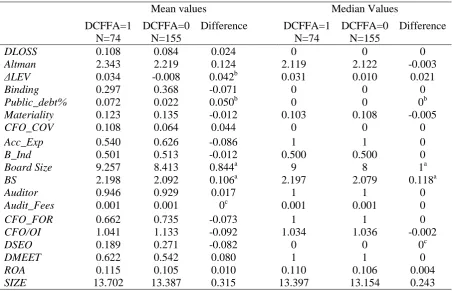
Table 1 presents mean and median values for the variables used in the models separately for firms which classify interest paid in CFFA versus CFOA. From our classification sample of 229 firms only about one third elect not to classify interest paid in CFFA (N=74) with the majority of firms (N=155) selecting to present this cash outflow in CFOA instead. This evidence is interesting in and of itself as it is consistent with our conjecture that the most natural category for this item is CFOA, leaving open the question of whether firms that choose not to do so are exploiting the discretion under IFRS in response to contractual or market incentives. The Table presents the difference in the mean (median) values across the two sub-samples along with t-tests (Wilcoxon tests) for the significance of the differences. In panel A, we present the statistics for the variables in the classification model. In general, the evidence suggests that the two groups do not exhibit significant differences for most of the explanatory variables with the only notable differences related to board size, ΔLEV, and
Public_debt%, suggesting that CFFA firms have larger boards, but that they also exhibit
greater increases in leverage at the year of the switch and are more exposed to public financing. Panel B presents the analysis for the additional variables included in the valuation model. Again, the two groups do not exhibit any significant differences in the additional explanatory variables of the model. However, differences in medians provide some evidence that CFFA firms exhibit higher valuations in the adoption year and that they are followed by more analysts.
Table 2 presents variable correlations. Panel A presents the correlations between the variables in the classification choice model, while panel B presents those of the valuation model. Except for the positive and significant correlation of DCFFA with board size, BS, change in
15 After excluding financial firms from the initial sample, we have missing data for a total of 67 non-financial
23
leverage, ΔLEV, and the percentage of public debt, Public_debt%, none of the other variables of Equation (1) are significantly correlated with DCFFA, consistent with the descriptive evidence presented in Table 1. According to the results presented in panel B, DCFFA does not exhibit any significant correlations neither with the valuation variables nor the additional control variables of the valuation model.16TQ is positively correlated with IND_Q and ROA
and negatively correlated with PPE, SIZE, and Materiality. Thus, firms with higher growth opportunities and profitability, smaller firms and firms with smaller capital intensity and material interest payments exhibit higher valuations. In general, the evidence presented in both Tables 1 and 2 fails to indicate that CFFA firms differ in significant ways from their CFOA counterparts. This is interesting in and of itself, as it suggests that based on most company characteristics a simple univariate analysis cannot help distinguish between the two types of firms. We examine whether a multivariable setting can better help explain the classification choice in the next section.
4.2 Explaining the classification choice
Results of Equation (1) are presented in Table 3. The first model separately examines the relation between contractual incentives and firm presentation choices while market incentives are examined in the second model. The third model examines the effect of corporate governance characteristics. The last model in Table 3 is the full model that includes all incentives along with the variables representing corporate governance characteristics.
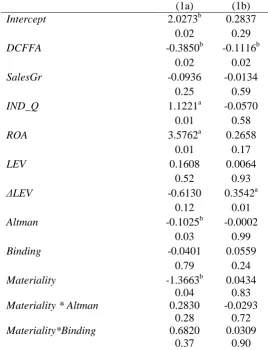
Overall, our evidence suggests a positive association between contractual incentives and the likelihood of firms inflating CFO. Specifically, the likelihood of not including interest paid in CFOA, (DCFFA=1) is positively related to firms reporting accounting losses, as indicated by the significantly positive coefficient on DLOSS. Findings show a significant positive relation between DCFFA and changes in leverage at the year of the switch, as suggested by the positive and significant coefficient on ΔLEV. Additionally, the composition of long-term debt seems to be associated with managers’ classification choice. More specifically, firms with a higher percentage of public debt have stronger incentives to inflate CFO, as suggested by the positive and significant coefficient on Public_Debt%. Even though the materiality of interest paid does not seem to explain the classification choice in the full model, model 1 of Table 3 suggests that materiality affects classification choice when firms are subject to binding debt
16 Given that some variables are included in both the classification choice and valuation models their
24
covenants.17 Finally, the existence of CFO-related covenants is associated with lower likelihood of including interest payments in CFOA but this relation is weaker for firms with lower probability of default, (reflected in higher values of the Altman score). Given that both
Public_Debt% and ΔLEV remain positive and significant in model 4 of Table 3 and based on
the evidence in Bradley and Roberts (2004) which suggests that the likelihood of having covenants in public debt issues is increasing with the firm’s leverage, we conclude that
contractual incentives are significantly associated with the firm’s classification choice. Specifically, our evidence suggests that the incentive to influence contractual outcomes is related to an increased probability of classifying interest payments in the CFFA rather than the CFOA category of the statement of cash flows. These results are consistent with extant research which suggests that firm reporting incentives are stronger when the firm is in poor financial condition (Lee, 2012; Christensen and Nikolaev, 2013) and confirm expectations that managers’ accounting and reporting choices are at least to some extent related to
incentives to reduce the likelihood of debt covenant violations (Watts and Zimmerman, 1986).
With respect to market incentives, (model 2 of Table 3), we find that the strongest incentives are those which relate to analyst cash flow forecasts. Specifically, the coefficient on
CFO_FOR is negative while the coefficient on DMEET is positive. Together this evidence
suggests that the existence of CFO forecasts is associated with greater probability of classifying interest paid in the CFOA section of the SCF. However, when managers face strong incentives to meet or beat these thresholds they are less likely to have classified interest paid in CFOA, consistent with research showing that firms manage earnings to meet or beat analyst earnings forecasts.18
Finally, our evidence presented in model 3 of Table 3 also suggests that firms with more effective corporate governance mechanisms in place, captured by the presence of an accounting expert on the audit committee and higher audit fees, are also associated with greater likelihood of classifying interest paid in CFOA as evidenced by the negative and significant coefficients on both of these variables. This evidence suggests that firms which
17 In untabulated results we find that the choice to classify interest received in CFOA does not explain the
classification choice of interest paid. We also find that the amount of interest received is significantly lower than the amount of interest paid. This implies that the impact of interest received on the firm’s cash flow is minimal and should not be expected to affect the reporting incentives associated with the classification of interest payments.
18DMEET is set to 0 if analysts do not make CFO forecasts. If we drop this assumption the number of
25
place a greater importance on disclosure quality, and hence exhibit lower information risk, are less likely to include interest paid in CFFA. This result suggests that better governed firms are more likely to include interest paid in CFOA to ensure the comparability of earnings and operating cash flows, increasing, in turn, the quality of financial reporting. We also find that the size of the firm’s board of directors is positively related to the choice of
CFFA as the disclosure medium, consistent with related research documenting that larger boards are less effective. Overall, this evidence suggests that firms with a strong governance structure, as it especially relates to financial information, are able to reduce agency costs and enhance firm disclosure quality by more effectively disciplining and monitoring managers.
4.3 Examining the effects of the classification choice on firm value
Table 4 presents results on the association between classification choice with firm value. These results are obtained after correcting for self-selection bias, in essence, alleviating concerns that the valuation difference observed is based on a non-random assignment of the sample firms to the two groups that is correlated with DCFFA. The model used to correct for endogeneity is presented in panel B and it includes all variables of the full model used to explain the classification choice (i.e., model 4 of Table 3) along with the additional variables in the valuation model. Excluding the additional valuation model variables in the first stage does not change the interpretation of results.
The first column of Table 4 presents the valuation model when the dependent variable is TQ
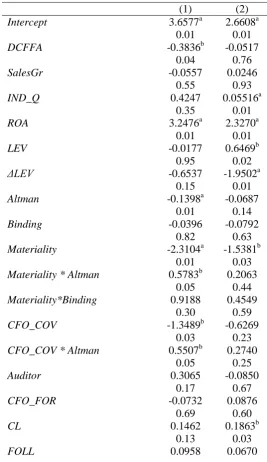
and the second when the dependent variable is ΔΤQt. Overall, results in the first model of Table 4 indicate that firms classifying interest paid in the financing section of the cash flow statement exhibit significantly lower valuations than firms presenting interest paid in CFOA, as evidenced by the negative and statistically significant coefficient on DCFFA. These results suggest that the market perceives this choice as indicative of poor future firm performance and/or lower disclosure quality. The inverse Mills ratio, λ, in Table 4 is negative and significant, which suggests that both endogeneity is present in our research setting and that the instruments of the first stage model aid in mitigating the resulting bias (Larcker and Rusticus, 2010).19 The negative coefficient on λ in particular, suggests that the unobserved factors that make the selection of CFFA more likely tend to be associated with lower valuations.
19
26
Turning to the rest of the control variables we find that firm profitability, ROA, is associated with higher valuations in line with higher ROA reflecting higher future cash flow expectations. Growth opportunities, as captured by IND_Q, are positively associated with firm value, consistent with the results of Doidge et al., (2004). We also find evidence that firms with material interest payments have lower valuations, as suggested by the significantly negative coefficient of Materiality. CFO_COV exhibits a negative coefficient, while this relation is weaker for firms with lower probability of default, (reflected in higher values of the Altman score). This finding is consistent with prior literature showing that the cost of debt covenant violation is impounded in lower shareholder wealth (Beneish and Press, 1995). Size is negatively related to firm value, consistent with the well-known small firm premium. The impact of IFRS adoption on financial statement measurement as captured by ΔROA04does not affect firm value, suggesting that the effect of DCFFA on firm value is not influenced by the overall impact of the IFRS switch on the firm’s reporting environment. Perhaps
counter-intuitively, we find a negative and significant coefficient on Altman, indicating that firms with higher probability of default actually exhibit higher valuations. Given the high correlation between Altman and ΔLEV of -0.148 as shown in panel B of Table 2, we posit that lower levels of Altman may capture a greater ability of debtholders to monitor managers reducing conflicts of interests and increasing in turn firm value.
An alternative method of correcting for the endogenous relation between firm value and the firm’s classification choice on the statement of cash flows is to employ a changes
specification which is less likely to be affected by endogeneity or omitted correlated variables even though documenting significant relations in a changes specification is generally more difficult.20 The second column of Table 4 presents results when the dependent variable is
ΔTQ, measured as the percentage change in Tobin’s q at the end of the first financial year
under IFRS reporting and the prior year. All explanatory variables, including DCFFA, are measured at the end of year t. 21 Results indicate that even in this specification, DCFFA is significantly and negatively related to changes in firm value. Thus, the choice allowed under IFRS to classify interest paid in the financing rather than the operating cash flow section of
20 The Heckman bias correction, λ, is significant at the 10% level suggesting that endogeneity is less of a
concern in this specification.
21Linking changes in classification choice to changes in firm value would provide further support for our
27
the statement of cash flows is associated with lower valuations. We interpret this result as being consistent with the classification choice reflecting higher information asymmetry and/or weaker future firm performance. This result is consistent with the evidence in Charitou et al. (2014) who find that IFRS adoption induces some firms to reveal their bad type. Interestingly, only one variable in this model is significant in this specification, in addition to
DCFFA. Results show that ΔLEV is positively related to changes in firm value around the
IFRS adoption event. This suggests that firms with increased levels of leverage benefit more from the classification choice allowed by IFRS possibly due to the ability of debtholders to better monitor firm management in enhanced disclosure environments.
5. Robustness Analyses
5.1 Reporting quality
In this section we address the concern that our inferences are affected by the firm’s overall reporting quality which might be correlated with the firm’s classification choice and in turn,
its valuation. If this is the case, our classification choice model may not adequately control for the firm’s reporting quality level, affecting our ability to explain this choice, and in turn,
impairing our ability to disentangle the effect of the presentation choice from the effect of accounting quality on firm value.
Panel A of Table 5 examines the sensitivity of our classification choice results by including in the full model (model 4) of Table 3, proxies for reporting quality. In the first model of panel A, we add in the model the variable ΔROA04 that captures the measurement impact of IFRS adoption on the firm’s net income. Under the assumption that firms with greater