warwick.ac.uk/lib-publications
Original citation:
Baker, Simon and Steiner, Wolfgang . (2017) On the regularity of the generalised golden
ratio function. Bulletin of the London Mathematical Society, 49 (1). pp. 58-70.
Permanent WRAP URL:
http://wrap.warwick.ac.uk/81650
Copyright and reuse:
The Warwick Research Archive Portal (WRAP) makes this work by researchers of the
University of Warwick available open access under the following conditions. Copyright ©
and all moral rights to the version of the paper presented here belong to the individual
author(s) and/or other copyright owners. To the extent reasonable and practicable the
material made available in WRAP has been checked for eligibility before being made
available.
Copies of full items can be used for personal research or study, educational, or not-for profit
purposes without prior permission or charge. Provided that the authors, title and full
bibliographic details are credited, a hyperlink and/or URL is given for the original metadata
page and the content is not changed in any way.
Publisher’s statement:
This is the peer reviewed version of the following article: Baker, S. and Steiner, W. (2017),
On the regularity of the generalised golden ratio function. Bull. London Math. Soc., 49: 58–
70. doi:10.1112/blms.12002, which has been published in final form at
http://dx.doi.org/10.1112/blms.12002
. This article may be used for non-commercial
purposes in accordance with
Wiley Terms and Conditions for Self-Archiving
.
A note on versions:
The version presented here may differ from the published version or, version of record, if
you wish to cite this item you are advised to consult the publisher’s version. Please see the
‘permanent WRAP url’ above for details on accessing the published version and note that
access may require a subscription.
On the regularity of the generalised golden ratio function
Simon Baker
1and Wolfgang Steiner
2 1Mathematics Institute,
University of Warwick,
Coventry, CV4 7AL, UK
2
IRIF, CNRS UMR 8243,
Universit´
e Paris Diderot - Paris 7,
Case 7014, 75205 Paris Cedex 13, France
Email contacts
:
[email protected]
[email protected]
September 5, 2016
Abstract
Given a finite set of real numbers A, the generalised golden ratio is the unique real number
G(A) >1 for which we only have trivial unique expansions in smaller bases, and have non-trivial unique expansions in larger bases. We show thatG(A) varies continuously with the alphabet A(of fixed size). What is more, we demonstrate that as we vary a single parameter m within A, the generalised golden ratio function may behave like m1/h for any positive integer h. These results
follow from a detailed study of G(A) for ternary alphabets, building upon the work of Komornik, Lai, and Pedicini (2011). We give a new proof of their main result, that is we explicitly calculate the functionG({0,1, m}). (For a ternary alphabet, it may be assumed without loss of generality that
A={0,1, m}withm∈(1,2)].) We also study the set ofm∈(1,2] for whichG({0,1, m}) = 1 +√m,
we prove that this set is uncountable and has Hausdorff dimension 0. We show that the function mappingmto G({0,1, m}) is of bounded variation yet has unbounded derivative. Finally, we show that it is possible to have unique expansions as well as points with precisely two expansions at the generalised golden ratio.
Mathematics Subject Classification 2010: 11A63, 28A80.
Key words and phrases: Beta expansions, Generalised golden ratios, Combinatorics on words
1
Introduction and statement of results
LetA:={a0, a1, . . . , ad} be a set of real numbers satisfyinga0< a1<· · ·< ad. We callAan alphabet.
Givenβ >1 andx∈R, we say that a sequence (uk)k∞=1∈ANis aβ-expansion forxover the alphabetA
if
x=
∞
X
k=1
uk
βk.
When the underlying alphabet is obvious we may simply refer to (uk) as a β-expansion. Expansions in
non-integer bases were introduced by R´enyi [8]. Perhaps the most well studied case is when β ∈(1,2] and A ={0,1}. Forβ ∈(1,2] and this choice of alphabet, x has a β-expansion over A if and only if
x∈[0,β−11 ]. Moreover, a result of Erd˝os, Jo´o, and Komornik [3] states that if β∈(1,1+
√ 5
2 ) then every
x∈(0,β−11 ) has a continuum ofβ-expansions. This result is complemented by a theorem of Dar´oczy and Katai [2] which states that ifβ∈(1+
√ 5
2 ,2] then there existsx∈(0, 1
β−1) with a uniqueβ-expansion. Note
above demonstrates that the golden ratio acts as a natural boundary between the possible cardinalities the set of expansions can take. It is natural to ask whether such a boundary exists for more general alphabets.
Before we state the definition of a generalised golden ratio it is necessary to define the univoque set. Given an alphabetA andβ >1 we set
Uβ(A) :=
n
(uk)∞k=1∈AN: ∞
X
k=1
uk
βk has a uniqueβ-expansion
o .
We call Uβ(A) the univoque set. Note that for any β > 1 and alphabet A = {a0, . . . , ad} satisfying
a0< a1<· · ·< ad,the points
∞
X
k=1
a0
βk and
∞
X
k=1
ad
βk
both have a unique expansion, soa0andadare always contained in the univoque set. Here and throughout
w denotes the infinite periodic word with period w. We are now in a position to define a generalised golden ratio for an arbitrary alphabet. Given an alphabetA, we callG(A)∈(1,∞) the generalised golden ratio forAif wheneverβ ∈(1,G(A)) we have Uβ(A) ={a0, ad}, and if β >G(A) thenUβ(A) contains a
non-trivial element.
Komornik, Lai, and Pedicini [4] were the first authors to make a thorough study of generalised golden ratios over arbitrary alphabets. Importantly they proved that for any alphabetA a generalised golden ratio exists. For ternary alphabets, they showed that the generalised golden ratio varies continously with the alphabet. We extend this result to alphabets of arbitrary size.
Theorem 1. Let∆d:={(a0, a1, . . . , ad)∈Rd+1: a0< a1<· · ·< ad},d≥1. The map(a0, a1, . . . , ad)7→
G({a0, a1, . . . , ad})is continuous on ∆d.
We prove this theorem in Section 2. In the rest of the paper, we restrict our attention to ternary alphabets. Every ternary alphabet can be assumed to be of the form A = {0,1, m} for some m > 1 because shifting the alphabet and multiplying by a constant does not affect the generalised golden ratio. We thus set
G(m) :=G({0,1, m}) andUβ(m) :=Uβ({0,1, m}).
Moreover,
G(m) =G({0,1, m}) =G({−m,1−m,0}) =Gn m
m−1,1,0
o
=G m
m−1
.
By the aboveG(m) =G(mm−1) and we may therefore assume m ∈(1,2]. The authors of [4] considered
m≥2, and their results read as follows in our setting.
Theorem KLP. The function G: (1,2]→Ris continuous and satisfies
2≤ G(m)≤1 +√m
for allm∈(1,2]. Moreover, the following statements hold.
• G(m) = 2form∈(1,2]if and only if m= 2k2−1k for some positive integerk.
• The set M:={m∈ (1,2] : G(m) = 1 +√m} is a Cantor set, its largest element is x2 ≈1.7548
wherex≈1.3247is the smallest Pisot number.
• Each connected component(m1, m2) of(1, x2)\Mhas a pointµsuch that G is strictly decreasing
on[m1, µ]and strictly increasing on [µ, m2];G is strictly increasing on [x2,2].
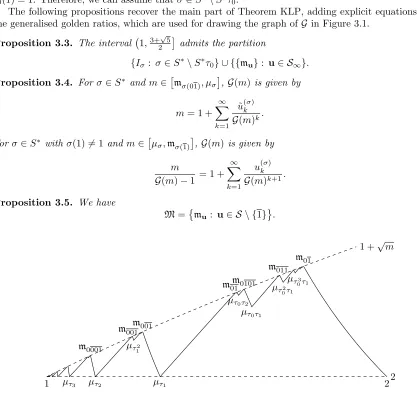
In Section 3, we reprove all these results, making some of the statements more explicit and simplifying several proofs. An approximation of the graph ofG can be found in Figure 3.1. The functionG is given by implicit equations on subintervals of (1,2], and it has the following unusual regularity properties.
We have the following result on the size ofM.
Theorem 3. The setMis an uncountable Cantor set with Hausdorff dimension0.
On certain intervals, the functionG has the following simple form.
Theorem 4. Let hbe a positive integer and 2h≤m≤ 1 +q m m−1
h
. Then we have
G(m) =G m
m−1
=m1/h.
Note that ifm= 2hthenm < 1+q m m−1
h
, thus the set ofmdefined within Theorem 4 is non-empty.
Moreover, we have the following result on the size of the set of expansions at the generalised golden ratio.
Theorem 5. There existsm∈(1,2]such that:
• UG(m)(m)contains non-trivial elements.
• Whenβ =G(m)there exists an xwith precisely twoβ-expansions.
Finally, we remark that the problem of calculating G(A) remains wide open. Only G({0,1, . . . , m}) has been calculated for any positive integermin [1].
2
Continuity of
G
(
A
)
Before proving Theorem 1, we recall results of Pedicini [7, Proposition 2.1 and Theorem 3.1] on (unique) expansions in non-integer bases over arbitrary alphabets; see also [4, Theorem 2.2].
Theorem P. Letβ ∈(1, q(A)], with
q(A) := 1 + ad−a0
max{a1−a0, a2−a1, . . . , ad−ad−1}
.
Everyx∈[ a0
β−1,
ad
β−1] has a β-expansion overA. We haveu1u2· · · ∈ Uβ(A) if and only if, for alli≥1,
∞
X
k=0
ui+k
βk < aj+1+
a0
β−1 whenui=aj6=ad, (2.1)
and
∞
X
k=0
ui+k
βk > aj−1+
ad
β−1 whenui =aj 6=a0. (2.2)
Remark 2.1. The conditions (2.1) and (2.2) can be restated in terms of uniqueness regionsEa: Let
Ea0 =
h a0β
β−1, a1+
a0
β−1
, Eaj =
aj−1+
ad
β−1, aj+1+
a0
β−1
,1≤j < d, Ead=
ad−1+
ad
β−1,
adβ
β−1
i .
Then (2.1) and (2.2) hold if and only ifP∞
k=0
ui+k
βk ∈Eui. By the following lemma, it is sufficient to considerβ≤q(A).
Lemma 2.2. We haveG(A)≤q(A).
Proof. Ifβ >1 + ad−a0
aj+1−aj for some 0≤j < d, thenaj+
ad
β−1< aj+1+βa−10 and thusajad∈ Uβ(A).
Remark 2.3. This upper bound is attained for certain alphabets. For example, let A={0,1,4,5}. For
β = q(A) = 8/3, the uniqueness regions areE0 = [0,1), E1 = (3,4), E4 = (4,5) andE5 = (7,8]. If
P∞
k=0
ui+k
βk ∈Eui, then
P∞
k=0
ui+1+k
Proof of Theorem 1. AsG(A) =G A−a0
ad−a0
, we haveG({a0, a1, . . . , ad}) =G(ι◦r(a0, a1, . . . , ad)), with
r: ∆d→∆0d, (a0, a1, . . . , ad)7→
a1−a0
ad−a0
,a2−a0 ad−a0
, . . . ,ad−1−a0 ad−a0
,
ι: ∆0d→ P(R), (a1, a2, . . . , ad−1)7→ {0, a1, a2, . . . , ad−1,1},
and ∆0d ={(a1, a2. . . , ad−1)∈Rd−1: 0 < a1 < a2 <· · · < ad−1 <1}. As r is continuous on ∆d, it is
sufficient to prove thatG ◦ιis continuous on ∆0d.
Leta= (a1, a2, . . . , ad−1)∈∆0dandε >0 arbitrary but fixed. We will show that|G(ι(b))− G(ι(a))| ≤
3ε for all b in a neighbourhood of a. Let first X ⊂ ∆0d be a closed neighbourhood of a such that
|q(ι(b))−q(ι(a))| ≤εfor allb∈X. (Note that q◦ιis continuous on ∆0d.) Set
α= min
b∈Xq(ι(b))−ε, Y ={b∈X : G(ι(b))< α}.
IfY =∅, then X is a neighbourhood ofa with |G(ι(b))− G(ι(a))| ≤ 2ε for all b∈ X. Otherwise, let
`≥2 be such thatP`
k=1α
−k ≥(α+ε−1)−1. Then
bj+1−bj ≤
1
q(ι(b))−1 ≤ 1
α+ε−1 ≤
`
X
k=1
1
αk (2.3)
for all (b1, . . . , bd−1)∈Y, 0≤j < d, with b0= 0,bd= 1. Set
δ(a,b) = min
0≤j<d (aj+1−aj)−(bj+1−bj)
(withb0=a0= 0, bd=ad= 1), and letZ⊂X be a neighbourhood ofa such that
aj
(α+ε)k −
bj
αk ≤δ(a,b),
bj
(α+ε)k −
aj
αk ≤δ(a,b) for all 1≤j≤d, 1≤k≤`, (2.4)
1−aj
(α+ε)k −
1−bj
αk ≤δ(a,b),
1−bj
(α+ε)k −
1−aj
αk ≤δ(a,b) for all 0≤j < d, 1≤k≤`, (2.5)
for allb= (b1, . . . , bd−1)∈Z. Note thatδ(a,b)≤0, thus we also have
aj
α+ε ≤ bj
α,
1−aj
α+ε ≤
1−bj
α , bj
α+ε ≤ aj
α,
1−bj
α+ε ≤
1−aj
α for all 0≤j≤d. (2.6)
Forb∈Y ∩Z and β ∈(G(ι(b)), α], choose u=u1u2· · · ∈ Uβ(ι(b)). Assume, w.l.o.g., thatu1u2 ∈/
{00,11}. We show first that u does not contain ` consecutive zeros or ones. Indeed, suppose that
ui+1=ui+2=· · ·=ui+`= 1 for somei≥1; then we have
∞
X
k=1
ui+k
βk ≥ `
X
k=1
1
βk ≥ `
X
k=1
1
αk ≥bj+1−bj
for all 0≤j < d, henceui= 1 because of (2.1); recursively we would obtain that ui−1 =· · ·=u1 = 1,
contradicting thatu1u26= 11. Similarly,ui+1=ui+2=· · ·=ui+`= 0 implies thatP
∞
k=1(1−ui+k)β−k≥
bj−bj−1 for all 1≤j≤d, henceui= 0 because of (2.2), eventually contradicting thatu1u26= 00.
We define the sequence ˜u via the relation ˜ui+k = aj if ui+k = bj. Let now i ≥ 1. We have
˜
ui+k(β+ε)−k ≤ui+kβ−k for allk≥1 because (2.6) implies that aj(β+ε)−k ≤bjβ−k for all 0≤j≤d.
Moreover, (2.4) and (2.6) give that
aj
(β+ε)k −
bj
βk ≤
aj
(α+ε)k −
bj
αk ≤δ(a,b)
for all 1≤k≤`, 1≤j≤d. Sinceui+k 6= 0 for some 1≤k≤`, we have ˜ui+k(β+ε)−k ≤ui+kβ−k+δ(a,b)
for somek≥1. Using (2.1), we get
∞
X
k=1
˜
ui+k
(β+ε)k ≤
∞
X
k=1
ui+k
Similarly, we obtain from (2.2), (2.5) and (2.6) that
∞
X
k=1
1−u˜i+k
(β+ε)k ≤
∞
X
k=1
1−ui+k
βk +δ(a,b)< bj−bj−1+δ(a,b)≤aj−aj−1 whenui=bj6= 0.
Therefore, we have ˜u∈ Uβ+ε(ι(a)), thusG(ι(a))≤ G(ι(b)) +εfor allb∈Y ∩Z.
For b∈X \Y, recall that G(ι(a))≤ q(ι(a))≤ α+ 2ε ≤ G(ι(b)) + 2ε. Similarly, we obtain for all
b∈ Z that G(ι(b)) ≤ G(ι(a)) +ε when a ∈ Y, G(ι(b)) ≤ G(ι(a)) + 3ε when a ∈/ Y. This gives that
|G(ι(b))− G(ι(a))| ≤3εfor allb∈Z, thusG ◦ιis continuous ata.
3
Generalised golden ratios over ternary alphabets
3.1
Statements
Komornik, Lai and Pedicini [4] described the functionm7→ G(m) on the interval (1,2]. We provide more details for this function, in particular for the set
M:={m∈(1,2] : G(m) = 1 +√m}.
Forh≥0, let τh be the substitution on the alphabet{0,1} defined by
τh(0) = 0h+11, τh(1) = 0h1,
and setS={τh: h≥0}. A (right) infinite worduis alimit wordof a sequence of substitutions (σn)n≥0
if there exist wordsu(n) with u(0) =uand u(n) =σ
n(u(n+1)) for all n≥0. A sequence (σn)n≥0 ∈SN
isprimitive ifσn6=τ0 for infinitely manyn≥0. A limit word of a primitive sequence in SNstarts with
σ0σ1· · ·σn(0) for alln≥0 and is therefore unique. Ifσn=τ0 for alln≥0, then 1k01,k≥0, and 1 are
limit words of (σn)n≥0; we are only interested in 01 and 1. Therefore, we define the following sets of limit
words (orS-adic words), whereS∗=S
n≥0S
n denotes the set of finite products of substitutions inS:
S=S∞∪ S01∪ S1 with S01={σ(01) : σ∈S∗}, S1={σ(1) : σ∈S∗},
S∞={u: uis the limit word of a primitive sequence of substitutions inSN}.
Remark 3.1. Komornik, Lai and Pedicini [4] observed that the sequences u ∈ S∞ with the leading 0
removed are exactly the standard Sturmian sequences. However, they omitted the word “standard”.
Foru=u0u1· · · ∈ {0,1}N, we definemu≥1 as the unique solution to
mu= 1 +
∞
X
k=0
uk
(1 +√mu)k
. (3.1)
Remark 3.2. We can rewrite (3.1) as
1 +√mu= 2 +
∞
X
k=0
uk
(1 +√mu)k+1
,
i.e., Parry’s [6]β-expansion ofβ= 1 +√muis 2u. We havemu= 1 if and only if u= 0.
Forσ∈S∗, we define the interval Iσ =
mσ(01),mσ(1)
⊂ 1,3+√5 2
. We defineβσ≥2 implicitly via
the equation
1 +
∞
X
k=1
˜
u(kσ) βk
σ
= (βσ−1)
1 +
∞
X
k=0
u(kσ) βσk+1
,
where
˜
u(0σ)u˜1(σ)u˜(2σ)· · ·=σ(01), u(0σ)u(1σ)u(2σ)· · ·=σ(1).
Moreover, we letµσ denote the coinciding value, i.e.,
µσ := 1 +
∞
X
k=1
˜
u(kσ) βk
σ
Note that all the numbers and sequences do not change if we replace σ by στ0 since τ0(01) = 01 and
τ0(1) = 1. Therefore, we can assume thatσ∈S∗\S∗τ0.
The following propositions recover the main part of Theorem KLP, adding explicit equations giving the generalised golden ratios, which are used for drawing the graph ofGin Figure 3.1.
Proposition 3.3. The interval 1,3+√5 2
admits the partition
{Iσ: σ∈S∗\S∗τ0} ∪ {{mu}: u∈ S∞}. (3.2)
Proposition 3.4. Forσ∈S∗ andm∈
mσ(01), µσ
,G(m)is given by
m= 1 +
∞
X
k=1
˜
u(kσ)
G(m)k.
Forσ∈S∗ with σ(1)6= 1andm∈
µσ,mσ(1)
,G(m) is given by
m
G(m)−1 = 1 +
∞
X
k=1
u(kσ)
G(m)k+1.
Proposition 3.5. We have
M=
mu: u∈ S \ {1} .
1 2
1 +√m
µτ3 µτ2
m0001
m001
µτ2 1
m001
µτ1
m01
µτ0τ2
m0101
µτ0τ1
m011
µτ2 0τ1
µτ3 0τ1
[image:7.612.84.501.59.462.2]2 m01
Figure 3.1: A graph ofG(m).
3.2
Partition of
(1
,
3+√
5 2
]
We first prove Proposition 3.3, using the following lemmas.
Lemma 3.6. Let σ∈S∗. Thenσ preserves the lexicographic order on infinite words.
Proof. The lexicographic order on infinite words is preserved by the identity and byσ∈S. By induction onn, this holds for allσ∈Sn,n≥0.
Lemma 3.7. Let σ∈S∗ with σ(1)6= 1, and writeσ(1) = 0w1. Then
σ(01) = 0w01.
In particular,1w0is a circular shift of σ(1).
Proof. Since σ(1) =στ0(1) and σ(01) =στ0(01), we assume w.l.o.g. that σ=τh0τh1· · ·τhn withn≥0,
hn 6= 0. Letσk=τhk. Thenσ[0,n](1) = 0w1 with
w=σ0(1)σ[0,1](1)· · ·σ[0,n−1](1)σ[0,n−1](0hn−1)σ[0,n−2](0hn−1)· · ·σ0(0h1)0h0.
Letv=σ0(1)σ[0,1](1)· · ·σ[0,n−1](1). Then we haveσ[0,n](0) = 0w01v and vσ[0,n](1) =w01v. Therefore,
Lemma 3.8. Let u=u0u1· · · ∈ {0,1}N\ {0}. We haveu∈ S if and only if
u0u1u2· · · ≤uiui+1ui+2· · · ≤1u1u2· · · for all i≥0. (3.3)
Proof. Assume that (3.3) holds. Then u0 = 0 or u= 1 = τ0(1). Ifu0 = 0, leth≥0 be minimal such
that uh+1 = 1. Then each 1 is followed by 0h+11 or 0h1, i.e., u=τh(u0) for some wordu0 =u00u01· · ·.
Moreover, we have u0 ≤ u0iu0i+1· · · ≤ 1u01u02· · · for all i ≥ 0. In case u0 = 0, we have u = τh+1(1).
Therefore, we can repeat the arguments and obtain recursively thatu is the limit word of a sequence (σn)n≥0∈SN. More precisely, we haveu∈ S01 orustarts withσ[0,n](0) for alln≥0, i.e.,u∈ S∞∪ S1.
Consider nowu∈ S∞∪ S01, limit word of (σn)n≥0 ∈SN. Thenustarts withσ[0,n](0) for alln≥0.
Denote the preimage of u by σ0 by u0 = u00u01· · ·, i.e., σ0(u0) = u. Suppose that uiui+1· · · ≤ u.
Thenuiui+1· · · starts withσ0(0), and uiui+1· · · =σ0(u0i0ui00+1· · ·) for somei0 ≥0. This implies that
u0i0u0i0+1· · · ≤ u0, thus u0i0u0i0+1· · · starts with σ1(0). Inductively, we obtain thatuiui+1· · · starts with
σ[0,n](0) for alln≥0, i.e., uiui+1· · · =u. Suppose now that uiui+1· · · ≥1u1u2· · ·. Thenui = 1 and
ui+1ui+2· · ·=σ0(u0i0u0i0+1· · ·) for somei0≥0, withu0i0u0i0+1· · · ≥1u01u02· · ·. We get that
uiui+1· · ·= 1σ0(1)σ[0,1](1)σ[0,2](1)· · ·= 1u1u2· · · .
Therefore, (3.3) holds.
Finally, letu∈ S1. If u= 1, then (3.3) holds trivially. Otherwise, we haveu=στh(1) with σ∈S∗,
h≥1. Then στh−1τj(01)∈ S01 converges toufor j→ ∞(in the usual topology of infinite words). By
the previous paragraph, (3.3) holds for these words. Hence, it also holds for the limit wordu.
Proof of Proposition 3.3. For m ∈ 1,3+
√ 5 2
, Parry’s (1+√m)-expansions of 1+√m are of the form 2u∈ {0,1,2}N with 0 <u≤1 and are ordered with respect to the lexicographic order. We show that
the interval (0,1]⊂ {0,1,2}N admits the partition
{[σ(01), σ(1)] : σ∈S∗\S∗τ0} ∪ {{u}: u∈ S∞}.
Assume that u=u0u1· · · ∈ S/ , i.e., (3.3) does not hold. Leti≥1 be minimal such that one of the
equalities is not satisfied. Suppose first that uiui+1· · · < u; then ui−1 = 1. Similarly to the proof of
Lemma 3.8, letσ0∈Sbe such thatu0· · ·ui−1=σ0(u00· · ·u0i0−1) withu00· · ·u0i0−16= 0· · ·0. By minimality of i, we have u0i0−1 = 1, and u00· · ·u0i0−1 = 1· · ·1 implies i0 = 1. Therefore, we can define recursively substitutionsσj ∈S until
σ[0,n](1) =u0u1· · ·ui−1.
Then we haveu< σ[0,n](1)u<· · ·< σ[0,n](1). By Lemma 3.6, we haveσ[0,n](01)<u.
Suppose now thatuiui+1· · ·>1u1u2· · ·. Then we have substitutionsσk =τhk such that
σ[0,n](0) =u0u1· · ·ui−11σ0(1)σ[0,1](1)· · ·σ[0,n−1](1),
withhn6= 0. We have u> u0u1· · ·ui−11, and the latter word is equal to σ[0,n](01) by Lemma 3.7 and
its proof. Sinceu0· · ·ui−1< σ[0,n](1), we also haveu< σ[0,n](1).
We have seen that eachuis the limit word of a primitive sequence of substitutionsσ∈SNor between
the extremal limit words of a non-primitive sequenceσ ∈SN. To see that σ is unique, let uand ˜u be
limit words of two different sequences (σn)n≥0 and (˜σn)n≥0. Letn≥0 be minimal such thatσn 6= ˜σn.
Let σn =τh, ˜σn = τj, and assume w.l.o.g. that h < j. Then we have ˜u ≤ σ˜[0,n](1) ≤ σ[0,n](0) < u.
Therefore, the intervals are disjoint.
3.3
Calculating the generalised golden ratio
We now prove thatG(m) is as in Theorem KLP and Proposition 3.4.
Lemma 3.9. Let m∈(1,2], β ∈[m, m+ 1], andu=u0u1· · · ∈ {0,1}N\ {0}. Then u∈ Uβ(m)if and
only if
m
β−1 <1 +
∞
X
k=1
ui+k
Proof. As q({0,1, m}) = 1 +m, Theorem P and Remark 2.1 give that u ∈ Uβ(m) if and only if
P∞
k=0
ui+k
βk ∈ Eui for all i ≥0, with E0 = [0,1) and E1 = (
m
β−1, m). If ui = 0, then we either have
uj = 0 for all j≥i and thus P∞k=0uβi+kk = 0∈E0 or there existsj > i such thatui =· · ·=uj−1 = 0,
uj = 1. In the latter case, P
∞
k=0
uj+k
βk ∈E1 implies thatP ∞
k=0
ui+k
βk ∈β
i−jE
1 ⊂E0 sinceβ ≥m. This
proves the lemma.
Lemma 3.10. Let u ∈ S∞, m ∈ (1,2]. Then we have u ∈ U1+√m(m) if and only if m = mu. In
particular, we haveG(mu)≤1 +
√
mu.
Proof. By Lemma 3.9, we have u=u0u1· · · ∈ U1+√m(m) if and only if
√
m <1 +
∞
X
k=1
ui+k
(1 +√m)k < m
for all i ≥ 0 such that ui = 1. By Lemma 3.8 and since u is aperiodic, ui = 1 implies that u <
ui+1ui+2· · · < u1u2· · ·. Here, the bounds u and u1u2· · · cannot be improved because, for all n ≥0,
1σ[0,n](0) and 1σ0(1)· · ·σ[0,n−1](1) (which is a suffix of σ[0,n](0)) are factors of u. Therefore, we have u∈ U1+√m(m) if and only if
√
m≤1 +
∞
X
k=1
uk
(1 +√m)k+1 and 1 + ∞
X
k=1
uk
(1 +√m)k ≤m.
This means that 1 +P∞
k=1uk(1+
√
m)−k =m, i.e.,m=m u.
Lemma 3.11. Let σ∈S∗ andm >1. There is a unique number fσ(m)>1 such that
m= 1 +
∞
X
k=1
˜
u(kσ) fσ(m)k
. (3.4)
We have fσ0(m) < 0, fσ(mσ(01)) = 1 +pmσ(01), fσ(m) < 1 +
√
m if and only if m > mσ(01), and σ(1)∈ U/ fσ(m)(m)if m≤2.
Proof. Lethm(x) = 1 +P∞k=1u˜
(σ)
k x
−k−m. Then lim
x→1hm(x) =∞, limx→∞hm(x) = 1−m <0,hm(x)
is continuous and strictly monotonically decreasing, thusfσ(m) is the unique solution ofhm(x) = 0. We
have
1
f0
σ(m)
=−
∞
X
k=1
ku˜(kσ)
fσ(m)k+1
<0,
in particularfσ(m)< fσ(mσ(01)) = 1 +pmσ(01)<1 +
√
mform >mσ(01).
By Lemma 3.7, 1˜u(1σ)˜u(2σ)· · · is a periodic word with the same period as σ(1). Therefore, (3.4) and Lemma 3.9 imply thatσ(1)∈ U/ fσ(m)(m).
Lemma 3.12. Let σ∈S∗ andm >1. There is a unique number gσ(m)>1 such that
m gσ(m)−1
= 1 +
∞
X
k=0
u(kσ) gσ(m)k+1
. (3.5)
We havegσ0(m)>0,gσ(mσ(1)) = 1 +pmσ(1),gσ(m)<1 +
√
m if and only if m <mσ(1), and σ(1)∈/
Ugσ(m)(m)ifm≤2.
Proof. Setting hm(x) = xm−1−1−P∞k=0
u(kσ)
xk+1, we have
h0m(x) =
∞
X
k=0
(k+ 1)u(kσ) xk+2 −
m
(x−1)2 ≤ ∞
X
k=0
k+ 1
xk+2 −
m
(x−1)2 =
1−m
forx >1. Similarly to the proof of Lemma 3.11,gσ(m) is the unique solution of hm(x) = 0. (Note that
gσ(m) =m ifσ(1) = 1.) We have
1
g0
σ(m)
= 1−gσ(m)hm0 (gσ(m))>0.
Now, gσ(m) < 1 +
√
m is equivalent to hm(1+
√
m) < 0, i.e., 1 +P∞
k=0u (σ)
k (1+
√
m)−k−1 > √m. By
Remark 3.2, we obtain thatm <mσ(1). Since 1σ(1) is a suffix ofσ(1), (3.5) and Lemma 3.9 give that
σ(1)∈ U/ gσ(m)(m).
Lemma 3.13. Let σ ∈ S∗. There is a unique µσ ∈ mσ(01),mσ(1)
with fσ(µσ) = gσ(µσ). We have
fσ(µσ) =gσ(µσ)≥2, with equality if and only ifσ(1) = 0n1 for somen≥0.
If m∈
mσ(01), µσ, thenσ(1)∈ Uβ(m)for allβ > fσ(m), in particularG(m)≤fσ(m).
If m∈
µσ,mσ(1)
, thenσ(1)∈ Uβ(m)for allβ > gσ(m), in particular G(m)≤gσ(m).
Proof. The number µσ is well defined sincef0(m)<0,g0(m)>0 onIσ,
fσ(mσ(01)) = 1 +pmσ(01)> gσ(mσ(01)) andfσ(mσ(1))<1 +pmσ(1)=gσ(mσ(1)).
Ifσ(1) = 1, thenµσ =βσ= 2. Assume in the following thatσ(1)6= 1 and letm= 1 +P
∞
k=0u (σ)
k 2− k−1,
i.e.,gσ(m) = 2. By Lemma 3.7, we haveσ(1) = 0w1≤w01 = ˜u
(σ) 1 u˜
(σ)
2 · · · for some finite wordw, thus
1 +
∞
X
k=1
˜
u(kσ)
2k ≥1 +
∞
X
k=0
u(kσ)
2k+1 =m,
hencefσ(m) ≥ 2 = gσ(m). This implies that βσ ≥ 2. If βσ = 2, then we must have 0w = w0, i.e.,
w= 0· · ·0. Therefore,βσ= 2 is equivalent toσ(1) = 0n1 for somen≥0.
Let now m∈
mσ(01), µσ
and β > fσ(m), or m ∈
µσ,mσ(1)
and β > gσ(m). Then we also have
β > gσ(m) andβ > fσ(m) respectively. Fori≥0 withu
(σ)
i = 1, we get
m
β−1 <1 +
∞
X
k=0
u(kσ) βk+1 ≤1 +
∞
X
k=1
u(i+σ)k βk ≤1 +
∞
X
k=1
˜
u(kσ) βk < m,
where the first inequality follows fromβ > gσ(m) and (3.6), the last inequality fromβ > fσ(m), and the
middle inequalities are direct consequences ofβ ≥2 andσ(1)≤u(iσ+1)ui(+2σ) · · · ≤u˜1(σ)u˜(2σ)· · ·, which holds by Lemmas 3.8 and 3.7. Thusσ(1)∈ Uβ(m).
The preceding lemmas show thatG(m)≤1 +√mfor allm∈(1,2]. The next lemma justifies why we have restricted our attention to sequences in{0,1}N.
Lemma 3.14. Let m∈(1,2],β≤1 +√m,u0u1· · · ∈ Uβ(m). Then ui=mimplies u0· · ·ui=m· · ·m.
Proof. If ui =m, i≥1, then (2.2) implies thatui−1+P∞k=1
ui−1+k
βk > ui−1+1β 1 + m β−1
≥ui−1+ 1,
thus (2.1) excludes thatui−1= 0 orui−1= 1. Recursively, we obtain thatuk =mfor all 0≤k≤m.
Lemma 3.15. Let m∈(1,2],β <2. ThenUβ(m) is trivial.
Proof. Letu0u1· · · ∈ Uβ(m). By Theorem P, we haveui6= 1 for all i≥0. Sincem≤1 +βm−1, we have
m0∈ U/ β(m), thus Lemma 3.14 implies thatUβ(m) ={0, m}.
Lemma 3.16. Let m ∈ (1,2], β ≤ 1 +√m, and u0u1· · · ∈ Uβ(m)∩({0,1}N\ {0}). Then we have
inf{ui+1ui+2· · ·: i≥0, ui= 1} ∈ S∞∪ S1.
Proof. Let ˜u= ˜u0u˜1· · · = inf{ui+1ui+2· · · : i≥0, ui= 1}. Since ˜u= 1∈ S1 when ˜u0= 1, we assume
in the following that ˜u0= 0. For alli≥0 with ˜ui = 1, we have
∞
X
k=1
˜
ui+k
βk < m−1≤β
m
β−1 −1
≤β inf
i≥0:ui=1
∞
X
k=1
ui+k
βk ≤β
∞
X
k=0
˜
uk
βk+1 = ∞
X
k=1
˜
uk
βk,
sinceE1 = βm−1, mand β≤1 +
√
m. Asβ ≥2 by Lemma 3.15, we obtain that ˜ui˜ui+1· · ·<1˜u1u˜2· · ·
for alli≥0. By the definition of ˜u, we also have ˜uiu˜i+1· · · ≥u˜, thus ˜u∈ S by Lemma 3.8. Moreover,
Remark 3.17. One obtains similarly that sup{0ui+1ui+2· · ·: i≥0, ui= 1} ∈ S∞∪ S01.
Proposition 3.18. We have
G(m) =
1 +√m ifm∈ {mu: u∈ S∞},
fσ(m) ifm∈mσ(01), µσ, σ∈S∗,
gσ(m) ifm∈µσ,mσ(1)
, σ∈S∗.
Proof. Let β ≥2, u ∈ Uβ(m)∩ {0,1}N and ˜u as in Lemma 3.16. Then ˜u∈ Uβ˜(m) for all ˜β > β. If
˜
u∈ S∞, then Lemma 3.10 gives thatβ≥1 +
√
m. If ˜u=σ(1),σ∈S∗, thenβ≥max{fσ(m), gσ(m)}by
Lemmas 3.11 and 3.12. This implies thatβ ≥fσ(m) ifm∈
mσ(01), µσ
, β≥gσ(m) ifm∈
µσ,mσ(1)
, andβ ≥1 +√motherwise. The opposite inequalities are also proved in Lemmas 3.10, 3.11 and 3.12.
The previous lemmas prove Propositions 3.4 and 3.5 and the main part of Theorem KLP.
Proof of Theorem 2. By Lemmas 3.11 and 3.12,G(m) is differentiable on (1,2]\ M∪ {µσ:σ∈S∗}
. By Propositions 3.3 and 3.18, Lemmas 3.11 and 3.12, and the continuity ofGon (1,2], the total variation is
X
σ∈S∗\S∗τ
0
G(mσ(01))− G(µσ)
+ X
σ∈S∗\S∗τ
0:σ(1)6=1
G(mσ(1))− G(µσ)
.
As limm→1+G(m) = 2 =G(2), the two sums are equal. Form∈ µσ,mσ(1),σ∈S∗,σ(1)6= 1, we have
1
G0(m)=
m
G(m)−1− G(m)−1
∞
X
k=1
(k+ 1)u(kσ)
G(m)k+2 = 1− ∞
X
k=1
k−k+ 1 G(m)
u(σ)
k
G(m)k+1
>1−
∞
X
k=1
k−k+ 1 G(m)
1
G(m)k+1 = 1−
1
G(m)2 ≥
3 4,
using thatk− k+1
G(m) ≥0 for allk≥1. Therefore, we have
X
σ∈S∗\S∗τ
0:σ(1)6=1
G(mσ(1))− G(µσ)
< 4
3
X
σ∈S∗\S∗τ
0:σ(1)6=1
(mσ(1)−µσ) =
4 3
1− X
σ∈S∗\S∗τ
0
(µσ−mσ(01))
.
We haveβτh = 2 for all h≥0 sinceτh(1) = 0
h1 and τ
h(01) = 0 0h1, thusµτh = 2
h+1/(2h+1−1), and
β= 1 +pm
τh(01)satisfiesβ
h+3−2βh+2−1 =β2−2β, henceµ
τ0−mτ0(01)≈0.24512 (andµσ=µτ0 when
σis the identity,m01=mτ
0(01)),µτ1−mτ1(01)≈0.05136. This gives that
P
σ∈S∗\S∗τ
0(µσ−mσ(01))>1/4,
thus the total variation is less than 2.
The derivative is unbounded because we have, for allm∈ mσ(01), µσ
withσ∈τhS∗,
1
G0(m)
= ∞ X k=1
ku˜(kσ)
G(m)k+1 ≤ ∞
X
k=h+1
k
2k+1 =
h+ 2 2h+1.
Proof of Theorem 4. Note that the map ι : m 7→ m
m−1 is an order-reversing involution on (1,∞). By
Proposition 3.18, we havem=ι(G(m)h) and thus G(m) =ι(m)1/h for allm∈[m
τh−1(01), µτh−1], h≥1.
Moreover,ι(m) ≥mτ
h−1(01) is equivalent to 1 +
p
ι(m)≥m1/h by Lemma 3.11, andµ
τh−1 = 2 by the
proof of Theorem 2. For 2h≤m≤ 1 +pι(m)h, we have thus G(ι(m)) =m1/h.
3.4
Hausdorff dimension of
M
In this section we show that the Hausdorff dimension ofMis 0.
Proof of Theorem 3. It suffices to show that dimH(G(M)) = 0 becauseG : M→Ris given byG(m) =
Given m∈ M, we know by Proposition 3.5 that m=mu for someu∈ S \ {1}. Remark 3.2 states
that 2uis also theβ-expansion ofβ = 1 +√mu. Therefore, for each n∈Nwe have
1 +√mu∈C2u1···un:=
β >1 : theβ-expansion of β starts with 2u1· · ·un .
We haveC2u1···un ⊂ [2,∞) and, hence, the diameter of C2u1···un is at most 2
−n, e.g., by a lemma of
Schmeling [10, Lemma 4.1].
We now prove dimH(G(M)) = 0 by explicitly constructing a cover. We introduce the set
Ln :=
u1· · ·un∈ {0,1}n : u1· · ·un is a prefix of an element ofS .
For eachn∈Nwe have
G(M)⊂ [
u1···un∈Ln
C2u1···un.
So the set{C2u1···un : u1· · ·un ∈Ln}is a cover of G(M). Lets >0 be arbitrary andH
s(·) denote the
s-dimensional Hausdorff measure. We observe
Hs(G(M))≤ lim n→∞
X
u1···un∈Ln
Diam(C2u1···un)
s≤ lim n→∞
#Ln
2ns .
As was pointed out in Remark 3.1, every element ofS is a Sturmian sequence. Thus it is a consequence of [5, Theorem 2.2.36] that #Ln grows at most polynomially inn. Therefore limn→∞#Ln2−ns= 0 and
dimH(M)≤s. Sincesis arbitrary we are done.
4
Behaviour at the generalised golden ratio
In this section we discuss the behaviour of the univoque set at the generalised golden ratio. It was observed in [1] that whenβ =G({0,1, . . . , m}) for some positive integerm, then everyx∈(0, m
β−1) either has a
countable infinite of expansions, or a continuum of expansions. In other wordsUG({0,1,...,m})({0,1, . . . , m})
is still trivial. However, Lemma 3.10 demonstrates that this is not always the case. Indeed the following result is an immediate consequence of this lemma.
Proposition 4.1. Ifu∈ S∞ then UG(mu)(mu)is non-trivial.
In [9] it was shown that the smallest β∈(1,2) for which anxhas precisely two expansions over the alphabet{0,1}wasβ2≈1.71064. As such, there is a small gap between the golden ratio for the alphabet
{0,1}, and the smallest β for which an xhas precisely two expansion. As we show below, for certain alphabets it is possible that anxhas precisely two expansions at the golden ratio.
Proposition 4.2. For everyu∈ S∞, the numbermu/G(mu)has precisely two expansions in baseG(mu)
over the alphabet{0,1,mu}.
Proof. Let β = G(mu) = 1 +
√
mu and let mu/β = P
∞
k=1vkβ−k be an expansion of mu/β over the
alphabet{0,1,mu}. Since mu> βm−1u , we have v1 ∈ {1,mu}, thus P
∞
k=1vk+1β−k equals mu−1 and 0
respectively. Clearly, 0 has a unique expansion, andmu−1 has the expansionu1u2· · · by (3.1), which
is also unique by Lemma 3.10.
Proposition 4.1 and Proposition 4.2 imply Theorem 5.
AcknowledgementsThe authors are grateful to Vilmos Komornik for posing the questions that lead to this research.
References
[1] S. Baker,Generalized golden ratios over integer alphabets,Integers14(2014), Paper No. A15, 28 pp.
[3] P. Erd˝os, I. Jo´o, V. Komornik,Characterization of the unique expansions1 =P∞
i=1q
−ni and related
problems, Bull. Soc. Math. Fr.118(1990), 377–390.
[4] V. Komornik, A.C. Lai, M. Pedicini, Generalized golden ratios of ternary alphabets, J. Eur. Math. Soc. (JEMS) 13(2011), no. 4, 1113–1146.
[5] M. Lothaire,Algebraic combinatorics on words, Encyclopedia of Mathematics and its Applications, 90. Cambridge University Press, Cambridge, 2002. xiv+504 pp. ISBN: 0-521-81220-8
[6] W. Parry, On theβ-expansions of real numbers, Acta Math. Acad. Sci. Hung.11(1960) 401–416.
[7] M. Pedicini,Greedy expansions and sets with deleted digits,Theoret. Comput. Sci.332(2005), no. 1–3, 313–336.
[8] A. R´enyi,Representations for real numbers and their ergodic properties, Acta Math. Acad. Sci. Hung.
8(1957) 477–493.
[9] N. Sidorov, Expansions in non-integer bases: lower, middle and top orders, J. Number Th. 129
(2009), 741–754.