warwick.ac.uk/lib-publications Manuscript version: Author’s Accepted Manuscript
The version presented in WRAP is the author’s accepted manuscript and may differ from the published version or Version of Record.
Persistent WRAP URL:
http://wrap.warwick.ac.uk/116283
How to cite:
Please refer to published version for the most recent bibliographic citation information. If a published version is known of, the repository item page linked to above, will contain details on accessing it.
Copyright and reuse:
The Warwick Research Archive Portal (WRAP) makes this work by researchers of the University of Warwick available open access under the following conditions.
Copyright © and all moral rights to the version of the paper presented here belong to the individual author(s) and/or other copyright owners. To the extent reasonable and
practicable the material made available in WRAP has been checked for eligibility before being made available.
Copies of full items can be used for personal research or study, educational, or not-for-profit purposes without prior permission or charge. Provided that the authors, title and full
bibliographic details are credited, a hyperlink and/or URL is given for the original metadata page and the content is not changed in any way.
Publisher’s statement:
Please refer to the repository item page, publisher’s statement section, for further information.
Manuscript version: Author’s Accepted Manuscript
The version presented in WRAP is the author’s accepted manuscript and may differ from the published version or Version of Record.
Gordon D. A. Browna John Gathergoodb
aDepartment of Psychology, University of Warwick, Coventry, CV4 7AL, United Kingdom.
Email: [email protected]
bSchool of Economics, University of Nottingham, Nottingham, NG7 2RD, United Kingdom.
Email: [email protected]
Corresponding author: Gordon D. A. Brown, Department of Psychology, University of
Warwick, COVENTRY, CV4 7AL, United Kingdom.
Email: [email protected]. Tel: +44 7818 423560
Acknowledgements: This study was supported by the Economic and Social Research Council
(U.K.) [grant numbers ES/K002201/1 and ES/P008976/1], the Leverhulme Trust [grant
number RP2012-V-022] and the European Research Council (ERC) under the European
Union’s Horizon 2020 research and innovation programme (grant agreement No 788826).
Abstract
Does happiness depend on what one earns or what one spends? Income is typically found to
have small beneficial effects on being. However, economic theory suggests that
well-being is conferred not by income but by consumption (i.e., spending on goods and services),
and a person’s level of consumption may differ greatly from their level of income due to saving
behavior and taxation. Moreover, research within consumer psychology has established
relationships between people’s spending in specific categories and their well-being. Here we
show for the first time using panel data that changes in life satisfaction are associated with
changes in consumption, not changes in income. We also find some evidence that increased
conspicuous consumption is more strongly associated with improved well-being than is
increased non-conspicuous consumption.
Consumption Changes, Not Income Changes, Predict Changes in Subjective Well-being
To what extent, and under what circumstances, are consumers happier when they have
more money? Much research into the relationship between economic circumstances and
subjective well-being has focused on the relationship between income and life satisfaction.
This strand of research has typically relied on the availability of large datasets to underpin the
relevant econometric analyses. It is usually found that income has a small beneficial effect on
the life satisfaction of people within a country at a given time, although effects of changing
GDP within countries over time are smaller or absent and effects of income on affective
well-being are sometimes smaller than effects on more cognitive/evaluative measures (Diener &
Seligman, 2004; Kahneman & Deaton, 2010; Stevenson & Wolfers, 2013).
While a strength of many of these studies is their use of large (and sometimes panel)
datasets, a major limitation is their focus on income rather than (or as well as) consumption.
The distinction matters both because of the difference between income and consumption and
in the light of a large body of work in consumer psychology concerning the effects of different
categories of consumption on well-being. Consumption is correlated with income, but at any
given point in time a person’s consumption level may differ greatly from their income level
due to saving behavior and taxation (Attanasio & Pistaferri, 2016; Meghir & Pistaferri, 2011).
Income may under-predict consumption (e.g., for poor households that receive food stamps, or
for households that borrow money to spend) or over-predict consumption (e.g., for wealthier
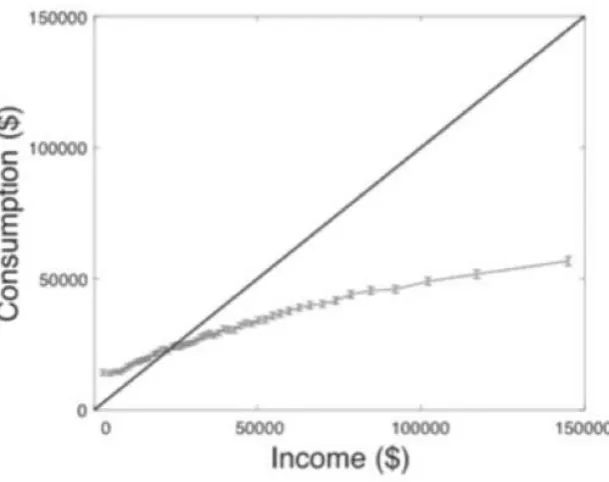
households, which typically save more). In Figure 1 we show that income and consumption
differ substantially among the sample of US households that we describe below. This
difference confirms that current income alone is a poor proxy for consumption of goods and
services. In this paper we therefore ask whether well-being is predicted by consumption,
Figure 1. Relation between income and consumption. Data are from the Panel Study of Income
Dynamics; see Supplementary Material available online for details. Income data sorted into 50
equally sized bins; points represent mean income and mean consumption within each bin. Error
bars show 95% confidence intervals.
The focus on income, rather than consumption, in econometric analyses of panel data
reflects the lack of available datasets. The few previous large dataset studies of consumption
and general well-being (DeLeire & Kalil, 2010; Headey, Muffels, & Wooden, 2008; Hudders
& Pandelaere, 2012; Noll & Weick, 2015) have mostly been cross-sectional and hence unable
individual differences (e.g., in personality)1. Moreover, previous studies have typically had
only partial consumption data available. Here in contrast we make use of a large dataset, the
Panel Study of Income Dynamics (PSID) which has complete consumption data (broken down
into categories) for individuals who are tested repeatedly. We exploit the panel structure of the
data to compare the effects of income changes and consumption changes as predictors of
changes in people’s life satisfaction.
Income might plausibly influence well-being even when conventional categories of
consumption are accounted for, perhaps because of savings or feelings of future security.
However the need to focus on the effects of consumption as well as of income on well-being
is confirmed by research (from both economics and psychology) that has focused on different
subcategories of consumption. Research in consumer psychology has typically focused on the
distinction between experiential and material consumption, research in social psychology has
examined effects of prosocial spending, and economic studies have placed more emphasis on
differential effects of conspicuous and non-conspicuous consumption.
Thus one suggestion is that only expenditure on experiential, rather than material, goods
leads to increased well-being (Gilovich & Kumar, 2015; Guevarra & Howell, 2015; Van Boven
& Gilovich, 2003) (although see Schmitt, Brakus, & Zarantonello, 2015). Thinking about past
experiential purchases improves mood more than does thinking about past material purchases,
experiences enter more strongly than do material items into people’s self-narratives (Carter &
Gilovich, 2012), and people are relatively more willing to wait for experiences than for
possessions (Kumar & Gilovich, 2016). Most of this research is laboratory-based and examines
1Headey et al. (2008) report a fixed effects analysis of satisfaction with standard of
living, using partial consumption data and finding a positive effect of consumption in British
the changes in affect associated with particular expenditures rather than the effect of general
consumption levels on a more cognitive/reflective measure of overall satisfaction with life,
although DeLeire and Kalil (2010) found, in analysis of a large dataset, that amongst older
Americans only leisure consumption was substantially and significantly related to life
satisfaction. DeLeire and Kalil also find a small positive effect of spending on charity and gifts.
Consistent with the latter finding, a third line of research has found positive effects of prosocial
spending on well-being (e.g., Dunn, Aknin, & Norton, 2008; Goodman, Lim, & Meyvis, 2017;
Whillans, Dunn, Sandstrom, Dickerson, & Madden, 2016).
Research within economics has in contrast emphasized the role of conspicuous or
positional consumption in conferring status-related utility (Frank, 2010; Saad, 2011; Veblen,
1899), consistent with a large body of research suggesting that the desire for status is a basic
human concern (Anderson, Hildreth, & Howland, 2015). Some correlational evidence is
consistent with a link between well-being and conspicuous consumption (Hudders &
Pandelaere, 2012, 2015; Masferrer-Dodas, Rico-Garcia, Huanca, Reyes-Garcia, & Team,
2012). While the literature on income and positional consumption differs from much research
in consumer psychology in the well-being measures that are typically used (i.e., often using
measures of cognitive/reflective rather than affective well-being), as well as in the manner in
which overall consumption is subdivided, it is possible that “experiential consumption” and
“conspicuous consumption” are at least partially overlapping categories. We return to this issue
below.
Here we address these issues in a novel way by making use of the PSID. This brings
two key advantages. First, use of panel data (in which the same individuals are surveyed on
more than one occasion) enables us to examine whether within-individual changes in economic
circumstances (whether of income or consumption) are associated with within-individual
achievable using cross-sectional data alone. Most previous results have not only been confined
to the study of income rather than consumption, but also have been cross-sectional (for
exceptions, see e.g. Cheng, Powdthavee, & Oswald, 2015; Hounkpatin, Wood, Brown, &
Dunn, 2015). Second, complete consumption data are available for individuals, broken down
by categories. This not only enables a more global examination of the effects of consumption
on well-being than is typical in the consumer psychology literature (in our dataset only about
5% of consumption expenditure is on vacations and hobbies, which are the categories closest
to “experiential” consumption), but allows us to look at sub-categories of consumption. We
first ask whether it is income, or consumption, that affect overall satisfaction with life. Income
can, after all, be allocated to material, experiential, or prosocial spending at the recipient’s
discretion. Taking an exploratory approach, we then look at possible differential effects of
different categories of consumption on well-being with a particular focus on the distinction
between conspicuous and non-conspicuous consumption.
Throughout, we focus on “fixed effects” analyses which exploit the panel structure of
the data and focus on within-individual changes in the variables of interest.2 While the results
from conventional cross-sectional regression analyses allow comparison of the effects of
consumption (and its subcategories) with the effects of income across individuals, such
analyses are limited in that they are susceptible to third-variable problems – there might be
some unmeasured individual characteristic (such as personality) which is correlated with both
well-being and spending behavior. The fixed effects analyses examine whether
within-individual changes over time in one variable (e.g., consumption) can predict within-within-individual
2 The term “fixed effects” is used in a number of different ways in different literatures
(see, e.g., Gelman, 2005). Our usage is most common in econometrics, and refers to estimating
changes in the outcome variable (well-being) after controlling for changes in other predictors.
The analyses therefore effectively control for the effects of unobservable but relatively stable
individual differences (e.g., in personality, although see Boyce, Wood, & Powdthavee, 2013;
Luhmann, Orth, Specht, Kandler, & Lucas, 2014) that might otherwise represent confounds.
Although the results from fixed effects analyses cannot exclude the possibility that some
causally relevant unobserved variable is changing over time within individuals, and are
informative solely about within-individuals effects, the fixed effects analyses represent a more
conservative approach than conventional cross-sectional regression. At the same time, these
analyses address different theoretical questions to those addressed by cross-sectional analyses,
and the fixed effects results that we report below cannot support claims about
between-individual relationships.
Analysis 1: Does income or consumption affect well-being?
Our first analysis examines whether income or consumption influences subjective
well-being. The PSID provides detailed consumption data on household expenditures in 34
categories as well as a measure of well-being and various control variables (Andreski, Li,
Samancioglu, & Schoeni, 2014).
Method
Our use of the PSID is motivated by the fact that, our knowledge, it is the only large scale
household panel survey that includes both measures of life satisfaction and detailed
consumption data. Full details of participants, data collection methods, and measures used in
the survey are available at psidonline.isr.umich.edu/Guide/documents.aspx. We use the three
most recently available waves — 2009, 2011 and 2013 — which include information on life
PSID has included a standard self-reported life satisfaction question phrased as follows:
‘Please think about your life as a whole. How satisfied are you with it? Are you completely
satisfied, very satisfied, somewhat satisfied, not very satisfied, or not at all satisfied?’ This
question is asked only of the main respondent, who also answers the household questionnaire.
Consequently, we use data on only one respondent per household. Our sample is therefore not
fully representative of the US adult population as it under-represents second and third adult
members of household units (typically spouses), with 74% of the respondents in our sample
being male. We restrict the sample to a balanced panel of households. We decided ahead of
time to omit observations which fall into the top 1% or bottom 1% of the distribution of
consumption or income, as there are typically extreme outliers (e.g., one or two incomes in the
millions of dollars, or reports of negative income and/or consumption) and hence such omission
is standard practice in econometric analyses.3
This left us with 16,992 observations for 5,664 individuals. Sample size was therefore
determined entirely by the nature of the sample available to us along with the above-mentioned
exclusionary criteria; no stopping rule was applied in our analyses. The STATA scripts used to
conduct the analyses are available in the online Supplementary Material. We have reported the
results of all analyses that were undertaken,
Summary data for demographics, socio-economic controls and the measure of life
satisfaction for the three waves of data pooled together are shown in the Supplementary
Material available online (Table S1). Among the balanced panel of individual-year
observations 74% are for male individuals, with an average age of 46. Approximately half of
the sample are married or have a partner, two-thirds have high school education or higher, more
3 We nonetheless repeated all analyses without the exclusions at the request of a referee
than two-thirds are employed and a little over 60% own their home. Average self-reported
health is 3.5 (mid-way between ‘good’ and ‘very good’), and the mean score on the Kessler
mental anxiety scale is 3.8 out of a possible 24. The average value of life satisfaction is 3.8,
with a standard deviation of 0.83. Equivalized total consumption (i.e. consumption per
household member) and consumption by main PSID category are summarized in Table S2 in
the Supplementary Material. The PSID consumption data are consistent with more detailed
consumption data in the Consumer Expenditure Survey. The table reports the unconditional
means and standard deviation (i.e. including zero values), hence the individual row means sum
to the mean of total consumption. The largest single consumption category is housing (36% of
total expenditure), followed by transport (19%) and food (15%). Summary data for the
sub-categories which together comprise these main sub-categories are shown in the online
Supplementary Material (Tables S3 and S4).
Results
Our main analysis estimates the following equation:
𝐿𝑆𝑖,𝑠,𝑡 = 𝛽1log(𝐶)𝑖,𝑠,𝑡+ 𝛽2log(𝑌)𝑖,𝑠,𝑡+ 𝛽3X𝑖,𝑠,𝑡 + 𝜃𝑖 + 𝜇𝑠 + 𝜑𝑡+ 𝜖𝑖,𝑠,𝑡(1)
where individual i lives in state s in time period, t, log(C) is the natural log of total equivalized
annual consumption, log(Y) is the natural log of equivalized annual income, X is a vector of
time-varying demographic and socio-economic controls and 𝜃, 𝜇, and 𝜑are individual, state
and time fixed effects. The time dimension of our data covers three waves: 2009, 2011 and
2013. In our baseline specification, consumption and income enter as their natural logs. To
ensure robustness, we also estimate models in which consumption and income enter in levels
As the majority of our analyses used the fixed effects method, in the Supplementary
Material we report overall between-subjects and within-subjects standard deviations for our
main variables (consumption and income: Table S5), main consumption categories (Table S6),
and socio-economic covariates (Table S7).
Our main econometric model regresses life-satisfaction (on a 5-point scale) against the
natural log of equivalized household consumption; the natural log of equivalized household
income; individual, geographic state of residence and time fixed effects, and controls. The key
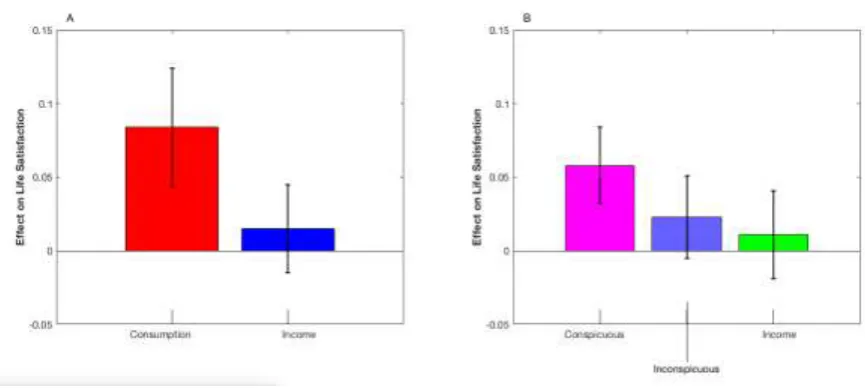
coefficients are shown in Figure 2A, with full results in Table 1.
[image:13.595.118.551.379.573.2]
Figure 2. Coefficients predicting life satisfaction from income and consumption. Data are from
the Panel Study of Income Dynamics. A: Coefficients on log(overall consumption) and
log(income). B: Coefficients on log(conspicuous consumption), log(inconspicuous
consumption) and log(income). All coefficients are from regressions that include controls.
In Columns 1 and 2 of Table 1 we show univariate models (i.e. without any controls or
fixed effects) in which life satisfaction is regressed against log income (Column 1) and log
consumption (Column 2) for the most recent (2013) wave of data.4 The variance inflation
factors were 1.03 (life satisfaction), 1.88 (log consumption), and 1.89 (log income), indicating
acceptable levels of collinearity. We then turn to the main analyses and include individual fixed
effects in Columns 3 and 4,
Table 1: Main regression estimates, log specification. Table reports regression estimates [95% Cis] for the balanced PSID panel 2009-2013.
Columns 1 and 2 are pooled cross-section regressions for the year 2013; Columns 3 - 7 include individual fixed effects. Education refers to highest
educational qualification obtained by the respondent. Employment refers to current employment status. Self-reported health question in full is:
`Would you say your health in general is excellent, very good, good, fair, or poor?' We code excellent = 5, poor = 1. Mental Anxiety Scale is
derived from responses to the Kessler-6 non-specific psychological distress scale.
(1) (2) (3) (4) (5) (6) (7)
Pooled Pooled Fixed Effects Fixed Effects Fixed Effects Fixed Effects Fixed Effects
Log Consumption 0.219 0.103 0.098 0.083 0.084
[0.179,0.259] [0.065,0.140] [0.059,0.137] [0.043,0.122] [0.045,0.124]
Log Income 0.179 0.033 0.018 0.009 0.015
[0.152,0.205] [0.004,0.062] [-0.012,0.047] [-0.021,0.039] [-0.015,0.045]
Age 0.027 -0.029
[-0.026,0.080] [-0.097,0.040]
Age Squared -0.000 0.000
[-0.001,0.001] [-0.001,0.001]
Age Cubed 0.000 -0.000
[-0.000,0.000] [-0.000,0.000]
Married / Partner (= 1) 0.103 0.094
[-0.012,0.218] [-0.021,0.209]
Widowed (= 1) 0.105 0.071
[-0.142,0.352] [-0.177,0.319]
Divorced (= 1) 0.015 -0.004
[-0.133,0.163] [-0.152,0.145]
Separated (= 1) -0.230 -0.239
[-0.385,-0.076] [-0.393,-0.085]
[image:15.842.79.764.219.526.2][0.011,0.063] [0.015,0.067]
Highschool Graduate (= 1) 0.109 0.096
[0.001,0.217] [-0.012,0.205]
College graduate (= 1) 0.048 0.059
[-0.078,0.174] [-0.068,0.185]
GED (= 1) 0.050 0.036
[-0.177,0.276] [-0.190,0.263]
Employed (= 1) 0.006 0.003
[-0.047,0.059] [-0.050,0.056]
Unemployed (= 1) -0.154 -0.158
[-0.221,-0.088] [-0.224,-0.092]
Temp. Non-Working (= 1) -0.036 -0.035
[-0.201,0.130] [-0.201,0.131]
Owns Home (=1) 0.046 0.041
[-0.038,0.130] [-0.043,0.126]
Rents Home (=1) 0.036 0.033
[-0.039,0.112] [-0.043,0.108]
Self-Reported Health (1-5) 0.090 0.089
[0.072,0.108] [0.070,0.107]
Mental Anxiety Scale -0.017 -0.021
[-0.021,-0.013] [-0.025,-0.017]
Observations 16992 16992 16992 16992 16992 16992 16992
State Fixed Effects No No No No No No Yes
CONSPICUOUS CONSUMPTION AND WELL-BEING
16
where it is evident that the magnitude of the coefficient on log consumption reduces by a half
and the coefficient on log income reduces to only one fifth of its previous magnitude. These
results confirm that controlling for individual level heterogeneity is very important in life
satisfaction estimates. When we include both log consumption and log income together
(Column 5) we find that the coefficient on log consumption is estimated to be greater than zero,
whereas the coefficient on log income is not. A t-test of equivalence confirms that the
coefficients are statistically significantly different from one another (p =.0030). The coefficient
on log consumption is five times larger than the coefficient on log income. With the addition
of socio-economic and demographic controls (Column 6) the coefficient on log consumption
falls slightly in magnitude but it increases very slightly when we add state of residence and
year fixed effects (Column 7).
Thus, there is a positive effect of consumption upon life satisfaction (β = 0.084, 95%
CI [0.045, 0.124]), but no evidence for an effect of income, in the most conservative analysis
(Column 7). The coefficient estimates imply that the effect of an increase in consumption is at
least five times as large as the effect of the same increase in income, when they are treated as
independent: A one standard deviation increase in consumption leads to an increase in life
satisfaction of approximately 5.2% of a standard deviation. We find very similar effects when
estimating models in which income and consumption enter in levels, not log (see Table S8 in
Supplementary Material for results).
Discussion
Our results show that consumption changes, not income changes, predict changes in
life satisfaction. We note possible implications for public policy. There has been much recent
CONSPICUOUS CONSUMPTION AND WELL-BEING
17
evaluated, at least in part, in terms of their effects on population well-being (Dolan &
Kahneman, 2008; O’Donnell, Deaton, Durand, Halpern, & Layard, 2014). While previous
studies use income-equivalents of well-being effects, our analysis suggests that the increases
in consumption that would be required to compensate for the negative effect of specific life
events on life satisfaction (consumption–equivalents) would differ.
Analysis 2: Effects of Different Categories of Consumption
The detailed consumption data available for this study allow us to examine the
relationship between different types of consumption and life satisfaction, and we do this in
Analysis 2. To our knowledge, ours is the first study to do so using detailed consumption
microdata in a panel survey design.
In analyzing the effects of subcategories of consumption, we adopt a conservative
approach. We first present results in a theory-neutral way by examining the effects of each
major subcategory of consumption on well-being after controlling for income and other
background variables. These analyses therefore make no assumption about the “correct” way
to group consumption categories together, and we include all the code for analysis so that other
researchers may construct their own groupings. However, given that there already exists a large
prior literature suggesting that conspicuous consumption is an important category, we then take
advantage of an independently-motivated categorization of consumption types as
“conspicuous” and “non-conspicuous” to examine the differential relations of these
subcategories of consumption to well-being.
Method
Table 2 shows the intercorrelation matrix between life satisfaction, income, total
CONSPICUOUS CONSUMPTION AND WELL-BEING
18
Table 2: Correlations between life satisfaction, income, total consumption, and all major
categories of consumption as defined in the PSID.
Life Satisfaction
Income Total
Cons
Food Housing Utilities Transport School Childcare Healthcare Home
Repairs
Home Furnishings
Clothing Holidays Hobbies
Life Satisfaction 1
Income 0.151 1
Total Consumption 0.123 0.645 1
Food 0.0877 0.406 0.552 1
Housing 0.0838 0.558 0.788 0.337 1
Utilities 0.0454 0.172 0.361 0.160 0.366 1
Transport 0.0580 0.300 0.568 0.209 0.209 0.106 1
School 0.0388 0.166 0.321 0.101 0.106 0.0214 0.0672 1
Childcare 0.0424 0.0958 0.133 0.0217 0.0695 -0.0221 0.0268 0.00997 1
Healthcare 0.0546 0.276 0.402 0.203 0.180 0.119 0.140 0.0669 0.0209 1
Home Repairs 0.0544 0.212 0.435 0.126 0.361 0.129 0.0736 0.0367 0.0225 0.125 1
Home Furnishings 0.0395 0.199 0.358 0.151 0.286 0.0595 0.0936 0.0247 0.0338 0.0721 0.154 1
Clothing 0.0277 0.219 0.329 0.191 0.180 0.0409 0.106 0.0655 0.0455 0.0499 0.0740 0.209 1
Holidays 0.117 0.397 0.439 0.261 0.261 0.0841 0.129 0.0901 0.0145 0.156 0.145 0.150 0.236 1
Hobbies 0.0398 0.257 0.313 0.199 0.172 0.00672 0.0971 0.0588 0.0150 0.0975 0.0805 0.112 0.222 0.233 1
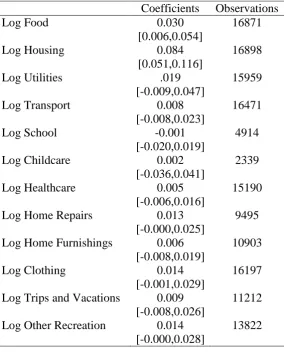
We first report the coefficients relating each PSID category of consumption to life satisfaction,
using the fixed effects specification and all the controls (income and socio-demographic
variables) used in the analyses reported above. Our aim here is to present an exploratory and
“theory neutral” analysis prior to exploiting an independently-developed classification of
consumption categories as “conspicuous” or “non-conspicuous”. The results can be seen in
Table 3, where it is evident that there are effects of spending in a number of different
[image:19.595.48.575.175.411.2]CONSPICUOUS CONSUMPTION AND WELL-BEING
[image:20.595.157.446.160.513.2]19
Table 3. Coefficients relating each PSID category of consumption to life satisfaction,
using the fixed effects specification and all controls.
Coefficients Observations
Log Food 0.030 16871
[0.006,0.054]
Log Housing 0.084 16898
[0.051,0.116]
Log Utilities .019 15959
[-0.009,0.047]
Log Transport 0.008 16471
[-0.008,0.023]
Log School -0.001 4914
[-0.020,0.019]
Log Childcare 0.002 2339
[-0.036,0.041]
Log Healthcare 0.005 15190
[-0.006,0.016]
Log Home Repairs 0.013 9495
[-0.000,0.025]
Log Home Furnishings 0.006 10903
[-0.008,0.019]
Log Clothing 0.014 16197
[-0.001,0.029]
Log Trips and Vacations 0.009 11212
[-0.008,0.026]
Log Other Recreation 0.014 13822
[-0.000,0.028]
For a more theory-driven analysis of conspicuous consumption, we assign each
sub-category as ‘conspicuous’ or ‘non-conspicuous’. We draw on data constructed by Heffetz
(2011) who commissioned a survey of a representative sample of US consumers who were
asked to evaluate the visibility of different consumption types. Respondents to the survey were
asked to evaluate 31 consumption categories with results indicating cigarettes to be most visible
category of expenditure and, perhaps unsurprisingly, underwear to be the least visible category.
The author uses those data to predict how consumption in different categories changes as a
CONSPICUOUS CONSUMPTION AND WELL-BEING
20
income when the consumption is more visible. This result is consistent with a model in which
consumers gain additional utility from consumption which is conspicuous. In our baseline
classification, we mapped all the PSID expenditure categories to the Heffetz classification, and
classified as “conspicuous” all and only all the PSID categories that appeared in the top half of
the ranking reported by Heffetz (2011). These were: food away from home, clothing, holidays,
recreation / hobbies and expenditure on telephones.
In additional classifications, we examine the sensitivity of results to including home
furnishings and schooling as ‘conspicuous’ (see below, and Supplementary Material).
Depending upon which classification we use, the share of conspicuous consumption among the
PSID sample ranges at the mean between one quarter to one third of total consumption.
Result
Table 4 presents estimates in which the natural log of total conspicuous and
non-conspicuous consumption enter into the econometric specification separately. The striking
result in Column 1 is that, when we include both conspicuous and non-conspicuous
consumption in the same specification, only the coefficient on conspicuous consumption is
estimated to be different from zero, although a t-test of equivalence found that the coefficients
were not statistically significantly different from one another at the conventional level (p =
0.1050). Columns 2 and 3 show that, even when the variables are entered separately, the
coefficient on non-conspicuous consumption is half the magnitude of that on conspicuous
consumption. As a sensitivity test, we also estimate the same model specifications, but with
Table 4: Conspicuous and non-conspicuous consumption, log specification. Table reports
individual fixed effects regression estimates (SEs) for balanced PSID panel 2009 -2013. For
categorization of consumption components into 'conspicuous' and 'non-conspicuous'
consumption groups see main text. Education refers to highest educational qualification
obtained by the respondent. Employment refers to current employment status. Self-reported
CONSPICUOUS CONSUMPTION AND WELL-BEING
21
fair, or poor?' We code excellent = 5, poor = 1. Mental Anxiety Scale is derived from responses
to the Kessler-6 non-specific psychological distress scale. Control variables not shown:
housing tenure dummies.
(1) (2) (3)
Fixed Effects Fixed Effects Fixed Effects
Log Conspicuous Consump. 0.058 0.061
[0.031,0.084] [0.035,0.087]
Log Non-Conspic. Consump. 0.023 0.033
[-0.005,0.051] [0.005,0.061]
Log Income 0.011 0.014 0.020
[-0.019,0.041] [-0.015,0.044] [-0.010,0.050]
Age -0.026 -0.025 -0.026
[-0.094,0.042] [-0.093,0.044] [-0.094,0.043]
Age Squared -0.000 -0.000 -0.000
[-0.001,0.001] [-0.001,0.001] [-0.001,0.001]
Age Cubed -0.000 -0.000 -0.000
[-0.000,0.000] [-0.000,0.000] [-0.000,0.000]
Married/Partner (= 1) 0.093 0.093 0.092
[-0.022,0.208] [-0.022,0.208] [-0.022,0.207]
Widowed (= 1) 0.065 0.067 0.071
[-0.183,0.313] [-0.181,0.315] [-0.177,0.319]
Divorced (= 1) -0.006 -0.006 -0.005
[-0.154,0.142] [-0.154,0.142] [-0.153,0.144]
Separated (= 1) -0.240 -0.239 -0.238
[-0.394,-0.085] [-0.394,-0.085] [-0.392,-0.084]
No. Dependent Children 0.041 0.040 0.036
[0.015,0.067] [0.014,0.066] [0.010,0.062]
Highschool Graduate (= 1) 0.098 0.099 0.097
[-0.010,0.207] [-0.010,0.207] [-0.012,0.205]
College graduate (= 1) 0.058 0.060 0.060
[-0.068,0.185] [-0.067,0.186] [-0.066,0.187]
GED (= 1) 0.038 0.036 0.033
[-0.188,0.265] [-0.190,0.262] [-0.194,0.259]
Employed (= 1) 0.002 0.003 0.004
[-0.051,0.055] [-0.050,0.056] [-0.049,0.057]
Unemployed (= 1) -0.158 -0.159 -0.159
[-0.224,-0.092] [-0.225,-0.093] [-0.226,-0.093]
Temp. Non-Working (= 1) -0.032 -0.030 -0.033
[-0.198,0.134] [-0.196,0.136] [-0.199,0.133]
Self-Reported Health (1-5) 0.088 0.088 0.089
[0.070,0.107] [0.069,0.106] [0.071,0.107]
CONSPICUOUS CONSUMPTION AND WELL-BEING
22
[-0.025,-0.017] [-0.025,-0.017] [-0.025,-0.017]
Observations 16992 16992 16992
consumption and income entering in levels (in units of ten thousand dollars), not log values
(see Table S9 in online Supplementary Material for results). The pattern in the coefficient
estimates is very similar to that in Table 4, with the exception that the estimate of the coefficient
of non-conspicuous consumption is not estimated to be different from zero in either
specification in which it enters and a t-test of equivalence confirms that the difference between
the coefficients approached the conventional level of statistical significance (p = 0.051). In
further sensitivity tests we i) excluded the measure of psychological anxiety from the
specification and also ii) excluded the measure of income from the specification. In both cases
results are unchanged.
As a sensitivity test, we change classifications of sub-categories of consumption across
groups. We see very similar results to those in the main tables (see Table S10 in Supplementary
Material for full results). When we include home furnishings in the conspicuous category, the
coefficient on the conspicuous consumption variable falls in magnitude and the coefficient on
the non-conspicuous consumption variable increases in magnitude. The same occurs to a lesser
extent when we also include school expenses in the conspicuous category. In both joint
specifications the coefficient on conspicuous consumption is more precisely estimated and
larger in magnitude than the coefficient on the non-conspicuous consumption variable.
Next, we note that it has recently been argued that the effects of income on well-being
reflect social comparison processes, and that is the relative rank of a person’s income within a
comparison group, rather than income per se, that is positively associated with well-being (e.g.,
CONSPICUOUS CONSUMPTION AND WELL-BEING
23
same is true for consumption. With the data we use here it is not possible to distinguish between
these possibilities, because the correlations between consumption and consumption rank are
very high. For example, rank of overall consumption is correlated .978 with log overall
consumption, and .938 with overall consumption level. For conspicuous consumption, the
correlations are .964 and .836 respectively. Although it may be possible to separate rank effects
and level effects by making use of different assumed comparison groups, such analyses fall
outside the scope of the present investigation.
Finally, we returned to the issue of whether the relevant categorization of consumption,
for the purposes of predicting life satisfaction, is conspicuous vs. non-conspicuous or
experiential vs. non-experiential. Experiential purchases such as vacations are often social and
highly visible, likely to be mentioned on social media, and the well-being benefit associated
with experiential goods is diminished if people are forbidden from talking about them (Kumar
& Gilovich, 2015). Set against this, it has been suggested that the beneficial effect on
well-being of experiential rather than material consumption reflects the fact that social comparison
is easier for material goods (Howell & Hill, 2009; Van Boven, 2005).
We do not have data on the purchasing intentions of our participants, so any analysis
must be tentative. However two of the sub-categories of consumption in our dataset appear to
be relatively unambiguously classifiable as experiential — expenditure on trips and vacations,
and expenditure on hobbies/recreation. We therefore calculated, for each individual, (a)
consumption falling within these two categories, which we label “experiential”, and (b) all
remaining consumption (“non-experiential”). We then conducted fixed effect analyses
paralleling those reported above for conspicuous and non-conspicuous consumption, and the
results are reported in Tables S11 (log specification) and S12 (level specification) in
CONSPICUOUS CONSUMPTION AND WELL-BEING
24
coefficients of similar magnitudes for experiential and non-experiential consumption when the
two categories were entered simultaneously and we cannot reject the null hypothesis of
equivalence of coefficients (p = 0.775), although the coefficient on non-experiential
consumption only just failed to reach significance at the conventional level, and both predicted
life satisfaction when entered separately (columns 2 and 3). Table S12 reveals a fairly similar
pattern, although when the two categories are entered simultaneously the difference between
coefficients was marginally significant (p = 0.08). Estimates are evidently sensitive to model
specification, so we consider these results to be inconclusive as to the effects of experiential
and non-experiential consumption on life satisfaction.
General Discussion
Ours is the first study to use large-scale longitudinal household panel microdata with
comprehensive consumption data to address the relationship between consumption and
well-being. Our findings demonstrate the importance of using consumption, as opposed to income,
to estimate the effects of economic resources upon well-being and in the use of such effects to
value non-market goods. Our use of a panel design (fixed-effects specification) goes some way
towards ruling out the possibility that our results reflect time-invariant confounding individual
differences like personality (e.g., individuals high in extraversion might both consume more
and experience higher well-being), although the possible existence of an unknown and causally
relevant third variable cannot be ruled out.
Our study relates to a large existing literature in both economics and psychology. It has
often been suggested that increased spending may actually reduce well-being (Frank, 2004;
Scitovsky, 1976) and, empirically, materialistic attitudes are associated with reduced
well-being on a number of dimensions (Kashdan & Breen, 2007; Kasser, 2002). Our results speak
CONSPICUOUS CONSUMPTION AND WELL-BEING
25
increased spending but they leave open the possibility that more affect-related aspects of
CONSPICUOUS CONSUMPTION AND WELL-BEING
26 References
Anderson, C., Hildreth, J. A. D., & Howland, L. (2015). Is the desire for status a fundamental
human motive? A review of the empirical literature. Psychological Bulletin, 141(3),
574-601.
Andreski, P., Li, G., Samancioglu, M. Z., & Schoeni, R. (2014). Estimates of annual
consumption expenditures and its major components in the PSID in comparison to the
CE. American Economic Review, 104(5), 132-135.
Attanasio, O. P., & Pistaferri, L. (2016). Consumption inequality. Journal of Economic
Perspectives, 30(2), 3-28.
Boyce, C. J., Brown, G. D. A., & Moore, S. C. (2010). Money and happiness: Rank of
income, not income, affects life satisfaction. Psychological Science, 21, 471-475.
Boyce, C. J., Wood, A. M., & Powdthavee, N. (2013). Is personality fixed? Personality
changes as much as "variable" economic factors and more strongly predicts changes
to life satisfaction. Social Indicators Research, 111(1), 287-305.
Carter, T. J., & Gilovich, T. (2012). I am what I do, not what I have: The differential
centrality of experiential and material purchases to the self. Journal of Personality
and Social Psychology, 102(6), 1304-1317.
Cheng, T. C., Powdthavee, N., & Oswald, A. J. (2015). Longitudinal evidence for a midlife
nadir in human well-being: Results from four data sets. The Economic Journal.
DeLeire, T., & Kalil, A. (2010). Does consumption buy happiness? Evidence from the United
States. International Review of Economics, 57(2), 163--176.
Diener, E., & Seligman, M. E. P. (2004). Beyond money: Toward an economy of well-being.
Psychological Science in the Public Interest, 5, 1-31.
Dolan, P., & Kahneman, D. (2008). Interpretations of utility and their implications for the
valuation of health. The Economic Journal, 118(525), 215-234.
Dunn, E. W., Aknin, L. B., & Norton, M. I. (2008). Spending money on others promotes
happiness. Science, 319(5870), 1687-1688.
Frank, R. H. (2004). How not to buy happiness. Daedalus, 133(2), 69-79.
Frank, R. H. (2010). Luxury fever: Weighing the cost of excess. Princeton, NJ: Princeton
CONSPICUOUS CONSUMPTION AND WELL-BEING
27
Gelman, A. (2005). Analysis of variance - Why it is more important than ever. Annals of
Statistics, 33(1), 1-31.
Gilovich, T., & Kumar, A. (2015). We'll Always Have Paris: The Hedonic Payoff from
Experiential and Material Investments. Advances in Experimental Social Psychology,
Vol 51, 51, 147-187.
Goodman, J. K., Lim, S., & Meyvis, T. (2017). When consumers prefer to give material gifts
instead of experiences: The role of social distance. Journal of Consumer Research.
Guevarra, D. A., & Howell, R. T. (2015). To have in order to do: Exploring the effects of
consuming experiential products on well‐being. Journal of Consumer Psychology,
25(1), 28-41.
Headey, B., Muffels, R., & Wooden, M. (2008). Money does not buy happiness: Or does it?
A reassessment based on the combined effects of wealth, income and consumption.
Social Indicators Research, 87(1), 65-82.
Heffetz, O. (2011). A test of conspicuous consumption: Visibility and income elasticities.
Review of Economics and Statistics, 93(4), 1101-1117.
Hounkpatin, H. O., Wood, A. M., Brown, G. D. A., & Dunn, G. (2015). Why does income
relate to depressive symptoms? Testing the income rank hypothesis longitudinally.
Social Indicators Research, 124(2), 637-655.
Howell, R. T., & Hill, G. (2009). The mediators of experiential purchases: Determining the
impact of psychological needs satisfaction and social comparison. The Journal of
Positive Psychology, 4(6), 511-522.
Hudders, L., & Pandelaere, M. (2012). The silver lining of materialism: The impact of luxury
consumption on subjective well-being. Journal of Happiness Studies, 13(3), 411-437.
Hudders, L., & Pandelaere, M. (2015). Is having a taste of luxury a good idea? How use vs.
Ownership of luxury products affects satisfaction with life. Applied Research in
Quality of Life, 10(2), 253-262.
Kahneman, D., & Deaton, A. (2010). High income improves evaluation of life but not
emotional well-being. Proceedings of the National Academy of Sciences of the United
States of America, 107(38), 16489-16493.
Kashdan, T. B., & Breen, W. L. (2007). Materialism and diminished well-being: Experiential
avoidance as a mediating mechanism. Journal of Social and Clinical Psychology,
26(5), 521-539.
CONSPICUOUS CONSUMPTION AND WELL-BEING
28
Kumar, A., & Gilovich, T. (2015). Some "thing" to talk about? Differential story utility from
experiential and material purchases. Personality and Social Psychology Bulletin,
41(10), 1320-1331.
Kumar, A., & Gilovich, T. (2016). To do or to have, now or later? The preferred consumption
profiles of material and experiential purchases. Journal of Consumer Psychology,
26(2), 169-178.
Luhmann, M., Orth, U., Specht, J., Kandler, C., & Lucas, R. E. (2014). Studying changes in
life circumstances and personality: It's about time. European Journal of Personality,
28(3), 256-266.
Masferrer-Dodas, E., Rico-Garcia, L., Huanca, T., Reyes-Garcia, V., & Team, T. B. S.
(2012). Consumption of market goods and wellbeing in small-scale societies: An
empirical test among the Tsimane' in the Bolivian Amazon. Ecological Economics,
84, 213-220.
Meghir, C., & Pistaferri, L. (2011). Earnings, consumption and life cycle choices. Handbook
of Labor Economics, 4, 773-854.
Noll, H.-H., & Weick, S. (2015). Consumption expenditures and subjective well-being:
empirical evidence from Germany. International Review of Economics, 62(2),
101--119.
O’Donnell, G., Deaton, A., Durand, M., Halpern, D., & Layard, R. (2014). Wellbeing and
policy. Retrieved from London, UK:
Saad, G. (2011). Consuming instinct. New York: Prometheus.
Schmitt, B., Brakus, J. J., & Zarantonello, L. (2015). From experiential psychology to
consumer experience. Journal of Consumer Psychology, 25(1), 166-171.
Scitovsky, T. (1976). The joyless economy: An inquiry into human satisfaction and consumer
dissatisfaction.
Stevenson, B., & Wolfers, J. (2013). Subjective well-being and income: Is there any evidence
of satiation? American Economic Review, 103(3), 598-604.
Van Boven, L. (2005). Experientialism, materialism, and the pursuit of happiness. Review of
General Psychology, 9(2), 132.
Van Boven, L., & Gilovich, T. (2003). To do or to have? That is the question. Journal of
Personality and Social Psychology, 85(6), 1193-1202.
Veblen, T. (1899). The theory of the leisure class. New York: The New American Library.
Whillans, A. V., Dunn, E. W., Sandstrom, G. M., Dickerson, S. S., & Madden, K. M. (2016).
CONSPICUOUS CONSUMPTION AND WELL-BEING
![Table 1: Main regression estimates, log specification. Table reports regression estimates [95% Cis] for the balanced PSID panel 2009-2013](https://thumb-us.123doks.com/thumbv2/123dok_us/9421786.445270/15.842.79.764.219.526/table-regression-estimates-specification-reports-regression-estimates-balanced.webp)