Exploiting Code Diversity to Enhance Code
Virtualization Protection
Chao Xue
†, Zhanyong Tang
†, Guixin Ye
†, Guanghui Li
†, Xiaoqing Gong
†, Wei Wang
†, Dingyi Fang
†, Zheng Wang
§ †School of Information Science and Technology, Northwest University, P. R. China.§Metalab, School of Computing and Communications, Lancaster University, U. K.
Abstract—Code virtualization built upon virtual machine (VM) technologies is emerging as a viable method for implementing code obfuscation to protect programs against unauthorized analysis. State-of-the-art VM-based protection approaches use a fixed set of virtual instructions and bytecode interpreters across programs. This, however, exposes a security vulnerability where an experienced attacker can use knowledge extracted from other programs to quickly uncover the mapping between virtual instructions and native code for applications protected under the same scheme. In this paper, we propose a novel VM-based code obfuscation system to address this problem. The core idea of our approach is to obfuscate the mapping between the opcodes of bytecode instructions and their semantics. We achieve this by partitioning each protected code region into multiple segments where the mapping of opcodes and their semantics is randomized in different ways in different segments. In this way, each bytecode instruction will be translated into different native code in different sections of the obfuscated code. This significantly increases the diversity of the program behavior. As a result, the knowledge of bytecode to native code mappings obtained from other programs will be less useful when targeting a new program. We evaluate our approach on a set of real-world applications and compare it against two state-of-the-art VM-based code obfuscation approaches. Experimental results show that our simple approach is effective, which provides stronger protection at the cost of little extra overhead.
Index Terms—Virtualized obfuscation, reverse engineering, instruction set randomization, analysis knowledge
I. INTRODUCTION
Unauthorized code reverse engineering is a major concern for software developers. It is often exploitted by adversaries to perform various attacks, including removing copyright protection of software, taking out advertisements from the application, or injecting malicious code into the program. By making the program harder to be traced and analyzed, code obfuscation is a viable means to protect software against unauthorized code modification [1], [2], [3], [4], [5], [6].
Code virtualization based on a virtual machine (VM) is emerging as a promising way for implementing code obfusca-tion [7], [8], [9], [10], [11], [12], [13]. This strategy forces the attacker to move from a familiar instruction set to an unfamiliar environment, which can significantly increase the time and effort involved in the attack.
Reverse engineering of VM-obfuscated code typically fol-lows several steps. The attack first reverse-engineers the virtual interpreter to understand the semantics of individual byte-code instructions. Then translates the bytebyte-code back to native
machine instructions or even high-level program languages to understand the program logic [14], [15]. Among these steps, understanding the semantics of individual bytecode instructions is often the most-consuming process, which is involved in analysing the handler that used to interpret every bytecode instruction.
Numerous approaches have been proposed to protect VM handlers from reverse engineering. Most of them aim to increase the diversity of program behavior by obfuscating the handler implementation [13] or iteratively transforming a single program multiple times using different interpretation techniques [10], [11]. However, all prior work employ a fixed strategy where each bytecode is deterministically translated to a fixed set of native code. Such techniques are vulnerable for programs protected under the same obfuscation technique. In particular, an attacker can reuse the knowledge (termed analysis knowledge) of the handler implementation obtained from one program to launch the attack on another program.
We present DCVP (Code Virtualization Protection with Diversity), an enhanced VM-based code obfuscation system to address the issue of reusing analysis knowledge. We employ a technique called Instruction Set Randomization (ISR) [16] to randomly change the opcodes of bytecode instructions and their semantics; so that the mapping between bytecodes and their handlers varies across programs. The randomization itself, however, is not sufficient for providing stronger pro-tection, because it is easy to be bypassed due to the non-uniform distribution of the bytecode instructions (e.g. the more frequent a bytecode is used, the more likely the relation between the bytecode and its handlers can be obtained from other programs). To overcome this issue, DCVPpartitions the protected code region into several parts where the mappings of bytecode instructions and their handlers in each part are different. As a result, the same bytecode instruction in different parts of the program will have different semantics.
Native Instr. VIs Bytecode
Binary Rewriting Virtualization Encoding
Code Extraction
Code Virtualized obfuscation
VM Core
VMcontext VMinit VMloop Handlers
Output Program
VM Section jmp VMinit Junk Instr
Target Program
Critical Code
VMexit
push ebx add ecx, eax
loadd r3 loadd r1 loadd r0 addd stored r1
01 03 02 01 02 00 1b 03 01
Encoding Schemes Virtual IS
a
[image:2.612.48.300.51.144.2]b
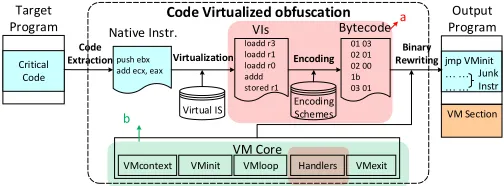
Fig. 1: A representative architecture for VM-based obfuscation. The main work of this paper is to improve the core steps of VM-based protection (areas marked as “a” and “b”). In the first region (a), we partition the protected code region into different segments, and obfuscate thebytecode handlersto generate multiple implementations for eachhandler. In the second region (b), we use a number of obfuscation and anti-taint analysis technologies to protect the important components of the VM core.
programs, but preventing this is outside the scope of this work.
II. BACKGROUND
Virtualization techniques is widely used to protect software programs from unauthorized analyses. Examples of VM-based code obfuscation tools include VMProtect [8], Code Virtual-izer [7] and [9]. Code obfuscation often comes at a cost, with bloating code size and longer execution time. To minimize the overhead, in practice only critical parts of the software are obfuscated [17]. VM-based protection works by transforming the native machine code of the protected code region into a set of bespoke virtual instructions which are stored as bytecode in the program binary. At runtime, the virtual instructions will be translated into native code using byte interpreters.
Figure 1 illustrates a classical VM-based obfuscation sys-tem. At the heart of this system are the virtual IS (Instruction Set) and the set of interpreters used to translate the IS to native code. Interpretation of virtual instructions follows the classical decode-dispatchapproach [18], using a bundle ofhandlers and a VMloop. Here, the VMloop is the execution engine which fetches and decodes a bytecode instruction and then dispatches a handlerto interpret instruction. VMcontext, which contains hardware-independent virtual registers and flags. At runtime, the virtual registers and flags will be mapped down to the underlying hardware, and the VMInit is responsible for saving the native context and initializing theVMcontext. In comparison,VMExitrestores the native context when exiting VM. Finally, these VM components will be assembled into a new section and attached to the end of the target program through binary rewriting.
Our work focuses on two key components of the VM-based obfuscation architecture, highlighted using labels ‘a’ and ’b’ in Figure 1. Our approach divides the protected code region to different sections. It generates multiple implementations for each bytecode handler using code obfuscation techniques. Different implementations of the same bytecode handler are semantically equivalent and will produce an identical output for a given virtual instruction; but they follow different ex-ecution paths and exhibit diverse behavior during runtime. We further enhance the strength of the protection by using a number of obfuscation and anti-taint analysis technologies to protect the important components of the VMCore.
III. THETHREATMODEL
In our threat model, we assume an attacker owns a copy of the target application and can run it in a malicious host envi-ronment [19]. Such a threat model is also known as the white-box attack [20], [21]. In such an environment, the adversary has full privileged accesses to the system. We also assume the adversary can use static and dynamic analysis tools, such as IDA[22],OllyDbg[23] andSysinternals Suite[24], to trace and analyze instructions, monitor registers and process memory, and modify instruction bytes and control flows at runtime, etc. Prior work has demonstrated that these are reason assumptions [14], which are often available to an experienced adversary.
There are two preliminarily used methods to attack VM-based protection systems. Our work assumes an adversary can use any of or a combination of the methods to launch the attack. These two methods are described as follows.
The first technique is based on the virtual execution analysis proposed by Rolleset al.[15]. This requires an analyst to have a deep understanding of the code virtualization techniques employed by the obfuscation system. It works by dynamically tracking the execution process of the virtual interpreter to extract the key bytecodes and handlers, and then through the analysis and code simplification to recover the program logic. Falliereet al.[14] show that it is possible to perform the above analysis [8]. This type of attack method is closely related to the principle and structure of code virtualization, and has been widely adopted to analyze obfuscated malware.
The second technique is based on behavior and semantic analysis of the target program. This type of attack method can be used to attack not only code virtualization but also other obfuscation methods. Coogan et al. [25] propose a behavior based analysis method. Their approach aims to analyze impor-tant behavior of code, but it does not pay attention to restoring the original code. Yadegariet al.[26] propose a method based on semantic analysis. The method uses taint propagation to track the flow of inputs values, and semantics-preserving code transformations to simplify the logic of the instructions. This type of method has wider applicability, but is restricted to a small code region.
IV. MOTIVATION
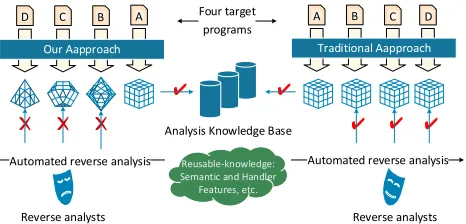
Figure 2 depicts an reverse analysis scenario where an analyst can reuse theanalysis knowledgeto attack applications protected by the same VM-based code obfuscation scheme. In this example, there are four different programs to be protected, labelled as A, B, C and D. In the right side of the diagram, all the four programs are protected using an identical set of virtual instructions and bytecode handlers.
Automated reverse analysis
Reverse analysts Reverse analysts
Traditional Aapproach
A B C D
Analysis Knowledge Base Four target
programs
Reusable-knowledge: Semantic and Handler
Features, etc.
Our Aapproach
D C B A
[image:3.612.60.293.52.164.2]Automated reverse analysis
Fig. 2: The process of reusing attacking knowledge for code reverse engineer-ing. Here we have four different target programs, A, B, C and D. In the right side of the scenario, all programs are obfuscated with a code obfuscation scheme that a virtual instruction will be deterministically translated to a fixed set of native code. This allows an attacker to reuse knowledge obtained from one program to efficiently reverse engineer other programs. In another scenario, the mapping between virtual instructions and native code is different for different programs. In this way, the attacker is unable to reuse the previously extracted knowledge to perform reverse analysis across programs.
knowledge thus can significantly reduce the cost involved in the attack. In another scenario, the translations between virtual instructions and native code vary among programs. Therefore, the knowledge obtained from one program will be inapplicable to others. This forces the analyst to start from the scratch when reverse engineering a new program. This example shows that shuffle the relationship between the virtual instructions and bytecode handlers can significantly increase the effort and cost involved in performing the attack. In the remainder sections of the paper, we describe how we can construct such as scheme in details.
V. OVERVIEW
DCVP consists of four components, described as follows.
Virtual Instruction Set and Handlers. The native machine
instructions within the target code region are translated into bespoke virtual instructions and stored as bytecode in the program binary. The virtual instructions will be decoded by the handlers during runtime. A virtual instruction can be decoded by multiple semantically-equivalent handlers. A brief description of the design of a virtual instruction set is given in Section VI.
Native code translation. We develop a tool to automatically
translate the native machine code into virtual instructions and stored as bytecode. This is detailed in Section VII-A.
Bytecode diversification.The generated bytecode instructions will be diversified using a special encoding scheme. Each protected code region is partitioned to multiple segments and the opcodes of the virtual instructions in each segment will be mapped to different native code. This means that a mapping from opcode to native code found at one segment is likely to be inapplicable for other segments. This is the key component of DCVP, presented at Section VII-B.
PE Refactoring.Finally, the generated bytecode program and
other VM components will be linked together through binary rewriting.
VI. VIRTUALINSTRUCTIONSET ANDHANDLERS
The virtual instruction set and their handlers are the founda-tions of any VM-based code obfuscation system. The virtual instruction set must be Turing-equivalent to target native machine code. This means that any native instruction could be substituted with some virtual instructions without violating the semantics of the original code. Virtual instructions will be interpreted by the hand-crafted handlers during program execution. It is to note that the instruction handlers are written in native instructions.
There are two mainstream approaches for implementing a VM: a stack-based approach and a register-based one. In this paper, we choose to use the stack-based architecture to implement DCVPfor the following reasons:
• In a stack-based VM, operations are carried out with the help of stack, where operands and results of operations are stored. This simplifies the addressing of operands and ultimately simplifies the implementation ofhandlers. • The process of converting native x86 instructions to virtual instructions is simpler compared to a register-based alternative.
• Stack-based VMs require more virtual instructions for a given computation; this makes the instructions more complex and conforms to our objective of impeding reverse analysis.
A n¨aive approach to design a virtual instruction set that is semantically equivalent to the native instruction set, is to map every single native instruction to a virtual instruction. However, this would require us to implement a large number of instruction handlers as our goal is to provide multiple handlers for a single virtual instructions. We choose a different approach that has a lower implementation cost, by exploiting the characteristics of a stack-based VM. Our design choice is based on the following observation. In a stack VM, a native operation is either executed or virtualized a three-step fashion: (i) pushing the operand into the stack, (ii) executing an operation, and (iii) storing the result into the execution context. Therefore, we can use the following, smaller number of instructions to implement a virtual instruction set:
• We needloadandstoreinstructions for data transfers. loadinstructions are for pushing operands into the stack, andstoreinstructions are for popping results out of the stack and storing the results back the virtual context. • We need arithmetical and logical instructions. The
num-ber of these virtual instructions needed are smaller than their Intel x86 counterparts, as the addressing mode of operands is simpler and uniform (i.e., stack-based memory addressing).
• Branch instructions for changing the control flow of the bytecode program.
native context and re-enter the VM to continue executing the remaining bytecode instructions.
VII. OFFLINECODEOBFUSCATION
We now describe how to translate native instruction instruc-tions to virtual instrucinstruc-tions and store them in the bytecode format.
A. Native Instructions to Virtual Instructions
At code obfuscation time, we first convert native instructions into virtual instructions. This conversion process follows the three-step execution process in a stack-based VM, which is described in Section VI. Specifically, we first load the operands into stack with theloadvirtual instruction; then, we execute the ready to execute operation; and store the result into virtual context or a certain memory address with store virtual instructions.
Native data transfer instructions are mainly mapped into loadandstoreinstructions. Examples of such instructions in the x86 instruction set include mov, push, and pop. Arithmetical and logical instructions will be translated by strictly following the aforementioned three-phase processing, and branch instructions are mapped into a load instruction followed by a virtual branching instruction. Native instructions with complex addressing modes are processed iteratively using a combination of the aboved virtual instructions.
B. Virtual Instructions to Bytecodes
Virtual instructions will be encoded into bytecodes in the end. It is similar to that an assembler assembles assembly instructions into machine code and only can be interpreted by virtual interpreter of VM-based protection system. We adopt an encoding scheme less compacted than the x86 instruction architecture which uses separate bytes for the opcode and operand of a virtual instruction. In practice, we assign each virtual instruction a distinct ID as its opcode. The ID is used by VMloopas an index to find the address of thehandler of the virtual instruction in the address table recording the addresses of each handler. Since the number of virtual instructions is less than 256, thus one byte is sufficient to encode their IDs. As for theoperands, since they could be of different size1, we use one, two, or four bytes to encode them correspondingly.
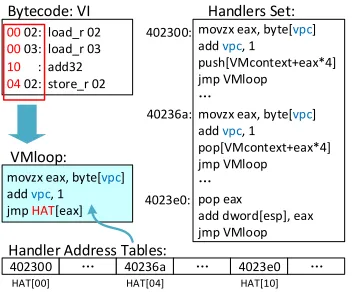
1) Randomize the Semantics of Bytecode Instructions: From the above demonstration, if an analyst gets known the semantics of a bytecode instruction, the next time she encounters it, she does not bother to analyze its handler once again to figure out what it does2. For example, in Figure 3, the bytecode instruction"10"means an addition operation through analyzing Handler 4023e0. The next time we
1Theoperandof a virtual instruction could be an index for virtual register,
an immediate value, or a memory address. They could be of different size: a virtual register index being 8 bits, an immediate value being 8/16/32 bits, and a memory address being 32 bits.
2Sincehandlerscould be mutated to hinder analysis, it saves an analyst
a lot of time end effort without bothering to analyze them once again.
00 02: load_r 02
00 03: load_r 03
10 : add32
04 02: store_r 02
movzx eax, byte[vpc] add vpc, 1
push[VMcontext+eax*4] jmp VMloop
movzx eax, byte[vpc] add vpc, 1
pop[VMcontext+eax*4] jmp VMloop
pop eax
add dword[esp], eax jmp VMloop
402300
402300:
40236a:
Handler Address Tables: VMloop:
HAT[00] HAT[04] HAT[10] Bytecode: VI Handlers Set:
40236a 4023e0
movzx eax, byte[vpc] add vpc, 1
[image:4.612.351.527.52.198.2]jmp HAT[eax] 4023e0:
Fig. 3: Examples of some virtual instructions and their bytecode. Each virtual instruction is encoded into a bytecode instruction, which consists of anopcode
and optionally anoperand. The bytecode instructions feed intoVMloopand
theopcodeof each bytecode instruction is used byVMloopas an index to
find the address of the corresponding handler in the HAT (Handler Address Table).
encounter a bytecode instruction of "10", we could say that it does an addition operation immediately.
To mitigate the effect of reuse of previously obtained analysis knowledge, we randomize the semantics of virtual instructions. According to the encoding scheme we adopt, it is easy to achieve this goal. The idea is to change the relationship between the IDs (opcodes) and the virtual instructions, which is similar to [16]. Every time to encode the virtual instructions, the IDs are first shuffled once. Then the shuffled IDs are used to encode the virtual instructions. The addresses of handlers are also filled into the handler address table accordingly.
00 03: load_r 03
10 : add32
93 : switch_HAT
7a 05: load_r 05
17 : add32
52 : switch_HAT
movzx eax, byte[vpc] add vpc, 1
push[VMcontext+eax*4] jmp VMloop
mov eax, [esp] add esp, 4 add dword[esp], eax jmp VMloop
add HAT, 250h jmp VMloop
pop eax add dword[esp], eax jmp VMloop
add HAT, 250h mov ecx, ecx jmp VMloop
push [vpc] pop eax add vpc, 1
push[VMcontext+eax*4] jmp VMloop
402300 4023e0 4024a6
4026a4 402300:
4023e0:
4024a6:
4026a4:
4026f8:
402740:
Handler Address Tables: HAT0:
HAT1: 4026f8 402740
VMloop:
HAT0[00] HAT0[10] HAT0[93]
HAT1[17] HAT1[52] HAT1[7a]
Bytecode: VI Handlers Set 0: Handlers Set 1:
[image:5.612.65.288.55.199.2]movzx eax, byte[vpc] add vpc, 1 jmp HAT[eax]
Fig. 4: Example of partitioning virtual instructions into several parts (two parts in this figure). Virtual instructions in different partitions are encoded differently and interpreted using different handlers set. The number of HAT increases accordingly. To switch the currently used (byVMloop) HAT to the next one, we add a new virtual instructionswitch HAT. Theoperand
ofswitch HATis the size of a HAT.
jmp 4020a8h (direct inner jump)
load_i32 42a585h load_i32 dest_HAT
jmp_di Handler_jmp_di:
pop eax mov HAT, eax pop eax mov VPC, eax
virtualization
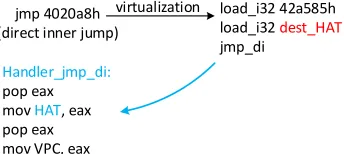
Fig. 5: The virtualization of a direct inner transfer instruction with HAT switching. The address of the destination HAT is pushed into stack by load i, and is assigned to the HAT pointer used byVMloopat runtime.
As the opcodes of bytecode instructions are used by VMloop as the indexes for the addresses of their corre-sponding handlers, and different partitions are encoded differently, each partition needs their own HAT. At the end of a partition, the HAT used byVMloopshould be switched to the HAT of the next partition. This is done by a new virtual instruction - switch HAT. Since switch HAT is always added to the end of a partition and the orders of HATs are in accordance with that of the partitions, switch HAT needs to add the size of a HAT to the HAT pointer used by VMloop (as Handler 4024a6 does in figure 4). In our prototype, the number ofHandlersis148and the address of a Handler is 4 bytes, thus the size of a HAT is 592 (250h in hexadecimal) bytes.
The switchings of HATs is not limited to the end of parti-tions. A branch instruction also causes the switching when its destination resides in a different partition. Branch instructions change the control flow of a program through changing the VPC. When encounter such an instruction, we cannot simply append a switch HATto it, since the switch HATmay not get interpreted by VMloop if the VPC is changed to a location in another partition. Hence, we put the code for switching inside the Handlers of the branch instructions. Here, the branch instructions indicate thedirect innerones, as direct outerbranches andindirectbranches all leave the virtual context and need not to worry about the switching of HATs.
During protection, for each direct inner branch instruction, we first calculate its destination, and then figure out which partition the destination resides. The address of the HAT of that partition is pushed into stack by load i and will be used by the Handler of the branch instruction to set the value of the HAT pointer used by VMloop. Figure 5 shows the virtualization of adirect inner branch instruction.
4) Security Analysis of Partition Design: The number of HAS obfuscated is determined by the number of partitions. Our system will randomly select several methods from the obfuscation method library which contains the junk instruc-tions injection, equivalent instruction substitution [27], code out-of-order [28] and control flow flattening [29]. Then the system will use the selected method in a random order to obfuscate thehandler. Finally we have multiple equivalent but different forms of HAS. We will also adopt some anti-taint analysis techniques (some details are presented in section III) to protect the HAS that after obfuscated. This can effectively prevent the virtual interpreter from being attacked by some de-obfuscation methods.
For example, HAS (Handler Set) as an original handler set that consists of mhandler. We use a HAT to store the address of these handlers, and their index corresponds to theopcodeof virtual instruction. HAS will be obfuscated forn times with different strategies,nis dependent on the number of partitions. Then we get multiple HASs and which are semantic equivalence but have different forms. At this time, all of the equivalent handlers still have the same index. This is a type of insecure and direct mapping relationship. Therefore, according to the method that partitions bytecode program and randomizes the semantics of bytecode instructions described in Section VII-B2, we first randomly shuffle the IDs of virtual instructions and then use these results to generate a new HAT for each partition (as shown in Figure 4). The effect of shuffles is that an identical opcode in different parts of the bytecode program probably reveals different semantics. The relationship of these equivalenthandlersin different HASs should be:
HAS1(i)⇔HAS2(j)⇔ ...⇔HASn(k), 1≤i, j, k≤m.
This various semantics of bytecode instructions and different forms ofhandlerscan effectively prevent the attacker from using the attack knowledge base matching to realize the automated reverse analysis. The attacker has to spend a lot of time to analyze every detail.
The above methods can prevent the spread of tainted data by laundering tainted data and resist the taint analysis effectively .
VIII. EVALUATION
[image:5.612.89.261.285.362.2]TABLE I: Statistics of the Target Programs.
Target Program Version Size(KB) Critical Code N1 N2 Ratio N3
md5 2.3 11 Transform() 1327 563 42.36% 85013
gzip 1.2.4 56 deflate() 10181 153 1.50% 539082
bcrypt 1.1.2 68 Blowfish Encrypt() 2997 54 1.80% 1735710
mat mul - 184 ijkalgorithm() 49327 60 0.12% 84325
Note:The 5th and 6th column gives the number of instructions in the entire program and these critical functions respectively, The 7th column gives the proportion of critical code. We use Pin [30] to count the number of the dynamically executed instructions in the critical functions and the results are shown in the last column. We chose only 60 instructions ofmat mulis special to verify the impact of DCVPon the program overhead when protecting a small amount of code. The results are shown in figure 8 and the impact is not obvious.
A. Effectiveness Evaluation
DCVPis effective for impeding reverse analysis by invalidat-ing existinvalidat-ing analysis knowledge. From Section II, we learned that understanding the semantics of bytecode instructions is essential for reverse engineering a VM-obfuscated program. Semantics are encapsulated in handlers, and the work of extracting them form handlers is tedious and error-prone. Therefore, it will save analysts lots of time and energy if the semantics of bytecode instructions are accessible,
without bothering to trace and analyze the handlers once again. DCVP’s aim is to frustrate this attempt and force analysts to analyze thehandlersevery time. Through randomizing the semantics of bytecode instructions, the same bytecode instruction probably means different obfuscated in-stances, and even different in the same obfuscated program by adopting different encoding schemes for different partitions of the bytecode program, which can largely confuse analysts and increase their workload.
Assuming that the number of virtual instructions, or the number of handlersin other words, is H, then the prob-ability of a bytecode instruction in two obfuscated programs having the same semantics is H1. The total number of distinct shuffle of the opcodes is H!. In an obfuscated program, supposing the bytecode program is partitioned into N parts, then the probability that a bytecode instruction in different partitions having the same semantics is H1N−1. Therefore, we believe DCVPcan effectively remove theanalysis knowlege about the semantics of bytecode instructions.
We also count the average frequencies of opcodes of our benchmarks. We take the obfuscated programs with 2, 8, and 32 partitions for comparison. The results are presented in figure 6. As we can see, as the number of partitions increases, the frequencies ofopcodestend to be closer. When the partition number is 1, we can easily get the instruction that has the highest frequency is “load r”, since it is the most commonly used instruction.
B. Overhead Evaluation
To evaluate the spatial and temporal overhead of our method, we implemented a prototype, namely DCVP, for obfuscating x86 PE executables on the Windows platform. In the implementation, we devised 148 virtual instructions and their corresponding handlers. We conducted all the experiments on a Dell Optiplex 960h with an Intel®CoreTM 2
0 50 100 150
0 0.02 0.04 0.06 0.08 0.1 0.12 0.14
Average Frequencie of Opcodes
0 20 40 60 80 100
0 0.005 0.01 0.015 0.02 0.025 0.03 0.035 0.04 0.045
[image:6.612.321.553.182.373.2]2 8 32
Fig. 6: The average frequency of anopcodeis used during runtime execution. The x-axis shows the opcode ID and the y-axis shows how often (normalized between 0 and 1) an opcoded is chosen.
Duo Processor E8400 at 3.00GHz with 4.00GB of RAM. The operating system environment is Windows 7 Enterprise.
We use DCVP to protect four x86 PE executables, namely md53,gzip4,bcrypt5,mat_mul6. The first three are used to process a text file (test.txt) of 10KB and mat mul is used to calculate the product of two 5×5 matrices. Table I shows the statistics of these executables. For each program, we choose a piece of critical code to protect, as shown in table I. The programs are protected 10 times, each time with a parameter that specifies a different number (1∼10) of partitions.
Figure 7 shows the code size of the obfuscated programs. The horizontal axis specifies the number of partitions in the obfuscated programs and “0” means the original program. As the partitions increase, the increased bytes mostly come from the added HATs and HAS. Since the size of a HAT is only 592 bytes, the sizes of the HATs increase slowly. Besides, the sections in PE executables are aligned to a value (4096 or 512 usually)[31], the filesize of the program is mainly affected by the number of HAS, and it increases with the increase of partition’s number regularity.
3MD5. http://www.fourmilab.ch/md5/.
4gzip. http://www.gzip.org/#sources.
0 2 4 6 8 10 0
50 100 150 200 250
Files
ize
(KB
) md5gzip
[image:7.612.51.547.53.207.2]bcrypt mat_mul
Fig. 7: The impact on code size (KB) of DCVP. The file size slightly increased with the increase of number of partitions
0 2 4 6 8 10
0 1 2 3 4 5x 10
4
Runtime (
µ
s)
md5 gzip bcrypt mat_mul
Fig. 8: The impact on runtime performance (µs) of DCVPwith different partitions.
0 2 4 6 8 10
0 1 2 3 4 5 6 7
Average Runtime
Overhead (%)
md5 gzip bcrypt mat_mul
Fig. 9: The average runtime overhead per dynam-ically executed critical instruction.
To evaluate the runtime overhead that DCVP introduces, we run the obfuscated programs for several times and cal-culate the average execution time of them: md5, gzip, and bcryptare used to process a text file (test.txt) of 10KB; matrix mul is used to calculate the product of two 5×5 matrices. The average execution time is shown in figure 8. Among them, bcrypt has the largest increase of execution time from original program7 to the obfuscated program with one partition. This resulted from that the critical instructions in bcrypt is executed much more times than others (as shown in the last column in table I). Besides, the execution time changes little as the number of partitions increases. From section VII-B2 we can learn that if the number of partitions increases by one, the program only needs to execute an extra handler to interpret the switch HAT instruction. The introduced runtime overhead is negligible. In some situations, the execution time of an obfuscated program with more partitions may have a slightly lower runtime overhead. This probably is due to better data locality that leads to favourable cache behaviors.
We evaluate the average runtime overhead per dynamically executed instruction. We use Tob to denote the execution time of a obfuscated program, To for that of the original program, and Ce for the count of the critical instructions been dynamically executed. The average runtime overhead per dynamically executed instruction is calculated by
(Tob−To)/Ce.
The results are shown in figure 9. From this figure, we can learn that md5 has the largest average runtime overhead per dynamically executed instruction. The reason is that the critical code of md5 is full of arithmetical and logical instructions, which takes a longer time to interpret.
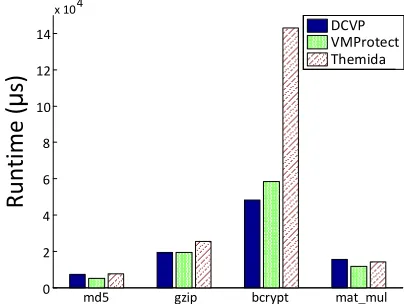
Finally, we compare DCVP to two commercial code virtu-alization protection systems: VMProtect [8] and Themida [9]. Figure 10 shows the impact of the three virtualization protec-tion system on the file size of the four target programs. The cost of Themida is much greater than the other two system, and the impact of DCVPand VMProtect is similar. This result
7The execution time of the original program is specified by “0” on the
horizontal axis.
md5 gzip bcrypt mat_mul 0
100 200 300 400 500 600 700 800 900 1000
Filesize
(K
B
)
[image:7.612.335.537.216.358.2]DCVP VMProtect Themida
Fig. 10: The comparison of impact on file size (KB) with VMProtect and Themida.
md5 gzip bcrypt mat_mul
0 2 4 6 8 10 12 14
x 104
Runtime (
μ
s)
DCVP VMProtect Themida
Fig. 11: The comparison of runtime performance (µs) with VMProtect and Themida.
[image:7.612.335.537.399.551.2]IX. RELATEDWORK
Code deobfuscation techniques have been proposed in recent years. The representative researches are as follows, Coogan et al. [25] proposed an approach to identify instruc-tions that related to system calls, and automatically extract an approximate dynamic trace of the original code. Yadegari et al. [26], proposed an approach to track the flow of inputs values, and then use semantics-preserving code transforma-tions to simplify the logic of the instructransforma-tions. These approach, however, or can only extract some execution characteristics of target program and can not restore the structure of the original code completely, or needed taint analysis to track and analyze the data flow, and this process may be impeded by enforcing dataflow obfuscation to the handling procedures [21]. These methods are limited more or less.
DCVP adopts ISR (Instruction Set Randomization) tech-niques while generating randomized and distinct virtual in-struction sets. ISR has been used to prevent code injection at-tacks by randomizing the underlying system instructions [32], [16], [33]. In this approach, instructions are encrypted with a set of random keys and then decrypted before being fetched and executed by the CPU. ISR is effective for defeating code injection attacks but cannot prevent from reverse engineering attacks. As in our attack model, software programs are exe-cuted in a malicious host environment, where attackers are able to trace and log the decrypted instructions for later analysis. DCVP employs an approach similar to ISR while generating random virtual instruction sets, by changing the relationship between the opcodes and the virtual instructions [16], but it never “decrypts” the virtual instructions back into their original ones. Instead, DCVPuseshandlers to interpret the virtual instructions. and the handlers of virtual instructions are more complex than their corresponding native instructions. Be-sides, DCVPuses the multiple partitions and has the different ISRs in a single program, making the reverse analyses even more difficult and tedious.
X. CONCLUSIONS
In this paper, we have presented the DCVP, a VM-based code obfuscation scheme. DCVP is designed to prevent code reverse engineering attacks that use knowledge obtained from programs protected under the same code obfuscation tech-nique. At the core of DCVP is a novel strategy to diversify the obfuscated program behavior. We achieve this by first partitioning the protected code region to different segments; then randomly mapping the opcode of each virtual instruction from different segments to different bytecode handlers. As a result, the mapping between a virtual instruction and native code changes from one code segment to the other. This makes the program behavior to be less predictable, increasing the dif-ficulty for reusing knowledge obtained from other programs to attack the target application. We have evaluated our approach on a set of real-world applications and compared it against state-of-the-art VM-based code protection tools. Experimental results show that DCVP provides stronger protection at the cost of little extract overhead.
REFERENCES
[1] S. Schrittwieseret al., “Protecting software through obfuscation:can it keep pace with progress in code analysis?” 2016.
[2] P. Ananthet al., “Optimizing obfuscation:avoiding barrington’s theo-rem,” 2014.
[3] J. Zeng and oters, “Obfuscation resilient binary code reuse through trace-oriented programming,” inCCS, 2013.
[4] L. Luoet al., “Semantics-based obfuscation-resilient binary code simi-larity comparison with applications to software and algorithm plagiarism detection,” inFSE, 2014.
[5] M. Preda and R. Giacobazzi, “Control code obfuscation by abstract in-terpretation,” inIEEE International Conference on Software Engineering
and Formal Methods(SEFM), 2005.
[6] Z. Wu and oters, “Mimimorphism: A new approach to binary code obfuscation,” inCCS, 2010.
[7] “Oreans Technologies. Code Virtualizer.
http://www.oreans.com/codevirtualizer.php.”
[8] “VMProtect Software. VMProtect. http://vmpsoft.com/.” [9] “Themida.http://www.oreans.com/themida.php.”
[10] H. Fang et al., “Multi-stage binary code obfuscation using improved virtual machine,” inInformation Security, 2011.
[11] M. Yang and L. S. Huang, “Software protection scheme via nested virtual machine,”Journal of Chinese Computer Systems, 2011. [12] H. Wanget al., “NISLVMP: Improved Virtual Machine-based software
protection,” in 9th International Conference on Computational
Intelli-gence and Security (CIS), 2013.
[13] H. Wang, D. Fang, G. Li, N. An, X. Chen, and Y. Gu, “Tdvmp:improved virtual machine-based software protection with time diversity,” inACM
Sigplan on Program Protection and Reverse Engineering Workshop,
2014, pp. 1–9.
[14] N. Falliereet al., “Inside the jaws of Trojan.Clampi,”Rapport technique,
Symantec Corporation, 2009.
[15] R. Rolles, “Unpacking virtualization obfuscators,” inProceedings of the
3rd USENIX Conference on Offensive Technologies, 2009.
[16] K. Kuang et al., “Enhance virtual-machine-based code obfuscation security through dynamic bytecode scheduling ,” 2018.
[17] D. Geneiatakis et al., “Adaptive defenses for commodity software through virtual application partitioning,” inCCS, 2012.
[18] K. Kuang, Z. Tang, X. Gong, D. Fang, X. Chen, H. Zhang, and Z. Wang, “Exploit dynamic data flows to protect software against semantic attacks,” 2017.
[19] C. S. Collberg and C. Thomborson, “Watermarking, tamper-proofing, and obfuscation-tools for software protection,” IEEE Transactions on
Software Engineering, 2002.
[20] S. Chowet al., “A white-box des implementation for drm applications,”
inDigital Rights Management, 2003.
[21] Y. Jia et al., “A generic attack against white box implementation of block ciphers,” inInternational Conference on Computer, Information
and Telecommunication Systems, 2016.
[22] “IDA Pro, https://www.hex-rays.com/index.shtml.” [23] “OllyDbg, http://www.ollydbg.de/.”
[24] “Sysinternals suite,
https://technet.microsoft.com/en-us/sysinternals/bb842062/.”
[25] B. Yadegariet al., “A generic approach to automatic deobfuscation of executable code,” inIEEE S & P, 2015.
[26] Z. Tang, K. Kuang, L. Wang, C. Xue, X. Gong, X. Chen, D. Fang, J. Liu, and Z. Wang, “Seead: A semantic-based approach for automatic binary code de-obfuscation,” inTrustcom/bigdatase/icess, 2017, pp. 261–268. [27] G. C. Nicolaou George, “Applied binary code obfuscation,” Tech. Rep.,
2009.
[28] M. Kayaalp et al., “Efficiently securing systems from code reuse attacks,” 2014.
[29] S. Blazy and A. Trieu, “Formal verification of control-flow graph flattening,” vol. 27, no. 4, 2016, pp. 176–187.
[30] “Pin - A dynamic binary instrumentation tool.
https://software.intel.com/en-us/articles/pin-a-dynamic-binary-instrumentation-tool.”
[31] “Peering inside the PE: A tour of the Win32 portable executable file format. https://msdn.microsoft.com/en-us/magazine/ms809762.aspx.” [32] J. A. Ambroseet al., “Randomized instruction injection to counter power
analysis attacks,” 2012.