warwick.ac.uk/lib-publications
Original citation:
Giannakopoulou, Anastasia, Brown, Helen, Clayards, Meghan and Wonnacott , Elizabeth . (2017) High or Low? Comparing high- and low-variability phonetic training in adult and child second language learners. PeerJ.
Permanent WRAP URL:
http://wrap.warwick.ac.uk/87819
Copyright and reuse:
The Warwick Research Archive Portal (WRAP) makes this work of researchers of the University of Warwick available open access under the following conditions.
This article is made available under the Creative Commons Attribution 4.0 International license (CC BY 4.0) and may be reused according to the conditions of the license. For more details see: http://creativecommons.org/licenses/by/4.0/
A note on versions:
The version presented in WRAP is the published version, or, version of record, and may be cited as it appears here.
1 High or Low? Comparing high- and low-variability phonetic training in adult and child
second language learners.
Anastasia Giannakopoulou1, Helen Brown2, Meghan Clayards3, & Elizabeth Wonnacott4
1 School of Psychology, University of Bedfordshire, LU1 3JU, UK
2 Department of Psychology, University of Warwick, CV4 7AL, UK
3 Department of Linguistics and School of Communications Sciences and Disorders, McGill
University, Montreal, Quebec, H3A 1A7
4 Psychology and Language Sciences, University College London, Gower Street, London,
WC1E 6BT
Corresponding Author:
Elizabeth Wonnacott
2
Abstract
Background. High talker variability (i.e. multiple voices in the input) has been found
effective in training non-native phonetic contrasts in adults. A small number of studies
suggest that children also benefit from high-variability phonetic training with some evidence
that they show greater learning (more plasticity) than adults given matched input, although
results are mixed. However no study has directly compared the effectiveness of high versus
low talker variability in children.
Methods. Native Greek speaking 8-year-olds (N=52), and adults (N=41)were exposed to the
English /i/-/ɪ/ contrast in ten training sessions through a computerized word-learning game.
Pre- and post-training tests examined discrimination of the contrast as well as lexical
learning. Participants were randomly assigned to high (4 talkers) or low (1 talker) variability
training conditions.
Results. Both age groups improved during training, and both improved more while trained
with a single talker. Results of a 3-interval oddity discrimination test did not show the
predicted benefit of high-variability in training in either age group. Instead, children showed
an effect in the reverse direction – i.e. reliably greater improvements in discrimination
following single talker training, even for untrained generalization items, although the result
is qualified by (accidental) differences in participant groups at pre-test. Adults showed a
numeric advantage for high-variability but were inconsistent with respect to voice and word
novelty. In addition, no effect of variability was found for lexical learning. There was no
evidence of greater plasticity for phonetic learning in child learners.
Discussion. This paper adds to the handful of studies demonstrating that, like adults, child
learners can improve their discrimination of a phonetic contrast via computerized training.
There was no evidence of a benefit of training with multiple talkers, either for discrimination
3 learning found in a previous paper (Giannakopoulou et al., 2013a). We discuss these results
in terms of various differences between training and test tasks used in the current work
4
Introduction
Phonetic training studies in adults
One of the most challenging aspects of learning a second language (L2) is learning to
accurately perceive novel phonetic categories. This is particularly difficult when the mapping
between phonetic properties and phonological categories is mismatched between the first
language (L1) and L2 (Best, 1995; Flege, 1995; Giannakopoulou et al., 2011). A substantial
body of literature has demonstrated that adult learners can improve their discrimination and
identification of non-native speech-sounds through phonetic training, but that effective
generalization may depend upon encountering sufficiently varied stimuli during training. For
example, in an early attempt to train a non-native contrast, Strange and Dittmann (1984)
trained native Japanese speakers on the English /r/-/l/ contrast using a discrimination task in
which participants made same-different judgements about stimuli from a synthetic rock-lock
continuum, receiving immediate trial by trial feedback. Variability was present in the form of
the ambiguous intermediate stimuli along the continuum, however there was a single
phonetic context and a single (synthesized) talker. Participants were given a variety of
discrimination and identification tasks pre- and post-training. These revealed improvements
in discrimination and identification for stimuli on the synthesized rock-lock continuum, and
for novel items on a synthesized rake-lake continuum, but not for naturally produced minimal
pair items that had not been encountered in training. Later experiments suggested that this
limited generalization was due to the low-variability present in the stimuli used in the training
intervention (i.e. a single phonetic context and single talker).
Logan, Lively and Pisoni (1991) also trained Japanese speakers on the English /r/-/l/
contrast, but used high-variability training stimuli that included multiple natural exemplars
(67 minimal pairs, where the target speech sounds appeared in different phonetic contexts)
5 task in which participants identified the correct member from a (written) minimal pair,
receiving trial by trial feedback. Comparison of performance on tests administered pre- and
post-training revealed improvements in tasks that involved both trained stimuli and untrained
stimuli produced by a new talker. Lively, Logan, and Pisoni (1993) replicated this finding of
generalization after high-variability training and, in a follow up experiment using the same
training paradigm but with training stimuli produced by a single (natural) talker (although
still exemplifying the contrast in multiple phonetic environments), they found improvements
between pre- and post-test for the trained, but not for an untrained talker, suggesting a
specific role for talker variability in high-variability training.
Following the work of Logan, Lively and Pisoni (1991), high-variability phonetic
training has become a standard methodology in the field. The effectiveness of this type of
training has been demonstrated for various phonetic contrasts and in studies which have also
found benefits for long-term retention and in production tasks (Bradlow et al., 1999; Bradlow
et al., 1997; Lively et al., 1994).
Phonetic training studies with children
To date, studies of L2 phonetic training have primarily been conducted in adults.
There is reason to predict that child L2 learners might outperform adults in these tasks, due to
enhanced brain plasticity. A large body of research reports declines in language learning
capacities with age (Lenneberg, 1967; Johnson & Newport, 1989; Newport, 1990), also see
Kuhl, 2004, for review), with various theories proposed to account for this including changes
to developing cognitive mechanisms (Newport, 1990) and increased neural commitment to
structures necessary for the L1 (Kuhl, 2004). For phonetic learning specifically, there is
some naturalistic support for a benefit of age in L2 speech-sound discrimination coming from
longitudinal studies comparing child and adult L2 learners in immersion situations. These
6 et al., 2004; Tsukada et al., 2005), although studies comparing adults and children after
periods of immersion less than one year, do not always find clear perception advantages for
children (e.g. Baker et al. 2008; Snow & Hoefnagel-Hohle, 1978). However a limitation to
these naturalistic studies is that, while they control for length of residence in the L2-speaking
country, the actual input received by the learners was not controlled. As Tsukada et al. (2005)
point out, it is possible that children may be immersed in a more L2-rich environment than
adults, making it difficult to pull apart age effects from differences in input.
Turning to training studies, only a handful of experiments have compared children
and adults. These have all used high-variability phonetic training but have produced mixed
results with regards to the role of age. Wang and Kuhl (2003) conducted a two-week
computer-based Mandarin tone training study in which native English speaking adults and
children (three age groups: 6, 10, and 14 year olds), with no previous experience of
Mandarin, were trained to associate tones with symbols (i.e. a picture of an animal for each of
the four trained tones). Training stimuli exhibited high-variability (648 stimuli produced by
six native speakers of Mandarin). Overall, older participants outperformed younger
participants (adults > 14 yrs > 10 yrs > 6 yrs) at both the pre- and post-training tests.
However, although all participant groups improved as a result of training, the amount of
improvement was approximately the same across all age groups. This result thus does not
support an account in which younger learners demonstrate greater plasticity.
Wang and Kuhl (2003) suggest that one possible explanation for the fact that they did
not see plasticity differences for children and adults is that, for tones, English speakers do not
have pre-existing comparable categories. This means that the “mental map” for tone is
equally open for children and adults, so that age effects due to previous L1 experience are not
expected. This would predict that plasticity effects should be more likely in segmental
7 trained adults and 12 year old native Dutch speakers, with no previous Finnish experience, to
discriminate the Finnish length contrast /t/-/t:/. This was a five-day study with a pre-test and
post-test on the first and last days and 3 days of training. Training consisted of an
identification paradigm (participants identified stimuli as “short t” or “long t” and received
feedback). Stimuli were 7-step continua created from recordings of five talkers. Pre- and
post-tests included identification and discrimination within and across category boundaries.
Although adults again out performed children overall, both age groups showed reliable
increases in sensitivity in the newly trained category boundaries and, critically, there were
again similar levels of improvement at each age. This result might appear to corroborate that
of Wang and Kuhl (2003), however the lack of age effects may be due to a different reason,
specifically, the amount of training provided (three training sessions) may be insufficient in
order for children to outperform adults (c.f. Giannakopoulou, Uther & Ylinen, 2013a,
discussed below).
In contrast to the studies discussed above, two further studies have found evidence of
greater learning in children than adults for high-variability phonetic training. Shinohara and
Iverson (2013, 2015; also Shinohara, 2014) compared learning of the English /r/-/l/ contrast
in native Japanese adults (25-59 years), adolescents (15-18 years) and older and younger
children (8-12 and 6-8 years). Training stimuli exhibited high-variability (100 word-initial
minimal pairs from 5 talkers) and involved ten days of minimal pair identification (with
written stimuli) and discrimination tasks (all with feedback). There were pre- and post-test
identification tasks with new talkers in both trained (word-initial) position and untrained
positions. In both identification accuracy and category discrimination abilities, all groups
showed evidence of learning and generalization to new speakers and phonetic contexts.
However adolescents and older children improved more than either 6-8 year olds or adults.
8 adolescents compared with adults as due to their less fossilized brain plasticity and lesser
interference from developed L1 phonetic units. Lesser learning in the 6-8 year olds, which
was unpredicted in a plasticity account, was explained as being a result of difficulties with the
tasks due to an immaturity of phonemic awareness.
One difference between the paradigms used by Heeren and Schouten (2008, 2010)
and Shinohara and Iverson (2013, 2015) is the length of training: Heeren and Schouten used
three training sessions whilst Shinohara and Iverson used 10. If children’s early learning is
slower than that of adults (Snow & Hoefnagel-Hohle, 1978), this could potentially account
for why Shinohara and Iverson saw a plasticity benefit (at least for older children compared
to adults), whilst Heeren and Schouten didn’t. Some evidence for this comes from a final
study by Giannakopoulou et al. (2013a), who also found a plasticity benefit (greater learning
in 7-8 year olds than in adults), but also found evidence that this maturational difference only
emerged after several sessions of exposure. This study used high-variability phonetic training
to train the tense-lax English vowel contrast /i/ versus /ɪ/ (e.g. bean-bin) with child (7-8
years) and adult (20-30 years) native Greek learners of L2 English. The study explored both
age effects and cue weightings, through the use of natural and modified duration stimuli
(whereby duration cues were equalised and not relevant or were reliable cues). A pre-test,
training, post-test paradigm was used, with training consisting of 10 sessions using an
identification task (identifying the correct member of a minimal pair given written stimuli)
with high-variability stimuli (45 minimal pairs produced by two male and two female
speakers). Half of the participants of each age group were trained with modified stimuli (no
duration cues) and half with natural stimuli. Participants were given the option to replay any
given stimulus and feedback was provided in the form of a video-game style animation.
Although Greek adults, who started with more years of L2 education, generally performed
9 performance for both groups (child and adults) and across all tasks (perceptual identification
and discrimination for both natural and modified stimuli conditions). However, critically,
children improved more than adults. Importantly, the results from Giannakopoulou et al.
(2013a)’s training task, which were recorded each day, suggested that children’s
identification performance only overtook that of adults by session 7 (see Giannakopoulou et
al., 2013a, Figures 11-14). This suggests that plasticity benefits, which are seen in this study
and in that of Shinohara and Iverson, but not in the Heeren and Schouten (2008, 2010) studies
could rely on more lengthy exposure. However this cannot account for why Giannakopoulou
et al saw this benefit for 7-8 year olds compared with adults while this was not seen for 6-8
year olds compared with adults in the Shinohara and Iverson study (only for older children
compared with adults). If Shinohara and Iverson are right that their youngest children had
greater difficulty with the learning task due to less well developed phonemic awareness, one
possibility is that the /i/ versus /ɪ/ contrast is somehow more salient for Greek speakers than
the /l/ versus /r/ contrast is for Japanese speakers, even for younger children. This may be
partially due to the length cue present in these stimuli: the difference between children and
adults was more marked for the natural stimuli compared with the modified stimuli,
suggesting that the children may have been particularly relying on durational cues during
training. This is in line with research showing that non-native listeners from many different
language backgrounds tend to rely heavily on the duration cue when discriminating English
tense-lax vowel pairs (unlike native listeners who rely more on formant frequency, e.g. Flege,
Bohn & Jang, 1997). The reliance on durational cues may also have been exacerbated by the
use of written stimuli during training since English spelling provides an additional analogue
length cue (two letters such as ee and ea are often used to represent the longer vowel /i/ while
10 learning (see also Giannakopoulou et al., 2013b, for evidence on the role of orthography in
learning this contrast). We return to this point in the General Discussion.
In sum, the results of a handful of phonetic training studies give mixed results with
respect to whether younger learners show stronger learning given matched input (i.e.
plasticity effects). It has been suggested that that the presence (or lack) of pre-existing
comparable categories in the L1, the length of exposure, and the salience of the contrast could
all influence children’s learning and contribute to differences across experiments. In the
current study, we build on the paradigm established in Giannakopoulou et al. (2013a) – where
plasticity benefits were clearly seen - comparing Greek 7-8 year olds and adults trained on
the English /i/ versus /ɪ/ contrast (though we modify the paradigm to remove orthographic
cues to learning). We use this paradigm to explore the effect of variability in training with
different age groups.
Comparison of high and low-variability training
As discussed above, work by Lively et al. (1993) suggested a benefit for
high-variability input over low-high-variability input in phonetic training for adult learners. The finding
that encountering varied training instances boosts generalization is intuitively sensible:
experience of variation allows the formation of generalized representations that include only
phonetically relevant cues and exclude irrelevant talker identity cues. Since the seminal
experiments of Lively et al. (1993), many phonetic training studies have continued to use
variability input, however surprisingly few have actually tested the benefit of
high-variability directly. One study which did find a high-high-variability benefit was conducted by
Clopper and Pisoni (2004), although this focused on dialect categorization rather than L2
phonetic learning. They tested participants’ ability to categorize dialects following exposure
to high-variability training (three talkers per dialect) compared with low-variability training
11 However, two studies looking at lexical tone learning also compared variable
(multi-speaker) training with less variable training, but did not find an overall benefit of
high-variability input (Peracchione et al., 2007; Sadakata & McQueen, 2014). Instead, these
studies found an interaction with aptitude (i.e. baseline perceptual ability for detecting pitch)
whereby only high aptitude participants benefitted from high-variability input whilst those of
low aptitude did better with low-variability training. However, since these studies did not use
segmental phonetic contrasts it is currently unclear the extent to which they would generalize
to phonetic training. Finally, one recent training study did specifically compare high and
low-variability in L2 phonetic learning at the segmental level: Sadakata and McQueen (2013),
tested native Dutch speakers ability to identity geminate and singleton variants of the
Japanese fricative /s/, comparing low and high-variability training (here manipulated in terms
of item variability). They found that more variable input did lead to greater improvements
with generalization but no interaction with aptitude.
To the best of our knowledge the studies reviewed above are the only ones to directly
compare low and high-variability training for phonetic contrasts. Moving beyond the
phonetic learning literature, a separate literature on L2 word learning has also explored the
benefits of input variability (Barcroft & Sommers, 2005; Barcroft & Sommers, 2014;
Sommers & Barcroft, 2007; Sommers & Barcroft, 2011). A general finding from this
literature is that vocabulary learning, as tested both in production and reception tests, is
stronger when exposure is more varied, with benefits both of multiple talkers and multiple
voice quality types. Further experiments rule out explanations in terms of a benefit of greater
cognitive effort (Sommers & Barcroft, 2011). Barcroft and Sommers (2005, 2014) explain
this general benefit of acoustic variability in terms of an exemplar based framework whereby
indexical information from all encountered examples is retained in the early stages. This
12 incorporate a wider variety of cues into their representations, allowing them to form more
“associative hooks” and robust representations for the target words. Note that this explanation
is subtly different from the standard explanation as to why high-variability input benefits
phonetic learning, which is assumed to stem from learning to ignore phonemically irrelevant
information and thus is specifically important for generalization (whereas the benefit of word
learning tasks should hold for both trained and novel talkers at test).
Turning to children, no study has specifically explored whether high-variability input
is more effective than low-variability input for L2 phonetic training in children. However,
there is some research into word learning in L1 which suggests a role for high-variability in
infants. This research has been conducted with infants in the early stages of word learning
(around 14 months). A surprising finding with this age group is that even if they have
mastered a particular L1 phoneme contrast (i.e. they discriminate between relevant phoneme
contrasts and fail to discriminate non-native contrasts) they may have difficulties learning
new words that differ by this contrast. For example, Stager and Werker (1997) found that
when 14 month olds were exposed to two novel words which formed a minimal pair (/bɪ/ and
/dɪ/) paired with two novel objects, they did not later differentiate between trials in which the
word-object pairing was identical versus opposite to that previously seen in habituation (the
so-called “switch task”). This is despite the fact that children of this age were shown to be
able to discriminate /p/ and/d/ outside of the context of a word learning task. This effect has
been demonstrated many times (see Werker & Curtin, 2005, for a review), critically,
however, Rost and McMurray (2009) demonstrated that it is affected by the variability of the
exposure set. Using a similar switch task to Stager and Werker (1997), they replicated the
null effect when the novel words (/buk/and /puk/ in their study) were produced by a single
talker, but showed that infants of the same age did differentiate between the minimal-pair
13 McMurray (2010) further probed what aspect of the variability in the input was beneficial for
word learning. They considered the possibility that, although infants could discriminate the
phonetic contrast in question (/b/-/p/) their phonetic categories might still be developing. In
this case, the critical aspect of variability might be the presence of a bimodal distribution of
the most relevant cue for differentiating the contrast (see also Maye, Werker & Gerken, 2002
– in this case Voice Onset Time (VOT)). Rost and McMurray (2010) tested this by varying
VOT in a clear bimodal distribution while holding talker constant. Surprisingly, infants were
not able to differentiate the minimal pair after exposure to these stimuli, nor were they able to
do so when exposed to the items spoken by a single talker but with variation in multiple
acoustic cues to the contrast (VOT, F0 transition, and burst amplitude). In contrast, infants
were able to discriminate between the minimal pairs when exposed to the items spoken by
multiple talkers but with a fixed VOT across talkers. This unexpected finding suggests that
what is critical is variability arising from talker differences but on irrelevant dimensions to
the contrast in question. Apfelbaum and McMurray (2011) provide an account of this in
terms of associative learning. Via computational simulation, they show that the experimental
results are predicted if word learning involves associating all available acoustic cues with
objects, including both relevant (e.g., place of articulation/voicing) and irrelevant (e.g.,
talker) cues. The intuition behind the model is that associative learning will pick up on any
consistent relationships across instances, meaning that both relevant and irrelevant acoustic
cues will become associated with an object if they are highly consistent, as is the case when
tokens all come from the same talker and thus are highly similar. The association of these
irrelevant talker cues reduces the contrast established by the phonetic cues since they are
shared across the words and provide evidence that they are the same. Note that a similarity
between this explanation and that that of Barcroft and Sommers (2005, 2014) is that they both
14 some independent evidence of this in L1 learning (Singh, Morgan & White, 2004; Singh,
White & Morgan, 2008).
In sum, there is a long standing assumption that more variable input is more beneficial
in L2 phonetic training, although very few published studies have actually directly tested this
in adults, and none have done so in children. There is also evidence that variable input is
beneficial in adult L2 and infant L1 vocabulary learning, which has been interpreted in terms
of the formation of robust, speaker independent representations.
The current study
The current experiment adds to the small literature exploring phonetic training in both
adults and children. We build on the work of Giannakopoulou et al. (2013a) and focus on
learning of the non-native English /i/-/ɪ/ contrast by adult and 7-8 year old native Greek
speakers. Our central research question was whether variability would benefit learning.
Although variability can be manipulated along a number of dimensions, we chose to
manipulate talker variability since this type of variability has been explored across both the
phonetic and word learning literatures. To this end we compared learning from
high-variability (four talkers) versus low-high-variability (one talker) input, with overall exposure
matched across conditions. We embedded the phonetic training task in a word learning task,
whereby training involved pairing minimal pairs with picture representations of the two
words (e.g. hear sheep, choose between pictures of a sheep and a ship), conducted in a child
friendly computerized training environment. This choice allowed us to investigate the effect
of variability on learning at both the phonetic and lexical levels. In addition, using pictures
allowed us to avoid using orthography in training, addressing the concern that learners in
Giannakopoulou et al. (2013a) may have relied on length cues in English spelling (e.g., sheep
vs. ship) as an aid to learning. We matched other aspects of the training to that in
15 For example the number and duration of the training sessions were approximately the same,
training used an animation to provide feedback and a “replay” button allowed participants to
hear repeat stimuli if necessary.
However, our test of phonetic learning was a three-interval oddity discrimination task,
rather than an identification task, in order to avoid using orthography but still be able to test
both trained and untrained items. The inclusion of untrained items was important since
high-variability is specifically predicted to benefit generalization - i.e. exposure to multiple talkers
should aid the ability to ignore phonetically irrelevant information. Voice novelty and word
novelty were manipulated separately (since it is possible that exposure to multiple speakers
might specifically benefit generalization across talkers, rather than generalization more
broadly).
Our primary measure was the extent to which training strengthened lexical
representations, since we assumed that our participants would begin the study with some
knowledge of the words. We chose to focus on the links between the forms and their
meanings and used a primed auditory lexical decision task to tap semantic representations in
the L2 via cross language priming (i.e. semantic priming from L2 to L1). This was adapted
from a task previously used to test vocabulary development in an artificial language learning
experiment (Tamminen & Gaskell, 2012). Comparison of pre- and post-training performance
tested whether this aspect of participants’ representations was changed by the training
process, and whether the extent of change was modulated by input variability. We also
included a more direct measure of vocabulary learning at both pre- and post-test. Participants
heard Greek (L1) words and matched these to the correct translation from one of four English
(L2) words, all taken from the training set (no minimal pairs included). This task served
multiple purposes. First, it allowed us to determine which words a participant was familiar
pre-16 and post-test, and finally, it ensured that all participants began the training task with some
knowledge of the word meanings.
Our main prediction was that, for both measures of phonetic learning and word
learning, there should be greater improvements from pre- to post-test for the high-variability
condition compared to the low-variability condition. This was based both on the theoretical
benefits of boosting generalization discussed above, and on the existing empirical literature
(although as has been seen, there are some substantial gaps in this literature, particularly for
phonetic learning and particularly in children).
A second prediction following Giannakopoulou et al. (2013a) was that in the
phonetic learning tasks (i.e. in the Training and 3-Interval Oddity Discrimination tasks),
children would show stronger learning effects than adults.
Materials and Methods
Ethics statement
This project received ethical consent by the ethical committee of the University of
Warwick (Ethical Application Ref: 80/12-13), abiding to the ethical standards of the
Declaration of Helsinki. For children, written informed consent was obtained from their
parents prior to the first session. Adults provided written consent at the beginning of the first
session. Participants received a certificate and small gift at the end of the experiment.
Participants
Child (M=8.4; SD=0.6; range 7;8-9;8yrs) and adult (M=24.3; SD=4.3; range
18;3-32;3yrs) native Greek speaking learners of English were recruited from primary schools and
higher education colleges in Athens. Participants were tested in school/college by researchers
17 sample consisted of 52 children and 41 adults. Participants were randomly assigned to each
of two counterbalanced versions of the two experimental conditions (high-variability
version1/version2 versus low-variability version1/version2). Although we had planned for
participants to be spread equally across conditions and versions, our final sample was uneven.
(Additional participants were tested but we were unable to use their datasets due to their
dropping out of the experiment, recording errors, and other errors in testing due to difficulties
of testing on multiple computers in a busy school environment, and that some of our testing
was done by school staff. We retained participant’s datasets where there was data for the
discrimination and lexical decision tasks (pre- and post-test), and where at least 60% of their
training data had been recorded.) Note that statistical analyses which allow for an uneven
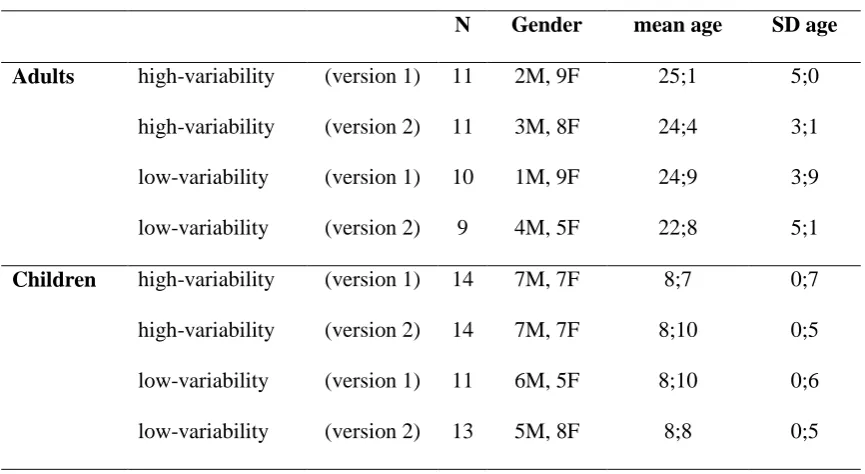
balance across conditions and versions were used. Details of participants in each condition
[image:18.595.82.515.451.688.2]are given in Table 1.
Table 1. Participant Details.
N Gender mean age SD age
Adults high-variability (version 1) 11 2M, 9F 25;1 5;0
high-variability (version 2) 11 3M, 8F 24;4 3;1 low-variability (version 1) 10 1M, 9F 24;9 3;9 low-variability (version 2) 9 4M, 5F 22;8 5;1
Children high-variability (version 1) 14 7M, 7F 8;7 0;7
high-variability (version 2) 14 7M, 7F 8;10 0;5 low-variability (version 1) 11 6M, 5F 8;10 0;6 low-variability (version 2) 13 5M, 8F 8;8 0;5
Participants lived in Greece and were students of L2 English. All participants had
18 language or learning disorder. Child participants’ level of proficiency was basic (L2 English
education, M = 1.96 years, range = 1-2 years). Adult participants’ level of proficiency was
advanced (L2 English education, M = 10.98 years, range = 9-13 years). All participants had
spent < 2 weeks in an English-speaking environment.
Stimuli
The experimental stimuli consisted of 20 real-word minimal pairs (e.g. ship-sheep)
and 20 non-word minimal pairs (e.g., stin-steen) containing the English tense-lax vowel
distinction (non-word minimal pairs were created so that they matched the real word minimal
pairs as closely as possible in their final syllables; see S1 Table for a list of all stimuli).
Participants learned the real-word minimal pairs in the training task, but were tested on both
these real-word items from training and non-word minimal pairs not included in training.
This allowed us to test both trained and novel items.
All minimal pairs were recorded by 5 native English speakers (3 female, 2 male) with
Southern British English pronunciation using a microtrack 24/96 digital recorder. Words
were edited into separate sound files, and peak amplitude was normalised using Audacity®
(2012). All other natural variation between recordings was kept. Clipart pictures of the 40
English words were selected from free online databases.
In addition to the main experimental stimuli, a second set of stimuli were developed
for a primed auditory lexical decision task. In this task, primes could be either English words
or Greek words, and targets were either related to the prime,
semantically-unrelated to the prime or non-words (see Table 2 for examples, and S2 Table for a full list of
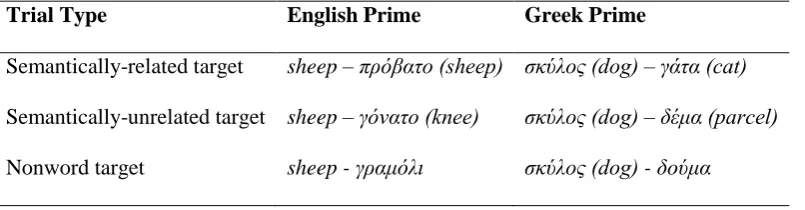
19 Table 2. Examples of the different trial types in the primed auditory lexical decision task.
Trial Type English Prime Greek Prime
Semantically-related target sheep – πρόβατο (sheep) σκύλος (dog) – γάτα (cat) Semantically-unrelated target sheep – γόνατο (knee) σκύλος (dog) – δέμα (parcel) Nonword target sheep - γραμόλι σκύλος (dog) - δούμα
For the English primes, one word from each real-word minimal pair was selected (12 /i/
items, 8 /ɪ/ items). Originally we had selected 10 /i:/ and 10 /ɪ/ items, but as two of the /ɪ/
items had Greek translations that were phonologically very similar to the English word (gin,
dip) these items were replaced with their /i:/ counterpart (gene, deep) since the primed
auditory lexical decision task aimed to examine semantic (not phonological) priming. For the
Greek primes, 20 words that matched the English primes as closely as possible in frequency
were selected. English word frequency was taken from the MRC psycholinguistic database
(Wilson, 1988). Greek word frequency was obtained from the GreekLex database (Ktori, van
Heuven & Pitchford, 2008). An independent-samples t-test confirmed that the two lists of
prime words did not differ significantly in frequency, t(38) = -1.12, p = .27. In addition, the
number of nouns, verbs, and adjectives was identical in both lists.
The semantically-related target word for the English primes was the Greek translation.
For the Greek primes, the semantically-related word was selected by asking 15 native Greek
speakers to write down the first word that came to mind for each Greek prime word. For both
types of prime word, semantically-unrelated words were words which were unrelated in
meaning with the target words which were matched as closely as possible in frequency and
length to the semantically-related words (frequency, t(78)=-.13, p=.90; N phonemes,
t(78)=.13, p=.89; N syllables, t(78)=.00, p=1.0). Non-words targets for both English and
20 the number of consonants and vowels, and were matched as closely as possible in length to
the word targets (N phonemes, t(158)=.98, p=.33; N syllables, t(158)=.99, p=.33). Primes and
targets were never cohorts or rhymes.
All Greek word and non-word stimuli for the lexical decision task were recorded by a
native Greek speaker, and were edited as above.
Design
Each participant completed 10 sessions over approximately two weeks (one session
per day over a minimum of 12 and maximum of 15 days). The experiment involved three
stages: pre-test, training, and post-test. The pre- and post-tests were identical, and contained
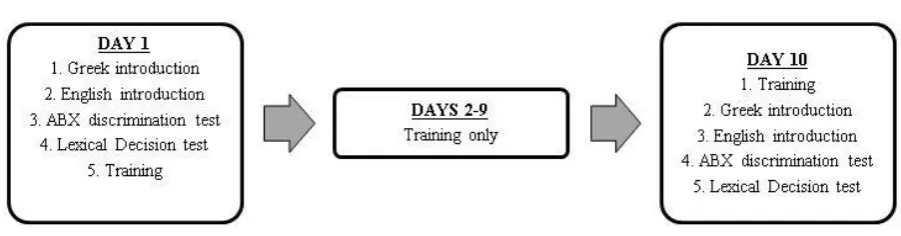
five tasks (see Figure 1). Session 1 began with the pre-test, followed by a block of training.
Sessions 2-9 consisted of training only. Session 10 consisted of training, followed by the
[image:21.595.71.522.463.581.2]post-test.
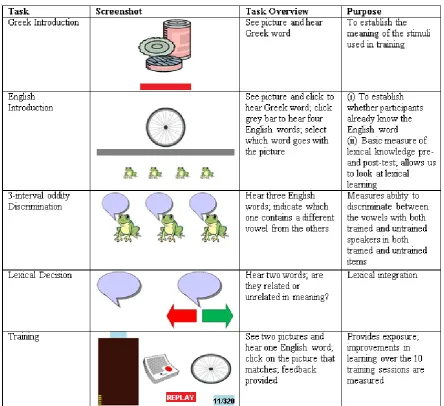
Figure 1. Tasks completed in each of the 10 experimental sessions.
There were two experimental conditions that differed only during training –
high-variability versus low-high-variability. In the high-high-variability training, English minimal-pair words
were spoken by four different talkers (2 female, 2 male). In the low-variability training,
English minimal-pair words were spoken by a single talker (always female). Pre- and
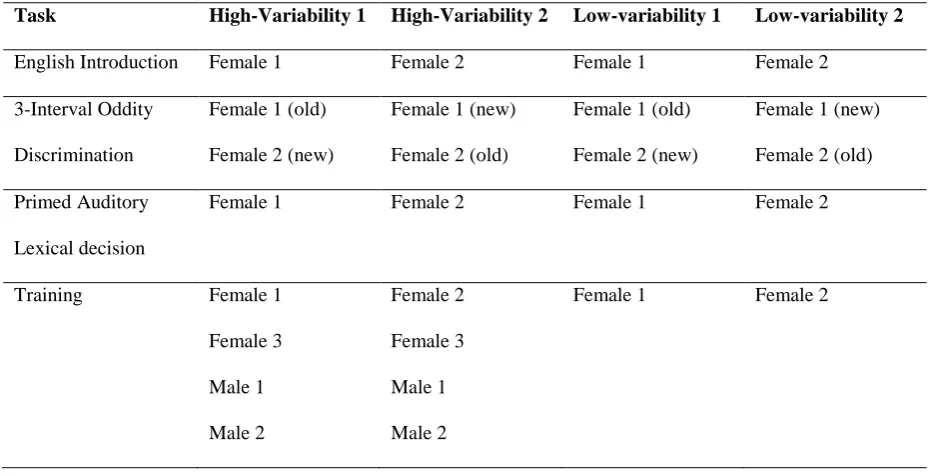
21 across participants in the discrimination task, resulting in four counterbalancing conditions;
[image:22.595.65.538.179.417.2]Table 3).
Table 3. Counterbalancing of the English talkers in each task.
Task High-Variability 1 High-Variability 2 Low-variability 1 Low-variability 2
English Introduction Female 1 Female 2 Female 1 Female 2
3-Interval Oddity
Discrimination
Female 1 (old)
Female 2 (new)
Female 1 (new)
Female 2 (old)
Female 1 (old)
Female 2 (new)
Female 1 (new)
Female 2 (old)
Primed Auditory
Lexical decision
Female 1 Female 2 Female 1 Female 2
Training Female 1
Female 3
Male 1
Male 2
Female 2
Female 3
Male 1
Male 2
Female 1 Female 2
Procedure
All tasks were run using Exbuilder (a custom built software package developed at the
University of Rochester) on laptop or desktop computers in quiet classrooms. Multiple
participants were tested simultaneously on separate computers. Stimuli were presented
22 Figure 2. Overview of the five experimental tasks.
Greek introduction: In this task, a picture of one of the minimal-pair words was
presented centrally on the screen, and participants heard the corresponding Greek word (see
Figure 2). Each minimal-pair word was presented once each in a random order. This task was
included to ensure that participants accessed the correct meaning for each picture since not all
items were concrete nouns (e.g., leap, slip etc.). No data were recorded from this task.
English introduction: In this task, participants saw a picture of one of the
minimal-pair words, presented centrally at the top of the screen. Participants could click on this picture
23 another button in the middle of the screen to hear four possible English words which were
each “spoken” by one of four frogs which appeared at the bottom of the screen (see Figure 2).
If the participant selected the correct English word, they received positive feedback (Greek
translation of correct (“σωστό”)) and the English word was replayed. If the wrong word was
selected participants listened to the four options again and had another go. This continued
until the correct word was chosen. The three distracter words for each trial were randomly
selected (but identical for all participants) with the following constraints; (a) no minimal pairs
were heard together (e.g., if ship was the target, sheep was not a distracter); (b) no rhyming
items were heard together (e.g., if ship was the target, chip was not a distracter); (c) each
word was heard once as a target, and three times as a distracter. Trials were presented in a
random order. Accuracy on the first attempt was recorded. Accuracy in Session 1 provided a
baseline measure of English vocabulary knowledge, whilst the change in accuracy between
Sessions 1 and 10 provided a measure of vocabulary learning.
Three-interval oddity discrimination test: In this test, participants heard three
words (played with ISIs of 200ms) spoken by a single talker. Two words were different
tokens of the same word (e.g., sheep, sheep), and one the other minimal pair item (e.g., ship).
Each word was “spoken” by one of three frogs which appeared on the screen and participants
clicked on a frog to indicate which word was the odd one out (see Figure 2). A response
could not be made until the third sound file had finished playing. Instructions emphasised
accuracy and no feedback was provided. All 20 real word and 20 non-word minimal pairs
were heard once each. Half of the trials contained an /ɪ/ target (e.g., sheep, sheep, ship), and
half contained an /i/ target (e.g., chip, chip, cheap). To minimise the influence of duration
cues (i.e., /i/ is a longer vowel than /ɪ/, so sheep is likely to have a longer acoustic duration
24 length of the longest item. Thus all trials were matched in length from the onset of the first
sound file until the moment when participants could respond.
Non-word trials tested whether participants could generalise their training to new
untrained items. We also tested whether participants could generalise to a new talker. To do
this, 10 of the 20 real-word minimal pairs were presented in a familiar voice, and the
remaining 10 in a new voice, and likewise for the 20 non-word minimal pairs. The two
talkers used as the familiar/ new voices were counterbalanced across participants (Table 3).
Primed auditory lexical decision test: A primed auditory lexical decision task
investigated the status of the semantic representations for English words and determined
whether this was altered following training. On each trial participants heard two words (a
prime and a target). The prime could be a trained English word or a Greek word. Each prime
was repeated four times, once with a semantically related word target, once with a
semantically unrelated word target, and twice with a non-word target. If the trained English
words have become integrated with Greek lexical knowledge then faster response times
should be observed when the English prime is followed by a semantically-related, compared
to semantically-unrelated Greek word. The inclusion of Greek primes enabled comparison of
the magnitude of semantic priming effects between English and Greek. Although priming
studies do not typically repeat the primes (more commonly repeating the target words with
different types of primes), using the English words as primes four times in the current study
increased the number of observations and thus the statistical power without the need to train
participants on a very large number of English words (see Tamminen & Gaskell, 2012, for a
similar design using an artificial language). The target word was unique on each trial.
Examples of each trial type are provided in Table 2 and a screenshot of the task is provided in
25 The task began with eight practice trials with feedback, followed by 160 experimental
trials without feedback. Participants were instructed to make a word/non-word judgment for
the second word as quickly as possible. Responses were made using the left (nonword) and
right (word) arrows on the computer keyboard. Response times were measured from the onset
of the second word.
Training: On each trial participants heard an English word and selected one of two
pictures (from the same minimal pair) displayed on the computer screen (see Figure 2).
Following Giannakopoulou et al. (2013a), participants could replay the English word an
unlimited amount of times before making a decision. If the correct picture was selected, the
incorrect picture disappeared, the English word was replayed, and a short video of a “happy”
bunny jumping up and down was played. A picture of a coin also appeared in a box on the
left-hand side of the screen, with the aim of motivating participants to try to earn more coins
during each subsequent training session. If the incorrect picture was identified both pictures
were removed from the screen and a short video of a “sad” bunny was played. The two
pictures then re-appeared and the English word was played again. Once the participant
clicked on the correct picture feedback was provided as in correct trials but no coin was
awarded. A training block consisted of the 40 English minimal-pair words each heard 8 times
each, resulting in 320 trials, presented in a random order. In the low-variability condition all
items were spoken by the same talker. In the high-variability condition participants heard
each word spoken twice by each of the four talkers (2 female, 2 male). We aimed that
participants would undertake one training block (320 trials) in each of their 10 sessions,
however due to time constraints associated with testing in schools, some children were only
able to complete 180 training trials in Sessions 1 and 10. In these cases children completed
26 respectively. Data were coded such that the first 320 trials and last 320 trials completed were
coded as Session 1 and Session 10 training blocks respectively.
Results
Analyses and statistical approach
Data were primarily analysed using linear mixed effects models (LMEs; Baayen,
Davidson & Bates, 2008; Jaeger, 2008; Quené & van den Bergh, 2008) using the package
lme4 (Bates, Maechler & Bolker, 2013) for the R computing environment (Dalgaard, 2010).
Since adults and children generally had very different starting points at pre-test, the data from
each age group were analysed separately for each task. However, since we were specifically
interested in age differences for phonetic discrimination, we also included additional analyses
comparing the age groups for the training and 3-interval oddity discrimination tasks.
Linear mixed effects models allow binary data to be analysed with logistic models
rather than as proportions, as recommended by Jaeger (2008). Our approach was to
automatically include all the relevant experimentally manipulated variables for each task, and
all the interactions between those variables, as fixed factors in a model, regardless of whether
they contributed significantly to the model (i.e., we did not use stepwise model comparison).
Since preliminary analysis suggested that the extent to which children had used the “replay”
button during training was positively correlated with their increase in performance from pre-
to post-test in the 3-interval oddity discrimination task (r = .38, df = .91 p < .01), we also
included each participant’s mean-replay-usage as a fixed factor in the models for that task
(note that although the correlation did not hold for adults (r = .17, df = .39 p = .27), the factor
was nevertheless included in both models for consistency). In addition, preliminary analyses
revealed that one of the two talkers used in the test stimuli (i.e. as the trained/untrained voice;
see Table 3) was more intelligible than the other, affecting discrimination. In order to ensure
27 interactions with talker as a fixed factor1. Finally, in all models, predicting variables
(including discrete factor codings) were centred to reduce the effects of collinearity between
main effects and interactions, and in order that main effects were evaluated as the average
effects over all levels of the other predictors (rather than at a specified reference level for
each factor). We do not report full statistical models. For the experimental factors, we report
statistics for main effects and interactions where there are predictions. For example, we did
not inspect the model for a main effect of voice-novelty (trained vs. untrained talker), since
this effect is not interpretable for both levels of test-session (i.e. novelty is only relevant after
training). We also inspected each model to see if there was a main effect of the control
variable talker, and in addition, wherever we found a reliable main effect or interaction for
the experimental factors we looked to see if it was qualified by a higher level interaction with
talker. For clarity of exposition, the results with the control variable are not reported in the
main text (see S3), with the exception of places where we found a reliable interaction
between an effect of interest and the control variable talker, and this broke down to suggest
that there was an effect only for one of the talkers.
The lme4 package provided p-values automatically for logistic mixed effects models
but not for linear mixed effect models. For models with a continuous outcome variable (i.e.,
RTs in the lexical decision task) p-values were calculated using the lmerTest package using
Kenward-Roger approximation for denominator degrees of freedom. We included participant
as a random effect and used a full random slope structure (i.e., by-subject slopes for all
within-subject factors (although not the control variables) and their interactions, as
recommended by Barr et al., 2013). In some cases, the full model did not converge and here
we removed the correlations between slopes (Barr et al., 2013). All of the models reported
1 There was just one model reported in the text where it was not possible to include the interactions with the
28 converged with Bound Optimization by Quadratic Approximation (BOBYQA optimization;
Powell, 2009). The analyses scripts and output can be viewed here:
http://rpubs.com/ewonnacott/247911. Data files and scripts are also available on the Open
Science Framework: https://osf.io/8anzk/.
Training
Participants’ accuracy in selecting the correct picture from its minimal pair on the first
attempt was recorded, though with some data loss (adults = 2%; children = 6%). Recall that
high-variability training comprised four talkers; for half of the participants in this condition,
these were talkers Female 1, Female 3, Male 1 and Male 2, for the other participants these
were talkers Female 2, Female 3, Male 1 and Male 2. In the low-variability training, half of
the participants were trained with Female 1 only and half with Female 2 only (where Female
1/Female 2 were not used in training, they were used as the novel voice in testing- see Table
3). This design meant that high-variability included three talkers that were never included in
the low-variability training. It is possible that stimuli produced by these talkers could be
easier or harder to identify than stimuli produced by the two talkers used in both training
conditions. To ensure a fair comparison across conditions, we only consider trials in the
high-variability condition where the stimuli were produced by one of the two talkers who were
also used in the low-variability condition (i.e., trials with female3, male1, and male2 were
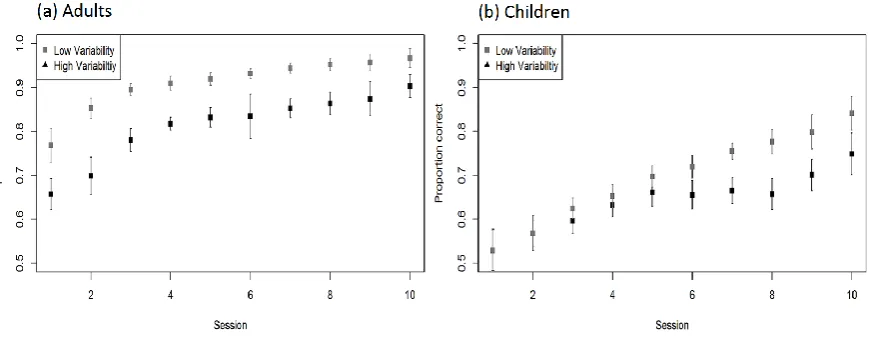
excluded; see Table 3). The proportion of correct responses in each session is shown in
Figure 3. For our primary analyses, the data were analysed in two logistic mixed effects
models predicting whether a correct response was given (1/0) on each trial. Experimental
factors in the model were training-session (110) and condition (high-variability,
low-variability),and the interaction between them. We were also interested in the contrast
between age-groups, however, as can be seen in Figure 3, by the final session, adult
29 analyses comparing age-groups to data from the adults and children in the high-variability
condition only. Here we used a mixed model predicting response accuracy with fixed effects
of training-session, age-group and talker, and all of the interactions between them, though
we only report the effect of age and interactions with age).
Figure 3. (a) Adult (left) and (b) child (right) performance during training (error bars show
standard error). For the high-variability condition, trials with the three additional talkers are
excluded (note: for all of the plots within this paper, means are corrected to control for imbalance in counterbalancing of talkers).
Adults: There were main effects of training-session (beta = 0.35, SE = 0.03, z =
11.21, p < .001) and condition (beta = 1.63, SE = 0.25, z = 6.41, p < .001) and a reliable
interaction between condition and session (beta = 0.21, SE = 0.05, z = 3.86, p < .001). This
reflects improvement across sessions and an overall better performance in the low-variability
condition which increases with training.
Children: There was a reliable main effect of training-session (beta = 0.22, SE =
0.03, z = 7.06, p < .001), reflecting improved performance across sessions, but no reliable
main effect of condition (beta = 0.37, SE = 0.24, z = 1.56, p = .12). There was also a near
[image:30.595.79.515.206.376.2]30 .054). Inspecting the graphs, this seems to reflect the fact that the difference between
conditions emerges only in the second half of training. As a follow up, we explored whether
the effect of variability changed from the first half of the experiment (sessions 1->5) to the
second half of the experiment (sessions 6->10) in an identical statistical model where session
replaced the binary factor test-half (sessions 1->5 versus 6->10). In this model, there was a
reliable effect of test-half (beta = 1.05, SE = 0.14, z = 7.51, p < .001) which broke down to
show no reliable effect of variability in the first five sessions (beta = 0.08, SE = 0.24, z =
0.32, p = .75) but a reliable effect of variability (benefitting low-variability) in last five
sessions (beta = 0.56, SE = 0.23, z = 2.44, p = .015).
Although we were not able to include the interactions with talker in the original model
(with session as a continuous variable), in the follow up model (with test-half replacing
test-session) the interaction between test-half and condition was qualified by a reliable effect of
talker (talker by test-half by condition: beta = 0.73, SE = 0.34, z = 2.16, p = .031). Breaking
this down, there was a reliable effect of variability only for talker2 (the more intelligible
talker) in the second half of training (female 1, first half: beta = -0.05, SE = 0.31, z = -0.16,
p = .88; female 1, second half: beta = 0.09, SE = 0.33, z = 0.27, p = .79; female 2, first half:
beta = 0.22, SE = 0.29, z = 0.756, p = .45; female 2, second half: beta = 1.09, SE = 0.29, z =
3.83, p < .001).
Age group comparisons: Adults in the low-variability condition hit ceiling by the
final training sessions, making statistical comparisons with children inappropriate. Restricting
analysis to the high-variability conditions (and returning to a model with training-session as a
continuous variable): there was a main effect of age (beta = -1.01, SE = 0.22, z = -4.64, p <
.001) reflecting the overall higher performance of adults, however, critically, there was no
-31 1.02, p = .31). Thus there was no reliable evidence of faster learning in children than in
adults.
Summary of training data: All participants improved overall in the training task
over time. For adults, there was a benefit of low-variability observable throughout training
and an interaction with session suggesting that this benefit increased throughout training. For
children, there was no overall benefit of low-variability, however there was marginal
evidence of greater improvement in the low- rather than high-variability training. This seems
to emerge in the second half of training and to be only true for the more intelligible speaker.
In contrast to Giannakopoulou et al. (2013a), there was no evidence of a “plasticity” benefit
whereby children showed larger benefits of training. Instead, in the low-variability condition,
adults (but not children) were at ceiling by the end of training, and in the high-variability
condition there was no reliable difference in the improvement shown by adults and children.
English Introduction
The English introduction task was included primarily to check whether participants
knew the meanings of any of the English words prior to the experiment. However, we were
also able to use this test to explore whether knowledge of word meanings improved following
training. Accuracy in selecting the correct word (from a choice of three foils) on the first
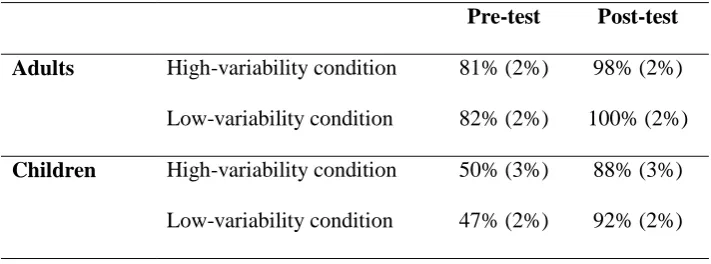
attempt was coded as 1/0. Table 4 shows the percentage of correct trials for adults and
children in each condition pre- and post-training. Both groups appear to improve with
training, although adults outperform children and are close to ceiling (above 80% correct,
even at pre-test, with many participants having perfect scores). Given ceiling effects, in the
adult data, we restricted our statistical analyses to the data collected from children. A logistic
mixed effects model was run over the child data predicting their accuracy (1/0) with fixed
factors of test-session (pre-test, post-test), condition and test-session by condition, as well as
32 test-session (beta = 3.19, SE = 0.26, z = -12.23, p < .001) and a marginal interaction between
test-session and condition indicating perhaps more learning in the low-variability condition
[image:33.595.120.476.232.364.2](beta = -0.95, SE = 0.51, z = -1.87, p = .061).
Table 4. Performance in the English introduction task: Adult and children's knowledge of word
meanings at pre- and post-test (standard error in parentheses).
Pre-test Post-test
Adults High-variability condition 81% (2%) 98% (2%)
Low-variability condition 82% (2%) 100% (2%)
Children High-variability condition 50% (3%) 88% (3%)
Low-variability condition 47% (2%) 92% (2%)
In summary, both adults and children showed a pattern of improved knowledge of the
word meanings from pre- to post-test with no differences between the high-variability and
low-variability conditions, although it was only possible to statistically verify these patterns
for children due to ceiling effects in adults.
Primed Auditory Lexical Decision
Trials with non-word targets were excluded. We conducted separate analyses for trials
with Greek and English primes (targets were always Greek words). The Greek-primes
analyses allowed us to determine whether standard semantic priming occurs within the native
language, and thus served as a check on our experimental set up. (Note that, in addition to the
means supplied within the text and in Figure 4, a full break down of means by condition can
33 Figure 4. (a) Adult (left) and (b) child (right) performance in the Primed Auditory Lexical
Decision Task collapsing across condition. Mean RTs for Greek target words with related and
un-related English primes pre- and post-test. Error bars show standard error (note: for all of the plots within this paper, means are corrected to control for imbalance in counterbalancing of talkers).
For the Greek-primes analyses, trials on which targets were incorrectly identified as
non-words were removed (adults = 5%; children = 10%), as were trials with RTs < 200ms or
> 2.5 SD above the mean for each participant in each test-session (i.e., a further 3% of data
for adults, 3% for children). The remaining data were analysed in a linear mixed effects
model predicting RT with fixed factors of prime-target relationship (related, unrelated),
test-session (pre-test, post-test) and the interaction between them.
For English-primes analyses, we analysed both RTs (for children and adults), and
accuracy (children only). For the RT analyses, data were filtered as described above
(incorrect trials: adult = 6%, children = 16%; additional data removed due to < 200ms or >
[image:34.595.77.522.81.356.2]34 mixed effects model predicting RT with fixed factors of prime-target relationship (related,
unrelated), test-session (pre-test, post-test) and condition (high-variability, low-variability),
the control variable talker and all of the interactions between these factors. For the accuracy
analyses, all English-prime trials with real word targets were included and the data were
analysed using a logistic linear mixed effects model predicting accuracy of response (i.e.,
whether the target was correctly identified as a real word – coded as 1/0) with the same
predictors as the RT data.
Adults:For Greek primes, there was a significant main effect of prime-target
relationship (beta = 101.33, SE = 13.52, t = 7.40, p < .001, related = 1014 ms, unrelated =
1114 ms), reflecting a standard priming effect for semantically related words within the
native language. There was no overall effect of test-session (beta = 37.90, SE = 39.45, t =
0.95, p = .35) and no interaction between test-session and prime-target relationship (beta =
17.71, SE = 26.41, t = 0.67, p = .507).
For English primes, there was a significant main effect of prime-target relationship
(beta = 83.62, SE = 20.13, t = 4.04, p < .001; related = 1153 ms, unrelated = 1238 ms),
reflecting semantic priming across the two languages. There was no overall effect of
test-session (beta = 42.18, SE = 48.64, t = 0.82, p = .41), suggesting no change in RTs in the
post-test. Of critical interest is whether there was an interaction between test-session and
prime-target relationship, since this could indicate an effect of training on priming. No such effect
was found (beta = -37.26, SE = 41.76, t = -0.85, p = .40) and there was no three-way
interaction between test-session, prime-target relationship and condition (beta = 95.90, SE =
83.81, t = 1.10, p = .28). Thus there was no evidence that across language semantic priming
was affected by the training (see Figure 4).
Children: For Greek primes there was a significant main effect of prime-target
35 1549 ms), reflecting a standard priming effect for related words within the native language.
There was a marginal overall effect of test-session (beta = 136.08, SE = 69.21, t = 1.95, p =
.057), reflecting a slight reduction in RT length from pre (1563 ms) to post (1469 ms) test for
children. There was no interaction between test-session and prime-target-relationship (beta =
-25.25, SE = 67.97, t = -0.37, p = 0.71).
For English primes (RT data) there was a marginal main effect of prime-target
relationship (beta = 65.17, SE = 33.39, t = 1.95, p = .058, related = 1620 ms, unrelated =
1664 ms), reflecting across language semantic priming. There was an overall effect of
test-session (beta = 181.88, SE = 74.46, t = 2.34, p = .023) indicating decreasing RTs from pre
(1704 ms) to post (1580 ms) test. However there was no interaction between test-session and
prime-target relationship (beta = -52.67, SE = 66.60, t = -0.79, p = .43) and no three-way
interaction between test-session, prime-target relationship and condition (beta = -7.55, SE =
133.81, t = -0.06, p = .96), suggesting that across language priming was not affected by the
training (see Figure 4).
Given the large amount of data excluded from the previous analyses of English
primes (i.e. 16% of words inaccurately identified as non-words), we also analysed the
accuracy data for children. Similar results were obtained. There was a significant main effect
of prime-target relationship (beta = -0.71, SE = 0.13, z = -5.60, p < .001, related: 87%,
unrelated 81%), reflecting across language semantic priming. However there was no
interaction between test-session and target-relationship (beta = 0.26, SE = 0.23, z = 1.12, p =
.26), and no three-way interaction between test-session, semantic priming and condition (beta
= 0.01, SE = 0.40, z = 0.03, p = .98).
Summary of primed auditory lexical decision data: Analyses of Greek-prime trials
established that both adults and children showed standard semantic priming effects within
36 primes), which held steady across the two test-sessions. Analyses of English-prime trials
demonstrated that both adults and children showed evidence of across language priming (for
adults, reliably shorter RTs, for children marginally shorter RTs and reliably more accurate
responses). However, for both age groups, there was no evidence of an increase in the degree
of semantic priming following training.
Three-Interval Oddity Discrimination Test
We first ran separate logistic mixed effects models for each age-group, predicting
whether a participant gave a correct response (i.e., picked the correct word as different out of
a choice of three, coded as 1/0) on each trial. The fixed factors were test-session (pre-test,
post-test), voice-novelty (trained voice, untrained voice), word-novelty (trained word,
untrained non-word), condition (high-variability, low-variability) and all the interactions
between these experimental factors. The factor talker and all of the interactions between
talker and the experimental factors were included as control factors. We also included the
continuous variable mean-replay-usage as an additional control factor. We ran a further
model over the combined data from children and adults which included the same factors as
before as well as the fixed effects of age-group (adult, child) and all of the interactions with
this factor. This model was specifically inspected to look for the effects of age-group. (Note
that, in addition to the means supplied within the text and the difference scores in Figure 5, a
full break down of means at pre and post-test by condition can be seen in the R script at
37
Figure 5. (a) Adult and (b) child discrimination data. Mean increase in percent correct responses
from pre- to post-test (error bars show standard error). Note: for all of the plots within this paper, means are corrected to control for imbalance in counterbalancing of talkers.
Adults: There was no reliable main effect of word-novelty (beta = -0.15, SE = 0.12, z
= -1.23, p = .22), suggesting no difference in discrimination for real English words compared
to non-words. There was a reliable effect of test-session, indicating an effect of training (beta
= -0.52, SE = 0.15, z = -3.44, p = .001). This was qualified by a reliable interaction with
talker (beta = -0.59, SE = 0.23, z = -2.53, p = .01), which broke down to show that though
there was numerical improvement from pre- to post-test for both talkers, this was only
reliable for the more intelligible talker (female 2: beta = -0.82, SE = 0.23, z = -3.61, p < .001;
87% 93% ; female 1, beta = -0.23, SE = 0.15, z = -1.51, p = .13: 66% 70%) (note that
there were no significant higher level interactions involving talker – see S3).
Of critical interest is how participants’ improvement from pre- to post-training was
[image:38.595.82.518.76.337.2]