Enabling high reliability of
network infrastructure;
an explorative study to map and monitor
appropriate motivations and forms of
knowledge that enable reliability.
Enschede, 7
thof October 2010
Version 2
© Copyright 2010 Thijs Alink.
None of the text or images in this publication may be copied, reproduced or distributed without prior written permission of the author. This publication may be printed for personal and non-‐commercial use only. The University of Twente may deposit this publication in an institutional, national or centrally organised digital repository.
Enabling high reliability of
network infrastructure;
an explorative study to map and monitor
appropriate motivations and forms of
knowledge that enable reliability.
This study was commissioned by Oxilion B.V. and carried out under the supervision of Jeroen Tekelenburg. The first supervisor of the University of Twente is dr. Fons Wijnhoven and the second supervisor is dr. Michel Ehrenhard. Contact information can be found below.
Client Student
Name:
J Tekelenburg BSc. Financial Director Oxilion B.V.
T. Alink
University of Twente
School of Management and Governance Master Business Administration, IM Student number: 0211141
Address: Boddenkampsingel 87
7514 AP Enschede P.O. Box: 575 7500 AN Enschede
Cato Elderinklaan 24 7576 EA Oldenzaal
Telephone: +31 (0) 887 87 7678
E-‐mail: [email protected] [email protected]
1e supervisor 2nd supervisor
Name:
Dr. A.B.J.M. Wijnhoven
Associate Professor of Knowledge Management and Information Systems University of Twente
School of Management and Governance Information Systems & Change Management
Dr. M.L. Ehrenhard
Assistant Professor Strategy & Entrepreneurship
University of Twente
Dutch Institute for Knowledge Intensive Entrepreneurship (NIKOS)
Address: Ravelijn Building, Room 3341
P.O. Box 217 7500 AE Enschede
Langezijds, Room LAA205 P.O. Box 217
7500 AE Enschede
Telephone: +31 (0) 53 489 3853 +31 (0) 53 489 4531
E-‐mail: [email protected] [email protected]
MANAGEMENT SUMMARY
The internet has become a vital element in modern society and modern business. Ensuring that it functions properly has become a crucial task. The internet needs a tough infrastructure to function well. The digital economy depends on this infrastructure for sharing any type of content.
The internet infrastructure is created and managed by a variety of companies. This study focuses on one of these companies, namely the hosting provider Oxilion. The company, like any hosting provider, offers a service that allows businesses to store and publish any type of data on the internet. These businesses are in need of a reliable partner and expect that Oxilion’s service is always up and running. These customer expectations pressure Oxilion to manage its complex network infrastructure extremely well. The infrastructure of Oxilion is designed to cope with failures, but it cannot handle unanticipated failures. When unanticipated failures occur, employees must be able to take appropriate action. However, what enables employees to take appropriate action? Additionally, how should this be monitored?
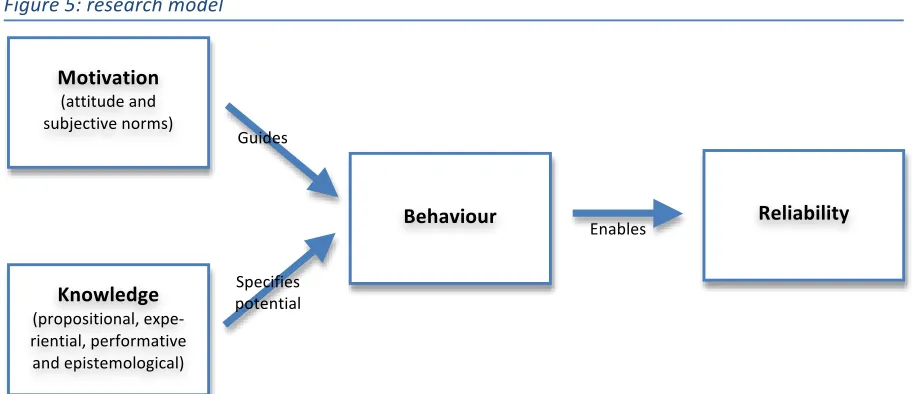
One assumes that by taking appropriate action (behaviour) employees can eliminate threats to reliability. Their actions are influenced by their motivation and their knowledge. An individual’s attitude and perceived subjective norms (collectively called motivation) guide the way in which an individual evaluates alternative courses of action and consequently the way he or she behaves. An individual’s knowledge specifies the potential range of actions that he or she can take and consequently potential behaviour.
Based on Oxilion’s practical problem and the proposed assumptions, three research goals were drafted. First, this study aims to describe what knowledge and motivations are needed to create appropriate behaviour. Second, this study aims to provide a ‘tool’ that can be used to monitor reliability, behaviour, motivation and knowledge. Third, this study aims to describe how Oxilion can learn from the information gathered by monitoring reliability.
The study uses a concurrent transformative mixed method design encompassing six data collection methods. The research diary method is the primary method for collecting data. Data collection spanned a period of four months (April – July 2010). The length of the data collection period and its broad spectrum resulted in a wealth of data. This data was analysed descriptively and by means of the qualitative data analysis method developed by Creswell (2009). This method involves coding data.
‘trouble-‐shooting’, meaning that they were containing the effects of incidents that had already occurred. This mode of realizing reliability requires a special configuration of motivations and knowledge. First of all, it requires appropriate containment motivations that focus on resilience. Three classes of motivations demonstrated to be especially important, namely: (1) motivations regarding diagnosis and resolution, (2) motivations regarding communication and collaboration, and (3) motivations regarding knowledge development and sharing. Second, two forms of experiential knowledge were required: (1) a complex set of understandings and experiences regarding a technology to interpreted signals of a failure correctly and (2) an acquaintance with an entity to effectively acquire information (propositional knowledge) about the diagnoses and resolution of incidents.
In order to realize high reliability, Oxilion should not only be able to create appropriate motivation and knowledge (and thereby behaviour and reliability), the organization should also to monitor any changes in the variables. Motivation and knowledge, the aspects that enable appropriate behaviour, should be monitored by a half-‐yearly internal survey and half-‐yearly assessment respectively. Both monitoring tools should be tailored to the motivations and forms of knowledge needed by Oxilion. These motivations and forms of knowledge were discussed above. The information gathered with the monitoring tools can be used to decide whether initiatives for improvement should be deployed and, if so, on what aspects these initiatives should focus.
Reliability should be monitored by archiving threats to reliability. Each threat should be registered and stored in an incident database. This information could be used to determine the reliability level of Oxilion. Additionally, the information stored in the database could be used for learning purposes. By reusing stored resolution strategies the organization could achieve more effective error-‐ correction (single-‐loop learning). By innovating and combining stored resolution strategies the organization could develop new resolution strategies (double-‐loop learning). The insights provided by the monitoring tool might lead to an adjustment in learning style and consequently deutero learning (learning to learn).
To sum up, in order to realize reliability, Oxilion should use a tool that consists out of three sub tools: (1) an incident database to monitor reliability and facilitate learning, (2) a half-‐yearly internal survey to monitor motivation and (3) a half-‐yearly assessment to monitor experiential knowledge.
INDEX
Preface ...3
1. Introduction ...4
1.1 Prologue ...4
1.2 Hosting and the hosting branch ...5
1.3 Oxilion ...9
1.4 Research assignment...13
2 Theoretical framework...15
2.1 Reliability...16
2.2 Behaviour ...18
2.3 Motivation...19
2.4 Knowledge...22
2.5 Wrap up...25
3 Methodology...26
3.1 Mixed method concurrent transformative design ...26
3.2 Sample, measurement and data collection...28
3.2.1 Direct observation and informal interviews...28
3.2.2 Research diary ...28
3.2.4 Small-‐scale survey ...30
3.2.5 Qualitative semi-‐structured interviews...30
4 Data analysis...32
4.1 Reliability...32
4.2 Behaviour ...35
4.3 Motivation...37
4.4 Knowledge...41
5 Monitoring and learning ...44
5.1 Reliability...44
5.2 Behaviour ...47
5.3 Motivation...48
6 Conclusions ...51
6.1 Conclusion ...51
6.2 Limitations...55
6.3 Contributions to practice and theory ...56
6.4 Suggestions for future research ...57
References...60
Appendices...63
Appendix A: results of the diary research method...64
Appendix B: results of the internal survey ...68
Appendix C: classification of incidents based on cause ...71
Appendix D: classification of behaviour based on ITIL ...72
Appendix E: classification of behaviour based on object and entity...73
Appendix F: coding and categorizing of motivations ...74
Appendix G: incident database structure...75
Appendix H: mock-‐up of an annual incident report...76
PREFACE
How do your check your savings? How do you transfer money from your bank account? Which service do you use if you want to sell the old furniture you have stored in the attic? Who do you turn to when you want to check the news at any time of the day? How do you know which houses are fore sale in the neighbourhood you want to move to?
Most likely you do not think about how much you use the internet. And you are probably not aware of your dependence on a functioning internet connection. For most people it is obvious that the internet just works. But what if it fails? A lot of people would not be able to search for information, look-‐up product reviews or check the news (these are the most popular activities on the internet according to Synovate, 2009). However, the damage of individual’s inability to use the internet is nothing compared to the damage suffered by some companies who experience an internet failure, because a number of companies rely heavily on the internet for its operations.
This study is all about increasing the reliability of the internet. Or, more precisely: increasing the reliability of network infrastructure. This study aims to answer the question: what would be the requirements, from a human perspective, to create a reliable network infrastructure?
This study is the last part of my master Business Administration at the University of Twente. In January 2010 I had finished all the regular courses. Therefore, I started looking for an interesting graduation assignment. The hosting branch had always intrigued me, so logically this branch formed the point to start my search. The first request I sent was to an interesting hosting provider called Oxilion. Luckily, they accepted my request. And the rest, as is commonly stated, is history.
I could not have completed the thesis with help and participation of a lot of people. First, I want to thank my supervisor at Oxilion, Jeroen Tekelenburg, for his advice, helpful insights and allowing me to develop my own assignment. Second, I want to thank my supervisors at the University of Twente, Fons Wijnhoven and Michel Ehrenhard for giving me useful feedback and pointing out issues in need of improvement. Additionally, I want to thank Larik-‐Jan Verschuren of Oxilion for providing me with interesting suggestions and explaining all the technical aspects of the company. Finally, I want to thank my family, friends and colleagues for their support.
Enschede, 6 October 2010.
1. INTRODUCTION
The purpose of this chapter is to introduce the context of this study, present the unit of analysis and describe the study’s objective. The chapter starts by establishing why a reliable internet infrastructure is, in general, important. Next, the chapter zooms in on a group of companies that manage a part of the internet infrastructure. Often these companies are jointly referred to as: the hosting branch. One of these companies is the unit of analysis of this study. The chapter will provide a description of this company and presents their main business challenge. From this challenge a practical problem and research objective is derived.
1.1 PROLOGUE
The internet has become an indispensable element in modern society: it is infused in almost every aspect in our daily lives (Yan, Eidenbenz, Thulasidasana, Datta, & Ramaswamy, 2009). It makes “economic activity more efficient, faster, and cheaper” (Yan et al. 2009, p. 2), and broadens social interaction in unmatched ways (OECD, 2008). The internet is boosting competition, spurring the tempo of innovation and promoting reorganization of industries and businesses (OECD, 2008).
A major part of the European consumers and almost every European business is connected to the internet. Within the European Union, 50% to 82% of all households and 93% of all businesses have access to the internet (OECD, 2009) (Eurostat, 2009). On average 16% of all European businesses receive orders on-‐line, while 28% of all European businesses make on-‐line purchases (Eurostat, 2009). Bear in mind that this is a European average. The proportions vary from country to country.
1.2 HOSTING AND THE HOSTING BRANCH
The internet infrastructure is created and managed by a variety of companies (Barua, Pinnell, Shutter, & Whinston, 1999). This study focuses on group of companies collectively called hosting providers. Hosting providers offer ‘online space’ that enable individuals and business to publish any type of data and make it accessible on the internet. Some organizations use the services of a hosting provider to support critical business processes or business applications. Others use hosting to inform their customers about their organization and their services by means of a website. At some companies hosting does not only enable business, it means business. Internet companies like Amazon or eBay use hosting to power their single distribution channel: their website.
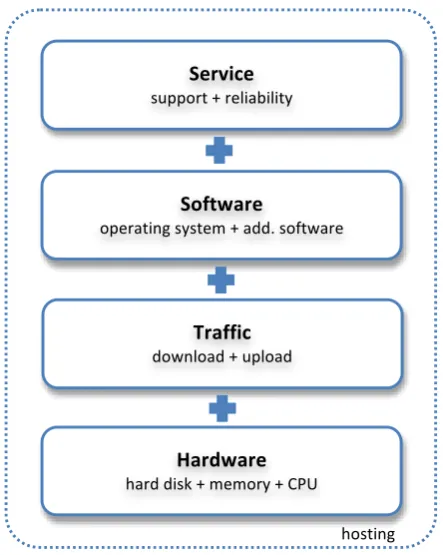
Hosting is usually described according to several characteristics, namely: hardware, traffic, software and service. These characteristics can in turn be broken down into several sub characteristics. Figure
1 depicts and describes the (sub) characteristics of hosting1. Hosting providers use these
characteristics as a basis for their pricing policy and promotion of their product offering.
1 This thesis uses a self-‐developed model to describe hosting. Other models, such as the frequently used OSI-‐model, are generally aimed at describing IT-‐infrastructure on a technical level (e.g. the OSI-‐model describes how systems communicate with each other). In general these models do not include the service characteristic of hosting given that it is not directly related to technology. The figure used in this thesis is derived from multiple descriptions of hosting product offerings. In other words: it characterizes hosting along the lines that providers regard as important.
Description: Often three hardware resources are distinguished: the hard disk (the amount of data that can be stored), CPU, and memory (which together determine the number of requests for data that can be handled at the same time).
Description: In general, two broad software categories can be distinguished: an operating system (e.g. Windows, Linux) and additional software (e.g. Direct Admin, Joomla, Magento). These two cate-‐ gories specify (to a large degree) the functionality of a hosting account.
Description: Service offered with hosting consists, in general, out of two elements: the level of support offered (e.g. by mail or telephone) and the level of reliability guaranteed (e.g. 95% or 99%). The level of support and the level of reliability are largely depended on contractual agreements.
Figure 1: characteristics and sub characteristics of hosting
hosting
Description: Traffic encompasses two elements: data that can be downloaded from and data that can be uploaded to a hosting account. Traffic is generally associated with the number of visitors an account can handle.
Service support + reliability
Software
operating system + add. software
Hardware hard disk + memory + CPU
[image:10.595.75.297.389.667.2]There are a lot of companies that are directly or indirectly connected to hosting (e.g. hardware manufactures, software developers, telecom providers, semi-‐governmental organizations). However, this study limits its description of the market to companies that offer some form of hosting. This group of organizations is generally referred to as the hosting branch. These companies can be categorized according to common stages of growth, meaning their scales of operations and money invested in hosting activities (figure 2). A short description of each company:
• A reseller is, as the name implies, an intermediary between a customer and a hosting provider.
Most resellers buy one large hosting account, divide this account into several accounts and resell these accounts. A reseller can either be a very small hosting provider or an internet-‐ related company that offers hosting to support their main product (e.g. web design or marketing). Resellers are only responsible for customer contact and associated tasks. Examples: TriMM, bSeen, Webton, GreenOrange.
• Small hosting providers are usually sole proprietorships that offer simple forms of hosting. They
lease their hardware from other providers and let this provider manage the hardware. The small provider is only responsible for the software on the server and customer contact. Examples: Serveo, Hofstad Hosting, NetMatters, xYnta.
• Medium hosting providers are commonly general partnerships and limited companies. These
providers own their hardware. They are responsible for all aspects of running a hosting company including hardware-‐, software-‐ and user management. Examples: Antagonist, PC Extreme, SoHosted, Cillix.
• Large providers are in general limited companies. These providers have the same
responsibilities as medium hosting providers. However, their product offering consists generally out of more complex products and their scale of operations and money invested far precedes medium hosting providers. Examples: Hostnet, Strato, Combell, Your Hosting.
• Very large providers are usually joint stock companies operating in multiple countries. They are
in essence a large provider, but operate out of multiple locations that they either own or lease from a third party. Examples: LeaseWeb, Rackspace, One, Active24.
• A data center facilitates a reliable and protected environment for the hardware of hosting
Enabling high reliability of network infrastructure – Thijs Alink 7
TASKS KNOWLEDGE COMPANIES THAT CONSITUTE THE HOSTING BRANCHE
sca
le
o
f o
pe
ra
tio
ns
an
d
m
on
ey
in ve st ed in h ost in
g
act
ivi
tie
s
Figure 2: overview of companies that constitute the hosting branch, their tasks and associated knowledge
Reseller
Data center
Small hosting provider
Medium hosting provider
Large hosting provider
Very large hosting provider (= hosting provider + data center)
-‐ customer contact (sales/support) -‐ user management
-‐ setting up hosting accounts -‐ tasks related to their main services
-‐ all of the above
-‐ manage software on one or a couple of servers
-‐ all of the above
-‐ management of one or several racks -‐ server maintenance and set-‐up -‐ local network maintenance and set-‐up
-‐ all of the above
-‐ set-‐up and maintenance of a overarching server base that enables complex and capital intensive technologies
-‐ facilitating interconnectivity -‐ intra-‐local network management
-‐ managing a building (security, power, fire prevention, climate control)
-‐ all of the above
-‐ general sales skills
-‐ general knowledge of internet/pc’s -‐ hosting account management
-‐ knowledge related to their main services
-‐ all of the above -‐ server configuration
-‐ installing and configuring operating systems and additional installed software
-‐ all of the above
-‐ configuring and managing servers and racks (installing and maintenance)
-‐ local network management
-‐ all of the above
-‐ configuring and managing a servers base consisting out of multiple servers and other hardware.
-‐ internet connectivity -‐ facility management
-‐ all of the above
Comment #1: Oxilion does not fit exactly into this model. The company is a hybrid between a large hosting provider and data center. Oxilion manages multiple racks filled with servers at several locations and manages its own network but does not own a data center. . Comment #2: percentages given represent proportion of the total number of providers and are estimates based on the type of business entity as registered at the Dutch Chamber of Commerce.
com
pa
ni
es
in
the
g
re
y
ar
ea
ar
e
ho
st
in
g
pr
ov
id
er
s
in fr as tr uc tu re pr oc ur em ent re la tio ns hi p
Oxilion
Data center Reseller
Small hosting provider (57%)
Medium hosting provider (24%)
Large hosting provider (15%)
Very large hosting provider (4%)
There are between 900 and 1100 hosting providers in the Netherlands (ISPam, 2009). Roughly 25% of all providers were established before 2000, 25% of all providers were established between 2000 and 2004, and 50% of all Dutch hosting providers were established in 2004 or later (ISPam, 2009). The vast majority of providers that operate on the Dutch market (90%) are based in the Netherlands, a small part (8%) is based in Belgium and only 2% is based outside the Netherlands or Belgium (ISPam, 2009).
There are approximately 2000 companies accredited to register a Dutch domain name (SIDN, 2010). However, this number does include non-‐hosting providers such as resellers and trademark companies. The Dutch domain name is, with over four million claimed names (SIDN, 2010), the fourth most popular country domain name in the world (SIDN, 2010).
The Dutch hosting market is a very segmented market in comparison to other countries2. A Dutch
hosting provider has to compete with a lot of small hosting providers and some large providers, whereas abroad the competition comprises mainly out of large providers. However, experts think that this will gradually change. Major players in the branch expect that the Dutch market will
consolidate in the upcoming years3. Larger hosting providers will buy smaller providers or small
providers will no longer be able to compete with large providers and will cease to exist.
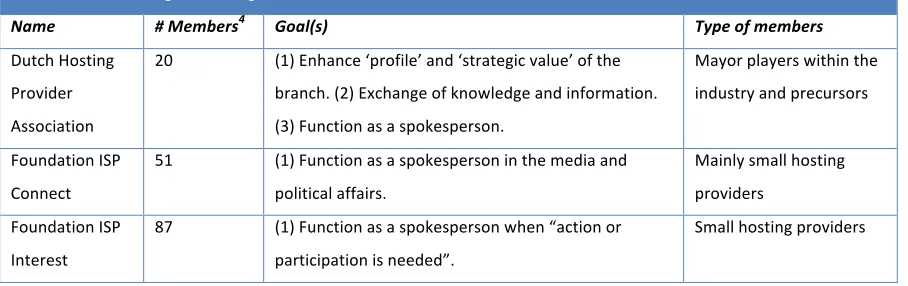
The hosting branch has founded several branch organizations (table 1). The branch organizations vary in number of members, sort of members and consequently in influence they could exercise. Approximately 16% of all hosting providers have joined one of these initiatives.
Table 1: Dutch hosting branch organizations
Name # Members4 Goal(s) Type of members Dutch Hosting
Provider Association
20 (1) Enhance ‘profile’ and ‘strategic value’ of the
branch. (2) Exchange of knowledge and information. (3) Function as a spokesperson.
Mayor players within the industry and precursors
Foundation ISP Connect
51 (1) Function as a spokesperson in the media and
political affairs.
Mainly small hosting providers
Foundation ISP Interest
87 (1) Function as a spokesperson when “action or
participation is needed”.
Small hosting providers
2 Derived from interviews on HostWise.nl and ISPam.nl with Con Zwinkels (Managing Director of LeaseWeb) in December
2009, Anthony Carter (CEO of Rackspace BeNeLux) in August 2008, Goran Andersson (Director Northern Europe of Amen) in May 2007.
3 Derived from interviews on HostWise.nl and ISPam.nl with Con Zwinkels (Managing Director of LeaseWeb) in December
2009, Wouter de Vries (founder of Antagonist) in September 2007, Anthony Carter (CEO of Rackspace BeNeLux) in August 2008, Valentijn Borstlap (Director of Your Hosting) in May 2007.
[image:13.595.77.531.503.646.2]1.3 OXILION
One of the companies operating in the Dutch hosting branch is the hosting provider Oxilion. Oxilion is a limited company based in Enschede. The provider is a hybrid between a large hosting provider and a data center. It offers hosting services to businesses that are in need of a reliable partner to store all kinds of data. These businesses do not have the knowledge to manage hosting services or do not have the funds to create a protected and reliable environment for their data.
The current two owners founded Oxilion ten years ago. They started by offering hosting to small business who searched a partner to host their website. Over the years their service portfolio changed. Oxilion now offers hosting to small-‐, medium-‐ and large businesses that use the company’s services to host websites, business-‐ and telecom applications. Oxilion has achieved an average growth rate of 60% (turnover) per year in the last three years. Their growth was mainly fuelled by word of mouth. But their policy regarding marketing is changing. The company now also applies active ways to reach potential customers.
Oxilion has changed their value proposition several times to tap in to new customer segments. This process has shaped the company’s current business model and consequently their current value proposition. The Financial Director described this process as following:
“We have used several trade names in the past. Our idea was that if we came up with a new name and a new price-‐scheme we could attract a new category of customers. However, we found out that this also attracted a lot of customers we did not sought after. For example customers who solemnly value price, who get furious when we increase the price of our services by merely € 2.50 a year and customers who do not pay on time, or do not pay at all for that matter. After this experience we told ourselves ‘we do not want to experience this ever again’. Now we are targeting customers who want to pay a bit more. By that I don’t mean we are an expensive hosting provider.
We are targeting customers who value our quality services and thus are willing to pay a little bit more […]. We aim
to be technically outstanding and consequently try to be a reliable partner for our customers. […] Our customers are mainly resellers of all kind of services, such as web designing or marketing. We seek after these types of customers. They need reliability but do not want to pay an incredible large sum of money”.
From the quote above one can infer two aspects of Oxilion’s value proposition, namely high quality products and reliable services. The Managing Director names two other aspects of Oxilion’s value proposition: being easy accessible and customer focussed. The next quote from the Managing Director provides a good example of what accessibility and customer focus entail in practice:
“Our customers find it very pleasant that they can just phone up an engineer, tell him that they have just started a
“Our sales consultants visit our customers on a regular basis in order to keep in touch. They want to make sure that they know what is happening and keep the customer posted on new developments. I think that the way other hosting providers handle customer contact is very different. They operate out of an office. They do have contact with customers, but only by telephone. I think that face-‐to-‐face contact with customers is one of the things that differentiates Oxilion from competitors.”
To summarize, Oxilion’s value proposition can be described as a customer focused hosting service for businesses that value a close relationship with their provider and are in need of a high quality, reliable environment to store their data.
The value proposition of Oxilion incorporates four important aspects of the company’s service. Reliability is however more important then other aspects. A customer survey (January 2010, N=324) showed that Oxilion’s customers acknowledge reliability to be the most important aspect of a hosting service. Reliability in this context means uptime. Oxilion’s customers expect that the company’s service is always up and running. Their customers include a telecommunications provider, a major online shop, an insurance company and a bank. For these and similar customers a reliable hosting service is crucial for supporting or enabling business. Hence, they cannot afford any downtime since it will have significant effect on their business. They need Oxilion’s service to be available 24 hours a day. Until now Oxilion has managed to meet this demand. The company has a track record of 99,99% uptime on a yearly basis. In order to retain this track record Oxilion cannot afford to be unavailable for more than two hours and 53 minutes on a yearly basis.
Setup 2 till N
Magnification location Enschede
Storage & processing unit
Zwolle
Amsterdam 1
Amsterdam 2
Enschede
Münster
Equinix
Oxilion’s network
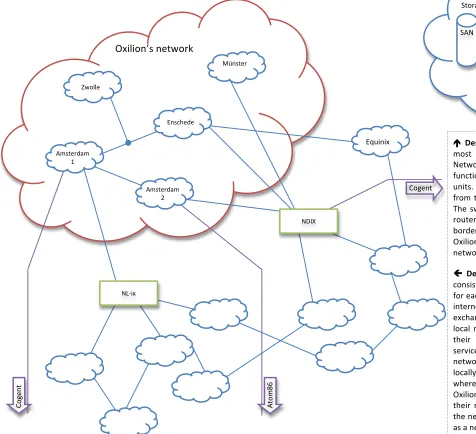
Description: The basic ‘building block’ that powers Oxilion’s
most sold service is the storage device SAN (Storage Area Network) in combination with multiple servers. The SAN functions as a storage unit, while the servers are processing units. If a visitor requests specific data, the data is retrieved from the SAN by the server and sent to the visitor’s computer. The switches distribute incoming requests for data. The access routers function as gateways to the local network, whereas the border routers (as the name implies) function as gateways for Oxilion’s network. They are situated at the periphery of Oxilion’s network and connect it to the rest of the internet.
Description: Oxilion’s network (depicted as the large cloud)
consists of five interconnected local networks, one local network for each physical location. Oxilion’s network is connected to two internet exchanges and three IP transit services. The internet exchanges NL–ix and NDIX (depicted as squares) are basically local market places where companies like Oxilion interconnect their networks and are able to exchange traffic. IP transit services (depicted as arrows) are firms that connect Oxilion’s network to the rest of the internet. Internet exchanges operate locally and connect Oxilion’s network directly to other networks, whereas IP transit services operate globally and connect Oxilion’s network indirectly with other networks (namely via their network). Additionally, Oxilion’s network is connected to the network of Equinix. This company runs a data center as well as a network. Their network is similar to that of Oxilion.
Figure 3: Oxilion’s network and connections to the internet infrastructure
SAN
Server Server Server Server
Sw
itc
h Acce
ss Rout er Sw itc
h
Ac ce ss Rout er Bor de
r
Rout
er
Bor
de
r
Rout er At om 86 Cog ent
NDIX
Cogent
[image:16.842.79.555.95.529.2]The network infrastructure of Oxilion is initially the factor that enables reliability. It is designed to cope with a number of failures in order to realize reliability. However despite its redundancy network infrastructure could break down. Unforeseen failures could occur. These failures cannot be handled by Oxilion’s systems given that these systems are only designed to handle anticipated problems. When unanticipated failures occur employees must step up. They have to use their knowledge, improvise and take action to restore systems and thereby Oxilion’s network infrastructure. Employees are thus essential when network infrastructure fails.
Oxilion currently employs fourteen people, of which seven have various technical functions. Three employees offer support. The other employees are engineers that manage Oxilion’s network. About half of the engineers possess a bachelor degree in information technology, the other half posses a master degree in information technology or electrical engineering. Additionally, depending on their function, the engineers have gained certificates for technologies of manufacturers such as Cisco, Dell, Microsoft, RedHat and VMware. Oxilion’s directors do not only value formal education, they also value former experience. Oxilion codifies some knowledge, but most knowledge resides in employee’s heads. This suggests that reliance on individuals is high. If employees leave the company, their valuable knowledge regarding the network infrastructure or specific hard-‐ and software leaves with them. Oxilion is aware of its heavy reliance on employees. The Financial Director expressed this heavy reliance as following:
“Hardware [referring to the network infrastructure] can be bought by anybody at HP or Dell, but it are the employees and their expertise who must make the difference”.
1.4 RESEARCH ASSIGNMENT
The previous section described that high customer expectations pressure Oxilion to manage its complex network infrastructure extremely well. This infrastructure needs to be reliable, meaning that it needs to be up and running 24 hours a day. The infrastructure of Oxilion is designed to cope with failures, but it cannot handle unanticipated failures. When unanticipated failures occur employees must step up. These employees must be able to take appropriate action. However, the company does not accurately know what enables their employees to take appropriate action. Moreover, Oxilion would like to know how this should be monitored.
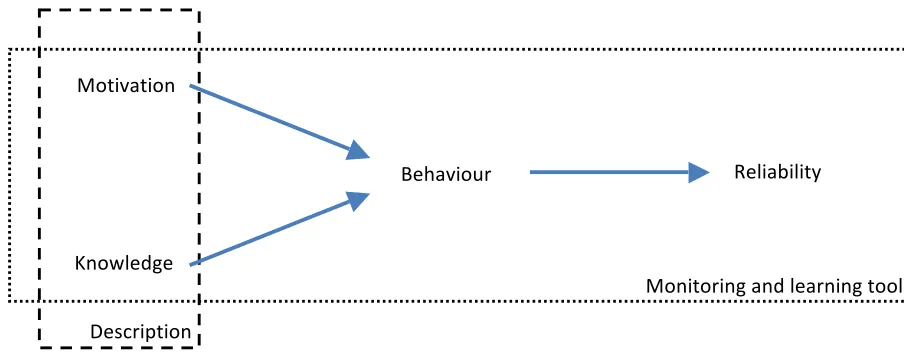
This thesis proposes a provisional model that links reliability directly with behaviour. Behaviour is in turn linked with motivation and knowledge. The model states that by taking appropriate action (behaviour) employees can eliminate threats to reliability. Their actions are influenced by their motivation and their knowledge. An individual’s motivation guides the way in which an individual evaluates alternative courses of action and consequently the way he or she behaves. An individual’s knowledge specifies the potential range of actions that he or she can take and consequently potential behaviour. These relationships form the provisional basis of this study. The model (figure 4) is further explained and motivated in the second chapter.
Based on the practical problem and the provisional model, this study defines three goals. First, this study aims to describe what motivation and knowledge is needed to create appropriate behaviour. Second, this study aims to provide a ‘tool’ that can be used to monitor reliability, behaviour, motivation and knowledge within a specific time interval. Third, this study aims to describe how Oxilion can learn from the information gathered by the monitoring tool. Figure 4 provides a visual description of the objectives.
Motivation
Knowledge
Behaviour Reliability
Monitoring and learning tool Description
Figure 4: provisional research model and visual description of research objectives
[image:18.595.67.519.573.752.2]In order to explore what knowledge and motivation is needed to create the appropriate behaviour one must formulate research questions that guide the study. This study poses three research questions that are closely related to its goals, namely:
RQ 1: What motivation and knowledge is needed to create appropriate behaviour that enables reliability?
RQ 2: How should motivation, knowledge, behaviour and reliability be monitored?
RQ 3: How can information acquired by the monitoring tool be used to learn and consequently improve reliability?
The first question is a normative question, while the second question is a design question. These questions imply the establishment of a ‘standard’ of which Oxilion’s performance should be measured with a self-‐developed tool. The development of the tool signals a methodological change in the way the performance of the company is monitored. The third question is a descriptive question. It implies that this thesis should illustrate how a monitoring tool can contribute to knowledge development and consequently improvement of Oxilion’s reliability level.
By answering the research questions, the study could contribute to practice and theory. This study could contribute to the research field of high reliability organizations by exploring high reliability issues in a SME in general, and hosting providers in particular. Both topics have received little attention from the research field. Previous studies about high reliability organizations have all explored reliability issues in large organisations. SMEs were basically ignored. By exploring reliability issues in a SME, the study could fill a gap in existing literature. Additionally, this study could create understanding about a branch on which limited literature is published. The growing dependence of society and economy on internet infrastructure marks the importance of creating understanding of reliability issues in hosting providers.
2 THEORETICAL FRAMEWORK
The purpose of this chapter is to introduce the main variables of the research theory. This section describes the main variables by drawing from literature in the research field of high reliability organizations, behavioural science and knowledge management. The literature was located by performing a search on the main variables of this study (plus synonyms and related variables) in Scopus, Web of Science and Google Scholar. Key authors were identified based on times cited and the relevance of their publications5. The chapter sets of by introducing three (genuine) incidents that have threatened Oxilion’s reliability. These incidents are used throughout the chapter to clarify the relationships between the variables. They are grounded in the theory. Next, several definitions of reliability are described of which one overarching definition is inferred. The chapter reasons that reliability is enabled by appropriate behaviour of employees. These individuals must in turn possess appropriate motivation and knowledge. These four variables (reliability, behaviour, motivation and knowledge) are linked together in one final theory. This theory forms the basis of the study.
In this chapter three (genuine) incidents are described that have threatened the reliability of Oxilion during the study. These incidents are presented in addition and parallel to the development of the model. The purpose of describing the incidents at this stage of the study is to provide an example of the relationships between the variables and to guide the development of the research model. The incidents were gathered by means of the research diary method. Employees were asked to report any incident that threatened the reliability of Oxilion and write down specific information regarding the incident in their logbook (diary). More information about the research diary method can be found in sub section 3.2.2 (page 28). The three incidents are introduced below:
INCIDENT 1: The first incident concerns maintenance on one of the SANs. Engineers had to move the machine. However, before the machine could be moved the engineers had to transfer the data on the machine to another SAN. During this process a failure occurred that left the engineers unable to manage the data transfer. The
potential impact of this incident was estimated to be € 11.000 annual turnover6.
INCIDENT 2: The second incident described here is a spam run. A spam run is a process in which an (unauthorised) user sends unsolicited bulk messages at random. Spam runs lead to a slow down in mail processing and can lead to a breakdown of mail processing if acted upon inappropriately. The potential impact of this incident was estimated to be € 115.200 annual turnover.
5 This study especially draws from literature written by Weick and associated authors, Ajzen and associated authors, and
Mingers. Weick and Ajzen were selected because they are key authors in their respective research fields. Mingers was selected given the practical applicability of his work.
6 Estimated impact is the direct annual turnover generated by products and services installed on or executed by the
INCIDENT 3: The third incident concerns a DOS-‐attack (denial-‐of-‐service). A DOS-‐attack is an assault on a server aimed at making the server unavailable for users. It involves requesting data multiple times within a very short time period. This causes the server to overload since the server cannot handle all the incoming requests because its resources are saturated. A DOS-‐attack not only makes a server unavailable to users, but also slows down the network to which the server is connected. The potential impact of this incident was estimated to be € 75.000 annual turnover.
2.1 RELIABILITY
Authors have been a bit circumspect to provide a clear definition of reliability (Weick, Sutcliffe, & Obstfeld, 1999). The traditional view of reliability as defined by Hannan & Freeman (1984) and quoted by Weick, Sutcliffe, & Obstfeld (1999) is the “unusual capacity to produce collective outcomes of a certain minimum quality repeatedly” (p. 35). This definition stresses that reliability is achieved by realizing a specific level of quality time after time.
Another definition that was used by a lot of authors in early research on high reliability organizations is the term ‘failure-‐free’ (Roberts & Rousseau, 1989), (Roberts, 1990), (LaPorte & Consolini, 1991), (LaPorte, 1996). Reliability is thus seen as the number of times an error or failure is observed within a specific time period. However, this implies that the level of reliability is judged based on historic empirical or observational evidence (Rochlin, 1993). Reliability is thus determined post facto. The definition is often accompanied with statistics to support the claim that an organization is indeed highly reliable (Hopkins, 2007). Note that with this way of conceptualizing reliability it is impossible to determine in advance whether an organization is highly reliable. Also note that reliability is defined by social and perceptual criteria (Rochlin, 1993). A consumer, for example, might consider a telephone company with an outage of three days in a year reliable, while a business might consider the same company unreliable. Hence, whether a company with a specific error-‐rate is considered reliable depends on the perceptions of its environment.
Leveson, Dulac, Marais, & Carroll (2009) provide another definition of reliability. They draw from engineering and define reliability as: “the probability that a component satisfies its specified behavioural requirements over time under given conditions” (p. 234). Their definition is based on the likelihood that a specific level of reliability is achieved, thus reliability is not determined post facto.
track record or the likelihood that a failure will occur based on, for example, a system’s schematics. Taking all these aspects into account, reliability is defined as: consistency in meeting a specific performance level as required by an organization’s environment and based on a organization’s track-‐ record and/or the chance that a lapse in reliability will occur.
In the context of a hosting provider ‘consistency in meeting a specific performance level’ means reassuring that their services are always available. This is called uptime. Uptime is the availability of a hosting provider’s services, measured per year and denoted as a percentage. Hence, uptime can be seen as a specific reliability level. The reliability level of a hosting provider can be threatened by incidents that cause unavailability (downtime) of (a part of) its network infrastructure. Next, this section presents a part of the logbook entries of each incident (introduced at the start of this chapter) to show how incidents can threaten reliability. The words that describe a threat to reliability are denoted (R).
INCIDENT 1: “The room where the SAN was placed would be renovated in a couple of weeks so we had to move the machine as well as the data on the machine. We can move data from one machine to another with VMware [a hosting management tool] without any downtime. However during the process of transferring the data from one SAN to another the management tool froze, leaving us without a way to manage the data transfer (R).”
INCIDENT 2: “One of our servers was hacked this week. Due to wrong execution rights of some files a ‘spammer’ was able to place a script on the server. The script automatically sent thousands of e-‐mails. This clogged up the mail queue and caused costumers that used the server [240 in total] to experience a slowdown of their mail processing (R). A slowdown is however not our biggest concern. If spam is sent from one of our servers, the address of that server will be placed on a blacklist. This means that all e-‐mail sent from that server is marked as spam and consequently filtered by the receivers e-‐mail client. Not only that particular server would be blacklisted, our entire server park would be placed on the blacklist. Hence, nobody would receive e-‐mails sent with one of our servers (R).”
INCIDENT 3: “On Queen’s day one of our customer’s servers hosted in the data center at Zwolle faced a DOS-‐ attack. The server had to deal with almost one gigabit of traffic per second. This overloaded the server (R) as well as the connection to the data center given that the connection can only handle one gigabit per second. Due to the connection overload our other servers in the data center at Zwolle were, to some degree, not able to exchange traffic (R).”
track record and remain reliable as promised to customers. Whether a provider is able to handle these threats depends on the behaviour of their employees. The relationship between reliability and behaviour is explained in the next section.
2.2 BEHAVIOUR
Reliability is not an isolated concept; it is directly linked with behaviour. High reliability organizations become highly reliable by creating appropriate behaviour (Leveson, Dulac, Marais, & Carroll, 2009). Behaviour is in turn influenced by an individual’s motivation (Cialdini, 2003) (Ajzen & Fishbein, 2005) and knowledge (Blatt, Christianson, Sutcliffe, & Rosenthal, 2006) (Meyer & Sugiyama, 2006). This section describes the influence of behaviour on reliability.
Jaccard & Blanton (2005) note that behaviour is in essence action. They define behaviour as: “any denotable overt action that an individual, a group of individuals, or some living system performs (p. 128). The authors stress that: “an action has a denotable ending and is performed in an environmental context in which the individual or group is embedded” (p. 128). Behaviour can thus be broken down into four core elements: “(1) an action, (2) an object or entity toward which the action is directed, (3) a setting and (4) a time” (Jaccard & Blanton, 2005, p. 131).
In order to show the relationship between reliability and behaviour this section continues with the incidents described in the previous section. The logbook entries depicted below describe which behaviour employees showed to eliminate the threats to reliability. In the examples action is coded (A), while the object or entity towards which the action was directed is coded (EO). Note that, for the sake of simplicity, only behaviour of Oxilion’s employees is coded. The other two elements of behaviour (setting and time) were regarded as irrelevant in the context of this study and are therefore not coded.
INCIDENT 1: After I discovered that the tool wasn’t working correctly a colleague and I checked (A) the logs (EO) of the server that processed the transfer. We found messages stating that the server was out of memory. We called (A) the support desk of VMware (EO). They confirmed what we already thought: the data transfer required more memory than was at that time available on the server and the only way to free up more memory was to clear another server.”
INCIDENT 3: “We received a report that a couple of services weren’t working correctly. In addition to the report a customer called telling us that his server wasn’t working. We checked (A) the monitoring tools (EO) and that’s how we discovered that one of the servers suffered from a DOS-‐attack. Luckily Engineer A was on ‘repair service’. He ‘null-‐routed’ (A) all traffic to