Different PEGI age labels and their effect on aggressive
affect, aggressive cognition and arousal
David van Duuren 0056316 Masterthesis C&M
Abstract
This study investigated the effects of three different Pan European Game Information (PEGI) age labels on aggression. These three different age labels, 3+, 12+ and 18+, were a reflection of three different degrees of violence. Based on the General Aggression Model (GAM),
Introduction
The video game industry is a large industry, and growing. Having its origins in the 70s, video games at that time were very primitive compared to current standards. Hand in hand with technological innovations since that period, video games have become more and more realistic. Realism in video games can manifest itself in different ways: graphical improvement is an important one. In the beginning, video games were nothing more than a number of geometrical shapes, nowadays they are a clear resemblance of the real world. Another way of growing realism is in the details. For example, a moving mouth when the character of the player is spoken to by another character, a hit in the limb which does not result in a direct kill compared to a headshot in a shooter game, or a player‟s character who dies by falling from a great height in a platform game instead of the staying away of this physical injury after such a fall. A third way in which realism can manifest itself is the controls. Traditionally, console games were played by a controller with buttons on it. These buttons were mainly meant for movement and action, but in the middle of the 90s the movement buttons were largely replaced by analogue sticks to enable the character to move in more specific directions. In 2006, Nintendo introduced a revolutionary motion control system: for example sports games could now be played imitating movements which are necessary when practising that specific sport for real. Video games getting more realistic and the video game market being adjusted from games for children to all kinds of target groups, people spend more time playing them, and more money buying them. Their status have reached that of the cultural mainstream nowadays, like movies or books. In 2008, 12,61 million consoles, console games and PC games were sold in the Netherlands, grossing €654 million (Nationaal Gaming Onderzoek 2008, GfK Retail and Technology Benelux B.V.).
The ‘Pan European Game Information’ rating system
As a result of the growing concern about the possible negative consequences of violent video games, national rating systems came into existence and in 2003 most of them in Europe merged into the “Pan European Game Information” (PEGI). The goal of PEGI is to assist European parents with making thoughtful decisons when buying video games for their children. Age logos and content descriptors are used to clarify what the content of the game is. On the front side of the game box an age logo can be found which means that a game is only suitable from that age. The different age logos are 3+, 7+, 12+, 16+ and 18+ (see Figure 1). On the back side of the game box content descriptors are found: these pictograms show whether there might be some objectionable content in it. The different content descriptors are the following: bad language, discrimination, drugs, fear, gambling, sex and violence. These content descriptors are the main reason why a certain age label is given to a game.
Fig. 1 The PEGI age labels and content descriptors
A study released by the the developer of PEGI, the Interactive Software Federation of Europe (ISFE), which was held in 2008 among 6000 video game players from 25 countries aged between 16 and 49, showed that 62% of the consumers are aware of the European game rating system: this percentage drops to 32% when the name „PEGI‟ is mentioned. However, this number is growing year by year. 93% of the participants recognized the age rating labels and 49% of the parents considered the age rating labels as useful when buying a game, compared to 35% of the whole population researched. Opposed to the 93% familiarity with the age labels, only 50% recognized the content descriptors. Only 24% found these content descriptors useful. For parents, the percentage of familiarity is lower: 43%. However, 34% of the parents consider these content descriptors as useful.
content. Since the content descriptors show the type of content of a game, this distinction can not be captured in the current system. The suggestion of these researchers to alter the current system of content descriptors with the goal to put more emphasis on the severity of a certain content instead of merely showing what kind of content there is in the game, could strengthen the so-called „forbidden fruit effect‟: The presence of age labels and content descriptors are making the video games more attractive (Funk, Flores, Buchman & Germann, 1999; Bijvank, Konijn, Bushman & Roelofsma, 2009).
The effect of violent video games on aggression
Despite the fact that society deems it necessary to have a rating system with the goal to protect children from harmful content, the scientific community has not reached a consensus concerning the negative effects of violent video games. Research of violent video games and its effect on aggression has yielded mixed results. A number of meta-analyses and literature reviews have been conducted, which also came to different conclusions. An early literature review suggests that violent video games increases aggressive behavior, but that more research is needed (Dill & Dill, 1998). Another literature review states that all video game research have methodological impairments and only measures short term aggression (Griffiths, 1999). Two meta analyses concluded that violent video games resulted in aggressive behavior (Anderson & Bushman, 2001; Anderson, 2003), while other ones did not find this effect (Sherry, 2001; Sherry, 2007). Ferguson (2007) attempts to stress the finding that there is a so-called „publication bias‟ ongoing: studies which have found an effect are more likely to be published than studies which have not found any effect. Including non-published studies in his meta-analysis have led to the conclusion that there is no effect of violent-video games on aggression. A literature review by Anderson and Carnagey (2004) has the same conclusions as Anderson‟s meta-analyses: violent video games cause aggressive cognition, aggressive affect, aggressive behavior and a decrease in prosocial behavior.
videogames cause aggressive behavior is in observational studies of very young children, but it is admitted that the type of methodology could contribute to the effect.
Most researchers acknowledge the lack of longitudinal research in the field of negative effects of violent video games. As a response to that, a one-month lengthy study was undertaken to investigate the effects of playing a violent “massively multiplayer online role playing game” (MMORPG) on aggression, but it turned out that playing such a game did not lead to real-world aggression (Williams & Skoric, 2005).
Another point of discussion is the external validity of experimental violent videogame research. Anderson & Bushman (1997) showed in a meta analysis, in which media violence was one of the situational variables, that there was a solid external validity from laboratory experiment aggression to real world aggression. More specifically to the negative effects of violent video games, this external validity was mentioned again in the literature review of Anderson and Carnagey (2004). On the other hand, it is suggested that most laboratory experiments are based on solo-play, while video game playing in the natural setting is a highly social experience (Sherry & Lucas, 2003). On top of that, it is stated that in laboratory settings the concept of ‟play‟ is violated: obliging a subject to play a video game for a short time is not ‟playing‟ (Goldstein, 2005), because „playing‟ is a voluntary, self-directed activity (Garvey, 1991).
On top of these areas of discussion a number of further disputes can be mentioned, like the sample size to use, the differences between violent and nonviolent content, the way in which aggression is measured, and the magnitude of the effects of violent video games (Anderson & Carnagey, 2004).
Underlying mechanisms
game play is high and when identification with the protagonist is strong, according to proponents of this theory (Sherry, 2001).
Another explanation for negative effects of violent video games is arousal and excitation transfer. Arousal and valence are two dimensions of emotion. Arousal can be explained as the intensity of the experience: it ranges, for example, from feeling energized or alert, to calm and sleepy. As arousal is the intensity of an experience, valence is about the attractiveness or aversiveness of the experience (Reeves & Nass, 1996). For example, when one is playing and enjoying a violent video game, arousal is probably high and valence is positive. When somebody is watching but is heavily disgusted by what he or she is seeing on the screen, arousal is high as well but valence is negative. The idea of excitation transfer (Zillman, 1971) is that heightened arousal influences or increases subsequent emotions. When one is playing a violent video game and is having an argument with another person, his or her reaction can be more severe because of the tranfer of the arousal which was a result of playing the game. A third explanation is the neo-associative networks or priming effects mechanism. This theory states that when a person is repeatedly exposed to violent media, this can lead to increased aggression or hostility because semantically connected informational nodes are triggered as a result of the exposure (Berkowitz & Rogers, 1986). When one is playing a violent video game, aggressive cognitions and associated affect are triggered. The likelihood of aggressive responses in the real world is increased when the exposure is repeated often, because these triggered cognitions and affect then become chronically accessible (Dill & Dill, 1998).
It is also possible that a person can become desensitized. This is closely related to prosocial behavior: desensitization means that repeated exposure to violent video games leads to decreased levels of arousal. Because of this decline of arousal, the possibility exists that one will act less prosocially. This is confirmed by Anderson (2003).
The General Aggression Model
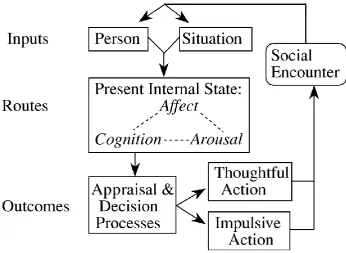
[image:9.595.69.416.213.466.2]All the mechanisms described above were merged into an eclectic model, called the General Aggression Model, of which the latest version can be seen in figure 2 (Anderson & Bushman, 2002).
Fig 2. The single episode General Aggression Model
person react thoughtfully or impulsive in an ambigious situation? This behaviour will subsequently influence the next cycle of input, routes and outcome.
Anderson and Bushman (2002) state that when a person is going through a lot of these cycles a player of violent video games will be exposed to a lot of situations in which the use of violence is the best way to act. This leads to aggressive beliefs, attitudes, schematas and scripts, and to increased desensitization. As a result an aggressive personality is developing. Since there is a great lack of longitudinal studies in the body of literature, this long term effect is merely hypothetical (Anderson & Bushman, 2001).
Hypotheses
Besides the scientific community, PEGI as well has given their position about the negative consequences of violent video games on behaviour. In the frequently asked questions (FAQ) section of the website, the following answer is given on the question whether games have an influence on children:
‘’The research on the impact of videogames has been focused primarily on violence.
Numerous studies have been published, but until today there is no evidence that playing
violent video games causes any long-term or lasting increase in aggressiveness or violence
among players.”
In this answer it is implicitly stated that besides the presence of violence in a video game, there are more types of content which can be harmful for children. The age labels however, which are based on the content descriptors, are largely explained by means of the presence of violence in the game.
With the goal to assist parents to make thoughtful decisions about buying suitable video games for their children, PEGI have given age and content labels to over 11.000 videogames until 2009. The research topic of this study is to examine to what extent these age labels are in accordance with the disputed scientific findings that violent video games lead to aggression. Since a higher age label corresponds with a more realistic and disturbing violence in a video game, the following hypotheses, based on the routes in the GAM, will be tested:
H2: The higher the age label of the game played, the higher the aggressive response is on the cognitive route.
H3 The higher the age label of the game played, the more aroused the player will be.
These hypotheses will be tested by means of an experiment in which the particpants will play violent video games with different age labels and thus different degrees of violence. The participants will be subjected to a pretest, subsequently they shall play a videogame, and then a posttest is conducted. More specific information about the experiment is described in the methods section.
Method
Participants
In this experiment, 84 subjects participated. 34 of them were male, 50 female. 45 of them were Dutch and 39 were German. All participants were students at the University of Twente, most of them studying social sciences. The average age of the participants was 22.08 (SD= 2,62). In exchange for participation, most of the participants received research credits, while other ones participated voluntarily.
Materials
For this experiment, six games were used: two of them labeled 3+, two of them 12+ and the other two 18+. For each age group, two games were used to increase generalizability. The main reason for choosing these three age categories is that both the ends and the middle of the age label range are represented. The possibility to include all age categories in the study was abandoned due to practical reasons.
in-game violence with the real world. In Shrek 2: Team Action the player is able to hit not-living objects like bags or stones to obtain items which are useful in the remainder of the game. On top of that semi-living fantasy creatures like giant sole eyes for example, can be hit. In Lemony Snicket: a Series of Unfortunate Events the player must eliminate a group of crabs on a beach with a fantasy bubble shooting weapon, and later a rat in a house with the same weapon.
The 12+ rated games were Prince of Persia: the Sands of Time by Ubisoft (2003) and the Lord of the Rings: the Fellowship of the Ring by Surreal Software (2002). The explanation for 12+ labeled games provided by PEGI is that the violence in the game can be somewhat more realistic against fantasy characters, or less realistic violence but then directed against human-like characters or recognizable animals. In the Lord of the Rings: the Fellowship of the Ring the protagonist has to defeat giant spiders by hitting them with a stick or throwing rocks. In Prince of Persia: the Sands of Time the player has to defeat enemies which are almost human-like, but they are able to dissappear instantly while in combat and reappaer in another spot to resume fighting. A major difference between the 12+ labeled games and the 3+ labeled games is that the enemies are fighting back in the first category: the 12+ games have violent content descriptors, while the 3+ games don‟t have them.
The 18+ rated games were Severance: Blade of Darkness by Codemasters (2001) and Silent Hill 2: Directors‟s Cut by Konami (2003). Unfortunately, these games are not PEGI rated. The reason for this is that the PEGI rating system was not yet developed while these games were first released (not necessarily in the EU). The British Board of Film Classification (BBFC), the British national rating system for films and some video games which was used before the full adoption of PEGI, rated Severance: Blade of Darkness with 18+. The American counterpart of PEGI, the Entertainment Software Rating Board (ESRB) rated it ‟Mature‟ (17+). On top of that, a warning has been put on the front of the game box: ‘this
Besides the gradation of severity of the violent content in each game used, which was the main reason for selecting them, some other features were also considered while selecting the games:
- all games are from a third person view;
- all games contain fantasy violence: there is no or hardly an equivalent of it in the real world;
- all games use fists or short range weapons when the protagonists engage in violent acts;
- all games are released in a time range of three years and thus the graphical realism is similar;
- all games were set on the easiest difficulty level.
It was important to keep other influential aspects as constant as possible among the games, with the goal to let the difference in severity of violence be the only aspect measured.
The experiment was conducted in six small rooms (Cubicles): each game had his own room. In each of the rooms there was a PC with the game installed on it. Headphones were connected to the PCs to enable the participant hearing the sound of the game. The PCs were also used for completing the questionnaires before and after playing the game. Because all cubicles were equipped with a camera, the experimenter was able to watch the participants doing the experiment on a screen outside the cubicles.
Questionnaires
To measure cognition, the Word Pair Rating Task was used (Bushman, 1996). This scale consists of twenty words, of which ten are aggression related words (e.g., murderer, blood, shotgun) while the other ten are aggression unrelated (e.g., animal, movie, bottle) Each possible pair of two words had to be rated to what extent the participant found them related or associated with each other on a seven point likert scale, ranging from 1 (not at all related) to 7 (completely related). Just as the SAS, this test was translated in Dutch. Another similarity with the SAS is that the order of the items presented was different for each participant to prevent any undesired sequence effects.
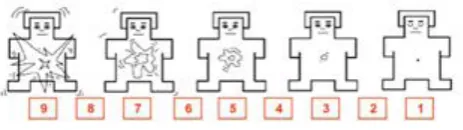
[image:14.595.80.312.360.425.2]To measure arousal, the Self-Assessment Manikin (Bradley & Lang, 1994) was used (see figure 3). This scale is a nine point scale which is meant to assess arousal by means of a set of pictures. The most left picture is „highly aroused‟, and the most right picture is „not aroused at all‟. The participants had to rate their perceived arousal by marking the picture, or a space between two pictures, which corresponded mostly with their current state.
Fig. 3. The arousal scale of the Self-Assessment Manikin
Procedure
Results
Aggressive Affect
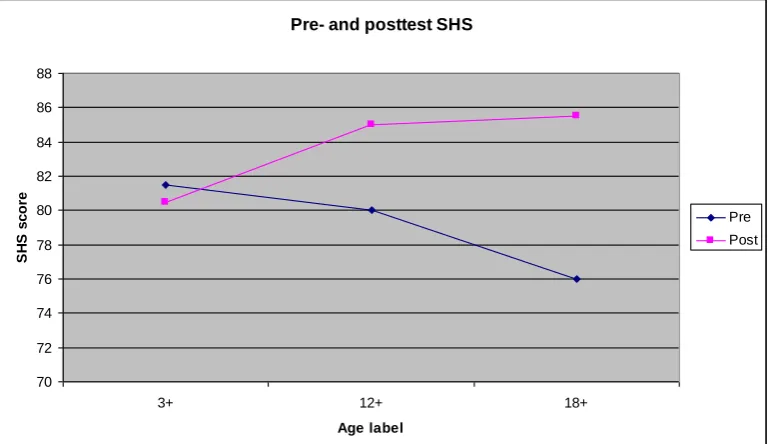
The State Hostility Scale, which was administered both pre- (α =.83) and posttest (α = .82), was analyzed using a GLM repeated measures. It turned out that there was a significant difference between the three conditions: F(2,83) = 8.28, p < .001. This effect can be seen in the figure below:
Pre- and posttest SHS
70 72 74 76 78 80 82 84 86 88
3+ 12+ 18+
Age label
S
H
S
s
c
ore
[image:15.595.75.460.267.489.2]Pre Post
Fig. 4. Pre- and Post SHS scores for each of the conditions
The blue line reflects the pre-test scores, the pink one the post-test scores. The x-axis shows the three age labels, while the y-axis shows the score on the SHS. Besides the significant main effect, it can be seen that the higher the age label of the games, the bigger the difference is between the pretest and the posttest measurement. The blue line also shows that the pretest scores were not randomly distributed among the conditions.
Concerning the word pair rating task, there were 190 pairings. 45 of them were Aggressive - Aggressive, 45 Ambiguous - Ambiguous, and the other 100 Aggressive - Ambiguous. Using ANOVA, it turned out that between the three age conditions there was a significant difference on the Aggressive - Ambiguous dimension F(2,83) = 3,313, p = < .05. More specifically, it was found that the 18+ condition scored significanly lower on this dimension compared to the 12+ and the 3+ conditions. The average score for 18+ was 2,90, for 12+ it was 3,39 and for 3+ it was 3,38. The figure below shows the results of the Aggressive - Ambiguous dimension: on the x-axis the age labels are represented and on the y-axis the mean scores of the Aggressive - Ambiguous word pairs.
Mean scores aggressive-ambiguous word pairs
2,6 2,7 2,8 2,9 3 3,1 3,2 3,3 3,4 3,5
3+ 12+ 18+
Age label
S
c
o
[image:16.595.75.470.279.524.2]re
Fig 5. Mean scores on the Aggressive – Ambiguous dimension for each of the conditions.
Arousal
The SAM measurements yielded no significant effect on arousal after playing the game. This was also the case when examining the three conditions separately.
Conclusion and Discussion
Aggressive Affect
Concerning the State Hostility Scale, It appeared that a significant difference was found between the pretest scores and the posstest scores. The higher the age category, the stronger the effect. It can thus be seen that playing a game in a higher age category leads to more aggressive answers. The first hypothesis is thus supported.
Aggressive cognition
The word pair rating task yielded a quite unexpected result: It appeared that the 18+ category scores significantly lower on the Ambiguous – Aggressive dimension than the 12+ and 3+ condition. This is exactly the opposite effect of the second hypothesis, which stated that playing a game in a higher age category would lead to a higher score on this dimension. A possible explanation for this effect could be the catharsis theory: the 18+ games actually have a positive effect on players in such a way that they are an outlet for aggression. In other words, playing them has the consequence that there is a decrease in aggression.
Arousal
There was no significant difference in reported arousal between the three conditions. A reason for this can be that the way of measuring arousal was different than the way arousal was measured in the studies described in the introduction. The SAM is a tool to self-report arousal, while the other studies measured physiological arousal. Due to practical reasons, it was not possible to measure physiological arousal in this study.
On top of this, it was seen that there was no correlation between the arousal scores on the one side and the affect and cognition scores on the other side, while there was a small correlation between the affect and the cognition scores: r (84) =.28, p < .05. Because of this, it can be stated that the arousal measurement in the current study is not a valid reflection of arousal in the GAM and therefore no concluding remarks can be made of it in relation to the model.
The General Aggression Model states that violent video game players are influenced by three routes: affective, cognitive and arousal. This study only found support for the affective route, while for the cognitive route a possible catharsis effect was found. This is remarkable, since catharsis is considered to be an unlikely explanation of media effects (Gunter, 1994). In recent violent video game research, no studies can be reported which found a catharsis effect. Because of this, it is very hard to draw conclusions about why such an effect was found on cognition, while on affect the expected result was found.
The results can question the support of the GAM and its underlying mechanisms as a solid predictor of the effects of playing violent video games. It could also be possible that there are several weaknesses in the study which account for the lack of support for the hypotheses. One of these weaknesses is the choice of conducting a laboratory experiment: as described in the introduction, the external validity of these kinds of experiments is disputed, the concept of ‟play‟ is violated, and gaming as a highly social activity is altered into a solo-play session. On top of that, the selection of participants is an important issue. Since the main goal of PEGI is assisting parents in protecting children for violent content, the ideal experiment would be using children in the experiment. Mainly for ethical reasons, this is not a possibility. The next best option would be to select participants based on gaming experience so that the lack of this would not be an unwanted, interfering variable. Unfortunately, a majority of the participants had no gaming experience. However, the results show that there was no interaction effect between gaming experience and the three different internal states.
on this question is that the origins of rating systems are subject of moral values, not academic findings (Valkenburg, Beentjes, Nikken & Tan, 2002; Olsberg, 2003). To illustrate this, a study comparing the classification of 426 video games between PEGI and ESRB found that the ESRB rated these games 1,35 years higher than PEGI, and the ESRB gave 1,34 content descriptors to each game on average, compared to 0,8 to each game by PEGI (Franken, 2008). Another answer could be that PEGI also uses other content descriptors besides aggression, as can be seen in figure 1, which do not get the same amount of attention in the video game research. An important question is whether it is desirable that moral values are such an important factor in the classification process.
References
Anderson C.A., Bushman B.J (1997). External validity of “trivial” experiments: The case of laboratory aggression. Review of General Psychology, 1, 19–41
Anderson, C. A., & Bushman, B. J. (2001). Effects of violent games on aggressive behavior, aggressive cognition, aggressive affect, physiological arousal, and prosocial behavior:
A meta-analytic review of the scientific literature. Psychological Science, 12, 353– 359.
Anderson, C. A., & Bushman, B. J. (2002). The general aggression model: An integrated social-cognitive model of human aggression. Annual Review of Psychology, 53.
Anderson, C.A. (2003). An update on the effects of playing violent video games. Journal of Adolescence, 27, 113−122.
Anderson, C.A., Deuser, W.E., DeNeve, K.M. (1995). Hot Temperatures, Hostile Affect, Hostile Cognition, and Arousal: Tests of a General Model of affective Aggression.
Personality and social psychology bulletin, 21(5), 434-448.
Bandura, A. (1971). Social learning theory of aggression. In J. G. Knutson (Ed.), Control of aggression: Implications from basic research, 201-250. Chicago: Aldine-Atherton.
Berkowitz, L., & Rogers, K. (1986). A priming effect analysis of media influences. In J. Bryant, & D. Zillmann (Eds.), Perspectives on media effects, 57-81. Hillsdale, NJ: Lawrence Erlbaum Associates, Inc.
Bijvank M.N., Konijn E.A., Bushman B.J., Roelofsma P.H. (2009). Age and violent-content labels make video games forbidden fruits for youth. Pediatrics;123, 870-6
Bradley, M.M. and Lang, P.J. (1994). Measuring Emotion: The Self-Assessment Manikin And The Semantic Differential. Journal of Behavior Therapy and Experimental Psychiatry, 25(1), 49-59
Bushman, B. J. (1996). Individual differences in the extent and development of aggressive cognitive–associative networks. Personality and Social Psychology Bulletin, 22, 811– 819.
Bushman, B. J., and Anderson, C. A. (2002). Violent video games and hostile expectations: A test of the general aggression model. Personality and Social Psychology Bulletin, 28, 1679‐1686.
Calvert, S.L., Tan, S. (1994). Impact of Virtual Reality on Young Adults‟ Physiological Arousal and Aggressive Thoughts: Interaction Versus Observation. Journal of applied developmental psychology, 15, 125‐139.
Dill, K. E., & Dill, J. C. (1998). Video game violence: A review of the empirical literature.
Aggression and Violent Behavior, 3, 407–428.
Ferguson, C. J. (2007). The good, the bad and the ugly: A meta-analytic review of positive and negative effects of violent video games. PsychiatricQuarterly, 78, 309–316.
Franken, I. 2008. Dezelfde games, andere classificaties. Masterthesis. Erasmus Universiteit Rotterdam/Media & Journalistiek
Funk, J.B., Flores, G., Buchman, D.D., & Germann, J.N. (1999). Rating electronic games: Violence is in the eye of the beholder. Youth & Society, 30, 283–312.
Garvey, C. (1991). Play. Cambridge, MA: Harvard University Press.
Goldstein, J. (2005). Violent video games. In J. Raessens & J. Goldstein (Eds.), The
handbook of computer game studies (pp. 341–358). Cambridge, MA: The MIT Press.
Griffiths, M. (1999). Violent video games and aggression: a review of the literature.
Aggression and Violent Behavior, 4, 203–212.
Gunter, B. (1994). The question of media violence. In J. Bryant & D. Zillman (Eds.), Media effects: Advances in theory and research (pp. 163-212). Hillsdale, NJ: Erlbaum
Nikken, P. and Jansz, J. (2006).Parental mediation of children's videogame playing: A comparison of the reports by parents and children. Learning, Media and Technology
31, 2 , 181-202.
Olsberg. 2003. EC Report: Empirical Study on the Practice of the Rating of Films Distributed in Cinemas, Television, DVD and Videocassettes in the EU and EEA Member States. Brussels: European Commission.
Reeves, B. and Nass, C. (1996). The Media Equation; How people treat computers, television, and new media like real people and places. New York: Cambridge University Press
Sherry, J. (2001). The effects of violent video games on aggression: a meta-analysis. Human Communication Research, 27, 409-431.
Sherry, J., & Lucas, K. (2003). Video game uses and gratifications as predictors of use and game preference. Paper presented at the Mass Communication Division, International Communication Association Annual Convention., San Diego, CA.
Sherry, J. L. (2007). Violent video games and aggression: Why can‟t we find effects? In R. W. Preiss, B. M. Gayle, M. Burrell, M. Allen, & J. Bryant (Eds.), Mass media effects research: Advances through meta-analysis (pp. 245–262). Mahwah, NJ: Erlbaum.
Valkenburg, P., Beentjes, H., Nikken, P. & Tan, E. 2002. Kijkwijzer: The Dutch Rating System for Audiovisual Productions. Communications (27) 1, 79-102.
Zillmann, D. (1971). Excitation transfer in communication-mediated aggressive behaviour.
Journal of Experimental Social Psychology, 7, 419-434.