Bilingual Structured Language Models for Statistical Machine Translation
Ekaterina Garmash and Christof Monz Informatics Institute, University of Amsterdam Science Park 904, 1098 XH Amsterdam, The Netherlands
{e.garmash,c.monz}@uva.nl
Abstract
This paper describes a novel target-side syntactic language model for phrase-based statistical machine translation, bilingual structured language model. Our approach represents a new way to adapt structured language models (Chelba and Jelinek, 2000) to statistical machine translation, and a first attempt to adapt them to phrase-based statistical machine translation. We propose a number of variations of the bilingual structured language model and evaluate them in a series of rescoring ex-periments. Rescoring of 1000-best transla-tion lists produces statistically significant improvements of up to 0.7 BLEU over a strong baseline for Chinese-English, but does not yield improvements for Arabic-English.
1 Introduction
Many model components of competitive statisti-cal machine translation (SMT) systems are based on rather simplistic definitions with little linguis-tic grounding, which includes the definitions of phrase pairs, lexicalized reordering, and n-gram language models. However, earlier work has also shown that statistical MT can benefit from ad-ditional linguistically motivated models. Most prominent among the linguistically motivated ap-proaches are syntax-based MT systems which take into account the syntactic structure of sen-tences through CKY decoding and categorial la-bels (Zollmann and Venugopal, 2006; Shen et al., 2008). On the other hand, the commonly used phrase-based SMT approaches can also reap some of the benefits of using syntactic information by
integrating linguistic components addressing spe-cific phenomena, such as Cherry (2008), Carpuat et al. (2010), Crego and Yvon (2010), Ge (2010), Xiang et al. (2011), Lerner and Petrov (2013), Garmash and Monz (2014).
This paper is a contribution to the existing body of work on how syntactically motivated models help translation performance. We work with the phrase-based SMT (PBSMT) (Koehn et al., 2003) framework as the baseline system. Our choice is motivated by the fact that PBSMT is a conceptu-ally simple and therefore flexible framework. It is typically quite straightforward to integrate an ad-ditional model into the system. Also, PBSMT is the most widely used framework in the SMT re-search community, which ensures comparability of our results to other people’s work on the topic.
There is a variety of ways syntax can be used in a PBSMT model. Typically a syntactic represen-tation of a source sentence is used to define con-straints on the order in which the decoder trans-lates it. For example, Cherry (2008) defines soft constraints based on the notion of syntactic cohe-sion (Section 2). Ge (2010) captures reordering patterns by defining soft constraints based on the currently translated word’s POS tag and the words structurally related to it. On the other hand, tar-get syntax is more challenging to use in PBSMT, since a target-side syntactic model does not have access to the whole target sentence at decoding. Post and Gildea (2008) is one of the few target-side syntactic approaches applicable to PBSMT, but it has been shown not to improve translation. Their approach uses a target side parser as a lan-guage model: one of the reasons why it fails is that a parser assumes its input to be grammatical and chooses the most likely parse for it. What we are interested in during translation is how
matical the target sentence actually is.
In addition to reordering constraints, source syntax can be used for target-side language mod-eling. A target side string can be encoded with source-syntactic building blocks and then scored as to how well-formed it is. Crego and Yvon (2010), Niehues et al. (2011), Garmash and Monz (2014) model target sequences as strings of tokens built from the target POS tag and the POS tags of the source words related to it through alignment and the source parse. In this paper, we define a target-side syntactic language model that takes structural constraints from the source sentence, but uses the words from the target side (as ‘building blocks’). We do it by adapting an existing mono-lingual model of Chelba and Jelinek (2000), struc-tured language models, to the bilingual setting. Our contributions can be summarized as follows:
• we propose a novel method to adapt monolin-gual structured language models (Chelba and Jelinek, 2000) (Section 3) to a PBSMT sys-tem (Section 4), which does not require an external on-the-fly parser, but only uses the given source-side syntactic analysis to infer structural relations between target words; • building on the existing literature, we
pro-pose a set of deterministic rules that incre-mentally build up a parse of a target trans-lation hypothesis based on the source parse (Section 4);
• we evaluate our models in a series of rescor-ing experiments and achieve statistically sig-nificant improvements of up to 0.7 BLEU for Chinese-English (Section 5).
Before describing the models, we motivate our method with a common assumption about cross-lingual correspondence (Section 2).
2 Direct correspondence assumption and syntactic cohesion in SMT
Before we apply the syntactic model introduced in Section 3 to the bilingual setting (Section 4), we first explain two widely used assumptions about syntactic correspondence across languages.
We take adependency treeto be a syntactic rep-resentation of a sentence and reason about other syntactic assumptions and models in its terms. In this work, we choose a dependency structure over a constituency structure because the former
0 1 2
(a)
0 1 2
(b)
0 1 2 3
(c)
0 1 2 3
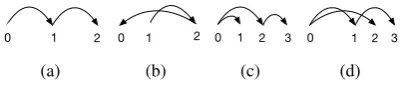
(d) Figure 1: Examples of projective and projective parses. (a-b): projective (a) and non-projective (b) parses of the same dependency tree. (b) is non-projective because node 1is not a de-scendant of either0or2(it is the parent of2). (c-d): projective (c) and non-projective (d) parses of the same dependency tree. Node2in (d) is placed between its sibling (node 1) and the child of its sibling (node3), neither of which is its ancestor.
is more primitive.1 A dependency parse D is a
dependency tree analysis of a sentence W, and we will think of it as a relation between words ofW, such that D(w, v) if w is a parent (head) ofv (v being a child/modifier). Dcan be gener-alized to D∗ which is an relation between words
that are connected by a continuous path in a de-pendency tree (i.e. D∗(w, v) ifD(w, v) or if∃u
s.t. D(w, u)∧D∗(u, v)). We assume unlabeled
dependency trees. Finally, we make a projectivity assumption, which is supported by empirical data in many languages (Kuhlmann and Nivre, 2006; Havelka, 2007), and makes a model computation-ally less expensive. A dependency parse D of a sentenceW =w1, . . . , wnisprojective, if for
ev-ery word pairwi, wj ∈W s.t.D(wi, wj)it holds
that everywk ∈W s.t.i < k < j orj < k < iis
a descendant ofwi, i.e.,D∗(wi, wk); see Figure 1.
Most NLP models that address the interaction of two or more languages are based (explicitly or implicitly) on thedirect correspondence assump-tion(DCA) (Hwa et al., 2002). It states that close translation equivalents in different languages have the same dependency structure. This is grounded linguistically, as translation equivalence implies semantic equivalence and therefore thematic rela-tions are preserved (Hwa et al., 2002). Thus pendency relations are preserved, as they are de-fined based on thematic relations between words. On the other hand, there is plenty empirical evi-dence supporting the violation of DCA under cer-tain conditions (Hwa et al., 2002). For instance, even semantically very close sentences in differ-ent languages may have a differdiffer-ent number of
1A dependency parse (a dependency tree analysis of a
[image:2.595.315.518.61.105.2]0 1 2
a b c
(a)
0 1 2
a b c
(b)
0 1 2 3
a b c d
(c)
0 1 2 3
a b c d
[image:3.595.86.278.62.128.2](d) Figure 2: Examples of cohesive and uncohesive translations. (a-b): cohesive (a) and uncohesive (b) translations of the same dependency parse. (b) is uncohesive because wordsaandctranslate the source subtree{(1,2)}, but the target wordbdoes not translate this subtree. (c-d): cohesive (c) and uncohesive (d) translations. (d) is uncohesive be-causeaandctranslate the source subtree{(0,1)}, butbdoes not translate it.
words. Syntactic divergence increases if the two languages are typologically different.
Even though DCA only holds up to a certain level of precision, it is widely used in NLP. There are models of cross-lingual transfer that define syntactic structure of one language by condition-ing it on the structure of semantically equiva-lent sentences in another language (Naseem et al., 2012). DCA has also been used in SMT. In partic-ular, syntax-based SMT is built implicitly around this assumption (Wu, 1997; Yamada and Knight, 2001). In Quirk and Menezes (2006) DCA is explicitly implemented by defining a translation model in terms of treelet pairs where target-side treelets are produced by projecting source depen-dencies via word alignments.
Closely related to DCA is the notion of syn-tactic cohesionof translation (Fox, 2002; Cherry, 2008). This is a constraint that does not allow for non-projective reordering: Given a source parse
DS, a translation W is cohesive if all translated
target wordswi, wj do not have any wordwk
be-tween them such that there is a source subtreesub
inDS such that some parts of it are translated by wiandwjbut not bywk(Figure 2). Cherry (2008)
and Bach et al. (2009) define a set of soft con-straints based on the syntactic cohesion assump-tion which are applicable to PBSMT decoding. They only require phrase applications, and not necessarily individual target words, to conform to the cohesion principle. For example, if we imag-ine a situation where a subtree as in Figure 2(b) is translated as a whole with one phrase applica-tion (and not word by word), then it does not vio-late the cohesion principle, although it is internally
uncohesive. Both our approach and Cherry (2008) implement the idea of conforming the target trans-lation to the source syntactic structure, but in dif-ferent ways. Approaches like Cherry (2008) de-fine principles that constrain the decoder in order to produce better translations. Our goal is to have a model that allows for a more direct way of evalu-ation of how well-formed the target translevalu-ation is. In Section 5 we compare translation performance of the two approaches.
3 Structured language models
As discussed in Sections 1 and 2, we would like to test how much a PBSMT can benefit from an ad-ditional syntax-based LM. In this section, we de-scribe a syntactic language model, structured LM (SLM) (Chelba and Jelinek, 2000), that we extend to a bilingual setting and apply to SMT in Sec-tion 4. SLMs have been applied in SMT before (Yamada and Knight, 2001; Yu et al., 2014), but as we show in Section 4, we provide a much sim-pler method to integrate it into the system. While a SLM is not the only syntactically defined LM, it is one of the few that models sentence genera-tion sequentially. And due to the way the decoding procedure of PBSMT is defined, it is natural and straightforward to use models whose score can be computed sequentially. Other syntactic language models define sentence generation hierarchically (Shen et al., 2008; Sennrich, 2015), which com-plicates their integration into a PBSMT system.
The linguistic intuition behind SLMs is that the structural children of a word do not essentially change its distributional properties but just provide additional specification. In Figure 3(a) the word
president has two modifiers: the andformer and it followsyesterday(an adjunct) and precedesmet
(a predicate). This ordering is correct in English. If instead its modifier was a or an entire relative clause, it would not make it incorrect.
To capture this observation, (Chelba and Je-linek, 2000) propose a language model where each word wi of a sentence W is predicted by an
or-dered subset of the words precedingwi. This
con-ditioning subset is selected based on the syntactic properties of the preceding sequence Wi−1: the strong predictors are kept and the weak ones are left out. The strong predictors are the set of ex-posed heads. Given a subsequence Wi−1 and its associated parseDi−1, exposed heads are the roots
the former president
the press yesterday
met
(a)
the former
president met yesterday
(b)
the arrived
president met
yesterday
who … in London two days before
[image:4.595.99.263.60.298.2](c)
Figure 3: A fully parsed sentence (a) and its partial parse (b) during sequential generation. The par-tial parse in (b) has two disconnected subtrees with rootsyesterdayandpresident. These roots are the exposed heads for met. (c) is an alternative sen-tence with a similar structure: president is still a root of a subtree, and thus and an exposed head.
a parseDi−1is not necessarily fully connected and thus a word can have multiple conditioning words. For an example, consider again Figure 3(a). In a left-to-right scenario, whenmet is generated, a regularn-gram LM conditions it onyesterday the former president, while a SLM conditions it on
yesterday president, since these two words are the exposed heads with respect to met (Figure 3(b)). The words theandformer are modifiers of pres-identand they get filtered out. Thus we obtain a less specific conditioning history, which may lead to the resulting model being less sparse. Another potential benefit is that SLMs can capture long-distance reordering: If president had as its mod-ifier a relative clause (Figure 3(c)) then a simple n-gram LM would be conditioned ondays before
(assumingn= 3), while an SLM would condition
metonyesterday president.
Summarizing the ideas of words being con-ditioned on a structurally defined subset of the preceding sentence, Chelba and Jelinek (2000) formalize the generation process of W as fol-lows:2 Each new word wi is conditioned on a 2The original model by (Chelba and Jelinek, 2000) is
de-fined in terms of a lexicalized constituency grammar, but as
sequence of exposed headsExpos(W, D). Then a tag ti is predicted, and the parse Di−i of Wi−1 is extended toDi incorporatingwi andti (where Wi−1is the prefix ofW precedingwi):
p(W, D) =
|W|
Y
i=1
p(wi|Expos(Wi−1, Di−1))
·p(ti|wi,Expos(Wi−1, Di−1)) ·p(Di|wi, ti,Expos(Wi−1, Di−1)).
(1) They use a shift-reduce parser with reduce-left, reduce-right, and shift operations.
4 Bilingual structured language models In this section, we combine the direct correspon-dence assumption (Section 2) and SLMs (Sec-tion 3), and define bilingual structured language models (BiSLMs) for PBSMT. Structured LMs have been successfully applied in SMT before. Yamada and Knight (2001) use SLMs in a string-to-tree SMT system where a derivation of a target-side parse tree is part of the decoding algorithm, and target syntactic representations are obtained ‘for free’. Yu et al. (2014) use an on-the-fly shift-reduce parser to build an incremental target parse. The approaches sketched above rely on re-sources that a standard PBSMT system does not have access to by default. Phrase-based decoders do not provide us with a parse of the target sentence, and inferring the parse of a target string with an external parser is computationally expen-sive and potentially unreliable (see Section 1). Our main insight is that in a bilingual setting one does not need an additional probabilistic target parsing model. We assume that the source parse is given (precomputed) and that the DCA (Section 2) holds, and project the parse deterministically onto the target side via word alignments3. We obtain
the following equation:
p(T|S, DS) = |T|
Y
i=1
p(ti|Expos(Ti−1,
ProjP(DS, S, Ti−1))), (2)
whereT is a target sentence,Ti−1is the sequence in T preceding the i-th target word ti, S is a
we discussed in Section 2, constituency parses can be trans-formed into dependency parses.
3Phrase-internal word alignments are stored in the phrase
pujing shuo ta xihuan suoyou de eluosi funv
putin said he likes all russian women
(a)
pujing shuo ta xihuan putin said he likes
(b)
pujing shuo ta xihuan suoyou de eluosi funv
putin said he likes all russian women
[image:5.595.102.259.60.246.2](c)
Figure 4: Chinese-English sentence pair (a) and sets of exposed heads (underlined) at different generation (b and c) steps of a bilingual SLM.
source sentence,DSis a source dependency parse,
andProjP is a function that returns a partial tar-get parseDT i−1 by projectingDS ontoTi−1. In
words, at each time stepiwe predict the next word
ti conditioned on the exposed heads of the partial
parse ofTi−1 projected from the source side. We limitExposto returning the four preceding exposed heads.4 Because the functionProjPis
determinis-tic and because we do not have to predict tags for words, Equation 2 is simpler than Equation 1.
We first illustrate Equation 2 with an example in Figure 4. Since word alignment is monotonic in Figure 4(a), it is straightforward to project the source dependencies onto the target side. We aim to imitate a monolingual parser in the way we build up our projected parse: Reduce operations should be invoked whenever both of the subtrees involved in the operation are complete, i.e., are not expected to have any more modifiers (Sec-tion 4.2). For example, when the target wordlikes
is produced its exposed heads aresaidandhe (Fig-ure 4(b)), sincePutin is a modifier ofsaid. Like-wise, the exposed heads forwomenaresaid likes all Russian(Figure 4(c)).
In what follows we discuss how to defineProjP. Compared to projection approaches like (Quirk
4As written above, we choose the dependency structures
over the lexicalized constituency ones because the latter can be mapped to the former. It is thus more likely that a pro-jected dependency tree is still be a well-formed parse, than a projected constituency tree. We decided to work with struc-tural models that are more flexible, but one may also define BiSLM in terms of the more constraining constituency trees and see if the such model has better generalization power.
and Menezes, 2006), we would like our model to project a source parse incrementally, allowing it to be used in a PBSMT decoder. We think of
ProjP as a function that computes the output in two stages: first, it infers from the source parse the dependency relations between target words (Sec-tion 4.1), second, it decides how to parse the tar-get sequence, i.e. in which order to assign these dependencies (Section 4.2). Additionally, in Sec-tion 4.3 we propose to use addiSec-tional labelings of target words, and in Section 4.4 we describe some important implementation details.
4.1 Dependency graph projection
Adoption of DCA (Section 2) allows to build up a target dependency tree from a source tree by pro-jecting the latter through word alignments. The definition of DCA can be rephrased as requiring a one-to-one correspondencemapbetween words of a sentence pair, allowing one to unambigu-ously map dependencies: Given a source parse, if t1 is the head of t2, then map(t1) is the head of map(t2). The correspondence relation that we have in PBSMT is the word alignmentalign: in the most general case, it is a many-to-many correspondence, and the straightforward projec-tion described above can lead to incorrect depen-dency structures. To overcome these problems, we describe a simple ordered set of projection rules, based on the ones specified by (Quirk and Menezes, 2006) (and we point out if otherwise).
The general idea behind this set of rules is to ex-tract a one-to-one function align1−1 from source words to target words from align and use it to project source dependencies as described in the paragraph above (R1below). We then use addi-tional rules (R2-R4 below) for the target words that are not in align1−1. Given a source sen-tenceS with a parseDS, a target sentenceT and
word alignmentalign,align1−1is extracted as fol-lows: For allti ∈T with multiple aligned source
words{si1, si2, ...}onlyalign1−1(si1) =ti (only
leftmost source word is kept, the links from the rest of the source words are removed5). For all si∈Swith aligned target words{ti1, ti2, ...}keep
the link only for the leftmost aligned target word:
align1−1(si) = ti1. For example, in Figure 5(b)
the link betweenf0 ande1is not inalign1−1, and in Figure 5(c) the link between f1 and e0 is re-moved (and the arc fromf2tof1is not projected).
f0 f1 f2
e0 e1 e2
(a)
f0 f1
e0 e1 e3
(b)
f0 f1 f2
e0 e1
(c)
f0 f1
e0 e1 e2 e3
(d)
f0
e0 f1 f2
e1
(e)
f0 f1 f2
e0 e1
(f)
f0 f1
e0 e1 e1
[image:6.595.78.287.61.207.2](g)
Figure 5: Examples for dependency projection rules. (a): no alignment links get removed (R1). (b): f0 −e1 link is removed fromalign1−1 (R1). (c): f1−e0 link gets removed (R1). (d): e1 and
e2 get adjoined to e0 (R2). (e): R3a. (f): R3b. (g) demonstrates two versions of R4: the dashed arrow gets ‘realized’ only if we adjoin unaligned words to the preceding head.
The following rules should be applied in order (as else-if conditions). Given a source sentence
S with a parseDS, a target sentenceT and word
alignmentalignbetween them,ti ∈T is a head of tj ∈T (i.e. DT(ti, tj)):
(R1) if there are sk, sl ∈ S s.t. DS(sk, sl) and
align1−1(sk) =tiandalign1−1(sl) =tj; see
Fig-ures 5(a)-5(c);
(R2)if∃s∈S s.t. align1−1(s) =tiand(s, tj)∈
align. This rule deals with one-to-many align-ments; see Figure 5(d);
(R3a) if ∃sk s.t. align1−1(sk) = ti and ∃sl s.t. (sl, tj)∈alignand andDS(sl, sk), andtilinearly
precedestj. In words: if two target words are in
align1−1 but do not get connected via R1, find a source word aligned to the second target word that may get them connected; see Figure 5(e);
(R3b)same as R3a, but in casetjprecedesti(i.e.,
find an additional source word aligned to the first target word; see Figure 5(f)).6
(R4)In case¬∃s(s, tj) ∈align(tj is unaligned),
we consider two strategies: We simplify the rule of Quirk and Menezes (2006) (dealing with the same situation) by adjoining it to the immediately pre-ceding head. We also consider a strategy whereby the word remains unconnected to any word in the sentence; see Figure 5(g).
6R3a and R3b differ from the rules proposed in Quirk and
Menezes (2006) dealing with the same situation, since we had to adapt it to the left-to-right parsing scenario.
f0 f1 f2
e0 e1 e2
(a)
f0 f1 f2
e0 e1 e2
f2
e3
(b)
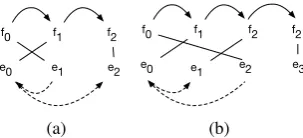
Figure 6: (a): The dashed lines are the dependency arcs that would project through word alignment, resulting in a non-projective projective (impossi-ble under strong source-completeness). (b): The dashed lines are the parse produced under weak source-completeness. Under strong completeness none of the words will get connected.
4.2 BiSLM parsing procedure
Given an inference procedure for dependency re-lations between target words (Section 4.1), one can specify in which order the corresponding de-pendency arcs are assigned to the target sentence. We define an incremental parsing procedure in terms of three operations: shift, left-reduce, and
right-reduce. The operations are applied as soon as the sufficient conditions hold: We specify the conditions using the following structural proper-ties. A target subtree issource-completeif all the descendants ofalign−1−11(root(sub))(source corre-spondent of the root of the current subtree) (Sec-tion 4.1) have been translated and reduced. A tar-get subtree iscompleteif it is source-complete and all the target words that are its children through non-projected arcs (through R2 or R4 in Sec-tion 4.1) have been translated and reduced. The bilingual parsing operations and the sufficient con-ditions for them are defined as follows:
Shift:after the word is produced it is shifted onto
the stack as an elementary subtree.
Left-reduce: if a disconnected subtree subi
and a disconnected subtree subi−1 imme-diately preceding it are both complete and
DT(root(subi),root(subi−1)), adjoin subi−1 to subi so that root(subi−1) is a modifier of
root(subi).
Right-reduce: analogous to left-reduce, but
DT(root(subi−1),root(subi)).
[image:6.595.340.492.62.131.2]of our model. Cherry (2008) simply assumes that non-cohesive reordering should be penalized, and our model is able to learn this pattern. We also consider an alternative to incorporating non-cohesive alignments by relaxing the definition of completeness for subtrees: A projected subtree
subis weakly source-completeif all descendants of all source word(s) which are aligned to the root ofsubhave been translated and,onlyif the defini-tion of reduce applies, reduced; see Figure 6(b).
4.3 Syntactic labeling of tokens
One of the problems with SLMs in general is that at time stepsiandjthe sets of exposed heads for
ti andtj can differ in size, which may imply
dif-ferent predictive power. To this end, we add an ad-ditional detail to our model: Each time a reduction occurs, we label the root of the subtree to which another subtree has been adjoined, thus making the conditioning history more specific. We use the following labelings:
Reduction labeling: if a subtree is adjoint tosub
from the left, then labelroot(sub)withLR. If it is adjoint from the right, then label it withRR.
Reduction POS-labeling: same as in simple
re-duction labeling, but add the POS tag of the root of the reduced subtree to the label.
4.4 Implementation and training
To use BiSLM during decoding, one needs access to phrase-internal alignments and target POS tags. We store phrase-internal alignments and target-side POS annotations of each phrase in the phrase table, based on the most frequent internal align-ment during training and the most likely target-side POS labeling ˆt given the phrase pair: ˆt = arg max¯tp(¯t|e,¯ f¯). We train BiSLMs on the par-allel training data (Section 5.1) and use the Stan-ford dependency parser (Chang et al., 2009) for Chinese and and the Stanford constituency parser (Green and Manning, 2010) for Arabic7.
POS-tagging of the training data is produced with the Stanford POS-tagger (Toutanova et al., 2003). We learn a 5-gram model using SRILM (Stolcke et al., 2011) with modified Kneser-Ney smoothing.
5 Experiments
To evaluate the effectiveness of BiSLMs for PB-SMT, we performed rescoring experiments for
7We extract dependency parses from its output based on
Collins (1999)
Arabic-English and Chinese-English. We com-pare the resulting 1-best translation lists with an output of the baseline system and the baseline aug-mented with soft cohesion constraints from Bach et al. (2009).
System MT06 MT08 MT06+MT08 baseline 32.60 25.94 29.56 cohesion 32.52 25.98 29.54
Table 1: Chinese-English baseline and compari-son model (Cherry, 2008; Bach et al., 2009) re-sults.
System MT08 MT09 MT08+MT09 baseline 45.84 48.61 47.18 cohesion constr. 45.61 48.49 47.02 Table 2: Arabic-English baseline and comparison model (Cherry, 2008; Bach et al., 2009) results.
5.1 Experimental setup
This section provides information about our base-line system. Word-alignment is produced with GIZA++ (Och and Ney, 2003). We use an in-house implementation of a PBSMT system similar to Moses (Koehn et al., 2007). Our baseline has all standard PBSMT features including language model, lexical weighting, and lexicalized reorder-ing. The distortion limit is set to 5. A 5-gram LM is trained on the English Gigaword corpus (1.6B tokens) using SRILM with modified Kneser-Ney smoothing and linear interpolation. Information about the training data for the Arabic-English and Chinese-English systems is in Table 3.8 Feature
weights are tuned using pairwise ranking opti-mization (Hopkins and May, 2011) on the MT04 benchmark (for both language pairs). For testing, we use MT08 and MT09 for Arabic, and MT06 and MT08 for Chinese. We use case-insensitive BLEU (Papineni et al., 2002) as evaluation met-ric. Approximate randomization (Noreen, 1989; Riezler and Maxwell, 2005) is used to detect sta-tistically significant differences.
5.2 Baseline and comparison systems
As a comparison model, we implemented six fea-tures from Cherry (2008) and Bach et al. (2009)9
and added them to the log-linear interpolation used
8The standard LDC corpora were used for training. 9Exhaustive and non-exhaustive interruption check,
Training set N. of lines N. of tokens Source side of Ar-En set 4,376,320 148M Target side of Ar-En set 4,376,320 146M Source side of Ch-En set 2,104,652 20M Target side of Ch-En set 2,104,652 28M Table 3: Training data for Arabic-English and Chinese-English experiments.
by the baseline system. Since these features are bi-nary or count-based, we cannot use them directly in rescoring. For that reason we integrated the fea-tures into the decoder and tuned the correspond-ing weights. The results for Chinese-English and Arabic-English translation experiments are pre-sented in Table 1 and 2, respectively. We see that adding the cohesion constraints does not improve performance. This finding is different from, for example, Feng et al. (2010), where they get im-provement for Chinese-English: however, we note that their training set is smaller than ours, and their baseline is weaker as it does not contain lexical-ized distortion models.
5.3 Rescoring experiments
Rescoring with BiSLMs is performed as follows: For the test runs of the baseline system we com-pute the n = 1000 best translation hypotheses for each source sentence and extract their deriva-tions (sequence of phrase pair applicaderiva-tions). Each phrase pair in our implementation is associated with a unique phrase-internal alignment and tar-get POS-sequence. We fully reconstruct word-alignment for each pair of a source sentence and its translation hypothesis. We project a preputed source parse onto the target side and com-pute representations of the target sentence to be computed by a BiSLM. For each hypothesis, we take its BiSLM score and its score assigned by the baseline system and compute the final score as a weighted sum of the original baseline score and a length-normalized BiSLM score10, where
the weightλis empirically set to 0.3:
λ·lengthscoreBiSLM
Hypothesis + (1−λ)·scoreBaseline (3)
5.3.1 Chinese-English
Our main focus here is Chinese-English, since it has more instances of longer-distance reordering, at which syntax-based models are typically good.
10Normalization is needed to ensure comparability of
scores for translation hypotheses of different lengths, since longer translation hypotheses will have lower scores.
labeling complete unalign BLEU diff.
-adjoin
plain strong + 30.09N +0.53
- 30.20N +0.64
weak + 30.11N +0.55
- 30.22N +0.66
reduce strong + 29.94M +0.40
- 30.19N +0.63
weak + 30.09N +0.53
- 30.24N +0.68
reduce-POS strong + 30.09N +0.53
- 30.25N +0.69
weak + 30.05N +0.49
- 30.25N +0.69
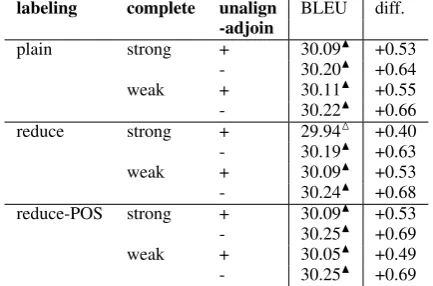
Table 4: Rescoring experiments for Chinese MT06+08 1000-best translation sets. Unrescored BLEU is 29.56. The columnlabelingcontains in-formation about the kind of labeling used on the target side of a BiSLM: just target words, target words with a reduction label, or target words with a reduction label and a POS of the root of the re-duced subtree (Section 4.3). The column
com-pleteindicates whether we use a strong or weak
definition of a complete subtree (Section 4.2). The columnunalign-adjoinindicates whether we ad-join an unaligned target word to the preceding subtree (Section 4.1). Statistically significant im-provements over the baseline are markedN at the
p < .01level andMat thep < .05level. Hmarks significant decrease at thep < .01level.
SLMs by design are good at capturing longer-distance dependencies. We try out several varia-tions of BiSLM. First, we test whether to use a strong or weak definition of a complete subtree (Section 4.2). Second, we investigate whether to adjoin unaligned target words to a preceding head (Section 4.1;unalign-adjoin+/-). Third, we com-pare several target-side labeling methods (Sec-tion 4.3): plain (just target words), reduce (LRor
RR) or reduce-POS (LRPOS orRR POS, where POSis the tag of the root of the reduced subtree). The rescoring results are presented in Table 4.
[image:8.595.305.522.63.206.2]labeling complete unalign BLEU diff.
-adjoin
plain strong + 47.20 -0.02
- 47.00H -0.18
weak + 47.22 +0.04
- 46.98H -0.20
reduce strong + 47.15 -0.03
- 46.99H -0.19
weak + 47.09 -0.09
- 46.98H -0.20
reduce-POS strong + 47.15 -0.03 - 46.98H -0.20
weak + 47.17 +0.01
- 47.00H -0.18
Table 5: Rescoring experiments for Arabic MT08+09 n-best translation sets. Unrescored BLEU for is 47.18. For notation see Table 4.
5.3.2 Arabic-English
We also rescore then-best lists for the output of the Arabic-English baseline system and results are shown in Table 5. Arabic and English are typolog-ically very different, but the range of reordering is much smaller than for Chinese-English. We ex-pect reordering-related models to have lesser ef-fect on Arabic as compared to Chinese (Carpuat et al., 2010). Experimental results on Arabic-English could indicate what kind of translation aspect benefits from BiSLMs. We see that for Arabic-English, just as for the cohesion constraint, BiSLM have little effect on BLEU scores, or even decrease them. This is a weak indication that BiSLMs are better at capturing reordering as-pects. As for the varying features defining dif-ferent BiSLM versions, we again see little effect of the labeling type or subtree completeness def-inition. On the other hand, we see the oppo-site pattern for theunalign-adjoinfeature, where
unalign-adjoin+is preferred.
To gain further insight into the different effect of BiSLM on the two language pairs, we evalu-ated our experimental output against a reordering-sensitive metric LRscore (Birch et al., 2010). We use the version of LRscore which is an average of the inverse Kendall’s Tau distance and the Ham-ming distance. In order to compute alignments for test sets which are needed to compute the score we concatenated the parallel text with an additional 250K lines of parallel text from the training data to ensure better generalization of the alignment algo-rithm (GIZA++). The LRscores of the baseline are compared to the best performing BiSLM system with respect to BLEU, for each of the language pair. The results are provided in Tables 6 and 7.
system LRscore MT06+08 baseline 0.4736
BiSLM 0.4907
Table 6: LRscores (average inverse Kendall’s Tau distance and Hamming distance) for Chinese-English baseline and BiSLM with reduce-labeling, weak completeness, unalign-adjoin-.
system LRscore MT08+09 baseline 0.6671
BiSLM 0.6719
Table 7: LRscores for Arabic-English baseline and BiSLM with plain-labeling, weak completeness, unalign-adjoin+.
As expected, the scores for Chinese-English are much lower than for Arabic-English, which is con-sistent with the observation reordering is more dif-ficult for Chinese-English. BiSLM yields larger improvements for Chinese-English suggesting that the proposed model helps addressing difficult re-ordering problems. While there are also small im-provements for Arabic-English the they may be too small to be detectable by BLEU.
6 Conclusions
In this paper we proposed a novel way to adapt structured language models to phrase-based SMT. Our method requires minimal changes to the PB-SMT pipeline. We tried a number of variations of our model and evaluated them in rescoring ex-periments, resulting in statistically significant im-provement for Chinese-English. The model is based on the idea of syntactic transfer (DCA; Sec-tion 2) and the positive result indicates its ability to capture syntactic patterns across languages. For Arabic-English, we did not observe any improve-ments, suggesting that our models indeed mainly improve reordering aspects. Improvements in rescoring are a positive indication that our model may be a strong feature during decoding. As fu-ture work, we will fully integrate our model into a PBSMT decoder and evaluate it on other language pairs with different reordering distributions.
Acknowledgments
[image:9.595.71.284.63.204.2]References
Nguyen Bach, Stephan Vogel, and Colin Cherry. 2009. Cohesive constraints in a beam search phrase-based decoder. InProceedings of the 2009 Annual Con-ference of the North American Chapter of the As-sociation for Computational Linguistics, pages 1–4. Association for Computational Linguistics.
Alexandra Birch, Miles Osborne, and Phil Blunsom. 2010. Metrics for mt evaluation: evaluating reorder-ing. Machine Translation, 24(1):15–26.
Marine Carpuat, Yuval Marton, and Nizar Habash. 2010. Improving Arabic-to-English statistical ma-chine translation by reordering post-verbal subjects for alignment. InProceedings of the ACL 2010 Con-ference Short Papers, pages 178–183. Association for Computational Linguistics.
Pi-Chuan Chang, Huihsin Tseng, Dan Jurafsky, and Christopher D. Manning. 2009. Discriminative reordering with chinese grammatical relations fea-tures. InProceedings of the Third Workshop on Syn-tax and Structure in Statistical Translation, pages 51–59. Association for Computational Linguistics. Ciprian Chelba and Frederick Jelinek. 2000.
Struc-tured language modeling. Computer Speech and Language, 14(4):283–332.
Colin Cherry. 2008. Cohesive phrase-based decoding for statistical machine translation. In Proceedings of Association for Computational Linguistics, pages 72–80.
Michael Collins. 1999. Head-Driven Statistical Mod-els for Natural Language Parsing. Ph.D. thesis, University of Pennsylvania.
Josep M. Crego and Franc¸ois Yvon. 2010. Improv-ing reorderImprov-ing with lImprov-inguistically informed bilin-gual n-grams. In Proceedings of the 23rd Inter-national Conference on Computational Linguistics, pages 197–205. Association for Computational Lin-guistics.
Minwei Feng, Arne Mauser, and Hermann Ney. 2010. A source-side decoding sequence model for statis-tical machine translation. InConference of the As-sociation for Machine Translation in the Americas, Denver, Colorado, USA.
Heidi J. Fox. 2002. Phrasal cohesion and statisti-cal machine translation. In Proceedings the Con-ference on Empirical Methods in Natural Language Processing, pages 304–311. Association for Com-putational Linguistics.
Ekaterina Garmash and Christof Monz. 2014. Dependency-based bilingual language models for reordering in statistical machine translation. In Pro-ceedings of the 2014 Conference on Empirical Meth-ods in Natural Language Processing (EMNLP), pages 1689–1700, Doha, Qatar, October. Associa-tion for ComputaAssocia-tional Linguistics.
Niyu Ge. 2010. A direct syntax-driven reordering model for phrase-based machine translation. In
Human Language Technologies: The 2010 Annual Conference of the North American Chapter of the Association for Computational Linguistics, pages 849–857. Association for Computational Linguis-tics.
Spence Green and Christopher D. Manning. 2010. Better arabic parsing: Baselines, evaluations, and analysis. In Proceedings of the 23rd International Conference on Computational Linguistics, pages 394–402. Association for Computational Linguis-tics.
Jiri Havelka. 2007. Beyond projectivity: Multilin-gual evaluation of constraints and measures on non-projective structures. InProceedings of the 45th An-nual Meeting of the Association of Computational Linguistics, pages 608–615. Association for Com-putational Linguistics.
Mark Hopkins and Jonathan May. 2011. Tuning as ranking. InProceedings of the Conference on Em-pirical Methods in Natural Language Processing, pages 1352–1362. Association for Computational Linguistics.
Rebecca Hwa, Philip Resnik, Amy Weinberg, and Okan Kolak. 2002. Evaluating translational corre-spondence using annotation projection. In Proceed-ings of the 40th Annual Meeting on Association for Computational Linguistics, pages 392–399. Associ-ation for ComputAssoci-ational Linguistics.
Philipp Koehn, Franz Josef Och, and Daniel Marcu. 2003. Statistical phrase-based translation. In Pro-ceedings of the 2003 Conference of the North Amer-ican Chapter of the Association for Computational Linguistics on Human Language Technology, pages 48–54. Association for Computational Linguistics. Philipp Koehn, Hieu Hoang, Alexandra Birch, Chris
Callison-Burch, Marcello Federico, Nicola Bertoldi, Brooke Cowan, Wade Shen, Christine Moran, Richard Zens, et al. 2007. Moses: Open source toolkit for statistical machine translation. In Pro-ceedings of the 45th Annual Meeting of the Associ-ation for ComputAssoci-ational Linguistics on Interactive Poster and Demonstration Sessions, pages 177–180. Association for Computational Linguistics.
Marco Kuhlmann and Joakim Nivre. 2006. Mildly non-projective dependency structures. In Proceed-ings of the COLING/ACL 2006 Main Conference Poster Sessions, pages 507–514, Sydney, Australia, July. Association for Computational Linguistics. Uri Lerner and Slav Petrov. 2013. Source-side
classi-fier preordering for machine translation. In Proceed-ings of the Empirical Methods in Natural Language Processing.
parsing. InProceedings of the 50th Annual Meet-ing of the Association for Computational LMeet-inguis- Linguis-tics: Long Papers-Volume 1, pages 629–637. Asso-ciation for Computational Linguistics.
Jan Niehues, Teresa Herrmann, Stephan Vogel, and Alex Waibel. 2011. Wider context by using bilin-gual language models in machine translation. In
Proceedings of the Sixth Workshop on Statistical Machine Translation, pages 198–206. Association for Computational Linguistics.
Eric W. Noreen. 1989. Computer Intensive Meth-ods for Testing Hypotheses. An Introduction. Wiley-Interscience.
Franz Josef Och and Hermann Ney. 2003. A sys-tematic comparison of various statistical alignment models. Computational Linguistics, 29(1):19–51.
Timothy Osborne. 2008. Major constituents and two dependency grammar constraints on sharing in coor-dination.Linguistics, 46(6):1109–1165.
Kishore Papineni, Salim Roukos, Todd Ward, and Wei-Jing Zhu. 2002. Bleu: a method for automatic eval-uation of machine translation. InProceedings of the 40th annual meeting of the Association for Compu-tational Linguistics, pages 311–318. Association for Computational Linguistics.
Matt Post and Daniel Gildea. 2008. Parsers as lan-guage models for statistical machine translation. In
Proceedings of the Eighth Conference of the Asso-ciation for Machine Translation in the Americas, pages 172–181. Citeseer.
Chris Quirk and Arul Menezes. 2006. Dependency treelet translation: The convergence of statistical and example-based machine translation? Machine Translation, 20:43–65, March.
Stefan Riezler and John T. Maxwell. 2005. On some pitfalls in automatic evaluation and significance test-ing for MT. InProceedings of the ACL Workshop on Intrinsic and Extrinsic Evaluation Measures for Ma-chine Translation and/or Summarization.
Rico Sennrich. 2015. Modelling and optimizing on syntactic n-grams for statistical machine translation.
Transactions of the Association for Computational Linguistics, 3:169–182.
Libin Shen, Jinxi Xu, and Ralph M. Weischedel. 2008. A new string-to-dependency machine translation al-gorithm with a target dependency language model. InProceedings of the Association for Computational Linguistics, pages 577–585.
Andreas Stolcke, Jing Zheng, Wen Wang, and Victor Abrash. 2011. Srilm at sixteen: Update and out-look. In Proceedings of IEEE Automatic Speech Recognition and Understanding Workshop, page 5.
Kristina Toutanova, Dan Klein, Christopher D. Man-ning, and Yoram Singer. 2003. Feature-rich part-of-speech tagging with a cyclic dependency network. InProceedings of the 2003 Conference of the North American Chapter of the Association for Computa-tional Linguistics on Human Language Technology, pages 173–180. Association for Computational Lin-guistics.
Dekai Wu. 1997. Stochastic inversion transduction grammars and bilingual parsing of parallel corpora.
Computational linguistics, 23(3):377–403.
Bing Xiang, Niyu Ge, and Abraham Ittycheriah. 2011. Improving reordering for statistical machine trans-lation with smoothed priors and syntactic features. In Proceedings of the Fifth Workshop on Syntax, Semantics and Structure in Statistical Translation, pages 61–69. Association for Computational Lin-guistics.
Kenji Yamada and Kevin Knight. 2001. A syntax-based statistical translation model. InProceedings of the 39th Annual Meeting on Association for Com-putational Linguistics, pages 523–530. Association for Computational Linguistics.
Heng Yu, Haitao Mi, Liang Huang, and Qun Liu. 2014. A structured language model for incremental tree-to-string translation. Proceedings of COLING 2014, the 25th International Conference on Computational Linguistics, pages 1133–1143.