The Economic and Social Review, Vol. 18, No. 3, April, 1987, pp. 149-158.
Labour Supply and Commodity Demands:
An Application to Irish Data*
A. M U R P H Y
St Patrick's College, Maynooth
D . R O D N E Y T H O M University College, Dublin
Abstract: Annual Irish data are used lo estimate a model which allows for the joint determination of commodity demands and labour supply. Consumer preferences are modelled by a cost function ol the Gorman polar form which permits exact linear aggregation over individuals with different money wage rales. Separability between goods and leisure is rejected by the data. Labour supply is (bund to be a positive function of the wage rate.
ver the last ten years there has been considerable interest i n ^ _ x t h e j o i n t m o d e l l i n g of labour supply and c o m m o d i t y demands. A b b o t and Ashenfelter (1976) use a variety of models to estimate the j o i n t demands for goods and leisure from annual U S time series data. Ashenfelter (1980), using an augmented L E S , estimates a model i n w h i c h the c o m m o d i t y demands of unrationed consumers are combined w i t h those o f consumers who are restricted in their choice o f leisure (labour supply). Blundell and W a l k e r (1982) estimate similarly rationed and unrationed demands derived from a generalisation of the LES suggested by Deaton and M u e l l b a u e r (1981). U s i n g U K cross section data Blundell and W a l k e r decisively reject the hypothesis of separability between goods and leisure as does Barnett (1979) using U S times series data.
I f separability between goods and leisure is not a sustainable hypothesis then parameter estimates derived from a model w h i c h either imposes it or w h i c h excludes leisure from the preference o r d e r i n g w i l l be inconsistent and w i l l result in incorrect inferences. Rejection of separability also has i m p o r t a n t implications for o p t i m a l tax theory w h i c h requires knowledge of the substitute/complement patterns between goods and leisure.
•We wish to thank an anonymous referee for comments on an earlier draft. The usual disclaimer applies.
T h e p r i m a r y objective of the present paper is to utilise annual Irish data for the period 1953 to 1983 to estimate a model which allows for the j o i n t determina tion of c o m m o d i t y demands and labour supply and which permits an explicit test of the separability hypothesis. As such, our objective is somewhat limited. W e do not, for example, include demographic factors or distinguish between male and female labour supply decisions and the role of children. N o r do we con sider the possibility that some consumers may be rationed i n their choice of leisure hours.1 A n adequate treatment of these aspects of household behaviour requires the use of cross-section data or panel data. Unfortunately we do not have direct access to cross-section and Irish panel data do not exist. Being re stricted to a time series context we consequently address only those questions w h i c h the data may be reasonably expected to deal w i t h .
A further restriction on our approach is the consideration that while i n d i v i duals may be reasonably assumed to face a c o m m o n set of c o m m o d i t y prices it is totally implausible to assume that they sell their labour at a c o m m o n wage. Given that wage rates differ over i n d i v i d u a l consumers the use of aggregate time series data requires that we work w i t h demand functions that p e r m i t aggrega tion in money wages and non-labour incomes. I n order to comply w i t h this restriction we confine our attention to the case of exact linear aggregation and model behaviour by a cost, or expenditure function, of the G o r m a n polar form. This type of cost function is somewhat restrictive i n that it implies that prefer ences are quasi-homothetic. Thus the Engel curves are linear in full income. The requirement of linear aggregation combined w i t h time-series data eliminates more flexible functional forms such as Deaton and Muellbauer's Almost Ideal D e m a n d System ( A I D S ) . Section I I outlines the model and discusses its pro perties. T h e estimates are presented i n Section I I I while Section I V discusses the paper's m a i n conclusions. A n A p p e n d i x is included w h i c h gives definitions and sources of the data used.
I I T H E O R Y
Consider an i n d i v i d u a l w h o is free to allocate a fixed time endowment T be tween labour supply h and leisure q0 = T - h. Corner solutions are ignored. I n a d d i t i o n the consumer allocates money income among the elements of an n-c o m m o d i t y ven-ctor q at exogenous prin-ces p. F u l l expenditure per period is given by:
x = w q0 + p ' q (1)
where w is the money wage rate or the o p p o r t u n i t y cost of leisure. We also
strain total c o m m o d i t y expenditure per period to equal the sum of labour and non-labour incomes so that p ' q = w h + y, where y denotes non-labour income. Substitution into (1) gives the full income budget constraint:
x = w T + y (2)
T o derive the consumer's demand system it is first necessary to define a prefer ence o r d e r i n g over q0 and q. T h r o u g h o u t this paper we assume that preferences are i n t e r t e m p o r a l l y weakly separable and describe w i t h i n period preferences by the u t i l i t y f u n c t i o n :2
u = v(q„,q) (3)
and model the i n d i v i d u a l as choosing leisure and commodities so as to maximise (3) subject to (2) i n each period. A l t e r n a t i v e l y , we may t h i n k of the i n d i v i d u a l as choosing (q0,q) in each period so as to minimise the full cost of achieving the u t i l i t y level given by the solution to the p r i m a r y problem. Hence we can define the cost (or expenditure) function for this problem as:
c(w,p,u) = m i n ( w q0 + p ' q : s.t. v(q„,q) = u) (4)
By Shepard's L e m m a the compensated or Hicksian labour supply and c o m m o d i t y demands are:
h = T - c0( w , p , u ) (5)
q, = c;( w , p , u ) , i = 1 . . . n. (6)
where c0 Cj are p a r t i a l derivatives of the cost function w i t h respect to w and p; respectively. I n v e r t i n g (4) to give the indirect u t i l i t y function u = f(w,p,x) and substituting for u in (5) and (6) gives the uncompensated or M a r s h a l l i a n demands:
h = T - g0( w , p , x ) (7)
Qi = g i (w, P >x) > i = 1 ••• n. (8)
W i t h time series data it is desirable to choose a functional form for (4) that allows exact linear aggregation over w and y. M u e l l b a u e r (1981) shows that exact linear aggregation over n consumers requires that the " m i c r o " and " m a c r o " cost functions be of the G o r m a n polar form:
^ ( W h . P . U h ) = ah ( P ) + whd( P ) + wkb ( p )( 1 _ k )uh; h = 1 . . . n (9)
c(w,p,u) = a(p) + wd(p) + wkb ( p )( 1~k )u (10)
where a(p) = ( l / n ) £ ah( p ) w = ( l / n ) Z whu - ( l / n ) Z uh and a(p) and b(p) are homogeneous of degree 1, and d(p) is homogeneous of degree zero. I f leisure and total c o m m o d i t y expenditure are b o t h n o r m a l then 0 < k < 1. T h e cost function (10) yields the following uncompensated demands:
w h = w ( T - d ( p ) ) - k M (11)
pi q i = pi a i(P) + wP id i ( p ) + p.,(l - k ) b * ( p ) M (12)
Where M = w T + y - a(p) - w d ( p ) and bj*(p) = bi( p ) / b ( p ) . Note that the labour hours supply function does not permit linear aggregation over individuals w i t h differing wage rates. W e therefore choose to work w i t h a labour income function and to express c o m m o d i t y demands i n expenditure terms.3
A p a r t from y i e l d i n g a tractable demand system (10) also permits a relatively simple test for separability. G o l d m a n a n d U z a w a (1964) show that goods and leisure are weakly separable i f ci 0 = zci u where z is a constant for all i = 1 . . . n. (See section (b) of the A p p e n d i x ) . I n the case of (10) separability holds when d; (p) = 0 for a l l i .
I l l E S T I M A T E S
Estimation of the system (11)—(12) requires that we first specify appropriate functional forms for a(p), d(p) and b(p). W e choose:
a(p) = Z Z aij(PiPj)1 / 2; =
d(p) = d0 n pd i;
Z
d; = 0 (13)i
b(p) = b0 n pb i; I b; = 1
i
As i n the L i n e a r Expenditure system the terms a(p) and d(p) may be interpreted as m i n i m u m expenditures on goods and leisure respectively. For example the m i n i m u m q u a n t i t y of good i purchased per period (at zero u t i l i t y ) is given by:
q; = Z a ^ p / p ; )1 7 2 + w d0d; I ! pd i/P i (14)
Hence m i n i m u m quantities are specified as general functions of prices rather than as constants as i n the L E S . However, whereas the a d d i t i v i t y of the L E S implies that substitution of one good for another operates t h r o u g h income effects
only, the use of a second order flexible functional form for a(p) and a non-constant expression for d(p) permits more general substitution effects between goods and between goods and leisure. Given (13) the cost function is a generalised form o f the L E S and reduces to the latter when the off-diagonal terms i n a(p) and the d; terms (1 = 1 . . . n) are zero. I n this case preferences w o u l d be separable a n d a d d i t i v e .4 Using (13) gives the following labour supply a n d c o m m o d i t y demands:
w h = w ( T - donP d i) - k M (15)
pi q i = I a ^ P i P j )1 7 2 + w d o d j n p * + (1 - k)t>iM; i = 1 . . . n. (16)
.1
M = w T + y - I I a ^ p i p - )1 7 2 - w d0nP d i (17)
Separability between goods and leisure requires that d; = 0 for a l l i = 1 . . . n and can be tested using the likelihood ratio test.
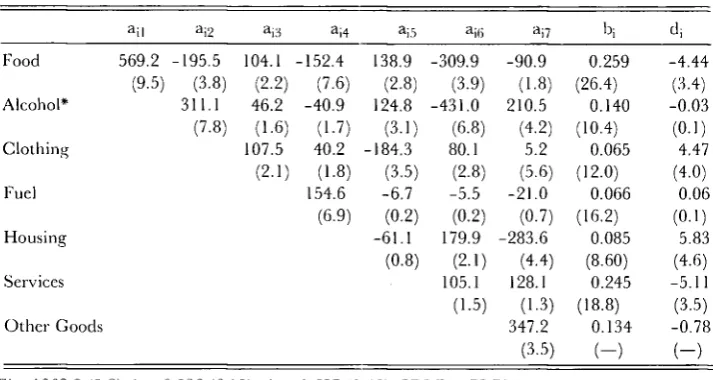
T o estimate the demand system (15)—(16) we used annual observations on seven classes of non-durable expenditures over the period 1951 to 1983/' A full description of the data and their sources are given i n the A p p e n d i x . O u r measures of the wage and labour supply are average earnings and numbers employed. T h i s is necessitated by the lack of a suitable economy-wide series on hours worked. I n order to remove the singularity of the system the labour supply equation was deleted and the r e m a i n i n g seven expenditure functions were esti mated using the appropriate m a x i m u m likelihood procedures i n the S H A Z A M package. Parameter estimates are presented i n T a b l e 1. As data are not avail able for the time endowment we treated T as a parameter in the estimation. As a rough check on the estimate for T we require that w T be greater t h a n labour income. T h e estimate for T meets this condition at a l l sample points. T h e m o d e l was also estimated w i t h separability imposed and a likelihood ratio test used to test the hypothesis that goods a n d leisure are separable. T h e statistic 2 D L R , equal to twice the absolute difference between the respective log likelihood func tions, is distributed as chi-square w i t h six degrees of freedom a n d indicates a decisive rejection of the separability hypothesis w i t h a critical level of less t h a n . 0 0 1 .6
4. Note that minimum leisure hours equal d„, a constant, under separability.
5. Initial results derived from a data set which included durables proved unsatisfactory. We note that it is not uncommon lor empirical demand studies to exclude durables. See Blundell and Walker (1982), Anderson and Blundell (1983) and Attlield and Browning (1985). Strictly, durables are assumed to be separable I'rom non-durables and leisure.
T a b l e 1: Parameter Estimates
ai 4
aifi ai 7 bi di
Food 569.2 -195.5 1 04.1 - 152.4 138.9 -309.9 -90.9 0.259 -4.44 (9.5) (3.8) (2.2) (7.6) (2.8) (3.9) (1.8) (26.4) (3.4) Alcohol* 311.1 46.2 -40.9 124.8 -431.0 210.5 0.140 -0.03 (7.8) (1.6) (1.7) (3.1) (6.8) (4.2) (10.4) (0.1) C l o t h i n g 1 07.5 40.2 -184.3 80.1 5.2 0.065 4.47 (2.1) (1.8) (3.5) (2.8) (5.6) (12.0) (4.0) Fuel 154.6 -6.7 -5.5 -21.0 0.066 0.06 (6.9) (0.2) (0.2) (0.7) (16.2) (0.1) Housing -61.1 179.9 --283.6 0.085 5.83 (0.8) (2.1) (4.4) (8.60) (4.6) Services 105.1 128.1 0.245 -5.11 (1.5) (1.3) (18.8) (3.5) O t h e r Goods 347.2 0.134 -0.78 (3.5) ( - ) ( - ) T = 1962.2 (5.9); k = 0.536 (6.15); d„ = 1.657 (1.40); 2 D L R = 79.7 14.
Figures in parentheses are t-statistics. * I n c l u d i n g tobacco.
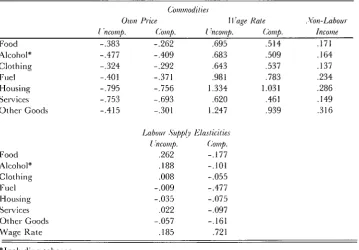
T h e parameter estimates appear to be reasonably "sensible". Leisure and total c o m m o d i t y expenditure are both n o r m a l as are the i n d i v i d u a l c o m m o d i t y groups. Various elasticities, computed at the sample means, are presented in T a b l e 2. T h e c o m p u t a t i o n o f the various elasticities is outlined in the A p p e n d i x . Both the uncompensated and compensated labour supply wage elasticities are positive i n d i c a t i n g an u p w a r d sloping supply curve. This result was replicated at 30 out of 31 sample points, the exception being 1983 w h i c h gave an uncompen sated wage elasticity o f - 0 . 0 2 7 . A l l commodities and leisure are unambiguous net substitutes w h i c h i m p l y that all commodities and labour supply are net complements. Leisure is a gross substitute for fuel, housing and other goods but a gross complement for the r e m a i n i n g c o m m o d i t y groups. Table 3 presents o w n -price elasticities based on parameter estimates when separability is imposed on the system. W i t h the exception of services the absolute values of these elasticities are lower than those computed from the unrestricted system suggesting the possibility of a systematic bias in the restricted model.
I V C O N C L U S I O N S
[image:6.469.81.438.79.269.2]L A B O U R S U P P L Y A N D C O M M O D I T Y D E M A N D S — I R I S H D A T A 155
T a b l e 2: Elasticities
Commodities
Own Price Wage Rale .Von-Labour I ncomp. Comp. 1 'ncomp. (Jomp. Income
Food -.383 -.262 .695 .514 .171 Alcohol* -.477 -.409 .68.3 .509 .164 C l o t h i n g -.324 -.292 .64.3 .537 .137 Fuel -.401 -.371 .981 .783 .234 Housing -.795 -.756 1.334 1.031 .286 Services -.753 -.693 .620 .461 .149 O t h e r Goods -.415 -.301 1.247 .939 .316
Labour Supply Elasticities I 'ncomp. Comp.
Food .262 -.177
Alcohol* .188 -.101 C l o t h i n g .008 -.055
Fuel -.009 -.477
Housing -.035 -.075 Services .022 -.097 O t h e r Goods -.057 -.161 Wage R a t e .185 .721 * I n c l u d i n g tobacco.
Table 3: Elasticities - Separability
Own Price
Uncomp Comp
Food -.284 -.162
A l c o h o l * -.394 -.327
C l o t h i n g -.211 -.177
Fuel -.373 -.341
Housing -.236 -.186
Services -.979 -.908
O t h e r Goods -.187 -.079
L a b o u r Supply .210 .752
i n c l u d i n g tobacco.
[image:7.471.32.392.83.333.2]hypothesis about i n d i v i d u a l preferences so that its rejection i n tests based on aggregate data may not have a clear interpretation. Second the functional forms used are somewhat restrictive. A l t h o u g h separability and a d d i t i v i t y are not imposed, homogeneity and symmetry are. W e note that this is the price w h i c h has to be paid for exact linear aggregation over individuals w i t h different wage rates. T h i r d , the model assumes that individuals are free to allocate their time between goods and leisure. A more realistic approach may be one i n w h i c h some individuals are rationed i n their choice of leisure hours. However, as we have shown elsewhere exact linear aggregation over rationed and unrationed con sumers is only possible under one of the following restrictive assumptions.7 (i) Preferences are weakly separable between goods and leisure, (ii) A l l rationed individuals are rationed at the same level, (iii) A l l unrationed individuals sell their labour at the same wage. I n the case of labour supply the assumptions of a c o m m o n r a t i o n or a c o m m o n wage are implausible and we wish to test for separ a b i l i t y , not to impose i t .
F i n a l l y , the approach taken i n this paper is that dictated by theory. W e recog nise that certain aspects of the model may be restrictive. However, given the con straints imposed by time-series data, alternative approaches are probably no less restrictive.
REFERENCES
A B B O T T , M . , and O . A S H E N F E L T E R , 1976. " L a b o u r Supply, Commodity D e m a n d and the Allocation of T i m e " , Review of Economic Studies, V o l . 43, pp. 389-411.
A N D E R S O N , G . J . , and R . W . B L U N D E L L , 1983. "Testing Restrictions in a Flexible D y n a m i c D e m a n d System: A n Application to Consumer's Expenditure in C a n a d a " , Review of Economic
Studies, V o l . 50, pp. 397-410.
A S H E N F E L T E R , O . 1980. "Unemployment as Disequilibrium in a Model of L a b o u r Supply",
Econometrica, V o l . 48, pp. 547-564.
A T T F I E L D , C . L . F . , and M . J . B R O W N I N G , 1985. " A Differential D e m a n d System, R a t i o n a l Expectations and the Life C y c l e Hypothesis", Econometrica, V o l . 53, pp. 31-48.
B A R N E T T , W . A . , 1979. " T h e J o i n t Allocation of Leisure and Goods Expenditure", Econo
metrica, V o l . 47, pp. 539-563.
B L U N D E L L , R . W . , and I . W A L K E R , 1982. "Modelling the Joint Determination ofHousehold L a b o u r Supplies and C o m m o d i t y Demands", Economic Journal, V o l . 92, pp. 351-364. D E A T O N , A . , and J . M U E L L B A U E R , 1981. "Functional Forms for L a b o u r Supply and
Commodity Demands with and without Q u a n t i t y Restrictions", Econometrica, V o l . 49, pp. 1521-1532.
G O L D M A N , S. M . , and H . U Z A W A , 1964. " A Note on Separability and D e m a n d Analysis",
Econometrica, V o l . 32, pp. 387-398.
M c C A R T H Y , C , 1977. "Estimates of a System of D e m a n d Equations U s i n g Alternative Commodity Classifications of Irish D a t a " , The Economic and Social Review, V o l . 8, pp. 201-211.
M c C U R D Y , T . , 1983. " A Simple Scheme for Estimating an Intertemporal Model of L a b o u r Supply and Consumption in the Presence of T a x e s and Uncertainty", International Economic
Review, V o l . 24, pp. 265-289.
M U E L L B A U E R , J . , 1981. " L i n e a r Aggregation in Neoclassical L a b o u r Supply", Review of
Economic Studies, V o l . L X V I I I , pp. 21-36.
M U R P H Y , A . , and R . T H O M , 1986. " L a b o u r Supply and C o m m o d i t y Demands: Problems in Aggregating Expenditure Functions", M i m e o ( U C D ) .
O ' R I O R D A N , W . , 1975. " A n Application of the R o t t e r d a m System to Irish D a t a " , TheEconomic
and Social Review, V o l . 6, pp. 511-529.
S I L V E Y , S. D . , 1970. Statistical Inference, L o n d o n : C h a p m a n H a l l .
A P P E N D I X
(a) Data
T h e data consist of annual Irish data for the period 1951-1983. T h e series on c o m m o d i t y expenditures are taken from various issues o f .National Income and Expenditure. Prices are computed as the ratio of expenditures at current prices to expenditures at constant (1975) prices.
Time-series of economy-wide data on hours is unavailable for I r e l a n d . T h i s d i d not present any problems for estimation as the labour supply equation is expressed i n income terms and is deleted to satisfy the adding-up constraint. As a series o n hours is unavailable labour supply is measured as numbers employed and the wage rate as a n n u a l earnings.
(b) Separability
Define G and H to be subgroups c o n t a i n i n g commodities (i = 1 . . . n) and leisure (0) respectively. G o l d m a n and U z a w a (1964) show that weak separability between goods and leisure requires that:
ci 0 = z # cl i xcl 0 x
for i = 1 . . . n. Where ci 0 is the Slutsky substitution t e r m , qi x and q0 x are the slopes of the Engel curves for goods (i = 1 . . . n) and leisure and z* depends on G and H but is independent of i . I n terms o f the cost function qi x = ci u/ cu. T h e above c o n d i t i o n can be recast as:
ci 0 = Z Ci u
where z =
z*Cq
u/(c
uc
u).
T h e derivative cu is the inverse of the m a r g i n a l u t i l i t y of income and is therefore independent of i under u t i l i t y maximisation.(c) Elasticities
by the appropriate p r i c e / q u a n t i t y ratio. T h e o w n price compensated elasticities are obtained for the Slutsky decomposition:
Ec - E + WjCj
where Ec is the compensated elasticity, E is the uncompensated elasticity, w; is the budget share and e; is the M a r s h a l l i a n income elasticity. Note that the second t e r m on the R H S reduces to (1 - k)bj and does not depend on the estimate for T . T o compute the labour supply wage elasticity we used the elasticity of labour income w i t h respect to w. F r o m (11) and using x = w T + y:
E(wh),w = ( l - k ) ( T - d ( p ) ) ( w / w h )
For hours the elasticity is:
Eh,w = - 1 + E(wh).w