ON THE REPRESENTATION OF QUERY TERM RELATIONS BY SOFT BOOLEAN oPERATORS
G e r a r d S a l t o n
D e p a r t m e n t o f Computer S c i e n c e C o r n e l l U n i v e r s i t y Ithaca, NY 14853, USA
ABSTRACT
The l a n g u a g e a n a l y s i s c o m p o n e n t i n m o s t t e x t r e t r i e v a l s y s t e m s i s c o n f i n e d t o a r e c o g n i t i o n o f n o u n p h r a s e s o f t h e t y p e n o r m a l l y i n c l u d e d i n b a c k - o f - t h e - b o o k i n d e x e s , and a n i d e n t i f i c a t i o n o f r e l a t e d t e r m s i n c l u d e d i n a p r e c o n s t r u c t e d t h e s a u r u s o f q u a s i - s y n o n y m s . Even s u c h a r e s - t r i c t e d l a n g u a g e a n a l y s i s i s f r a u g h t w i t h d i f f i c u l - t i e s b e c a u s e o f t h e w e l l - k n o w n p r o b l e m s i n t h e a n a l y s i s o f compound n o m i n a l s , a n d t h e h a z a r d s a n d c o s t o f c o n s t r u c t i n g word synonym c l a s s e s v a l i d f o r l a r g e t e x t s a m p l e s .
I n t h i s s t u d y a n e x t e n d e d ( s o f t ) B o o l e a n l o g i c i s u s e d f o r t h e f o r m u l a t i o n o f i n f o r m a t i o n r e t r i e v a l q u e r i e s w h i c h i s c a p a b l e o f r e p r e s e n t i n g b o t h t h e u s e o f compound n o u n p h r a s e s a s w e l l a s t h e i n c l u s i o n o f synonym c o n s t r u c t i o n s i n t h e q u e r y s t a t e m e n t s . The o p e r a t i o n s o f t h e e x t e n d e d B o o l e a n l o g i c a r e d e s c r i b e d , and e v a l u a t i o n o u t p u t i s i n c l u d e d t o d e m o n s t r a t e t h e e f f e c t i v e n e s s o f t h e e x t e n d e d l o g i c c o m p a r e d w i t h t h a t o f o r d i n a r y t e x t r e t r i e v a l s y s t e m s .
I . L i n g u i s t i c A p p r o a c h e s i n I n f o r m a t i o n R e t r i e v a l I t i s p o s s i b l e t o c l a s s i f y t h e v a r i o u s a u t o m a t i c t e x t p r o c e s s i n g s y s t e m s by t h e d e p t h a n d t y p e o f l i n g u i s t i c a n a l y s i s n e e d e d f o r t h e i r o p e r a - t i o n s . S o p h i s t i c a t e d l a n g u a g e u n d e r s t a n d i n g com- p o n e n t s a r e b e l i e v e d t o b e e s s e n t i a l t o c a r r y o u t a u t o m a t i c t e x t t r a n s f o r m a t i o n s s u c h a s t e x t
abstracting and text translation. [I,14,24] Com-
plete language understanding systems are also
needed in automatic question-answering where direct responses to user queries are automatically gen- erated by t h e s y s t e m . [ 1 1 ] On t h e o t h e r h a n d , r e l a t i v e l y l e s s s o p h i s t i c a t e d l a n g u a g e a n a l y s i s s y s t e m s may b e a d e q u a t e f o r b i b l i o g r a p h i c i n f o r m a - t i o n r e t r i e v a l , w h e r e r e f e r e n c e s a s o p p o s e d t o d i r e c t a n s w e r s a r e r e t r i e v e d i n r e s p o n s e t o u s e r queries. [21]
In bibllographic retrieval, the content of i n d i v i d u a l d o c u m e n t s i s n o r m a l l y r e p r e s e n t e d by s e t s o f k e y w o r d s , o r k e y p h r a s e s , a n d o n l y a few s p e c i f i e d t e r m r e l a t i o n s h i p s a r e r e c o g n i z e d u s i n g
D e p a r t m e n t o t C o m p u t e r S c i e n c e , C o r n e l l U n i v e r - s i t y , I t h a c a , New York 1 4 8 5 3 .
T h i s s t u d y was s u p p o r t e d i n p a r t by t h e N a t i o n a l S c i e n c e F o u n d a t i o n u n d e r g r a n t 1ST 8 3 - 1 6 1 6 6 .
preconstructed dictionaries or thesauruses. Even
in this relatively simplified environment one does not normally undertake a linguistic analysis of any
scope. In fact, syntactic and semantic analysis
h a v e b e e n u s e d in b i b l i o g r a p h i c information
retrieval only under special circumstances to
analyze query phrases [22], to process structured text samples of a certain kind, [7,15], or finally t o p r o c e s s t e x t s i n s e v e r e l y r e s t r i c t e d t o p i c
areas.
[2]
Where s p e c i a l c o n d i t i o n s do n o t o b t a i n , t h e p r e f e r r e d a p p r o a c h i n i n f o r m a t i o n r e t r i e v a l h a s b e e n t o u s e s t a t i s t i c a l o r p r o b a b i l i s t i c c r i t e r i a f o r t h e g e n e r a t i o n o f t h e c o n t e n t i d e n t i f i e r s a s s i g n e d t o d o c u m e n t s a n d s e a r c h q u e r i e s . O b v i - o u s l y , n o t a l l t e r m s a r e e q u a l l y u s e f u l f o r c o n t e n t
identification. Accordin E to the term discrimina-
tion theory, the following criteria are of impor- tance i n t h i s c o n n e c t i o n [ 1 6 ] :
a)
t e r m s w h i c h o c c u r w i t h h i g h f r e q u e n c y i n t h e d o c u m e n t s o f a c o l l e c t i o n a r e n o t p r e - f e r r e d f o r c o n t e n t r e p r e s e n t a t i o n b e c a u s e s u c h t e r m s a r e t o o b r o a d t o d i s t i n g u i s h t h e d o c u m e n t s f r o m e a c h o t h e r ;b)
t e r m s w h i c h o c c u r w i t h v e r y low f r e q u e n c y i n t h e c o l l e c t i o n a r e a l s o n o t o p t i m a l , b e c a u s e s u c h t e r m s a f f e c t o n l y a v e r y s m a l l f r a c t i o n o f d o c u m e n t s ;c)
t h e b e s t t e r m s t e n d t o b e l o w - t o - m e d i u m f r e q u e n c y e n t i t i e s w h i c h c a n b e p r o d u c e d bytaking single terms that exhibit the
required frequency characteristics; alter- natively, it is possible to obtain medium frequency entities by refining high fre- quency terms thereby rendering them more
narrow, or by broadening low frequency
terms.
In many operational information situations, the term broadening and narrowing operations are
effectively carried out by using formulations in
2. Extended Boolean Logic in Information Retrieval I t i s c u s t o m a r y t o e x p r e s s i n f o r m a t i o n s e a r c h r e q u e s t s by u s i n g B o o l e a n f o r m u l a s t h a t i n c l u d e t h e o p e r a t o r s a n d , o r , and n o ~ . Of p a r t i c u l a r i n t e r e s t i n a l i n g u i s t i c c o n t e x t a r e t h e and a n d o r o p e r a - t o r s :
a)
b)
The a n d - o p e r a t o r i s a d e v i c e f o r s p e c i f y i n g a c o m p u l s o r y p h r a s e w h e r e a l l t e r m s i n t h e a n d - c l a u s e m u s t b e p r e s e n t t o a f f e c t t h e r e t r i e v a l o p e r a t i o n . Thus a q u e r y s t a t e - m e n t s u c h a s " i n f o r m a t i o n and r e t r i e v a l " i s u s e d t o r e p r e s e n t t h e compound n o m i n a l s " i n f o r m a t i o n r e t r i e v a l " , o r " r e t r i e v a l o f i n f o r m a t i o n " . The a n d - o p e r a t o r i s u s e d a s a r e f i n i n g d e v i c e s i n c e a b r o a d t e r m s u c h a s " i n f o r m a t i o n " i s made m o r e s p e c l f l c when i t i s i n c o r p o r a t e d i n a n a n d - c l a u s e .
The o r - o p e r a t o r , o n t h e o t h e r h a n d , i s a d e v i c e f o r s p e c i f y i n g a g r o u p o f synonymous t e r m s , o r a l t e r n a t i v e l y , a t h e s a u r u s c l a s s o f t e r m s i n w h i c h a l l t e r m s a r e t r e a t e d a s c o e q u a l . T h a t i s , any o n e t e r m i n a n o r - c l a u s e w i l l c a u s e r e t r i e v a l o f t h e c o r r e s p o n d i n g d o c u m e n t , and e a c h t e r m i s a s s u m e d t o b e a s good a s any o t h e r t e r m . The o r - o p e r a t o r i s a b r o a d e n i n g d e v i c e b e c a u s e e a c h o r - c l a u s e h a s a b r o a d e r s c o p e t h a n any i n d i v i d u a l c l a u s e c o m p o n e n t .
W h i l e t h e l o g i c a l o p e r a t o r s , n d and o r a r e u s e d u n i v e r s a l l y i n r e t r i e v a l e n v i r o n m e n t s , t h e a s s o m p t i o n s o f B o o l e a n l o g i c a r e n o t v e r i f i e d i n
normal text processing enviror..ents. Strict
synonyms occur relatively rarely in query formula- tions or in the texts of documents, so that the nOrmal o r - c l a u s e d o e s n o t r e f l e c t a p r a c t i c a l
situation. In fact, it should be possible to make
distinctions between more or less important terms in an or-clause; furthermore, or-clauses should be usable to represent collections of loosely related t e r m s i n s t e a d o f o n l y s t r i c t s y n o n y m s , A n a l o - g o u s l y , i t s h o u l d b e p o s s i b l e t o r e l a x t h e c o m p u l - s o r y n a t u r e o f t h e p h r a s e c o m p o n e n t s i n c l u d e d i n a n ~ & ~ - c l a u s e , and d i s t i n c t i o n s o u g h t t o b e i n t r o d u c a - b l e b e t w e e n p h r a s e c o m p o n e n t s o f g r e a t e r o r l e s s e r i m p o r t a n c e .
In summary, the uncertain (fuzzy) nature of the term relationships which obtain in the natural language are not reflected by the rules of ordinary
Boolean logic. [25] Instead a relaxed type of
logic is needed which is capable of broadening or narrowing the term units, while also providing for distinctions in term importance and for the specif- ication of fuzzy or soft term relationships. Such an extended logical system was introduced recently with the following main properties: [17-18]
a)
The e x t e n d e d l o g i c s y s t e m d i s t i n g u i s h e s among more o r l e s s i m p o r t a n t t e r m s i n b o t h g u e r i e s and d o c u m e n t s by u s i n g w e i g h t s , o r i m p o r t a n c e i n d i c a t o r s a t t a c h e d t o t h e t e r m s . Thus i n s t e a d o f t e r m s A and B, t h e s y s t e m p r o c e s s e s t e r m s ( A . a ) and(B,b)
r e s p e c t i v e l y , w h e r e a and b d e s i g n a t e t h e w e i g h t s o f t e r m s A and B.b)
c)
d)
The extended system simulates the llnguis- tic characteristics of more or less strict synonyms, by attaching a ~-value to each or-operator that specifies the degree of strictness of the corresponding operator. The higher the p-value attached to an operator, the closer is the interpretation of that operator in accordance with the
rules of ordinary Boolean logic. On the
other hand, the smaller the p-value, the more relaxed is the interpretation of the or-operator.
The e x t e n d e d s y s t e m a l s o s i m u l a t e s t h e l i n g u i s t i c c h a r a c t e r i s t i c s o f more o r l e s s s t r i c t p h r a s e a t t a c h m e n t , by u s i n E a p - v a l u e f o r e a c h a n d - o p e r a t o r . The h i g h e r t h e p - v a l u e , t h e m o r e s i m i l a r • t h e c o r r e s p o n d i n g o p e r a t o r w i l l b e t o t h e com- p u l s o r y B o o l e a n a n d . C o r r e s p o n d i n g l y , t h e s m a l l e r t h e p - v a l u e , t h e m o r e r e l a x e d i s t h e i n t e r p r e t a t i o n o f t h e and o p e r a t o r . The e x t e n d e d s y s t e m ( u n l i k e t h e o r d i n a r y B o o l e a n s y s t e m ) p r o v i d e s r a n k e d o u t p u t of t h e s t o r e d d o c u m e n t s i n p r e s u m e d d e c r e a s i n g o r d e r o f i m p o r t a n c e o f a g i v e n i t e m w i t h r e s p e c t t o a q u e r y . I n a d d i t i o n , t h e e x t e n d e d s y s t e m p r o v i d e s much b e t t e r r e t r i e v a l o u t p u t , t h a n s y s t e m s b a s e d o n c o n v e n t i o n a l B o o l e a n l o g i c . E x p e r i m e n - t a l l y , i m p r o v e m e n t s o f 100 t o 200 p e r c e n t i n r e t r i e v a l e f f e c t i v e n e s s h a v e b e e n n o t e d f o r t h e e x t e n d e d l o g i c o v e r t h e c o n v e n - t i o n a l B o o l e a n s y s t e m . [ 1 7 , 1 8 ]
It is not possible in the present context to
furnish the details of the operation of the
extended logic system. The following results are,
however, relatively easy to prove: [17]
a)
When p - v a l u e s e q u a l t o i n f i n i t y a r e u s e d , t h e e x t e n d e d s y s t e m p r o d u c e s r e s u l t s i d e n t - i c a l t o t h a t o f t h e c o n v e n t i o n a l B o o l e a n l o g i c s y s t e m s ;b)
When the p-values are reduced from infin-ity, the distinctions between phrase com- ponents (and) and synonym specification (or) become more and more blurred;
c) W h e n p reaches its lower limit of 1, the distinction between and and or operators is completely lost. and the system reduces the queries (A and B) and (A or B) to a system with terms (A,B), without any relationship
specification between terms A and B.
Using linguistic analogues, the following
examples illustrate the operations of the extended
logic system. The p-value attached to operators is
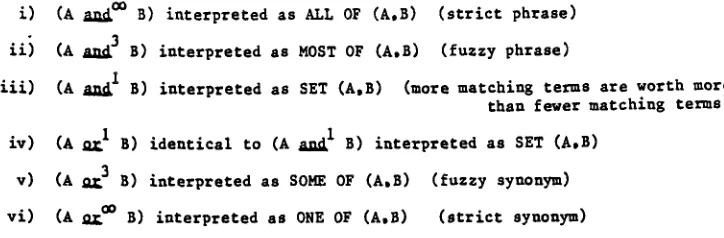
i) (A andco B) i n t e r p r e t e d as ALL OF (A,B) (strict phrase)
iii (A and 3 B) interpreted as MOST OF (A,B) (fuzzy phrase)
iii) (A and I B) interpreted as SET (A,B) (more matching terms are worth more
than fewer matching terms)
iv) (A fl~ I B) identical to (A ~nd I B) interpreted as SET (A,B)
v) (A ~ 3 B) interpreted as SOME OF (A,B) (fuzzy synonym)
vi) (A ~ B) interpreted as ONE OF (A,B) (strict synonym)
3. Experimental Results
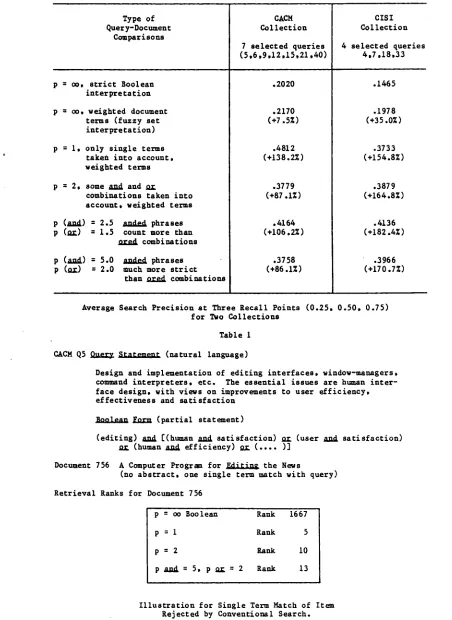
The operations of the extended logic system are illustrated by using a collection of 3204 com- puter s c i e n c e a r t i c l e s ( t i t l e s a n d a b s t r a c t s ) o r i - g i n a l l y p u b l i s h e d i n t h e C ~ u n i c a t i o n s o f t h e ACM ( t h e CACM c o l l e c t i o n ) , a n d a c o l l e c t i o n o f 1460 a r t i c l e s i n l i b r a r y s c i e n c e o b t a i n e d f r o m t h e I n s t i t u t e f o r S c i e n t i f i c I n f o m a t i o n ( t h e C I S I c o l - l e c t i o n ) . T a b l e 1 shows a v e r a g e p e r f o r m a n c e f i g - u r e s f o r 7 s e l e c t e d q u e r i e s u s e d w i t h CACM, a n d 4 s e l e c t e d q u e r i e s f o r C I S I . The p e r f o r m a n c e i n T a b l e 1 i s s t a t e d i n t e r m s o f t h e s e a r c h D r e c l s l o n a t v a r i o u s ~ p o i n t s a v e r a g e d o v e r t h e s e t o f s e a r c h r e q u e s t s i n u s e . [ 1 9 ]
The d a t a o f T a b l e 1 i n d i c a t e t h a t t h e c o n v e n - t i o n a l B o o l e a n s e a r c h e s (p = co, B o o l e a n ) p r o d u c e by f a r t h e w o r s t p e r f o r m a n c e f o r b o t h c o l l e c t i o n s . P e r f o r m a n c e i m p r o v e m e n t s b e t w e e n 100 a n d 200 p e r - c e n t a r e o b t a i n e d by r e l a x i n g t h e i n t e r p r e t a t i o n o f t h e B o o l e a n o p e r a t o r s ( t h a t i s , by u s i n g l o w e r p - v a l u e s ) . A d i s t i n c t i o n m u s t b e made b e t w e e n t a k i n g i n t o a c c o u n t o n l y s i n g l e t e r m m a t c h e s ( p - v a l u e s a r e e q u a l t o 1 ) , a n d g i v i n g e x t r a w e i g h t t o t e r m p h r a s e m a t c h e s (A a n d B .rid . . . ) , and t o synonym s e t m a t c h e s (A o r B o r . . . ) , when p - v a l u e s h i g h e r t h a n 1 m u s t b e u s e d . The r e s u l t s o f T a b l e I show t h a t f o r t h e CACM q u e r i e s t h e b e s t o v e r a l l p o l i c y i s a c o m p l e t e s o f t e n i n g o f t h e B o o l e a n o p e r a t o r s down t o p = 1 . E v i d e n t l y n o t many o f t h e q u a s i - B o o l e a n p h r a s e s i n c l u d e d i n t h e CACM q u e r i e s w e r e a l s o p r e s e n t i n t h e d o c u m e n t a b s t r a c t s . F o r t h e I S I q u e r i e s , o n t h e o t h e r h a n d , 154 p e r c e n t i m p r o v e m e n t i s p r o d u c e d when p = 1 ; when t h e p h r a s e c o m b i n a - t i o n s a r e g i v e n e x t r a w e i g h t , t h e i m p r o v e m e n t i n p e r f o r m a n c e jumps t o 164 p e r c e n t f o r p = 2, a n d t o 182 p e r c e n t when a n d - and o r - o p e r a t o c s a r e g i v e n different values (p and = 2.5 and p o r = 1.5, respectively).
These phenomena are further illustrated in the
output of Tables 2 and 3. The comparison between
query CACM Q5 and Document 756 is outlined in Table
2. No abstract was available for document 756;
hence only the title words could be used in the
query-document comparison. As t h e example shows.
only the term "editing" was present in both docu- ment title and query. This explains why the single term match (p = l) produces the best output rank of
5 for this document. Obviously, the sample docu-
ment is not retrievable by the pure Boolean search (p = co) as demonstrated by the simulated retrieval rank of 1667 out of 3204 CACM documents.
Table 3 shows an example where matching
phrases make a substantial difference in the
retrieval results. The m a t c h e d phrases in Document
1410 are given a double underline in Table 3, whereas matched single terms have a single under-
line. The output of Table 3 shows that when the
s i n g l e t e r m s a l o n e a r e c o n s i d e r e d , d o c u m e n t 1410 i s r e t r i e v e d w i t h a r a n k o f 53 i n r e s p o n s e t o q u e r y I S I Q33. When t h e p h r a s e m a t c h e s a r e g i v e n e x t r a weight (p = 2. or p and = 5, p or = 2), the r e t r i e v a l r a n k i m p r o v e s t o 2 a n d 7 , r e s p e c t i v e l y .
T h e s e r e s u l t s d e m o n s t r a t e t h a t t h e c o n v e n - t i o n a l B o o l e a n l o g i c d o e s n o t a d e q u a t e l y r e f l e c t t h e t e n t a t i v e a n d u n c e r t a i n n a t u r e o f t h e r e l a t i o n s b e t w e e n t e r m s i n t h e l a n g u a g e . When a r e l a x e d
i n t e r p r e t a t i o n o f B o o l e a n l o g i c i s u s e d , t h e correspondence with the fuzzy nature of linguistic relations is much greater and dramatic improvements in t e r m matching and hence retrieval effectiveness are obtained.
4. Relationship of Extended Boolean Model with
Other Retrieval Developments
The extended Boolean system is based on the use of certain term relationships--notably term
phrases and synonymous constructions. These rela-
tions are. however, interpreted flexibly, reflect- ing the uncertain nature of term relations in the
language. Tn the extended system, soft Boolean
queries are easy to formulate, and methods exist for a completely automatic formulation of the soft queries, given only some basic information about
user n e e d s . [20] Analogously, initial queries may
b e automatically reformulated, following an initial search operation, based on information obtained from the user about the relevance of previously retrieved documents. [183
The current development may then be related to other retrieval models that incorporate term rela- tions, and to systems with advanced user inter-
faces. Term relations of a statistical, or proba-
bilistic nature are included in the probabilistic retrieval model; more general linguistic relations are used in systems that include a natural language
analyzer. In t h e probabilistic retrieval system,
the documents are ranked in decreasing order of the probabilistic expression p(x[rel)/P(xlnonrel) where P(x~rel) and P(x[nonrel) represent the occurrence probabilities of an item x in the relevant and non-
[image:3.612.128.490.90.209.2]Type o f Query-Document
C o m p a r i s o n s
p = co, strict Boolean interpretation
p = co, w e i g h t e d document t e r m s (fuzzy s e t
interpretation)
p = 1 , o n l y s i n g l e t e r m s t a k e n i n t o a c c o u n t , w e i g h t e d t e r m s
p = 2 , some and and or
combinations taken into account, weighted terms
CACM C o l l e c t i o n
7 s e l e c t e d q u e r i e s ( 5 , 6 , 9 . 1 2 , 1 5 , 2 1 . 4 0 )
p (and) = 2 . 5 ~nd~d p h r a s e s p ( o r ) = 1 . 5 c o u n t more t h a n
o r e d combinations
p ( ~ ) = 5 . 0
p(or) =2.0
a n d e d p h r a s e s much more s t r i c t
t h a n o r e d c o m b i n a t i o n s
.2020
. 2 1 7 0 ( + 7 . 5 % )
. 4 8 1 2 ( + 1 3 8 . 2 % )
. 3 7 7 9 ( + 8 7 . 1 % )
.4164
( + 1 0 6 . 2 % )
. 3 7 5 8
(+86.1%)
CISI Collection 4 selected queries
4,7o18,33
.1465
. 1 9 7 8 ( + 3 5 . 0 % )
. 3 7 3 3
(+154.8Z)
. 3 8 7 9 ( + 1 6 4 . 8 % )
.4136 (+182.4%)
.3966 (+170.7Z)
A v e r a g e S e a r c h P r e c i s i o n a t T h r e e R e c a l l P o i n t s ( 0 . 2 5 , 0 . 5 0 , 0 . 7 5 ) f o r Two C o l l e c t i o n s
T a b l e 1
CACM Q 5 0 u e r y ~ (natural language)
Design and implementation of editing interfaces, window-managers, command interpreters, etc. The essential issues are human inter- face design, with views on improvements to user efficiency, effectiveness and satisfaction
B o o l e , n Form ( p a r t i a l s t a t e m e n t )
( e d i t i n g ) , n d [(human and s a t i s f a c t i o n ) o r ( u s e r ~nd s a t i s f a c t i o n ) o r (human , n d e f f i c i e n c y ) o r ( . . . . ) ]
Document 756 A Computer Program f o r ~ t h e News
(no a b s t r a c t , one s i n g l e t e r m m a t c h w i t h q u e r y )
Retrieval Ranks for Document 756
p = oo B o o l e a n Rank 1667
p = 1 Rank 5
p = 2 Rank 10
p ~ = 5. p o r = 2 Rank 13
lllustration for Single Term Match of Item Rejected by Conventional Search.
[image:4.612.78.530.88.708.2]ISl Q33 Ouerv ~ (natural language)
Retrieval systems providing the automated transmission of information to the user from a distance
~ g a J l ~ X ~ ( p a r t i a l s t a t e m e n t )
[ ( d i s t a n c e ~ r t r a n s m i s s i o n ) a n d ( r e t r i e v a l ~ i n f o r m a t o n ) ] or (telefacsimile and system) or ...
Document 1410 ~ i n L i b r a r i e ~ (/ single term match)
( / / p h r a s e m a t c h )
The use of ~ l ~ f ~ e ~ m ~ f i ~ to p r o v i d e rapid transfer of
~ has great appeal. Because of a growing interest in the
applicability of this technology to IJJZE£Eig£, a grant was provided to the Institute of LiJZEax~Research to conduct an experiment in
equipment in a working library situation.
The feasibility of ~ f o r interlibrary use was explored.
is provided on the performance, cost, and utility of
~ . L ~ ~ for libraries
R e t r i e v a l Ranks f o r Doc 1410
p = co B o o l e a n Rank 29
p = 1 Rank 53
p = 2 Rank 2
pa.i~ = 5 , pOX. = 2 Rank 7
[image:5.612.220.378.394.477.2]Illustration for Phrase Matching Process Table 3
r e q u i r e d o c c u r r e n c e p r o b a b i l i t i e s o f t h e v a r i o u s d o c u m e n t s d e p e n d o n t h e o c c u r r e n c e p r o b a b i l i t i e s i n t h e r e s p e c t i v e d o c u m e n t s u b s e t s o f t h e i n d i v i d u a l t e r m s x . , x . , ~ , e t c . When t e r m r e l a t i o n s h i p s a r e
x j
t o b e u s e d , t ~ e o c c u r r e n c e p r o b a b i l i t i e s m u s t a l s o b e a v a i l a b l e f o r t e r m p a i r s - - f o r e x a m p l e , P ( x . . I r e l ) , and P ( x . . [ n o n r e l ) ; f o r t e r m t r i p l e s P(x.~J._[rel), P(x..~InX~nrel), and so on, for higher
i K .I .
orde~ term c o m b z ~ i o n s .
Unfortunately, the experiences accumulated
with the probabilistic retrieval model show that enough information is rarely available in practical situations to render possible an accurate estima-
tion of the needed probabilities. In practice, it
then becomes necessary to avoid the use of term dependencies by assuming that all terms occur
independently. The probabilistic model is then
effectively equivalent to a vector processing sys- tem that does not include any term relations. [3]
When l i n g u i s t i c a n a l y s i s m e t h o d s a r e u s e d t o a n a l y z e q u e r y a n d d o c u m e n t c o n t e n t , i t i s i n t h e o r y p o s s i b l e t o p r o v i d e a p r e c i s e r e p r e s e n t a t i o n o f q u e r y and d o c u m e n t c o n t e n t b y i n c l u d i n g a g r e a t v a r i e t y o t t e r m r e l a t i o n s i n t h e s e a r c h a n d
retrieval Operations. In particular, complex
indexing units such as noun and prepositional phrases might then be assigned to the information items for content representation, Unfortunately, a complete treatment of noun phrases by automatic means remains elusive in view of the multiplicity of different term relations that are expressible by
noun and prepositional phrases. An automatic
recognition of semantically equivalent noun phrases of the kind needed for the construction of classif- ication schedules is also exceedingly difficult.
thus of questionable help in general retrieval situations where topic areas and linguistic com- plexities are not severely restricted. The Boolean
model which includes only a general pnrase (den, tea
by the Boolean and) and a general synonym relation
(denote~ by the Boolean ~tE) may not therefore
represent an intolerable simplification when meas- ured against the realistically possible, alterna- tive m e t h o d o l o g i e s .
Considering now the user-system interfaces that have been designed for use in information retrieval, the following types ot development may be distinguished.
a)
The use of minicomputer-based file access-ing methods providing simple access to specific data bases, or to specific file c a t a l o g s . Such s y s t e m s a r e o f t e n m e n u - d r i v e n and o t f e r a c o n v e r s a t i o n a l s t y l e , p e r m i t t i n g t h e u s e r t o c o n s u l t a g i v e n t e r m c l a s s i f i c a t i o n o r t h e s a u r u s , a n d t o b r o w s e t h r o u g h t h e d o c ~ e n t c o r r e s p o n d i n g t o a g i v e n q u e r y f o r m u l a t i o n . [ 4 , 6 J
b)
The c o n s t r u c t i o n o f l a r g e , s o p h i s t i c a t e d s y s t e m s d e s i g n e d t o p r o v i d e u n i f i e d i n t e r - f a c e m e t h o d s t o a v a r i e t y o f d a t a b a s e s implemented on a single retrieval facility, or to data bases available on a multipli-city of different retrieval systems.
[12,13] A connnon command language may
then be provided by the interface system, in addition to tutorial and help provi- sions, o r e v e n d i a g n o s t i c p r o c e d u r e s a b l e t o d e t e c t , and p o s s i b l y t o c o r r e c t q u e s - t i o n a b l e s e a r c h s t r a t e g i e s .
c)
The use of interface methods based on fancygraphic displays that make it possible t o
exhibit vocabulary schedules, command
s e q u e n c e s , and m e s s a g e s t h a t may b e h e l p f u l d u r i n g t h e c o u r s e o f t h e s e a r c h o p e r a t i o n s . [5,103
d)
The simulation ot automatic "searchexperts" that are able to translate arbi- trary queries in natural language by using stored knowledge bases for query analysis
and search purposes, Such automatic
experts may perform the work normally
assigned to human search intermediaries, in the sense that a conversational dialog sys-
tem ascertains user requirements and
chooses search strategies corresponding to particular user needs. [8,9]
In each case the automatic interface system is designed to help the user to access a possibly
unfamiliar retrieval system and to pick a useful
search strategy. The operational retrieval system
that actually performs the searches is normally not
modified by the interface system. The extended
Boolean system described in this note differs from these other developments because the conventional search system is actually modified by replacing a complete Boolean match by a fuzzy query-document
comparison system. Furthermore, the burden placed
on the user during the query construction process is kept as small as possible.
The minicomputer-based facilities and the
fancy graphic di,play systems may be used in con- junction with the extended Boolean processing, since the two types of developments are somewhat
independent of each other, The same is true of the
systems that provide common interfaces to mulriple
data bases. The retrieval expert capable of
interacting with the user in natural language may not he usable in practical situations for some years to come, unless severe restrictions are imposed on the topic areas under consideration, and the freedom of formulating the search requests, An interface system of more limited scope may be more effective under current clrcumstances than the automated ~expert" of the future.
R E F E R ~ C E S
[ I] T.R. Addis, Machine Understanding of Natural Language, I n t . Journal of Man-Machine Stu- dies, Vol. 9, 1977, 207-222.
[ 2] L.M. Bernstein and R.E. Willianson, Testing a
National Language Retrieval System for a
Full-Text Knowledge Base, JASIS, 35:4, July 1984, 235-247.
[ 3] A. Bookstein, Explanation and Generalization of Vector Models in Information Retrieval, Lecture Notes in Computer Science, Vol. 146, Springer-Verlag, Berlin, 1983.
[ 4] E.G. Fayen and M. Cochran, A New User Inter- face for the Dartmouth On-Line Catalog, Proc. 1982 National On-Line Meeting, Learned Infor- mation Inc., Medford, NJ, March 1982, 87-97. [ 5] H.P. Frei and J.F. Jauslin, Graphical Presen-
tation of Information and Services: A User
Oriented Interface, Information Technology: Research and Development, VOlo 2, 1983, 23- 42.
[ 63 C.M. Goldstein and W.H. Ford, The User Cor- dial Interface, On-Line Review, 2:3, 1978, 269-275.
[ 7] R. Grishman and L. Hirschman, Question
Answering from Medical Data Bases, Artificial Intelligence, Vol. 11, 1978, 25-63.
[ 8] G. Guida and C. Tasso, An Expert Intermediary System for Interactive Document Retrieval, Automatics, 19:6, 1983, 759-766.
[ 9] L.R. Harris, Natural Language Data Base
Query, Report TR 77-2, Computer Science
Department, Dartmouth College, Hanover, NH, February 1977.
[i0] G.E. Heidorn, g. Jensen, L.A. Miller, R.J. Byrd and M.S. Chodorow, The Epistle Text Cri- tiquing System, IBM Systems Journal, 21:3, 1982, 305-326.
[ii] W. Lehnert, The Process of Question-
Answering, (Ph.D. Dissertation), Research
[123 R.S. Marcus. An Experimental Comparison of the Effectiveness of Computers and Humans as Search Intermediaries, Journal o f the ASIS, 34:6. 1983. 381-404.
[13] C.T. Meadow, T.T. Hewett and E.g. Aversa. A
Computer Intermediary for Interactive Data
Base Searching. Part I: Design. Part II:
Evaluation. Journal of the ASIS, 33:5, 1982, 325-332 and 33:6. 1982, 357-364.
[14] N. Sager, Computational Linguistics, in
Natural Language in Information Science, D.E. Walker. H. K a r l g r e n and M. Kay, e d i t o r s , FID P u b l i c a t i o n 551. S k r i p t o r , Stockholm, 1977, 75-100.
[15] N. Sager. Sublanguage Grsmmars .in Science Information Processing, Journal of the ASIS,
January-February 1975, 10-16.
[16] G. S a l t o n , C.S. Yang, and C.T. Yu, A Theory of Term Importance i n Automatic Text A n a l y s i s and I n f o r m a t i o n R e t r i e v a l . J o u r n a l of t h e ASIS, 2 6 : 1 , J a n u a r y - F e b r u a r y 1975, 3 3 - 4 4 . [17] G. S a l t o n , E.A. Fox and H° Wu, Extended
Boolean I n f o r m a t i o n R e t r i e v a l , C ~ u n i c a t i o n s of t h e ACM, 26:11, November 1983, 1022-1036. [18] G. S a l t o u , E.A. Fox. and E. Voorhees,
Advanced Feedback Methods i n I n f o r m a t i o n
Retrieval, Technical Heport 83-570, Depart-
ment of Computer S c i e n c e , Cornell University,
I t h a c a , NY. August 1983o
[19] G. Salton and M.J. McGill, Introduction to Modern Information Retrieval. McGraw Hill Book Company. New York. 1983o
[20] G. Salton, C. Buckley and E.A. Fox, Automatic Query Formulations in Information Retrieval. Journal of the ASIS. 34:4. July 1983. 262- 280.
[21] K. Sparck Jones and M. Kay. Linguistics and
Information Science: A Postscript. in
Natural Language in Information Science, D.E.
Walke~, R. Karlgren and M. Kay, editors. FID
Publication 551, Skriptor. Stockholm. 1977, 183-192o
[22] K. Sparck Jones and J.1° Tait. Automatic Search Term Variant Generation. Journal of Documentation, 4 0 : 1 , March 1984, 50-66. [23] C . J . van E i j s b e r g e n , I n f o r m a t i o n R e t r i e v a l ,
Second E d i t i o n . B u t t e r w o r t h s . London. 1979o
[24] D.E. Walker. The Organization and Use of
Information: Contributions of System for a
Full-Text Knowledge Base. JASIS, 35:4, July
1984. 235-247. Information Science. Computa-
tional Linguistics and Artificial Intelli- gence. Journal of the ASIS. 32:5. September 1981, 347-363.