NAmlmAL LANGUAGE INFO~4ATION R E T £ I E V ~ SYST~4 DI.&LOG L. 9o]0, K. Kochut, A. Le§niewski I, T. Strzalkowski 2
Warsaw University Institute of Informatics
PKIN, pok.850 00-901 Warszawa
P O L A N D
~BSTRAe~
Presented paper contains a descrip- tion of an experimental version of the natural language information retrieval system DIALOG. The system is destined for the use in the field of medicine. Its main purpose is to ensure access to information to phlsiclans in a conver- sational manner. The use of the system does not require ability of programming from its user.
I.. Introduction
The paper presents the state of elaboration of the natural language in- formation retrieval system DIALOG. Its aim is an automatic, conversational ex- traction of facts from a given text. Actually it is real medical text on gastroenterology, which was prepared by a team of specialists. The system has a modular structure.
The first, and in fact very import- ant module is the language analysis mod- ule. Its task is to ensure the transi- tion of a medical text from its natural form, i.e. rentences formed by phys- icians, into a formal ~ogical notation. This logical notation, i.e. logical for- mulae, is rather universal and can be easy adapted to various deductive and knowledge representation methods. The program of the analyser was written with the use of the CATN /Cascaded ATN/ tech- nlque, where the syntactic and semantic components constitute separate cascades.
In the deduction and knowledge rep- resentation module the weak second order language was used. The works by E.Konrad /Konrad 76/ and N.Klein /Klein 78/ from the Technical University in Berlin were
I Presently:
Universitat Stuttgart, Institute fur Informatlc, Herdeweg 5 1 R a u m 4, Postfach 560.7000 Stuttgart, FRG 2 Presently: °
Simon Fraser University, Dept. of Computing Sci., Burnaby, B.C. Canada
the starting ~oint in the e!abor~tion of this module.
Presented version of the system was implemented on the IBM 370 computer /~.I 370 operating system/.
2. Transformation of natural language sentences into logical formulae The user of the DIALOG system intro- ducing his utterance into the system comes into direct contact with the natu- ral language analysis module. This mod- ule plays the key role in the machine natural lang1~age communication process. Similarly as in many other information systems of this type, e.g. L[fMAR /Woods 72/, PLANES /Yaltz 76/, SO~FIF, /~urton 76/, RENDEZ-VOUS /Codd 78/, PLIDIS
/Berry-Rogghe 78/, OIALOGIC /Grosz e t a ] . 82/, the purpose of the module is to transform a text in the natural language into a chosen formal representation. Suc~ Such a representationmust meet a number of requirements. Firstly, it must be "intelligible" to the internal parts of the system, i.e. the deductive comoonent and/or managing the data base. Secondly, it must carry in a formal, and clear man- er the sense and meaning of utterances in natural language. Finally, the repre- sentation should allow for a reproduc- tion of the original input sentence with the aim of generating intermediate para- phrases and/or answers for the user.
In the parser of the DIALOC, system, we attempted on the gratest, in our opinion, achievements in the field of natural language processing. The follow- ing works had the greatest influence on the final form of the module: /Berry- -Rogghe 78/, /Bates 78/, /Carbonell 81/, /Cercone 80/, /Chomsky 65/, /Ferrari 80/, /Fillmore 68/, /Gershman 79/, /Grosz 82/, /Lnndsbergen 81/, /Marcus 80/, /Martin 81/, /Moore 81/, /Robinson 82/, /Rosenschein 82/, /Schank 78/, /Steinacker 82/, /Waltz 78/, /Wi]ensky 80/, /Woods 72/ and /Woods 80/. We have transferred, with greater or less suc- cess, the most valuable achievements presented in these works, pertaining
mainly to the English language process- ing, into our system, using them in the treatment of the Polish language. We attempted thus, to preserve a certain distance with regard to the language it- self, as well as the subject of conver- sation with the computer, so that the adapted solutions were of a broader character and through that became com- parable with the state of research in that field in other countries.
2 . 1 . T h e role, wlace and structure of the language analysis module The purpose of the language analy- sis module in the DIALOG system is tran- sformation of the user's utterance /in Polish/ into the I order logic formulae. Other formal notations such as II order logic formulae, FUZZY formulae, M i n s k y frames and even the introduction of intensional logic elements are also con- sidered. At present, ~e will concentrate on the process of transforming a natural sentence into a I order logic formula.
The system is equipped with two independent modules: deduction and data base management. The data for these mod- ules are the formulae generated by the parser. We will present only one module working on the basis of the we~( second order logic.
The parsing system consists of the two closely cooperating parts: a syntac- tic analyser and a sem(nntlc interpreter. The whole was programmed with the aid o~ a mechanism called CATN /Cascaded ATN/ /Woods 80/, /Bolc, Strzalkowskl 82a,82b/ /Kochut 83/, where the syntactic compo- nent plays the role of the "upper", i.e.
the dominating "cascade". For the syn- tactic analyser produces a structure of the sentence grammatical analysis, which in turn undergoes a semantical verifica- tion. In case, where the semantic inter- preter is not able to give the meaning of the sentence, the syntactic component is activated again with the aim of pre- senting another grammatical analysis. If such an analysis cannot be found, the input sentence is treated as incorrect. 2.2. The syntactic analyser
The syntactic component of the par- ser produces a gra~natical analysis of the input sentence in Polish. This was possible due to a skillful programming of rules governing the morphology and syntax of the language. Although, the whole system was oriented towards a de- fined type of texts /medical/, the ac- cepted solutions make it a much more universal tool. We do not claim that the
syntactic analyser in its present fol-m is able to solve all or the majority of problems of the Polish language syntax. It includes, however, rather wide subset of the colloquial language, enriched by constructions characteristic for medical texts.
A natural language sentence intro- duced into the parser undergoes firstly a pretreatment in a so called spelling correcter. If all the words used in the sentence are listed in the system vocabu- lary then the sentence is passed for syn- tactic analysis. Otherwise the system a t t e m p t s to state whether the speaker
made a spelling error, giving him a chance to correct the error and even suggesting the proper word, or whether 11e used a word unknown to the system. In the last case, the user has a possibility of introducing the questioned word into the vocabulary but in practice it may turn out to be too troublesome for him. Usual- ly then, the user is given a chance of withdrawing the unfortunate utterance or formulating it in a different way.
The proper syntactic analysis begins at the moment of activating the first "cascade" of the parser. It consists of five ATN nets, with the aid of which the grammar of the subset of the Polish lan- guage has been written. The two largest nets SENTENCE /sentences/ and N0[~-P_RR /nominal groups/ play a superiorrole in relation to others: ADH-PT~A /adiective groups/~ ADV-PT~A /adverb groups2 and Q-EXPR /question phrases/. The process of syntactic analysis is usually quite com- plex and uses essentially the non-deter- ministic character of orocessing in ATN. It Is justified by the-specific nature of the Polish language, which is charac- gerised by a developed i n ~ e c t i o n and a Sentence free word order.
The result of the syntactic analysis is a grammatical analysis of the input sentence in the form of a so called o-form. It is a nonflexional form of a sentence, ordered according to a fixed key. The construction of the o-form can be expressed ba the structure:
< o - f o r m ~ : :=
(S (questiqns) i (negation~ I (modalitie~ l(predlcate/verb)l (vague~ I (subject)
!
~direct objectS_| (indirect object> I ~(pre~. phrase)I}"(CAUSE/RES[~(o-forn~]
END)
The s t i c k mark "|,, is usually used as a symbol of the meta-language. Here it is used as a symbol of the defined language. Symbols S and END comnrise a single clause. A clause expresses every elemen- tary activity or event expressed in the
input sentence. Often, the o-form has a richer structure than a classical analysis tree. The elements of the o-form called ~ s u b j e c t ~ , ( d i r e c t ob- J e c t ~ , (indirect objectS, and ~adJect- ive phrase) can also be expressed or modified with the use of clauses. The
stick marks "I" separate the parts of the o-form and are its constatnt ele- ments. Then transformed nuestion is
subjected to semantic interpretation. The syntactic analyser manages the vocabulary, where infle×ional forms of words are kept. The vocabulary defini- tion specifies the syntactic categories, to which given words belong. It also describes forms of words with the aid of lexlcalparameters: case, number, person and gender. These parameters are of gret value in examining the grammatical con- struction of sentences.
2.3.
The semantic interpreterWhen the syntactic analysis is suc- cessfully completed the o-form of the input dentence is forwarded for the sem- antic interpretation. The syntactic "cascade" is suspended, i.e. removed from the operational field, leaving place for the semantic "cascade". The configuration of the removed "cascade" is remembered thus, in case of necessity of generating an alternative grammatical analysis.
The semantic interpreter consists of the two main parts: a constant con- trolling part, working on the basis of a very general pattern adjustment, and compatible experts algorithms, where the knowledge of the system in the field of conversation has been coded. The pro- cess of interpretation is assisted by a special vocabulary of semantic rules and on additional vocabulary complement- ing the expert knowledge.
The sentence in the o-form is for- warded directly to the controlling part of the interpreter, where such its par- ameters as time, negation, aspect .... are evaluated first. Then the central predicative element of the sentence "calls for" a proper semantic rule, which from then will guide the interpre- tation process. The rule has a form of ~ pattern-concept pair /Wilensky 80/
Gershman 79/, /Carbonell 81/, where ~he pattern reflects the scheme of an ele- mentary event, wheras the concept indi- cates how its meaning should be express- ed through formulae. The semantic rule is activated for the time of interpre- tation of a single clause. If the pat tern is adjusted to the cl~use, an
atomic formula is generated, expressing the meaning of the clause. The meaning of the whole sentence is expressed as a logical combination of meanings of all the o-form clauses. The semantic rules bring different /on the surface/ descrip- tions of the same phenomenon into a com- mon interpretation.
The.general structure of formulae generated by the interpreter is ex- pressed by an implication:
41^~2^ . . . ^ ~ n - ~
"where ~ has been introduced from a sem- antic rule a n d ~ i come from the system knowledge - special compatible parts of the interpreter called the experts. Individual o-form phrases, in the con- text of the dialogue subject, are inter- preted in experts.
In our system, designed for conver- sation with a phlsician, we have experts for names of sicknesses /SICKNESS/, names of ~rgaus /ORGAN/, internal sub-
stances /oUBSTANCE/, therapies /TREAT- ~ N T / , medicaments /MEDICAmeNT/ and names of animate objects /ANIMATE/ and the remaining objects foreign to the
body /PHYSOBJ/. Experts are activated on the request of a proper semantic rule. The controlling part of the inter~eter "instructs" the expert/s/ chosen by the pattern to interpret a notion or expres- sion. The indicated expert can solve the problem on its o~m or seek for the help of other experts. Often, one complex ex- pression has to be gualified by two or three exprrts.
All the experts, as well as the controlling part of the interpreter /FOR~UJLA, CASES and QWORDS nets/ have been recoreded in ATN formalism and form a lower "cascade" of the parser.
The interpreter is also egulpped with a mechanism of context pronominal reference solution.
2.4. Examples of transformation of a m e d i c a l t e x t into logical formulae We will present two examples of transformation of medical sentences into I order logic formulae. Before that, a few words on the adopted convention of formula notation. The symbols IMPLSYM and KONJSYM are logical operators /implication/ a n d S / c o n j u n c t i o n / re- spectively. Integer placed directly after the symbol KONJSYN indicates the number of conjlmction factors. Names of predicates are preceded by symbols '~" 7hash mark/, and an integer placed right to the name defines the number of predi-
cate arguments. The arguments specify their type /sort/, name of the variable and constant /if there is one/.
Example
1
Sentence :
Alkehol powoduje r6wnie~ wzrost napi~- cia m i ~ n i 6 w k i dwunastnlcy.
/Alcohol also causes the rise of the tenlcity of the duodenum muscular coat/
o-form:
(s
DC~I I I I
~O:'IODOWAC I RO~VWIEZ I
A~KOHOLI
s! II I
WZR0STI I I
NAPIECIE MODIFIERS NIESNIOWFA DWU~fASTNICA~I ~ END J I I END)
formula:
(If.TPLSYM
(KONJSYM 3 ((~tBADf.TE,
DIC 1) (r.~OlO X44))
((I~I~EDICIC.,'E,
NT 2) (P.~DIO X44) (f.S~A~TE
X45
ALJ<OT-TOL
))
(IMLSYM
( K O N J ~
+(~','~YDZ-NARZA~
I)
(ORGAN X+9))
((~0RGAN 2) (ORGAN X+9) (0NINE
X50
D W U N A S T N I O A B((~PART-OF-ORGAN 3) (BODY X48)
(PNAME X51 NIESNIOWKA) [ORGAN X49 ))
((# SICKNESS 4)(SIeIC X47)
(STYPE X52 FIZJ) (SNAME X53 NAPIECIE) (BODY X48)))
((SRISE 2) (SYI,TPTON X46} (SYI.FPTON X47)
((~IMPLY 3)(INFER X43)(P-~EDIC
X4:4J
)}J
(SIOKNESS X46)))
Example 2 Sentence :
Czy alkohol mo~e by6 przyczyn~ 0ZT? /Can alcohol be the cause of acute
pancreatitis ?/ o- form:
(S CZY II N0C I I BYO II AI:KOHOL I PRZYCZYNA ~'ODIFIERS 0STR. ZAPALENIE TRZUSTKA I II END)
formula: (NIL
(T~T,SYM
(KONJSIq,~ 6[(aVAGI~ 2)
~CTION
X69)(VAG XTO M00))
((UBADfTDIO I) (MEDIC X71)) ((~MEDICAHENT 2) ~.[EDIC X71)(~A~[E X72 ALKOHOL)) ((~ORGAN 2) (ORGAN X74)
(ONm+~, X75 TRZUSTKA))
((~'~DZ-NARZAD I; (ORGAN XV4)
[~SIC]~fESS 4)(SICK X73) (STYPEX76 PATO) ( S N A ~ X77 OZT) {BODY X76 )))
[(:~IMPLY 3) (INFER X69) (ETIO X71)
(STOKNESS
x73))))
. The deduction and knowledge repre- sentation module
The deduction module is a separate part of the whole DIALOG system. Its maiz purpose is to collect and represent the knowledge gained by the system and also the ability to use the possessed infor- mation in accordance with the wishes of the user of the system.
Our work on the achievement of the objectives indicated above was based on the experiences pre~ented by E.Konrad and N.Klein /Konrad 76/, /Klein 78/ from Technical University in West Berlin.
In the previous chapter we present- ed how the text, written in Polish, is transformed into I order logic formulae. This, of course, implies the way of rep- resentation of the knowledge presented in the natural language.
3.1. Knowledge representation
The information included in the logical formulae coming from the lan- guage module has to be stored for later use. The logical formulae are then in- troduced into the data base. The data base, adequately filled with the men- tioned formulae, constitutes the knowl- edge represenlation carried through the natural language sentences. It is as equivalent to the text as the I order logic allows to convey the meaning of th~ natural language sentences.
Data Base
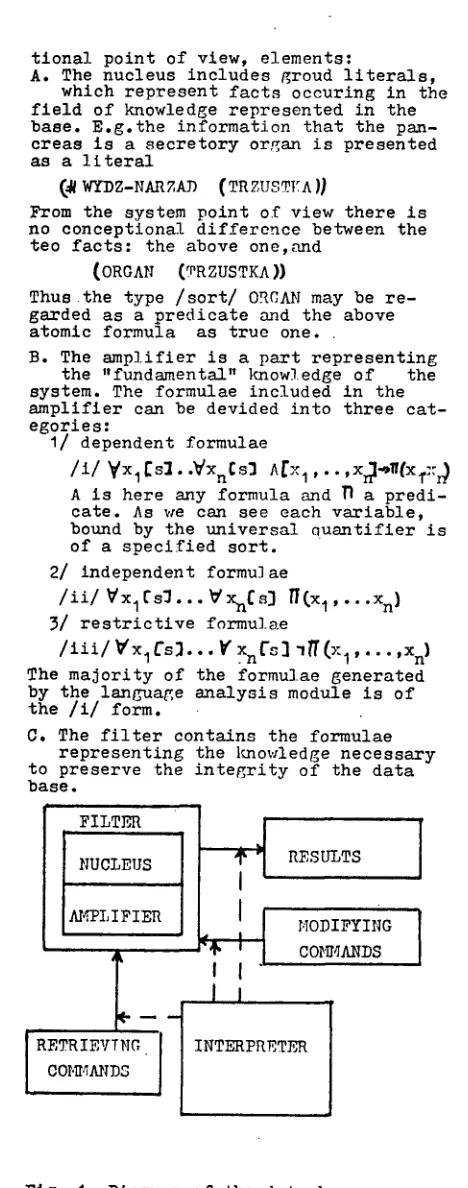
The date base consists of three sep- arate parts: a nucleus, ~ amplifier and a filter /Konrad 76/. Each of the parts includes a different , from the concep-
199
tional point of view, elements:
A. The nucleus includes groud literals, which represent facts occuring in the field of knowledge represented in the base. E.g.the information that the pan- creas is a secretory organ is presented as a literal
(~ WYDZ-NARZAD (TRZUSTtfA)~
From the system point of view there is no conceptional difference between the
tee facts: the above one,and (ORGAN ([nRZUSTKA))
Thus the type /sort/ ORGAN may be re- garded as a predicate and the above atomic formula as true one.
B. The amplifier is a part representing the "fundamental" knowledge of the system. The formulae included in the amplifier can be devided into three cat- egories:
I/ dependent formulae
/i/Vx~ ~s~..VXnCS~ A~x~,..
,x~,Ixf=~
A is here any formula and n a predi- cate. As we can see each variable, bound by the universal ~uantifier is of a specified sort.
2/ independent formulae
/ii/ ~ X l r S S . . . ~ X n ( S ] ~(Xl,...Xn) 3/ restrictive formulae
/ i i i / V x
1Cs]... ~ XngS] l ~ ( x l , . . . , x n)
The majority of the formulae generated by the language analysis module is of the /i/ form.C. The filter contains the formulae representing the Imowledge necessary to preserve the integrity of the data base.
FILTER NUCLEUS
AMPLIFIER
RESULTS I
. ~ . MODIFYING I C O ~ A N D S
I I
l i
INTERPRETER
Fig. I. Diagram of the data base system /Konrad 76/
Recapitulating, the nucleus repre- sents the extensional part of the know- ledge represented in the data base. It is the fundamental knowledge which can- not be obtained from the amalysis of the presented text, and which is assential to proper deduction. The amplifier represents the intensional part of the data base. The knowledge represented there is a co31ection of statements used for deduction.
Each of the logical formulae is kept in a certain internal form, corre- sponding to the way of deduction, de- scribed later on. As we have already mentioned, the majority of formulae is of the /i/ form. Every such formula is converted, at the moment of inserting into the data base, to a pair of the following form:
( ~ c o n c l u s i o n ~ p r e m i s e s testing procedure) 3.2. The knowled6e extraction
Because of the menner of storing the knowledge described in the point 3.1, the answer to the question presented to the system does not have to be represent- ed explicite in the data base. The de- duction module should be able to obtain all the information included in the data base.
The questions presented to the sys- tem are also converted to the logical formulae. Thus, the extraction of knowl- edge is reduced to the verification of a given formula towards the present con- tent of the data base.
The logical formula representing the question is converted to an appro- priate LISP form. Evaluation of such a form is equivalent to examination whether the represented by it formula is
true. This form correspond to the normal form of the logical formula /LISP func- tion AND, OR and NOT are used/. The literals are tested by a TESTE function according to the following algorithm: I. Check the amplifier, trying to find
the rule with the conclusion unifi- able with the literal under proof. If such a formula does not exist that there is no proof of a given literal;
2. If there is such a formula then: a. if it is indicated as an indepen-
d e n t formula then STOP with a proof b. if it is indicated as a restrictive
formula then STOP without a proof~ c. otherwise evaluate the form asso-
ciated with the conclusion; if we obtain NIT, /false in LISP/ then search the amplifier for another rule and go to 2. If we obtain value different than NIL then STOP
200
[image:5.612.70.304.68.662.2]with a proof.
O t h e r w i s e Stop w i t h o u t a nroof. It is therefore a so called backward d e d u c t i o n zystem. The nroof goes b a c k from the formula - aim ~ to the facts, applying the formulae from the amplifier in the "Backward" direction.
The answer can be YES or NO or it can be a list of constants d e p e n d i n g on the kind of question.
The I order logic has been enriched h e r e w i t h some elements of the II order language. P r e d i c a t e variables, quantifi-
cation of these v a r i a v l e s and r e t r i e v a l of predicates as well as constants have been introduced.
3.3. Access to the data base
The system c o m m u n i c a t e s w i t h the data base through commands of the spe- cially designed language. These commands enable introduction and erasing from the d a t a base.
The basic commands serving the pur- pose of knowledge extraction are TEST and FIND:
a. TEST A
- looking for the proof of a formula A. Answer YES/NO.
b. FIND ~ 1 " " 1 1 ' m X ~ x l " ' x n ) ~r~1"';x1" '~ ~ i - predicate v a r i a b l e s
- retrieval of all the pairs: m-tuple predicates and n-tuple oe constants which satisfy a given formula A. 3.4. Example
The f o r m u l a presented in the example I and a formula b e l o w have been introduced into the amlifier.
Sentence:
Wzrost n a p i @ c i a mi~dni6wki d ~ m n a s t n i c y mo~e by4 p r z y c z y n ~ OZT.
/The rise of the tonicity of the duodenum m u s c u l a r coat m a y be the reason of acute pancreatitis/ Formula:
(IMPLSYM
(VAC x84
~oc))
~ , ~ L S ~
D W ~ A S T N I O A ~
,((~ART-OF-OROAN ~)(~Y
xe~)
XgO r IESHIO A)
(ORC N X88))
L@szcm~;ss 4) (szc~ × s 6 ) ( S ~ E X91
FIZJ) (S~A~, X92
~APIECIE) [~0~[ ~S7)))
(@ OROAN
2]
(ORGAN X94) (O~Tm~ X95
TRZUS~KA);
[(#
~:~/DZ-NARZAD I) (ORGAN X94)
((~
SICKNESS 4) (SICK X95) (STYPE X96
PATO) (SNA~:E X97 OZT)(BODY X94)))
((II~$PLY 3)(INFER X85] ~TIO X85)
(SIC~<~TESS X95)))
F o r m u l a c o r r e s p o n d i n g to the question is p r e s e n t e d in the E x a m p l e 2. The ampli-
fier contains the formula d e s c r i b i n g t r a n s i t i v i t y of the predicate I ~ L Y .
Facts - ground l i t e r a l s - w e r e introduced into the nucleus. E.g.
( ( ~ B A D ~ D I O
(ALI(O~OL)) ,
(WV~DZ-NARZAD (DWUNASTNICA)), etc. After converting the formulae of theorem~ and question into the LISP form its evaluation Will find the a n s w e r to the question. The answer is of course YES. 4. C o n c l u s i o n
The results obtained during the w o r k on the system confirmed our direc- tion of research. Our further w o r k will concentrate on constant i m p r o v e m e n t of the existing modules. At the sere time we will u n d e r t a k e attempts of e n r i c h i n g the system w i t h better deductive m o d u l e s such as r e s o l u t i o n in modal logic, default r e a s o n i n g /Relter/, F U Z Z Y and M i n s k y frames.
ACKNO~WLEDGEMENTS
The m e d i c a l text was prepared by a team of p h y s i c i a n s from the Post- graduate E d u c a t i o n Center in W a r s a w under the l e a d e r s h i p of Prof. Dr
J.Doroszewski. Prof. D o r o s z e w s k l and his associates have been giving us constant assistance in the i n t e r p r e t a t i o n of the medical knowledge included in the pre- sented text. Due to their creative and active cooperation we were able to u n d e r t a k e the elaboration of the de- s c r i b e d system. We would like to express
our cordial g r a t i t u d e to Prof. D o r o s z e w - ski and the whole team of doctors.
5. References
Bates, M., The Theory and Practice of Augmented transition Network Grammars in L.Bolc /ed/ Natural Language Com- munication with Computers
Berry-Rogghe, G.L., Wulz, U., An Over- view of PLIDIS a Problem Solving In- formation System with German as Query Language, in L.Bolc /ed/ Natural Lan- guage Question-Answering Systems Bolc, L., /ed/ Natural Language Communi-
cation with Computers, I, ecture Notes in Computer Science, Vol 63, Springer -Verlag 1978
Bolc, L. /ed/ Natural Language Based Computer Systems, Hanser Verlag and MacMillan Press, London 1980
Bolc, L. /ed/ Natural LanEuage Question -Answering Systems, Hanser-Verlag and MacMillan Press, London 1980
Bolc, L. /ed/ Representation and Proces- sing of Natural Language, Hanser-Ver- lag and MacMillan Press, London 1980 Bolc, L., StrzaZkowski, T. Transforma-
tion of Natural Language into Logical Formulas, Proceedings of the 9Th International Conf. on Comp. Ling. 1982, North ffolland Pub. Comp., 1982 Bolc, L., StrzaZkowskl, T.. Natural Lan-
guage Interface to the Question-Answe- ring System for Physicians, 2nd Inter- national Conf. on AI and Information Control Systems of Robots, Conference Proceedings, 1982
Bolc, L., StrzaZkowski, T., The Automa- tic Transformation of Medical Text to a Deductive Data Base, to apDear Bolc, L. /ed/ The Design of Interpreters
Compilers, and Editors for Augmented Transition Networks, Springer-Verlag, Berlin, Heidelberg, New York, Tokyo,
1983
Codd, F.c., Arnold, R.S., Cadiou, J-M., Chang, C.L., Roussopoulos, N., RENDEZ -VOUS version 1. ~m Experimental English L~nguage euery Formulation System for Casual Users of Relational Data Base, RJ 2144, IBM Research Lab. San Jose 1978
Burton, R., ~rovm, J.S., Semantic Cram- mars: A Technique of constructing Natural Language Interfaces to Indus-
trial Systems, BBN Report No. 5587, Cambridge Ma 1977
Carbonell, J.G., Multi-Strategy Parsing, Dept. of Comp. Scl., Cornegie-Mellon Univ., Pittsburgh Pa, 1981
Chang, C.I., Lee, F.C., Symbolic Logic and Mechanical Theorem Proving, Academic Press, 1973
Dahl, V., Translating Spanish into Logic Through Logic, American Jrnl. of Comp. Linguistics, vol 7., no 3, 1981
Gershman, A.V., Knowledge-Based Parsing, Research Report 156, Yale [~iverslty, Dept. of Comp. Sci., 1979
Gro~z, B., Haas, N., Hendrix, G., T{obbs, J., Martin, P., Moore, R., Robinson, J., Rosenschein, S., DIALOGIC: A Core Natural Language Processing System, Proceedings of the 9th Int. Conf. on Compo Ling. COLLING'82, North Holland,
1982
Klein, N., Implementierung eines Frage- -Antwort-Systems aufder Basis der Predikatenlogik II stufe, Technical Univ. Berlin, 1978
Kochut, K., Towards the Elastic ATN Implementation, in L.Bolc /ed/ The Design of Interpreters, Compilers, and Editors for Augmented Transition Networks, Springer-Verlag, Berlin, Heidelberg, New York, Tokyo, 1983 Konrad, E., Formale Semantic yon
Datenbenksprachen, T[~, Berlin, 1976 Landsbergen, J., Adaptation of Montague
Grammar to the Requirements of Parsing, reprint from MC Tract 136, Formal Methods in the Study of Language, J.A.G Groendijk, T.M.V. Jassen, M.B.J.
Stokhof /ads/ 1981
Marcus, M.M., ATheory of Syntactic Recognition for Natural Language, The MIT Press, Cambridge Ma, 1980
Martin,W.A., Church, K.N., Patil, R.S., Preliminary Analysis of a Breadth- First Parsing Method, MIT Laboratory Comp. Scl., 1981
Moore, R.C., Problems in Logical Form, Proc. of the 19th Annual Meeting of the ACL, Stanford, California, 1981 Nilsson, N.J., Principles of Artificial
Intelligence, Springer-Verlag, Berlin, IIeide]berg, New York, 1982
Rosenschein, S.J., Shieber, S.M.,
Translating English into Logical Form, Proc. of the 20th Ann. Meetiag of the ACL, Toronto, 1982
Waltz, D.L., Finin, T.N., Dreen, F., Conrad, E., Coodman, B., Hadden, G., The PLANES System: Natural Language Access to a Large Data Base, Techn. Rap. T-34, Coordinated Sci. Lab., University of Illinois, 1976
Wilensky, R., Arens, Y., PTmAN - A Knowl- edge-Based Approach to Natural Languag~ Analysis, Dept. of Comp. Sci., Univ. of California, Berkeley, 1980
Woods, W.A., Transition Network Grammars for Natural Language Analysis,
CACM, No 13, 1979, 5~)I-606
Woods, W.A., Kaplan, R.M., Nash-Webber, B., The LUN#~R Science Natural Lan- guage Information System: Final Report BBN Report No 2378, Bolt Beranek and Newman Inc., Cambridge r~a., 1972 Woods, W.A., Cascaded ATN Grammars,
American Jrnl. of Comp. Ling., vol 6 No I, 1980
203