promoting access to White Rose research papers
Universities of Leeds, Sheffield and York
http://eprints.whiterose.ac.uk/
This is an author produced version of a paper published in The New Review of Information Behaviour Research.
White Rose Research Online URL for this paper: http://eprints.whiterose.ac.uk/3791/
Published paper
Petrelli, D., Beaulieu, M., Sanderson, M. and Hansen, P. (2002) User
This is a preprint of an article published in The New Review of Information Behaviour Research – Studies of information seeking in context - Vol. 3 - 2002
User Requirement Elicitation for
Cross-Language Information Retrieval
Daniela Petrelli* Preben Hansen^ Micheline Beaulieu* Mark Sanderson*
* University of Sheffield Department of Information Studies
Regent Court – 211 Portobello Street – S1 4DP Sheffield – UK d.petrelli,m.beaulieu,[email protected]
^SICS – Swedish Institute of Computer Science Box 1263
SE-164 29 Kista - Sweden preben@sics.
Abstract
Who are the users of a cross-language retrieval system? Under what circumstances do they need to perform such multi-language searches? How will the task and the context of use affect successful interaction with the system? Answers to these questions were explored in a user study performed as part of the design stages of Clarity, a EU founded project on cross-language information retrieval. The findings resulted in a rethink of the planned user interface and a consequent expansion of the set of services offered. This paper reports on the methodology and techniques used for the elicitation of user requirements as well as how these were in turn transformed into new design solutions.
1. INTRODUCTION
documents written in one language using a query written in another. Those requiring CLIR services are varied: two common groups are users wishing to obtain a subset of documents to be manually translated; and bilingual users who wish to search for documents in all languages they know but all from a single query. Cross language searching is achieved through automatic translation of the query, or the document collection, or both. Despite the relatively poor accuracy of machine translation, CLIR can, with the right resources, retrieve almost as well as a monolingual system (1).
Whilst most research has been concerned with the retrieval effectiveness of cross-language systems through the application of established IR test collection approaches, (e.g. TREC and CLEF (2)), few studies have addressed user or interface issues related to retrieval in a multilingual environment (3). As Wang and Oard (4) point out, translation may be thought as a user interface challenge, where the user should be provided with the support to perform interactive CLIR related tasks. This support should be integrated into the user interface at important stages in the searching process e.g. collection overviews, query formulation, reformulation, relevance judgement or document selection, etc.
argued that users’ work tasks and goals also need to be taken into account and understood in the context of information seeking and retrieval (10,11).
The design of a CLIR system presents a specific challenge regarding how best to handle the multiple language and translation elements in terms of the system capability as well as presentational requirements for the user. Collecting and specifying requirements is a crucial task in CLIR system design. As for other complex systems, poor or inadequate requirements specification generally results in interaction difficulties, including lack of facilities and usability problems (12).
Requirements can be considered from a system perspective (13,14), that is to define the goals that the system has to fulfill and formally describe how these goals will be achieved, or from a user perspective (12,15,16,17), that is focusing on psychological and social aspects of the user and the context of use. The purpose is to provide designers with some understanding of users’ needs and behaviours. The focus is on interface layout and the functional presentation of the system to the user. One of the main goals with understanding the interaction between user and system and designing user interfaces is thus to overcome the mismatch between the user’s goals when using the system, and the physical system mechanisms (18 p.38). Therefore the user needs assessment process for the development of a CLIR system must start with the identification of the users and the tasks that they will seek to accomplish (19).
was important for Clarity to study cross-lingual information search tasks in real environments with real users.
A general overview of the user-centred design approach adopted in this study is given in Section 2. Sections 3, 4 and 5 describe the field study, data analysis and the user requirements derived from them. The implications of the results of the field study and their impact on the interface design are then discussed in Section 6, followed in 7 by conclusions and future work.
A USER-CENTRED DESIGN FOR Clarity
2.1. User-Centred System Design Framework
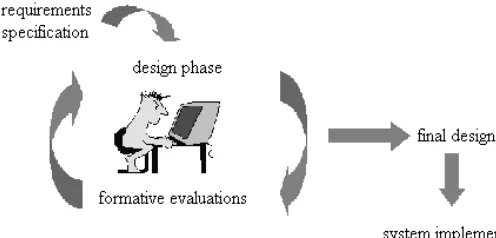
[image:5.595.166.414.559.678.2]To be effective an information system has to be faithful to a real context and in keeping with the use the end-users will make of it. Designing with a user-centred approach (fig.1) requires that the user be involved from the very beginning. It is important to integrate users expertise and knowledge and to understand the reality: what are people doing, how, when, and why. There are varied sets of techniques that may be applied for this purpose (16,17).
Figure 1. User-Centred System Design
Promising solutions can then be tested with users. This formative evaluation verifies choices and indicates design revisions.
The design cycle ends when a satisfying solution is reached and implemented. The prototype generated at this stage should be close to the final system and is tested in a summative evaluation to detect any minor problems.
The work reported in this paper focuses on the first part of the user-centred design cycle as illustrated in Figure 1. The following steps were applied:
1. Preliminary Requirements Specification: an informal initial definition of users’ needs was gathered via a discussion with end-users’ representatives; 2. Scenarios and Preliminary Design Phase: on the basis of what emerged in
the informal discussion above, two proposed scenarios were written, representing the designers’ view of possible users, their tasks and their interaction with the proposed system;
3. Formative Evaluation: the proposed scenarios were then used to design a proposed user interface; mock-ups were drawn to address the different steps
of an information seeking behaviour and these were submitted to users’ judgement when the detailed user field study took place;
5. Main Design Phase: the integration and combination of the results of the previous step led to a revision of the first mock-ups and a new solution was reached based on the knowledge acquired.
The form and use of the proposed scenarios (point 2 above) is worth a brief discussion. As stated by Carroll (20), a scenario is a story describing a person with specific characteristics and motivations who performs a specific task by interacting with a specific system. The proposed scenarios (fig.2 shows an excerpt) were used in Clarity as a tool to stimulate discussion on what was feasible or not. Indeed the right column reports the interface designer’s questions (to be discussed with the technical colleagues) on what the system should offer to users in term of both system’s capabilities and interface features.
Joannes Scenario
Joannes is a journalist. He is from Finland. He is fluent in English Any other relevant skill?
and French, but does not speak any Italian at all.
He has to write an article about the follow-up actions taken by the The task requires to find
Italian government after the disorder in Genoa during last G8 information on a single topic;
meeting. He is interested in the political discussion that also only the most important ones
followed those facts. Images are important too. matter.
He does not have a precise idea of what happened after. He heard rumours about public inquiry and parliament clarification done by the government after the Left asked for explanation.
He sits at his computer and uses his usual browser to connect to Clarity has to be multi-browser
CLARITY site. He is asked for login and password. e.g.. Netscape and Explorer
He enters his domain, customised respect to his profile. Here the Is customisation important?
history of past searches is kept.
The screen for new search is displayed as default. Joannes types Should Clarity translated proper
in few words: Genoa G8 disorder political discussion names e.g. Genoa – Genova ?
Given his information need, his search will be more effective if Italian newspapers are searched. Nevertheless other international agencies may have reported about it already. So he sets the language to “search in” to Italian, but did not excluded other languages (“only” tick box left blank).
Figure 2 An excerpt of a proposed scenario.
The following sections elaborate on the main issues that arose in the design process relating to steps 3 to 5.
2.2. Proposed layout for the Clarity User Interface
One of the first steps in designing a new system in a user-centred way is to involve users and sketch the interface. In this way it is possible to envisage the relative importance of the system features and functionalities, their role and transparency with respect to use and usability. The initial Clarity interface layout sketches were based on proposed or assumed scenarios (point 2 above).
The six mock-ups described below correspond to individual panes, representing different stages of the searching process of a possible user-CLIR interaction. No attempt was made at this stage to relate the panes to overall screen layouts.
• The system set-up pane allows the user to set a Clarity working profile: the
language (only one) used in the query; the language(s) of the documents to be retrieved; the collection(s) as well as the type of data (i.e. text, images, video, etc.), and other attributes.
• In cross-language information retrieval, one of the basic assumptions is that
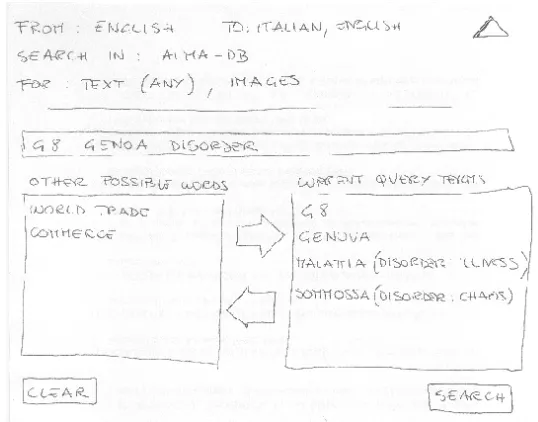
the user will type in the query in his/her own language; then it is translated by the system in the document language(s). A query formulation and translation pane (fig. 2) allows for typing in and for the user to have full control of the
system’s translation/expansion work (3,19,21).
• A result overview pane of the retrieved set can be represented graphically or
graphical highly interactive representation of the ranked list was considered a starting point for the exploration of the retrieved documents. In the initial design this visualization was the first part shown to the user in the result pane. Clarity will also have a content-based visualization of the result will be based on the dynamic generation of a concept hierarchy (23) built on the retrieved set of documents.
• The retrieved documents are presented as a ranked list in a result presentation
pane (fig.3). Judging the relevance of a document written in a foreign language requires both language skills from the user and support by the system. Thus the ranked list proposed provides as much information as possible about the individual documents retrieved (22).
• Another mock-up feature included a multi document inspection pane. This
provides a concurrent display of several documents at the same time and allows the user to explore and compare the results more easily. Other works that propose tools for comparing retrieved documents are 3,24,25.
• The final pane sketched out for users to comment on was the working area.
2.3. Identifying Users’ Characteristics and Tasks
As mentioned earlier, it is essential, that the designers gain as much prior understanding of users and usage as possible. As there are few examples of operational cross-language information retrieval systems, there are limited opportunities for gaining an understanding of the nature of the retrieval task in the multilingual context. Hence the Clarity project team considered that it was of paramount importance to find ways of eliciting the necessary in-depth understanding of how a cross-language IR system would be used. Indeed users have different knowledge and expertise, and may perform different tasks, as well as interact with different people (e.g. colleagues, customers) or work alone in the course of information seeking. Different users may need different features or may make different use of the same features. Moreover the place where the interaction takes place may affect its use and effectiveness.
These potential differences between users and uses may make it very difficult to design a single system valid for all. On the other hand it is not necessarily realistic to design different systems to suit each user class. Therefore some effort has to be spent in identifying the main user class(es) and to synthesise a set of features able to satisfy the broadest, common uses. Therefore a wide user study was set-up with the purpose of collecting information on:
• Potential users: characteristics, needs and desires, opinions;
• Different tasks: goals, workflows, current practices;
• Environments of use: desktop or remote access, collaboration in
In order to obtain a richer picture about users and tasks, a combination of data collection techniques was used in the field study (17). Each technique here described was adopted for its capability of eliciting different types of information.
The main technique used to get first hand experience of users searching for information was through direct observation in the actual work environment. Observations were undertaken simultaneously with interviews and made it possible to focus on concrete tasks and problems. The combined approach provided useful insight into the constraints of the environment as well as the dynamics of the social context where the action was taking place.
Direct observations are very expensive both in terms of users’ time and researcher involvement. Moreover, if videotaped, the subsequent analysis can be a very long and elaborate process. Therefore direct observations were done to get qualitative data for a very limited number of subjects. As a complementary technique, to obtain quantitative data, questionnaires were used to survey a larger sample of potential users within the workplace. The questionnaires provided a measure of the different phenomena such as certain characteristics (i.e. searching expertise) and working practice (i.e. searching while writing) that have to be considered when designing the interface and the system features.
Being at the user premises was also an opportunity to ask users to try out a CLIR system available on the Web (ARCTOS, http://messene.nmsu.edu/ursa/arctos, accessed 10.2.2002). This “informal test” provided further insight of what worked and what didn’t in the interface and/or in the technical solutions adopted. This collection of user feedback revealed also further details about users’ characteristics and the way
Finally, in order to discuss design choices with end-users a participatory design session was undertaken. Subjects were shown the six prepared interface mock-ups and were invited to discuss and comment on the solutions presented. This technique enabled users to directly influence the design process itself. They were asked not only to judge the proposed design, but were also requested to suggest alternative solutions, thus contributing and sharing some responsibility over the eventual final design.
2. THE FIELD STUDY
The goal of the field study was to observe current practice on how real multi- language tasks are accomplished through monolingual tools and to imagine a multi-language system that would fully support multi-multi-language information handling tasks. As described above, the field study incorporated four data collection exercises: real time user-task observation and interview; interaction with a cross-language information retrieval system available on the Web (ARCTOS) and machine-translated web pages (Google); user evaluation of the interface mock-ups and proposals on future improvements; and lastly filling in a questionnaire. Two sites were involved: Alma Media, Helsinki, Finland and BBC Monitoring, Caversham, UK. Alma Media is a media company and the Group's main business is newspaper publishing, production and distribution of business information, television and radio broadcasting, and new media. BBC Monitoring supplies the English peaking world with news, information and comment gathered from news agencies and mass media worldwide.
subjects participated in the study across the two sites representing 4 different user categories. These included: business analysts (1), journalists (1), librarians (3), and translators (5).
Because of time constraints due to work commitments, subjects did not participate in all of the data collection components. The business information analyst was the only one who went through all four exercises. She was observed while searching information on “venture capitalism in Sweden”. Her final goal was to write a report on the topic, including the actors involved (companies and people). The journalist was observed while searching background information for writing an article for the evening newspaper. She was also asked to give her opinion and feedback on the cross-language information retrieval system and on the dynamically machine-translated pages. The three librarian/information specialists were only interviewed. Lastly the five translators of foreign broadcast news contributed in different degrees: three were observed and interviewed, while two were involved in a group session on the participatory design. Most of the participants observed filled out the questionnaire and a total of 20 questionnaires were collected.
With the exception of the interviews with the librarians, all the field study sessions were video recorded. Despite the fact that a full analysis of the video recordings was undertaken, it is worth noting that retrospective analysis of video material does not replace the value and necessity of real time observation by researchers. The video evidence provided a valuable support for data analysis, but direct observation by the researchers and first hand interpretation recorded in real time notes with pen and paper were deemed to be essential. The surrogate record served to confirm or add to the certainty of the right intuition, which triggered the observer’s interpretation of the occurring phenomena in the first instance but was not a substitute for the intuition itself.
3. DATA ANALYSIS APPROACH
The main source of data for analysis included the video recordings, together with the observer’s notes. The analysis will be complemented by the questionnaire to be exploited at a later stage. All user sessions were analysed to identify a number of points of interest as follows:
• Goals: final objective of the user’s information seeking activity, e.g. write a
report or write a translation.
• Tasks: addresses a set of coherent actions done for a purpose, e.g. find
information about a person. Tasks could also be identifiable as sub-goals. • Acts: the undertaking of a single atomic action, e.g. clicking an option to
access a database, clicking on a retrieved document that seems promising. • Community context: evidence of interaction between people, e.g. searching
• Practices and procedures: a common response to certain situations done
despite its effectiveness, e.g. when results are not satisfactory changing the database instead of changing the query.
• Design implications: user suggested improvements related to existing design
solutions, e.g. apply Boolean constraints over a probabilistic retrieved set. • Opinions: when the user expresses an opinion or preference, e.g. on the
usefulness of a list of proper names extracted from the documents.
Exploiting the videos generated long lists of factual observations. The next step was to make sense of all the apparently unrelated data. As suggested by Hackos and Redish (17) all the items in the lists were annotated and organized following the sequence of the observed users’ tasks. This visual representation made it possible to identify commonalities across different users and tasks and relate them to the main system features, which supported them. For example it was observed that all the users accessed different information sources in a single search session, although they may do so for different reasons. For example, the expert user may exploit other sources to ensure a comprehensive coverage, whereas a less experienced user may access other sources as a result of a previously failed search, in either case, such common behaviour must be supported.
future uses, scenarios of use need to be taken into account throughout the design and implementation phases. This approach ensures that the information task performed in the scenarios will be supported by the final system.
The first result to emerge from the data analysis was the classification of the subjects with regard to different user characteristics that included:
• High quality goals vs. average quality goals.
• Broad as well as in-depth experienced searchers vs. advanced beginners.
• Search-only users vs. search-and-use users.
• Search for known topics vs. search for unknown topics.
• Search in a known language vs. search in an unknown language.
The last three bullet points in the list mainly account for the differences between the librarians and all the other end-users. Indeed librarians perform a classic intermediary information-seeking task. They receive a request from a customer who has an information need (possibly on a topic on which they have little previous knowledge), documents judged to be relevant are collected and handed over to the enquirer who will make use of the information retrieved. Moreover they may also search for information in a language not known to them. Because of their deep differences with respect to the other groups, librarians will not be considered primary users, i.e. those for which the system is designed (17). As a consequence, the interface design would not be influenced by their specific needs even if they are still considered (secondary) users of the system. In the following only the other groups are considered.
Based on the user scenarios, the following list of user requirements was derived through extensive comparisons and detailed discussions (numbers do not reflect importance):
1. Search multiple sources of information at the same time: all users accessed more than one database or Web search engines and sites to search for the same query; access to multiple sources at the same time would save user time;
2. Same search query in multiple sources. Users also used the same query term(s) when switching between sources. This may imply that the information need is the same even though sources and functionalities of search engines may differ;
3. Search multiple languages at the same time: while changing source users change the language; to save user’s time, the query should be translated in many languages and then broadcasted to the different sources;
4. Choose own query language: it can be useful to be able to search in a different language other than the user’s primary one; the language used depends on the user skills and on the task (in the translation process both source and target languages can be used alternately)
5. Generate multilingual queries: Although English will be used as the main pivot language for translation in the Clarity system, it could also be used in conjunction with the user’s native language to cover all possibilities for retrieval.
7. Need synonyms and morphological aids: non expert users do not have efficient strategies to identify effective terms; system should handle synonymous term variants (e.g. venture capital, venture capitalism, venture capitalist);
8. Expectation for fast and efficient search engines: searchers tend to look at only the top documents: professional searchers can overcome the system’s limitations and can arrive at more satisfactory result, but most searchers do not have the time or the knowledge to try different strategies and exploit the system capabilities;
9. Ability to combine Boolean and probabilistic retrieval approaches: users want to use the “NOT” operator to refine a ranked list. This is deemed as a powerful strategy for speeding up the browsing of results;
10. Filtering features: different ways or criteria of sorting or reducing the retrieved set, i.e. language, date, source, genre/style to speed up browsing results;
11. Import external documents as a starting point for a query: the search can be triggered by the result of other tasks (e.g. through citation linking or serendipity during browsing);
12. Support user-created dictionaries: users often work in specific areas (e.g. only limited topics, only specific languages) and build up domain knowledge that can be shared with colleagues.
The initial ideas on Clarity capabilities were then revised to take account of the user study results. Furthermore, many points were raised in relation to the technical aspects of cross-language information retrieval as well as for interface design.
The user requirements list above can be divided with respect to the influence over different software module(s) of the system: a) the user interface (points 4, 10, 12), b) generic mechanism of information retrieval (1, 2, 6, 7, 8, 9 and 11), and c) specific of the cross-language task (3 and 5).
Figure 3. The mock-up of the query formulation and translation pane.
6.1. A New User Interface
The strongest impact of the user field study was on the user interface. Following the in-depth analysis of user information seeking behaviours, we recognised that some of our initial assumptions were wrong. The most important finding related to the amount of control a user required over the translation process. With the exception of the expert user, none of the subjects were interested in seeing what the system was doing. They were primarily concerned with the actual search outcome. User control became an issue only when subjects encountered difficulties in getting satisfactory results. Only then did they need to bother about the appropriateness of the translation.
by the system. The user can include new terms in the final query as well as remove current translations using the two arrows displayed between the two lists. Terms displayed in both lists are in the user language and the translation is included in brackets. Words with multiple meanings are expanded with a synonym so that the user can exclude those not related to the query. The example given in figure is the term “disorder” which could mean “chaos” or “illness”. When the user is satisfied with the translation, i.e, with the content of the window on the right, the user can click a button to initiate the search.
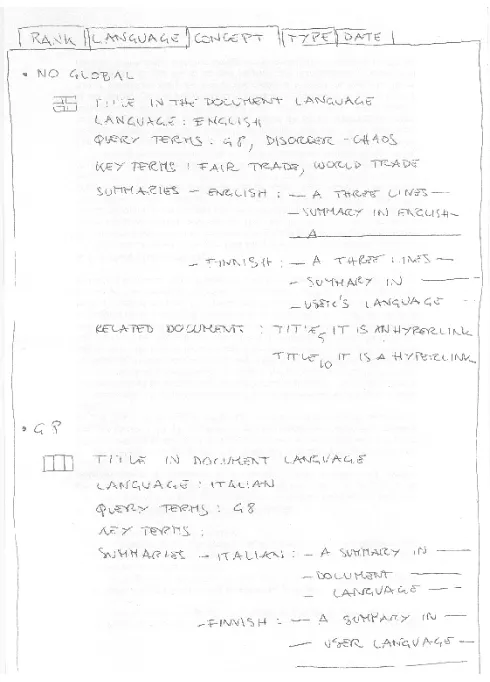
Figure 4. The mock-up of the first sketch of the ranked list pane.
freedom to move from one language to another or expand the search by including further languages, or reducing the number of languages if the result of a query was unmanageable. This “language shift” was performed by all the observed users: the business analysts started a search using English as the pivot language, moved to Finnish and finally to Swedish, the journalist searched in a number of European and American online newspapers thus using English, Spanish and German, and finally the translators shift from source to destination languages and vice versa.
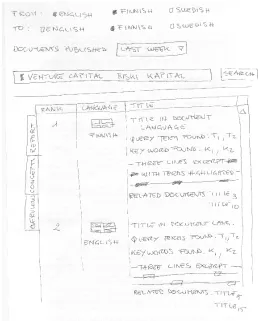
Figure 5. The mock-up of the revised interface of Clarity
The presentation of information for each item in the ranked list was also revised. In the first version (fig.5) a rich representation of each document is proposed including: title, document language, query terms contained in the document, additional key term concepts, a summary in the document language, a summary in the user language, and a list of other related documents. In this design, the set of retrieved documents can be filtered using some of the above criteria associated with the documents, for example the language or key term concepts, but also including other attributes like the date/time or source. Such a different organization of the results is obtained by simply clicking on the tab labels displayed on the upper border.
to filtering, it should be applicable to only the features of each single document, i.e. the language, the ranking, the date and so on. Features related to the content such as concepts or style have to be kept separated to avoid confusion. In the revised design, tabs are used for accessing different views of the same data (e.g. the concept hierarchy or the graphical presentation) while the filtering options based only on document attributes are selected by clicking on the head cell of the column. Although the interface design features discussed above were the main ones emanating from the field study, further improvements and alternatives are likely to be considered, as further formative evaluations will be conducted in order to arrive at a design that will be fully compatible with our users and context of use.
6.2. CONCLUSIONS AND FUTURE WORK
By observing current practices with monolingual search engines, we were able to come some way in assessing what support users would require in using a cross-language information retrieval system. The findings led to the redesign of a number of different components of the use interface. In some cases enough evidence was gathered to suggest a sound solution whereas for other aspects the redesign remains tentative and will require further user evaluation.
The redesigned interface will be implemented in the near future and will undergo further user testing. It is likely that some of the weaker solutions will lead to a further iteration of the design-evaluation cycle
ACKNOWLEDGEMENT
Clarity is a European Founded project in the framework of Information Society Technology. Partners are: University of Sheffield (coordinator), University of Tampere, SICS – Swedish Institute for Computer Science, Alma Media, BBC Monitoring. We thank the partners for their collaboration and the anonymous people who volunteered for being our users during this study.
REFERENCES
(1) PIRKOLA, A. The effects of query structure and dictionary setups in dictionary-based cross-lingual information retrieval. In: Proceedings of the ACM SIGIR 1998,Melbourne: Australia, August 1998, 55-64.
(2) BRASCHLER, M., PETERS, C and SCHAUBLE, P. Cross language information retrieval (CLIR) track overview. In: Voorhees, E.M. and Harman, D. K. (eds,). The eighth Text REtrieval Conference (TREC-8). Gaithersburg, MD: National
(3) OGDEN,W.C. and DAVIS M.W. Improving cross-language text retrieval with human interactions, Proceedings of the Hawaii International Conference on System Science – HICSS-33, Maui, Hawaii, IEEE, January 2000.
(4) WANG, J. And OARD, D. ICLEF 2001 at Maryland: Comparing word-for-word gloss and MT, In: Working Notes for the CLEF 2001 Workshop, Darmstadt: Germany, ERCIM EEIG, September 2001, 219-230.
(5) MARCHIONINI, G. Information seeking in electronic environments. Cambridge Series on Human Computer Interaction 9. Cambridge: Cambridge University Press, 1995.
(6) BELKIN, N. J., MARCHETTI P. G. and COOL., C. BRAQUE: Design of an interface to support user interaction in Information Retrieval. Information Processing & Management, 29(3), 1993, 325-344.
(7) BRAJNIC, G., MIZZARO, S and TASSO, C. Evaluating user interfaces to information retrieval systems. A case study on user support. In: Frei, H-P., Harman, D., Schäuble, P., and Wilkinson, R. (eds.). Proceedings of the 19th Annual International ACM SIGIR Conference on Research and Development in
Information Retrieval (SIGIR'96). Zurich, Switzerland, ACM, August 18-22, pp.
(8) BEAULIEU, M. and JONES, S. Interactive searching and interface issues in the Okapi best match probabilistic retrieval system. Interacting with Computers, 10(3), 1998, 237-248.
(9) KOENEMANN, J., and BELKIN, N. J. A case for interaction: A study of interactive information retrieval behavior and effectiveness, Proceedings of CHI96, Vancover: Canada, ACM, 1996, 205-212.
(10) BYSTRÖM, K and JÄRVELIN, K Task complexity affects information seeking and use. Information Processing & Management, Vol. 31, No. 2, 1995, 191-213.
(11) HANSEN, P. and JÄRVELIN, K. The information seeking and retrieval process at the Swedish Patent- and Registration Office. Moving from Lab-based to real life work-task environment. Proceedings of the ACM-SIGIR 2000 Workshop on Patent Retrieval, Athens, Greece, ACM, July 28, 2000, 43-53.
(12) NIELSEN, J., Usability Engineering. Academic Press, 1993.
(13) VAN LAMSWEERDE, A. Requirements engineering in the year 2000: A research perspective’. 22th International Conference on Software Engineering, Limerick, Ireland, ACM, 2000, 5-19.
(15) GOGUEN, J. and M. JIROTKA (eds.) Requirements Engineering: Social and
Technical Issues, Academic Press, 1994.
(16) SCHULER, D. and NAMIOKA (eds.) Participatory design: principles and practices, Hillside: Lawrance Erlbaum Ass., 1993.
(17) HACKOS, J. T. and REDISH, J. C., User and task analysis for interface design.Wiley, 1998.
(18) NORMAN, D. Cognitive engineering. In: D. Norman and Draper, S., eds. User centered system design. New perspectives on human-computer interaction.
Hillsdale, N. J.: Lawrence Erlbaum Ass., 1986, 31-61.
(19) OARD, D. Serving users in many languages cross-language information retrieval for digital libraries, D-Lib Magazine, December 1997.
(20) CARROLL, J. M. Scenario-based design. In: Helander M. G., Landauer T.K., and Prabhu P.V. eds. Handbook of Human-Computer Interaction, Elsevier Science, 1997.
(22) CHEN, H. and DUMAIS, S. Bringing Order in the Web: Automatically Categorizing Search Results. Proceeding of CHI2000, The Hague, Netherlands, ACM, 2000, 145-152.
(23) SANDERSON, M. and CROFT, W.B. Deriving concept hierarchies from text, in the Proceedings of the 22nd ACM SIGIR Conference, Berkeley, California, ACM, 1999, 206-213.
(24) GOLOVCHINSKY, G. Queries? Link? Is there a difference? Proceedings of CHI97, Atlanta: Georgia, ACM, 1997, 407-414.
(25) ANDO, R. K., BOGURAEV, B. K., BYRD, R. J. and NEFF, M.S. Multi-document summarization by visualizing topical content. ANLP-NAACL 2000 Workshop on Automatic Summarization, Seattle, Washington, 2000.
(26) HEARST, M. A. User Interfaces and Visualization, Chapter 10 in Baeza-Yates R. And Ribeiro-Neto B. ‘Modern Information Retrieval, Addison-Wesley, 1999. (available at http://www.sims.berkeley.edu/~hearst/irbook/chapters/chap10.html accessed 1.2.2002)