Dynamic Data Selection for Neural Machine Translation
Marlies van der Wees
Informatics Institute University of Amsterdam
Arianna Bisazza∗
LIACS Leiden University
Christof Monz
Informatics Institute University of Amsterdam
Abstract
Intelligent selection of training data has proven a successful technique to simul-taneously increase training efficiency and translation performance for phrase-based machine translation (PBMT). With the recent increase in popularity of neural machine translation (NMT), we explore in this paper to what extent and how NMT can also benefit from data selection. While state-of-the-art data selection (Ax-elrod et al., 2011) consistently performs well for PBMT, we show that gains are substantially lower for NMT. Next, we in-troducedynamic data selectionfor NMT, a method in which we vary the selected sub-set of training data between different train-ing epochs. Our experiments show that the best results are achieved when applying a technique we call gradual fine-tuning, with improvements up to +2.6 BLEU over the original data selection approach and up to +3.1 BLEU over a general baseline. 1 Introduction
Recent years have shown a rapid shift from phrase-based (PBMT) to neural machine transla-tion (NMT) (Sutskever et al., 2014; Cho et al., 2014;Bahdanau et al.,2014) as the most common machine translation paradigm. With large quan-tities of parallel data, NMT outperforms PBMT for an increasing number of language pairs (Bo-jar et al.,2016). Unfortunately, training an NMT model is often a time-consuming task, with train-ing times of several weeks not betrain-ing unusual.
Despite its training inefficiency, most work in NMT greedily uses all available training data for a given language pair. However, it is unlikely
∗Work done while at University of Amsterdam
that all data is equally helpful to create the best-performing system. In PBMT, this issue has been addressed by applying intelligent data selection, and it has consistently been shown that using more data does not always improve translation quality (Moore and Lewis, 2010; Axelrod et al., 2011; Gasc´o et al.,2012). Instead, for a given translation task, the training bitext likely contains sentences that are irrelevant or even harmful, making it ben-eficial to keep only the most relevant subset of the data while discarding the rest, with the additional benefit of smaller models and faster training.
Motivated by the success of data selection in PBMT, we investigate in this paper to what ex-tent and how NMT can benefit from data selec-tion as well. While data selecselec-tion has been ap-plied to NMT to reduce the size of the data (Cho et al., 2014; Luong et al., 2015b), the effects on translation quality have not been investigated. In-tuitively, and confirmed by our exploratory exper-iments in Section 5.1, this is a challenging task; NMT systems are known to under-perform when trained on limited parallel data (Zoph et al.,2016; Fadaee et al., 2017), and do not have a separate large-scale target-side language model to compen-sate for smaller parallel training data.
To alleviate the negative effect of small training data on NMT, we introduce dynamic data selec-tion. Following conventional data selection, we still dramatically reduce the training data size, fa-voring parts of the data which are most relevant to the translation task at hand. However, we exploit the fact that the NMT training process iterates over the training corpus in multiple epochs, and we al-ter the quantity or the composition of the training data between epochs. The proposed method re-quires no modifications to the NMT architecture or parameters, and substantially speeds up training times while simultaneously improving translation quality with respect to a complete-bitext baseline.
In summary, our contributions are as follows: (i) We compare the effects of a commonly used data selection approach (Axelrod et al., 2011) on PBMT and NMT using four different test sets. We find that this method is much less effective for NMT than for PBMT, while using the exact same training data subsets.
(ii) We introduce dynamic data selection as a way to make data selection profitable for NMT. We explore two techniques to alter the selected data subsets, and find that our method called grad-ual fine-tuning improves over conventional static data selection (up to +2.6 BLEU) and over a high-resource general baseline (up to +3.1 BLEU). Moreover, gradual fine-tuning approximates in-domain fine-tuning in∼20% of the training time, even when no parallel in-domain data is available.
2 Static data selection
As a first step towards dynamic data selection for NMT, we compare the effects of a commonly used, state-of-the-art data selection method (Axel-rod et al.,2011) on both neural and phrase-based MT. Briefly, this approach ranks sentence pairs in a large training bitext according to their difference in cross-entropy with respect to an in-domain cor-pus (i.e., a corcor-pus representing the test data) and a general corpus. Next, the topnsentence pairs with the highest rank—thus lowest cross-entropy—are selected and used for training an MT system.
Formally, given an in-domain corpusI, we first create language models from the source sidefofI (LMI,f) and the target sideeofI(LMI,e). We then
draw a random sample (similar in size toI) of the large general corpusGand create language mod-els from the source and target sides ofG: LMG,f
and LMG,e, respectively. Note that the data for
creating these LMs need not be parallel but can be independent corpora in both languages.
Next, we compute for each sentence pairsinG four cross-entropy scores, defined as:
HC,sb =− X
p(sb) log LMC,b(sb), (1)
whereC ∈ {I, G}is the corpus,b∈ {f, e}refers to the bitext side, andsbis the bitext sidebof
sen-tence pairsin the parallel training corpus. To find sentences that are similar to the in-domain corpus, i.e., have lowHI, and at the same
time dissimilar to the general corpus, i.e., have high HG, we compute for each sentence pair s
the bilingual cross-entropy difference CEDs
fol-lowingAxelrod et al.(2011):
CEDs= (HI,sf−HG,sf)+(HI,se−HG,se). (2) Finally, we rank all sentence pairss∈ G accord-ing to theirCEDs, and then select only the topn
sentence pairs with the lowestCEDs.
Following related work by Moore and Lewis (2010), we restrict the vocabulary of the LMs to the words occurring at least twice in the in-domain corpus. To analyze the quality of the selected data subsets, we also run experiments on random se-lections, all performed in threefold. Finally, we always use the exact same selection of sentence pairs in equivalent PBMT and NMT experiments. LSTM versus n-gram The described data se-lection method uses n-gram LMs to determine the domain-relevance of sentence pairs. We adhere to this setting for our comparative experiments on PBMT and NMT (Section 5.1). However, when applying data selection to NMT, we examine the potential benefit of replacing the conventional n-gram LMs with LSTMs1. These have the
advan-tage to remember longer histories, and do not have to back off to shorter histories when encountering out-of-vocabulary words. In this neural variant to rank sentences, the score for each sentence pair in Gis still computed as the bilingual cross-entropy difference in Equation (2). In addition, we use the same idomain and general corpora as with the n-gram method, and we again restrict the vocabulary to the most frequent words.
3 Dynamic data selection
While data selection aims to discard irrelevant data, it can also exacerbate the problem of low vocabulary coverage and unreliable statistics for rarer words in the ‘long tail’, which are major is-sues in NMT (Luong et al.,2015b;Sennrich et al., 2016b). In addition, it has been shown that NMT performance drops tremendously in low-resource scenarios (Zoph et al., 2016;Fadaee et al.,2017; Koehn and Knowles,2017).
a) Dynamic data selection: sampling b) Dynamic data selection: gradual fine-tuning
Most relevant data Least relevant data Training data
epoch 3&4: Top 60%
Training data epoch 5&6:
Top 36%
Training data epoch 7&8: Top 21.6% Training data
epoch 1&2: Complete
x 0.6
x 0.6
x 0.6 Training data
epoch 2: New sample
Training data epoch 3: New sample
Training data epoch 4: New sample Training data
epoch 1: Sample 30%
Training data epoch 6: New sample
Training data epoch 7: New sample
Training data epoch 8: New sample Training data
[image:3.595.73.524.65.241.2]epoch 5: New sample
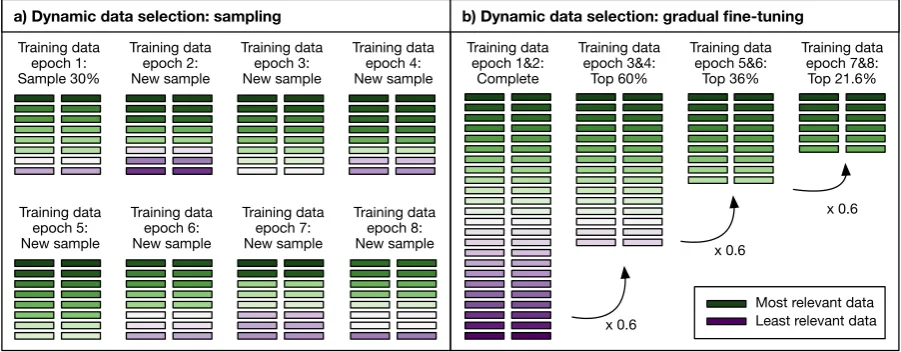
Figure 1: Illustration of two dynamic bitext selection techniques for NMT:sampling(left) andgradual fine-tuning(right). Measured over 16 training epochs (which is used in this work), the total training time of both examples would be∼30% of the training time needed when using the complete bitext.
allowing to use a different subset of the training data in every epoch.
Dynamic data selection starts from a relevance-ranked bitext, which we create using CED scores as computed in Equation (2). Given this ranking, we investigate two dynamic data selection tech-niques2that vary per epoch the composition or the
size of the selected training data. Both techniques aim to favor highly relevant sentences over less relevant sentences while not completely discard-ing the latter. In all experiments, we use a fixed vocabulary created from the complete bitext.
While we use in this work a domain-relevance ranking of the bitext following Axelrod et al. (2011), dynamic data selection can also be ap-plied using other ranking criteria, for example lim-iting redundancy in the training data (Lewis and Eetemadi,2013) or complementing similarity with diversity (Ruder and Plank,2017).
Sampling sentence pairs In the first technique, illustrated in Figure1a, we sample for every epoch n sentence pairs from G, using a distribution computed from the domain-specificCEDsscores.
Concretely, this is done as follows:
First, since higher ranked sentence pairs have lowerCEDs scores, and they can be either
nega-tive or posinega-tive, we scale and invertCEDs scores
such that0 ≤ CED0
s ≤ 1for each sentence pair s∈G:
CED0
s= 1−max(CEDsCEDG−)min(−min(CEDGCEDG) ), (3) 2Code for bitext ranking and both selection techniques: github.com/marliesvanderwees/dds-nmt.
whereCEDG refers to the set ofCEDs scores for
bitextG.
Next, we convert CED0
s scores to relative
weights, such thatPs∈Gw(s) = 1:
w(s) = CED0s P
si∈GCED0si
. (4)
We then use{w(s) :s∈G}to perform weighted sampling, drawing for each epochnsentence pairs without replacement. While all selection weights are very close to zero, higher ranked sentences have a noticeably higher probability of being se-lected than lower-ranked sentences; in practice we find that top-ranked sentences get selected in nearly each epoch, while bottom-ranked sentence pairs get selected at most once. Note that the sam-pled selection for any epoch is independent of se-lections for all other epochs.
Gradual fine-tuning The second dynamic data selection technique, see Figure1b, is inspired by the success of domain-specific fine-tuning (Luong and Manning, 2015; Zoph et al., 2016;Sennrich et al., 2016a; Freitag and Al-Onaizan, 2016), in which a model trained on a large general-domain bitext is trained for a few additional epochs only on small in-domain data. However, rather than training a full model on the complete bitextG, we gradually decrease the training data size, starting fromGand keeping only the topnsentence pairs for the duration ofηepochs, where the topnpairs are defined by their CEDs scores. Given its
During gradual fine-tuning, the selection sizen is a function of epochi:
n(i) =α· |G| ·βb(i−1)/ηc. (5)
Here0 ≤ α ≤1is therelative start size, i.e., the fraction of general bitextG used for the first se-lection,0 ≤ β ≤ 1is the retention rate, i.e., the fraction of data to be kept in each new selection, and η ≥ 1 is the number of consecutive epochs each selected subset is used. Note thatbi/η+ 1c
indicates rounding downi/η+ 1to the nearest in-teger. For example, if we start with the complete bitext (α= 1), select the top 60% (β= 0.6) every second epoch (η = 2), then we run epochs 1 and 2 with a subset of size|G|, epochs 3 and 4 with a subset of size 0.6· |G|, epochs 5 and 6 with a subset of size0.36· |G|, and so on. For every size n, the actual selection contains the topnsentences pairs ofG.
4 Experimental settings
We evaluate static and dynamic data selection on a German→English translation task comprising four test sets. Below we describe the MT systems and data specifications.
4.1 Machine translation systems
While the main aim of this paper is to improve data selection for NMT, we also perform comparative experiments using PBMT. Our PBMT system is an in-house system similar to Moses (Koehn et al., 2007). To create optimal PBMT systems given the available resources, we apply test-set-specific parameter tuning using PRO (Hopkins and May, 2011). In addition, we use a linearly interpolated target-side language model trained with Kneser-Ney smoothing on 480M tokens of data in various domains. LM interpolation weights are also opti-mized per test set. Consistent withAxelrod et al. (2011), we do not vary the target-side LM between different experiments on the same test set. All n-gram models in our work are 5-n-gram.
For our NMT experiments we use an in-house encoder-decoder3 model with global attention as
described in Luong et al. (2015a). This choice comes at the cost of optimal translation quality but allows for a relatively fast realization of large-scale experiments given our available resources. Both the encoder and decoder are four-layer unidi-rectional LSTMs, with embedding and layer sizes
3github.com/ketranm/tardis
of 1,000. We uniformly initialize all parameters, and use SGD with a mini-batch size of 64 and an initial learning rate of 1, which is decayed by a factor two every epoch after the fifth epoch. We use dropout with probability 0.3, and a beam size of 12. We train for 16 epochs and test on the model from the last epoch. All NMT experiments are run on a single NVIDIA Titan X GPU.
Train Dev/valid Test
Corpus Lines Tokens Lines Tokens Lines Tokens EMEA 206K 3.3M 3.9K 59K 5.8K 93K Movies 101K 1.2M 4.5K 54K 7.1K 87K TED 189K 3.3M 2.5K 50K 5.4K 99K WMT 3.8M 84M 3.0K 64K 3.0K 65K
[image:4.595.308.526.186.295.2]Mix 4.3M 92M 3.5K 61K – –
Table 1: Data specifications with tokens counted on the German side. The WMT training cor-pus contains Commoncrawl, Europarl, and News Commentary but no in-domain news data.
4.2 Training and evaluation data
We evaluate all experiments on four domains: (i) EMEA medical guidelines (Tiedemann,2009), (ii) movie dialogues (van der Wees et al.,2016) con-structed from OpenSubtitles (Lison and Tiede-mann, 2016), (iii) TED talks (Cettolo et al., 2012), and (iv) WMT news. For TED, we use IWSLT2010 as development set and IWSLT2011-2014 as test set, and for WMT we use new-stest2013 as development set and newstest2016 as test set. We train our systems on a mixture of domains, comprising Commoncrawl, Europarl, News Commentary, EMEA, Movies, and TED. Corpus specifications are listed in Table1.
The in-domain LMs used to rank training sen-tences for data selection are trained on small por-tions of in-domain parallel data whenever avail-able (3.3M, 1.2M and 3.3M German tokens for EMEA, Movies and TED, respectively). Since no sizeable in-domain parallel text is available for WMT, we independently sample 200K sentences from the WMT monolingual News Crawl corpora (3.3M German tokens or 3.5M English tokens). This demonstrates the applicability of data selec-tion techniques even in cases where one lacks par-allel in-domain data.
remov-0 10 20 30 40 50
BLEU
EMEA medical
0 5 10 15 20 25 30
BLEU
Movie dialogues
0 5 10 15 20 25 30 35 40 45 50
Selection size (% of complete bitext) 0
5 10 15 20 25 30
BLEU
TED talks
0 5 10 15 20 25 30 35 40 45 50
Selection size (% of complete bitext) 0
5 10 15 20 25 30
BLEU
WMT news
[image:5.595.77.525.60.328.2]Size of in-domain bitext PBMT complete baseline PBMT Axelrod selection PBMT random selection NMT complete baseline NMT Axelrod selection NMT random selection
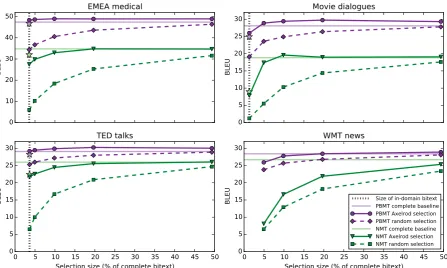
Figure 2: PBMT (purple) and NMT (green) German→English results of Axelrod data selection and random data selection (average of three runs) for four domains. Purple and green stars indicate BLEU scores when only the available in-domain data is used. We use selections of the in-domain size|I|, and 5%, 10%, 20%, and 50% of the complete bitext, which are exactly the same for PBMT and NMT.
ing sentences that are longer than 50 tokens or that are identified as a different language. After selec-tion, we apply Byte-pair encoding (BPE,Sennrich et al.(2016b)) with 40K merge operations on ei-ther side of the complete mix-of-domains training bitext. For our NMT experiments we use BPE-processed corpora on both bitext sides, while for PBMT we only apply BPE to the German side. Our NMT systems use a vocabulary size of 40K on both the source and target side.
5 Results
Below we discuss the results of our translation ex-periments using static and dynamic data selection, measuring translation quality with case-insensitive untokenized BLEU (Papineni et al.,2002).
5.1 Static data selection for PBMT and NMT We first compare the effects of static data selec-tion with n-gram LMs on both NMT and PBMT using various selection sizes. Concretely, we se-lect the topnsentence pairs such that the number of selected tokenst ∈ 5%,10%,20%,50% of G, or t = |I| (the in-domain corpus size). Fig-ure2shows German→English translation
perfor-mance in BLEU for our four test sets. The benefits of n-gram-based data selection for PBMT (purple circles) are confirmed: In all test sets, the selec-tion of size |I|(dotted vertical line) yields better performance than using only the in-domain data of the exact same size (purple star), and at least one of the selected subsets—often using only 5% of the complete bitext—outperforms using the com-plete bitext (light purple line). We also show that the informed selections are superior to random se-lections of the same size (purple diamonds).
In NMT, results of n-gram-based data selection (green triangles) vary: While for Movies a selec-tion of only 10% outperforms the complete bitext (light green line), none of the selected subsets for other test sets is noticeably better than the full bi-text.4 Interestingly, the same selections of size|I|
that proved useful in PBMT, never beat the sys-tem that uses exactly the available in-domain data (green star), indicating that the current selections can be further improved for NMT. In all scenarios we see that NMT suffers much more from small-data settings than PBMT. Finally, the random
lections (green squares) show that NMT not only needs large quantities of data, but it is also affected when the selected data is of low quality. In PBMT, both low-quantity and low-quality scenarios ap-pear to be compensated for by the large monolin-gual LM on the target side.
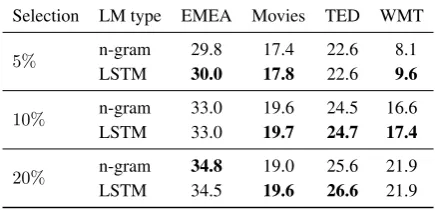
When comparing the different test sets, we observe that the impact of domain mismatch in NMT with respect to PBMT is largest for the two domains that are most distinct from the gen-eral bitext, EMEA and Movies. For WMT, both MT systems achieve very similar baseline results, but translation quality deteriorates considerably in data selection experiments, which is likely caused by the lack of in-domain data in the general bitext. LSTM versus n-gram Before proceeding with dynamic data selection for NMT, we test whether bitext ranking for NMT can be improved using LSTMs rather than conventional n-gram LMs. Ta-ble 2 shows NMT BLEU scores of a few differ-ent sizes of selected subsets created using n-gram LMs or LSTMs. While results vary among test sets and selection sizes, we observe an average im-provement of 0.4 BLEU when using LSTMs in-stead of n-gram LMs. For PBMT, similar results have been reported when replacing n-gram LMs with recurrent neural LMs (Duh et al.,2013). In all subsequent experiments we use relevance rankings computed with LSTMs instead of n-gram LMs.
Selection LM type EMEA Movies TED WMT
5% n-gramLSTM 29.830.0 17.417.8 22.622.6 8.19.6
10% n-gramLSTM 33.033.0 19.619.7 24.524.7 16.617.4
20% n-gram 34.8 19.0 25.6 21.9
LSTM 34.5 19.6 26.6 21.9
Table 2: NMT BLEU comparison between using n-gram LMs and LSTMs for bitext ranking. Selec-tion sizes concern the selected bitext subsets; LMs are created from the exact same in-domain data.
5.2 Dynamic data selection for NMT
Equipped with a relevance ranking of sentence pairs in bitextG, we now examine two variants of dynamic data selection as described in Section3.
We are interested in reducing training time while limiting the negative effect on BLEU for various domains. Therefore we report BLEU as
well as the relative training time of each exper-iment. Since wall-clock times depend on other factors such as the NMT architecture and memory speed, we define training time as the total number of tokens observed while training the NMT sys-tem, i.e., the sum of tokens in the selected subsets of all epochs. We report all training times relative to the training time of our complete-bitext base-line (i.e., 4.3M tokens × 16 epochs). Note that this measure of training time corresponds closely but not exactly to the number of model updates, as the latter relies on the number of sentences, which vary in length, rather than the number of tokens in the training data. For completeness: Training the 100% baseline takes 106 hours, while our fastest dynamic selection variant takes 19–21 hours. Computing CED scores takes∼15 minutes when using n-gram LMs and 5–6 hours when us-ing LSTMs.
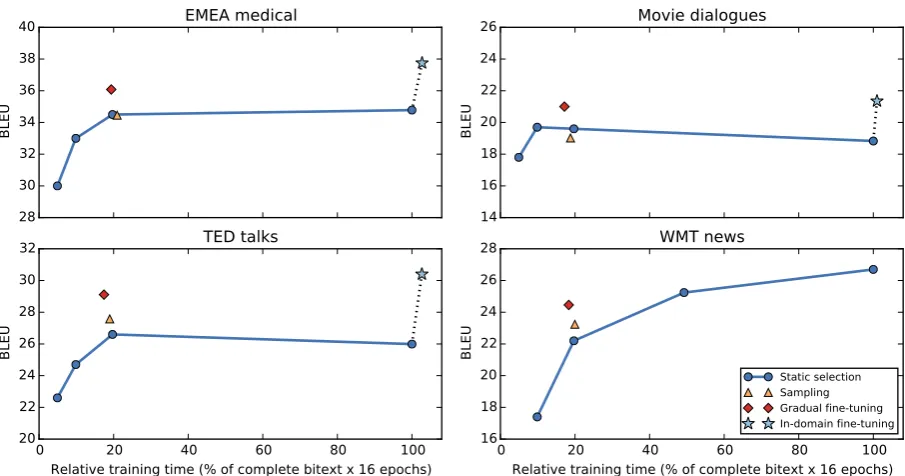
Figure3shows BLEU scores of some selected experiments as a function of relative training time. Compared to static data selection (blue lines), our weighted sampling technique (orange triangles) yields variable results. When sampling a subset of 20% of|G|from the top 50% of the ranked bi-text, we obtain small improvements for TED and WMT, but small drops for EMEA and Movies. Other selection sizes (30% and 40%, not shown) give similar results lacking a consistent pattern.
By contrast, our gradual fine-tuning method performs consistently better than static selection, and even beats the general baseline in three out of four test sets. The displayed version uses settings
(α= 0.5, β= 0.7, η= 2) and is at least as fast as static selection using 20% of the bitext, yielding up to +2.6 BLEU improvement (for WMT news) over this static version. Compared to the com-plete baseline, this gradual fine-tuning method im-proves up to +3.1 BLEU (for TED talks).
[image:6.595.73.291.479.584.2]28 30 32 34 36 38 40
BLEU
EMEA medical
14 16 18 20 22 24 26
BLEU
Movie dialogues
0 20 40 60 80 100
Relative training time (% of complete bitext x 16 epochs) 20
22 24 26 28 30 32
BLEU
TED talks
0 20 40 60 80 100
Relative training time (% of complete bitext x 16 epochs) 16
18 20 22 24 26 28
BLEU
WMT news
[image:7.595.73.526.59.297.2]Static selection Sampling Gradual fine-tuning In-domain fine-tuning
Figure 3: Selected German→English translation results of dynamic data selection methods (orange and red markers) compared to conventional static data selection (blue circles). Relative training timeequals the total number of training tokens relative to the complete baseline, which takes 106 hours to train and is represented by the rightmost blue circle. Note that no parallel in-domain data is available for WMT news. All y-axes are scaled equally for easy comparison of BLEU differences across domains.
Experiment Relative BLEU
Start size Retention rateβ Decrease every training time EMEA Movies TED WMT
Static selection top 20% 20% 34.5 19.6 26.6 21.9
50% (α= 0.5) 0.7 η= 2epochs 18–20% 36.1 (+1.6) 21.0 (+1.4) 29.1 (+2.5) 24.5 (+2.6) 50% (α= 0.5) 0.5 η= 4epochs 21–23% 36.0 (+1.5) 21.2 (+1.6) 29.0 (+2.4) 25.0 (+3.1) 50% (α= 0.5) 0.6 η= 4epochs 25–27% 35.6 (+1.1) 21.0 (+1.4) 28.5 (+1.9) 25.1 (+3.2) 100% (α= 1) 0.6 η= 2epochs 29–31% 35.5 (+1.0) 21.1 (+1.5) 29.0 (+2.4) 25.6 (+3.7) 100% (α= 1) 0.7 η= 2epochs 37–39% 35.9 (+1.4) 20.4 (+0.8) 28.2 (+1.6) 25.8 (+3.9) 100% (α= 1) 0.9 η= 1epoch 50–52% 35.4 (+0.9) 19.6 (±0.0) 27.4 (+0.8) 26.1 (+4.2)
Complete bitext baseline 100% 34.8 18.8 26.0 26.7
Gold: fine-tuning on in-domain data 101–103% 37.7 21.3 30.4 –
Table 3: German→English BLEU results of various gradual fine-tuning experiments sorted by relative training time. Indicated improvements are with respect to static selection using 20% of the bitext, and highest scores per test set are bold-faced. Results from the first experiment are also shown in Figure3.
does not improve translation performance for any domain except WMT news.
Finally, we compare our data selection exper-iments to domain-specific fine-tuning (light blue stars in Figure3), which is the current state-of-the-art for domain adaptation in NMT. To this end, we first train a model on the complete bitext, and then train for twelve additional epochs on available in-domain data, using an initial learning rate of 1 which halves every epoch. Depending on the test
[image:7.595.72.526.391.560.2]6 Further analysis
In this section we conduct a few additional exper-iments and analyses. We restrict to one parameter setting per selection approach: Static selection and sampling with 20% of the data, and gradual fine-tuning using(α= 0.5, β = 0.7, η = 2). All have very similar training times.
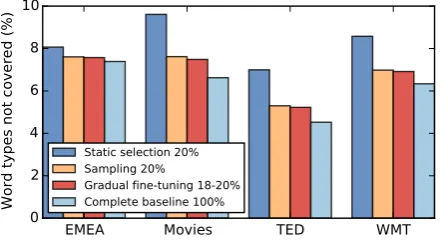
First, we hypothesize that dynamic data selec-tion works well because more different sentence pairs are observed during training, and it therefore increases coverage with respect to static data se-lection. To verify this, we measure for each test set the number of unseen source word types in the training data of different selection methods. Fig-ure 4 shows indeed that the average number of unseen word types is reduced noticeably in both of our dynamic selection techniques, being much closer to the complete bitext baseline than to static selection. Note that all methods use the same vo-cabulary during training.
EMEA Movies TED WMT
0 2 4 6 8 10
Word types not covered (%)
Static selection 20% Sampling 20%
[image:8.595.308.525.115.212.2]Gradual fine-tuning 18-20% Complete baseline 100%
Figure 4: Test set source words not covered in the training data of different data selection methods.
Next, following the static data selection exper-iments in Section5.1, we examine how well dy-namic data selection performs using random selec-tions. To this end, we repeat all techniques using a bitext which is ranked randomly rather than by its relevance to the test sets. The results in Table4 show that the bitext ranking plays a crucial role in the success of data selection. However, the results also show thatevenin the absence of an appropri-ate bitext ranking, dynamic data selection—and in particular gradual fine-tuning—is still superior to static data selection. We explain this result as fol-lows: Compared to static selection, both sampling and gradual fine-tuning have better coverage due to their improved exploration of the data. How-ever, sampling also suffers from a surprise effect of observing new data in every epoch. Gradual fine-tuning on the other hand gradually improves
learning on a subset of the selected data, suggest-ing that repetition across epochs has a positive ef-fect on translation quality.
Ranking Method EMEA Movies TED WMT
Relevance Gradual FTSampling 20% 36.134.5 21.019.0 29.1 24.527.6 23.2 Static 20% 34.5 19.6 26.6 21.9
Random
[image:8.595.72.293.352.472.2]Gradual FT 29.2 16.1 23.2 21.3 Sampling 20% 26.7 14.4 22.0 19.8 Static 20% 25.3 14.4 20.9 18.2
Table 4: BLEU scores of data selection using rel-evance versus random ranking of the bitext. Grad-ual fine-tuning uses(α = 0.5, β = 0.7, η = 2), with relative training times of 18–20%.
One could expect that changing the data during training results in volatile training behavior. To test this, we inspect cross-entropy of our devel-opment sets after every training epoch. Figure5 shows these results for TED. Clearly, static data selection converges most steadily. However, both dynamic selection techniques eventually converge to a lower cross-entropy value which is reflected by higher translation quality of the test set. We ob-serve very similar behavior for the other test sets.
0 20 40 60 80 100
Cumulative training time (% of model updates) 2.0
2.5 3.0 3.5 4.0 4.5
Cross-entropy
Static selection 20% Sampling 20%
Gradual fine-tuning 18-20%
Figure 5: German→English cross-entropy of the TED dev set as a function of training time. Each data point represents a completed training epoch.
[image:8.595.308.527.432.579.2]decay the learning rate after a fixed number of updates (i.e., the same as in static data selection) rather than per epoch, or (ii) keep the learning rate fixed. In the first scenario, we observe that trans-lation performance drops with –1.1–2.0 BLEU. When keeping a fixed learning rate, BLEU scores hardly change or even improve, indicating that the implicit change in search behavior may contribute to the success of gradual fine-tuning.
7 Related work
A few research topics are related to our work. Regarding data selection for SMT, previous work has targeted two goals; to reduce model sizes and training times, or to adapt to new domains. Data selection methods for domain adaptation mostly employ information theory metrics to rank train-ing sentences by their relevance to the domain at hand. This has been applied monolingually (Gao et al.,2002) as well as bilingually (Yasuda et al., 2008). In more recent work, training sentences are typically ranked according to their cross-entropy differencebetween in-domain and general-domain data (Moore and Lewis, 2010; Axelrod et al., 2011, 2015), favoring sentences that are similar to the test domain and at the same time dissimi-lar from the general domain.Duh et al.(2013) and Chen and Huang (2016) present similar methods in which n-gram LMs are replaced by neural LMs or neural classifiers, respectively.
Data selection with the aim of model size and training time reduction has the objective to use the minimum amount of data while still maintaining high vocabulary coverage (Eck et al.,2005;Gasc´o et al.,2012;Lewis and Eetemadi,2013). In a com-parative study, Mirkin and Besacier (2014) find that similarity-objected methods perform best if the test domain and general corpus are very differ-ent, while a coverage-objected method is superior if test and general corpus are relatively similar. A comprehensive survey on data selection for SMT is provided by Eetemadi et al. (2015). While in this work we have used a similarity objective to rank our bitext, one could also apply dynamic data selection using a coverage objective.
In NMT, data selection can serve similar goals as in PBMT; increasing training efficiency or do-main adaptation. Dodo-main adaptation in NMT typ-ically involves training a model on the complete bitext, followed by fine-tuning the parameters on a smaller in-domain corpus (Luong and Manning,
2015;Zoph et al., 2016). Other work combines fine-tuning with model ensembles (Freitag and Al-Onaizan,2016) or with domain-specific tags in the training corpus (Chu et al., 2017). Finally, Sen-nrich et al.(2016a) adapt their systems by back-translating in-domain data, which is then added to the training data and used for fine-tuning.
Some other previous work has addressed train-ing efficiency for NMT, for example by paral-lelizing models or data (Wu et al., 2016), modi-fying the NMT network structure (Kalchbrenner et al., 2016), decreasing the number of parame-ters through knowledge distillation (Crego et al., 2016;Kim and Rush,2016), or by boosting parts of the data that are ‘challenging’ to the NMT sys-tem (Zhang et al.,2016). The latter is most related to our work since training data is also adjusted dur-ing traindur-ing, however we reduce the traindur-ing data size much more aggressively and study different techniques of data selection.
Finally, recent work comparing various aspects for PBMT and NMT includes (Bentivogli et al., 2016; Farajian et al., 2017; Toral and S´anchez-Cartagena,2017;Koehn and Knowles,2017).
8 Conclusions
With the recent increase in popularity of neural machine translation (NMT), we explored in this paper to what extent and how NMT can benefit from data selection. We first showed that a state-of-the-art data selection method yields unreliable results for NMT while consistently performing well for PBMT. Next, we have introduceddynamic data selectionfor NMT, which entails varying the selected subset of training data between different training epochs. We explored two techniques of dynamic data selection and found that our grad-ual fine-tuning technique, in which we gradu-ally reduce training size, improves consistently over conventional static data selection (up to +2.6 BLEU) and over a high-resource general base-line (up to +3.1 BLEU). Moreover, gradual fine-tuning approximates in-domain fine-fine-tuning using only∼20% of the training time, even when no par-allel in-domain data is available.
Acknowledgments
References
Amittai Axelrod, Xiaodong He, and Jianfeng Gao. 2011. Domain adaptation via pseudo in-domain data selection. InProceedings of the 2011 Conference on Empirical Methods in Natural Language Process-ing, pages 355–362.
Amittai Axelrod, Philip Resnik, Xiaodong He, and Mari Ostendorf. 2015. Data selection with fewer words. In Proceedings of the Tenth Workshop on Statistical Machine Translation, pages 58–65. Dzmitry Bahdanau, Kyunghyun Cho, and Yoshua
Ben-gio. 2014. Neural machine translation by jointly learning to align and translate. arXiv preprint arXiv:1409.0473.
Luisa Bentivogli, Arianna Bisazza, Mauro Cettolo, and Marcello Federico. 2016. Neural versus phrase-based machine translation quality: a case study. In Proceedings of the 2016 Conference on Empiri-cal Methods in Natural Language Processing, pages 257–267.
Ondrej Bojar, Rajen Chatterjee, Christian Federmann, Yvette Graham, Barry Haddow, Matthias Huck, An-tonio Jimeno Yepes, Philipp Koehn, Varvara Lo-gacheva, Christof Monz, et al. 2016. Findings of the 2016 conference on machine translation (WMT16). In Proceedings of the first conference on machine translation (WMT16).
Mauro Cettolo, Christian Girardi, and Marcello Fed-erico. 2012. Wit3: Web inventory of transcribed and translated talks. In Proceedings of the 16th
Con-ference of the European Association for Machine Translation (EAMT), pages 261–268.
Boxing Chen and Fei Huang. 2016. Semi-supervised convolutional networks for translation adaptation with tiny amount of in-domain data. In Proceed-ings of the 20th SIGNLL Conference on Computa-tional Natural Language Learning (CoNLL), pages 314–323.
Kyunghyun Cho, Bart van Merrienboer, Caglar Gul-cehre, Dzmitry Bahdanau, Fethi Bougares, Holger Schwenk, and Yoshua Bengio. 2014. Learning phrase representations using RNN encoder–decoder for statistical machine translation. InProceedings of the 2014 Conference on Empirical Methods in Nat-ural Language Processing (EMNLP), pages 1724– 1734.
Chenhui Chu, Raj Dabre, and Sadao Kurohashi. 2017. An empirical comparison of simple domain adapta-tion methods for neural machine translaadapta-tion. In Pro-ceedings of the 55th Annual Meeting of the Associa-tion for ComputaAssocia-tional Linguistics.
Josep Crego, Jungi Kim, Guillaume Klein, Anabel Re-bollo, Kathy Yang, Jean Senellart, Egor Akhanov, Patrice Brunelle, Aurelien Coquard, Yongchao Deng, et al. 2016. SYSTRAN’s pure neu-ral machine translation systems. arXiv preprint arXiv:1610.05540.
Kevin Duh, Graham Neubig, Katsuhito Sudoh, and Ha-jime Tsukada. 2013. Adaptation data selection us-ing neural language models: Experiments in ma-chine translation. InProceedings of the 51st Annual Meeting of the Association for Computational Lin-guistics, pages 678–683.
Matthias Eck, Stephan Vogel, and Alex Waibel. 2005. Low cost portability for statistical machine transla-tion based on n-gram frequency and TF-IDF. In Proceedings of the 2005 International Workshop on Spoken Language Translation, pages 61–67. Sauleh Eetemadi, William Lewis, Kristina Toutanova,
and Hayder Radha. 2015. Survey of data-selection methods in statistical machine translation. Machine Translation, 29(3-4):189–223.
Marzieh Fadaee, Arianna Bisazza, and Christof Monz. 2017. Data augmentation for low-resource neural machine translation. InProceedings of the 55th An-nual Meeting of the Association for Computational Linguistics.
M. Amin Farajian, Marco Turchi, Matteo Negri, Nicola Bertoldi, and Marcello Federico. 2017. Neural vs. phrase-based machine translation in a multi-domain scenario. InProceedings of the 15th Conference of the European Chapter of the Association for Com-putational Linguistics, pages 280–284.
Markus Freitag and Yaser Al-Onaizan. 2016. Fast domain adaptation for neural machine translation. arXiv preprint arXiv:1612.06897.
Jianfeng Gao, Joshua Goodman, Mingjing Li, and Kai-Fu Lee. 2002. Toward a unified approach to statis-tical language modeling for chinese. ACM Trans-actions on Asian Language Information Processing (TALIP), 1(1):3–33.
Guillem Gasc´o, Martha-Alicia Rocha, Germ´an Sanchis-Trilles, Jes´us Andr´es-Ferrer, and Francisco Casacuberta. 2012. Does more data always yield better translations? InProceedings of the 13th Con-ference of the European Chapter of the Association for Computational Linguistics, pages 152–161. Mark Hopkins and Jonathan May. 2011. Tuning as
ranking. InProceedings of the 2011 Conference on Empirical Methods in Natural Language Process-ing, pages 1352–1362.
Nal Kalchbrenner, Lasse Espeholt, Karen Simonyan, Aaron van den Oord, Alex Graves, and Koray Kavukcuoglu. 2016. Neural machine translation in linear time. arXiv preprint arXiv:1610.10099. Yoon Kim and Alexander M. Rush. 2016.
Sequence-level knowledge distillation. InProceedings of the 2016 Conference on Empirical Methods in Natural Language Processing, pages 1317–1327.
Richard Zens, Chris Dyer, Ondrej Bojar, Alexandra Constantin, and Evan Herbst. 2007. Moses: Open source toolkit for statistical machine translation. In Proceedings of the 45th Annual Meeting of the As-sociation for Computational Linguistics Demo and Poster Sessions, pages 177–180.
Philipp Koehn and Rebecca Knowles. 2017. Six challenges for neural machine translation. arXiv preprint arXiv:1706.03872.
William D. Lewis and Sauleh Eetemadi. 2013. Dra-matically reducing training data size through vocab-ulary saturation. InProceedings of the 8th Workshop on Statistical Machine Translation, pages 281–291. Pierre Lison and J¨org Tiedemann. 2016.
Opensub-titles2016: Extracting large parallel corpora from movie and tv subtitles. InProceedings of the 10th International Conference on Language Resources and Evaluation (LREC 2016).
Minh-Thang Luong and Christopher D Manning. 2015. Stanford neural machine translation systems for spo-ken language domains. InProceedings of the 12th International Workshop on Spoken Language Trans-lation, pages 76–79.
Minh-Thang Luong, Hieu Pham, and Christopher D. Manning. 2015a. Effective approaches to attention-based neural machine translation. InProceedings of the 2015 Conference on Empirical Methods in Nat-ural Language Processing, pages 1412–1421. Minh-Thang Luong, Ilya Sutskever, Quoc Le, Oriol
Vinyals, and Wojciech Zaremba. 2015b. Addressing the rare word problem in neural machine translation. In Proceedings of the 53rd Annual Meeting of the Association for Computational Linguistics and the 7th International Joint Conference on Natural Lan-guage Processing (Volume 1: Long Papers), pages 11–19.
Shachar Mirkin and Laurent Besacier. 2014. Data se-lection for compact adapted SMT models. In Pro-ceedings of the 11th Conference of the Associa-tion for Machine TranslaAssocia-tion in the Americas, pages 301–314.
Robert C. Moore and William Lewis. 2010. Intelligent selection of language model training data. In Pro-ceedings of the ACL 2010 Conference Short Papers, pages 220–224.
Kishore Papineni, Salim Roukos, Todd Ward, and Wei-Jing Zhu. 2002. Bleu: a method for automatic eval-uation of machine translation. In Proceedings of 40th Annual Meeting of the Association for Compu-tational Linguistics, pages 311–318.
Sebastian Ruder and Barbara Plank. 2017. Learning to select data for transfer learning with bayesian opti-mization. InProceedings of the 2017 Conference on Empirical Methods in Natural Language Process-ing.
Rico Sennrich, Barry Haddow, and Alexandra Birch. 2016a. Improving neural machine translation mod-els with monolingual data. In Proceedings of the 54th Annual Meeting of the Association for Compu-tational Linguistics, pages 86–96.
Rico Sennrich, Barry Haddow, and Alexandra Birch. 2016b. Neural machine translation of rare words with subword units. InProceedings of the 54th An-nual Meeting of the Association for Computational Linguistics, pages 1715–1725.
Ilya Sutskever, Oriol Vinyals, and Quoc V. Le. 2014. Sequence to sequence learning with neural net-works. InAdvances in neural information process-ing systems, pages 3104–3112.
J¨org Tiedemann. 2009. News from OPUS-a collection of multilingual parallel corpora with tools and inter-faces. InRecent advances in natural language pro-cessing, volume 5, pages 237–248.
Antonio Toral and V´ıctor M. S´anchez-Cartagena. 2017. A multifaceted evaluation of neural versus phrase-based machine translation for 9 language directions. InProceedings of the 15th Conference of the Euro-pean Chapter of the Association for Computational Linguistics: Volume 1, Long Papers, pages 1063– 1073.
Marlies van der Wees, Arianna Bisazza, and Christof Monz. 2016. Measuring the effect of conversational aspects on machine translation quality. In Proceed-ings of COLING 2016, the 26th International Con-ference on Computational Linguistics, pages 2571– 2581.
Yonghui Wu, Mike Schuster, Zhifeng Chen, Quoc V Le, Mohammad Norouzi, Wolfgang Macherey, Maxim Krikun, Yuan Cao, Qin Gao, Klaus Macherey, et al. 2016. Google’s neural ma-chine translation system: Bridging the gap between human and machine translation. arXiv preprint arXiv:1609.08144.
Keiji Yasuda, Ruiqiang Zhang, Hirofumi Yamamoto, and Eiichiro Sumit. 2008. Method of selecting train-ing data to build a compact and efficient translation model. InInternational Joint Conference on Natu-ral Language Processing (IJCNLP), pages 655–660. Dakun Zhang, Jungi Kim, Joseph Crego, and Jean Senellart. 2016. Boosting neural machine transla-tion. arXiv preprint arXiv:1612.06138.