Identifying Patterns for Unsupervised Grammar Induction
Jes ´us Santamar´ıa
U. Nacional de Educaci´on a Distancia NLP-IR Group, Madrid, Spain.
Lourdes Araujo
U. Nacional de Educaci´on a Distancia NLP-IR Group, Madrid, Spain.
Abstract
This paper describes a new method for un-supervised grammar induction based on the automatic extraction of certain pat-terns in the texts. Our starting hypoth-esis is that there exist some classes of words that function as separators, mark-ing the beginnmark-ing or the end of new con-stituents. Among these separators we dis-tinguish those which trigger new levels in the parse tree. If we are able to detect these separators we can follow a very simple procedure to identify the constituents of a sentence by taking the classes of words be-tween separators. This paper is devoted to describe the process that we have followed to automatically identify the set of sepa-rators from a corpus only annotated with Part-of-Speech (POS) tags. The proposed approach has allowed us to improve the re-sults of previous proposals when parsing sentences from the Wall Street Journal cor-pus.
1 Introduction
Most works dealing with Grammar Induction (GI) are focused on Supervised Grammar Induction, using a corpus of syntactically annotated sen-tences, or treebank, as a reference to extract the grammar. The existence of a treebank for the lan-guage and for a particular type of texts from which we want to extract the grammar is a great help to GI, even taking into account the theoretical limi-tations of GI, such as the fact that grammars can-not be correctly identified from positive examples alone (Gold, 1967). But the manual annotation of thousands of sentences is a very expensive task and thus there are many languages for which there are not treebanks available. Even in languages for which there is a treebank, it is usually composed
of a particular kind of texts (newspaper articles, for example) and may not be appropriate for other kind of texts, such as tales or poetry. These rea-sons have led to the appearance of several works focused on unsupervised GI.
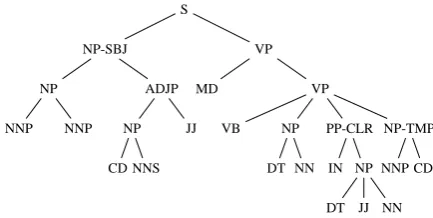
Thanks to our knowledge of the language we know that some classes of words are particularly influential to determine the structure of a sentence. For example, let us consider the tree in Figure 1, for which the meaning of the POS tags appears in Table 1. We can observe that the tag MD (Modal) breaks the sentence into two parts. Analogously, in the tree appearing in Figure 2 the POS tag VBZ breaks the sentence. In both cases, we can see that after the breaking tag, a new level appears in the parse tree. A similar effect is observed for other POS tags, such as VB in the tree of Figure 1 and IN in the tree of Figure 2. We call these kind of POS tags separators. There are also other POS tags which are frequently the beginning or the end of a constituent1. For example in the tree in Fig-ure 1 we can find the sequences (DT NN) and (DT JJ NN), which according to the parse tree are con-stituents. In the tree in Figure 2 we find the se-quence (DT NNP VBG NN). In both trees we can also find sequences beginning with the tag NNP: (NNP NNP) and (NNP CD) in the tree in Figure 1 and (NNP NNP), which appears twice, in the tree in Figure 2. This suggests that there are classes of words with a trend to be the beginning or the end of constituents without giving rise to new lev-els in the parse tree. We call these POS tags
sub-separators. These observations reflect some of our
intuitions, such as the fact that most sentences are composed of a noun phrase and a verb phrase, be-ing frequently the verb the beginnbe-ing of the verbal phrase, which usually leads to a new level of the parse tree. We also know that determiners (DT) are frequently the beginning of the noun phrases.
1Constituents are language units in which we can arrange
the structure of a sentence.
S
NP-SBJ
NP
NNP NNP
ADJP
NP
CD NNS JJ
VP
MD VP
VB NP
DT NN PP-CLR
IN NP
DT JJ NN NP-TMP
[image:2.595.72.289.63.172.2]NNP CD
Figure 1: Parse tree for the sentence Pierre Vinken,
61 years old, will join the board as a nonexecutive director Nov. 29. from the Penn Treebank
S
NP-SBJ
NNP NNP
VP
VBZ NP-PRD
NP
NN PP
IN NP
NP
NNPNNP NP
[image:2.595.73.288.247.376.2]DT NNPVBG NN
Figure 2: Parse tree for the sentence Mr. Vinken
is chairman of Elsevier N.V., the Dutch publishing group. from the Penn Treebank
At this point we could either try to figure out what is the set of tags which work as separators, or to compute them from a parsed corpus for the con-sidered language, provided it is available. How-ever, because we do not want to rely on the exis-tence of a treebank for the corresponding language and type of texts we have done something differ-ent: we have devised a statistical procedure to au-tomatically capture the word classes which func-tion as separators. In this way our approach can be applied to most languages, and apart from pro-viding a tool for extracting grammars and parsing sentences, it can be useful to study the different classes of words that work as separators in differ-ent languages.
Our statistical mechanism to detect separators is applied to a corpus of sentences annotated with POS tags. This is not a strong requirement since there are very accurate POS taggers (about 97%) for many languages. The grammar that we obtain does not specify the left-hand-side of the rules, but only sequences of POS tags that are constituents.
CC Coordinating conjunction CD Cardinal number DT Determiner EX Existential there FW Foreign word
IN Preposition / subordinating conjunction JJ Adjective
JJR Adjective, comparative JJS Adjective, superlative LS List item marker
MD Modal
NN Noun, singular or mass NNS Noun, plural
NNP Proper noun, singular NNPS Proper noun, plural PDT Predeterminer POS Possessive ending PRP Personal pronoun PP$ Possessive pronoun
RB Adverb.
RBR Adverb, comparative RBS Adverb., superlative RP Particle
SYM Symbol (mathematical or scientific)
TO To
UH Interjection VB Verb, base form VBD Verb, past tense
VBG Verb, gerund / present participle VBN Verb, past participle
VBP Verb, non-3rd ps. sing. present VBZ Verb, 3rd ps. sing. present WDT wh-determiner
WP wh-pronoun
WP$ Possessive wh-pronoun WRB wh-adverb
Table 1: Alphabetical list of part-of-speech tags used in the Penn Treebank, the corpus used in our experiments
At this point we have followed the Klein and Man-ning (2005) setting for the problem, which allows us to compare our results to theirs. As far as we know these are the best results obtained so far for unsupervised GI using a monolingual corpus. As they do, we have used the Penn treebank (Mar-cus et al., 1994) for our experiments, employing the syntactic annotations that it provides for eval-uation purposes only. Specifically, we have used WSJ10, composed of 6842 sentences, which is the subset of the Wall Street Journal section of the Penn Treebank, containing only those sentences of 10 words or less after removing punctuation and null elements, such as $, ”, etc.
5 presents and discusses the experimental results, and section 6 draws the main conclusions of this work.
2 State of the Art
A growing interest in unsupervised GI has been observed recently with the appearance of several works in the topic. Some of these works have fo-cused on finding patterns of words (Solan et al., 2005) more than syntactic structures. It has been noted that the rules produced by GI can also be in-terpreted semantically (David et al., 2003), where a non-terminal describes interchangeable elements which are instances of the same concepts.
Distributional approaches to unsupervised GI exploit the principle of substitutability: con-stituents of the same type may be exchanged with one another without affecting the syntax of the surrounding context. Distributional approaches to grammar induction fall into two categories, de-pending on their treatment of nested structure. The first category covers Expectation-Maximization (EM) systems (Dempster et al., 1977). These sys-tems propose constituents based on analysis of the text, and then select a non-contradictory combina-tion of constituents for each sentence that maxi-mizes a given metric, usually parsing probability. One of the most successful proposals in this area is the one by Klein and Manning (2005), which, as mentioned before, starts from a corpus labelled only with POS tags. The key idea of the model proposed in this work is that constituents appear in constituent contexts. However, the EM algo-rithm presents some serious problems: it is very slow (Lari and Young, 1990), and is easily trapped in local maxima (Carroll and Charniak, 1992). Alignment Based Learning (ABL) (van Zaanen and Leeds, 2000) is the only EM system applied directly to raw text. However, ABL is relatively inefficient and has only been applied to small cor-pora. Brooks (Brooks, 2006) reverses the notion of distributional approaches: if we can identify “surrounding context” by observation, we can hy-pothesize that word sequences occurring in that context will be constituents of the same type. He describes a simplified model of distributional anal-ysis (for raw test) which uses heuristics to reduce the number of candidate constituents under con-sideration. This is an interesting idea in spite that Brook showed that the system was only capable of learning a small subset of constituent structures in
a large test corpus.
The second category is that of incremental learning systems. An incremental system analyzes a corpus in a bottom-up fashion: each time a new constituent type is found it is inserted into the cor-pus to provide data for later learning. The EMILE (Adriaans, 1999) and ADIOS (David et al., 2003) systems are examples for this category, not yet evaluated on large corpora.
Bilingual experiments have been also conducted with the aim to exploit information from one lan-guage to disambiguate another. Usually such a setting requires a parallel corpus or another an-notated data that ties the two languages. Co-hen and Smith (2009) use the English and Chi-nese treebanks, which are not parallel corpora, to train parsers for both languages jointly. Their re-sults shown that the performance on English im-proved in the bilingual setting. Another related work (Snyder et al., 2009) uses three corpora of parallel text. Their approach is closer to the un-supervised bilingual parsing model developed by Kuhn (2004), which aims to improve monolingual performance.
The approach considered in this work follows a different direction, trying to identify certain pat-terns that can determine the structure of the parse trees.
3 Extracting Separators from the Corpus
To automatically extract the set of separators and sub-separators from a corpus of POS tagged sen-tences we start from some assumptions:
• The most frequent sequence (of any length) of POS tags in the corpus is a constituent, that we call safe constituent (sc). It is quite a sensible assumption, since we can expect that at least for the most frequent constituent the number of occurrences overwhelms the num-ber of sequences appearing by chance.
• We also assume that the POS tag on the left,
Lsc, and on the right, Rsc, of the safe
con-stituent are a kind of context for other se-quences that play the same role. Accord-ing to this, other extended sequences with
Lsc andRsc at the ends but with other POS
to them, constituents appear in constituent contexts. Their model exploits the fact that long constituents often have short, common equivalents, which appear in similar contexts and whose constituency as a grammar rule is more easily found.
• According to the previous point, we use the tag on the left (Lsc) and on the right (Rsc) of
the safe constituent as discriminant with re-spect to which to study the behavior of each POS tag. A POS tagEcan have a bias to be inside the safe constituent, to be outside the safe constituent (separator), or not to have a bias at all (sub-separator). We define the
de-termining side of a tagE, as the end tag,Lsc
orRsc, of the sc with the greater difference
on the number of occurrences ofE on both sides of the end tag. For example, if the ra-tio of occurrences ofEon the left and on the right ofLsc is smaller (they are more
differ-ent) than the ratio ofEon the left and on the right ofRsc, thenLsc is the determining side
ofE, ds(E)2. Then:
– E is considered a separator in the fol-lowing cases:
∗ ifLsc is the determining side forE
andEappears a 75% more often to the left ofLsc than to the right (the
75% has been fixed after some esti-mates described below), or
∗ ifRsc is the determining side forE
andEappears a 75% more often to the right ofRsc than to the left.
– E is considered a sub-separator if the following conditions hold:
∗ ifLsc is the determining side forE
and E appears a 75% less often to the left ofLsc than to the right (the
ratios are very similar) , or
∗ ifRsc is the determining side forE
and E appears a 75% less often to the right ofRsc than to the left.
– In the remaining cases E is considered to be part of a constituent (the prefer-ence is to be inside).
Let us introduce some notation to define more formally the separators and sub-separators. Let 2If the number of occurrences of Eon any side ofL
sc
orRscis zero, then we compare differences between
occur-rences instead of ratios.
#(E1,· · ·, En) be the number of occurrences of
the sequence of tags(E1,· · · , En). We define a
predicate sim to denote the similarity between the number of occurrences of a sequence of two tags and the one with reverse order, as
sim(E1, E2)) = #(E1, E2)
#(E2, E1) ≥0.75 if#(E1, E2)≤#(E2, E1) #(E2, E1)
#(E1, E2) ≥0.75 if#(E2, E1)≤#(E1, E2)
Then a tag E is considered a separator if the following predicate is true:
sep(Lsc, E, Rsc) =
(sd(Lsc)∧(#(E, Lsc)>#(Lsc, E)∧
¬sim(E, Lsc)))∨
(sd(Rsc)∧(#(Rsc, E)>#(E, Rsc)∧ ¬sim(E, Rsc))
. A tag is considered a sub-separator when the following predicate is true:
subsep(Lsc, E, Rsc) =
(sd(Lsc)∧sim(E, Lsc))∨
(sd(Rsc)∧sim(E, Rsc))
.
We have computed the number of occurrences of every sequence of POS tags in the corpus, find-ing that the most frequent sequence of tags is (DT,NN). This sequence, which is our safe con-stituent, appears 2222 times in the considered cor-pus WSJ10.
Applying our procedure to the corpus we have obtained the following sets of separators and sub-separators:
Separators MD, PRP, IN, RB, RBR, CC, TO, VB, VBD, VBN, VBZ, VBP, VBG, EX, LS, RP, UH, WP, WRB, WDT Sub-separators DT, PDT, POS, SYM, NN,
NNS, NNP, NNPS
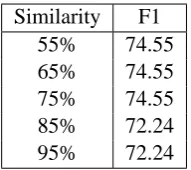
and 75%, is classified as separator using higher thresholds, and the tag SYM (Symbol), which is classified as sub-separator using a threshold be-tween 50% and 75%, is classified neither as a sep-arator nor as a sub-sepsep-arator using higher thresh-olds. We have adopted a threshold value of 75% because higher values can be too restrictive, and in fact provide worse results.
Similarity F1
55% 74.55
65% 74.55
75% 74.55
85% 72.24
[image:5.595.134.230.180.265.2]95% 72.24
Table 2: F-measure results obtained for different values of the threshold used to classify the set of POS-tags.
Sub-separators can be grouped to their right or to their left, depending on the case. In order to measure the bias of each of them for one direc-tion or another we have compared the number of occurrences of the most frequent sequence com-posed of the sub-separator and a POS tag on the right and on the left. We choose as preference di-rection for a sub-separator the corresponding to the most frequent sequence. Table 3 shows the results obtained, the preference direction of each sub-separator appearing in the last column. In the case of NNP, for which the frequency of the most frequent tag to the right and to the left are the same, we have looked at the second most frequent sequence to choose the grouping direction.
sub-sep left freq. right freq. D
DT (DT, NN)(2222) (IN,DT)(894) L
PDT (PDT,DT)(28) (NN,PDT)(14) L
POS (POS, NN)(169) (NNP, POS)(223) R
SYM (SYM, IN)(11) (NN,SYM)(4) L
NN (NN, IN)(892) (DT,NN)(2222) R
NNS (NNS, VBP)(591) (JJ,NNS)(797) R NNP (NNP, NNP)(2127) (NNP,NNP)(2127) R NNPS (NNPS, NNP)(42) (NNP,NNPS)(82) R
Table 3: Preference direction to which each sub-separator clusters. The first column corresponds to the sub-separator, the second one to the most frequent sequence composed of the sub-separator and a tag on its right, the third one to the most fre-quent sequence of the sub-separator and a tag on its left, and the last column to the resulting direc-tion.
4 Identifying Constituents
Once we have the sets of separators and sub-separators the procedure to identify the con-stituents of each sentence is as follows:
• We identify the separators in the sentence. For example, if we consider the sentence:
CC DT NN IN NNP NNP POS NN VBZ
the separators are marked in boldface:
CC DT NN IN NNP NNP POS NN VBZ
[image:5.595.72.292.543.636.2]• The next step is to split the sentence ac-cording to the separators. The first separator which is a verb, if any, is used to split the sen-tence into two parts. Each separator can give rise to two groups: one composed of the tag sequence between the separator and the next separator, and another one which includes the separator and the POS tags up to the end of the part of the sentence in which it appears (usually sentences are divided into two parts using the first separator which is a verb). In our example, this mechanism leads to the fol-lowing structure:
[[CC [DT NN] [IN [NNP NNP POS NN]]] [VBZ]]
• Now it is the turn of the sub-separators (DT, PDT, POS, SYM, NN, NNS, NNP, NNPS), which are underlined in the sentence:
[[CC [DT NN] [IN [NNP NNP POS NN]]] [VBZ]]
• Finally, each group of the sentence is split according to the separators. Each sub-separator has been assigned a preference di-rection to form the group with the next POS tag. Looking at Table 3, which tells us the direction in which each sub-separator forms the group, we apply this step to our sentence example, obtaining:
The sub-separator DT is grouped with the tags on its right, while NN is grouped with the tags on its left, thus composing the group (DT NN). When two or more sub-separators appear in a sequence, they are grouped to-gether in a unique constituent whenever they have the same grouping direction. In our sen-tence example this criterion leads to [NNP NNP POS] instead of [NNP[NNP[POS]]]. A constituent finishes if the next POS tag is a separator or if it is a sub-separator that makes groups towards the left. Since POS (Pos-sessive ending) tends to be grouped with the POS tag on its left, it is the end of the con-stituent.
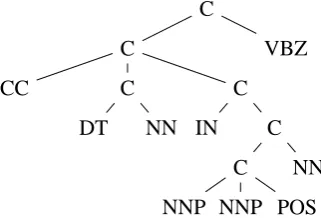
Figure 3 represents the obtained structure as a parse tree. Figure 4 represents the correct parse tree according to the Penn treebank. We can ob-serve that both structures are very similar. The method based on separators has been able to cap-ture most of the constituent appearing in the parse tree: (DT, NN), (NNP, NNP, POS), (NNP, NNP, POS, NN), (IN, NNP, NNP, POS, NN). The differ-ences between both trees come from our criterion of splitting the sequence of tags into two subse-quences using the first verb. This problem will be tackled in the future in a more refined model.
C
C
CC C
DT NN
C
IN C
C
NNP NNP POS NN VBZ
Figure 3: Parse tree for the sentence And the nose
on Mr. Courter’s face grows from the Penn
tree-bank (WSJ), obtained with our separators method.
5 Evaluation
Our proposal has been evaluated by comparing the tree structures produced by the system to the gold-standard trees produced by linguists, which can be found in the Penn Treebank. Because we do not assign class name to our constituents, i.e. a left hand side symbol for the grammar rules, as the lin-guists do in treebanks, the comparison ignores the class labels, considering only groups of tags.
S
CC NP-SBJ
NP
DT NN
PP-LOC
IN NP
NP NNP NNP POS
NN VP
VBZ
Figure 4: Parse tree appearing in the Penn tree-bank (WSJ) for the sentence And the nose on Mr.
Courter’s face grows.
The results presented in the work by Klein and Manning (2005) have been our reference, since as far we know they are the best ones obtained so far for unsupervised GI. For the sake of comparison, we have considered the same corpus and the same measures. Accordingly, we performed the experi-ments on the 6842 sentences3of the WSJ10 selec-tion from the Penn treebank Wall Street Journal section.
In order to evaluate the quality of the obtained grammar we have used the most common mea-sures for parsing and grammar induction evalua-tion: recall, precision, and their harmonic mean (F-measure). They are defined assuming a bracket representation of a parse tree.
Precision is given by the number of brackets
in the parse to evaluate which match those in the correct tree and recall measures how many of the brackets in the correct tree are in the parse. These measures have counterparts for unlabeled trees, the ones considered in this work – in which the label assigned to each constituent is not checked. Constituents which could not be wrong (those of size one and those spanning the whole sentence) have not been included in the measures.
The definitions of Unlabeled Precision (UP) and Recall (UR) of a proposed corpusP = [Pi]against
a gold corpusG= [Gi]are:
U P(P, G) = P
i|brackets(Pi)∩brackets(Gi)|
P
i|brackets(Pi)|
,
U R(P, G) = P
i|bracketsP (Pi)∩brackets(Gi)| i|brackets(Gi)|
.
Finally,U F (Unlabeled F-measure) is given by:
U F = 2·U P(P, G)·U R(P, G) U P(P, G) +U R(P, G) .
[image:6.595.100.261.449.558.2]1 2 3 4 5 6 7 8 9 10 Constituent size
60 70 80 90 100
%
[image:7.595.70.292.60.221.2]Recall Precision F-measure
Figure 5: Results obtained per constituent size: unlabeled recall, precision, and F-measure.
Figure 5 shows the results of unlabeled recall, precision and F-measure obtained per constituent size. We can observe that recall and precision, and thus the corresponding F-measure, are quite sim-ilar for every constituent size. This is important, because obtaining a high F-measure thanks to a very high recall but with a poor precision, is not so useful. We can also observe that the best results are obtained for short and long constituents, with lower values for middle lengths, such as 5 and 6. We believe that this is because intermediate size constituents present more variability. Moreover, for intermediate sizes, the composition of the con-stituents is more dependent on sub-separators, for which the statistical differences are less significant than for separators.
2 3 4 5 6 7 8 9
Constituent size 50
60 70 80 90
F-measure
[image:7.595.316.514.180.225.2]Separator approach Klein-Manning approach
Figure 6: Comparison of the separator approach and Klein and Manning’s approach per constituent size.
We have compared our results to those obtained by Klein and Manning (2005) for the same corpus.
Table 4 shows the obtained results for WSJ10. We can observe that we have obtained more balanced values of recall and precision, as well as a better value for the F-measure. Thus the method pro-posed in this work, that we expect to refine by assigning different probabilities to separators and sub-separators, depending on the context they ap-pear in, provides a very promising approach.
UR UP U F
Separ. A. 77,63% 71,71% 74,55%
KM 80.2% 63.8% 71.1%
Table 4: Results (unlabeled recall, precision, and F-measure), obtained with the separator approach (first row) and with the Klein and Manning ap-proach (second row) for the WSJ10 corpus.
Figure 6 compares the F-measure for the two approaches by constituents length. We can ob-serve that the separator approach obtains better re-sults for all the lengths. The figure also shows that the results per constituent length follow the same trend in both approaches, thus reflecting that the difficulty for middle length constituents is greater.
6 Conclusions
We have proposed a novel approach for unsuper-vised grammar induction which is based on iden-tifying certain POS tags that very often divide the sentences in particular manners. These separators are obtained from POS tagged texts, thus making the model valid for many languages. The con-stituents corresponding to a sentence are found by means of a simple procedure based on the sepa-rators. This simple method has allowed us to im-prove the results of previous proposals.
We are currently working in defining a more re-fined statistical model which takes into account the probability of a tag to be a separator or sub-separator, depending on its context. We plan to apply a similar study to other languages, in order to study the different classes of words that func-tion as separator in each of them.
Acknowledgements
[image:7.595.69.293.512.675.2]References
Pieter Adriaans. 1999. Learning Shallow Context-Free Languages under Simple Distributions. Technical Report, Institute for Logic, Language, and Compu-tation, Amsterdam.
David J. Brooks. 2006. Unsupervised grammar in-duction by distribution and attachment. In CoNLL-X ’06: Proceedings of the Tenth Conference on Com-putational Natural Language Learning, pages 117– 124. Association for Computational Linguistics.
Glenn Carroll and Eugene Charniak. 1992. Two exper-iments on learning probabilistic dependency gram-mars from corpora. In Working Notes of the Work-shop Statistically-Based NLP Techniques, pages 1– 13. AAAI.
Shay B. Cohen and Noah A. Smith. 2009. Shared logistic normal distributions for soft parameter ty-ing in unsupervised grammar induction. In NAACL ’09: Proceedings of Human Language Technolo-gies: The 2009 Annual Conference of the North American Chapter of the Association for Compu-tational Linguistics, pages 74–82. Association for Computational Linguistics.
Zach Solan David, David Horn, and Shimon Edelman. 2003. Unsupervised efficient learning and represen-tation of language structure. In Proc. 25th Confer-ence of the Cognitive SciConfer-ence Society, pages 2577– 3596. Erlbaum.
A. Dempster, N. Laird, and D. Rubin. 1977. Max-imum likelihood from incomplete data via the EM algorithm. Royal statistical Society B, 39:1–38.
E. Mark Gold. 1967. Language identification in the limit. Information and Control, 10(5):447–474.
Dan Klein and Christopher D. Manning. 2005. Nat-ural language grammar induction with a genera-tive constituent-context model. Pattern Recognition, 38(9):1407–1419.
Jonas Kuhn. 2004. Experiments in parallel-text based grammar induction. In ACL ’04: Proceedings of the 42nd Annual Meeting on Association for Computa-tional Linguistics, page 470. Association for Com-putational Linguistics.
K. Lari and S. J. Young. 1990. The estimation of stochastic context-free grammars using the inside-outside algorithm. Computer Speech and Language, 4:35–56.
Mitchell P. Marcus, Beatrice Santorini, and Mary Ann Marcinkiewicz. 1994. Building a large annotated corpus of english: The penn treebank. Computa-tional Linguistics, 19(2):313–330.
Benjamin Snyder, Tahira Naseem, and Regina Barzi-lay. 2009. Unsupervised multilingual grammar in-duction. In ACL-IJCNLP ’09: Proceedings of the Joint Conference of the 47th Annual Meeting of the
ACL and the 4th International Joint Conference on Natural Language Processing of the AFNLP: Vol-ume 1, pages 73–81. Association for Computational Linguistics.
Zach Solan, David Horn, Eytan Ruppin, and Shi-mon Edelman. 2005. Unsupervised learning of natural languages. Proceedings of the National Academy of Sciences of the United States of Amer-ica, 102(33):11629–11634.