Proceedings of the 2019 Conference on Empirical Methods in Natural Language Processing 6032
Question-type Driven Question Generation
Wenjie Zhou, Minghua Zhang, Yunfang Wu∗
Key Laboratory of Computational Linguistics, Ministry of Education
School of Electronics Engineering and Computer Science, Peking University, Beijing, China
{wjzhou013, zhangmh, wuyf}@pku.edu.cn
Abstract
Question generation is a challenging task which aims to ask a question based on an an-swer and relevant context. The existing works suffer from the mismatching between question type and answer, i.e. generating a question with typehowwhile the answer is a personal name. We propose to automatically predict the question type based on the input answer and context. Then, the question type is fused into a seq2seq model to guide the question genera-tion, so as to deal with the mismatching prob-lem. We achieve significant improvement on the accuracy of question type prediction and finally obtain state-of-the-art results for ques-tion generaques-tion on both SQuAD and MARCO datasets.
1 Introduction
Question generation (QG) can be effectively ap-plied to many fields, including question answering (Duan et al.,2017), dialogue system (Shum et al.,
2018) and education. In this paper, we focus on the answer-aware QG, which is to generate a question according to the given sentence and the expected answer.
Recently, the neural-based approaches on QG have achieved remarkable success, by applying large-scale reading comprehension datasets and employing the encoder-decoder framework. Most of the existing works are based on the seq2seq network incorporating attention mechanism and
copy mode, which are first applied in Zhou
et al. (2017). Later, Song et al. (2018)
lever-age multi-perspective matching methods, andSun
et al. (2018) propose a position-aware model to put more emphasis on answer-surrounded context words. Both works are trying to enhance the
rel-evance between the question and answer. Zhao
et al.(2018) aggregate paragraph-level context to
∗
Corresponding author.
provide sufficient information for question gener-ation. Another direction is to integrate question answering and question generation as dual tasks (Tang et al., 2017). Beyond answer-aware QG, some systems try to generate questions from a text
without answer as input (Du and Cardie, 2017;
Subramanian et al.,2018).
Despite the progress achieved by the previous work, we found that the types of generated
ques-tions are often incorrect. According to
experi-ments on SQuAD, one strong model (Zhou et al.,
2017) we replicate only obtains 57.6% accuracy
in question type. As we know, question type is vital for question generation, since it determines the question pattern and guides the generating pro-cess. If the question type is incorrect, the remained generated sequence would drift far away.
Several works have addressed this issue. Sun
et al.(2018) incorporated a question word gener-ation mode to generate question word at each de-coding step, which utilized the answer information by employing the encoder hidden states at the an-swer start position. However, their method did not consider the structure and lexical features of an-swer. Meanwhile, the way they utilize the question word is not as effective as ours. Hu et al. (2018) proposed a model to generate question based on the given question type and aspect, and their work verifies the effect of question word but fails in the conventional QG task which does not give a question type, since their experimental results show poor performance when trying to generate
question types automatically. Our work solves
this problem as Section 3.3 shows. Wang et al.
(2018) devised a type decoder which combines
Attention
Answer Position Word Embedding
Lexical Features
Jürgen Schmidhuber proposed
In 1997answer span LSTM .
h
q1
h
2q Softmaxh1 h2 h3 h4 h5 h6 h7
s
1s
2s
3s
4Who proposed LSTM ?
Who
Who proposed LSTM
Attention
s
2….
Vocabulary Source Text
P(p r o p o s e d) =pgPvocab(p r o p o s e d) + (1 −pg)Pcopy(p r o p o s e d)
[image:2.595.77.520.62.196.2]Softmax
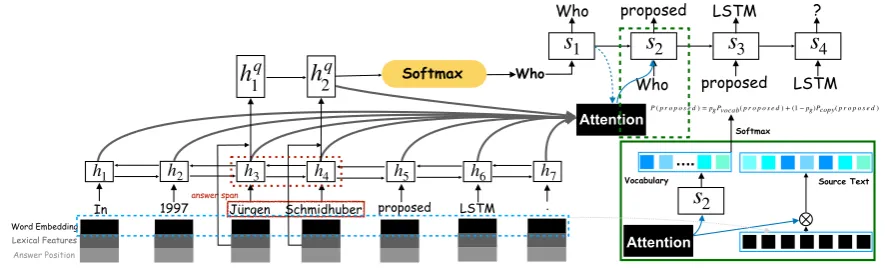
Figure 1: Structure of our unified model
between two tasks.
In this paper, we propose a unified model to predict the question type and to generate ques-tions simultaneously. We conduct experiments on two reading comprehension datasets: SQuAD and MARCO, and obtain promising results. As for the auxiliary task, our unified model boosts the accuracy of question type prediction significantly, by 16.79% on SQuAD and 3.5% on MARCO. For question generation, our model achieves new state-of-the-art results on both datasets, with BLEU-4 16.31 on SQuAD and 21.59 on MARCO.
2 Model Description
The structure of our model is shown in Figure1.
A feature-rich encoder is used to encode the input sentence and corresponding answer that is a span of the sentence. Besides, the answer hidden states are used to predict the type of target question. This prediction will further be used to guide QG with a unified attention-based decoder.
2.1 Feature-rich Encoder
FollowZhou et al.(2017), we exploit lexical fea-tures to enrich the encoder, where feafea-tures are composed of POS tags, NER tags, and word case.
We concatenate the word embedding et, answer
position embedding at and lexical features
em-beddingltas input ((x1, ..., xT),xt = [et;at;lt]).
Then a bidirectional LSTM is used to produce a sequence of hidden states(h1, ..., hT).
2.2 Question Type Prediction
Since different types of questions are various in syntax and semantics, it is essential to predict an accurate type for generating a reasonable question. According to the statistics on SQuAD, 78% of questions in the training set begin with the 7 most
common used question words as Table 1 shows.
So we divide question types into 8 categories, in-cluding 7 question words and an additional type ’others’. It shows that the data distribution on dif-ferent types is quite unbalanced, suggesting it is a hard task to predict the correct question type.
We use an unidirectional LSTM network to
pre-dict the expected question type. Assumingm+1,
..., m+ais the index of given answer span in the
in-put sentence, based on the corresponding feature-rich hidden states(hm+1, ..., hm+a), we calculate the question type hidden states as follow:
hqj=LST Mq([hm+j;lm+j], hqj−1), j∈[1, a] (1)
hq0 =hT (2)
wherelm+j is the corresponding lexical features.
Besides, to make full use of the feature-rich en-coder hidden states, we take the last hidden state as the initial hidden state ofLST Mq.
Then, the last output hidden statehqaare fed into
a softmax layer to obtain the type distribution:
P(Qw) =sof tmax(Wqhqa) (3)
Eq =−log(P(Q∗w)) (4)
Eq is the loss of question type prediction, Q∗
w is
the target type.
2.3 Unified Attention-based Decoder
The conventional attention-based decoder adopts a <BOS> token as the first input word at step
1, while we replace it with the predicted question
wordQwto guide the generation process. At step
i, we calculate the decoder hidden state as follow:
si=LST M([wi−1;ci−1], si−1) (5)
Further, to fuse the type information in every step of question generation, our model takes hqa
Type What Who How When Which Where Why Others
SQuAD 43.26% 9.39% 9.12% 6.26% 4.78% 3.76% 1.37% 21.83% MARCO 44.29% 1.47% 16.28% 1.52% 1.11% 4.16% 1.88% 29.29%
Table 1: Proportions of each type of questions on two datasets.
vector, i.e. the context vector is conditioned on
(h1, ..., hT, hT+1), wherehT+1 =hqa.
ci =
T+1
X
t=1
αitht (6)
where αit is calculated via attention mechanism
(Bahdanau et al.,2014).
Then,sitogether withciwill be fed into a two-layer feed-forward network to produce the vocab-ulary distributionPvocab.
Following (See et al.,2017), the copy mode is used to duplicate words from the source via point-ing:
P(wi) =pgPvocab(wi)+(1−pg)Pcopy(wi) (7)
wherePcopyis the distribution of copy mode,pg∈ [0,1]is a gate to dynamically assign weights.
The loss at step iis the negative log-likelihood of the target wordw∗i. To obtain a combined train-ing objective of two tasks, we add the loss of ques-tion type predicques-tion into the loss of quesques-tion gen-eration to form a total loss function:
Etotal= 1
K K
X
i=1
−logP(w∗i) +Eq (8)
3 Experiment
3.1 Experiment Settings
Dataset Following the previous works, we
con-duct experiments on two datasets, SQuAD and
MARCO. We use the data released byZhou et al.
(2017) and Sun et al. (2018), there are 86,635, 8,965 and 8,964 sentence-answer-question triples in the training, development and test set for SQuAD, and 74,097, 4,539 and 4,539 sentence-answer-question triples in the training, develop-ment and test set for MARCO, respectively. Lexi-cal features are extracted using Stanford CoreNLP.
Implementation DetailsOur vocabulary is set to
contain the most frequent 20,000 words in each
training set. Word embeddings are initialized
with the pre-trained 300-dimensional Glove vec-tors, and they are allowed to be fine-tuned during
training. The representations of answer position, POS tags, NER tags, and word case are randomly initialized as 32-dimensional vectors, respectively. The feature-rich encoder consists of 2 layers BiL-STM, and the hidden size of all encoders and de-coder is set to 512. The cutoff length of the input sequences is set to 10. In testing, we used beam search with a beam size of 12. The development set is used to search the best checkpoint. In order to decrease the volatility of the training procedure, we then average the nearest 5 checkpoints to ob-tain a single averaged model.
Following the existing work, we use BLUE (
Pa-pineni et al., 2002) as the metrics for automatic evaluation, with BLUE-4 as the main metric.
3.2 Upper Bound Analysis
To study the effectiveness of the question type for QG, we make an upper bound analysis. The ex-perimental results are shown in Table2.
First, we feed the decoder with the original first word of questions, regardless whether the first
word is a question word or not. As shown in
Table 2, comparing with the baseline model, the
performance gets 3.41 and 3.32 points increment on SQuAD and MARCO, respectively, which is a large margin.
Since the beginning words which are not ques-tion words compose a large vocabulary while the number of each word is few, it is irrational to train a classifier to predict all types of these beginning words. Therefore, we reduce the question type vocabulary to only question words. In details, if the start of a targeted question is a question word, the corresponding question word will replace the
<BOS> to feed into decoder, otherwise we just use the original<BOS>without any replacement. This experiment still gains a lot, as shown in Table
2with ”given the quetion type”.
Dataset SQuAD MARCO
Model BLEU-1 BLEU-2 BLEU-3 BLEU-4 BLEU-1 BLEU-2 BLEU-3 BLEU-4
feature-rich pointer generator (baseline) 41.25 26.76 19.53 14.89 54.04 36.68 26.62 20.15
given the first word of question 47.00 31.82 23.69 18.30 59.51 41.42 30.70 23.47 given the question type 45.56 30.53 22.61 17.38 57.39 39.60 29.29 22.52
Table 2: Upper bound analysis by incorporating question words with different ways.
Dataset SQuAD MARCO
Model BLEU-1 BLEU-2 BLEU-3 BLEU-4 BLEU-1 BLEU-2 BLEU-3 BLEU-4
NQG++ (Zhou et al.,2017) - - - 13.29 - - - -question word generate model (Sun et al.,2018) 42.10 27.52 20.14 15.36 46.59 33.46 24.57 18.73 Hybrid model (Sun et al.,2018) 43.02 28.14 20.51 15.64 48.24 35.95 25.79 19.45 Maxout Pointer (sentence) (Zhao et al.,2018) 44.51 29.07 21.06 15.82 - - - 16.02
Our Model
Feature-rich pointer generator (Baseline) 41.25 26.76 19.53 14.89 54.04 36.68 26.62 20.15 Question-type driven model (Unified-model) 43.11 29.13 21.39 16.31 55.67 38.16 28.12 21.59
Table 3: Experimental results of our model comparing with previous methods on two datasets.
3.3 Results and Analysis
Main Results The experimental results on two
datasets are shown in Table 3. By
incorporat-ing the question type prediction, our model ob-tains obvious performance gain over the baseline model, with 1.42 points gain on SQuAD and 1.44 on MARCO. Comparing with previous methods, our model outperforms the existing best meth-ods, achieving new state-of-the-art results on both datasets, with 16.31 on SQuAD and 21.59 on MARCO.
Question Type Accuracy We evaluate different
models in terms of Beginning Question Word Ac-curacy (BQWA). This metric measures the ratio of the generated questions that share the same begin-ning word with the references which begin with a
question word. Table4displays the BQWA of two
models on both datasets. It shows that our uni-fied model brings significant performance gain in question type prediction.
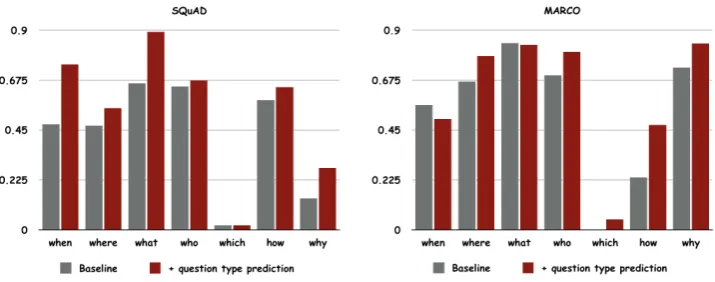
Further, in Figure 2 we show the accuracy of
different question words on both datasets in detail. Our unified model outperforms the baseline for all question types on SQuAD, and all but two types on MARCO.
[image:4.595.73.527.63.131.2]Model BQWA on SQuAD BQWA on MARCO Baseline 57.62% 76.98% Unified model 74.41% 80.48%
Table 4: Experiments of the beginning question word accuracy.
Model AnalysisWe conduct experiments on
dif-ferent variants of our model, as shown in Table5. “w/o answer hidden state” takes(xm+1, ..., xm+a)
as the input of type decoder instead of answer hid-den states; “w/o question word replace<BOS>” simply use<BOS>as the first input word of de-coder. Experiments on SQuAD verify the effec-tiveness of our model setting.
Dataset SQuAD
Model BLEU-1 BLEU-2 BLEU-3 BLEU-4
Unified-model 43.11 29.13 21.39 16.31 w/o answer hidden states 41.91 27.77 20.37 15.54 w/o question word replace<BOS> 41.05 26.93 19.73 15.10
Table 5: Experiments on different settings of our model.
Case StudyTo show the effect of question words
prediction on question generation, Table 6 lists
some typical examples.
In the first example, the baseline fails to
recog-nizeLen-shapedas an adjective, while the
unified-model succeeds by utilizing lexical features which are the input of question type prediction layer.
In the second example, the baseline assigns a location type for the generated question based on
AmericanandIsrael, it fails to consider the whole
answer span. Our unified model resolves it by encoding the answer hidden states sequence as a whole.
The third example shows another typical error, which fails to consider answer surrounding text. In this example the given answer only
con-tains a number 66. By taking article 66into
nu-Figure 2: The accuracy on different question words.
merical type. Since the answer hidden states used as the input of type prediction contain surrounding information, our model resolves this problem.
Context: In land plants , chloroplasts are generally lens-shaped, 5–8 m in diameter and 1–3 m thick. Reference: How are chloroplasts in land plants usually shaped?
Baseline:What are chloroplasts generally generally? Unified-model:How are chloroplasts in land plants?
Context:In response to American aid to Israel, on Octo-ber 16, 1973, OPEC raised the posted price of oil by 70%, to $5.11 a barrel.
Reference:Why did the oil ministers agree to a cut in oil production?
Baseline: Where did OPEC receive the price of oil by 70%?
Unified-model: Why did OPEC raised the posted price of oil by 70%?
Context:Article 65 of the agreement banned cartels and article 66 made provisions for concentrations, or mergers, and the abuse of a dominant position by companies. Reference:Which article made provisions for concentra-tions or mergers and the abuse of a dominant position by companies?
Baseline:How many provisions made provisions for con-centrations?
Unified-model: Which article made provisions for con-centrations, or mergers?
Table 6: Examples of generated questions. The under-line words are the target answer.
4 Conclusion
In this paper, we discuss the challenge in question type prediction for question generation. We pro-pose a unified model to predict the type and uti-lize it to guide the generation of question. Experi-ments on SQuAD and MARCO datasets verify the effectiveness of our model. We improve the accu-racy of question type prediction by a large margin, and achieve new state-of-the-art results for ques-tion generaques-tion.
Acknowledgments
We thank Weikang Li, Xin Jia and Nan Jiang for their valuable comments and suggestions. This work is supported by the National Natural Science Foundation of China (61773026).
References
Dzmitry Bahdanau, Kyunghyun Cho, and Yoshua Bengio. 2014. Neural machine translation by jointly learning to align and translate. CoRR, abs/1409.0473.
Xinya Du and Claire Cardie. 2017. Identifying where to focus in reading comprehension for neural ques-tion generaques-tion. In Proceedings of the 2017 Con-ference on Empirical Methods in Natural Language Processing, EMNLP 2017, Copenhagen, Denmark, September 9-11, 2017, pages 2067–2073.
Nan Duan, Duyu Tang, Peng Chen, and Ming Zhou. 2017. Question generation for question answer-ing. InProceedings of the 2017 Conference on Em-pirical Methods in Natural Language Processing, EMNLP 2017, Copenhagen, Denmark, September 9-11, 2017, pages 866–874.
Wenpeng Hu, Bing Liu, Jinwen Ma, Dongyan Zhao, and Rui Yan. 2018. Aspect-based question gener-ation. In 6th International Conference on Learn-ing Representations, ICLR 2018, Vancouver, BC, Canada, April 30 - May 3, 2018, Workshop Track Proceedings.
Kishore Papineni, Salim Roukos, Todd Ward, and Wei-Jing Zhu. 2002. Bleu: a method for automatic eval-uation of machine translation. InProceedings of the 40th Annual Meeting of the Association for Compu-tational Linguistics, July 6-12, 2002, Philadelphia, PA, USA., pages 311–318.
[image:5.595.120.478.61.202.2]- August 4, Volume 1: Long Papers, pages 1073– 1083.
Heung-Yeung Shum, Xiaodong He, and Di Li. 2018.
From eliza to xiaoice: challenges and opportuni-ties with social chatbots. Frontiers of IT & EE, 19(1):10–26.
Linfeng Song, Zhiguo Wang, Wael Hamza, Yue Zhang, and Daniel Gildea. 2018. Leveraging context infor-mation for natural question generation. In Proceed-ings of the 2018 Conference of the North American Chapter of the Association for Computational Lin-guistics: Human Language Technologies, NAACL-HLT, New Orleans, Louisiana, USA, June 1-6, 2018, Volume 2 (Short Papers), pages 569–574.
Sandeep Subramanian, Tong Wang, Xingdi Yuan, Saizheng Zhang, Adam Trischler, and Yoshua Ben-gio. 2018. Neural models for key phrase extrac-tion and quesextrac-tion generaextrac-tion. In Proceedings of the Workshop on Machine Reading for Question An-swering@ACL 2018, Melbourne, Australia, July 19, 2018, pages 78–88.
Xingwu Sun, Jing Liu, Yajuan Lyu, Wei He, Yan-jun Ma, and Shi Wang. 2018. Answer-focused and position-aware neural question generation. In Pro-ceedings of the 2018 Conference on Empirical Meth-ods in Natural Language Processing, Brussels, Bel-gium, October 31 - November 4, 2018, pages 3930– 3939.
Duyu Tang, Nan Duan, Tao Qin, and Ming Zhou. 2017.
Question answering and question generation as dual tasks.CoRR, abs/1706.02027.
Yansen Wang, Chenyi Liu, Minlie Huang, and Liqiang Nie. 2018. Learning to ask questions in open-domain conversational systems with typed decoders. InProceedings of the 56th Annual Meeting of the As-sociation for Computational Linguistics, ACL 2018, Melbourne, Australia, July 15-20, 2018, Volume 1: Long Papers, pages 2193–2203.
Yao Zhao, Xiaochuan Ni, Yuanyuan Ding, and Qifa Ke. 2018. Paragraph-level neural question gener-ation with maxout pointer and gated self-attention networks. InProceedings of the 2018 Conference on Empirical Methods in Natural Language Process-ing, Brussels, Belgium, October 31 - November 4, 2018, pages 3901–3910.