Proceedings of the 10th International Workshop on Health Text Mining and Information Analysis (LOUHI 2019), pages 126–135
126
Automatic rubric-based content grading for clinical notes
Wen-wai Yim, Harold Chun, Teresa Hashiguchi, Justin Yew, Bryan Lu
Augmedix, Inc.
{wenwai.yim,haroldchun,teresa, justinyew,bryan}
@augmedix.com
Ashley Mills
University of Cincinnati College of Medicine
Abstract
Clinical notes provide important documenta-tion critical to medical care, as well as billing and legal needs. Too little information de-grades quality of care; too much information impedes care. Training for clinical note doc-umentation is highly variable, depending on institutions and programs. In this work, we introduce the problem of automatic evaluation of note creation through rubric-based content grading, which has the potential for accelerat-ing and regularizaccelerat-ing clinical note documenta-tion training. To this end, we describe our cor-pus creation methods as well as provide sim-ple feature-based and neural network baseline systems. We further provide tagset and scal-ing experiments to inform readers of plausible expected performances. Our baselines show promising results with content point accuracy and kappa values at 0.86 and 0.71 on the test set.
1 Introduction
Clinical notes, essential aspects of clinical care, document the principal findings of the visit, hos-pital stay or treatment episode, including com-plaints, symptoms, relevant medical history, tests performed, assessments and plans. During an en-counter or soon after, notes are created based on subjective history, objective observations, as well as clinician assessment and care plans. Although this is a regular aspect of clinical care in all in-stitutions, there is a large variability in the details taken. Clinical documentation training is often informal and institution-dependent, as systematic training of clinical documentation can be time-consuming and expensive. Training involves con-tinued monitoring of note quality and complete-ness.
In this work, we present the problem of clini-cal note grading and provide several baseline sys-tems for automatic content grading of a clinical
note given a predefined rubric. To solve the prob-lem, we built a simple feature-based system and a simple BERT-based system. We additionally pro-vide training size experiments and tagset ments for our baseline systems, as well as experi-ment with the relevance of using Unified Medical Language System (UMLS) and similarity features.
2 Background
Clinical notes serve as critical documentation for several purposes: medical, billing, and legal requirements. At the same time, a clinical note is written, updated, and consumed for the purpose of communication between clinicians for clinical care over a period of time. Too much irrelevant information can become an impediment to clinical care. Therefore, the identification of a base level of information is required to assess a note.
At our institution, clinical note documentation (or medical scribe) trainees are assessed via quizzes and exams in which trainees produce clinical notes based on mock patients visits (written to mimic outpatient encounters). Clinical note responses are graded against a grading rubric by training specialists, who have medical scribing experience as well as specialized training in determining note quality. The goal is to train scribes to produce a clinical note based on listen-ing to the patient-clinician conversation durlisten-ing a clinical visit. Thus, the scribe expected to actively producing content, not just merely transcribe dictations from a clinician.
symptom will typically require information about duration and severity. A rubric item discussing medication will often include dosage information. Each rubric is associated with a section of the note where it needs to be placed. For training purposes, standard note sections include: History of Present Illness (HPI), a detailed subjective record of the patient’s current complaints; Review of Systems (ROS), the patient’s subjective com-plaints grouped by organ system; Physical Exam (PE), the clinician’s objective findings grouped by organ system; and Assessment and Plan (AP), the clinician’s diagnosis and the next steps in treatment for each diagnosis. Figure 1 gives an example of a clinical note with these sections.
If the note contains text that satisfies a rubric item, then a content point for that rubric item is awarded. If the note contains an incorrect statement (e.g. the wrong medication dosage), then that rubric point is not awarded, regardless of a correct statement appearing elsewhere. If the note lacks the inclusion of a rubric point, then that rubric point is not awarded. At most, one content point can be awarded per rubric item. Examples of several rubric items with corresponding portions of a clinical note are shown in below.
Rubric item examples
• frequent bm 3-4 times per day (HPI section), documents relevant symptom history –”The pa-tient complains of frequent bowel movements, 3-4 times daily.”
• pe skin intact no clubbing cyanosis (PE sec-tion), documents physical exam performed dur-ing visit – ”Skin: Skin intact. No clubbing or cyanosis. Warm and dry.”
• plan advise brat diet (AP section), documents that the provider recommended the BRAT diet to the patient –”Recommended that the patient follow the BRAT diet for the next few days. ”
3 Related Work
Most community efforts in automatic grading have been in the context of automatic essay grad-ing (AEG) and automatic short answer gradgrad-ing (ASAG), both of which harbor significant differ-ences than our rubric-based content grading task.
AEG involves rating the quality of an essay in terms of coherence, diction, and grammar varia-tions. Typically, an essay is given a score, e.g.
CHIEF COMPLAINT: Frequent urination
HISTORY OF PRESENT ILLNESS:
The patient is a 33 year old female who presents today complaining of frequent urination and bowel movements...
...
REVIEW OF SYSTEMS:
Constitutional: Negative for fevers, chills, sweats. ...
PHYSICAL EXAM:
General: Temperature normal. Well appearing and no acute distress ...
ASSESSMENT & PLAN:
1. Ordered urinalysis to rule out urinary tract infection 2. Put her on brat diet, counseled patient that BRAT diet is... ...
Figure 1: Abbreviated example of a clinical note. Clin-ical notes are typClin-ically organized by sections. The ex-act section types and ordering in real prex-actice my vary by specialty and organization.
from 1-6. Applications include essay grading for standardized tests such as for the GMAT (Gradu-ate Management Admission Test) or TOEFL (Test of English as Foreign Language) (Valenti et al., 2003). Key architects for these systems are often commercial organizations. Examples of commer-cial computer-assisted scoring (CAS) systems in-clude E-rater and Intelligent Essay Assessor. Sys-tems such as E-rater use a variety of lingustic features, including grammar, diction, and as well as including discourse level features (Attali and Burstein, 2006; Zesch et al., 2015). In another approach, the Intelligent Essay Assessor uses la-tent semantic analysis to abstract text to lower-rank dimension-cutting representations of docu-ments. Scores are assigned based on similarity of new text to be graded to a corpus of previously graded text (Foltz et al.,1999). The release of the Kaggle dataset has made this type of data more available to the public (kaggle.com/c/asap aes). A key difference of AEG task from our grading task is that our efforts focus on specific content item grading and feedback, over a single holistic docu-ment level rating.
(Lea-cock and Chodorow,2003;Sukkarieh and Black-more,2009). Each required piece of content, sim-ilar to our rubric, in the text is marked as absent, present, negated, with a default of not scored. Text goes through several processing steps, in-cluding spelling correction, concept recognition, pronoun resolution, and parsing. These features are then sent through a maximum entropy model for classification. Semantic similarity approaches apply a mixture of deep processing features, e.g. shortest path between concepts or concept sim-ilarities (Mohler and Mihalcea, 2009). In the SemEval 2013 Task 7 Challenge, the task in-volved classification of student answers to ques-tions, given a reference answer, and student an-swers. Student answers are judged to be correct, partially correct incomplete, contradictory, irrel-evant, or non domain (Dzikovska et al., 2013). Although it has much in common to our rubric-based content grading setup, short answer grading has less document level issues to contend with. Moreover, specifically for our case, document-level scoring has some non-linearity with the in-dividual classification of sub-document level text, e.g. finding one contradictory piece of evidence negates a finding of a positive piece of evidence.
The work of (Nehm et al., 2012), which at-tempts to award content points for specific items for college biology evolution essays, most closely resembles our task. In the task, students are awarded points based on whether they articu-late key natural selection concepts, e.g. familiar plant/trait gain (mutation causing snail to produce poisonous toxin would increase fitness). The au-thors experimented with configuring two text an-alytic platforms for this task: SPSS Text Analy-sis 3.0 (SPSSTA) and Summarization Integrated Development Environment (SIDE). SPSSTA re-quires building hand-crafted vocabulary and at-tached rules. SIDE uses a bag-of-words represen-tation run through a support vector machine algo-rithm for text classification. Key differences from our task are that rubric items are more numerous and specific; furthermore, our medium is a clinical note, which has documented linguistic and docu-ment style differences than normal essays; finally, our goal is not only to grade but to give automated in-text feedback.
In this work, we present our system for grading a clinical note given a grading rubric, which also gives subdocument level feedback. To our
knowl-edge, there has been no previous attempt at clinical note automatic content grading.
4 Corpus Creation
We created a corpus by grading training notes by multiple different trainees quizzed on the same mock patient visit quiz, which included 40 rubric items. Annotation was carried out using using the ehost annotation tool (South et al., 2012). Annotators were asked to highlight sentences for if they were relevant to a rubric item. Further-more, they were to mark whether a highlight had one of four attributes: correct, incorrect contrary, incorrect missingitem, and incorrect section.
frequent bm 3-4 times per day attribute examples
• correct –”The patient reports having 3-4 bowel movements a day.”(Located in the HPI)
• incorrect contrary –”The patient has been hav-ing bowel movements every 30 minutes.” (Lo-cated in the HPI) Explanation: The frequency is much higher than what would be expected for 3-4 times per day. Thus the information content is considered to be inaccurate or contrary to what is given by the rubric.
• incorrect missingitem – ”The patient reports having many bowel movements each day.” (Lo-cated in the HPI) Explanation: This statement does not give any inaccurate information but is missing a crucial element that is required to earn this rubric point, which is the frequency value is 3-4 times per day.
• incorrect section –”The patient reports having 3-4 bowel movements a day.” (Located in the AP) Explanation: This statement is correct, but is located in the wrong section of the note.
A1 A2 A3 A4 A5
A1 - 0.84/0.68 0.84/0.69 0.86/0.72 0.85/0.69 A2 - - 0.86/0.72 0.87/0.73 0.87/0.73 A3 - - - 0.87/0.73 0.85/0.69
[image:4.595.327.502.60.151.2]A4 - - - - 0.88/0.76
Table 1: Content-point inter-annotator agreement (per-cent identity/kappa).
A1 A2 A3 A4 A5
A1 - 0.84/0.68 0.84/0.69 0.86/0.72 0.85/0.69 A2 - - 0.86/0.72 0.87/0.73 0.87/0.73 A3 - - - 0.87/0.74 0.85/0.69
[image:4.595.83.283.61.114.2]A4 - - - - 0.88/0.76
Table 2: Offset-level inter-annotator agreement (label/label-attribute).
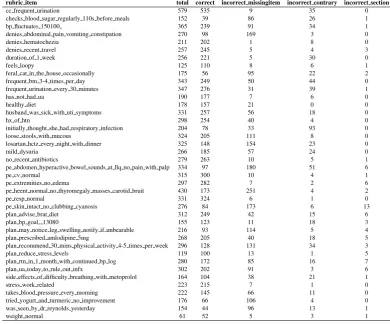
notes, with a total of 10406 highlights1. A total of 244 rubric items required connecting discontinous highlights. The full corpus statistics are shown in Table3.
Inter-annotator agreement was measured among 5 annotators for 9 files. We measured agree-ment at several levels. At a note level, we mea-sured pairwise percent identity and Cohen’s kappa (McHugh, 2012) by content points. At the text offset level, we measured precision, recall, and f1 (Hripcsak and Rothschild, 2005) for inexact overlap of highlights both at the label level (e.g. cc frequent urination) and at a label attribute level (e.g. cc frequent urination:correct). Since incor-rect section is not counted in content-based grad-ing, for both inter-annotator agreement and for subsequent analysis, incorrect section highlights were counted as correct unless overlapping with a incorrect missingitem highlight, which would make it count as incorrect missingitem. The agreement scores are shown in Table 1 and 2. Fleiss kappa (Fleiss, 1971) at the content point level was at 0.714. The rest of the corpus was di-vided among 5 annotators.
5 Methods
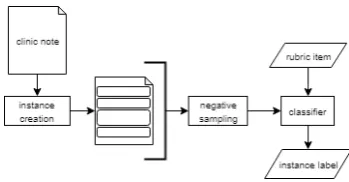
We performed classification for two types of systems: a feature-based and a simple BERT based neural network system for text classifi-cation. Since discontinuous text highlights ac-counted for less than 10% of items, we choose not to model this nuance. Both systems used the same pre-processing pipeline configurations shown in Figure2.
1Includes highlights for excluding the note, as well as
ex-cluding short hand text and ROS sections
Figure 2: General pipeline
We split 338 files into 270 training, 68 test set. Tuning was performed on the training set in 5-fold cross validation.
5.1 Pipeline configurations
The text was preprocessed, where short-hand text and blank lines were removed. Sentences and words were tokenized using spaCy (spacy.io).
Instances were created by extracting minichunks (sentences or subsections in the case of the PE section) from the clinical note iden-tified using regular expressions. We experimented with three tag-set configurations (tag gran) with values (2lab, 3lab, 4lab), which represents {1 vs 0 points}, {correct, incorrect contrary, vs missing} and {correct, incorrect contrary, in-correct missingitem, missing} per rubric item. Missing is the default value if no relevant high-light annotates the sentence.
For the minichunk level, we set a configura-tion negative sampling ratio (neg samp) which specifies the factor of default class instances to non-default class instances. A similarity feature flag (simfeat on) turns on similarity features in the feature-based system or switch the BERT-based system to one which includes matching features. For our feature based modeling, we used scikit-learn (Pedregosa et al., 2011), for our neural network pipelines we incorporated allennlp (Gardner et al.).
5.2 Feature based system
The feature based system includes an n-gram fea-ture extraction, which then passed through a chi-squared statistical feature selection, before using a support vector machine implemented by scikit learn svc.
[image:4.595.78.283.163.217.2]rubric item total correct incorrect missingitem incorrect contrary incorrect section
cc frequent urination 579 535 9 35 0
checks blood sugar regularly 110s before meals 152 39 86 26 1
bp fluctuates 150100 365 239 91 34 1
denies abdominal pain vomiting constipation 270 98 169 3 0
denies hematochezia 211 202 1 8 0
denies recent travel 257 245 5 4 3
duration of 1 week 256 221 5 30 0
feels loopy 125 110 8 6 1
feral cat in the house occasionally 175 56 95 22 2 frequent bm 3-4 times per day 343 249 50 44 0 frequent urination every 30 minutes 347 276 31 39 1
has not had ua 190 177 7 6 0
healthy diet 178 157 21 0 0
husband was sick with uti symptoms 331 257 56 18 0
hx of htn 298 254 40 4 0
initially thought she had respiratory infection 204 78 33 93 0
loose stools with mucous 324 205 111 8 0
losartan hctz every night with dinner 325 148 154 23 0
mild dysuria 266 185 57 24 0
no recent antibiotics 279 263 10 5 1
pe abdomen hyperactive bowel sounds at llq no pain with palp 334 97 180 51 6
pe cv normal 315 300 10 4 1
pe extremities no edema 297 282 7 2 6
pe heent normal no thyromegaly masses carotid bruit 430 173 251 4 2
pe resp normal 331 324 6 1 0
pe skin intact no clubbing cyanosis 276 84 173 6 13
plan advise brat diet 312 249 42 15 6
plan bp goal 13080 155 123 11 18 3
plan may notice leg swelling notify if unbearable 216 93 114 5 4 plan prescribed amlodipine 5mg 268 205 40 18 5 plan recommend 30 mins physical activity 4-5 times per week 296 128 131 34 3
plan reduce stress levels 119 100 13 1 5
plan rtn in 1 month with continued bp log 280 172 85 16 7 plan ua today to rule out infx 302 202 91 3 6 side effects of difficulty breathing with metoprolol 164 104 38 21 1
stress work related 223 215 7 1 0
takes blood pressure every morning 222 145 66 11 0 tried yogurt and turmeric no improvement 176 66 106 4 0 was seen by dr reynolds yesterday 154 44 96 13 1
[image:5.595.100.491.64.388.2]weight normal 61 52 5 3 1
Table 3: Label frequencies for full corpus
and umls concept grams (if the umls flag is on) are also added. We used jaccard similarity between 1-, 2-1-, and 3- grams. The full configurations include the following :
• top n : top number of significant features to keep according to chi-squared statistic fea-ture selection (integer)
• sec feat : setting to determine how section information is encoded. If “embed” is set, then each feature with be concatenated with its section, e.g. “sect[hpi]=patient”. If “sep” is turned on, “sect=hpi” is added as a feature.
• umls : whether or not to use umls features (binary)
• simfeat on : whether or not to turn on simi-larity features (binary)
• text off : whether or not to turn off the fea-tures not related to similarity
• umls text off : whether or not to turn off the umls features not related to similarity
• sent win : window for which surrounding sentence features should be added, e.g. sent[-1]=the would be added as a feature from previous sentence unigram feature “the” if
sent win=1. (integer)
5.3 BERT based system
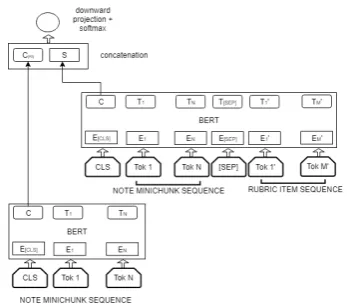
The neural network system made use of the pre-vious instance creation pipeline; however in place of feature extraction, instances were transformed into BERT word vector representations. We used the output for CLS position of the embeddings to represent the whole sequence similar to that of the original paper (Devlin et al.,2018).
To mimic the feature-based system’s case of simfeats on, we include a switch to an architec-ture that also feeds in the CLS position output from a paired BERT classification setup. When simfeats on is turned off, the architecture be-comes that of a simple BERT sentence classifi-cation (bert). When text off is turned on, then the architecture becomes that of a simple BERT sentence pair classification (bertpair). When sim-feats on is turned on and text off is turned off, we have a system with both types off representations (bert+bertpair). A figure of the BERT classifier setup is show in Figure3.
cor-Figure 3: BERT with additional sentence pair classifier
pora, we used pre-trained BERT embedding and vocabulary from bio-bert, which is fine-tuned on pubmed data (Lee et al.,2019).
5.4 Simple baseline
For a further comparison, we have included a feature-based document-based baseline. This baseline largely follows the previously mentioned feature-based baseline though performed at the document level. Because it is performed at a doc-ument level, some attribution to a sub-docdoc-ument level unit becomes necessary. (Recall, we wish to be able to identify which part of the document is relevant to a rubric item as well as if we believe it is correct or otherwise.) To identify a correspond-ing offset labelcorrespond-ing for this settcorrespond-ing, we attributed a document level classification to a sentence which contained the maximum amount of important fea-tures. We defined features to be important ac-cording to their learned feature weight magnitude crossing a configurable threshold value. Thus, for a document classification, based on this logic we are able to assign a sentence related to that classi-fication, for which we can use all our previously mentioned metrics for evaluation. We found a threshold of 10 to work well in our experiments.
5.5 Evaluation
Similar to inter-annotator agreement, we mea-sured performance using several metrics. At the note level, we measured distance to target full doc-ument score by mean absolute error (MAE). We also measured content point accuracy and kappa to get a sense of the performance in point assign-ment.
At the offset level, we measured precision, re-call, and f1 for rubric item label-attribute value.
For minichunk classification, offsets were trans-lated according to the start and end of the minichunk in the document.
6 Results
Evaluations in cross-validation are reported as the average of all 5 folds. Consistent with this, graph-ical error bars in the learning curve figures repre-sent the standard deviation across folds.
6.1 Experimental configurations
Feature-based parameter tuning. We started with tag gran at 4lab, simfeats on true, and top n set at 1000, sent win=0, and neg samp=2. We then greedily searched for an optimal solution varying one parameter at a time to optimize precision, recall and f1 measure. Our final configura-tions were set to neg samp=10, sect feat set to ”sep”, top n=4000, sent win=0. We kept the same configurations for the other feature-based systems.
Neural network hyperparmeter tuning.
For the neural network models, we mainly ex-perimented with negative sampling size, dropout, and context length. We found a neg samp=100, dropout=0.5, epochs=2 and context len=300 to work well.
6.2 Cross-validation and test results
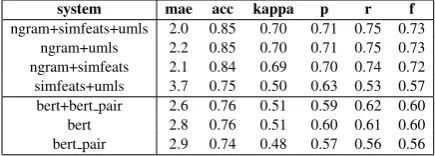
Table4shows performances for the feature-based system using different tagsets in cross-validation. Unsurprisingly the most detailed label (4lab) at the more granualar level (minichunk) showed the best performance. Tables4 and 5shows the compar-ison of different system configurations in evalu-ated in cross validation. Table 6 shows results for the test set for different systems. In general, the feature-based system with the full feature-set out performed for the cross-validation and test ex-periments. Among the BERT systems, the simple BERT system did better than the other two config-urations.
6.3 Scaling and tagset experiments
[image:6.595.90.264.60.212.2]tagset mae acc kappa p r f
[image:8.595.71.293.63.148.2]4lab 2.0 0.85 0.70 0.71 0.75 0.73 3lab 4.5 0.82 0.63 0.69 0.64 0.66 2lab 5.4 0.80 0.60 0.69 0.63 0.66 doc-4lab 3.1 0.80 0.59 0.58 0.53 0.55 doc-3lab 2.5 0.80 0.58 0.65 0.43 0.52 doc-2lab 2.9 0.78 0.55 0.67 0.42 0.52
Table 4: Feature-based system results for 5-fold cross-validation, varying tagsets.
system mae acc kappa p r f ngram+simfeats+umls 2.0 0.85 0.70 0.71 0.75 0.73
ngram+umls 2.2 0.85 0.70 0.71 0.75 0.73 ngram+simfeats 2.1 0.84 0.69 0.70 0.74 0.72 simfeats+umls 3.7 0.75 0.50 0.63 0.53 0.57 bert+bert pair 2.6 0.76 0.51 0.59 0.62 0.60 bert 2.8 0.76 0.51 0.60 0.61 0.60 bert pair 2.9 0.74 0.48 0.57 0.56 0.56
Table 5: Results for 5-fold cross-validation, tag gran=4lab.
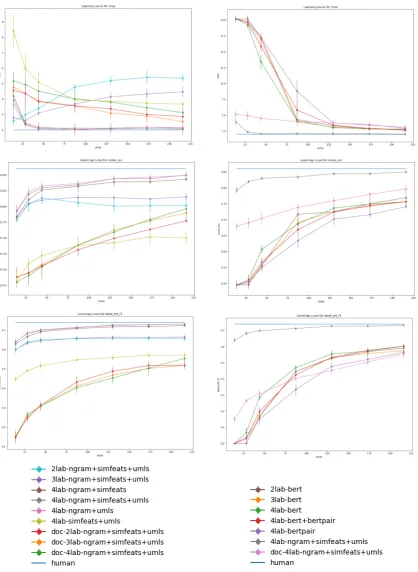
when trained to maximize both precision and re-call equally for label attributes, MAE will rise in-stead of lower such as for the other system setups. This makes sense, as both tagset settings miss cru-cial examples that exhibit confusing features. For example, on the 2lab setting, only positive exam-ples are shown not those that have incorrect infor-mation or those that have missing inforinfor-mation (i.e. partially correct information). Likewise, the 3lab setting does not have evidence for partially correct items. We found experimentally, when tuning for higher precision and lower recall, that MAE also tends to lower– suggesting that these two settings can be better maximized by tuning for MAE in-stead.
Like the document-based baseline, the BERT systems’ performances showed that tagset did not make as big of a difference across all three metrics at different training size levels. This is possibly because there were not enough examples to even properly fine-tune for these two systems which require more training data. At higher levels of training sizes, tagsets may again come into ef-fect. Though the BERT systems at lower train-ing sizes start at lower performances, it quickly catches up to the document classification baseline for the MAE and f1 metrics, though never gets close to the 4lab feature-based baseline.
system mae acc kappa p r f ngram+simfeats+umls 2.5 0.85 0.70 0.68 0.78 0.72
[image:8.595.71.289.225.303.2]ngram+umls 2.5 0.85 0.70 0.68 0.78 0.72 ngram+simfeats 2.3 0.86 0.71 0.68 0.79 0.73 simfeats+umls 3.8 0.77 0.54 0.63 0.55 0.59 bert+bert pair 3.2 0.77 0.53 0.57 0.60 0.58 bert 2.8 0.79 0.57 0.59 0.63 0.61 bert pair 3.1 0.76 0.51 0.58 0.60 0.59
Table 6: Detailed results for the test set, tag gran=4lab.
6.4 UMLS and similarity features
The addition of similarity features did not pro-vide a significant boost for the ngram feature-based system. Similarity features alone for the feature-based system underperformed at all train-ing size levels compared to the ngram models. On the other hand, the addition of UMLS features in-creased performance across three metrics for all training size levels.
The BERT based system using only the sim-ple BERT representation (without paired features), outperformed the other two settings across the three metrics at most training size levels in cross-validation. However, near higher levels of training data, BERT with BERT pair becomes comparable. The BERT pair system underperforms across all three metrics and at all training sizes.
6.5 Error Analysis
eval tp fp fn p r f
label-att 1470 700 424 0.68 0.78 0.72
[image:9.595.73.287.63.104.2]label 1708 413 186 0.81 0.90 0.85
Table 7: Results for the test set, ngram+simfeats+umls tag gran=4lab.
indicates that many errors are due to confusion between classification categories. Contradictions, labeled incorrect contrary, for this reason was a large problem.
Manually studying errors in the test set for the best performing system, we found that rubric items frequently identified in the training, were broadly correctly classified. How-ever, there were some rubric items that had more inconsistencies in how they were being tagged or graded. Some errors were partly due to human grading error. For example, checks blood sugar regularly 110s before meals was a rubric item that scribes frequently missed when creating notes. Due to this, some sentences with just “checks” were sometimes labeled for checks blood sugar regularly 110s before meals despite the fact that the sentences were about checking blood pressure. This leads to cases where synonymous phrases to “blood sugar”,
“blood glucose”, did not get labeled as instances with“blood glucose”by the human graders.
7 Conclusions
In this paper we present the problem of clinical note grading and provide several baseline system evaluations at different levels of training data. We show experimentally that the choice of labeling has large effects upon the system performance. Furthermore, though neural network systems may relieve a lot of feature-engineering, this may not be plausible for smaller corpora.
Further improvements can be made by rubric-item specific pipeline specialization, as well as further augmentation of specific feature extrac-tion modules, e.g. better negation handling. Deeper processing methods and features, includ-ing use of lemma-ization and dependency struc-tures, would make features more generalizable. On the other hand, to maximize performance, feature-extraction can also be made more rubric-item specific, for example by hand-crafting fea-tures. For this work, we used a linear support
vector machine for our classifier, but further ex-perimentation with different classifiers for each rubric item would lead to higher performances. The BERT systems can be improved by increasing training size and adding more feed-forward layers. Our proposed system can be used to expedite and formalize clinical note creation in a training setting. For example, instead of having a human grader view all training notes, a simple pass of the automated grading system can eliminate those that will fail with some confidence. For others, a hu-man grader can correct the output of the system, which would speed the grading process then if the grader had to mark highlights alone. In this work, we focus on cases for which we have many exam-ples of clinical notes generated for the same en-counter with a fixed rubric. Future work will in-vestigate grading for arbitrary notes and rubrics.
Acknowledgments
We would like to thank the Augmedix training specialist team as well as all those involved with creating the source dataset for this work.
Very special thanks to Kevin Holub and Sonny Siddhu for their efforts in initiating Augmedix’s efforts in AI-assisted in-text grading for which is the motivation behind this project.
References
kaggle.com/c/asap aes. The hewlett foundation: Auto-mated essay scoring|kaggle.
Alan R Aronson and Franois-Michel Lang. 2010. An overview of MetaMap: historical perspective and re-cent advances. 17(3):229–236.
Yigal Attali and Jill Burstein. 2006. Automated essay scoring with e-rater v.2|the journal of technology, learning and assessment. 4(3).
Steven Burrows, Iryna Gurevych, and Benno Stein. 2015.The eras and trends of automatic short answer grading. 25(1):60–117.
Jacob Devlin, Ming-Wei Chang, Kenton Lee, and Kristina Toutanova. 2018. BERT: Pre-training of deep bidirectional transformers for language under-standing. abs/1810.04805.
Volume 2: Proceedings of the Seventh International Workshop on Semantic Evaluation (SemEval 2013), pages 263–274, Atlanta, Georgia, USA. Association for Computational Linguistics.
JL Fleiss. 1971. Measuring nominal scale agreement among many raters. 76(5):378–382.
Peter W Foltz, Darrell Laham, and Thomas K Lan-dauer. 1999. IMEJ article - the intelligent essay as-sessor: Applications to educational technology.
Matt Gardner, Joel Grus, Mark Neumann, Oyvind Tafjord, Pradeep Dasigi, Nelson F. Liu, Matthew E. Peters, Michael Schmitz, and Luke S. Zettlemoyer. AllenNLP: A deep semantic natural language pro-cessing platform. abs/1803.07640.
George Hripcsak and Adam S Rothschild. 2005.
Agreement, the f-measure, and reliability in infor-mation retrieval. 12(3):296–298.
Claudia Leacock and Martin Chodorow. 2003. C-rater: Automated scoring of short-answer questions. 37(4):389–405.
Jinhyuk Lee, Wonjin Yoon, Sungdong Kim, Donghyeon Kim, Sunkyu Kim, Chan Ho So, and Jaewoo Kang. 2019. BioBERT: a pre-trained biomedical language representation model for biomedical text mining.
Mary L McHugh. 2012. Interrater reliability: the kappa statistic. 22(3):276–282.
Michael Mohler and Rada Mihalcea. 2009. Text-to-text semantic similarity for automatic short answer grading. InEACL.
Ross H. Nehm, Minsu Ha, and Elijah Mayfield. 2012. Transforming biology assessment with ma-chine learning: Automated scoring of written evolu-tionary explanations. 21(1):183–196.
F. Pedregosa, G. Varoquaux, A. Gramfort, V. Michel, B. Thirion, O. Grisel, M. Blondel, P. Pretten-hofer, R. Weiss, V. Dubourg, J. Vanderplas, A. Pas-sos, D. Cournapeau, M. Brucher, M. Perrot, and E. Duchesnay. 2011. Scikit-learn: Machine learning in Python. Journal of Machine Learning Research, 12:2825–2830.
Brett R. South, Shuying Shen, Jianwei Leng, Tyler B. Forbush, Scott L. DuVall, and Wendy W. Chapman. 2012. A prototype tool set to support machine-assisted annotation. In Proceedings of the 2012 Workshop on Biomedical Natural Language Pro-cessing, BioNLP ’12, pages 130–139, Stroudsburg, PA, USA. Association for Computational Linguis-tics.
Jana Z Sukkarieh and John Blackmore. 2009. c-rater: Automatic content scoring for short constructed re-sponses.
Salvatore Valenti, Francesca Neri, and Alessandro Cucchiarelli. 2003. An overview of current research on automated essay grading. 2:319–330.