Reading The Web with Learned Syntactic-Semantic Inference Rules
Ni Lao1∗, Amarnag Subramanya2, Fernando Pereira2, William W. Cohen1 1Carnegie Mellon University, 5000 Forbes Avenue, Pittsburgh, PA 15213, USA 2Google Research, 1600 Amphitheatre Parkway, Mountain View, CA 94043, USA
[email protected], {asubram, pereira}@google.com, [email protected]
Abstract
We study how to extend a large knowledge base (Freebase) by reading relational informa-tion from a large Web text corpus. Previous studies on extracting relational knowledge from text show the potential of syntactic patterns for extraction, but they do not exploit background knowledge of other relations in the knowledge base. We describe a distributed, Web-scale implementation of a path-constrained random walk model that learns syntactic-semantic inference rules for binary relations from a graph representation of the parsed text and the knowledge base. Experiments show significant accuracy im-provements in binary relation prediction over methods that consider only text, or only the existing knowledge base.
1 Introduction
Manually-created knowledge bases (KBs) often lack basic information about some entities and their relationships, either because the information was missing in the initial sources used to create the KB, or because human curators were not confident about the status of some putative fact, and so they excluded it from the KB. For instance, as we will see in more detail later, many person entries in Freebase (Bollacker et al., 2008) lack nationality information. To fill those KB gaps, we might use general rules, ideally automatically learned, such as
“ifperson was born intownandtownis incountry
∗
This research was carried out during an internship at Google Research
then the person is a national of the country.” Of course, rules like this may be defeasible, in this case for example because of naturalization or political changes. Nevertheless, many such imperfect rules can be learned and combined to yield useful KB completions, as demonstrated in particular with the
Path-Ranking Algorithm (PRA) (Lao and Cohen,
2010; Lao et al., 2011), which learns such rules on heterogenous graphs for link prediction tasks.
Alternatively, we may attempt to fill KB gaps by applying relation extraction rules to free text. For instance, Snow et al. (2005) and Suchanek et al. (2006) showed the value of syntactic patterns in extracting specific relations. In those approaches, KB tuples of the relation to be extracted serve as positive training examples to the extraction rule induction algorithm. However, the KB contains much more knowledge about other relations that could potentially be helpful in improving relation extraction accuracy and coverage, but that is not used in such purely text-based approaches.
In this work, we use PRA to learn weighted rules (represented as graph path patterns) that combine both semantic (KB) and syntactic infor-mation encoded respectively as edges in a graph-structured KB, and as syntactic dependency edges in dependency-parsed Web text. Our approach can easily incorporate existing knowledge in extraction tasks, and its distributed implementation scales to the whole of the Freebase KB and 60 million parsed documents. To the best of our knowledge, this is the first successful attempt to apply relational learning methods to heterogeneous data with this scale.
1.1 Terminology and Notation
In this study, we use a simplified KB consisting of a setCof concepts and a setRof labels. Each labelr denotes some binary relation partially represented in the KB. The concrete KB is a directed, edge-labeled graph G = (C, T) whereT ⊆ C ×R×C is the set of labeled edges (also known astriples)(c, r, c0). Each triple represents an instance r(c, c0) of the relation r ∈ R. The KB may be incomplete, that is,r(c, c0)holds in the real world but(c, r, c0) 6∈T. Our method will attempt to learn rules to infer such missing relation instances by combining the KB with parsed text.
We denote by r−1 the inverse relation of r: r(c, c0) ⇔ r−1(c0, c). For instance Parent−1 is equivalent to Children. It is convenient to take G as containing triple(c0, r−1, c)whenever it contains triple(c, r, c0).
Apath typeinGis a sequenceπ =hr1, . . . , rmi.
Aninstanceof the path type is a sequence of nodes
c0, . . . , cmsuch that ri(ci−1, ci). For instance, “the
persons who were born in the same town as the query person”, and “the nationalities of persons who were born in the same town as the query person” can be reached respectively through paths matching the following types
π1:BornIn,BornIn−1 π2:
BornIn,BornIn−1,Nationality
1.2 Learning Syntactic-Semantic Rules with Path-Constrained Random Walks
Given a query concept s ∈ C and a relation r ∈ R, PRA begins by enumerating a large set of bounded-length path types. These path types are treated as ranking “experts,” each generating some random instance of the path type starting froms, and ranking end nodestby their weights in the resulting distribution. Finally, PRA combines the weights contributed by different “experts” by using logistic regression to predict the probability that the relation r(s, t)holds.
In this study, we test the hypothesis that PRA can be used to find useful “syntactic-semantic patterns” – that is, patterns that exploit both semantic and syntactic relationships, thereby using semantic knowledge as background in interpreting syntactic
wrote
She
Mention
dobj
Charlotte was
nsubj nsubj
Jane Eyre Charlotte
Bronte
Mention
Jane Eyre
Mention
Coreference Resolution Entity
Resolution
Freebase
News Corpus
Dependency Trees Write
Patrick Brontë
HasFather ?
Profession
[image:2.612.322.529.63.263.2]Writer
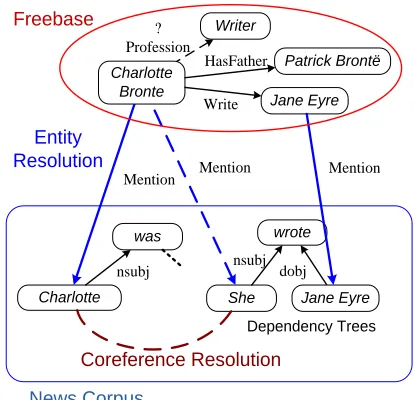
Figure 1: Knowledge base and parsed text as a labeled graph. For clarity, some word nodes are omitted.
relationships. As shown in Figure 1, we extend the KB graph G with nodes and edges from text that has been syntactically analyzed with a dependency parser1 and where pronouns and other anaphoric referring expressions have been clustered with their antecedents. The text nodes are word/phrase instances, and the edges are syntactic dependencies labeled by the corresponding dependency type. Mentions of entities in the text are linked to KB concepts by mention edges created by an entity resolution process.
Given for instance the query
Profession(CharlotteBronte,?), PRA produces
a ranked list of answers that may have the relation
Profession with the query node CharlotteBronte.
The features used to score answers are the random walk probabilities of reaching a certain profession node from the query node by paths with particular path types. PRA can learn path types that combine background knowledge in the database with syntactic patterns in the text corpus. We now exemplify some path types involving relations described in Table 3. Type
M,conj,M−1,Profession is active (matches
paths) for professions of persons who are mentioned in conjunction with the query person as in “collaboration between McDougall and Simon
1
Philips”. For a somewhat subtler example, type
M,TW,CW−1,Profession−1,Professionis active for persons who are mentioned by their titles as in “President Barack Obama”. The type subsequence
Profession−1,Profession ensures that only
profession concepts are activated. The features generated from these path types combine syntactic dependency relations (conj) and textual information relations (TW and CW) with semantic relations in the KB (Profession).
Experiments on three Freebase relations (profes-sion, nationality and parents) show that exploiting existing background knowledge as path features can significantly improve the quality of extraction compared with using either Freebase or the text corpus alone.
1.3 Related Work
Information extraction from varied unstructured and structured sources involves both complex relational structure and uncertainty at all levels of the extrac-tion process. Statistical Relaextrac-tional Learning (SRL) seeks to combine statistical and relational learning methods to address such tasks. However, most SRL approaches (Friedman et al., 1999; Richardson and Domingos, 2006) suffer the complexity of inference and learning when applied to large scale problems. Recently, Lao and Cohen (2010) introduced Path Ranking algorithm, which is applicable to larger scale problems such as literature recommendation (Lao and Cohen, 2010) and inference on a large knowledge base (Lao et al., 2011).
Much of the previous work on automatic relation extraction was based on certain lexico-syntactic patterns. Hearst (1992) first noticed that patterns such as “NP and other NP” and “NP such as NP” often imply hyponym relations (NP here refers to a noun phrase). However, such approaches to relation extraction are limited by the availability of domain knowledge. Later systems for extracting arbitrary relations from text mostly use shallow surface text patterns (Etzioni et al., 2004; Agichtein and Gravano, 2000; Ravichandran and Hovy, 2002). The idea of using sequences of dependency edges as features for relation extraction was explored by Snow et al. (2005) and Suchanek et al. (2006). They define features to be shortest paths on dependency trees which connect pairs of NP candidates.
This study is most closely related to work of Mintz et al. (2009), who also study the problem of extending Freebase with extraction from parsed text. As in our work, they use a logistic regression model with path features. However, their approach does not exploit existing knowledge in the KB. Furthermore, their path patterns are used as binary-values features. We show experimentally that fractional-valued features generated by random walks provide much higher accuracy than binary-valued ones.
Culotta et al. (2006)’s work is similar to our approach in the sense of relation extraction by discovering relational patterns. However while they focus on identifying relation mentions in text (microreading),this work attempts to infer new tuples by gathering path evidence over the whole corpus (macroreading). In addition, their work involves a few thousand examples, while we aim for Web-scale extraction.
Do and Roth (2010) use a KB (YAGO) to aid the generation of features from free text. However their method is designed specifically for extracting hierarchical taxonomic structures, while our algorithm can be used to discover relations for general general graph-based KBs.
In this paper we extend the PRA algorithm along two dimensions: combining syntactic and semantic cues in text with existing knowledge in the KB; and a distributed implementation of the learning and inference algorithms that works at Web scale.
2 Path Ranking Algorithm
We briefly review the Path Ranking algorithm (PRA), described in more detail by Lao and Cohen (2010). Each path typeπ =hr1, r2, ..., r`ispecifies
a real-valuedfeature. For a given query-answer node pair(s, t), the value of the featureπisP(s→t;π), the probability of reaching t from s by a random walk that instantiates the type. More specifically, suppose that the random walk has just reachedviby
traversing edges labeledr1, . . . , riwiths=v0. Then
vi+1 is drawn at random from all nodes reachable from vi by edges labeled ri+1. A path type π is activefor pair(s, t)ifP(s→t;π)>0.
Let B = {⊥, π1, ..., πn} be the set of all path
represents the bias feature. For convenience, we set P(s→ t;⊥) = 1for any nodess,t. The score for whether query nodesis related to another nodetby relationris given by
score(s, t) = X
π∈B
P(s→t;π)θπ ,
where θπ is the weight of feature π. The model
parameters to be learned are the vector θ =
hθπiπ∈B. The procedures used to discover B and
estimateθ are described in the following. Finally, note that we train a separate PRA model for each relationr.
Path Discovery: Given a graph and a target relation r, the total number of path types is an exponential function of the maximum path length ` and considering all possible paths would be computationally very expensive. As a result, B is constructed using only path types that satisfy the following two constraints:
1. the path type is active for more thanKtraining query nodes, and
2. the probability of reaching any correct target nodetis larger than a thresholdα on average for the training query nodess.
We will discuss how K,α and the training queries are chosen in Section 5. In addition to making the training more efficient, these constraints are also helpful in removing low quality path types.
Training Examples: For each relationr of inter-est, we start with a set of node pairsSr ={(si, ti)}.
FromSr, we create the training setDr={(xi, yi)},
where xi = hP(si → ti;π)iπ∈B is the vector
of path feature values for the pair (si, ti), and yi
indicates whetherr(si, ti)holds.
Following previous work (Lao and Cohen, 2010; Mintz et al., 2009), node pairs that are in r in the KB are legitimate positive training examples2. One can generate negative training examples by considering all possible pairs of concepts whose type is compatible withr (as given by the schema) and are not present in the KB. However this
2In our experiments we subsample the positive examples. See section 3.2 for more details.
procedure leads to a very large number of negative examples (e.g., for the parents relation, any pair of person concepts which are related by this relation would be valid negative examples) which not only makes training very expensive but also introduces an incorrect bias in the training set. Following Lao and Cohen (2010) we use a simple biased sampling procedure to generate negative examples: first, the path types discovered in the previous (path discovery) step are used to construct an initial PRA model (all feature weights are set to 1.0); then, for each query node si, this model is used to retrieve
candidate answer nodes, which are then sorted in descending order by their scores; finally, nodes at thek(k+ 1)/2-th positions are selected as negative samples, wherek= 0,1,2, ....
Logistic Regression Training: Given a training setD, we estimate parametersθby maximizing the following objective
F(θ) = 1
|D|
X
(x,y)∈D
f(x, y;θ)−λ1kθk1−λ2kθk22
where λ1 and λ2 control the strength of the L1 -regularization which helps with structure selection and L22-regularization which prevents overfitting. The log-likelihood f(x, y;θ) of example (x, y) is given by
f(x, y,θ) =ylnp(x,θ) + (1−y) ln(1−p(x,θ))
p(x,θ) = exp(θ
Tx)
1 + exp(θTx) .
Inference: After a model is trained for a relation r in the knowledge base, it can be used to produce new instances of r. We first generate unlabeled queriesswhich belong to the domain ofr. Queries which appear in the training set are excluded. For each unlabeled query node s, we apply the trained PRA model to generate a list of candidatet nodes together with their scores. We then sort all the predictions(s, t)by their scores in descending order, and evaluate the top ones.
3 Extending PRA
concepts and edges, training on all the generated queries is computationally challenging. Further, we extend the Freebase graph with parse paths of mentions of concepts in Freebase in millions of Web pages. Yet another issue is that the training queries generated using Freebase are inherently biased towards the distribution of concepts in Freebase and may not reflect the distribution of mentions of these concepts in text data. As one of the goals of our approach is to learn relation instances that are missing in Freebase, training on such a set biased towards the distribution of concepts in Freebase may not lead to good performance. In this section we explain how we modified the PRA algorithm to address those issues.
3.1 Scaling Up
Most relations in Freebase have a large set of existing triples. For example, for the profession relation, there are around 2 million persons in Freebase, and about 0.3 million of them have known professions. This results in more than 0.3 million training queries (persons), each with one or more positive answers (professions), and many negative answers, which make training computationally challenging. Generating all the paths for millions of queries over a graph with millions of concepts and edges further complicates the computational issues. Incorporating the parse path features from the text only exacerbates the matter. Finally once we have trained a PRA model for a given relation, say profession, we would like to infer the professions for all the 1.7 million persons whose professions are not known to Freebase (and possibly predict changes to the profession information of the 0.3 million people whose professions were given).
We use distributed computing to deal with the large number of training and prediction queries over a large graph. A key observation is that the different stages of the PRA algorithm are based on independent computations involving individual queries. Therefore, we can use the MapReduce framework to distribute the computation (Dean and Ghemawat, 2008). For path discovery, we modify Lao et al.’s path finding (2011) approach to decouple the queries: instead of using one depth-first search that involves all the queries, we first find all paths up to certain length for each query node in the
map stage, and then collect statistics for each path from all the query nodes in the reduce stage. We used a 500-machine, 8GB/machine cluster for these computations.
Another challenge associated with applying PRA to a graph constructed using a large amounts of text is that we cannot load the entire graph on a single machine. To circumvent this problem, we first index all parsed sentences by the concepts that they mention. Therefore, to perform a random walk for a query concepts, we only load the sentences which mentions.
3.2 Sampling Training Data
Using the r-edges in the KB as positive examples distorts the training set. For example, for the
profession relation, there are 0.3 million persons
for whom Freebase has profession information, and amongst these 0.24 million are either politicians or actors. This may not reflect the distribution of professions of persons mentioned in Web data. Using all of these as training queries will most certainly bias the trained model towards these professions as PRA is trained discriminatively. In other words, training directly with this data would lead to a model that is more likely to predict professions that are popular in Freebase. To avoid this distortion, we use stratified sampling. For each relationr and conceptt∈ C, we count the number ofredges pointing tot
Nr,t =|{(s, r, t)∈T}| .
Given a training query (s, r, t) we sample it according to
Pr,t= min 1, p
m+Nr,t
Nr,t !
We fixm = 100in our experiments. If we take the profession relation as an example, the above implies that for popular professions, we only sample about
p
Nr,tout of theNr,t possible queries that end int,
whereas for the less popular professions we would accept all the training queries.
3.3 Text Graph Construction
of a concept follows a somewhat heavy-tailed distribution: there are a small number of very popular concepts (head) and a large number of not so popular concepts (tail). For instance the concept
BarackObamais mentioned about 8.9 million times
in our text corpus. To prevent the text graph from being dominated by the head concepts, for each sentence that mentions concept c ∈ C, we accept it as part of the text graph with probability:
Pc= min
1, √
k+Sc
Sc
where Scis the number of sentences in which cis
mentioned in the whole corpus. In our experiments we usek= 105. This means that ifSck, then we
only sample about√Scof the sentences that contain
a mention of the concept, while ifSc k, then all
mentions of that concept will likely be included.
4 Datasets
We use Freebase as our knowledge base. Freebase data is harvested from many sources, including Wikipedia, AMG, and IMDB.3 As of this writing, it contains more than 21 million concepts and 70 million labeled edges. For a large majority of con-cepts that appear both in Freebase and Wikipedia, Freebase maintains a link to the Wikipedia page of that concept.
We also collect a large Web corpus and identify 60 million pages that mention concepts relevant to this study. The free text on those pages are POS-tagged and dependency parsed with an accuracy comparable to that of the current Stanford dependency parser (Klein and Manning, 2003). The parser produces a dependency tree for each sentence with each edge labeled with a standard dependency tag (see Figure 1).
In each of the parsed documents, we use POS tags and dependency edges to identify potential referring noun phrases (NPs). We then use a within-document coreference resolver comparable to that of Haghighi and Klein (2009) to group referring NPs into co-referring clusters. For each cluster that contains a proper-name mention, we find the Freebase concept or concepts, if any, with a name or alias that matches
3www.wikipedia.org, www.allmusic.com, www.
[image:6.612.324.530.78.134.2]imdb.com.
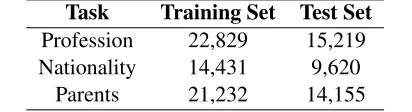
Table 1: Size of training and test sets for each relation.
Task Training Set Test Set
Profession 22,829 15,219 Nationality 14,431 9,620
Parents 21,232 14,155
the mention. If a cluster has multiple possible matching Freebase concepts, we choose a single sense based on the following simple model. For each Freebase conceptc∈C, we computeN(c, m), the number of times the concept c is referred by mention m by using both the alias information in Freebase and the anchors of the corresponding Wikipedia page for that concept. Based onN(c, m)
we can calculate the empirical probabilityp(c|m) =
N(c, m)/P
c0N(c0, m). If u is a cluster with
mention setM(u) in the document, andC(m) the set of concepts in KB with name or alias m, we assign u to concept c∗ = argmax
c∈C(m),m∈M(u)
p(c|m),
provided that there exists at least onec∈C(m)and m ∈ M(u)such that p(c|m) > 0. Note thatM(c)
only contains the proper-name mentions in clusterc.
5 Results
We use three relations profession, nationality and
parents for our experiments. For each relation, we
select its current set of triples in Freebase, and apply the stratified sampling (Section 3.2) to each of the three triple sets. The resulting triple sets are then randomly split into training (60% of the triples) and test (the remaining triples). However, the parents relation yields 350k triples after stratified sampling, so to reduce experimental effort we further randomly sub-sample 10% of that as input to the train-test split. Table 1 shows the sizes of the training and test sets for each relation.
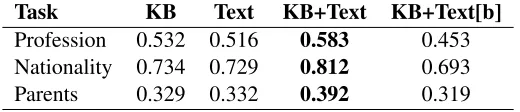
Table 2: Mean Reciprocal Rank (MRR) for different approaches under closed-world assumption. Here KB, Text and KB+Text columns represent results obtained by training a PRA model with only the KB, only text, and both KB and text. KB+Text[b] is the binarized PRA approach trained on both KB and text. The best performing system (results shown in bold font) is significant at 0.0001 level over its nearest competitor according to a difference of proportions significance test.
Task KB Text KB+Text KB+Text[b]
Profession 0.532 0.516 0.583 0.453 Nationality 0.734 0.729 0.812 0.693 Parents 0.329 0.332 0.392 0.319
performance on the training set for each relation. We report results of two evaluations. First, we evaluate the performance of the PRA algorithm when trained on a subset of existing Freebase facts and tested on the rest. Second, we had human annotators verify facts proposed by PRA that are not in Freebase.
5.1 Evaluation with Existing Knowledge
Previous work in relation extraction from parsed text (Mintz et al., 2009) has mostly used binary features to indicate whether a pattern is present in the sentences where two concepts are mentioned. To investigate the benefit of having fractional valued features generated by random walks (as in PRA), we also evaluate abinarized PRA approach, for which we use the same syntactic-semantic pattern features as PRA does, but binarize the feature values from PRA: if the original fractional feature value was zero, the feature value is set to zero (equivalent to not having the feature in that example), otherwise it is set to 1.
Table 2 shows a comparison of the results obtained using the PRA algorithm trained using only Freebase (KB), using only the text corpus graph (Text), trained with both Freebase and the text corpus (KB+Text) and the binarized PRA algorithm using both Freebase and the text corpus (KB+Text[b]). We report Mean Reciprocal Rank (MRR) where, given a set of queriesQ,
MRR= 1
|Q|
X
q∈Q
1
rank ofq’s first correct answer .
Comparing the results of first three columns we see that combining Freebase and text achieves significantly better results than using either Freebase or text alone. Further comparing the results of last
two columns we also observe a significant drop in MRR for the binarized version of PRA. This clearly shows the importance of using the random walk probabilities. It can also be seen that the MRR for the parents relation is lower than those for other relations. This is mainly because there are larger number of potential answers for each query node of
Parentrelation than for each query node of the other
two relations – all persons in Freebase versus all professions or nationalities. Finally, it is important to point out that our evaluations are actually lower
boundsof actual performance, because, for instance,
a person might have a profession besides the ones in Freebase and in such cases, this evaluation does not give any credit for predicting those professions — they are treated as errors. We try to address this issue with the manual evaluations in the next section.
Table 2 only reports results for the maximum path length`= 4case. We found that shorter maximum path lengths give worse results: for instance, with ` = 3 for the profession relation, MRR drops to
0.542, from 0.583 for ` = 4 when using both Freebase and text. This difference is significant at the 0.0001 level according to a difference of proportions test. Further we find that using longer path length takes much longer time to train and test, but does not lead to significant improvements over the`= 4case. For example, for profession,`= 5
gives a MRR of0.589.
Table 3: Top weighted path types involving text edges for each task grouped according to functionality. M relations connect each concept in knowledge base to its mentions in the corpus.TWrelations connect each token in a sentence to the words in the text representation of this token.CW relations connect each concept in knowledge base to the words in the text representation of this concept. We use lower case names to denote dependency edges, word capitalized names to denote KB edges, and “−1” to denote the inverse of a relation.
Profession Top Weighted Features Comments
1 M,conj,M−1,Profession Professions of persons mentioned in conjunction with the query person:“McDougall and Simon Phillips collaborated ...”
M,conj−1,M−1,Profession
2
M,TW,CW−1,Profession−1,Profession
Active if a person is mentioned by his profession: “The president said ...”
3 M,TW,TW−1,M−1,Children,Profession
First find persons with similar names or mentioned in similar ways, then aggregate the professions of their children/parents/advisors: starting from the conceptBarackObama, words such as“Obama”,“leader”,“president”, and “he”are reachable through pathhM,TWi
M,TW,TW−1,M−1,Parents,Profession
M,TW,TW−1,M−1,Advisors,Profession
Nationality Top Weighted Features Comments
4 M,conj,TW,CW−1,Nationality The nationalities of persons mentioned in conjunction with the query person:“McDougall and Simon Phillips collaborated ...”
M,conj−1,TW,CW−1,Nationality
5 M,nc−1,TW,CW−1,Nationality The nationalities of persons mentioned close to the query person through other dependency relations.
M,tmod−1,TW,CW−1,Nationality
M,nn,TW,CW−1,Nationality
6 M,poss,poss−1,M−1,PlaceOfBirth,ContainedByThe birth/death places of the query person with restrictions to different syntactic constructions.
M,title,title−1,M−1,PlaceOfDeath,ContainedBy
Parents Top Weighted Features Comments
7
M,TW,CW−1,Parents
The parents of persons with similar names or mentioned in similar ways: starting from the conceptCharlotteBrontewords such as
“Bronte”,“Charlotte”,“Patrick’’, and“she”are reachable through pathhM,TWi.
8
M,nsubj,nsubj−1,TW,CW−1 Persons with similar names or mentioned in
similar ways to the query person with various restrictions or expansions.nsubj,nsubj−1and
nc−1,ncrequire the query to be subject and noun compound respectively.TW−1,TW expands further by word similarities.
M,nsubj,nsubj−1,M−1,CW,CW−1
M,nc−1,nc,TW,CW−1
M,TW,CW−1
person, and then find their professions or nation-alities. The features in group 2 capture the fact that sometimes people are mentioned by their pro-fessions. The subpath Profession−1,Profession ensures that only profession related concepts are activated. Features in group 3 first find persons with similar names or mentioned in similar ways to the query person, and then aggregate the professions of their children, parents, or advisors. Features in group 6 can be seen as special versions of feature hPlaceOfBirth,ContainedByi
and hPlaceOfDeath,ContainedByi. The subpaths
M,poss,poss−1,M−1andM,title,title−1,M−1 return the random walks back to the query node only if the mentions of the query node haveposs(stands forpossessive modifier, e.g. “Bill’s clothes”) ortitle (stands for person’s title, e.g. “President Obama”) edges in text; otherwise these features are inactive. Therefore, these features are active only for specific subsets of queries. Features in group 8 generally find persons with similar names or mentioned in similar ways to the query person. However, they further expand or restrict this person set in various ways.
Typically, each trained model includes hundreds of paths with non-zero weights, so the bulk of classifications are not based on a few high-precision-recall patterns, but rather on the combination of a large number of lower-precision high-recall or high-precision lower-recall rules.
5.2 Manual Evaluation
We performed two sets of manual evaluations. In each case, an annotator is presented with the triples predicted by PRA, and asked if they are correct. The annotator has access to the Freebase and Wikipedia pages for the concepts (and is able to issue search queries about the concepts).
[image:9.612.324.526.77.134.2]In the first evaluation, we compared the perfor-mance of two PRA models, one trained using the stratified sampled queries and another trained using a randomly sampled set of queries for the profession relation. For each model, we randomly sample 100 predictions from the top 1000 predictions (sorted by the scores returned by the model). We found that the PRA model trained with stratified sampled queries has 0.92 precision, while the other model has only 0.84 precision (significant at the 0.02 level). This shows that stratified sampling leads to improved
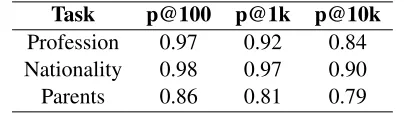
Table 4: Human judgement for predicted new beliefs.
Task p@100 p@1k p@10k
Profession 0.97 0.92 0.84 Nationality 0.98 0.97 0.90 Parents 0.86 0.81 0.79
performance.
We also evaluated the new beliefs proposed by the models trained for all the three relations using stratified sampled queries. We estimated precision for the top 100 predictions and randomly sampled 100 predictions each from the top 1,000 and 10,000 predictions. Here we use the PRA model trained using both KB and text. The results of this evaluation are shown in Table 4. It can be seen that the PRA model is able to produce very high precision predications even when one considers the top 10,000 predictions.
Finally, note that our model is inductive. For instance, for the profession relation, we are able to predict professions for the around 2 million persons in Freebase. The top 1000 profession facts extracted by our system involve 970 distinct people, the top 10,000 facts involve 8,726 distinct people, and the top 100,000 facts involve 79,885 people.
6 Conclusion
We have shown that path constrained random walk models can effectively infer new beliefs from a large scale parsed text corpus with background knowledge. Evaluation by human annotators shows that by combining syntactic patterns in parsed text with semantic patterns in the background knowledge, our model can propose new beliefs with high accuracy. Thus, the proposed random walk model can be an effective way to automate knowledge acquisition from the web.
Acknowledgments
We thank Rahul Gupta, Michael Ringgaard, John Blitzer and the anonymous reviewers for helpful comments. The first author was supported by a Google Research grant.
References
Eugene Agichtein and Luis Gravano. 2000. Snowball: extracting relations from large plain-text collections. InProceedings of the fifth ACM conference on Digital libraries, DL ’00, pages 85–94, New York, NY, USA. ACM.
Kurt Bollacker, Colin Evans, Praveen Paritosh, Tim Sturge, and Jamie Taylor. 2008. Freebase: a collaboratively created graph database for structuring human knowledge. InProceedings of the 2008 ACM SIGMOD international conference on Management of data, SIGMOD ’08, pages 1247–1250, New York, NY, USA. ACM.
Aron Culotta, Andrew McCallum, and Jonathan Betz. 2006. Integrating probabilistic extraction models and data mining to discover relations and patterns in text. In Proceedings of the Human Language Technology Conference of the NAACL, Main Conference, pages 296–303, New York City, USA, June. Association for Computational Linguistics.
Marie-Catherine de Marneffe and Chris Manning.
2008. Stanford dependencies. http:
//www.tex.ac.uk/cgi-bin/texfaq2html?
label=citeURL.
Jeffrey Dean and Sanjay Ghemawat. 2008. Mapreduce: simplified data processing on large clusters. Commun. ACM, 51(1):107–113, January.
Quang Do and Dan Roth. 2010. Constraints based taxonomic relation classification. In Proceedings of the 2010 Conference on Empirical Methods in Natural Language Processing, pages 1099–1109, Cambridge, MA, October. Association for Computational Linguis-tics.
Oren Etzioni, Michael Cafarella, Doug Downey, Stanley Kok, Ana-Maria Popescu, Tal Shaked, Stephen Soderland, Daniel S. Weld, and Alexander Yates. 2004. Web-scale information extraction in knowitall: (preliminary results). In Proceedings of the 13th international conference on World Wide Web, WWW ’04, pages 100–110, New York, NY, USA. ACM. Nir Friedman, Lise Getoor, Daphne Koller, and Avi
Pfeffer. 1999. Learning Probabilistic Relational Models. InIJCAI, volume 16, pages 1300–1309. Aria Haghighi and Dan Klein. 2009. Simple
coref-erence resolution with rich syntactic and semantic
features. In Proceedings of the 2009 Conference on Empirical Methods in Natural Language Processing, pages 1152–1161, Singapore, August. Association for Computational Linguistics.
Marti A. Hearst. 1992. Automatic acquisition of hyponyms from large text corpora. In Proceedings of COLING-92, pages 539–545. Association for Computational Linguistics, August.
Dan Klein and Christopher D. Manning. 2003. Accurate unlexicalized parsing. In Erhard Hinrichs and Dan Roth, editors,Proceedings of the 41st Annual Meeting on Association for Computational Linguistics, pages 423–430. Association for Computational Linguistics, July.
Ni Lao and William Cohen. 2010. Relational retrieval using a combination of path-constrained random walks. Machine Learning, 81:53–67.
Ni Lao, Tom Mitchell, and William W. Cohen. 2011. Random walk inference and learning in a large scale knowledge base. In Proceedings of the 2011 Conference on Empirical Methods in Natural Language Processing, pages 529–539, Edinburgh, Scotland, UK., July. Association for Computational Linguistics.
Mike Mintz, Steven Bills, Rion Snow, and Daniel Jurafsky. 2009. Distant supervision for relation extraction without labeled data. InProceedings of the Joint Conference of the 47th Annual Meeting of the ACL and the 4th International Joint Conference on Natural Language Processing of the AFNLP, pages 1003–1011, Suntec, Singapore, August. Association for Computational Linguistics.
Deepak Ravichandran and Eduard Hovy. 2002. Learning surface text patterns for a question answering system. In Proceedings of 40th Annual Meeting of the Association for Computational Linguistics, pages 41–47, Philadelphia, Pennsylvania, USA, July. Association for Computational Linguistics.
Matthew Richardson and Pedro Domingos. 2006. Markov logic networks. Machine Learning, 62:107– 136.
Rion Snow, Daniel Jurafsky, and Andrew Y. Ng. 2005. Learning syntactic patterns for automatic hypernym discovery. In Lawrence K. Saul, Yair Weiss, and L´eon Bottou, editors,Advances in Neural Information Processing Systems 17, pages 1297–1304, Cambridge, MA. NIPS Foundation, MIT Press.