Proceedings of the 2018 EMNLP Workshop SCAI: The 2nd Int’l Workshop on Search-Oriented Conversational AI, pages 17–23
17
Building Dialogue Structure from Discourse Tree of a Question
Boris Galitsky
Dmitry Ilvovsky
Oracle Inc., Redwood Shores, CA USA
National Research University Higher School
of Economics, Moscow, Russia
[email protected] [email protected]
Abstract
In this section we propose a reasoning-based approach to a dialogue management for a customer support chat bot. To build a dialogue scenario, we analyze the dis-course tree (DT) of an initial query of a customer support dialogue that is frequent-ly complex and multi-sentence. We then enforce rhetorical agreement between DT of the initial query and that of the answers, requests and responses. The chat bot finds answers, which are not only relevant by topic but also suitable for a given step of a conversation and match the question by style, communication means, experience level and other domain-independent attrib-utes. We evaluate a performance of pro-posed algorithm in car repair domain and observe a 5 to 10% improvement for sin-gle and three-step dialogues respectively, in comparison with baseline approaches to dialogue management.
1
Introduction
Answering questions, a chat bot needs to reason to properly select answers from candidates. In industrial applications of search, reasoning is of-ten substituted by learning from conversational logs or user choices. It helps to make search more relevant as long as a similar question has been asked many times. If there is no data on previous similar question, which is frequently the case, a chat bot needs to apply some form of rea-soning to select from candidate answers (Wilks, 1999).
Most frequent type of reasoning is associated with topical relevance. It requires ontology and is domain-specific. Difficulties in building domain ontologies are well known, and in this paper we take a different reasoning-based approach. Once a set of candidate answers or replies is available, how to select most suitable ones? The suitability criteria are two-dimensional: 1) topical relevance; and 2) an appropriateness not associated with
top-ic but instead connected with communtop-icative dis-course. Whereas topical relevance has been thor-oughly investigated, chat bot’s capability to main-tain the cohesive flow, style and merits of conver-sation is an underexplored area.
When a question (Q) is detailed and includes multiple sentences, there are certain expectations concerning the style of an answer (A). Although topical agreement between questions and answers has been extensively addressed, a correspondence in style and suitability for the given step of a dia-logue between questions and answers has not been thoroughly explored. In this study we focus on as-sessment of the cohesiveness of the Q/A flow, which is important for a chat bots supporting longer conversation. When an answer is in a style disagreement with a question, a user can find this answer inappropriate even when a topical rele-vance is high. Matching rhetorical structures of questions and answers is a systematic way to im-plement high-level reasoning for dialogue man-agement, to be explored in this work.
A problem in communicative discourse occurs mostly for complex questions (Chali et al., 2009; Galitsky, 2017), arising in miscommunication, a lack of understanding, and requiring clarification, argumentation and other means to bring the an-swer’s author point across. Rhetorical disagree-ment is associated with a broken dialogue and is usually evident via the means an answer is com-municated, explained or backed up.
Our paper is organized as follows. In Section 2 we discuss basic notions of discourse tree text rep-resentation. In Section 3 we consider details our approach to building a dialogue based on dis-course trees. In Section 4 we present evaluation results for the one of the Q/A tasks.
The system described in this paper is available on our GitHub1.
1
2
Discourse Tree and Rhetorical
Struc-ture
To represent the linguistic features of a text, we used Rhetorical relations (RR) between the parts of the sentences, obtained as a discourse tree. We relied on Rhetorical Structure Theory (RST, Mann and Thompson, 1988) and deployed state-of-the-art rhetorical parsers (Joty et al., 2013; Surdeanu et al., 2015) to build these discourse trees auto-matically.
Rhetorical Structure Theory models the logical organization of text, a structure employed by a writer relying on relations between parts of text. RST simulates text coherence by forming a hier-archical connected structure of texts via discourse trees. Rhetorical relations are split into coordinate and subordinate classes; these relations hold across two or more text spans and therefore im-plement coherence. These text spans are called el-ementary discourse units (EDUs).
Clauses in a sentence and sentences in a text are logically connected by the author. The mean-ing of a given sentence is related to that of the previous and following sentences. This logical re-lation between clauses is called the coherence structure of the text. RST is one of the most popu-lar theories of discourse and is based on tree-like discourse structures called discourse trees. The leaves of a DT correspond to EDUs, the contigu-ous atomic text spans. Adjacent EDUs are con-nected by coherence rhetorical relations (e.g., At-tribution, Sequence), forming higher-level dis-course units. These units are then also subject to this relation-linking. EDUs linked by a relation are then differentiated based on their relative im-portance: nuclei represent the core parts of the re-lation, whereas satellites represent the peripheral ones.
Let’s consider small example of a discourse tree for the text. For the question
“What does Clinton foundation really do” one can find the following answer:
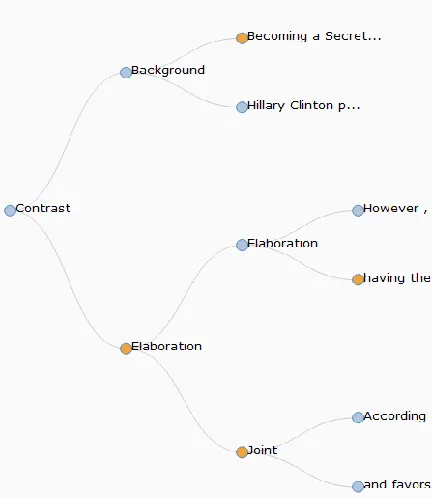
Becoming a Secretary of State, Hillary Clinton promised to distance herself from the Clinton Foundation. However, Clinton continued to have a cozy relationship with the foundation, having the US foreign policy for sale there. According to some sources, Clinton was granting access and favors to major Clinton Foundation donors.
[image:2.595.308.524.120.369.2]The discourse tree of an answer is presented on Figure 1 is based on Elaboration and Background rhetorical relations.
Figure 1: Example of a discourse tree
3
Building Dialogue Structure with
Dis-course
3.1 Maintaining Discourse in a Dialogue
Once we have a detailed initial question, we fre-quently can determine which direction we can take a given dialogue. If an answer is formulated in a straight-forward way, then a definitional or factual answer is to follow.
Otherwise, if a question includes a doubt, a re-quest to dig deeper into a topic, or to address a controversy, the dialogue should be handled with replies including attribution, communicating a contrast, explicit handling of what was expected and what actually happened. Hence from Rhetori-cal relations in initial query the chat bot can select one set of answers over the other not only to cover the main topic, but to also address associated is-sues raised by the user. It can be done even if the initial query is short and its DT is trivial.
Now imagine for each of answers we obtain multiple candidates, with distinct entities. How the chat bot would know which entity in an an-swer would be of a higher interest to a user? The chat bot need to include a clarification procedure.
2017). For the dialogue management problem, where a sequence of answers Ai need to be in
agreement with an initial question Q, we refer the proposed solution as maintaining communicative discourse in a dialogue. It includes three compo-nents:
1) Finding a sequence of answers Ai to be in
agreement with an initial question Q 2) Maintaining clarification procedure where
for each i we have multiple candidate an-swers and need to rely on a user to select which one to deliver.
3) Allowing the chat bot user to specify addi-tional constraints, formulate more specific questions as answers Ai are being delivered.
3.2 Building Dialogue Structure in
Customer Support Dialogues
Let us start with an example of a customer sup-port dialogue, where a customer supsup-port agent tries to figure out a root cause of a problem (Fig.2.). Customer support scenarios form a spe-cial class of dialogues where customers attempt to resolve certain problems, get their questions answered and get to their desired outcomes un-reachable using default business procedures. Customer support dialogues frequently start with initial question, a multi-sentence statement of problems Q, from which experienced customer support personal frequently plan a resolution strategy.
The personnel come up with a sequence of rec-ommendations and explanations for them address-ing customer concerns expressed in Q. Also, the personnel comes up with some questions to the customer to adjust their recommendations to the needs expressed by the customer in Q. Frequently, due to diverse nature of most businesses, it is hard to find a dialogue in a customer support problem which addresses this exact problem. Therefore, individual answers and recommendations from the previous customer support sessions are used, not the whole such sessions, in the majority of cases. Hence the customer support dialogue management cannot be reduced to the problem of finding suffi-ciently similar dialogue and just following it: in-stead, actual construction of a dialogue to address Q is required most of times.
The system finds candidate answers with the keywords and phrases from the initial query, such as Google Earth, cannot see, attention and others. Which candidate answers would be the best to match the communicative discourse of the query?
A customer support dialogue can be represent-ed as a sequence:
Q, A1, C1, A2, C2, …,
where Q is an initial query describing a problem, A1 is an initial recommendation and also a
clari-fication request, C1 is a response to this request,
A2 is a consecutive recommendation and
clarifi-cation request, C2 is a response to A2 and
possi-bly a further question, and so forth. Our goal is to simulate a broad spectrum of dialogue structures via correspondence of discourse trees of utter-ances. This way once Q is given, the chat bot can maintain the sequence of answers Ai for Q.
Figure 2: An example of a customer support dialogue
3.3 Finding a Sequence of Answers to be in Agreement with Question
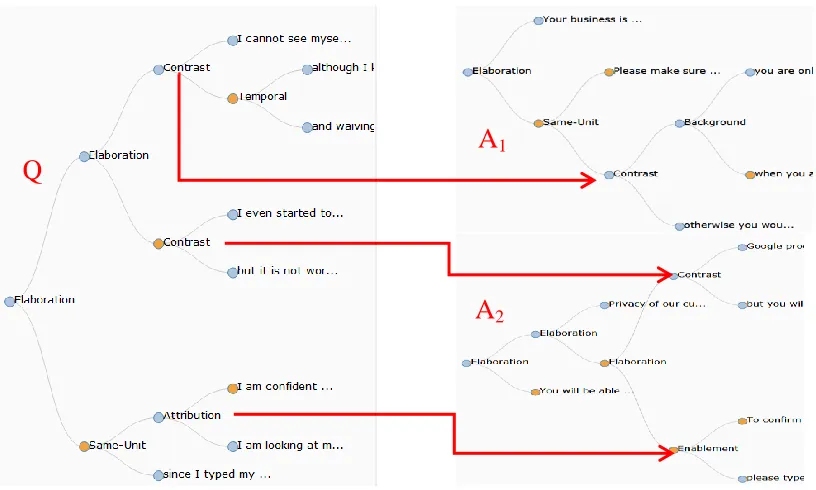
DT for the Q, and DT for the sequence of two answers A1 and A2 from our example are shown
in Fig. 3. Arrows show which chains of DT-Q determine which chains of DT-Ai.
We will now demonstrate that a chain of nodes in DT-Q is determining a corresponding chain of nodes in DT-A. This chain is defined as a path in a DT. The chain of RRs with entities are Elabora-tion [see myself Google Earth]-Contrast [walk laptop house]-Temporal [waiving] on the top of DT-Q is addressed by the chain Elaboration [online]-Same_Unit [walking]-Contract [Other-wise, not able connect] in the first answer A1. We
use the label RR [abbreviated phrase] for each node of a chain in DT. Notice that not only RRs are supposed to be coordinated but the entities in phrases as well.
The second answer A2 attempts to address in a
Figure 3: Discourse tree of a question Q (on the left) and a sequence (pair) of combined discourse trees (on the right) for the answers Ai.
The main observation here is that the question itself gives us a hint on a possible sequence of an-swers, or on the order the issues in the question are raised. One can look at the DT-Q and form a dialogue scenario (first do this, obtain confirma-tion, then do that …). Since a dialogue is built from available answer fragments (e.g. from con-versational logs), we take candidate answers, form candidate DTs from them and see if they match DT-Q. Hence a single nontrivial DT-Q determines both DT-A1 and DT-A2. We refer to this capability
as determining the structure of a dialogue (the structure of a sequence of answers) by the initial Q. We intentionally selected this anecdotal, mean-ingless example of a customer support dialogue to demonstrate that a full “understanding” of a query is not required; instead, the logical structure of in-ter-relations between the entities in this query is essential to find a sequence of answers.
Is it possible to come up with a rule for DT-Ai
given DT-Q, to formalize the notion of “address-ing” an issue in Q by an A? A simple rule would be for a chain of rhetorical relations for an A to be a sub-chain of that of a Q, also maintaining re-spective entities. But this rule turns out to be too restrictive and even invalid in some cases. Our observation is that DT–A does not have to copy DT-Q or its parts, but instead have some
comple-mentarity features. There are two types of consid-erations for DT-Ai :
1) Each nontrivial RR in Q needs to be ad-dressed by a RR in DT-Ai.
2) There should be a rhetorical agreement be-tween Q and Ai, defined for a search engine.
Whereas rhetorical agreement introduces a pair-wise constraint that can be learned from ex-amples of good and bad Q/A pairs (Galitsky, 2017), we extend it to one-to-many relation be-tween a single Q and a sequence of Ai.
For an RR in DT-Aito address an RR in Q, it
does not necessarily need to be the same RR but it should not be a default RR such as Elaboration or Joint. Attribution and Enablement, for example, can address Contrast.
Also, for a RR(EDUq1, EDUq2) in Q to be
cov-ered by RR(EDUai1, EDUai2) in Ai, entities E
should be shared between EDUq1 and EDUai1 :
EDUq1 EDUai1 = E : E .
3.4 Searching for the Answers for Dialogue construction
Once we established the rules for addressing RRs in Q, we can implement search for a series of an-swers Ai given Q. Assuming we have a corpus of
dialogues with utterances tagged as A or Q, it should be indexed offline in at least two
follow-Q
A
1ing fields: 1) keywords of A and 2) RRs with their EDUs.
Then once we receive Q, build DT-Q, and split DT-Q into subtrees each of which contains at least single non-default RR. Then for each subtree-DT-Q we form a query against these fields:
1) Keywords from the EDU-subtree-DT-Q; 2) Non-default RR from subtree-DT-Q. For each candidate answer satisfying the query we still have to verify
rhetorical_agreement(subtree-DT-Q, Ai).
Once the answer Ai is selected and given to the
user, user responds with Ci which in general case
contains some clarification expressed in Ai and
al-so an additional question part Qi . The latter would
then require an additional answer which should be added to Ai if it has been already computed.
The high-level view of the search algorithm that supports the dialogue is as follows:
1) Build DT-Q;
2) Split DT-Q into parts Q1, Q2,… to correspond
to A1, A2,…;
3) Form search query for A1 from Q1 in the
form RST-relation [phrase] ;
4) Run the search against the set of dialogue ut-terances and obtain the list of candidate an-swers for the first step A1candidate;
5) Build DT-A1candidate for each candidate and
approve/reject each based on rhetori-cal_agreement (DT–Q, DT-A1candidate ). Select
the best candidate A1;
6) Respond to the user with the selected A1 and
receive C1;
7) Form search query for A2 from Q1&C1;
8) Repeat steps 4) and 5) for A2 , respond to the
user with the selected A2 and receive C2;
9) Conclude the session or switch to a human agent
Hence the dialogue management problem can be formulated as a search with constraints on DTs and can be implemented via traditional search engineering means plus discourse parsing, when an adequate set of chat logs is available. Discourse-tree based dialogue management does not cover all possibilities of assuring smooth dia-logue flows but provides a plausible mechanism to select suitable utterances from the available set. It allows avoiding solving NL generation problem for dialogues that is a source of a sub-stantial distortion of conversation flow and a noise in meaning of utterances.
In this paper we suggested a mechanism to build a dialogue structure where the first utter-ance formulated a detailed Q requiring some
knowledge and explanation. If this Q is detailed enough the chat bot can attempt to find a se-quence of answers to address all issues raised in Q.
3.5 Clarification-driven Dialogue
Some goals related to dialogue management do not need to be achieved via DTs. For example, an implementation of clarification feature can be hard-coded and does not require specific RRs. When a user asks a broad question, the chat bot forms topics for this user to choose from. Once such a topic is selected, the full answer is provid-ed.
We have built an algorithm for mapping Q Ai. When multiple valid candidate answers for
each i obtained, a clarification procedure is need-ed to have the user selectneed-ed Aij from the set Ai of
answers or recommendations valid from both relevance and rhetorical agreement perspectives. We now update step 6) of the search algorithm which requests clarification when multiple suita-ble answers are availasuita-ble:
6) Respond to the user with the list of choices selected {A1s |s=0..n} and receive
clarifica-tion result with possibly addiclarifica-tional con-straint request C1 (which includes the
choice A1j )
4
Evaluation of Dialogue Construction
4.1 Example from Car Repair Domain
As we proceed to evaluation, we will share an example of a dialogue from the evaluation domain of recommendations on car repair. Key character-istics of this domain are an importance of accurate recommendation, adequate dialogue structure, lesser bios than in other domains such as political, and an availability of a complete and accurate coverage of a broad spectrum of car problems. We provide an example of a sample dialogue:
Q1: I have checked the spark plugs, replaced the
bat-tery, also replaced ignition coils and the solenoid, but I still could not start my car.
A1: Is the engine getting spark and fuel? Will it start
for a couple seconds using starting fluid?
Q2: It did at first but not anymore. What should I do?
A2 : Check fuel pressure. But if no pressure, check the
In this example, since Q1 includes rhetorical
re-lation of Contrast (something is done correctly but still not working), detailed answer should in-clude Contrast, Condition, or other RR that would address Contrast in Q. A certain recommended ac-tion is performed either correctly or incorrectly and both these cases need to be addressed.
4.2 Dataset and Results
We formed a dataset of 9300 Q/A pairs related to car repair recommendations from
www.2carpros.com. These pairs were extracted from dialogues as first and second utterance, so that the question is 7 – 15 keywords and answer is 3 to 6 sentences. This resource was obtained to train a dialogue support system but it also proved to be useful to evaluate search. The dataset is available online 2 in our GitHub.
To automate the relevance assessment, we con-sidered the dialogue built correctly if an actual di-alogue from the dataset is formed, given the first Q as a seed. Otherwise, if the sequence of utter-ances does not occur in the dataset, we consider it to be incorrect. There are some deficiencies of this approach since some actual dialogs are illogical and some synthetic dialogues built from distinct ones can be plausible, but it allows avoiding a manual tagging and construction of dialogues. The number of formed answers is limit to three: once initial Q is given, the system forms A1, a set
of A2i and A3j. A1 is followed by the actual C1 from
the dialogue Q, so the proper A2 needs to be
se-lected. Analogously, once actual C2 (if applicable)
is provided, proper A3needs to be selected.
As a first baseline approach, we selected dia-logue construction based on keyword similarity only, without taking into account a dialogue flow by considering a DT-Q. As a second baseline ap-proach, we augment keyword similarity with lin-guistic relevance by computing maximal common sub-parse trees between the Q and Ai (Galitsky,
2013; Galitsky et al., 2013).
For the selected dataset, baseline approach is capable of building correct scenarios in the cases when similar keywords or similar linguistic phrases deliver the only dialogue scenario that is correct. On the contrary, DT-Q dialogue formation does not always succeed because some scenarios deviate from actual ones in the training set,
2
https://github.com/bgalitsky/relevance-based-on-parse-trees/blob/master/examples/CarRepairData_AnswerAnatom yDataset2.csv.zip
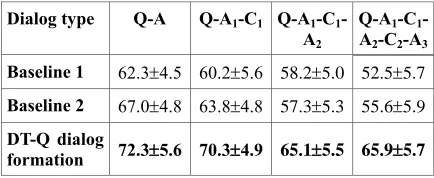
hough they are still plausible. Hence we see 10 and 5% improvement over the first and second baselines respectively for a basic, single-step sce-nario (Table 1).
As scenario becomes more complex, the chance that the proper scenario is selected by topic rele-vance decreases. At the same time, overall scenar-io formatscenar-ion complexity increases, and therefore an error rate for DT-Q approach increases as well. For the most complex, 3-step dialogue scenarios, DT-Q approach exceeds the baselines by 13 and 10% respectively.
5
Conclusions
In this paper we discovered that a dialogue struc-ture could be built from the discourse tree of an initial question. This structure is built on top of the default conversational structure implementing such features as clarification, personalization or recommendation. For personalization, for a user query, the customer support chat bot system re-duces the list of resolution scenarios based on what information is available for the given user. Chat bot recommendation scenario proposes a so-lution to a problem by finding the one accepted by users similar to the current one. Clarification, per-sonalization and recommendation scenario covers only a small portion of plausible customer support scenarios. Discourse analysis of dialogues support dialogue scenario management in a universal way, for a broad range of available text fragments and previously accumulated responses.
Acknowledgments
The work of Dmitry Ilvovsky was supported by RFBR grants 16-29-12982 and 16-01-00583 and was prepared within the framework of the Basic Research Program at the National Research Uni-versity Higher School of Economics (HSE) and supported within the framework of a subsidy by the Russian Academic Excellence Project '5-100'.
Dialog type Q-A Q-A1-C1 Q-A1-C1
-A2
Q-A1-C1
-A2-C2-A3
Baseline 1 62.34.5 60.25.6 58.25.0 52.55.7
Baseline 2 67.04.8 63.84.8 57.35.3 55.65.9
DT-Q dialog
[image:6.595.306.523.127.216.2]formation 72.35.6 70.34.9 65.15.5 65.95.7
References
Wilks, Y. A. (Ed.). 1999. Machine conversations.
Kluwer.
Mann, William and Sandra Thompson. 1988. Rhetori-cal structure theory: Towards a functional theory of text organization. Text - Interdisciplinary Journal for the Study of Discourse, 8(3):243–281.
Joty, Shafiq R, Giuseppe Carenini, Raymond T Ng, and Yashar Mehdad. 2013. Combining intra-and multi- sentential rhetorical parsing for document-level discourse analysis. In ACL (1), pages 486– 496.
Mihai Surdeanu, Thomas Hicks, and Marco A. Valen-zuela-Escarcega. 2015 Two Practical Rhetorical Structure Theory Parsers. NAACL HLT.
Chali, Y. Shafiq R. Joty, and Sadid A. Hasan. 2009.
Complex question answering: unsupervised learn-ing approaches and experiments. J. Artif. Int. Res. 35, 1 (May 2009), 1-47.
Boris Galitsky. 2017. Discovering Rhetorical Agree-ment between a Request and Response. Dialogue & Discourse 8(2) 167-205.
B Galitsky, D Ilvovsky, SO Kuznetsov, F Strok. 2013.
Matching sets of parse trees for answering multi-sentence questions. RANLP-2013.
Boris Galitsky. 2013. Machine Learning of Syntactic Parse Trees for Search and Classification of Text.