Improving Multi-label Emotion Classification via Sentiment Classification
with Dual Attention Transfer Network
Jianfei Yu♣, Lu´ıs Marujo♥, Jing Jiang♣, Pradeep Karuturi♥, William Brendel♥ ♣
School of Information Systems, Singapore Management University, Singapore ♥Snap Inc. Research, Venice, California, USA
♣[email protected], [email protected] ♥ {luis.marujo, pradeep.karuturi, william.brendel}@snap.com
Abstract
In this paper, we target at improving the per-formance of multi-label emotion classifica-tion with the help of sentiment classificaclassifica-tion. Specifically, we propose a new transfer learn-ing architecture to divide the sentence rep-resentation into two different feature spaces, which are expected to respectively capture the general sentiment words and the other impor-tant emotion-specific words via a dual atten-tion mechanism. Extensive experimental re-sults demonstrate that our transfer learning ap-proach can outperform several strong base-lines and achieve the state-of-the-art perfor-mance on two benchmark datasets.
1 Introduction
In recent years, the number of user-generated comments on social media platforms has grown exponentially. In particular, social platforms such as Twitter allow users to easily share their per-sonal opinions, attitudes and emotions about any topic through short posts. Understanding people’s emotions expressed in these short posts can fa-cilitate many important downstream applications such as emotional chatbots (Zhou et al., 2018b), personalized recommendations, stock market pre-diction, policy studies, etc. Therefore, it is crucial to develop effective emotion detection models to automatically identify emotions from these online posts.
In the literature, emotion detection is typically modeled as a supervised multi-label classifica-tion problem, because each sentence may con-tain one or more emotions from a standard emo-tion set containing anger, anticipation, disgust,
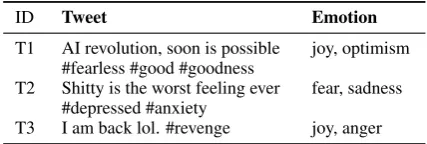
fear,joy,love,optimism,pessimism,sadness, sur-prise and trust. Table 1 shows three example sentences along with their emotion labels. Tra-ditional approaches to emotion detection include
lexicon-based methods (Wang and Pal, 2015),
ID Tweet Emotion
T1 AI revolution, soon is possible #fearless #good #goodness
joy, optimism
T2 Shitty is the worst feeling ever #depressed #anxiety
fear, sadness
[image:1.595.309.523.222.294.2]T3 I am back lol. #revenge joy, anger
Table 1:Example Tweets from SemEval-18 Task 1.
graphical model-based methods (Li et al.,2015b) and linear classifier-based methods (Quan et al., 2015; Li et al., 2015a). Given the recent suc-cess of deep learning models, various neural net-work models and advanced attention mechanisms have been proposed for this task and have achieved highly competitive results on several benchmark
datasets (Wang et al., 2016; Abdul-Mageed and
Ungar, 2017; Felbo et al., 2017; Baziotis et al., 2018;He and Xia,2018;Kim et al.,2018).
However, these deep models must overcome a heavy reliance on large amounts of annotated data in order to learn a robust feature represen-tation for multi-label emotion classification. In reality, large-scale datasets are usually not read-ily available and costly to obtain, partly due to the ambiguity of many informal expressions in user-generated comments. Conversely, it is eas-ier to find datasets (especially in English) associ-ated with another closely relassoci-ated task: sentiment classification, which aims to classify the sentiment polarity of a given piece of text (i.e., positive, neg-ative and neutral). We expect that these resources may allow us to improve sentiment-sensitive rep-resentations and thus more accurately identify emotions in social media posts. To achieve these goals, we propose an effective transfer learning (TL) approach in this paper.
31
L S T M
ys yt
xs xt
L S T M
L S T M L
S T M
ys yt
xs xt
L S T M
L S T M
ys yt
xs xt
a. Fully-Shared (FS) b. Private-Shared-Private (PSP) d. Dual Attention Transfer Network
α𝑠 α𝑝 α𝑠 α𝑝 α𝑠 α𝑝
L S T M
L S T M
ys yt
xs xt
α𝑠 α𝑝
c. Shared-Private (SP)
Attention weights Sentence Embedding
[image:2.595.114.480.62.187.2]Sentence Encoding Layer
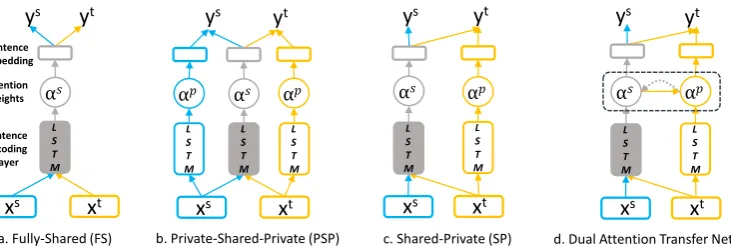
Figure 1:Overview of Different Transfer Learning Models.
shared feature space and two task-specific feature spaces (Liu et al.,2017;Yu et al.,2018), as demon-strated by Fig1.a and Fig1.b. However, when ap-plying these TL approaches to our scenario, the former approach may lead the learnt sentence rep-resentation to pay more attention to general senti-ment words such asgoodbut less attention to the
other sentiment-ambiguous words likeshock that
are also integral to emotion classification. The lat-ter approach can capture both the sentiment and the emotion-specific words. However, some sen-timent words only occur in the source sensen-timent classification task. These words tend to receive more attention in the source-specific feature space but less attention in the shared feature space, so they will be ignored in our emotion classification task. Intuitively, any sentiment word also indicates emotion and should not be ignored by our emotion classification task.
Therefore, we propose a shared-private (SP)
model as shown in Fig 1.c, where we employ a
shared LSTM layer to extract shared sentiment features for both sentiment and emotion classifi-cation tasks, and a target-specific LSTM layer to extract specific emotion features that are only
sen-sitive to our emotion classification task.
How-ever, as pointed out by Liu et al. (2017) and Yu et al.(2018), it is not guaranteed that such a simple model can well differentiate the two feature spaces to extract shared and target-specific features as we
expect. Take the sentence T1 in Table 1 as an
example. Both the shared and task-specific lay-ers could assign higher attention weights togood
andgoodnessdue to their high frequencies in the training data but lower attention weights to fear-lessdue to its rare occurrences. In this case, this SP model can only predict thejoyemotion but ig-nores theoptimismemotion. Hence, to enforce the orthogonality of the two feature spaces, we fur-ther introduce a dual attention mechanism, which
feeds the attention weights in one feature space as extra inputs to compute those in the other feature space, and explicitly minimizes the similarity be-tween the two sets of attention weights. Experi-mental results show that our dual attention trans-fer architecture can bring consistent performance gains in comparison with several existing transfer learning approaches, achieving the state-of-the-art performance on two benchmark datasets.
2 Methodology
2.1 Base Model for Emotion Classification
Given an input sentence, the goal of emotion anal-ysis is to identify one or multiple emotions con-tained in it. Formally, letx = (w1,w2, . . . ,wn)
be the input sentence withnwords, wherewj is
a d-dimensional word vector for word wj in the
vocabulary V, and is retrieved from a lookup
ta-ble E ∈ Rd×|V|. Moreover, let E be a set of
pre-defined emotion labels. Accordingly, for each
x, our task is to predict whether it contains one
or more emotions in E. We denote the output as
e ∈ {0,1}K wheree
k ∈ {0,1} denotes whether or notxcontains thek-th emotion. We further as-sume that we have a set of labeled sentences, de-noted byDe={x(i),e(i)}N
i=1.
Sentence Representation: We use the stan-dard bi-directional Long Short Term Memory (Bi-LSTM) network to sequentially process each word in the input:
−→
hj =LSTM( −−→
hj−1,xj,Θf), ←−
hj =LSTM( ←−−
hj+1,xj,Θb),
where Θf and Θb denotes all the parameters in
the forward and backward LSTM. Then, for each wordxj, its hidden statehj ∈Rdis generated by concatenating−h→j and
←−
hj ashj = [ −→
hj; ←−
hj].
predic-tions, we adopt the widely used attention mech-anism (Bahdanau et al., 2014) to select the key words for sentence representation. Specifically, we first take the final hidden statehnas a sentence
summary vector z, and then obtain the attention
weightαifor each hidden statehjas follows:
uj =v>tanh(Whhj+Wzz), (1)
αj =
exp(uj) Pn
l=1exp(ul)
, (2)
whereWh,Wz ∈Ra×dandv∈Raare learnable parameters. The final sentence representationHis computed as:
H=
n X
j=1
αjhj.
Output Layer: We first apply a Multilayer Per-ceptron (MLP) with one hidden layer on top ofH, followed by normalizing it to obtain the probabil-ity distribution over all of the emotion labels:
p(e(i)|H) =o(i)=softmax(MLP(H)).
Then, we propose to minimize the KL divergence between our predicted probability distribution and the normalized ground truth distribution as our ob-jective function:
L= 1 N
N X
i=1 K X
k=1
e(i)k log(e(i)k )−log(o(i)k )
.
During the test stage, we will select a thresholdγ
on the development set so that the emotion with scores higher thanγ will be predicted as 1.
2.2 Transfer Learning Architecture
Due to the limited number of annotated data for multi-label emotion classification, here we resort to sentiment classification to consider a transfer learning scenario. Let Ds = {x(m), y(m)}M
m=1 be another set of labeled sentences for sentiment classification, wherey(m)is the ground-truth label indicating whether them-th sentence ispositive,
negativeorneutral.
2.2.1 Shared-Private (SP) Model
Intuitively, sentiment classification is a coarse-grained emotion analysis task, and can be fully leveraged to learn a more robust sentiment-sensitive representation. Therefore, we first use
31
See Justin Bieber …… So happy
...
...
AI revolution #fearless ……#good #goodness
...
...
SoftmaxSource Task positive neutral negtive
MLP
joy Target Task
optimism love
anticipation anger fear disgust sad surprisetrustpessimism
Source Input Sentence Target Input Sentence
α𝑠
α𝑡
Hc
[image:3.595.312.522.65.220.2]Ht
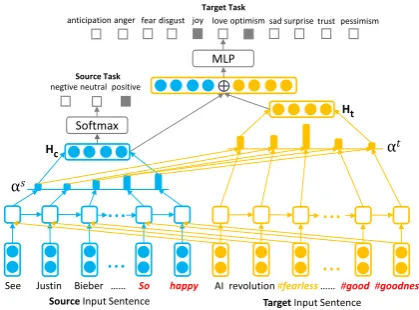
Figure 2:Dual Attention Transfer Network.
a shared attention-based Bi-LSTM layer to trans-form the input sentences in both tasks into a shared hidden representationHc, and also employ another task-specific Bi-LSTM layer to get the target-specific hidden representationHt. Next, we employ the following operations to map the
hid-den representations to the sentiment label y and
the emotion labele:
p(y(m)|Hc) =softmax WsHc+bs
,
p(e(i)|Hc,Ht) =softmax MLP([Hc;Ht])
,
whereWs ∈ Rd×3 andbs ∈ R3 are the parame-ters for the source sentiment classification task.
2.2.2 Proposed Dual Attention Transfer Network (DATN)
As we introduced before, the shared and target-specific feature spaces in the above SP model are expected to respectively capture the general senti-ment words and the task-specific emotion words. However, without any constraints, the two feature spaces may both tend to pay more attention to fre-quently occurring and important sentiment words like greatand happy, but less to those rarely oc-curring but crucial emotion words likeanxietyand
weightsαtin the target specific layer:
utj =vt>tanh(Whthjt+wααsj +Wtzzt),
αtj = exp(u
t j) Pn
l=1exp(utl)
.
In addition, we introduce another similarity loss to explicitly enforce the difference between the two attention weights and minimize the cosine simi-larity betweenαsandαt.
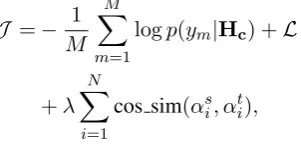
Finally, our combined objective function is de-fined as follows:
J =− 1
M
M X
m=1
logp(ym|Hc) +L
+λ
N X
i=1
cos sim(αsi, αti),
where λ is a hyperparameter used to control the
effect of the similarity loss.
2.2.3 Model Details
During the training stage, we adopted the widely used alternating optimization strategy, which
iter-atively samples one mini-batch fromDs for only
updating the parameters in the left part of our model, followed by sampling another mini-batch
from De for updating all the parameters in our
model. It is also worth noting that in Fig. 2, we first obtain the shared attention weights αs and feed it as extra inputs to compute αt. In fact, to differentiate the attention weights in the two fea-ture spaces, we can also first computeαt, followed by computingαs based onαt. We refer to these two variants of our model as 1 and DATN-2 respectively.
3 Experiments
3.1 Experiment Settings
Datasets: We conduct experiments on both En-glish and Chinese languages.
For English, we employ a widely used
Twit-ter dataset from SemEval 2016 Task 4A (Nakov
et al.,2016) as our source sentiment classification task. For our target emotion classification task, we use the Twitter dataset recently released by
Se-mEval 2018 Task 1C (Mohammad et al., 2018),
which contains 11 emotions as shown in the top of Fig.2. To tokenize the tweets in our dataset, we follow (Owoputi et al.,2013) by adopting most of
Dataset Train Dev Test Words
E1 SemEval-18 6,838 886 3,259 32,557
S1 SemEval-16 28,631 - - 40439
E2 Ren-CECps-1 13,841 1,972 3,602
40,099 S2 Ren-CECps-2 15,199 -
-Table 2:The number of sentences in each dataset.
their preprocessing rules except that we split the hashtag into ‘#’ and its subsequent word.
ForChinese, we use a well known Chinese blog
dataset Ren-CECps from (Quan and Ren, 2010),
which contains 1487 documents with each sen-tence labeled by a sentiment label and 8 emotion labels:anger,expectation,anxiety,joy,love,hate,
sorrowandsurprise. Given the difficulty of find-ing a large-scale sentiment classification dataset specific to Chinese blogs, we simply divided the original dataset to form our source and target tasks1. The basic statistics of our two datasets are summarized in Table2.
Parameter Settings:The word embedding size
d is set to be 300 for E1 and 200 for E2, and
the lookup table E is initialized by pre-trained
word embeddings based on Glove2. The hidden
dimension and the number of LSTM layers in both datasets are set to be 200 and 1. During training, Adam (Kingma and Ba,2014) is used to schedule the learning rate, where the initial learning rate is set to be 0.001. Also, the dropout rate is set to 0.5. After tuning,λis set as 0.05 for both datasets, andγ is set as 0.12 for E1 and 0.2 for E2. All the models are implemented with Tensorflow.
Evaluation Metrics: We take the official code from SemEval-18 Task 1C and use accuracy and Macro F1 score as main metrics. For E2, we fol-low (Zhou et al.,2018a) to use average precision (AP) and one error (OE) as secondary metrics.
3.2 Results
To better evaluate our proposed methods, we em-ployed the following systems for comparison: 1)
Base, training our base model in Section2.1only
on De; 2) FT (Fine-Tuning), using Ds to
pre-train the whole model, followed by using De to
Fine Tune the model parameters; 3)FS, the Fully-Shared framework by (Mou et al.,2016) as shown in Fig1.a; 4)PSPandAPSP, the Private-Shared-Private framework and its extension with
Adver-1
The first 560/80/160 documents are used as train/dev/test set for emotion classification, and the remaining 687 docu-ments are used for sentiment classification.
[image:4.595.108.259.242.315.2]31
When you dread going to work early … but you always come back home happy ; smiling # goodday
Base
DATN-2 α
𝑠
α𝑡
Methods Prediction
joy, optimism
joy, optimism, love
Figure 3:Comparison of attention weights betweenBaseand ourDATN-2model on a test sentence from SemEval-18. Note that the ground truth emotion labels for this example arejoy,optimismandlove.
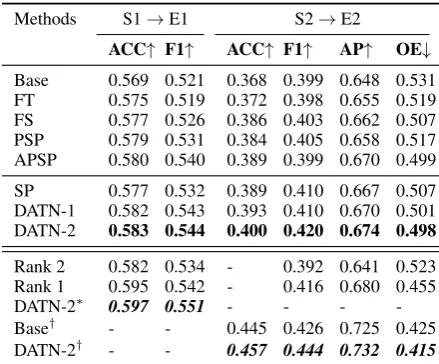
Methods S1→E1 S2→E2
ACC↑ F1↑ ACC↑ F1↑ AP↑ OE↓
Base 0.569 0.521 0.368 0.399 0.648 0.531 FT 0.575 0.519 0.372 0.398 0.655 0.519 FS 0.577 0.526 0.386 0.403 0.662 0.507 PSP 0.579 0.531 0.384 0.405 0.658 0.517 APSP 0.580 0.540 0.389 0.399 0.670 0.499
SP 0.577 0.532 0.389 0.410 0.667 0.507 DATN-1 0.582 0.543 0.393 0.410 0.670 0.501 DATN-2 0.583 0.544 0.400 0.420 0.674 0.498
Rank 2 0.582 0.534 - 0.392 0.641 0.523 Rank 1 0.595 0.542 - 0.416 0.680 0.455
DATN-2∗ 0.597 0.551 - - -
-Base† - - 0.445 0.426 0.725 0.425 DATN-2† - - 0.457 0.444 0.732 0.415
Table 3: The results of different transfer learning methods by averaging ten runs (top) and the comparison between our best model and the state-of-the-art systems (bottom). DATN-2∗ indicates the ensemble results of ten runs. Base† and DATN-2†denotes the average results of conducting ten-fold cross validation on the whole dataset for fair comparison, and here for the source and target tasks in DATN-2†, we use the same training data. For E1, Rank1 and Rank2 are the top two systems from the official leadboard; For E2, Rank1 and Rank2 are from (Zhou et al.,2016,2018a).
sarial losses by (Liu et al., 2017) as shown in Fig1.b; 5)SP,DATN-1andDATN-2, the Shared-Private model and two variants of our Dual At-tention Transfer Network as shown in Fig1.c and Fig1.d.
In Table3, we report the comparison results be-tween our method and the baseline systems. It can be easily observed that 1) for transfer learning, al-though the performance ofSPis similar to or even lower than some baseline systems, our proposed
dual attention models, i.e., DATN-1 and
DATN-2, can generally boostSP to achieve the best re-sults. To investigate the significance of the im-provements, we combine each model’s predictions of all emotion labels followed by treating them as a single label, and then perform McNemar’s sig-nificance tests (Gillick and Cox, 1989). Finally, we verify that for English,DATN-1is significantly
better than Base, FT, FS and SP, while DATN-2
is significant better than all the methods except
APSP; for Chinese,DATN-1andDATN-2are
sig-nificantly better than all the compared methods. 2)
Even compared with the state-of-the-art systems in E1 which also employ other external resources, including the affective embedding, emotion lexi-con and sentiment classification datasets (Baziotis et al.,2018), the ensemble results ofDATN-2can achieve slightly better performance; in addition, it is clear that our model can obtain the best perfor-mance in E2.
Furthermore, to obtain a better understanding of the advantage of our method, we choose one sen-tence from the test set of E1, and visualize the
at-tention weights obtained byBaseandDATN-2 in
Fig3. We can see thatBasepays more attention to those frequent emotion words while ignoring the less frequent but important emoji, and thus fails to predict theloveemotion implied by the emoji. In contrast, with the proposed dual attention
mech-anism, DATN-2 makes correct predictions since
it can respectively capture the general sentiment words and the emotion-specific emojis.
4 Conclusion
In this paper, we proposed a dual attention-based transfer learning approach to leverage sentiment classification to improve the performance of
multi-label emotion classification. Using two
bench-mark datasets, we show the effectiveness of the proposed transfer learning method.
Acknowledgments
We would like to thank Aletta Hiemstra, Andr´es Monroy-Hern´andez and three anonymous review-ers for their valuable comments.
References
Muhammad Abdul-Mageed and Lyle Ungar. 2017. Emonet: Fine-grained emotion detection with gated recurrent neural networks. In Proceedings of the 55th Annual Meeting of the Association for Compu-tational Linguistics.
[image:5.595.71.291.160.342.2]learning to align and translate. arXiv preprint arXiv:1409.0473.
Christos Baziotis, Nikos Athanasiou, Alexandra Chronopoulou, Athanasia Kolovou, Georgios Paraskevopoulos, Nikolaos Ellinas, Shrikanth Narayanan, and Alexandros Potamianos. 2018. NTUA-SLP at SemEval-2018 task 1: Predicting af-fective content in tweets with deep attentive rnns and transfer learning. arXiv preprint arXiv:1804.06658.
Bjarke Felbo, Alan Mislove, Anders Søgaard, Iyad Rahwan, and Sune Lehmann. 2017. Using millions of emoji occurrences to learn any-domain represen-tations for detecting sentiment, emotion and sar-casm. In Proceedings of the 2017 Conference on Empirical Methods in Natural Language Process-ing.
Laurence Gillick and Stephen J Cox. 1989. Some sta-tistical issues in the comparison of speech recogni-tion algorithms. In International Conference onA-coustics, Speech, and Signal Processing.
Huihui He and Rui Xia. 2018. Joint binary neu-ral network for multi-label learning with appli-cations to emotion classification. arXiv preprint arXiv:1802.00891.
Yanghoon Kim, Hwanhee Lee, and Kyomin Jung. 2018. Attnconvnet at semeval-2018 task 1: Attention-based convolutional neural networks for multi-label emotion classification. arXiv preprint arXiv:1804.00831.
Diederik Kingma and Jimmy Ba. 2014. Adam: A method for stochastic optimization. arXiv preprint arXiv:1412.6980.
Li Li, Houfeng Wang, Xu Sun, Baobao Chang, Shi Zhao, and Lei Sha. 2015a. Multi-label text cate-gorization with joint learning predictions-as-features method. InProceedings of the 2015 Conference on Empirical Methods in Natural Language Process-ing.
Shoushan Li, Lei Huang, Rong Wang, and Guodong Zhou. 2015b. Sentence-level emotion classification with label and context dependence. InProceedings of the 53rd Annual Meeting of the Association for Computational Linguistics.
Pengfei Liu, Xipeng Qiu, and Xuanjing Huang. 2017. Adversarial multi-task learning for text classifica-tion. InProceedings of the 55th Annual Meeting of the Association for Computational Linguistics.
Saif M Mohammad, Felipe Bravo-Marquez, Moham-mad Salameh, and Svetlana Kiritchenko. 2018. Semeval-2018 task 1: Affect in tweets. InSemEval.
Lili Mou, Zhao Meng, Rui Yan, Ge Li, Yan Xu, Lu Zhang, and Zhi Jin. 2016. How transferable are neural networks in NLP applications? In Proceed-ings of the 2016 Conference on Empirical Methods in Natural Language Processing.
Preslav Nakov, Alan Ritter, Sara Rosenthal, Fabrizio Sebastiani, and Veselin Stoyanov. 2016. Semeval-2016 task 4: Sentiment analysis in twitter. In Se-mEval.
Olutobi Owoputi, Brendan O’Connor, Chris Dyer, Kevin Gimpel, Nathan Schneider, and Noah A Smith. 2013. Improved part-of-speech tagging for online conversational text with word clusters. In
Proceedings of NAACL.
Changqin Quan and Fuji Ren. 2010. Sentence emotion analysis and recognition based on emotion words us-ing ren-cecps. International Journal of Advanced Intelligence.
Xiaojun Quan, Qifan Wang, Ying Zhang, Luo Si, and Liu Wenyin. 2015. Latent discriminative models for social emotion detection with emotional depen-dency. ACM Transactions on Information Systems (TOIS), 34(1):2.
Yaqi Wang, Shi Feng, Daling Wang, Ge Yu, and Yifei Zhang. 2016. Multi-label chinese microblog emo-tion classificaemo-tion via convoluemo-tional neural network. InAsia-Pacific Web (APWeb) and Web-Age Informa-tion Management (WAIM) Joint Conference on Web and Big Data.
Yichen Wang and Aditya Pal. 2015. Detecting emo-tions in social media: A constrained optimization approach. InProceedings of the International Joint Conference on Artificial Intelligence.
Jianfei Yu, Minghui Qiu, Jing Jiang, Jun Huang, Shuangyong Song, Wei Chu, and Haiqing Chen. 2018. Modelling domain relationships for transfer learning on retrieval-based question answering sys-tems in E-commerce. InProceedings of the Eleventh ACM International Conference on Web Search and Data Mining.
Deyu Zhou, Yang Yang, and He Yulan. 2018a. Rel-evant emotion ranking from text constrained with emotion relationships. InProceedings of the North American Chapter of the Association for Computa-tional Linguistics.
Deyu Zhou, Xuan Zhang, Yin Zhou, Quan Zhao, and Xin Geng. 2016. Emotion distribution learning from texts. In Proceedings of the 2016 Conference on Empirical Methods in Natural Language Process-ing.