Proceedings of the 2018 EMNLP Workshop W-NUT: The 4th Workshop on Noisy User-generated Text, pages 79–84 79
Using Wikipedia Edits in Low Resource Grammatical Error Correction
Adriane Boyd
Department of Linguistics University of T¨ubingen
Abstract
We develop a grammatical error correction (GEC) system for German using a small gold GEC corpus augmented with edits extracted from Wikipedia revision history. We extend the automatic error annotation tool ERRANT (Bryant et al., 2017) for German and use it to analyze both gold GEC corrections and Wikipedia edits (Grundkiewicz and Junczys-Dowmunt, 2014) in order to select as addi-tional training data Wikipedia edits contain-ing grammatical corrections similar to those in the gold corpus. Using a multilayer convo-lutional encoder-decoder neural network GEC approach (Chollampatt and Ng, 2018), we evaluate the contribution of Wikipedia edits and find that carefully selected Wikipedia edits increase performance by over 5%.
1 Introduction and Previous Work
In the past decade, there has been a great deal of research on grammatical error correction for En-glish including a series of shared tasks, Helping Our Own in 2011 and 2012 (Dale and Kilgarriff, 2011;Dale et al.,2012) and the CoNLL 2013 and 2014 shared tasks (Ng et al.,2013, 2014), which have contributed to the development of larger En-glish GEC corpora. On the basis of these resources along with advances in machine translation, the current state-of-the-art English GEC systems use ensembles of neural MT models (Chollampatt and Ng, 2018) and hybrid systems with both statis-tical and neural MT models (Grundkiewicz and Junczys-Dowmunt,2018).
In addition to using gold GEC corpora, which are typically fairly small in the context of MT-based approaches, research in GEC has taken a number of alternate data sources into con-sideration such as artificially generated errors (e.g., Wagner et al., 2007; Foster and Ander-sen,2009;Yuan and Felice,2013), crowd-sourced
corrections (e.g., Mizumoto et al., 2012), or er-rors from native language resources (e.g., Cahill et al.,2013;Grundkiewicz and Junczys-Dowmunt, 2014). For English, Grundkiewicz and Junczys-Dowmunt (2014) extracted pairs of edited sen-tences from the Wikipedia revision history and fil-tered them based on a profile of gold GEC data in order to extend the training data for a statistical MT GEC system and found that the addition of filtered edits improved the system’s F0.5 score by
~2%. For languages with more limited resources, native language resources such as Wikipedia offer an easily accessible source of additional data.
Using a similar approach that extends existing gold GEC data with Wikipedia edits, we develop a neural machine translation grammatical error cor-rection system for a new language, in this instance German, for which there are only small gold GEC corpora but plentiful native language resources.
2 Data and Resources
The following sections describe the data and re-sources used in our experiments on GEC for Ger-man. We create a new GEC corpus for German along with the models needed for the neural GEC approach presented inChollampatt and Ng(2018). Throughout this paper we will refer to the source sentence as theoriginaland the target sentence as thecorrection.
2.1 Gold GEC Corpus
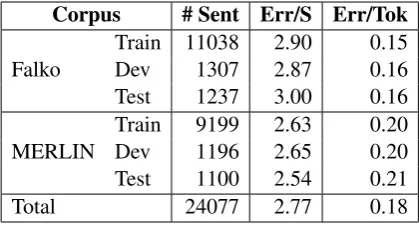
ad-Corpus # Sent Err/S Err/Tok
Falko
Train 11038 2.90 0.15
Dev 1307 2.87 0.16
Test 1237 3.00 0.16
MERLIN
Train 9199 2.63 0.20
Dev 1196 2.65 0.20
Test 1100 2.54 0.21
[image:2.595.76.286.62.176.2]Total 24077 2.77 0.18
Table 1: Falko-MERLIN German GEC Corpus
vanced German learner essays (Reznicek et al., 2012). The MERLIN project (Boyd et al.,2014) adapted the Falko guidelines and annotated learner texts from a wide range of proficiency levels.1
We extract pairs of original sentences and cor-rections from all annotated sentence spans in FalkoEssayL2 v2.42(248 texts), FalkoEssayWhig v2.02 (196 texts), and MERLIN v1.13 (1,033 texts) to create the new Falko-MERLIN GEC Cor-pus, which contains 24,077 sentence pairs. The corpus is divided into train (80%), dev (10%), and test (10%) sets, keeping all sentences from a single learner text within the same partition.
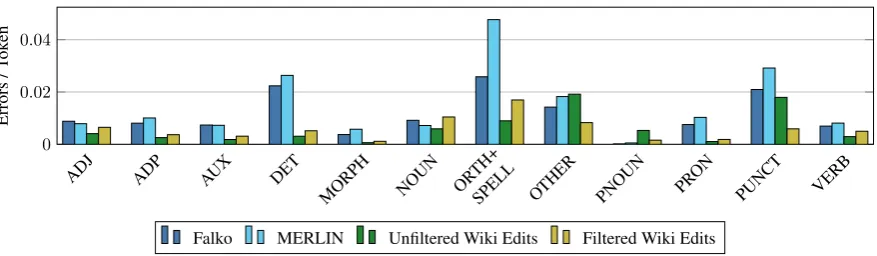
An overview of the Falko-MERLIN GEC Cor-pus is shown in Table1with the number of errors per sentence and errors per token as analyzed by ERRANT for German (see section3.1). On aver-age, the Falko corpus (advanced learners) contains longer sentences with fewer errors per token while the MERLIN corpus (all proficiency levels) con-tains shorter sentences with more errors per token. A more detailed ERRANT-based analysis is pre-sented in Figure2in section3.2.
2.2 Wikipedia
In our experiments, we use German Wikipedia dumps of articles and revision history from June 1, 2018. Wikipedia edits are extracted from the revi-sion history using Wiki Edits (Grundkiewicz and Junczys-Dowmunt, 2014) with a maximum sen-tence length of 60 tokens, since 99% of the Falko and MERLIN sentences are shorter than 60 to-kens. For training the subword embeddings, plain text is extracted from the German Wikipedia arti-cles using WikiExtractor.4
1
We also considered including German data from Lang-8, however it seemed to be far too noisy.
2
https://www.linguistik.hu-berlin. de/de/institut/professuren/
korpuslinguistik/forschung/falko/zugang
3
https://www.merlin-platform.eu
4https://github.com/attardi/
wikiextractor
2.3 BPE Model and Subword Embeddings
We learn a byte pair encoding (BPE) (Sennrich et al., 2016) with 30K symbols using the correc-tions from the Falko-MERLIN training data plus the complete plain Wikipedia article text. As sug-gested byChollampatt and Ng(2018), we encode the Wikipedia article text using the BPE model and learn fastText embeddings (Bojanowski et al., 2017) with 500 dimensions.
2.4 Language Model
For reranking, we train a language model on the first one billion lines (~12 billion tokens) of the deduplicated German Common Crawl corpus (Buck et al.,2014).
3 Method
We extend the Falko-MERLIN GEC training data with sentence-level Wikipedia edits that include similar types of corrections. In order to automat-ically analyze German GEC data, we extend ER-RANT from English to German (section3.1) and use its analyses to select suitable Wikipedia edits (section3.2).
3.1 ERRANT
ERRANT, the ERRor ANnotation Tool (Felice et al., 2016; Bryant et al., 2017), analyzes pairs of English sentences from a GEC corpus to iden-tify the types of corrections performed. The to-kens in a pair of sentences are aligned using Damerau-Levenshtein edit distance with a custom substitution cost that includes linguistic informa-tion — lemmas, POS, and characters — to pro-mote alignments between related word forms. Af-ter the individual tokens are aligned, neighbor-ing edits are evaluated to determine whether two or more edits should be merged into one longer edit, such as merging wide → widespread fol-lowed by spread → ∅ into a single edit wide spread→widespread.
Error Type Example
POS (15) dem→den(DET:FORM)
MORPH solid→solide
ORTH Große→große
SPELL w¨achseln→wechseln
ORDER zu gehen→gehen zu
CONTR ’s→∅
[image:3.595.83.281.62.173.2]OTHER hochem→einem hohen
Table 2: German ERRANT Error Types
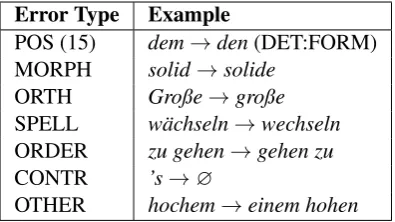
each POS error type has an additional FORM sub-type if the tokens have the same lemma.
The POS tag types include 14 UD POS types plus the German-specific STTS tag TRUNC. The MORPH tag captures errors for related word forms with different POS tags, ORTH is for cap-italization and whitespace errors, SPELL errors have an original token that is not in a large word list with>50% overlapping characters compared to the corrected token, ORDER errors cover adja-cent reordered tokens, and CONTR errors involve the contraction ’s(‘it’). All remaining errors are classified as OTHER.
In ERRANT for English, all linguistic anno-tation is performed with spaCy.5 We preserve as much of the spaCy pipeline as possible us-ing spaCy’s German models, however the lem-matizer is not sufficient and is replaced with the TreeTagger lemmatizer.6 All our experiments are performed with spaCy 2.0.11 and spaCy’s de-fault German model. The word list for detecting spelling errors comes from Hunspell igerman98-201612077 and the mapping of STTS to UD tags from TuebaUDConverter (C¸ ¨oltekin et al.,2017).
An example of a German ERRANT analysis is shown in Figure1. The first token is analyzed as an adjective substitution error where both adjec-tives have the same lemma (S:ADJ:FORM), the inflected deverbal adjectivebestandenen‘passed’ is inserted before Pr¨ufung ‘exam’ (I:ADJ), and the past participle bestanden ‘passed’ is deleted at the end of the sentence (D:VERB). Note that ERRANT does not analyzePr¨ufung bestanden→
bestandenen Pr¨ufung as a word order error be-cause the reordered word forms are not identical. In cases like these and ones with longer distance movement, which is a frequent type of correction
5
https://spacy.io
6http://www.cis.uni-muenchen.de/
˜schmid/tools/TreeTagger/
7https://www.j3e.de/ispell/igerman98/
dict/
in non-native German texts, ERRANT has no way to indicate that these two word forms are related or that this pair of edits is coupled.
3.2 Filtering Edits with ERRANT
Even though the Wiki Edits algorithm ( Grund-kiewicz and Junczys-Dowmunt, 2014) extracts only sentence pairs with small differences, many edits relate to content rather than grammatical er-rors, such as inserting a person’s middle name or updating a date. In order to identify the most rele-vant Wikipedia edits for GEC, we analyze the gold GEC corpus and Wikipedia edits with ERRANT and then filter the Wikipedia edits based on a pro-file of the gold GEC data.
First, sentences with ERRANT error types that indicate content or punctuation edits are dis-carded: 1) sentences with only punctuation, proper noun, and/or OTHER error types, 2) sentences with edits modifying only numbers or non-Latin characters, and 3) sentences with OTHER edits longer than two tokens. Second, the ERRANT profile of the gold corpus is used to select edits that: 1) include an original token edited in the gold corpus, 2) include the same list of error types as a sentence in the gold corpus, 3) include the same set of error types as a sentence in the gold corpus for 2+ error types, or 4) for sets ofGoldandW iki error types have a Jaccard similarity coefficient to a gold sentence greater than 0.5:
J(Gold, W iki) = |Gold∩W iki|
|Gold∪W iki|
After ERRANT-based filtering, approximately one third of the sentences extracted with Wiki Ed-its remain.
Original Herzliche Gl¨uckwunsch zur Pr¨ufung bestanden . Correction Herzlichen Gl¨uckwunsch zur bestandenen Pr¨ufung .
ERRANT S:ADJ:FORM I:ADJ D:VERB
heartfelt congratulation to the passed exam .
‘Congratulations on passing your exam.’
Figure 1: Example German ERRANT Analysis
ADJ ADP AUX DET
MORPH NOUN OR TH+
SPELL OTHER PNOUN PR ON
PUNCT VERB
0 0.02 0.04
Errors
/
T
ok
en
[image:4.595.107.496.62.115.2]Falko MERLIN Unfiltered Wiki Edits Filtered Wiki Edits
Figure 2: Distribution of Selected ERRANT Error Types
Training Data Unfiltered Wiki Edits Filtered Wiki Edits
P R F0.5 P R F0.5
Falko-MERLIN (19K) 45.38 25.42 39.22 45.38 25.42 39.22
+ 100K Wiki Edits 53.91 22.44 42.10 54.59 22.25 42.30
+ 250K Wiki Edits 57.57 21.80 43.35 57.30 23.04 44.17
+ 500K Wiki Edits 58.55 20.33 42.55 58.74 22.37 44.33
+ 1M Wiki Edits 57.86 21.72 43.41 60.19 21.75 44.47
+ 1M Wiki Edits + EO 41.43 28.74 38.07 39.95 29.03 37.15
+ 1M Wiki Edits + LM 44.72 28.39 40.11 51.81 29.26 44.89
+ 1M Wiki Edits + LMN orm 48.65 28.69 42.71 51.99 29.73 45.22
1M Wiki Edits Only 31.12 5.33 15.82 30.13 5.42 15.75
1M Wiki Edits Only + EO 19.66 11.40 17.17 20.26 12.18 17.89
1M Wiki Edits Only + LM 26.34 12.59 21.62 29.12 13.95 23.92
1M Wiki Edits Only + LMN orm 25.21 12.38 20.88 29.96 13.95 24.37
Table 3: Results for MLConv GEC on Falko-Merlin Test Set (M2)
4 Results and Discussion
We evaluate the effect of extending the Falko-MERLIN GEC Corpus with Wikipedia edits for a German GEC system using the multilayer con-volutional encoder-decoder neural network ap-proach from Chollampatt and Ng (2018), using the same parameters as for English.8 We train a single model for each condition and evaluate on the Falko-MERLIN test set using M2 scorer (Dahlmeier and Ng,2012).9
8
https://github.com/nusnlp/ mlconvgec2018
9https://github.com/nusnlp/m2scorer/
archive/version3.2.tar.gz
The results, presented in Table3, show that the addition of both unfiltered and filtered Wikipedia edits to the Falko-MERLIN GEC training data lead to improvements in performance, however larger numbers of unfiltered edits (>250K) do not consistently lead to improvements, similar to the results for English inGrundkiewicz and Junczys-Dowmunt(2014). However for filtered edits, in-creasing the number of additional edits from 100K to 1M continues to lead to improvements, with an overall improvement of 5.2 F0.5for 1M edits over
the baseline without additional reranking.
[image:4.595.77.516.161.289.2]rerank-ing decreases scores in conditions with gold GEC training data in our experiments and reranking with a web-scale language model (LM) does not consistently increase scores, although both rerank-ing methods lead to increases in recall. The best result of 45.22 F0.5 is obtained with
Falko-MERLIN + 1M Filtered Wiki Edits with language model reranking that normalizes scores by the length of the sentence.
An analysis of the performance on Falko vs. MERLIN shows stronger results for MERLIN, with 44.19 vs. 46.52 F0.5 for Falko-MERLIN +
1M Filtered Wiki Edits + LMN orm. We expected
the advanced Falko essays to benefit from being more similar to Wikipedia than MERLIN, how-ever MERLIN may simply contain more spelling and inflection errors that are easy to correct given a small amount of context.
In order to explore the possibility of develop-ing GEC systems for languages with fewer re-sources, we trained models solely on Wikipedia edits, which leads to a huge drop in performance (45.22 vs. 24.37 F0.5). However, the genre
differ-ences may be too large to draw solid conclusions and this approach may benefit from further work on Wikipedia edit selection, such as using a lan-guage model to exclude some Wikipedia edits that introduce (rather than correct) grammatical errors.
5 Future Work
The combined basis of ERRANT and Wiki Ed-its make it possible to explore MT-based GEC approaches for languages with limited gold GEC resources. The current German ERRANT error analysis approach can be easily generalized to rely on a pure UD analysis, which would make it possi-ble to apply ERRANT to any language with a UD parser and a lemmatizer. Similarly, the process of filtering Wikipedia edits could use alternate meth-ods in place of a gold reference corpus, such as a list of targeted token or error types, to generate GEC training data for any language with resources similar to a Wikipedia revision history.
For the current German GEC system, a de-tailed error analysis for the output could iden-tify the types of errors where Wikipedia ed-its make a significant contribution and other ar-eas where additional data could be incorporated, potentially through artificial error generation or crowd-sourcing.
6 Conclusion
We provide initial results for grammatical error correction for German using data from the Falko and MERLIN corpora augmented with Wikipedia edits that have been filtered using a new German extension of the automatic error annotation tool ERRANT (Bryant et al., 2017). Wikipedia ed-its are extracted using Wiki Eded-its (Grundkiewicz and Junczys-Dowmunt,2014), profiled with ER-RANT, and filtered with reference to the gold GEC data. We evaluate our method using the multi-layer convolutional encoder-decoder neural net-work GEC approach from Chollampatt and Ng (2018) and find that augmenting a small gold German GEC corpus with one million filtered Wikipedia edits improves the performance from 39.22 to 44.47 F0.5and additional language model
reranking increases performance to 45.22. The data and source code for this paper are available
at: https://github.com/adrianeboyd/
boyd-wnut2018/
Acknowledgments
We are grateful to the anonymous reviewers for their helpful feedback. This work was supported by the German Research Foundation (DFG) under project ME 1447/2-1.
References
Piotr Bojanowski, Edouard Grave, Armand Joulin, and Tomas Mikolov. 2017. Enriching word vectors with subword information. Transactions of the Associa-tion for ComputaAssocia-tional Linguistics, 5:135–146.
Adriane Boyd, Jirka Hana, Lionel Nicolas, Detmar Meurers, Katrin Wisniewski, Andrea Abel, Karin Sch¨one, Barbora ˇStindlov´a, and Chiara Vettori. 2014. The MERLIN corpus: Learner language and the CEFR. In Proceedings of LREC 2014, Reyk-javik, Iceland. European Language Resources Asso-ciation (ELRA).
Christopher Bryant, Mariano Felice, and Ted Briscoe. 2017. Automatic annotation and evaluation of error types for grammatical error correction. In Proceed-ings of the 55th Annual Meeting of the Association for Computational Linguistics (Volume 1: Long Pa-pers), pages 793–805, Vancouver, Canada. Associa-tion for ComputaAssocia-tional Linguistics.
Aoife Cahill, Nitin Madnani, Joel Tetreault, and Di-ane Napolitano. 2013. Robust systems for preposi-tion error correcpreposi-tion using Wikipedia revisions. In
Proceedings of the 2013 Conference of the North American Chapter of the Association for Computa-tional Linguistics: Human Language Technologies, pages 507–517. Association for Computational Lin-guistics.
C¸ a˘grı C¸ ¨oltekin, Ben Campbell, Erhard Hinrichs, and Heike Telljohann. 2017. Converting the T¨uBa-D/Z treebank of german to Universal Dependencies. In
Proceedings of the NoDaLiDa 2017 Workshop on Universal Dependencies (UDW 2017), pages 27–37, Gothenburg, Sweden.
Shamil Chollampatt and Hwee Tou Ng. 2018. A multi-layer convolutional encoder-decoder neural network for grammatical error correction. InProceedings of the Thirty-Second AAAI Conference on Artificial In-telligence.
Daniel Dahlmeier and Hwee Tou Ng. 2012. Better evaluation for grammatical error correction. In Pro-ceedings of the 2012 Conference of the North Amer-ican Chapter of the Association for Computational Linguistics: Human Language Technologies, pages 568–572. Association for Computational Linguis-tics.
Robert Dale, Ilya Anisimoff, and George Narroway. 2012. A report on the preposition and determiner er-ror correction shared task. InProceedings of the 7th Workshop on the Innovative Use of NLP for Building Educational Applications, pages 54–62.
Robert Dale and Adam Kilgarriff. 2011. Helping Our Own: The HOO 2011 pilot shared task. In Pro-ceedings of the Generation Challenges Session at the 13th European Workshop on Natural Language Generation, pages 242–249, Nancy, France. Associ-ation for ComputAssoci-ational Linguistics.
Mariano Felice, Christopher Bryant, and Ted Briscoe. 2016. Automatic extraction of learner errors in ESL sentences using linguistically enhanced alignments. In Proceedings of COLING 2016, the 26th Inter-national Conference on Computational Linguistics: Technical Papers, pages 825–835, Osaka, Japan. The COLING 2016 Organizing Committee.
Jennifer Foster and Øistein Andersen. 2009. Gen-errate: Generating errors for use in grammatical er-ror detection. In Proceedings of the Fourth Work-shop on Innovative Use of NLP for Building Edu-cational Applications, pages 82–90. Association for Computational Linguistics.
Roman Grundkiewicz and Marcin Junczys-Dowmunt. 2014. The WikEd error corpus: A corpus of correc-tive Wikipedia edits and its application to grammat-ical error correction. In Advances in Natural Lan-guage Processing – Lecture Notes in Computer Sci-ence, volume 8686, pages 478–490. Springer.
Roman Grundkiewicz and Marcin Junczys-Dowmunt. 2018. Near human-level performance in grammati-cal error correction with hybrid machine translation. InProceedings of the 2018 Conference of the North American Chapter of the Association for Computa-tional Linguistics: Human Language Technologies, Volume 2 (Short Papers), pages 284–290. Associa-tion for ComputaAssocia-tional Linguistics.
Tomoya Mizumoto, Yuta Hayashibe, Mamoru Ko-machi, Masaaki Nagata, and Yuji Matsumoto. 2012. The effect of learner corpus size in grammatical er-ror correction of ESL writings. InProceedings of COLING 2012: Posters, pages 863–872. The COL-ING 2012 Organizing Committee.
Hwee Tou Ng, Siew Mei Wu, Ted Briscoe, Christian Hadiwinoto, Raymond Hendy Susanto, and Christo-pher Bryant. 2014. The CoNLL-2014 shared task on grammatical error correction. InProceedings of the Eighteenth Conference on Computational Natu-ral Language Learning: Shared Task, pages 1–14. Association for Computational Linguistics.
Hwee Tou Ng, Siew Mei Wu, Yuanbin Wu, Christian Hadiwinoto, and Joel Tetreault. 2013. The CoNLL-2013 shared task on grammatical error correction. In Proceedings of the Seventeenth Conference on Computational Natural Language Learning: Shared Task, pages 1–12. Association for Computational Linguistics.
Marc Reznicek, Anke L¨udeling, Cedric Krummes, and Franziska Schwantuschke. 2012. Das Falko-Handbuch. Korpusaufbau und Annotationen Version 2.0.
Rico Sennrich, Barry Haddow, and Alexandra Birch. 2016. Neural machine translation of rare words with subword units. InProceedings of the 54th An-nual Meeting of the Association for Computational Linguistics (Volume 1: Long Papers), pages 1715– 1725. Association for Computational Linguistics.
Joachim Wagner, Jennifer Foster, and Josef van Gen-abith. 2007. A comparative evaluation of deep and shallow approaches to the automatic detec-tion of common grammatical errors. In Proceed-ings of the 2007 Joint Conference on Empirical Methods in Natural Language Processing and Com-putational Natural Language Learning (EMNLP-CoNLL), pages 112–121, Prague, Czech Republic. Association for Computational Linguistics.